Introduction
Accompanying the global spread and diversification of English, a growing number of studies continue to investigate attitudes toward English as an international language (EIL), capturing the dynamic and fluid ways in which English is used across the world (e.g., Jenkins, Cogo, & Dewey, Reference Jenkins, Cogo and Dewey2011; Marlina & Giri, Reference Marlina and Giri2014; Bowles & Cogo, Reference Bowles and Cogo2015; Galloway & Rose, Reference Galloway and Rose2015). There are complexities surrounding learners’ attitudes, such as reports of learners’ strongly preferring native varieties of English, while simultaneously showing openness toward EIL. Some studies suggest that exposure to diverse varieties of English and English language proficiency could be related to positive attitudes toward EIL (e.g., Galloway, Reference Galloway2013; Wang & Jenkins, Reference Wang and Jenkins2016). Nevertheless, the extant research instruments for language attitudes are limited by their focus on geographical locations and static varieties, and thus cannot capture complex attitude formation in a dynamic global context. In response to the need for the development of research tools reflecting the sociolinguistic reality, in the present study, the Global Englishes Orientation questionnaire (GEO-Q) was developed to explore English language learners’ attitudes toward EIL in the twenty-first century. The aims of this studyFootnote 1 were to investigate English language learners' attitudes toward EIL by exploring the factors underpinning these attitudes and examining the relationships between their attitudes and exposure to varieties of English and English language proficiency.
Methods
A mixed methods study was conducted using questionnaires followed by focus group interviews. The questionnaire (GEO-Q) consisted of two parts: (1) factual questions, such as demographic information, exposure to varieties of English, and proficiency and (2) an attitudinal measure. The exposure to varieties of English measure consisted of 12 six-point Likert items regarding the extent of respondents’ current and past exposure to native, Japanese, and other varieties of English. The scores from the Test of English for International Communication or TOEIC (Educational Testing Service, 2020) were used as the proficiency measure. The attitudinal measure consisted of 25 six-point Likert items covering learners’ attitudes toward EIL, such as their views about diverse varieties of English and the speakers of these varieties. The online GEO-Q was distributed to 660 university students from 24 universities in Japan. This study employed maximum variation sampling, in which the researcher used discretion in selecting which people to include, trying to obtain a broad spectrum of student profiles by reaching out to 37 universities that offer full-time, four-year programmes. The data was analysed using an exploratory factor analysis to identify the attitudinal factors and multiple regression analysis to examine the relationships between the factors and two variables: exposure to varieties of English and English language proficiency. Then nine focus group interviews were conducted with 30 volunteers from the questionnaire survey, aiming to confirm the questionnaire results and further explore the participants’ views. The collected qualitative data was examined through content analysis.
Findings
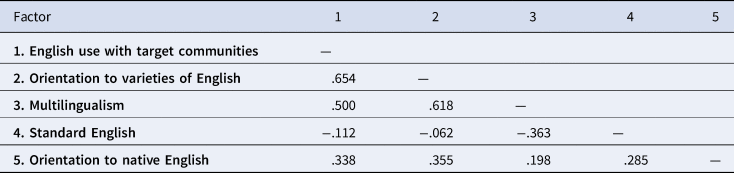
An exploratory factor analysis using the maximum likelihood method was conducted on the 25 attitudinal items with an oblique rotation (promax). The analysis identified five factors, which together explained 56.73% of the overall variance in attitudes toward EIL. The factors were named by considering the items which loaded above ±.30. (See below for details of the five factors and the Cronbach's alpha reliability coefficient for each factor.) The relationships between them are shown in Table 1. The communalities revealed one item that did not correlate well with the others (‘My native/first language is a useful resource for learning English’) and was subsequently deleted.
The correlations among the attitudinal factors

Factor 1. English use with target communities (α =.80)
Loaded on the factor were five items. The factor reflected interest in learning about various English-speaking communities and using English with native and non-native speakers of English. A sense of ownership also was loaded (i.e., ‘English is one of my languages’).
Factor 2. Orientation to varieties of English (α =.81)
Six items were loaded on this factor. The factor showed interest in and awareness of the importance for diverse varieties of English and learning about them.
Factor 3. Multilingualism (α =.78)
Four items were loaded on this factor. The factor included items that involve beliefs about the importance of being able to use one's native language and English. A sense of ownership was also loaded (i.e., ‘The true owners of English are not only the first users of the language but also everyone who uses English’).
Factor 4. Standard English (α =.74)
The factor was determined by appreciative loadings from three items reflecting beliefs about Standard English and the importance of learning and being taught correct grammar.
Factor 5. Orientation to native English (α =.63)
Six items were loaded on the factor. The factor reflected positive views about learning native English, which is often associated with varieties of English spoken in nations where English is the prominent native language, such as American and British English, as a model. It also included items that cover beliefs about the importance of learning these varieties, and desires for a native-like fluency as well as the legitimacy of native speaker supremacy.
In the questionnaire, mainly two types of attitudes were identified: global (Factors 1, 2, and 3) and traditional, native speaker orientations (Factor 5). Factor 4 did not correlate well with either of the orientations, as shown in Table 1. These findings were also confirmed in the focus groups. Regarding Factors 1, 2, and 3, the target communities imagined by the participants centred on business, education, travel, and media. Most of these communities included both native and non-native speakers. A majority had encountered different varieties of English and showed openness toward them. Some participants were also aware of the diverse English language usage with speakers from different cultural and linguistic backgrounds. As shown in Table 1, the questionnaire results addressed the positive correlations, especially between Factors 1 and 2. This was supported by the focus group data. If the participants were thinking about using English with both native and non-native speakers, they spoke positively about diverse varieties of English. If not, they were unable to articulate their thoughts on these varieties.
In terms of traditional orientations, the focus group participants who had positive attitudes toward native English also tended to agree with the importance of learning native English, as captured by Factor 5.
Regarding Factor 4, regardless of the participants’ orientations, there was a consensus in all focus groups on the importance of standards in pronunciation and grammar and a pursuit for ‘correctness.’ Learners equated Standard English to American or British English, and these varieties were thought of as desirable for use and as classroom models. This was reflected in the factor correlations.
Additionally, the relationship between global and traditional orientations was not so clear-cut. For example, in the questionnaire, the participants who showed global orientations did not necessarily indicate negative attitudes toward native English. This was further explored in the focus groups. It appeared that, regardless of their global orientations, they aimed to learn native English, especially American English and held a positive image of American English as being stylish and influential. These images were deeply rooted in how they viewed language not only in class but also in society, where they believed that the economy, technology, media, film, drama, and international business communities were dominated mainly by America. Although a few of the participants suggested how the current sociolinguistic reality in the globalised world should be, they thought it was different from the reality they were experiencing. These confirmed that, although the participants were globally oriented and open to diversity and flexibility in their English language usage, they still believed in the strong influence of native English usage on all users of English across the world.
Finally, multiple linear regressions were performed to investigate the extent to which learners’ proficiency and exposure to varieties of English predicted their attitudes toward EIL in terms of the five attitudinal factors extracted during the exploratory factor analysis. Sequential regressions were employed to determine whether exposure to varieties of English predicted the variation in each attitudinal factor beyond what could be explained by the learners’ proficiency (see Tables A1–A5 in the supplementary material for detailed results of the regression analyses). Altogether, the predictors accounted for 25% of the variance in English use with target communities, 23% of the variance in Orientation to varieties of English, 12% of the variance in Multilingualism, 7% of the variance in Standard English, and 15% of the variance in Orientation to native English. By itself, proficiency explained a significant proportion of the variance in attitudes toward English use with target communities, Multilingualism, and Standard English. All models were significantly improved by the addition of the exposure variables in step two.
Exposure to native and Japanese varieties of English were shown to predict an overall higher global orientation (Factors 1, 2, and 3). This corresponded to the qualitative finding that both quantity and quality of exposure to native and Japanese varieties appeared to play a crucial role in contributing to an increase in the participants’ global orientations. Exposure to Japanese varieties contributed positively to Orientation to native English. The focus group data suggested that the participants’ unsuccessful EIL experiences with Japanese varieties might have made them resort to more traditional ideas overwhelmingly preferring native varieties.
Exposure to other varieties of English, on the other hand, predicted both an increase in positive attitudes toward Standard English and a decrease in positive views of Multilingualism. Based on the questionnaire and focus group findings, this might be attributed to the fact that a majority of the participants had a relatively small amount of exposure to other varieties and had not yet formed positive attitudes toward these varieties. The focus group participants’ formation of positive attitudes toward other varieties of English was linked to their particular personal experiences relating to engaging in successful conversations with speakers of different varieties. Regarding proficiency, the focus group participants with a higher proficiency appeared to have more opportunities to engage in successful EIL conversations.
Discussion and conclusion
Through rigorous quantitative and qualitative analyses, the study found that English language learners in Japan showed positive attitudes toward EIL, accepting possibilities of speaking not only with native speakers but also with non-native speakers and understanding the importance of being aware of, and learning, different varieties of English. At the same time, they addressed the strong influence of native varieties, recognising them as desirable. Exposure to varieties of English and proficiency were identified as important influences on the learners’ attitudes toward EIL. At least a certain amount of exposure to varieties of English, together with experiences of successful EIL conversations seemed vital to fostering globally oriented attitudes. A higher proficiency tended to help the learners get more chances to be involved in such interactions. These findings are in line with what has been found in previous research (e.g., Galloway, Reference Galloway2013; Wang & Jenkins, Reference Wang and Jenkins2016).
This study further identified that these learners’ complex attitudes reflected how they currently perceived a reality, contradicting the sociolinguistic reality in the twenty-first century. The learners strongly believed that being able to speak native varieties was more likely to be advantageous, accepting the idea that native varieties have been winning the support of a majority; thus, these varieties are still viewed as a norm. In order to develop positive attitudes toward EIL, it is indispensable to offer an approach taking into account micro perspectives, such as exposure and proficiency, and macro perspectives that include historical, political, and economic factors (Kubota, Reference Kubota2018). Thus, teachers and teacher educators who are interested in incorporating innovative EIL pedagogic actions into their practice are strongly encouraged to conduct their own classroom-based or action research. The GEO-Q may be one of the useful research tools they might use.
Supplementary material
To view supplementary material for this article, please visit https://doi.org/10.1017/S0261444820000373
Natsuno Funada is a D.Phil. candidate in the Department of Education, University of Oxford. Her research interests have focused on learners’ and teachers’ beliefs regarding English language learning and teaching and attitudes toward English as an international language.