Introduction
The mud turtle genus Kinosternon Spix, Reference Spix1824, is a diverse taxon that comprises at least 34 currently recognized extant and fossil taxa (Iverson, Reference Iverson1991; Bourque, Reference Bourque2012b). Some molecular studies have suggested that the genus is paraphyletic relative to its sister taxon Sternotherus Gray, Reference Gray1825 (Seidel et al., Reference Seidel, Iverson and Adkins1986; Iverson et al., Reference Iverson, Brown, Akre, Near, Le, Thomson and Starkey2007, Reference Iverson, Le and Ingram2013; Reid et al., Reference Reid, Le, McCord, Iverson, Georges, Bergmann, Amato, DeSalle and Naro-Maciel2011), whereas others have recovered a monophyletic group (Iverson, Reference Iverson1991, Reference Iverson1998; Iverson et al., Reference Iverson, Brown, Akre, Near, Le, Thomson and Starkey2007; Spinks et al., Reference Spinks, Thomson, Gidis and Shaffer2014). All published morphology-based analyses have recovered a monophyletic assemblage (Hutchison and Bramble, Reference Hutchison and Bramble1981; Hutchison, Reference Hutchison1991; Iverson, Reference Iverson1991; Bourque, Reference Bourque2012a, Reference Bourque2012b; Bourque and Schubert, Reference Bourque and Schubert2015; results below). The oldest reports of Kinosternon are from the Hemingfordian North American Land Mammal Age (NALMA) between 18 and 16 million years old (Holman, Reference Holman1998; Hutchison, Reference Hutchison1991; Bourque, Reference Bourque2013; Weems and George, Reference Weems and George2013), but those voucher specimens are fragmentary and it is uncertain if they are stem representatives or referable to the crown group. The vouchers reported as the oldest record of Kinosternon (sensu Holman, Reference Holman1998; Weems and George, Reference Weems and George2013) may in fact represent a new genus yet to be diagnosed, perhaps directly ancestral to Kinosternon and Sternotherus (Bourque and Schubert, Reference Bourque and Schubert2015; see Discussion below). The most complete previously described fossils that represent the Kinosternon crown group are the types of Kinosternon skullridgescens Bourque, Reference Bourque2012b, and Kinosternon pojoaque Bourque, Reference Bourque2012a, from the middle Miocene (Barstovian NALMA) Tesuque Formation (16–13 Ma) of the Española Basin, New Mexico. Little has been published about kinosternines from the late Miocene, particularly from the Clarendonian NALMA, and what has been reported from this interval is based on scant and fragmentary material (Wilson, Reference Wilson1968; Bourque, Reference Bourque2011; Bourque, Reference Bourque2013). Here I will describe a new species of mud turtle from the late Barstovian of the northern Albuquerque Basin of New Mexico, and discuss its relationships with other middle–late Miocene Kinosternon. Additionally, I will describe three extinct species of Kinosternon from the Clarendonian of Texas, Kansas, Nebraska, and Florida and present an updated morphology-based phylogenetic hypothesis for the Kinosternidae that incorporates extant and more completely preserved extinct taxa.
Geological settings and background
Rincon Quarry, Sandoval County, New Mexico
Two previously undescribed partial kinosternine specimens are part of the Frick Collection housed at the AMNH in New York. The specimens, FAM 13822 and FAM 13014, were collected by John Blick and Ted Galusha from the Rincon Quarry locality at Arroyo Ojito, in the northern Albuquerque Basin of Sandoval County, New Mexico (Fig. 1). The Rincon Quarry represents a late Barstovian assemblage (14.5–12.5 Ma) in the Cerro Conejo Formation (Tedford, Reference Tedford1981; Tedford et al., Reference Tedford, Albright, Barnosky, Ferrusquia-Villafranca, Hunt, Storer, Swisher, Voorhies, Webb and Whistler2004; Connell et al., Reference Connell, Koning, Kelley and Brandes2007), also referred to as the Cerro Conejo Member of the Zia Formation (Connell, Reference Connell2001; Morgan and Lucas, Reference Morgan and Lucas2001). The paleoenvironment of the region was primarily composed of temperate xerophytic shrubland (Pound et al., Reference Pound, Haywood, Salzmann and Riding2012). The Rincon Quarry shares similar faunal components to the Pojoaque Member of the Tesuque Formation in the Española Basin, New Mexico (Tedford, Reference Tedford1981; Morgan and Lucas, Reference Morgan and Lucas2001; Tedford et al., Reference Tedford, Albright, Barnosky, Ferrusquia-Villafranca, Hunt, Storer, Swisher, Voorhies, Webb and Whistler2004). Mammals reported from the fauna include the borophagine canids Aelurodon ferox Leidy, Reference Leidy.1858, and Paratomarctus temerarius Leidy, Reference Leidy.1858, and horses Neohipparion Gidley, Reference Gidley1903, and Pliohippus Marsh, 1874 (Morgan and Lucas, Reference Morgan and Lucas2001).
Map of North America illustrating Barstovian and Clarendonian localities with Kinosternon fossils described here. Dots represent the following (from left to right): New Mexico, Rincon Quarry; Texas, Lewis Quarry 7; Kansas, WaKeeney Local Fauna; Nebraska, Middle of Road Locality; Florida, Suwannee River Mine (upper dot), and Love Bone Bed (lower dot). Scale bar equals 497 miles. Map generated using data from nationalatlas.gov/atlasftp.html#srldpri.

FAM 13822 was preserved in soft fine-grained sandstone before preparation by the author. The specimen is badly crushed and highly fractured due to sedimentary compaction over time. Despite this, the right side of the carapace and plastron, mandible, and postcranial elements including partially articulated cervical and caudal vertebrae are relatively well preserved. FAM 13014 is a partial shell comprised of disarticulated fragments.
Lewis Quarry 7, Donley County, Texas
The fossil shell of a previously undescribed kinosternine, FAM 12778, is likewise part of the Frick Collection housed at the AMNH in New York. The specimen was collected in the panhandle region of northern Texas, Donley County, from the Lewis Quarry 7 locality (Schultz, Reference Schultz1977; Reference Schultz1990; Reference Schultz2002) (Fig. 1), which has also been referred to as ‘Lewis Place Quarry 7’ or ‘Chamberlain’s Quarry 7’ in the AMNH database. FAM 12778 was collected in 1958 by Will Chamberlain of Clarendon, Texas. Mr. Chamberlain did extensive field collecting in the panhandle region between 1929 and 1960 for the Frick Laboratories of New York (Schultz, Reference Schultz1977). FAM 12778 is highly fractured, but preserved almost in its entirety having been partially encapsulated in a concretionary nodule. The surrounding matrix is a ferruginous concretionary sandstone, like that described by Schultz (Reference Schultz1977, Reference Schultz1990); a composite of iron-rich yellow and tan to grey sand bonded by calcium carbonate, with fossilized impressions and delicate ferric casts of tiny freshwater snails, cf. Hydrobiidae (identified by Roger Portell, Division of Invertebrate Paleontology, FLMNH, personal commun., 2013), interspersed throughout. FAM 12778 is exceptionally preserved, but exhibits chipping and minor damage on the dorsal carapace, right anterior peripherals, ventral epiplastra, and left hyoplastron. This is most noticeable on the ventral face of the epiplastra, where the intergular and gular scute sulci are faint and surface texture of the bone is abnormally smooth as if it was sheared by a chisel-like implement. FAM 12778 was recently prepared by the author at the FLMNH using a formic acid process similar to that described by Bourque (Reference Bourque2012b).
Lewis Quarry 7 represents one in a complex of Clarendonian (~12–9.5 Ma) sinkhole deposits along a paleostream channel (Schultz, Reference Schultz1977; Reference Schultz1990; Tedford et al., Reference Tedford, Albright, Barnosky, Ferrusquia-Villafranca, Hunt, Storer, Swisher, Voorhies, Webb and Whistler2004). The paleoclimate and paleoecology of the region has been proposed as warm and temperate to subtropical, with slow-moving streams (occasionally transformed to high-energy rivers in flood events), bordered by grassy and savanna-like floodplain habitats with peripheral ponds and marshes (Schultz, Reference Schultz1977; Reference Schultz1990). Pound et al. (Reference Pound, Haywood, Salzmann and Riding2012) hypothesized that the region was dominated by temperate deciduous broadleaf savanna. Previously reported components of the herpetofauna from the region include testudinid, emydid, and trionychid turtles, and an alligatorid (Schultz, Reference Schultz1990). The emydid Trachemys hilli (Cope, Reference Cope1878) (the senior synonym of Chrysemys limnodytes Galbreath, Reference Galbreath1948 [sensu Adler, Reference Adler1968]) is reported from the similarly aged Laverne (= Beaver) Local Fauna, Beaver County, Oklahoma. The mammalian fauna of the middle Clarendonian Texas panhandle was dominated by medium to large sized grazing mammals, including the wetland-associated rhinoceros Teleoceras Hatcher, 1894 (Schultz, Reference Schultz1977, Reference Schultz1990, Reference Schultz2002).
WaKeeney Local Fauna, Trego County, Kansas
The WaKeeney Local Fauna from northwestern Kansas (Fig. 1) comprises a rich herpetofauna that was collected from a small stream basin (Wilson, Reference Wilson1968; Holman, Reference Holman1975). The paleoenvironment is hypothesized to have been a riverine community (Wilson, Reference Wilson1968), perhaps bordered by temperate deciduous broadleaf savanna (Pound et al., Reference Pound, Haywood, Salzmann and Riding2012). Wilson (Reference Wilson1968) proposed a middle to late Clarendonian age for the site, and biochronologically informative mammalian taxa from this fauna show similarities to the Beaver Quarry and Cragin Quarry faunas, which are believed to be middle to late Clarendonian in age, ~11.5–9.5 Ma (Tedford et al., Reference Tedford, Albright, Barnosky, Ferrusquia-Villafranca, Hunt, Storer, Swisher, Voorhies, Webb and Whistler2004). Previously reported chelonians from the WaKeeney Local Fauna include: Kinosternon, Pseudemys Gray, Reference Gray1856b, cf. Chrysemys Gray, Reference Gray1844, ‘Trionyx’ Geoffroy Saint-Hilaire, Reference Geoffroy Saint-Hilaire1809 (now Apalone Rafinesque, Reference Rafinesque1832), Terrapene Merrem, Reference Merrem1820, cf. T. carolina (Linnaeus, Reference Linnaeus1758), ‘Geochelone’ orthopygia (Cope, Reference Cope1878), and ‘Geochelone’ Fitzinger, Reference Fitzinger1835, sp. (Wilson, Reference Wilson1968; Holman, Reference Holman1975, Reference Holman1981). Holman (Reference Holman1975, Reference Holman1981) also reported the occurrence of the stinkpot musk turtle, Sternotherus odoratus, in the WaKeeney fauna; however, the vouchers of this record more likely represent the xiphiplastron and nuchal from an extinct species of Kinosternon (described below) (Bourque, Reference Bourque2011).
The author has reexamined some of the turtle fossils from the WaKeeney Local Fauna that were collected by the Michigan State University field expeditions, and will here add some comments previously unreported on the turtle fauna. A chelydrid, Macrochelys Gray, Reference Gray1856a, is present in the fauna and represented by a single posterior neural (probably N5) bearing the lot catalog number MSU-VP 1177. It has a highly protuberant mid-dorsal keel that is much more pronounced than that of Chelydra Schweigger, Reference Schweigger1812, and compares well to Macrochelys in having a deeply stepped vertebral scute sulcus where it crosses the mid-dorsal keel. The neural is unbroken yet small in size (11.54 mm long and 13.79 mm wide) and as such belonged to a small subadult (under 150 mm carapace length). The presence of Macrochelys supports the hypothesis that this was a fluvial deposit.
At least two small deirochelyine emydids are represented in the fauna by costals, peripherals, plastral fragments, and a neural (again all under the lot catalog number MSU-VP 1177). The neural (an N2) is anteriorly symmetrically short-sided and broadest anteriorly. It measures 18.09 mm long and 18.87 mm wide. In its size, shape, proportions, thinness, and surface texture, this neural compares well to Deirochelys reticularia (Latreille in Sonnini and Latreille, Reference Latreille1801). It is smaller and thinner than that of Deirochelys carri Jackson, Reference Jackson1978, but is similar in shape, proportions, and surface texture. The deirochelyine costals however do not resemble D. reticularia or D. carri, as they lack crenulations on the dorsum. They also lack distally positioned proximal rib ends on the visceral face, which are characteristic of extant D. reticularia. The costals do compare well with Chrysemys picta, and cf. Chrysemys was reported from the WaKeeney fauna by Wilson (Reference Wilson1968). However, Wilson (Reference Wilson1968) acknowledged that a nuchal that he identified as cf. Chrysemys did not exactly compare well to extant C. picta.
Love Bone Bed, Alachua County, Florida
The Love Bone Bed is a highly fossiliferous late Clarendonian (10–9 Ma) fluvial deposit in Alachua County, Florida, (Webb et al., Reference Webb, MacFadden and Baskin1981; Tedford et al., Reference Tedford, Albright, Barnosky, Ferrusquia-Villafranca, Hunt, Storer, Swisher, Voorhies, Webb and Whistler2004) (Fig. 1). Faunal components indicate an array of paleoenvironments associated with a riverine community, such as estuarine, lentic, open country, and deciduous forest habitats (Webb et al., Reference Webb, MacFadden and Baskin1981). The majority of mammals were open grassland or savanna dwellers (Webb et al., Reference Webb, MacFadden and Baskin1981). The site is rich in fossil freshwater turtles and land tortoises that include the emydids Pseudemys caelata (Hay, Reference Hay1908), Deirochelys carri, and Pseudemys williamsi (Rose and Weaver, Reference Rose and Weaver1966); two testudinid species (large and small); a chelydrid, cf. Chelydra sp.; a trionychid; and a kinosternid, Kinosternon n. sp. (described below) (Webb et al., Reference Webb, MacFadden and Baskin1981; Bourque, Reference Bourque2013). The emydids, trionychid, and giant testudinid are represented by hundreds of isolated shell bones and postcranial elements, and some nearly complete shells and skulls represent the emydids and the trionychid. However, the chelydrid (N=1) and Kinosternon n. sp. (N=8) are the least common chelonians in the fauna, collectively represented by nine identified specimens in total. This could indicate that these two taxa preferred habitats adjacent to the fluvial system that the Love Bone Bed represents, such as floodplain swamps or other lentic backwaters.
Systematic paleontology
Institutional abbreviations
AMNH, American Museum of Natural History, New York; ETMNH, East Tennessee State University Museum of Natural History collections, ETSU and General Shale Natural History Museum, Gray, Tennessee; FAM, Frick Collection, Department of Vertebrate Paleontology, American Museum of Natural History, New York; FLMNH, Florida Museum of Natural History, University of Florida, Gainesville, Florida; FM, Department of Vertebrate Paleontology, Field Museum of Natural History, Chicago, Illinois; KU, Biodiversity Institute, Division of Herpetology, University of Kansas, Lawrence, Kansas; MSUM and MSU VP, Michigan State University Museum, East Lansing, Michigan; NMMNH, Division of Paleontology, New Mexico Museum of Natural History, Albuquerque, New Mexico; UCMP, University of California Museum of Paleontology, University of California, Berkeley, California; UF, Division of Vertebrate Paleontology, Florida Museum of Natural History, University of Florida, Gainesville, Florida; UF/H, Division of Herpetology, Florida Museum of Natural History, University of Florida, Gainesville, Florida; UF/TRO, Timberlane Research Organization (John Waldrop Collection), now housed at the Division of Vertebrate Paleontology, Florida Museum of Natural History, Gainesville, Florida; UNSM, University of Nebraska State Museum, Division of Vertebrate Paleontology, Lincoln, Nebraska; USNM, Department of Paleobiology, National Museum of Natural History, Washington, D. C.
Anatomical abbreviations
Anatomical descriptions of shell bones and scutes, as well as their corresponding abbreviations follow Hutchison and Bramble (Reference Hutchison and Bramble1981), Hutchison (Reference Hutchison1991), and Iverson (Reference Iverson1991). Bones: C, costal; N, neural; P, peripheral. Scutes: M, marginal; PLR, pleural; V, vertebral.
Material examined
Fossil specimens examined during this study include: ETMNH 4687, ETMNH 4867, ETMNH 7643, ETMNH 10000, ETMNH 13912, FAM 9090, FAM 12744, FAM 12778, FAM 13013, FAM 13014, FAM 13822, FM P12214, MSU VP 771 (comprising two specimens), MSU VP 1177 (comprising multiple specimens that include shell fragments, limb elements, and osteoderms of different chelonian taxa, as well as small artiodactyl foot bones), NMMNH 63853; UF 43031, UF 13893, UF 111725, UF 150029–150032, UF 150034, UF 287349, UF 287350, UF 225682, UF 239822, UF 239905–239907, UF 246630–246634, UF/TRO 2621, UF/TRO 1964, UF/TRO 1996, UNSM 125577, USNM 483389. Modern kinosternids examined for comparative purposes include skeletal and wholly preserved specimens housed in the Division of Herpetology at the FLMNH (see Bourque [Reference Bourque2012b] and Bourque and Schubert [Reference Bourque and Schubert2015] for a complete list of specimens examined with the exception of Kinosternon sonoriense sonoriense, UF/H 153871).
Nomenclature
Species group names for closely related crown taxa are used throughout this paper. These follow Bourque (Reference Bourque2012b) and include the following. (Kinosternon) subrubrum group: Kinosternon subrubrum (Lacépède, Reference Lacépède1788), Kinosternon hippocrepis (Gray, 1856), Kinosternon baurii (Garman, Reference Garman1891), and Kinosternon steindachneri (Siebenrock, Reference Siebenrock1906); (Kinosternon) flavescens group: Kinosternon flavescens (Agassiz, Reference Agassiz1857), Kinosternon arizonense (Gilmore, Reference Gilmore1922), Kinosternon durangoense (Iverson, Reference Iverson1979). The generic names Platythyra Agassiz, Reference Agassiz1857, and Thyrosternum Agassiz, Reference Agassiz1857, are available for the flavescens and subrubrum groups respectively. These are used here minimally under subgeneric classifications as suggested by Iverson et al. (Reference Iverson, Le and Ingram2013) regarding Thyrosternum pending more comprehensive analyses. Based on phylogenetic results of Iverson (Reference Iverson1998) and those presented here (below) the taxon K. hippocrepis is discussed at the species level. Sternotherus peltifer is likewise referred to at the species level based on previous phylogenetic results (Iverson et al., Reference Iverson, Le and Ingram2013; Bourque and Schubert, Reference Bourque and Schubert2015) and results presented below. Spinks et al. (Reference Spinks, Thomson, Gidis and Shaffer2014) recently proposed that Kinosternon steindachneri be classified as a subspecies of K. subrubrum, but did not include K. steindachneri in their own analysis and as such had little basis for their nomenclatural recommendation. Currently there are no phylogenetic results (using genetic and/or morphological datasets) that support a subspecific classification of K. steindachneri under K. subrubrum (Iverson, Reference Iverson1998; Bourque, Reference Bourque2012a, Reference Bourque2012b; Iverson et al., Reference Iverson, Le and Ingram2013; Bourque and Schubert, Reference Bourque and Schubert2015; results presented below).
Order Testudines Linnaeus, Reference Linnaeus1758
Suborder Cryptodira Cope, Reference Cope1868
Family Kinosternidae Hay, Reference Hay1892
Subfamily Kinosterninae Hay, Reference Hay1892
Genus Kinosternon Spix, Reference Spix1824
Diagnosis
Plastral lobes moderately to very broad; plastron 75%–90% of carapace length; anterior and posterior plastral lobe kinesis; epiplastron without cusp; caudal notch between xiphiplastra well developed to absent (as in some species with broad plastra); carapace tricarinate, unicarinate, or acarinate; perimeter length of nuchal longer to shorter than longest peripheral; weak or no cusp at posterolateral margin of femoral scute; posterior buttress terminates in posterior two-thirds of P7 (Hutchison, Reference Hutchison1991); posterior humeral–femoral sulcus situated posteriorly on the hypoplastron running either parallel with, nearly parallel with, or along the hypo-xiphiplastral suture (Bramble et al., Reference Bramble, Hutchison and Legler1984; Bourque, Reference Bourque2012a); two or three sets of Rathke’s gland termini (axillary, inguinal, and caudal); anteromedial boundary of the fossa temporalis superior on the parietal reduced to a weakly developed ridge (Bourque, Reference Bourque2012b); anterior humeral scutes medially shorter than gular scutes (Ernst and Lovich, Reference Ernst and Lovich2009).
Kinosternon rincon new species
Holotype of Kinosternon rincon n. sp., FAM 13822, in (1) dorsal and (2) ventral aspects. Scale bar equals 1 cm.
Illustrations of Kinosternon rincon n. sp., holotype, FAM 13822. Partial skull and shell in (1) dorsal; and (2) ventral aspects. Shaded areas indicate surrounding sediments. (3, 4) Reconstructions of K. rincon based on FAM 13822: (3) dorsal carapace with bone sutures and scute sulci drawn on the right side and scute sulci only on the left side of the shell, and (4) ventral plastron. Scale bar equals 1 cm. Abbreviations: abt, terminus of the axillary bridge buttress; ag, axillary musk duct groove; ahm, anterior humeral scute; an, anal scute; at, axillary musk duct terminus; ax, axillary scute; C1–8, costals 1–8; cb, cornu branchiale of the hyoid; cdv, caudal vertebrae; ch, corpus hyoideus; cor, coronoid process; cp, costiform process; crv, cervical vertebrae; dnt, dentary; epi, epiplastron; fem, femoral scute; gul, gular scute; hyo, hyoplastron; hyp, hypoplastron; igl, intergular scute; ing, inguinal scute; N1–5, neurals 1–5; nuc, nuchal; P1–10, peripherals 1–10; pa, parietal; pes, phalanges of the pes; pf, prefrontal; po, postorbital; pyg, pygal; spg, suprapygal; xip, xiphiplastron.
Holotype
FAM 13822, nearly complete carapace, plastron, and partial skull of a young adult. The specimen is missing much of the left side of the carapace and plastron.
Diagnosis
Lateral sulci of V1 do not extend onto P1 (shared with Kinosternon wakeeniense [described below], some of the subrubrum group such as Kinosternon steindachneri, and extant Sternotherus); costiform processes moderately developed; axillary buttress contacts posterior P3; M9 moderately heightened (although not as tall as M10) and obtusely angled in shape (shared with Kinosternon integrum [LeConte, Reference LeConte1854] and Kinosternon scorpioides [Linnaeus, Reference Linnaeus1766] complex; not as tall or wave-shaped as Kinosternon pojoaque and the extant flavescens group); crest of M9 sulcus intersects P8–9 suture (shared with the K. scorpioides complex; M9 crest is anterior to the P8–9 suture in K. pojoaque and the extant flavescens group); femoral scute broadly overlaps ~40% of the hindlobe (shared with Kinosternon arizonense and K. wakeeniense); anal scute short, ~15% carapace length (shared with Kinosternon angustipons Legler, Reference Legler1965, Kinosternon dunni Schmidt, Reference Schmidt1947, Kinosternon herrerai Stejneger, Reference Stejneger1925, and Kinosternon sonoriense longifemorale Iverson, 1981).
Occurrence
Type locality: Rincon Quarry, northern Albuquerque Basin, Sandoval County, New Mexico. Age and formation: Middle Miocene, late Barstovian NALMA (Ba 2), 14.5–12.5 Ma, Cerro Conejo Formation (Tedford, Reference Tedford1981; Tedford et al., Reference Tedford, Albright, Barnosky, Ferrusquia-Villafranca, Hunt, Storer, Swisher, Voorhies, Webb and Whistler2004; Connell et al., Reference Connell, Koning, Kelley and Brandes2007) (also referred to as the Cerro Conejo Member of the Zia Formation sensu Connell [Reference Connell2001] and Morgan and Lucas [Reference Morgan and Lucas2001]).
Description
Carapace: The carapace of FAM 13822 is ~106.09 mm long and comprised of a nuchal, five neurals, one suprapygal, a pygal, eight paired costals, and ten paired peripherals (Fig. 3). The costals, peripherals, and suprapygal are best preserved on the right side of the shell. There are five vertebral scutes, a single cervical scute, four pairs of pleural scutes, and 11 pairs of marginal scutes. V1 is narrow (17.88 mm wide, 17% carapace length) and the anterior sulci are wholly contained on the nuchal with no V1 overlap onto P1. This condition is atypical for Kinosternon (although it can be a variant) and shared with Kinosternon wakeeniense and many Kinosternon steindachneri. Extant Sternotherus possess a similarly narrow V1 that does not overlap P1; however, the oldest Sternotherus, Sternotherus palaeodorus Bourque and Schubert, Reference Bourque and Schubert2015, possesses a wider V1 that does overlap P1. As such, in extant Sternotherus a narrow V1 without P1 overlap is likely independently derived. There is contact between the nuchal and N1 in FAM 13822, but this contact is narrow and not as broad as observed in the other middle Miocene taxa Kinosternon skullridgescens and Kinosternon pojoaque. The costiform processes are moderately developed and extend across the visceral face of P1 and contact the anterior of P2.
The carapace is overall smooth and acarinate. However, on N5 just anterior to the V3–4 sulcus and on the pygal, the faint trace of a posterior-medial keel is discernible. This is interpreted as an ontogenetically diminishing keel of which the keel is present in neonates, and lost in adults (which is typical of extant kinosternids that are acarinate as adults). As FAM 13822 appears to represent a young adult, the likelihood is high that it would possess some residual trace of neonatal carination. This keel was not significant enough to score as being present in the character analysis presented below. The posterior margin of the carapace is moderately flared like that of Kinosternon skullridgescens and Kinosternon pojoaque.
Neurals 1–4 are posteriorly symmetrically short sided, while N5 is four sided and asymmetrical posteriorly. The shortest side of N5 is the posterior-most suture that contacts the right C6. Vertebral sulci overlap N1, N3, and N5. Costals 1–6 have neural contact and C7–8 contact only their respective pairs at the midline. Costal 1 has slight contact with P1, unlike the broad contact seen in Sternotherus, Kinosternon skullridgescens, Kinosternon pannekollops, and Kinosternon herrerai.
The axillary musk duct groove extends from approximately midway on P4 to its anterior terminus, which is situated on the posterior-most P2. The suture that accepts the slender axillary process of the hyoplastron terminates on the posterior-most P3, similar to that of Kinosternon skullridgescens. The axillary buttress terminates more posteriorly in Kinosternon pojoaque. There is no trace of a caudal musk duct pore (Bourque, Reference Bourque2012b) on the right P10 and this area is not preserved on the left P10. The left and right P7s are preserved in FAM 13822, but the exact position of the posterior musk duct orifice and the extent of the inguinal bridge buttress cannot be discerned because these bones are damaged ventrally. However, it can be inferred that the posterior musk duct orifice was situated on the anterior third of P7, as it is not situated on P6, the posterior two-thirds of P7, or P8. The inguinal bridge buttress likely terminated approximately midway on P7, which is best discerned on the left P7 of FAM 13822. The P7 and P8 are well preserved in the referred specimen of Kinosternon rincon FAM 13014 and the inguinal musk duct pore and inguinal buttress suture are preserved on the P7. In FAM 13014 the inguinal musk duct pore is situated exactly midway on P7 (P7 length=13.1 mm, length from P6–7 suture to inguinal pore = 6.56 mm). The suture for the inguinal buttress is more extensive in FAM 13014 than in FAM 13822 in that it extends the entire length of P7 and appears to terminate at the P7–8 suture. Due to the incongruity between what is observed in FAM 13822 and FAM 13014, the extent of the inguinal buttress (Appendix 1: ch. 12) and position of the inguinal musk duct pore (Appendix 1: ch. 15) were not scored in the phylogenetic analysis because the states cannot be discerned in the holotype.
Marginal 9 is preserved only on the right side of the carapace. It is moderately heightened and not as tall as M10, but slightly taller than M8. The shape of the scute is obtusely angled and differs from Kinosternon pojoaque and the extant flavescens group in that it is not wave-shaped, that is, curved towards the posterior on the anterior half of the scute. In these attributes, the M9 compares well to Kinosternon integrum and the Kinosternon scorpioides complex. The crest of the M9 sulcus and the distal PLR3–4 sulcus are situated on the P8–9 suture. This is atypical for kinosternids and as such was tentatively included in the species diagnosis; however, it shares this with some specimens of the K. scorpioides complex examined including Kinosternon cruentatum. The M9 crest is anterior to the P8–9 suture in K. pojoaque and most Kinosternon. In FAM 13822, PLR4 broadly overlaps the suprapygal, similar to the holotype of Kinosternon pannekollops. By contrast, PLR4 does not overlap the suprapygal in Kinosternon skullridgescens, and only slightly contacts the suprapygal in the paratype of K. pojoaque, FAM 13013. The holotype of K. pojoaque, FAM 12744 has an atypical posterior scute configuration comprised of supernumerary sulci on the suprapygal; however, these do broadly overlap the suprapygal. It is currently unclear if the high degree of PLR4 overlap on the suprapygal seen in the holotypes of Kinosternon rincon and K. pannekollops is phylogenetically significant.
Plastron: The plastron of FAM 13822 is comprised of paired epiplastra, hyoplastra, hypoplastra, and xiphiplastra. It is 86.23 mm long and 81% carapace length. The shape of the forelobe is similar to that of Kinosternon pojoaque in that it is moderately angled at the distal margin at the gular–anterior humeral sulcus. The plastral fore- and hindlobes were probably highly kinetic. In the forelobe, this is evident by a smooth and rounded over edge along the anterior suture of the hyoplastron, and step along the posterior suture of the epiplastron. Additionally, when the epiplastron and hyoplastron of FAM 13822 are articulated, there is a substantial transverse notch between the forelobe and the hyoplastron, just proximal to the axillary notch of the hyoplastron (Fig. 3:4). Conceivably this notch could be an artifact of distortion in the preservation of the fossil, but more likely housed connective tissue to facilitate kinesis. In the hindlobe, a slightly depressed area between the posterior humeral–femoral sulcus and the hypo–xiphiplastral suture probably housed connective tissue as well to facilitate kinesis. The posterior humeral–femoral sulcus is situated just anterior and parallel to the hypo–xiphiplastral suture and the sutural teeth between the hypoplastron and xiphiplastron are shallow, typical of Kinosternon with hindlobe mobility.
The shape of the hyoplastron of Kinosternon rincon is more similar to that of Kinosternon skullridgescens than to the type specimens of Kinosternon pojoaque. The hyoplastron is much wider than long and more transversely straight along its anterior margin than in K. pojoaque. In K. pojoaque, the hyoplastron is relatively longer with deeper axillary notches. The length of the plastral bridge of FAM 13822 is 19.94 mm long, ~19% carapace length. The plastral buttresses are flat like those of K. pojoaque, and lack an inguinal groove on the hypoplastron. A distinct anal notch is present on the hindlobe, which differs from K. pojoaque and Kinosternon wakeeniense. The type specimens of the latter two species possess a more lobate hindlobe with no anal notch. It is unclear at this time if this character is sexually dimorphic for middle and late Miocene Kinosternon as it is sexually dimorphic (males possessing and females lacking an anal notch) with extant members of the flavescens group.
Plastral scutes on FAM 13822 comprise an intergular, and paired gulars, anterior humerals, posterior humerals, femorals, anals, and axillary and inguinal inframarginals (sensu Hutchison and Bramble, Reference Hutchison and Bramble1981). The intergular length is 13.71 mm, 13% carapace length, and the intergular width is 15.42 mm, 15% carapace length. The gulars are much longer than the anterior humerals at the midline, which is typical of other Kinosternon (the anterior humerals are much longer in Sternotherus by contrast). The femorals are long, 14.21 mm at the midline, 13% carapace length, and broadly overlap the hindlobe. The hindlobe is 30.93 mm long and the femorals comprise 40% of the hindlobe length, similar to Kinosternon arizonense and Kinosternon wakeeniense, as well as Kinosternon pannekollops and Kinosternon sonoriense longifemorale in which the femorals comprise ~37%–38% of the hindlobe length. In contrast, the femoral overlap on the hindlobes of Kinosternon pojoaque and Kinosternon skullridgescens is distinctly less. In FAM 13822, the anals are relatively short at the midline (15.91 mm) and 15% carapace length. The M5–6 sulcus contacts the inguinal inframarginal scute on the hyoplastron in FAM 13822, whereas in K. pojoaque and K. skullridgescens, the M5–6 sulcus contacts the axillary scute.
Skull: The skull of FAM 13822 (Figs. 2 and 3) is poorly preserved and as such, little will be described at this time. It is missing the anterior-dorsal and posterior-most portions. The mandible is well preserved in ventral view and looks almost identical to the holotype of Kinosternon pojoaque in size and shape. The triturating surfaces are obscured in part, but appear to be relatively slender and not overly expanded as in primarily durophagous taxa. The anteromedial boundary of the fossa temporalis superior lacks an overhanging ridge on the parietals. Instead only a weak ridge is present, typical of Kinosternon (Bourque, Reference Bourque2012b).
Etymology
Named for the Rincon Quarry, Rincon Fork of Canyada de Zia, and the nearby Rincon Fault which are all situated in the type area of the species. The word ‘rincón’ is Spanish for ‘corner.’
Referred material
FAM 13014, peripherals and fragments of a partial shell.
Remarks
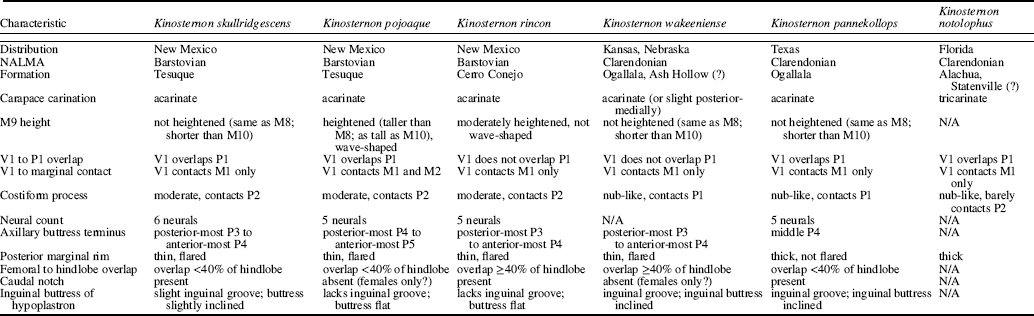
Kinosternon rincon is morphologically similar to Kinosternon pojoaque. These two species also overlap temporally and the type locality of each is in north central New Mexico, K. rincon from the Cerro Conejo Formation of the northern Albuquerque Basin and K. pojoaque from the Pojoaque Member of the Tesuque Formation in the central Española Basin (Bourque, Reference Bourque2012a). The mammalian faunas associated with the Cerro Conejo Formation and Pojoaque Member are very similar (Tedford, Reference Tedford1981; Morgan and Lucas, Reference Morgan and Lucas2001; Tedford et al., Reference Tedford, Albright, Barnosky, Ferrusquia-Villafranca, Hunt, Storer, Swisher, Voorhies, Webb and Whistler2004). As such, it is conceivable that K. rincon and K. pojoaque are synonymous, with their most significant differences attributable to either a high degree of character variability and/or sexual dimorphism between male and female K. pojoaque (which only a more robust fossil sample will elucidate). However, the holotype of K. rincon is differentiated from the types of K. pojoaque in a number of traits that include the following (see also Table 1): narrow V1 width to carapace length (V1 is wider in K. pojoaque); V1 without overlap onto P1 and contacts M1 only (V1 overlaps P1 in the types of K. pojoaque and contacts M1–2); four posteriorly symmetrical neurals (K. pojoaque has five); M11 lower than M10 (M11 is about as high as M11 in K. pojoaque); more pronounced anal notch (the holotype of K. pojoaque lacks an anal notch, but the paratype possesses a minimal notch); M5–6 sulcus contacts the inguinal scute on the hyoplastron (contacts the axillary scute on the hyoplastron in K. pojoaque); lacks conspicuous indications of medial plastral scute skin (plastral scute skin is present in at least the paratype of K. pojoaque); long intergular scute (the holotype of K. pojoaque possesses a short intergular while the paratype possesses a long intergular); longer femoral scute overlap on the plastral hindlobe; short anal scute (the types of K. pojoaque possess a short to intermediate anal); more anterior-posteriorly narrow hyoplastron with less deep axillary notches (the hyoplastron is longer in relation to width and axillary notches deeper in K. pojoaque); an axillary buttress that extends into the posterior of P3 (terminates on anteriormost P5 or posteriormost P4 in K. pojoaque); costiform process that terminates in P2 (terminates at the P1–2 suture in K. pojoaque); M9 that is only moderately heightened and differently shaped (more similar to Kinosternon integrum and the Kinosternon scorpioides complex in a combination of characteristics than to K. pojoaque, which has a taller M9 that is curved at its anterior).
Comparison of middle to late Miocene Kinosternon
The partial shell of a Kinosternon (NMMNH 63853) was previously reported from the Pojoaque Member of Rio Arriba County, New Mexico (Bourque, Reference Bourque2012b). This specimen differs from the types of Kinosternon pojoaque and Kinosternon rincon. NMMNH 63853 looks more like K. pojoaque in possessing a much wider V1 than K. rincon as well as an axillary buttress that terminates more posteriorly than in K. rincon, but it lacks a heightened wave-shaped M9 unlike the types of K. pojoaque and more like K. rincon.
Kinosternon pannekollops new species
Holotype of Kinosternon pannekollops n. sp., FAM 12778, in (1) dorsal and (2) ventral aspects. Illustrations (with some reconstruction in gray) of FAM 12778 in (3) dorsal and (4) ventral aspects. Axillary musk duct depicted on right side of shell in (4) was drawn from left side of shell (obscured by forelobe in photo). Scale bar equals 1 cm. Abbreviations: af, axillary musk duct foramina; ag, axillary musk duct groove; at, axillary musk duct terminus; axb, developed axillary buttressing on P3–4; C1–9, costals 1–9; cp, costiform process; epi, epiplastron; hyo, hyoplastron; hyp, hypoplastron; imd, inguinal musk duct orifice; N1–5, neurals 1–5; nuc, nuchal; P1–10, peripherals 1–10; pyg, pygal; spg, suprapygal; xip, xiphiplastron.
Holotype of Kinosternon pannekollops n. sp., FAM 12778, in (1) right lateral, (2) right ventro-lateral, (3) left lateral, (5) anterior, (6) posterior-ventral, and (7) posterior aspects. Illustrations of FAM 12778 in (4) left lateral and (8) posterior aspects, with missing portions indicated in gray. Scale bar equals 1 cm. Abbreviations: C1–8, costals 1–8; epi, epiplastron; N1, neural 1; N5, neural 5; nuc, nuchal; P1–10, peripherals 1–10; pyg, pygal; spg, suprapygal.
Stereograph of Kinosternon pannekollops n. sp., FAM 12778, in ventral aspect. This species possesses a thick posterior carapacial margin. The concave plastral hindlobe suggests that this specimen represents a male. Scale bar equals 1 cm.
Holotype
FAM 12778, nearly complete shell of an adult, consisting of the carapace and plastron. The specimen is missing portions of the right P1, distal two-thirds of right P2, and anterior right P3; distal margins of the right P10, pygal, and left P9–10; portions of left P4–6; and anterior-most margins of the right epiplastron and left hyoplastron.
Diagnosis
Autapomorphies: V1–4 much longer than wide with V3–4 sulcus that crosses C6 pair; thick anteriorly extensive axillary buttressing on visceral P3–4 (that terminates on P2); deeply incised anterior musk duct groove with its originating foramen on the anterior of P3 and its terminus housed by a deep foramen situated on the anterior-most P2. Symplesiomorphies: nuchal contacts N1 (shared with Kinosternon skullridgescens, Kinosternon pojoaque, Kinosternon rincon, the Kinosternon flavescens and subrubrum groups, Kinosternon alamosae Berry and Legler, Reference Berry and Legler1980, Kinosternon wakeeniense, and Kinosternon notolophus [described below]); P1 broadly contacts C1 dorsally (shared with Kinosternon herrerai, Kinosternon hippocrepis, and K. skullridgescens) Synapomorphies: Costiform processes of the nuchal reduced, contacting P1 only and not extending to P2 (shared with Kinosternon herrerai and K. wakeeniense); reduced number (five) of neurals (shared with Kinosternon acutum [Gray, Reference Gray1831], Kinosternon angustipons, Kinosternon chimalhuaca Berry, Seidel, and Iverson, Reference Berry, Seidel and Iverson1997, Kinosternon cruentatum [Duméril and Bibron in Duméril and Duméril, Reference Duméril and Duméril1851], Kinosternon dunni, Kinosternon hippocrepis, Kinosternon leucostomum [Duméril and Bibron in Duméril and Duméril, Reference Duméril and Duméril1851], K. rincon, and K. pojoaque); N1–5 posteriorly symmetrically short-sided (shared with Kinosternon hirtipes [Wagler, Reference Wagler1830], Kinosternon integrum, Kinosternon oaxacae Berry and Iverson, Reference Berry and Iverson1980, and K. pojoaque); carapacial carination absent (shared with the K. flavescens and subrubrum groups, K. pojoaque, K. skullridgescens, K. angustipons, and K. dunni); posterior marginals M8–9 thick and broad ventrally with deep visceral step and M10–11 taper to thin (shared with K. subrubrum, Kinosternon baurii, K. angustipons, Kinosternon sonoriense sonoriense [LeConte, Reference LeConte1854], and K. notolophus); posterior marginals not flared (shared with the subrubrum and flavescens groups and K. angustipons); ventral M11 sulcus situated on distal half of pygal (shared with the K. flavescens and subrubrum groups, K. angustipons, and K. sonoriense); plastron reduced, ~83% of carapace length (shared with K. baurii, K. hippocrepis, Kinosternon steindachneri, K. angustipons, K. dunni, K. herrerai, K. pojoaque, and K. skullridgescens); presence of grooved and inclined plastral bridge (shared with extant members of the K. flavescens and subrubrum groups); axillary scute moderately anteriorly extensive, terminating midway on M4 at the P3–4 suture (shared with some K. herrerai and Kinosternon oaxacae; by comparison the axillary scute is much less anteriorly extensive in K. flavescens and is more anteriorly extensive in K. leucostomum); femoral scute with broad overlap (~37%) on the plastral hindlobe (shared with Kinosternon sonoriense longifemorale).
Description
Carapace: The carapace of FAM 12778 is comprised of a nuchal, five neurals, one suprapygal, a pygal, eight costal pairs, and ten peripheral pairs (Fig. 4.3). The total length of the carapace is 150.94 mm. There are five vertebral scutes, a single cervical scute, four pairs of pleural scutes, and eleven pairs of marginal scutes. The carapace of Kinosternon pannekollops is smooth, with no trace of dorsal carinae on the nuchal, neurals, suprapygal, pygal, and costals. The bridge peripherals are smooth and lack a pronounced lateral keel that is present on the type specimens of Kinosternon pojoaque and Kinosternon rincon. The overall shape of the carapace is elongate and the carapacial rim is not flared. A medial depression is present along the dorsum of the carapace, similar to that discussed for K. pojoaque and Kinosternon skullridgescens (Bourque, Reference Bourque2012a, Reference Bourque2012b), although this depression has likely been enhanced due to some distortion in the preservation of the specimen.
The nuchal broadly contacts N1. The nuchal lacks substantial costiform processes. Instead, these are short and nub-like and contact only P1 without P2 contact. The P1 set broadly contacts the C1 set dorsally, similar to Kinosternon herrerai, Kinosternon hippocrepis, and Kinosternon skullridgescens. Conversely, Kinosternon subrubrum, Kinosternon baurii, and Kinosternon steindachneri lack substantial contact between P1 and C1. The five neurals are relatively large with N5 being the smallest, and all are posteriorly symmetrically short-sided. Costals 1–6 contact the neural series and C6–8 contact their respective pairs at the midline of the carapace.
The shape of the posterior carapace of Kinosternon pannekollops is steep sided and abruptly rounded over, similar to the subrubrum group and Kinosternon angustipons. The posterior carapacial rim in K. pannekollops is thick (most clearly observed in ventral view) along M8–9 and viscerally stepped at an angle of ~90 degrees (Figs. 4–6), and the marginal rim tapers to thin along M10–11. The posterior carapacial rim is not flared, but is instead straight sided. Likewise, in K. pannekollops the distal edge of M8–10 is rounded over. This combination of features is shared by Kinosternon subrubrum, Kinosternon baurii, and K. angustipons (and probably Kinosternon notolophus) and these attributes give the shells of these taxa an egg-shaped appearance. The posterior carapacial rim is much thinner and more sharply edged along M8–10 in Staurotypus Wagler, Reference Wagler1830, Sternotherus, and most species of Kinosternon, and the marginal scute to visceral transition is smoother and much less abruptly stepped and closer to 180 degrees or at least more obtuse than 90 degrees.
The arrangement of the features associated with the axillary musk duct is unique in Kinosternon pannekollops compared with congeners (Fig. 4.4). In FAM 12778 the posterior origin of the axillary musk duct groove is marked by a foramen that is situated on the anterior of P3, which is more anteriorly situated than observed in other species of Kinosternon. In most Kinosternon this foramen is situated on P4, or on the posterior-most P3 such as in Kinosternon leucostomum and Kinosternon integrum. The axillary musk duct groove is very deeply incised, more so than in any other kinosternid examined for this study. The terminus for the axillary musk duct groove is also unique amongst other kinosternids in that it becomes enclosed as a foramen approximately halfway on P2 at the visceral M2–3 sulcus. This foramen terminates externally on the anterior-most P2 as a pore on the ventral M2. The peculiar morphology of the axillary musk duct terminus could in fact be the result of a pathological pock on M2 so deeply bored that it intersects the axillary musk duct groove, prompting the illusion that it is a natural structure of the axillary musk duct. FAM 12778 does exhibit a number of pockmarks, particularly on the peripherals. The axillary musk duct terminus is preserved only on the left side of FAM 12778, and it is difficult to inspect (or photograph) as it is obscured in part by the epiplastra. For this reason, the axillary musk duct has been illustrated on the right side of the shell in Figure 4.4, despite the fact that the anterior of the right axillary musk duct is not preserved in the fossil. FAM 12778 possesses thick secondary axillary buttressing on the visceral face of P3–4 that diminishes approximately halfway on P2. The great thickness of the peripheral buttressing was not observed in any other fossil or extant Kinosternon examined and like the composition of the axillary musk duct may be autapomorphic for K. pannekollops. Similar but less robust buttressing was observed in specimens of Kinosternon angustipons, some Kinosternon herrerai, and some members of the extant subrubrum group. In FAM 12778, the deeply incised anterior musk duct lies just ventral to and along the axillary buttress. The inguinal musk duct orifice is situated on the anterior half of P7 at the juncture where the posterior-most inguinal inframarginal scute contacts the anterior M7. Like the external terminus of the axillary musk duct, the external inguinal musk duct orifice is a deep and relatively broad pock. It is unclear if K. pannekollops possessed a set of caudal musk duct pores at the ventral juncture of M10–11 as this area is badly damaged in FAM 12778. The presence of caudal musk duct pores is a synapomorphy for K. subrubrum, Kinosternon steindachneri, and Kinosternon baurii.
Vertebrals 1–4 are antero-posteriorly long and narrow in width (Fig. 4.1 and 4.3). V1 is 33.02 mm wide and is ~22% of the carapace length. The anterior-most lateral sulci of V1 are not restricted to the nuchal as in Kinosternon rincon, Kinosternon wakeeniense, and extant species of Sternotherus, but instead overlap onto P1. Vertebral 1 contacts only M1 and does not extend to M2. There is a pronounced constriction at the contact between V1–2, so that PLR1 overlaps N1. The degree of overlap of PLR1 onto N1 in FAM 12778 was not observed in extant kinosternine specimens examined, although PLR1 contact with the N1–C1 suture was more commonly observed. V3 is particularly long and overlaps the anterior of the proximal end of the C6 pair at their medial contact and does not overlap a neural (N5). The V3–4 sulcus typically intersects the C5 pair and N5 in other kinosternines. This character has been included as an autapomorphy in the diagnosis for Kinosternon pannekollops, but perhaps more specimens will elucidate how variable this feature is. The posterior shape of V4 is pointed posteriorly in FAM 12778, which was atypical in modern Kinosternon examined; however, some Kinosternon flavescens exhibit a similar V4 shape. The lateral sulci of V5 greatly overlap the suprapygal as seen in the holotype of K. rincon and to a lesser degree in specimens of K. flavescens, Kinosternon herrerai, Kinosternon integrum, and Kinosternon cruentatum. A specimen of Kinosternon leucostomum, UF/H 165987, exhibits a high degree of V5 to suprapygal overlap similar to that observed in FAM 12778.
Marginals 1–3 broadly underlap the anterior carapacial margin as with many species of Kinosternon. Conversely, underlap is narrow in Staurotypus, Sternotherus, and some Kinosternon such as Kinosternon steindachneri. Marginal 9 is as high as M8 and both are dorso-ventrally short as is the state with most kinosternines. Marginal 9 is not heightened to the extent of M10. Marginal 10 is notably heightened in FAM 12778, much more so than M8–9 and M11.
Plastron: The plastron of FAM 12778 is completely preserved, with only some minor damage along anterior margins of the forelobe and anterior suture of the left hyoplastron. The length of the plastron is 125.72 mm and 83% of the carapace length. It is comprised of paired epi-, hyo, hypo-, and xiphiplastra (Figs. 4.2 and 4.4; 5.2 and 5.6; and 6).
While no substantial trace of an entoplastron is present in FAM 12778, a minute anomalous bony structure exists posteromedially on the ventral side of the right epiplastron at its contact with the hyoplastron. It is unclear if the ovate structure represents an entoplastral vestige, a minor pathology, or a small area of remodeled bone (e.g., a bony plug within a pockmark) along the forelobe hinge. This structure is situated in a small pockmark, and a symmetrical pock is present on the left epiplastron. Bramble et al. (Reference Bramble, Hutchison and Legler1984) and I have observed atavistic entoplastra in the form of tiny rudimentary bones in modern specimens of Sternotherus odoratus (e.g., KU 7849 and UF/H 165594), but these appear to be dissimilar to what is present in FAM 12778. Character 31 in the phylogenetic analysis presented here was scored as lacking a substantial entoplastron for FAM 12778.
The plastral forelobe is ~43.16 mm long and 68.45 mm wide. It is expansive and would have likely been capable of encapsulating the anterior portion of the turtle in life. The forelobe was highly kinetic, evident by the stepped scute margins at the contact between the anterior humeral and posterior humeral scutes (Hutchison and Bramble, Reference Hutchison and Bramble1981), and rounded over sutural teeth along the epi–hyoplastral suture. The intergular scute is 16.68 mm long (11% carapace length) and 24.06 mm wide (16% carapace length). The length of the anterior humeral scute is 6.49 mm at the midline and 4% of the carapace length. The axillary notch of the hyoplastron is moderate in depth, and typical for species with broad forelobes. It is not as deep as taxa with more narrow forelobes (e.g., Kinosternon steindachneri), nor is it diminished to the degree seen in Kinosternon cruentatum and Kinosternon leucostomum.
The plastral hindlobe is ~43.76 mm long and 61.46 mm wide. The anal scute is 29.45 mm long at the midline and ~20% of the carapace length. The femoral scute is moderately long at the midline and ~37% of the hindlobe length. The hindlobe is less expansive than the forelobe in relation to the width of the carapace, and would unlikely have been capable of fully encapsulating the hind portions of the turtle. Like the forelobe, the hindlobe was also highly kinetic made evident by rounded over sutural teeth along the hypo–xiphiplastral suture. A high degree of bone remodeling on the ventral hypoplastron just posterior to the posterior humeral–femoral scute sulcus likewise suggests this. Additionally, there are indications of connective tissue or skin scarring along the hypo–xiphiplastral suture, which would have facilitated kinesis. FAM 12778 almost certainly represents a male in possessing a distinctly concave hindlobe with the distal margins of the xiphiplastra curved ventrally (Figs. 5.6 and 6). A distinct caudal notch is present in FAM 12778 and it is unknown if this feature is sexually dimorphic for Kinosternon pannekollops. Along the midline of the plastron, e.g., from the posterior of the epiplastra to the anal scutes, sulci that likely delineate interplastral scute skin are present. This interplastral scute skin was moderate (not as developed as that in many Sternotherus) and potentially gender informative as plastral skin is more typically seen in males than females of extant Kinosternon.
The combined length of the axillary and inguinal bridge buttresses is 34.3 mm and ~23% of the carapace length. The axillary and inguinal inframarginal scutes contact one another on the distal hyoplastron, and the axillary–inguinal sulcus is wholly contained on the hyoplastron as with other species of Kinosternon. Conversely, in Sternotherus and Staurotypus, the axillary–inguinal sulcus overlaps onto the peripherals. In FAM 12778, the M5–6 sulcus broadly underlaps onto the hyoplastron and contacts the inguinal scute. Marginal 5 is extensive on the hyoplastron. A distinct inguinal groove is present, just proximal to the inguinal scute on the hypoplastron. This groove terminates anteriorly on the posterior-most hyoplastron. The inguinal bridge buttress is inclined as in Kinosternon wakeeniense, the subrubrum group, Kinosternon flavescens, and Kinosternon arizonense.
Etymology
Species name is the combination of the Anglo-Saxon ‘panne’ for ‘pan’ and Greek ‘kollops’ for ‘handle,’ in reference to the panhandle region of northern Texas where the holotype was collected.
Occurrence
Type locality: Lewis Quarry 7, Donley County, Texas. Age and formation: Late Miocene, Clarendonian NALMA, 12–9.5 Ma, Ogallala Formation (Schultz, Reference Schultz1977:fig. 6; Schultz, Reference Schultz1990:fig. 3; Tedford et al., Reference Tedford, Albright, Barnosky, Ferrusquia-Villafranca, Hunt, Storer, Swisher, Voorhies, Webb and Whistler2004).
Remarks
Kinosternon pannekollops is the largest known kinosternid from the Miocene of North America. Its large body size suggests that dwarfing has occurred over time within the subrubrum group lineage (see phylogenetic results below), which today comprises some of the smallest members of Kinosternon (Iverson, Reference Iverson1991). A number of characteristics including the possession of thickly developed axillary buttresses, thick shell and posterior carapacial margin, shallow axillary notches on the hyoplastra, highly kinetic plastral lobes, and expansive plastral forelobe that could encapsulate the head and forelimbs of the turtle are shared with other species of Kinosternon (e.g., K. baurii, K. flavescens, K. leucostomum, and K. scorpioides) that are semi-terrestrial in some aspect of their life history (e.g., overland dispersal and/or subterranean aestivation). As such, these attributes could indicate a similar semi-terrestrial life history component for K. pannekollops. The unique arrangement of the axillary musk duct (excessively deep axillary musk duct groove and extensive anterior-most terminal foramen) could suggest this as well. Given how little is currently understood regarding how osteological features correspond to Rathke’s gland soft tissue morphology (Plummer and Trauth, Reference Plummer and Trauth2009), one might speculate that K. pannekollops was capable of excreting copious amounts of musk through its deep canal-like musk duct grooves and likewise of producing a pungent odor. This could be advantageous for gender and species recognition and other intraspecific communication (Ehrenfeld and Ehrenfeld, Reference Ehrenfeld and Ehrenfeld1973), and for long treks overland in search of new water sources, as seen in Chelydra serpentina (Linnaeus, Reference Linnaeus1758) and Kinosternon flavescens (personal observ.). Emitting plentiful secretions of aqueous musk could prove a beneficial deterrent against predators (Neill, Reference Neill1948; Ehrenfeld and Ehrenfeld, Reference Ehrenfeld and Ehrenfeld1973), and perhaps even aid in keeping the skin moist over terrestrial dispersal or during subterranean aestivation in periods of drought. These behaviors might be expected of a relatively large kinosternid inhabiting a region hypothesized as having been composed of drought-prone savanna-like floodplain habitats with peripheral temporal water bodies and numerous mammalian predators (Schultz, Reference Schultz1977, Reference Schultz1990; Pound et al., Reference Pound, Haywood, Salzmann and Riding2012).
Some morphological characteristics of Kinosternon pannekollops are similar to members of the Kinosternon scorpioides species complex. These attributes include an overall thick shell, relative large size, expansive plastron with highly kinetic fore- and hindlobes, broad plastral forelobe, shallow axillary notches on the hyoplastra, and long narrow vertebral scutes. Conceivably these similarities reflect convergence associated with more semi-terrestrial habits, in this case two separate instances in which both K. pannekollops and the K. scorpioides group exhibit modifications of the Kinosternon shell morphotype likened with that of the testudinoid box turtle morphotype. Alternatively, K. pannekollops could represent a phylogenetic intermediate between the subrubrum group and some derived species of Kinosternon with more expansive plastra, such as Kinosternon sonoriense sonoriense, Kinosternon oaxacae, Kinosternon integrum, and the K. scorpioides complex. This scenario is not completely unfounded when considering that Kinosternon notolophus (described below), interpreted here as a close relative of K. pannekollops and the subrubrum group (see Discussion), shares some morphological similarities with K. s. sonoriense and K. scorpioides, such as a tricarinate carapace and nub-like costiform processes.
Kinosternon wakeeniense new species
Type and referred specimens of Kinosternon wakeeniense n. sp. (1, 2) holotype, MSU-VP 771, nuchal in (1) dorsal; and (2) ventral aspects. (3, 4) cf. K. wakeeniense, UNSM 125577, nuchal in (3) dorsal; and (4) ventral aspects. (5, 6) MSU-VP 1177, left P1 in (5) ventral; and (6) dorsal aspects. (7) Reconstruction of anterior carapace in dorsal aspect. (8, 9) MSU-VP 1177, left P4 in (8) ventral; and (9) dorsal aspects. (10, 11) MSU-VP 1177, left P4 in (10) ventral; and (11) dorsal aspects. (12, 13) MSU-VP 1177, right P4 in (12) dorsal; and (13) ventral aspects. (14, 15) MSU-VP 1177, left P8 in (14) dorsal; and (15) ventral aspects. (16, 17) MSU-VP 1177, right P9 in (16) dorsal; and (17) ventral aspects. (18, 19) MSU-VP 1177, left P9 in (18) dorsal; and (19) ventral aspects. (20, 21) MSU-VP 1177, pygal in (20) dorsal; and (21) ventral aspects. (22) Reconstruction of external posterior carapace. (23, 24) MSU-VP 1177, N3 in (23) dorsal; and (24) ventral aspects. (25) MSU-VP 1177, proximal left C2 in dorsal aspect. (26) MSU-VP 1177, right C3 in dorsal aspect. (27, 28) MSU-VP 1177, partial right epiplastron in (27) ventral; and (28) dorsal aspects. (29) MSU-VP 1177, left hypoplastron in ventral aspect. (30, 31) MSU-VP 771, right xiphiplastron in (30) ventral; and (31) dorsal aspects. Scale bar equals 1 cm. Abbreviations: C7, insertion point for the distal C7 rib end; cp, costiform process; cps, insertion point of the costiform process; M8–M11, marginal scutes 8–11; mk, medial keel; N1s, neural 1 sutural contact; P8–P10, peripherals 8–10; pyg, pygal; V1, vertebral scute 1.
1968 Kinosternon Wilson, p. 96.
1975 Sternotherus odoratus Holman, p. 57, fig. 2.
1981 Sternotherus odoratus Holman, p. 256.
2011 cf. Kinosternon sp. and Kinosternon sp., Bourque, p. 235, fig. 1.
2012a Kinosternon sp. cf. aff. flavescens and subrubrum Bourque, p. 78, fig. 9.
Holotype
MSU-VP 771, nuchal.
Diagnosis
Symplesiomorphies: nuchal with broad N1 contact (shared with some Kinosternon; extant Sternotherus lacks N1 contact); V1 narrow and lacks contact with M2 (shared with Kinosternon pannekollops, Kinosternon herrerai, Kinosternon skullridgescens, Kinosternon rincon, and Kinosternon notolophus); M9 as tall as M8 (shared with most Kinosternon excluding Kinosternon pojoaque and the flavescens group); M8–10 thin and flared and lack deep visceral step (Kinosternon angustipons, K. pannekollops, and the subrubrum group have thick M8–10 with a deep visceral step and non-flared posterior marginals); femoral scute long at the midline (shared with K. pannekollops; K. rincon; Kinosternon arizonense, Kinosternon sonoriense longifemorale, K. angustipons; K. herrerai, and K. skullridgescens) and overlaps ~40% of the hindlobe (shared with K. rincon and K. arizonense). Synapomorphies: Lateral sulci of V1 do not extend onto P1 (shared with K. rincon, extant Sternotherus, some Kinosternon steindachneri, and aberrant individuals of the subrubrum group); costiform processes diminutive and nub-like, only contacting P1 viscerally (shared with K. pannekollops; Sternotherus has more elongate costiform processes); nuchal horns (Appendix 1: ch. 5) reduced but present (shared with K. rincon); overall nuchal width relatively broad (the nuchal of Sternotherus is comparatively more narrow); carapace acarinate (possibly with slight medial keel posteriorly in young individuals); axillary bridge buttress extends across entire visceral P4 (shared with K. rincon) probably terminating at posterior-most P3 (buttress terminates more posteriorly on P4 in K. pannekollops); pronounced lateral peripheral keel (shared with K. rincon and K. pojoaque); M10 taller than M11 (shared with most Kinosternon; in Sternotherus M10 and M11 are equal in height); inguinal bridge buttress inclined with distinct inguinal groove present (shared with extant flavescens and subrubrum groups); plastral hindlobe lobate and lacks distinct caudal notch (shared with K. pojoaque and females of the flavescens group).
Occurrence
Type locality: WaKeeney Local Fauna (Wilson, Reference Wilson1968; Holman, Reference Holman1975). Age and formation: Late Miocene, middle–late Clarendonian NALMA (Cl 2–Cl 3), 11.5–9.5 Ma, Ogallala Formation (Wilson, Reference Wilson1968; Tedford et al., Reference Tedford, Albright, Barnosky, Ferrusquia-Villafranca, Hunt, Storer, Swisher, Voorhies, Webb and Whistler2004). The referred specimen UNSM 125577 was collected from the Middle of Road Locality (USNM site WT-105), early Clarendonian component of the Ash Hollow Formation, Nebraska (G. Corner, personal communication, 2014).
Description
Carapace: The nuchal of Kinosternon wakeeniense, MSU-VP 771 (Fig. 7.1, 7.2, and 7.7), is broad (18.45 mm long and ~27.51 mm wide if it were not broken) and relatively flat dorso-ventrally. Although damaged, it was much broader than long in life and compares well to Kinosternon rincon and Kinosternon steindachneri in overall shape, proportions, and in having narrow marginal and cervical scute margins ventrally. It lacks substantial visceral buttressing often seen in many species of Kinosternon and compares well to Kinosternon flavescens, K. rincon, Kinosternon pojoaque, and K. steindachneri in this way. The nuchal lacks a pair of pronounced cervical tuberosities on the posterior-ventral side. These tuberosities occur at the site where the postzygapophyses of cervical vertebra 7 articulate with the prezygapophyses of cervical vertebra 8, and are pronounced in Sternotherus and some Kinosternon such as K. herrerai, but reduced to absent in most Kinosternon. The presence or absence of pronounced cervical tuberosities could be phylogenetically informative, but was not sufficiently examined here.
The suture along the posterior-most pinnacle is transverse for 2.53 mm and not sharply pointed, indicating that there was nuchal–N1 contact. The lateral sulcus of V1 did not contact M2 or overlap onto P1, but instead this sulcus terminates anteriorly on the nuchal where it contacts M1. The costiform process is only preserved on the right side, and is a minute nub-like structure.
The nuchal MSU-VP 771 compares well with a partial nuchal, UNSM 125577 (Fig. 7.3 and 7.4 ). UNSM 125577 was collected from a site called the Middle of Road Locality (USNM site WT-105) and is from the early Clarendonian component of the Ash Hollow Formation (=Penny Creek Local Fauna), Nebraska (George Corner, UNSM, personal communication, 2014). UNSM 125577 is ~19.02 mm long and ~23.55 mm wide (if it were not broken), similarly sized to the nuchal MSU-VP 771 and dorsoventrally flat in the same manner. The lateral V1 sulcus of UNSM 125577 contacts only M1 and did not overlap onto P1. The costiform process (preserved only on the right side) is a minute nub-like structure just like that described above for nuchal MSU-VP 771. The nuchal horns of both MSU-VP 771 and UNSM 125577 are less developed than Kinosternon pannekollops, and are instead more similar to those of Kinosternon rincon.
A left P1 (part of the lot catalog number MSU-VP 1177) (Fig. 7.5–7.7) lacks any sulcus for V1 on the dorsal surface indicating that V1 did not overlap P1 and did not contact M2. On the ventral face, there is a very small sutural notch that would have accommodated a small nub-like costiform process that terminated in P1 and did not contact P2. The combination of these attributes agrees with the nuchal MSU-VP 771 described above.
One right and two left P4s (part of MSU-VP 1177) (Fig. 7.8–7.13 ) all possess a distinct peripheral keel on the external surface discussed by Bourque (Reference Bourque2012a) similar to that of Kinosternon pojoaque and Kinosternon rincon. On the visceral face, the suture for the axillary buttress is extensive and runs almost the entire length of each of the P4 specimens, and probably contacted and terminated on the posterior-most P3 as in K. rincon.
A left P8 (part of MSU-VP 1177) (Fig. 7.14, 7.15, and 7.22) preserves the anterior of M9. This scute is low and not as heightened as seen in Kinosternon pojoaque and the flavescens group. Also unlike these taxa, the shape of the M9 is obtusely angled and not curved on its anterior half (or wave-shaped) at its intersection with the PLR3–4 sulcus. The marginal rim is not as thick as that for Kinosternon pannekollops and the subrubrum group.
A left P9 (part of MSU-VP 1177) (Fig. 7.16, 7.17, and 7.22 ) is comparatively large (1.8 cm long and 1.6 cm high) in contrast to the rest of the kinosternid sample from the WaKeeney Local Fauna. It shows a resemblance in size, shape, and thickness to Kinosternon sonoriense and Kinosternon flavescens, although the marginal rim is slightly thicker than in K. flavescens. The sutural pocket that accommodated the distal C7 rib end is situated approximately midway across the visceral face of the peripheral, and in this way it is most like K. flavescens. A left P10 (part of MSU-VP 1177) (Fig. 7.18, 7.19, and 7.22) is longer than tall. M10 is taller than M11 and the marginal rim of the peripheral is thin.
A pygal (part of MSU-VP 1177) (Fig. 7.20–7.22) is from a subadult. It is small (8.84 mm long, 9.32 mm wide) and exhibits a subtle midline keel on V5. The keel may be ontogenetically influenced in this taxon, in that it would diminish in adults such as discussed above for Kinosternon rincon. The visceral M11 sulcus is situated approximately halfway on the pygal.
An N3 (part of MSU-VP 1177) (Fig. 7.23 and 7.24) is that of an adult and lacks any trace of a medial keel dorsally. The V2–3 sulcus is situated on the anterior third of the neural. The N3 has six sutural contacts and is posteriorly symmetrically short-sided. A left C2 and right C3 (part of MSU-VP 1177) (Fig. 7.25 and 7.26) are also smooth dorsally and lack any trace of a lateral keel.
Plastron: A partial right epiplastron (part of MSU-VP 1177) (Fig. 7.27 and 7.28) is too fragmentary to discern much from. The dorsal overlap of the gular and anterior humeral scutes is preserved and relatively narrow. The left hypoplastron (part of MSU-VP 1177) (Fig. 7.29) has a highly inclined inguinal buttress and an inguinal groove. This differs from Kinosternon rincon and Kinosternon pojoaque, which have flattened plastral buttresses and lack an inguinal groove, and Kinosternon durangoense, which has more flattened plastral bridge buttresses but possesses an inguinal groove.
A right xiphiplastron (part of MSU-VP 771) (Fig. 7.30 and 7.31) is 25.5 mm long and 20.05 mm wide. The bone lacks an anal notch, similar to the type specimens of Kinosternon pojoaque and females of the flavescens group, and like these taxa would have had a short lobate hindlobe. The femoral scute is distinctly long at the midline in relation to the hindlobe length, more so than K. pojoaque, K. flavescens, and Kinosternon durangoense. However, in this way it compares well to Kinosternon rincon and the type fossils and modern specimens of Kinosternon arizonense. In MSU-VP 771, the femoral is 43% of the hindlobe length, and in K. rincon and K. arizonense it is 40% of the hindlobe length. By contrast, in K. pojoaque, the femoral is 24% of the hindlobe length and in K. flavescens, the femoral is ~9% to 14% of the hindlobe length. The femoral scute length of K. durangoense is similar to that of K. flavescens. Kinosternon sonoriense longifemorale, Kinosternon herrerai, K. rincon, and Kinosternon pannekollops possesses an elongate femoral scute, but these species also possesses a distinct anal notch unlike MSU-VP 771. The xiphiplastron MSU-VP 771 has an anomalous posteriorly situated sulcus previously discussed (Bourque, Reference Bourque2011).
Etymology
Specific epithet refers to the WaKeeney Local Fauna and is the combination of a shortened form of the word WaKeeney (a portmanteau of the surnames of Albert Warren and James Keeney, founders of the city of WaKeeney, Kansas (Kansas Heritage Project, Fort Hays State University; http://fhsuguides.fhsu.edu/kansasheritage) and the Latin suffix ‘-ense’ for ‘of or from a place.’
Referred material
MSU-VP 771, right xiphiplastron; MSU-VP 1177, proximal left C2, proximal right C3, N3, left P1, partial P3, two left P4s, right P4, left P8–10, pygal, partial right epiplastron, and left hypoplastron. Referred material: UNSM 125577, partial nuchal.
Remarks
The nuchal of Kinosternon wakeeniense is diagnostic in lacking V1 overlap onto P1 in combination with having miniscule nub-like costiform processes that lack P2 contact. The nuchals of Kinosternon steindachneri, Kinosternon rincon, and extant Sternotherus lack V1 to P1 overlap, but have longer costiform processes with P2 contact. The nuchal, UNSM 125577, may be attributable to K. wakeeniense or K. rincon in lacking V1 to P1 overlap, but is more like K. wakeeniense in having short nub-like costiform processes and in lacking cervical tuberosities ventrally (although the latter are obscured in the holotype of K. rincon). UNSM 125577 from the early Clarendonian of Nebraska could represent the oldest record of K. wakeeniense.
Kinosternon wakeeniense was possibly contemporaneous with Kinosternon pannekollops, but grew to a smaller adult size than K. pannekollops. Kinosternon wakeeniense is morphologically similar to Kinosternon rincon (Table 1), and like K. rincon, possesses symplesiomorphies and synapomorphies with the Kinosternon flavescens and subrubrum species groups. It is similar to Kinosternon pojoaque and female members of the crown flavescens group in having a lobate plastral hindlobe that lacks a distinct anal notch, thin posterior marginal rim, and the insertion sutural pocket for C7 is situated midway on P10, a synapomorphy with K. flavescens. The hindlobe morphology of K. wakeeniense is similar to Kinosternon arizonense by a combination of shape and scute proportions. However, K. wakeeniense lacks a heightened M9 and has a narrower V1, more similar to K. rincon and the subrubrum group. Unlike K. rincon, it possesses inclined plastral bridge buttress accompanied by an inguinal groove, which it shares with the crown flavescens group and stem and crown members of the subrubrum group.
Some of the type and referred specimens of Kinosternon wakeeniense were previously reported (Holman, Reference Holman1975; Bourque, Reference Bourque2011). None of the bones catalogued under MSU-VP 771 or MSU-VP 1177 have known associations with each other and therefore it is presumed that these specimens represent multiple individuals. As such, much of the description of this species is a composite based on isolated bones believed by the author to represent a single taxon.
Kinosternon notolophus new species
Type and referred specimens of Kinosternon notolophus n. sp. (1, 2) holotype, UF 43031, nuchal in (1) dorsal and (2) ventral aspects. (3) UF 225682, proximal right C4 in dorsal view. (4, 5) UF 150031, right P1 in (4) dorsal; and (5) ventral aspects. (6–8) UF 150032, right P8 in (6) dorsal, (7) anterior, and (8) ventral aspects. (9) UF 150029, proximal left C3 in dorsal view. Scale bar equals 1 cm. Abbreviations: C6, insertion point of the distal C6 rib end; cp, costiform process of the nuchal; cps, insertion point of the costiform process; lk, lateral keel; mw, anterior nuchal margin width; N1s, sutural contact between the nuchal and N1; nh, nuchal horn.
2013 cf. Kinosternon n. sp. Bourque, pp. 470–473.
Holotype
UF 43031, nuchal, collected by a field crew from the Florida State Museum (now the FLMNH) sometime between 1974 and 1980.
Diagnosis
Autapomorphy: pronounced medial keel on the nuchal that is more developed than in extant kinosternines, and is broad and flattened (not sharply peaked) anteriorly along its crest (the full extent of this keel and its shape along the length of the carapace is unknown at this time; a nuchal that is keeled to a lesser degree is present in Kinosternon hirtipes murrayi [Glass and Hartweg, Reference Glass and Hartweg1951], Kinosternon integrum, Kinosternon oaxacae, some Kinosternon scorpioides, and Kinosternon sonoriense sonoriense). Synapomorphies: Costiform processes of the nuchal short and nub-like (shared with Kinosternon pannekollops, Kinosternon wakeeniense, Kinosternon herrerai, K. sonoriense, and some K. scorpioides); weakly developed set of lateral carinae on costals (shared with K. h. murrayi, K. integrum, Kinosternon acutum, Kinosternon creaseri Hartweg, Reference Hartweg1934, Kinosternon alamosae, and some K. scorpioides); posterior marginals thickened with deep visceral step (shared with K. pannekollops, the subrubrum group, Kinosternon angustipons, K. s. sonoriense, Kinosternon cruentatum, and Kinosternon leucostomum). Symplesiomorphy: nuchal contacts N1 (shared with K. pannekollops, Kinosternon skullridgescens, K. alamosae, and the flavescens and subrubrum groups).
The holotype nuchal of Kinosternon notolophus n. sp. is distinct from extant keeled Kinosternon in possessing a more pronounced anteriorly flat-crested keel, and a combination of symplesiomorphies possessed by no single species of extant keeled Kinosternon that include: broad nuchal to N1 contact, more posteriorly situated nuchal horns, lack of an abrupt constriction posterior to the nuchal horns, relatively narrow V1 that lacks M2 contact, and broad marginal rim (comprising the M1 scute set and cervical scute) in relation to the overall width of the nuchal (Fig. 8.1). Conversely, extant keeled Kinosternon possess a nuchal with a pointed posterior pinnacle in having no N1 contact, more anteriorly situated and diminutive nuchal horns with an abrupt constriction posterior to the nuchal horns, a wider V1, and a more narrow marginal rim in relation to the maximum nuchal width. Staurotypus possesses a keeled nuchal with N1 contact, but has a much wider cervical scute and elongate costiform processes, and Sternotherus lacks a keeled nuchal and has more pronounced costiform processes.
Occurrence
Type locality: Love Bone Bed, Alachua County, Florida. Age and formation: Late Miocene, late Clarendonian NALMA (Cl 3), 10–9 Ma, Alachua Formation (Hulbert, Reference Hulbert2001; Tedford et al., Reference Tedford, Albright, Barnosky, Ferrusquia-Villafranca, Hunt, Storer, Swisher, Voorhies, Webb and Whistler2004). The referred specimen UF 225682 was collected from the Suwannee River Mine, Hamilton County, Florida; Statenville Formation, early Clarendonian (Morgan, Reference Morgan1989; Hulbert, Reference Hulbert2001; Bourque, Reference Bourque2013).
Description
Carapace: The nuchal of Kinosternon notolophus, UF 43031 (Fig. 8.1 and 8.2), is distinct from extant Kinosternon with a keeled nuchal in overall shape. The shape is more similar to Kinosternon pannekollops with the exception of the well-developed medial keel. There is a distinct transverse suture at the peak of the nuchal indicating broad contact with N1. V1 is narrower in K. notolophus than extant Kinosternon with a keeled nuchal and the anterior rim of the nuchal (comprised of the M1 set and cervical scute) is broader in relation to the total nuchal width (Fig. 8.1). The anterior of V1 overlapped P1. The orientation of the nuchal–P1 suture (from the anterior-most point to the widest point of the nuchal) is distinct in K. notolophus compared to other keeled Kinosternon. In the former, the suture is diagonally almost straight, whereas in the latter group there is a significantly angled crook at the M1 sulcus. The nuchal lacks pronounced cervical tuberosities on the posterior-ventral side.
UF 43031 possesses nub-like costiform processes (Fig. 8.2); however, the right P1, UF 150031 (Fig. 8.4 and 8.5), exhibits a deep sutural depression on the visceral face indicating that the nuchal extended the width of P1 and probably just contacted P2. The combination of what is observed on the nuchal and that on the P1 is similar to what is observed in Kinosternon sonoriense and some Kinosternon scorpioides, where the costiform processes are not well developed but the visceral face of the nuchal extends across the visceral face of P1 and contacts P2. A pock along the dorsal M1 sulcus of UF 150031 may represent pathology at the V1 contact with M1.
The proximal left C3, UF 150029 (Fig. 8.9), exhibits a lateral keel of low relief. This keel is similar to that of Kinosternon sonoriense sonoriense. The V2 sulcus indicates that V2 more significantly overlapped the C3 than the V3, similar to that seen for Kinosternon pannekollops. As such, Kinosternon notolophus may have possessed long and narrow vertebral scutes like those of K. pannekollops. The ratio of V2 and V3 overlap onto C3 appears to be more equal in extant Kinosternon with wider vertebral scutes. Similar to UF 150029, the proximal portion of a right C4, UF 225682 (Fig. 8.3) from the Suwannee River Mine of northern Florida possesses a faint keel just distal to the V3 sulci. This specimen belonged to a larger individual than UF 150029.
The P8, UF 150032 (Fig. 8.6 and 8.8), is small with bulbous marginal scutes and a rounded over (rather than sharp) distal edge. The transition from the ventral marginal to the visceral face forms an abrupt step at an angle of approximately 90 degrees. In these ways, it most closely resembles Kinosternon pannekollops, Kinosternon sonoriense sonoriense, Kinosternon angustipons, and the subrubrum group. A pit at the P7–8 suture in UF 150032 indicates that the inguinal bridge buttress was posteriorly extensive (Bourque, Reference Bourque2013). The inguinal buttress in Kinosternon notolophus probably terminated posteriorly on P7 or the anterior-most P8, which is shared with some K. sonoriense examined.
Etymology
Species name is the combination of the Greek words ‘notos’ for ‘back’ and ‘lophos’ for ‘ridge.’ Thus, the colloquial name is the ‘ridgeback mud turtle,’ in reference to the thick pronounced dorsomedial keel on at least the anterior carapace.
Referred material
UF 150029, proximal portion of left C3; UF 150030, proximal left costal fragment; UF 150031, right P1; UF 150032, right P8. Referred material: UF 287349, water-worn right P4; and UF 287350, proximal portion of a left C2 or C4 of a neonate; both from the Love Bone Bed. The proximal portion of a right C4, UF 225682, exhibits a weak lateral carina similar to that of K. notolophus and may represent it or perhaps a closely related species. A left P2, UCMP 194406, from the Love Bone Bed may represent K. notolophus, but was unavailable for examination during this study.
Remarks
This is the only tricarinate Kinosternon from the Miocene of the United States; however, Bourque (Reference Bourque2012b) reported a laterally keeled kinosternid from the late Miocene (6.6–9 Ma) Gracias Formation of Honduras that was possibly related to the Kinosternon scorpioides species complex. The kinosternid taxon from Honduras has a much more pronounced lateral keel than that of Kinosternon notolophus. The degree of carination in K. notolophus is similar to Kinosternon sonoriense sonoriense, which too has a distinct medial keel and lesser costal carinae and also possesses a thickened posterior marginal rim similar to K. notolophus, Kinosternon pannekollops, and members of the subrubrum group. It shares the possession of slight contact between the hypoplastral buttress and P8 with some K. s. sonoriense (e.g., UF/H 153871).
The type specimens of Kinosternon notolophus were previously described in some detail (Bourque, Reference Bourque2013). Only isolated carapacial bones have been collected and no plastral elements are currently known. The type and referred specimens of this species are not clearly associated with one another and it is therefore presumed that these specimens represent multiple individuals. Therefore, much of the description of this species is a composite based on isolated bones believed by the author to represent a single taxon. The referred specimen UF 225682 may represent the oldest record of K. notolophus or a closely related species.
Phylogenetic analysis
A phylogenetic analysis was performed using the matrix of Bourque and Schubert (Reference Bourque and Schubert2015) with the addition of 19 characters and the taxa Kinosternon rincon n. sp., Kinosternon pannekollops n. sp., and Kinosternon hippocrepis (Appendix 1). Additionally, both subspecies of Kinosternon sonoriense (Kinosternon sonoriense sonoriense and Kinosternon sonoriense longifemorale) were analyzed. Kinosternon wakeeniense n. sp. and Kinosternon notolophus n. sp. were excluded from the analysis due to a lack of more complete fossil material at this time. The program Mesquite 2.5 (Maddison and Maddison, Reference Maddison and Maddison2008) was used to develop the character-taxon matrix (Appendix 2), which comprised 57 morphological characters and 35 fossil and extant kinosternid ingroup taxa. The extinct taxon Xenochelys Hay, Reference Hay1906, was used as the outgroup. A parsimony analysis was conducted using 1000 heuristic search replicates with random addition sequence and tree-bisection-reconnection branch swapping in the program PAUP* 4.0 b10 (Swofford, Reference Swofford2003). The maximum number of trees was set to 100,000. Character states were unordered and equally weighted, and multistate characters were interpreted as polymorphisms. To assess support for these topologies, 1,000 bootstrap replicates were performed for each of three heuristic searches. The analysis was conducted using the High Performance Computing Center at the University of Florida.
Results
Fifteen equally most-parsimonious trees were recovered (tree length=255; consistency index=0.4902; homoplasy index=0.6902; retention index=0.7240; rescaled consistency index=0.3549). The strict consensus and 50% majority rule consensus cladograms are presented in Figure 9. Kinosternon is recovered as a monophyletic assemblage. The Kinosternon flavescens group (Platythyra Agassiz, Reference Agassiz1857) and Kinosternon subrubrum group (Thyrosternum Agassiz, Reference Agassiz1857) represent distinct monophyletic clades nested within Kinosternon, but with low bootstrap support. Kinosternon rincon is nested between the clade that comprises Kinosternon pojoaque and the flavescens group, the subrubrum group, and more derived Kinosternon including the clade comprised of Kinosternon angustipons and Kinosternon dunni. Kinosternon pannekollops is recovered as a stem taxon of the subrubrum group with Kinosternon hippocrepis as the most basal living member of that clade. Kinosternon herrerai is recovered as the most basal Kinosternon, which is similar to results of Iverson (Reference Iverson1991) using combined allozyme and morphological data. The early Barstovian Kinosternon skullridgescens is the sister taxon to K. herrerai and likewise recovered as a basal Kinosternon. The position of the clade composed of K. angustipons and K. dunni differs from results of previous analyses, which have suggested these taxa have closer affinities with K. herrerai and Kinosternon leucostomum (Iverson, Reference Iverson1991, Reference Iverson1998; Iverson et al., Reference Iverson, Brown, Akre, Near, Le, Thomson and Starkey2007, Reference Iverson, Le and Ingram2013; Spinks et al., Reference Spinks, Thomson, Gidis and Shaffer2014). The genus Cryptochelys Iverson, Le, and Ingram Reference Iverson, Le and Ingram2013, is recovered as polyphyletic, but supported in part because K. leucostomum (the type species of Cryptochelys), Kinosternon creaseri, and Kinosternon acutum are recovered as monophyletic. However, other species included in that genus (K. herrerai, K. angustipons, and K. dunni) are distributed throughout the cladogram. Kinosternon sonoriense sonoriense and Kinosternon sonoriense longifemorale are paraphyletic. Sternotherus palaeodorus is placed in a polytomy with extant Sternotherus and Kinosternon in the strict consensus and a stem taxon of Sternotherus in the 50% majority rule consensus, suggesting that a new generic name may be appropriate for that taxon pending further analyses.
Phylogenetic hypotheses of fossil and Recent Kinosternidae based on morphological evidence only. (1) Strict consensus cladogram; and (2) 50% majority rule consensus cladogram of 15 most parsimonious trees. Numbers at nodes in (1) indicate bootstrap support values, and numbers in (2) indicate frequency of occurrence. Dagger symbol indicates extinct taxa.
Discussion
The early Neogene fossil record of kinosternids is limited, but it is evident that Kinosternon underwent moderately rapid speciation during the middle to late Miocene of North America, exemplified by the taxa Kinosternon skullridgescens, Kinosternon pojoaque, Kinosternon rincon, Kinosternon wakeeniense, Kinosternon pannekollops, and Kinosternon notolophus. Divergent speciation occurred relatively soon after the first appearance of Kinosternon in the early Miocene (Hemingfordian NALMA), and at least two extant clades diverged from other Kinosternon by the middle to early late Miocene. These include the flavescens group (Platythyra) that diverged by the late Barstovian, and the subrubrum group (Thyrosternum) that diverged sometime in the Clarendonian (see Discussion below). Representative fossils of modern species first occur relatively late at the Miocene–Pliocene boundary, 6–5 Ma (Fig. 10), and subsequent records up to the Holocene appear to represent only extant taxa (Ernst and Lovich, Reference Ernst and Lovich2009). Kinosternon today exemplifies a highly speciose taxon contrasted to the little known fossil record. Extant Kinosternon have their greatest species diversity in Mexico and Mesoamerica (Legler and Vogt, 2013), but have diversified throughout their range in North America and South America into almost every fresh to brackish wetland habitat available in biomes that range from desert to tropical rainforest (Ernst and Barbour, 1989; Ernst and Lovich, Reference Ernst and Lovich2009). In the Miocene, at least five of the fossil species were associated with warm arid to semi-arid open habitat paleoenvironments, and these habitats may be where Kinosternon first evolved. The paleoenvironments occupied by K. skullridgescens, K. pojoaque, and K. rincon were likely water bodies in temperate xerophytic shrubland in the southwestern United States (Pound et al., Reference Pound, Haywood, Salzmann, Riding, Lunt and Hunter2011; Pound et al., Reference Pound, Haywood, Salzmann and Riding2012). Kinosternon pannekollops and K. wakeeniense were more likely savanna associated wetland species in the central and southeastern United States (Webb, Reference Webb1977; Schultz, Reference Schultz1977, Reference Schultz1990; Pound et al., Reference Pound, Haywood, Salzmann, Riding, Lunt and Hunter2011, Reference Pound, Haywood, Salzmann and Riding2012), and K. notolophus may have inhabited wetlands in woodland savanna or deciduous forest habitats of the southeastern Gulf Coast (Webb, Reference Webb1977; Webb et al., Reference Webb, MacFadden and Baskin1981). All of these fossil species inhabited regions where the paleoclimate was influenced by low estimated mean annual precipitation during the middle and late Miocene (Pound et al., Reference Pound, Haywood, Salzmann, Riding, Lunt and Hunter2011, Reference Pound, Haywood, Salzmann and Riding2012; Eronen et al., Reference Eronen, Fortelius, Micheels, Portmann, Puolamäki and Janis2013).
Correlation chart showing pre-late Pleistocene records of extinct and extant kinosternines (modified from Bourque, Reference Bourque2012a). Grey bars indicate approximate temporal ranges for each taxon. Numbers under Range heading correspond to each taxon listed in order of occurrence from bottom to top. Previously published taxonomic identifications and voucher specimens after the following (listed by number in Range column): (1), (14), (16), (19), and (21) (Bourque and Schubert, Reference Bourque and Schubert2015); (2) (Hutchison, Reference Hutchison1991); (3), (4), and (17) (Bourque, Reference Bourque2013); (5) and (15) (Bourque, Reference Bourque2012b); (6) and (22) (Bourque, Reference Bourque2012a); (18) (Fichter, Reference Fichter1969; Parmley, Reference Parmley1992); (20) (Gilmore, Reference Gilmore1922). NALMAs after Tedford et al. (Reference Tedford, Albright, Barnosky, Ferrusquia-Villafranca, Hunt, Storer, Swisher, Voorhies, Webb and Whistler2004). Abbreviations: C, central; NC, north central; NE, northeastern, NW, northwestern; SC, south central SE, southeastern; SW, southwestern. Dagger symbol indicates extinct taxa.
Because the Miocene species of Kinosternon are temporally and perhaps phylogenetically similar they are not readily distinguished by a profusion of autapomorphies, but rather each possesses a mosaic of symplesiomorphies and synapomorphies with each other and extant species of Kinosternon (Table 1; Appendix 2). The majority of similarities shared with extant taxa are with two closely related clades, the Kinosternon flavescens group (Platythyra) and the Kinosternon subrubrum group (Thyrosternum). Together, these two clades are geographically widespread in North America and comprise nearly all of the taxonomic diversity for the genus Kinosternon inhabiting the United States today. Six of the nine currently recognized extant taxa of Kinosternon in the United States belong to these two species groups. The only exceptions to this are Kinosternon sonoriense (comprising two subspecies) and Kinosternon hirtipes murrayi, three taxa that live in the arid southwestern United States and northern Mexico (Ernst and Lovich, Reference Ernst and Lovich2009). Kinosternon pannekollops and Kinosternon notolophus appear to be closely allied, and in turn the former is most closely related to the subrubrum group. However, K. notolophus shares a combination of carapacial features with the Sonoran mud turtle Kinosternon sonoriense sonoriense as well. It is currently unclear whether these similarities with K. s. sonoriense are purely homoplastic or phylogenetically significant based on the limited fossils of K. notolophus. If the latter, the occurrence of a plausible progenitor of K. s. sonoriense in Florida during the late Miocene has significant paleobiogeographical implications (perhaps related to more easterly distributed savanna-like habitats along the Gulf Coast [Webb, Reference Webb1977]), and could even indicate a sister group relationship between the subrubrum group and K. sonoriense.
The age and phylogenetic position of Kinosternon pannekollops suggests that the subrubrum group diverged from other Kinosternon by the late middle to early late Miocene. This estimate is concordant with molecular-based divergence dates for the subrubrum group proposed by Iverson et al. (Reference Iverson, Le and Ingram2013), although the range given in their results includes the middle Miocene. Interestingly, Kinosternon rincon is from the middle Miocene and is recovered as a plausible basal sister taxon of the subrubrum group in the phylogenetic results presented here. It is therefore not unlikely that the subrubrum group could have descended from K. rincon or a common ancestor that originated in xeric habitats of the southwestern United States. The group then likely emigrated into the open savanna-like portion of the central United States by the early Clarendonian, which is corroborated with UNSM 125577 from the early Clarendonian of Nebraska and represents a species similar to K. rincon, but most like or synonymous with K. wakeeniense. Kinosternon wakeeniense and K. pannekollops from Texas were possibly contemporaneous and persisted in what is today the Great Plains region during the Clarendonian. This indicates that the progenitors of the subrubrum group (e.g., K. pannekollops) likely evolved in the late Miocene savannas of the Great Plains, and that the group has dispersed from that region over time. Under this scenario, the most likely route of dispersal for the subrubrum group would be from west to east, probably across the Gulf Coastal Plain to the Atlantic Coastal Plain. This seems plausible given that the Gulf Coastal Plain was comprised of woodland savanna and mesic forest habitats in the late Miocene (Webb, Reference Webb1977; Webb et al., Reference Webb, MacFadden and Baskin1981) and that the Gulf Coastal Plain and Atlantic Coastal Plain regions (sensu lato) encompass the modern range of the subrubrum group today (Ernst and Lovich, Reference Ernst and Lovich2009). The basal phylogenetic position and current geographic range of the Mississippi mud turtle, Kinosternon hippocrepis, suggest that the other members of the subrubrum group arose from K. hippocrepis or a common ancestor thereof that dispersed from the western Gulf Coastal Plain, from more open habitats in the central United States to more closed canopy forests in eastern and southeastern United States. In some regard, this scenario agrees with the oldest reports of Kinosternon ‘subrubrum’ that are from the late Hemphillian (latest Miocene, earliest Pliocene) of the central United States in Kansas (Fichter, Reference Fichter1969).
The oldest reports of Kinosternon are based on scant water-worn material from the Pollack Farm locality in Delaware (Holman, Reference Holman1998; Weems and George, Reference Weems and George2013). Those vouchers (USNM 483389) more likely represent a new kinosternine genus that shares similarities with both Kinosternon and Sternotherus (Bourque and Schubert, Reference Bourque and Schubert2015). This taxon (Fig. 10; items 1 and 4 listed as Kinosterninae gen. et sp. nov.) also occurs in the early Barstovian Willacoochee Creek Local Fauna (Bryant, Reference Bryant1991; Bourque, Reference Bourque2013) of northern Florida, but there is no record of it younger than the early Barstovian. As such, the only two records are from the Atlantic and Gulf coastal plains during an interval that spans the Middle Miocene Climatic Optimum (Zachos et al., Reference Zachos, Pagani, Sloan, Thomas and Billups2001), suggesting that this taxon may have gone extinct at the end of that megathermal event. However, Kinosternon herrerai (from the Gulf Coastal Plain of eastern Mexico) possesses plastral symplesiomorphies with this taxon at the exclusion of most other Kinosternon, such as very broad contact between the axillary and inguinal scutes on the hyoplastron and in many individuals a more anteriorly situated posterior humeral–femoral sulcus on the hypoplastron. Additionally, it has been suggested that K. herrerai is the most primitive modern Kinosternon in a number of morphological attributes (Bramble et al., Reference Bramble, Hutchison and Legler1984), and K. herrerai has been recovered as the most basal Kinosternon in some phylogenetic results (Iverson, Reference Iverson1991; results here in Fig. 9). Perhaps K. herrerai is a direct descendant (or last surviving member) of this otherwise extinct genus that used the Gulf Coastal Plain to disperse into Mexico, and like dermatemydids, staurotypines (e.g. the stem staurotypine Baltemys sensu Iverson [Reference Iverson1991] and Bourque [Reference Bourque2012b]), and geoemydids was once more northerly distributed, but has endured in a southern North American refugium. More complete fossils of this early to middle Miocene kinosternid will undoubtedly better our understanding of kinosternine phylogeny, particularly concerning the divergence between Kinosternon and Sternotherus and in ascertaining whether K. herrerai is primarily or secondarily plesiomorphic.
Acknowledgments
Many thanks to E. Gaffney and C. Mehling for allowing me to borrow, prepare, and study AMNH specimens discussed here; G. Corner, J. Head, L. Albaczinskas, K. Krysko, and M. Nickerson for specimen loans; R. Hulbert, B. MacFadden, and A. Wood for discussions and providing pertinent literature; J. Bloch for equipment use; E. Woodruff for assistance with phylogenetic analysis and for uploading matrix to the University of Florida High Performance Computing Center; C. Manz for phylogenetic discussions; P. Morse for gathering map data; S. Chester for travel to AMNH; R. Portell for identifying snail fossils associated with FAM 12778; C. May and R. Hare for modern specimen donations; J. O’Brien (Amarillo, TX) for granting me access to his ranch to visit the type area of FAM 12778 in June 2013; and W. Joyce, D. Brinkman, M. Silcox, and S. Hageman for suggestions that improved the manuscript. This is University of Florida Contribution to Paleobiology 673.
Accessibility of supplemental data
Supplemental data deposited in Dryad data package: http://dx.doi.org/10.5061/dryad.v6sm8