The percentage of women in the US workforce has increased over the past few decades. According to the Bureau of Labor Statistics (2010), this percentage increased from 42.5% in 1980 to 47% in 2010. As more female employees have entered the workforce, work groups have become more diverse (Myaskovsky, Unikel, & Dew, Reference Myaskovsky, Unikel and Dew2005). For organizations, higher gender diversity can be important because it can improve work processes, along with the public image of the organization (Jansen, Otten, & van der Zee, Reference Jansen, Otten and van der Zee2017). However, there are opposing views concerning the consequences of demographic diversity. Some researchers have found that gender diversity has positive implications for performance and productivity (e.g., Ali, Ng, & Kulik, Reference Ali, Ng and Kulik2014), whereas other researchers have argued that gender diversity can increase conflict and turnover and decrease cohesion (e.g., Guillaume, Brodbeck, & Riketta, Reference Guillaume, Brodbeck and Riketta2012; Haile, Reference Haile2012). These conflicting findings suggest that some mediator mechanisms and boundary conditions can influence the relationship between gender similarity and job attitudes (Wegge, Roth, Neubach, Schmidt, & Kanfer, Reference Wegge, Roth, Neubach, Schmidt and Kanfer2008; Shore et al., Reference Shore, Chung-Herrera, Dean, Ehrhart, Jung, Randel and Singh2009; Bell, Villado, Lukasik, Belau, & Briggs, Reference Bell, Villado, Lukasik, Belau and Briggs2011).
Accordingly, two research questions are asked in this paper. The first question focuses on an underlying mechanism that links gender similarity and job attitudes. Specifically, in view of the relational demography literature, does coworker support mediate the impact of the perceived gender composition among coworkers on job satisfaction and intention to quit. The second research question asks whether the creative requirement of different occupations is a boundary condition whereby the creative requirements of a person’s occupation moderates the effect of coworker support on job-related attitudes.
By answering these two research questions, this study seeks to contribute to the literature in three ways. We focus on the critical role of coworker support, which is a type of social support received in an organizational context, and involves having a sense of trust and thinking that one can seek help from other employees who are at the same level of the organizational hierarchy (Liao, Joshi, & Chuang, Reference Liao, Joshi and Chuang2004; Chiaburu & Harrison, Reference Chiaburu and Harrison2008). There are three types of social support that can be observed in organizational contexts: supervisor support, organizational support, and coworker support (Michel, Kotrba, Mitchelson, Clark, & Baltes, Reference Michel, Kotrba, Mitchelson, Clark and Baltes2011). Although supervisor support (e.g., Nahum-Shani, Henderson, Lim, & Vinokur, Reference Nahum-Shani, Henderson, Lim and Vinokur2014; Wu & Parker, Reference Wu and Parker2014) and organizational support (e.g., Kraimer, Seibert, Wayne, Liden, & Bravo, Reference Kraimer, Seibert, Wayne, Liden and Bravo2011) have been studied more extensively in the organizational behavior literature, coworker support has received considerably less attention (Chiaburu & Harrison, Reference Chiaburu and Harrison2008). Therefore, examining the role of coworker support in organizations is the first contribution of our paper. We argue that the effects of coworker support on employees’ job attitudes goes above and beyond that of the effects of supervisor support or organizational support. For instance, according to the seventh Workforce Mood Tracker Survey, 61% of employees report crying with their coworkers as they share each other’s problems (Globalforce Survey, 2014). When employees are emotionally satisfied with their interpersonal relationships at work, they develop higher emotional attachment with their organization, feel more satisfied with their job, and have lower levels of intention to quit (Rousseau & Aubé, Reference Rousseau and Aubé2010). Since full-time employees spend more time with their coworkers than their families and spouses, and employees often work together, supportive coworker relationships can reduce employees’ stress levels while improving their overall well-being (Sloan, Reference Sloan2011; Halbesleben & Wheeler, Reference Halbesleben and Wheeler2015). Hence, it is important to examine coworker relationships in order to understand the context in which an employee is working (Chiaburu & Harrison, Reference Chiaburu and Harrison2008). In fact, according to a report based on 40,000 employees from 300 companies worldwide, coworker support had a significantly stronger impact on employee satisfaction than supervisor support and organizational support (TINYpulse Employee Engagement and Organizational Culture Report, 2014).
The second contribution of this paper is the examination of an underlying mechanism linking gender similarity and job attitudes. It has been found a number of times that demographic similarity and job attitudes have a positive association (O’Reilly, Caldwell, & Barnett, Reference O’Reilly, Caldwell and Barnett1989; Shapcott, Carron, Burke, Bradshaw, & Estabrooks, Reference Shapcott, Carron, Burke, Bradshaw and Estabrooks2006). However, the underlying mechanisms that link them remain elusive. We argue that it is important to understand mechanisms that link demographic similarity to job attitudes in order to develop means to facilitate positive affective states, and we introduce coworker support as a mediating mechanism.
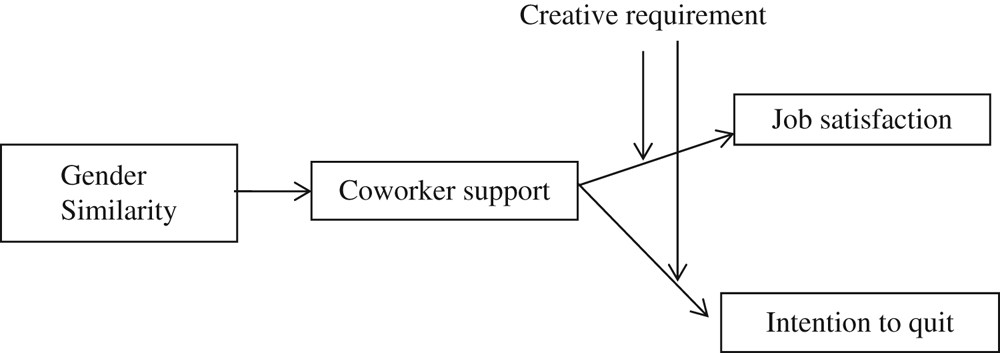
The third contribution of this paper is the potential generalizability and external validity of our findings. Although there are some studies that have examined the relationship between coworker support and job attitudes (Ducharme & Martin, Reference Ducharme and Martin2000; Chiaburu & Harrison, Reference Chiaburu and Harrison2008), these studies did not question the generalizability of their findings across occupations. By using a large sample of employees working in a wide variety of occupations, across different organizations and industries, it is possible to examine the role of an occupational characteristic, creative requirement, as a boundary condition that can influence the relationship between coworker support and job attitudes. Over the last two decades, there has been a growing demand for organizations to be more innovative. For instance, the 2005 report of the U.S. Council on Competitiveness reported that US firms can maintain market power only by being innovative (Shalley, Hitt, & Zhou, Reference Shalley, Hitt and Zhou2015). As a result of this growing emphasis on organizational innovation, there has been an increased need for creativity in all types of occupations at all levels (Shalley, Gilson, & Blum, Reference Shalley, Gilson and Blum2000). Therefore, the level of an occupation’s creative requirement becomes an important boundary condition to examine the generalizability of the role of coworker support. In short, we suggest that coworker support is a mediator underlying the relationship between gender similarity and job attitudes, and the creative requirement of the occupation moderates this relationship. Our theoretical model can be seen in Figure 1.
The theoretical model

Theoretical framework and hypotheses development
The effect of demographic similarity on job attitudes (i.e., job satisfaction and intention to quit) has been examined in the existing literature (e.g., Liao, Joshi, & Chuang, Reference Liao, Joshi and Chuang2004; Haile, Reference Haile2012), and scholars have found a significant relationship between them (O’Reilly, Caldwell, & Barnett, Reference O’Reilly, Caldwell and Barnett1989; Tsui, Egan, & O’Reilly, Reference Tsui, Egan and O’Reilly1991). However, the mechanisms that link them remain elusive. We introduce coworker support as an underlying mechanism between perceived gender similarity and job attitudes. Specifically, we argue that relational demography is a factor associated with coworker support that can affect employees’ job satisfaction and intention to quit. Relational demography, the comparable demographic similarity (or dissimilarity) among coworkers (Tsui & O’Reilly, Reference Tsui and O’Reilly1989), suggests that group dynamics are affected by the degree to which a group member feels different from the rest of their group based on demographic characteristics (Klein, Lim, Saltz, & Mayer, Reference Klein, Lim, Saltz and Mayer2004; Valenti & Rockett, Reference Valenti and Rockett2008).
The relationship between gender similarity and coworker support
We focus on gender similarity as a form of relational demography among coworkers because individuals are strongly inclined to categorize themselves with respect to gender (Bargh, Chen, & Burrows, Reference Bargh, Chen and Burrows1996; Chattopadhyay, Tluchowska, & George, Reference Chattopadhyay, Tluchowska and George2004). Gender similarity is defined as the extent to which attitudes and behaviors that are associated with gender are perceived to be shared with or different from their coworkers (Guillaume, Brodbeck, & Riketta, Reference Guillaume, Brodbeck and Riketta2012; Jansen, Otten, & van der Zee, Reference Jansen, Otten and van der Zee2017). Previously, researchers found that individual’s perceptions of similarity among team members on age (Cunningham, Reference Cunningham2007) and race (Cunningham, Choi, & Sagas, Reference Cunningham, Choi and Sagas2008) influence both individual and team level outcomes (see Shemla, Meyer, Greer, & Jehn, Reference Shemla, Meyer, Greer and Jehn2016 for a review). Here, we focus on the effects of the extent to which an employee perceives similarity among coworkers in terms of their gender. The perceptions about how women and men differ underlies gender not biological sex (Powell, Reference Powell1987; Kent & Moss, Reference Kent and Moss1994). Since we used participant’s perceptions while evaluating their similarity with their coworkers in their workgroup, we preferred to use gender similarity rather than sex similarity in order to take into account the psychological perceptions of being male or female into account (Powell & Greenhaus, Reference Powell and Greenhaus2010). We argue that employees working among coworkers who they perceive to be similar to themselves are expected to receive more coworker support, and thus, gender similarity is a perceived contextual factor associated with coworker support.
In the literature, the argument behind the relationship between demographic similarity and coworker support has been explained by the three micro-theoretical frameworks of relational demography. According to social identity and self-categorization theories, people differentiate themselves from other members of their workgroup on the basis of surface-level differences such as sex or deep level differences such as values or personality (Harrison, Price, Gavin, & Florey, Reference Harrison, Price, Gavin and Florey2002). As people differentiate themselves from others, they start to polarize themselves from coworkers who do not share the same characteristics, resulting in behavioral and attitudinal differences between individuals (Ely, Reference Ely1995). According to the similarity-attraction paradigm, the main source of attraction among individuals is the similarity of attitudes (Byrne, Reference Byrne1971). This theory is embedded in the homophily principle (Williams & O’Reilly, Reference Williams and O’Reilly1998), such that individuals have a tendency to prefer interacting with those who share similar attitudes with themselves (Blau, Reference Blau1977). Some consequences of similarity attraction are increased frequency of communication, higher group affiliation, and higher social integration (Tsui, Egan, & O’Reilly, Reference Tsui, Egan and O’Reilly1991; Guillaume, Brodbeck, & Riketta, Reference Guillaume, Brodbeck and Riketta2012).
Consistent with social identity theory, social categorization theory, and the similarity attraction paradigm discussed above, previous researchers found that gender similarity and coworker support have a positive relationship, because feelings of belonging to the same category and sharing the same social identity should encourage employees to support each other since gender similarity can influence how individuals are psychologically connected to their work group (Jansen, Otten, & van der Zee, Reference Jansen, Otten and van der Zee2017). According to Baugh and Graen (Reference Baugh and Graen1997), when there is high gender dissimilarity in a team, individuals can feel less involved with their coworkers because people who work in demographically dissimilar teams perceive their teams to be less effective, and the employees who are dissimilar from their team members are more likely to feel isolated from the social network of the team. Accordingly, in a study of 397 employees, Jansen, Otten, and van der Zee (Reference Jansen, Otten and van der Zee2017) found that gender dissimilarity was negatively related to work group inclusion. Furthermore, gender dissimilarity has been found to lead to higher amounts of interpersonally deviant behavior as dissimilar members can have a harder time identifying with their coworkers (Liao, Joshi, & Chuang, Reference Liao, Joshi and Chuang2004). Since dissimilar members may not feel included in their groups, they may hesitate in asking for help, advice and support from their coworkers (Valenti & Rockett, Reference Valenti and Rockett2008).
The relationship between gender similarity, coworker support and job attitudes
We argue that higher levels of coworker support can lead to higher levels of job satisfaction and lower levels of intention to quit. Regarding job satisfaction, the influence of coworker support can be explained by using a number of theoretical lenses. First, employees tend to have positive attitudes toward their jobs when coworker support compensates for work–family conflict (Major, Fletcher, Davis, & Germano, Reference Major, Fletcher, Davis and Germano2008). Moreover, employees who receive coworker support have access to more resources that can help them deal with work-related stress (Halbesleben & Wheeler, Reference Halbesleben and Wheeler2015). Finally, according to Schneider’s (Reference Schneider1987) attraction–selection–attrition perspective, person-environment fit is a critical factor in determining how employees perceive their work environment. When employees receive support from their coworkers, they should feel part of their work environment. Congruence with one’s environment leads to higher job satisfaction and feelings of stability, especially when the work environment is enriched by gaining assistance from coworkers for task completion (Beehr & Drexler, Reference Beehr and Drexler1986). Consistent with these arguments, Chiaburu and Harrison (Reference Chiaburu and Harrison2008) found in their meta-analysis of 161 independent samples that coworker support leads to improved job satisfaction.
The second job attitude that we focus upon is intentions to quit. Employees who are emotionally satisfied with their interpersonal relationships within their organization develop higher emotional attachment to the organization (Rousseau & Aubé, Reference Rousseau and Aubé2010), reducing their intention to quit. When employees consider intentionally quitting, they assess what they will be sacrificing by turning over from their current job (Mitchell, Holtom, Lee, Sablynski, & Erez, Reference Mitchell, Holtom, Lee, Sablynski and Erez2001), and their relationships with their coworkers are one of the assets that could be lost (Mitchell et al., Reference Mitchell, Holtom, Lee, Sablynski and Erez2001). Therefore, if an employee has strong and supportive relationships with his or her coworkers, it should become harder to leave their current organization, reducing their intention to quit. In addition, coworker support reduces the intention to quit by providing a coping mechanism to help deal with work stressors and can act as a moderator between stress and attitudinal and behavioral outcomes (Fisher, Reference Fisher1985). The meta-analysis by Chiaburu and Harrison (Reference Chiaburu and Harrison2008) also reported a significant negative direct relationship between coworker support and intentions to quit.
It has been shown numerous times that gender similarity leads to positive job attitudes, yet to our knowledge the underlying mechanism that connects these two has been overlooked. As presented above, there is strong theoretical and empirical evidence in the literature that suggests that gender similarity has a positive relationship with coworker support, and coworker support has a positive relationship with job satisfaction and a negative one with intention to quit. In order to answer how gender similarity improves job attitudes, the combined arguments discussed above suggest that the relationship between perceived gender similarity and job attitudes is mediated by the support received from coworkers. In other words, employees who perceive that they are similar to their coworkers are more likely to have high job satisfaction and lower intentions to quit, because they are more likely to receive support from those who are similar to themselves. Therefore, we hypothesize that:
Hypothesis 1: Coworker support provides an indirect (mediation) effect between gendersimilarity and (a) a positive relationship with job satisfaction and (b) a negative relationship with intention to quit.
The role of the creative requirement of occupations
The importance of coworker support may differ according to contextual characteristics (Tews, Michel, & Ellingson, Reference Tews, Michel and Ellingson2013), however, the generalizability of the findings on the relationship between coworker support and job attitudes is rarely questioned in the literature (Ng & Sorensen, Reference Ng and Sorensen2008; Rousseau & Aubé, Reference Rousseau and Aubé2010). To our knowledge, only two studies have examined boundary conditions that might change the importance of coworker support. For example, Ng and Sorensen (Reference Ng and Sorensen2008) compared jobs that involved customer contact with jobs that did not involve interaction with customers. They suggested that jobs that involve customer contact can be more stressful since interacting with customers can create role conflict and role ambiguity. Hence, in their meta-analysis, they hypothesized and found that coworker support had a stronger impact on the job satisfaction of frontline employees who frequently interact with customers compared with employees who do not have direct interaction with customers. Rousseau and Aubé (Reference Rousseau and Aubé2010) examined the role of the resource availability of jobs. Using a sample of 215 employees working in a health care organization, they hypothesized and found that the relationship between coworker support and affective commitment was stronger if the job resource adequacy was high. They argued that when job resources are inadequate, employees feel frustrated and powerless since they cannot fully appreciate the support they receive from their coworkers. In this paper, we introduce an occupational characteristic, the creative requirement of the occupation, as a boundary condition that influences the relationship between coworker support and job attitudes. The creative requirement of an occupation is the extent to which one is expected to generate work-related creative ideas, processes, or outcomes (Shalley, Gilson, & Blum, Reference Shalley, Gilson and Blum2000; Unsworth, Wall, & Carter, Reference Unsworth, Wall and Carter2005). Occupations can vary in how much creativity is required, with creativity existing on a continuum ranging from minor, incremental changes to radical breakthroughs (Zhou & Shalley, Reference Zhou and Shalley2011).
We propose that an occupation’s creative requirement can play a critical role in determining the importance of coworker support for job attitudes. Coworkers can influence employees’ attitudes and behaviors by providing help, support, and information (Chiaburu & Harrison, Reference Chiaburu and Harrison2008). Intimate supportive relationships among coworkers encourages employees to overcome resistance to change (Hon, Bloom, & Crant, Reference Hon, Bloom and Crant2014), and boosts trust and norms of reciprocity, which can lead to higher levels of information and knowledge exchange (Bacharach, Bamberger, & Vashdi, Reference Bacharach, Bamberger and Vashdi2005). Sharing information, feeling confident about coming up with new ideas, and providing support are important factors that can help to enable employees to generate novel ideas (Madjar, Oldham, & Pratt, Reference Madjar, Oldham and Pratt2002). Therefore, it could be argued that when occupations have a creative requirement, these supportive relationships become more critical for their job attitudes. Furthermore, feeling supported by coworkers increases the pleasantness of the work environment (Van Yperen & Hagedoorn, Reference Van Yperen and Hagedoorn2003). Especially in more stressful occupations, the availability of support increases employees’ feelings of connectedness to others and their motivation (Van Yperen & Hagedoorn, Reference Van Yperen and Hagedoorn2003). Feeling safe and supported is important for improving intrinsic motivation (Elsbach & Hargadon, Reference Elsbach and Hargadon2006) and creative performance (Shalley, Gilson, & Blum, Reference Shalley, Gilson and Blum2000; Hon, Bloom, & Crant, Reference Hon, Bloom and Crant2014). This could be explained in part by creating a work environment that is perceived as more psychologically safe. Creative occupations require a higher degree of risk-taking and trying to generate more novel ideas that could potentially be criticized by others. Therefore, in occupations where employees are required to share their ideas and perspectives, coworker support becomes more critical in terms of creating a suitable environment for creativity (Hon, Bloom, & Crant, Reference Hon, Bloom and Crant2014). The match between occupational characteristics and the work environment has been found to positively reflect employees’ job attitudes such as job satisfaction and intention to quit (Shalley, Gilson, & Blum, Reference Shalley, Gilson and Blum2000). We expect that coworker support will have a stronger positive relationship with job satisfaction when employees are in occupations that have a higher creative requirement because they will perceive that their work environment is safe for them to generate new ideas which can help them to meet their work goals. In addition, under these conditions, it would be harder for them to consider sacrificing this pleasant environment, thereby leading to lower intentions to quit. Hence, we propose that:
Hypothesis 2: The creative requirement of an occupation moderates the relationship between coworker support and (a) job satisfaction, and (b) intention to quit, such that for occupations that require more creativity there is a stronger positive relationship with job satisfaction and a stronger negative relationship with intention to quit as compared to occupations that require less creativity.
As we indicated above, there are conflicting findings on the role of gender similarity in organizations, and researchers have suggested examining boundary conditions (Wegge et al., Reference Wegge, Roth, Neubach, Schmidt and Kanfer2008; Shore et al., Reference Shore, Chung-Herrera, Dean, Ehrhart, Jung, Randel and Singh2009; Bell et al., Reference Bell, Villado, Lukasik, Belau and Briggs2011). Testing only the individual paths is not sufficient for concluding that the role of gender similarity on job attitudes through coworker support changes for occupations that have different levels of creativity required (Edwards & Lambert, Reference Edwards and Lambert2007; Preacher, Rucker, & Hayes, Reference Preacher, Rucker and Hayes2007). Thus, it is necessary to test the role of the creative requirement of occupations as a moderator mechanism on the complete mediation mechanism. Following this, we argue that coworker support will be a stronger mediator between gender similarity and job attitudes (i.e., job satisfaction and intention to quit) when higher levels of creativity are required, but it will not be a critical mediator when an occupation has a low creative requirement. As argued above, feeling safe and supported among coworkers is more important for employees in occupations with higher creative requirements. Therefore, we provide a final hypothesis which specifies the second stage moderated mediation effects predicted by our model (see Figure 1 for our hypothesized model).
Hypothesis 3: The mediation effect of coworker support between gender similarity and (a) job satisfaction and (b) intention to quit is moderated by the creative requirement of the occupation, such that when occupations have higher creative requirements this mediation relationship will be stronger.
METHODS
Study sample
In this study, we used the National Employee Survey which was conducted by a university survey research center in 1997. A probability sampling procedure was utilized in order to conduct computer-assisted telephone interviews with 1,465 individuals, with a response rate of 61.4%. For this study, employees who indicated that they had between 2 and 20 coworkers were included in the analysis, which resulted in a sample size of 975, corresponding to ~67% of the total sample. Eligible participants for this study were household members that were 18 years and older, worked at least 30 hr per week, and were not self-employed. The structured survey had 179 questions including questions on demographics, coworkers, supervisors, occupation, work environment, and psychological well-being. A pilot survey was conducted initially because most of the questions used in the survey were developed for paper and pen questionnaires rather than structured phone interviews, and the questions seemed to translate well to a phone interview. In the sample, 51% were males and 49% were females. In addition, 83% of the sample was white, while 17% were non-white, with 8.5% identifying as black, 1.7% as Asian, 3.6% as Hispanic, and 3.2% as ‘other.’ The average age of the participants was 38.6 years.
The survey was collected at one point in time. In addition, since there was only a single respondent, non-obtrusive objective measures were used as much as possible. Each respondent was asked to state his or her occupation. Then, these jobs were coded into objective occupational categories using the three-digit occupational codes defined by the U.S. Census Bureau (2000) using the same process as that used by Shalley, Gilson, and Blum (Reference Shalley, Gilson and Blum2000) in their analysis of employee creative requirements. According to the U.S. Census Bureau an ‘occupation describes the kind of work the person does on the job’ (U.S. Census Glossary, n.d.). Therefore, the respondents’ job titles were not in question since we specifically asked them to state their occupation. The U.S. Census Bureau has a coding system of 539 occupational categories for employed people including military personnel. Therefore, all the occupations that respondents reported matched with one of the 539 categories defined by the U.S. Census Bureau. Due to the objective nature of this coding procedure, such as assigning occupations like lawyer, teacher, bus driver, secretary, and custodian, only one coder was used to assign a code to each of the reported occupations with a supervisor checking for accuracy. The reported occupations were later matched with the occupations and industries using the Dictionary of Occupational Titles (DOT) that was developed by the U.S. Department of Labor. The DOT system includes characteristics typical of occupations such as its creative requirement. Our sample included participants from a wide range of occupations, primarily including executive, administrative and managerial occupations (16.10%), professional occupations such as engineers, scientists, and architects (23%), and administrative support occupations (17.20%). Comparison of the occupational distribution in our sample to the U.S. Census distributions, provides evidence for the occupational representativeness and external validity of the National Employee Survey.
Measures
Unless otherwise noted, we used a 4-item-point scale with 1=‘strongly disagree’ and 4=‘strongly agree,’ because the National Employee Survey data that we used was collected in collaboration with multiple research centers and universities. The answers did not provide a neutral category (i.e., neither agree nor disagree) in the 4-point scale, which can be a weakness. However, a meta-analysis did not show significant differences in the reliabilities, mean or median scores between scales that used an odd number of item categories with a neutral point and scales that used an even number of items that did not use a neutral point (Churchill & Peter, Reference Churchill and Peter1984; Peterson, Reference Peterson1994). Consistently, our measures had high reliabilities as well.
Job satisfaction
Overall job satisfaction was measured with three items developed and tested by Quinn and Staines (in Price & Mueller, Reference Price and Mueller1986) such as: ‘I am generally satisfied with the kind of work I do in this job’ (α=0.75).
Intention to quit
Intention to quit was measured with a 2-item scale adapted from Hom, Griffeth, and Sellaro (Reference Hom, Griffeth and Sellaro1984) such as: ‘I frequently think of quitting my job’ (correlation=0.71).
Coworker support
Coworker support was measured with a 7-item scale (α=0.90), and used items similar to those used by Bacharach, Bamberger, and Vashdi (Reference Bacharach, Bamberger and Vashdi2005), such as: ‘When I need help, I feel that I can turn to my coworkers’ and ‘My coworkers give useful advice to me.’ An exploratory factor analysis with principal components extraction, with and without Varimax rotation, showed that these seven items loaded onto one factor.
Gender similarity
We used gender similarity as a measure of relational demography, and it was measured based on the perception of each participant in terms of their perceived gender-based similarity with their coworkers in his or her work group. The participants were asked: ‘In your workgroup, would you say that’ followed by the responses: ‘all are men’ n=179 (18.4%); ‘most are men’ n=212 (21.7%), ‘all are women’ n=141 (14.5%), ‘most are women’ n=210 (23.6%) and ‘there are about equal numbers of men and women’ n=230 (23.6%). Due to the fact that the data were collected by a phone interview, there was no information regarding the participant’s coworkers except from the participant’s own perspective. Hence, following Gilson (Reference Gilson2000), we assigned individuals a dissimilarity score based on how different they viewed themselves with regard to their gender from their coworkers. For instance, a male who perceived all of his coworkers to be female would have the lowest similarity, while a male who perceived all of his coworkers to be males would have the highest similarity. Accordingly, similarity scores ranged for a male from 5=‘all men’; 4=‘mostly men’; 3=‘equal’; 2=‘mostly women’; and 1=‘all women’. It should be noted here that as Gilson (Reference Gilson2000) pointed out, a male working in a group of females may reply to the question as ‘working among all females’ or ‘working among mostly females.’ His answer depends on how much he is distancing himself from the group or how dissimilar he feels from his coworkers. Similar coding was applied for the female participants. Theoretically, measuring perceived similarities rather than actual compositional ones was critical because the relational demography literature primarily focuses on individuals’ perceptions (Riordan, Reference Riordan2000; Williams, Parker, & Turner, Reference Williams, Parker and Turner2007).
Creative requirement of an occupation
Following Shalley, Gilson, and Blum (Reference Shalley, Gilson and Blum2000), we used an objective measure of creative requirement by using the DOT’s rating of how much creativity was required for each occupation. The respondents were asked to state their occupation. These occupations were then coded into objective occupational categories, using the three-digit occupational codes defined by the U.S. Census Bureau (2000), and in which each occupation fell into one of 539 occupational categories. These codes were used to code the creative requirement. For instance, if respondents stated that their occupation was being a lawyer, their three-digit occupation code was 178, or if their occupation was a textile machine operator, the code was 749. For each of these 539 occupations, the DOT assigned creative requirement ratings, ranging from −1 to +1; where −1 represents routine and organized work and +1 represents abstract and creative work. For example, the occupation with the lowest creative requirement was mail carrier (−0.99); and the occupation with the highest creative requirement was musician (0.97).
Control variables
There were five control variables in this study. First, supervisor and organizational support was controlled because we sought to examine the role of coworker support in organizations above and beyond the role of these two other types of social support which have received more research attention. Second, symptoms of depression and income were controlled for since both of these can influence employees’ attitudes toward their jobs. Finally, we controlled for employee sex because women are a traditional minority group in many organizations and occupations, so they can be subject to negative stereotypes (Tsui, Egan, & O’Reilly, Reference Tsui, Egan and O’Reilly1991; Ibarra, Reference Ibarra1992) that may affect their reaction to social situations in different ways. Consequently, these five control variables were each included in order to eliminate potential alternative explanations for our findings (Shalley, Gilson, & Blum, Reference Shalley, Gilson and Blum2009).
Supervisor support
Supervisor support was measured with six questions (α=0.90) such as ‘My supervisor uses his or her power to help me’ and ‘I can count on my supervisor.’
Organizational support
We measured this variable with three items adapted from Tierney and Farmer’s (Reference Tierney and Farmer2004) creativity-supportive behavior scale (α=0.75), such as: ‘My organization encourages the development of new ideas.’
Symptoms of depression
We used the short version of the Center for Epidemiological Studies of Depression, which is a 7-item scale ranging from 1 to 7 was used (α=0.83). This scale questions whether the participants experienced a number of affective states (e.g., sad, lonely) during the last 7 days.
Income
We controlled for income level since it may reflect overall satisfaction. Income was measured by 10 categories ranging from ‘less than $10,000,’ ‘$20,000 to $29,999’ to ‘$80,000 to $89,000’ and ‘$90,000 or more.’ The average income of respondents was ‘$30,000 to $39,000.’
Results
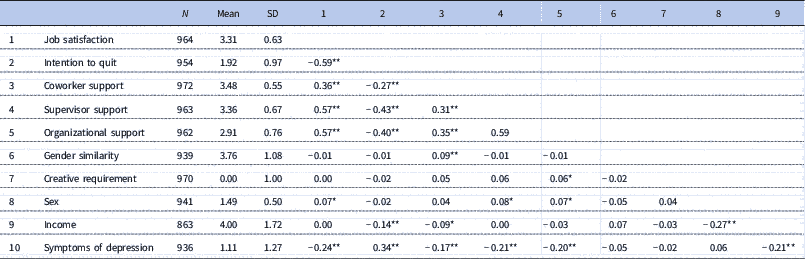
Descriptive statistics and correlations among variables can be seen in Table 1. Generally speaking, the pattern of correlations seems to be supportive of the suggested theoretical model. Gender similarity had a positive and significant bivariate correlation with coworker support (r=0.09, p<.01). Coworker support had a strong positive relationship with job satisfaction (r=0.36, p<.01) and a significant negative relationship with intention to quit (−0.27, p<.01).
Means, standard deviations, and correlations among study variables

Note: N=975.
Sex is coded as 0=‘female’, 1=‘male.’
*p<.05, **p<.01.
Common method variance
Since we measured a number of variables with a self-report questionnaire during the same time period, we tested for common method variance. First, we conducted Harman’s one factor test by running an exploratory factor analysis with principal axis factoring and Varimax rotation (Shalley, Gilson, & Blum, Reference Shalley, Gilson and Blum2009). Our perceptual study variables (i.e., coworker support, job satisfaction, and intention to quit) failed to converge on one single factor and none of the factors accounted for the majority of variance (Podsakoff, MacKenzie, & Podsakoff, Reference Podsakoff, MacKenzie and Podsakoff2012). Second, Podsakoff, MacKenzie, & Podsakoff (Reference Podsakoff, MacKenzie and Podsakoff2012) suggested that a confirmatory factor analysis (CFA) provides a more sophisticated test than a single factor that is based on an exploratory factor analysis, and that the one factor CFA model should fit the data very well if the relationship between the variables is due to common method variance (Mossholder, Bennett, Kemery, & Wesolowski, Reference Mossholder, Bennett, Kemery and Wesolowski1998). Our one factor model demonstrated a very poor fit (χ2=1378.919 [df: 54]; CFI: 0.73; REMSEA: 0.17; p<.001), showing no evidence for common method variance.
Finally, we used the CFA marker technique which uses a structural equation modeling approach to examine potential common method variance (Williams, Hartman, & Cavazotte, Reference Williams, Hartman and Cavazotte2010; Podsakoff, MacKenzie, & Podsakoff, Reference Podsakoff, MacKenzie and Podsakoff2012). For this analysis, we chose simple control in the organization, which is a three-item perceptual measure (Edwards, Reference Edwards1980) as our marker variable. This variable is a suitable marker because it was not theoretically related to our study variables (Richardson, Simmering, & Sturman, Reference Richardson, Simmering and Sturman2009), was measured for all of the respondents and was not otherwise used in this study (Lemoine, Parsons, & Kansara, Reference Lemoine, Parsons and Kansara2015). Specifically, the correlations between the marker variable and coworker support, job satisfaction, and intention to quit were −0.03, −0.04, and 0.04, respectively. Although the previous two methods (i.e., Harman’s one-factor test and one factor CFA test) did not show evidence for common methods bias, the CFA marker variable test provided some evidence for potential common method variance that could potentially create bias. However, we cannot conclude that the potential common method bias affects our regression coefficients because the model was non-congeneric suggesting that the marker variable was equally problematic on all the study variables. Researchers argue that when there is non-congeneric common method variance as opposed to congeneric, it cannot be concluded for certain that common method variance has contaminated the correlations (Richardson, Simmering, & Sturman, Reference Richardson, Simmering and Sturman2009). Therefore, the corrected correlation coefficients calculated using the CFA marker technique were compared with the uncorrected natural study correlations and no significant differences were found. In fact, the largest difference was only 0.006, which was between coworker support and intention to quit. Therefore, it appears that common method variance did not significantly change the correlations, and it is safe to assume that significant differences in our regression coefficients due to common method variance are unlikely (Richardson, Simmering, & Sturman, Reference Richardson, Simmering and Sturman2009).
Hypotheses testing
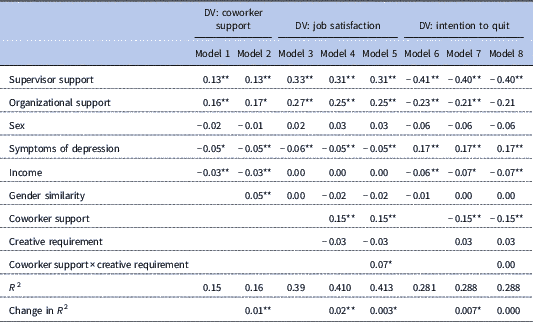
Prior to conducting our analyses, all the variables were centered. Hypotheses 1a and 1b predict the mediated relationship among demographic similarity and job attitudes through coworker support. According to the stepwise linear regression results on Table 2, Model 2, there was a positive significant relationship between gender similarity and coworker support (β=0.05, p<.01). Furthermore, according to Models 4 and 7, there was a positive and significant relationship between coworker support and job satisfaction (β=0.15, p<.01) and a significant negative relationship between coworker support and intention to quit (β=−0.15, p<.01). A bootstrap technique with 5,000 bootstrap samples suggested by Preacher and Hayes (Reference Preacher and Hayes2008) using the macro developed for the SPSS program (Preacher, Rucker, & Hayes, Reference Preacher, Rucker and Hayes2007; Hayes, Reference Hayes2012) was conducted. The analysis revealed that the indirect effect between gender similarity and job satisfaction via coworker support was significant with a point estimate of 0.01 and a 95% bias-corrected bootstrap confidence interval of 0.003 and 0.02. The point estimate for the mediation effect on intention to quit was −0.01 with 95% a bias-corrected confidence interval of −0.02 and −0.002, providing support for the indirect effect. In short, our first set of hypotheses were supported in that coworker support mediated the effect of gender similarity on job satisfaction (Hypothesis 1a) and intention to quit (Hypothesis 1b).
Interaction effect of coworker support and creative requirement for job satisfaction and intention to quit
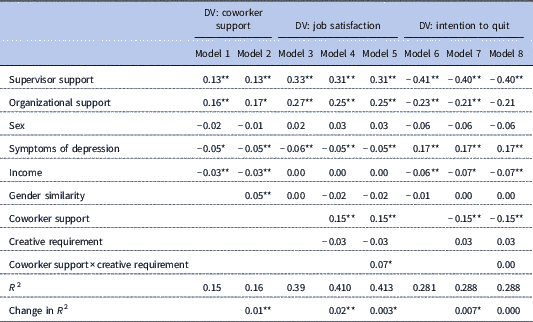
Note: All the variables were centered prior to analysis. The table indicates unstandardized β coefficients.
*p<.05, **p<.01.
DV = dependent variable.
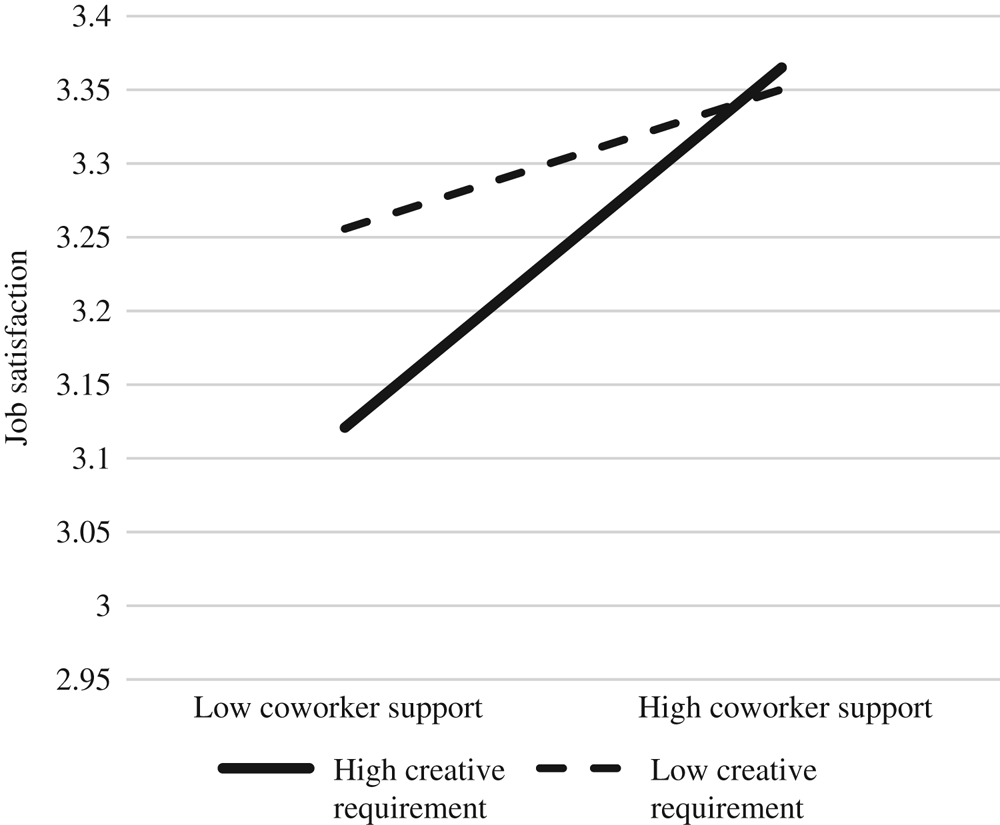
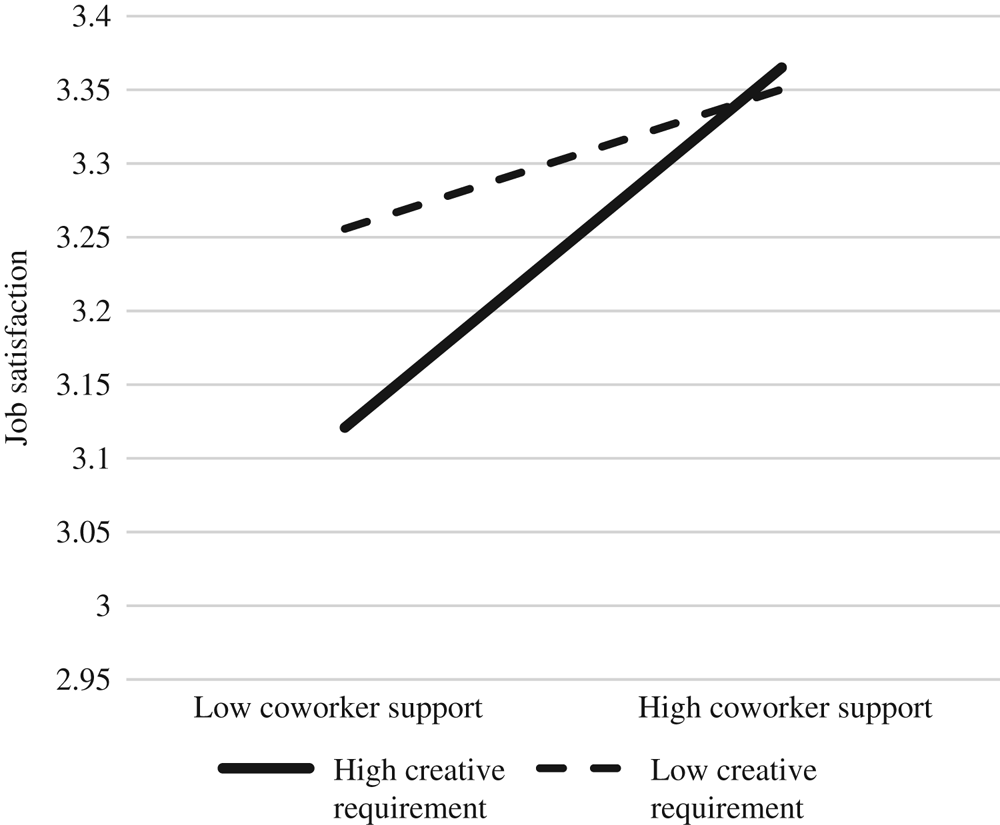
The interactions specified in Hypotheses 2a and 2b were tested using stepwise linear regression (Models 3–8 on Table 2). According to Model 4, the main effect of coworker support (β=0.15, p<.001) was significant in predicting job satisfaction, but the main effect of creative requirement was not (β=−0.03, p>.1). The R 2 change with the addition of the interaction effect in Model 5 was significant (β=0.07, p≤.05; R 2 change=0.003; p≤.05). Therefore, Hypothesis 2a was supported. The direction of the interaction between coworker support and creative requirement was positive as predicted. Simple slope tests (Aiken & West, Reference Aiken and West1991) were found to be significant when the occupation had a high creative requirement (t=4.96; p<.001), but was insignificant when the creative requirement was low (t=1.19, p>.05). In other words, as hypothesized, coworker support was found to facilitate job satisfaction for occupations that required high levels of creativity (see Figure 2).
Interaction of coworker support and creative requirement on job satisfaction
We failed to find support for Hypothesis 2b. According to Model 7, we found a significant main effect for coworker support (β=−0.15, p<.01). However, the main effect of creative requirement (β=0.03, p>.05), and the interaction of these two in Model 8, were not significant (β=0.00, p>.05), with a negligible R 2 change at the third step (R 2 change=0, p>.05). Although the interaction effect was not significant, the simple slopes tests showed that the direction of the relationship between coworker support and intention to quit was significant and negative for occupations with low levels of creative requirement (t=−1.98 p<.05) and marginally significant at high levels of creative requirement (t=−1.92, p=.055).
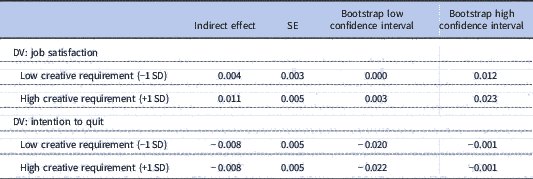
Finally, the moderated mediation hypothesis was tested with 5,000 bootstrap samples using the same PROCESS macro (Preacher, Rucker, & Hayes, Reference Preacher, Rucker and Hayes2007; Hayes, Reference Hayes2012) that was used to test the first set of hypotheses. A statistically significant interaction between coworker support and creative requirement (β=0.18; SE=0.08, t=2.17, p<.05) was found, implying that the indirect effect of gender similarity on job satisfaction through coworker support was moderated by the creative requirement of the occupation, providing support for Hypothesis 3a. As can be seen on Table 3, the confidence interval for the indirect relationship between gender similarity and job satisfaction via coworker support excluded zero at high levels of creative requirement (indirect effect: 0.011; CI: 0.004 to 0.023), but included zero at low levels of creative requirement (indirect effect: 0.004; CI: 0.00 to 0.012). In other words, the nonparametric test that relies on bootstrapping indicated that the hypothesized indirect effect was significant at high levels of creative requirement, but insignificant at low levels of creative requirement (see Table 3). The indirect effect between gender similarity and intention to quit via coworker support was significant both at high levels of creative requirement (indirect effect: −0.008; CI: −0.022 to −0.001) and low levels of creative requirement (indirect effect; −0.008; CI: −0.020 to −0.001), however there was not a significant difference between them (β=0.004; SE=0.14, t=−0.31, p>.05). Therefore, we failed to find support for the conditional mediation hypothesis (i.e., Hypothesis 3b).
The indirect effect of gender similarity on job attitudes through coworker support moderated by creative requirement
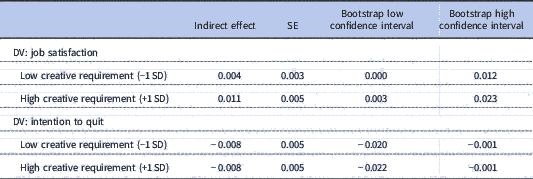
DV = dependent variable.
Discussion
Theoretical implications
The first goal of this study was to show that the importance of coworker support may vary according to the occupational context (Tews, Michel, & Ellingson, Reference Tews, Michel and Ellingson2013). Second, we examined whether an occupational characteristic (i.e., creative requirement) influenced the relationship between coworker support and job attitudes. Specifically, we found that for occupations that required higher levels of creativity, coworker support and job satisfaction had a significant relationship, while this relationship was insignificant when occupations required lower levels of creativity. This could be because occupations that have a higher creative requirement involve more complex rather than routine work, and coworker support may be more necessary and beneficial for complex work. For example, employees that work among supportive coworkers may generate more novel ideas without the fear of being criticized (Hon, Bloom, & Crant, Reference Hon, Bloom and Crant2014). When working on complex tasks that require creativity, employees may be more appreciative that they have received help from their coworkers, and this may lead them to feel more satisfied with their job. On the other hand, when employees receive help from their coworkers on tasks that are relatively simple, this may lead them to feel less competent and more incapable of completing their tasks (Ng & Sorensen, Reference Ng and Sorensen2008).
There was not a significant interaction between coworker support and creative requirement for intentions to quit. Therefore, we can conclude that a creative requirement affects job satisfaction and intention to quit in different ways. Work environments are composed of both proximal factors that affect the daily work of employees, such as a creative requirement, and distal factors that are associated with the organization itself (Shalley, Gilson, & Blum, Reference Shalley, Gilson and Blum2000). Intention to quit is a job attitude related to more distal organizational factors, while job satisfaction is more of an attitude toward proximal factors of everyday tasks the employee is working on (Kraut, Reference Kraut1975). We would argue that the reasons why an employee may choose to leave an organization can be different from what makes an individual stay in that organization (Kraut, Reference Kraut1975). For example, intention to quit might change with off-the-job factors such as the extent to which the family of the employee is embedded in the community in which they live (Lee, Mitchell, Sablynski, Burton, & Holtom, Reference Lee, Mitchell, Sablynski, Burton and Holtom2004) or for factors related to a spouses’ job. Since the creative requirement of an occupation is also considered to be a proximal factor, it is not surprising to see that it is more influential in affecting attitudes toward proximal factors (i.e., job satisfaction) than attitudes toward more distal factors (i.e., intention to quit).
One contribution of this paper is that we were able to show that coworker support can be an important underlying mechanism that explains the relationship between gender similarity and job attitudes (i.e., job satisfaction and intention to quit). This could be because having supportive coworkers can lead to having a more pleasant work setting which can improve job satisfaction and reduce intentions to quit, since relationships with coworkers are an asset that is hard to sacrifice when changing jobs (Mitchell et al., Reference Mitchell, Holtom, Lee, Sablynski and Erez2001). Furthermore, we found that the creative requirement of an occupation can moderate the indirect relationship between gender similarity and job satisfaction, such that the indirect effect takes place only for jobs that have high levels of creative requirement. However, we failed to find the same moderated mediation relationship for intention to quit. As explained before, this can be because both creative requirement and job satisfaction are proximal factors, while intention to quit is a more distal factor.
A second contribution of this paper is focusing on the role of coworker support, above and beyond the role of the other two types of social support (i.e., supervisor and organizational support) in organizational contexts. Specifically, coworker support contributed unique, significant effects over and above these two other types of social support at work. Therefore, our findings suggest that future research should consider including coworker support in their examination of contextual factors at work. Finally, we were able to examine our model for a wide variety of occupations across a broad range of organizations and industries which increases both the generalizability and external validity of our findings.
Practical implications
As gender diversity in organizations increases, managers have to deal with more issues based on the gender composition of the group (Fields & Blum, Reference Fields and Blum1997). Managers should realize that encouraging coworker support is essential in order to transfer the benefits of gender similarity to positive job attitudes. Since gender similarity positively relates to coworker support, in settings with low gender similarity, managers should pay extra attention to employees’ relationships in order to ensure that there are supportive and inclusive relationships among employees. Another practical implication of our findings is that organizations may want to look for ways to help increase the cohesiveness of their workforce by fostering team building events. For example, Hawley (Reference Hawley2014) found that by encouraging employees to participate in volunteering activities outside of the work setting with their colleagues can help to increase the bonding and sense of community at work, and increase job satisfaction.
Limitations
The first limitation of this study is that we collected the data at one point in time. Although mediation analysis conducted on cross-sectional data can yield biased estimates (Maxwell & Cole, Reference Maxwell and Cole2007; Maxwell, Cole, & Mitchell, Reference Maxwell, Cole and Mitchell2011; Shrout, Reference Shrout2011), a mediation model that is found to be significant in cross-sectional data analysis may not be significant in longitudinal mediation analysis (Maxwell, Cole, & Mitchell, Reference Maxwell, Cole and Mitchell2011). However, while using cross-sectional data can be problematic, providing that the suggested causal direction has a strong theoretical basis, cross-sectional data can still reveal potential causal mediation mechanisms (Shrout, Reference Shrout2011). Even though the direction of the hypothesized mediation mechanism has a strong theoretical basis (Shrout, Reference Shrout2011), because of the cross-sectional nature of our data, we have limited ability to make definitive inferences about causality or the temporal flow among the constructs examined (Chen, Liu, & Portnoy, Reference Chen, Liu and Portnoy2012). In addition, most of the measures we used were based on the perception of a single employee which can lead to common method bias. Brannick, Chan, Conway, Lance, and Spector (Reference Brannick, Chan, Conway, Lance and Spector2010) discussed that common method variance problems are often exaggerated, and they should not be considered as fatal flaws that lead to manuscript rejections, especially if the self-reported data provides important benefits. The benefit of our data collection provides both generalizability and high external validity based on information that includes a wide variety of occupations, across different organizations and industries. In addition, in order to deal with the common method bias issue, the creative requirement of the occupation was objectively measured from the U.S. Census source rather than from a self-rated measure.
Our second limitation is having small effect sizes. However, we should emphasize here that we are studying the effect of coworker support over and above the other two forms of social support (i.e., supervisor and organizational support). Thus, we controlled for the effects of these other social support factors in order to eliminate alternative explanations, and this potentially reduced our effect sizes. In addition, instead of focusing on one or a few types of organizations, we were able to cover a wide range of industries, organizations, and occupations by random sampling, so there could be a number of organizationally specific characteristics that play a role in the relationships tested which could have lowered the effect sizes.
Another potential limitation of our study is using a data set that was collected in 1997. It should be noted here that in the United States occupational gender segregation has been very stable over the last century (Cohen, Reference Cohen2004; Hegewisch, Liepmann, Hayes, & Hartmann, Reference Hegewisch, Liepmann, Hayes and Hartmann2010), while power and demographic status differences between genders still remain the same (Hekman, Johnson, Foo, & Yang, Reference Hekman, Johnson, Foo and Yang2017). In addition, the mean levels of variables such as the gender composition of occupations are independent of its correlation with other variables (Goodman & Blum, Reference Goodman and Blum1996). Therefore, it is maintained that even if the data was collected today, and even if the amount of segregation in occupations decreased over time, the relationship between the study constructs would yield similar theoretical predictions, and likely similar conclusions from tests of the hypotheses.
Future research directions
Although a good number of studies have operationalized coworker support as one single construct, it may be useful to distinguish between different types of coworker support as mediating mechanisms between gender similarity and job attitudes. For example, a meta-analysis by Chiaburu and Harrison (Reference Chiaburu and Harrison2008) showed that the content of coworker support (i.e., affective or instrumental) plays a significant role in predicting job outcomes, such that instrumental support has stronger relationships with work effectiveness including citizenship behaviors directed at one’s coworkers and task performance; while affective support is a stronger predictor of job satisfaction, job involvement, and organizational commitment. Since a single construct scale for coworker support was used in this study, the affective and instrumental types of coworker support were not distinguishable, hence future research could examine this.
Second, in this study, one occupational characteristic, creative requirement, was emphasized. Other occupational characteristics, such as task interdependence, should be considered in the future in order to increase the generalizability of the findings. Moreover, by measuring creative requirement as an objective occupational characteristic using the DOT scores, the assumption is that all jobs within an occupation have similar creative requirements. Yet, people who have the same occupation but work in different jobs might have varying levels of a creative requirement. For instance, a lawyer doing pro-bono work for a small non-profit firm might have different requirements than a corporate lawyer working for a large firm although they share the same occupation. In the future, creative requirement as a job characteristic should be studied.
The difference between traditional majorities (e.g., men) and traditional minorities (e.g., women) in organizations is also a critical factor to evaluate in future studies. Since women are numerical minorities in both the societal and organizational power elites, they are subject to negative stereotypes (Tsui, Egan, & O’Reilly, Reference Tsui, Egan and O’Reilly1991; Ibarra, Reference Ibarra1992). There is research evidence that suggests that traditional majority groups and traditional minority groups, particularly sex groups, react to social situations in different ways (Tolbert, Graham, & Andrews, Reference Tolbert, Graham and Andrews1999). For example, Kanter (Reference Kanter1977) argued that the dominant groups in a society experience higher levels of coworker support, less role conflict, more adequate resources, and greater autonomy within an organization compared to minority or lower status groups. This can lead to higher job satisfaction and lower intentions to quit, and this interaction effect should be empirically tested in the future. While some researchers found that gender similarity might have different effects on men and women (e.g., Chatman & O’Reilly, Reference Chatman and O’Reilly2004; Ely, Reference Ely2004), some other researchers did not find any significant differences in the role of gender similarity across genders (Baugh & Graen, Reference Baugh and Graen1997; Fields & Blum, Reference Fields and Blum1997; Graves & Elsass, Reference Graves and Elsass2005; Jansen, Otten, & van der Zee, Reference Jansen, Otten and van der Zee2017). A post-hoc analysis of the data found that the results align with this latter group, because there were no significant differences that suggested that the relationship between gender similarity and coworker support and their relationship with job attitudes differed between men and women.
Finally, in this study, gender similarity is a measure of relational demography. Future work can examine the effects of other types of demographic similarities. For instance, race is also a factor that can shape employee decisions (Bargh, Chen, & Burrows, Reference Bargh, Chen and Burrows1996). Unfortunately, this particular sample was not suitable to differentiate effects based on racial similarity since only 17% of the employees were non-white and these employees were not further characterized according to their racial identity.
Conclusion
In conclusion, this study examined the role of an overlooked organizational phenomenon, coworker support. The results showed that the level of creative requirement of an occupation can influence the relationship between gender similarity and job satisfaction mediated by coworker support. When employees are in occupations with a high creative requirement, they seem to appreciate the help they receive from their coworkers more than employees working in occupations that require low levels of creativity. Furthermore, coworker support is one key underlying mechanism that helps to link gender similarity to job satisfaction and intention to turnover, in addition to the support received from their leader and organization.
Acknowledgements
The authors would like to thank Journal of Management & Organization's editor-in-chief Tui McKeown, associate editor Remi Ayoko, and two anonymous reviewers for their comments on previous versions of this article.