INTRODUCTION
The development of productivity and society has been pushing to promote the service industry. Hochschild (Reference Hochschild1983) first used the term ‘emotional labor’ to describe the daily work of employees in the service industry, defining this as the observable facial expressions or body and verbal language displayed by employees interacting with customers in accordance with the organization’s requirements (Hochschild, Reference Hochschild1983). In other words, emotional labor is a type of paid work with particular requirements that need to be met. It is thought that emotional labor is beneficial to organizations but detrimental to employees (Grandey, Reference Grandey2000).
Since the concept of emotional labor was created, researchers have been increasingly interested in its effect in the workplace and have explored it from many perspectives. Despite variable results, there has been a consensus that a job’s emotional demands or display rules can be viewed as the defining cause or beginning of the emotional labor process, whereas the psychological effects on employees such as job satisfaction (JB) or burnout are the results or the end of the process (Côté & Morgan, Reference Côté and Morgan2002; Diefendorff, Croyle, & Gosserand, Reference Diefendorff, Croyle and Gosserand2005; Bakker & Heuven, Reference Bakker and Heuven2006; Johnson & Spector, Reference Johnson and Spector2007; Kim, Reference Kim2008).
According to Hobfoll’s conservation of resources theory, people ‘strive to retain, protect, and build resources and that what is threatening to them is the potential or actual loss of these valued resources’ (Reference Hobfoll1989: 513), and the loss of resources without regain may lead to stress. Following this line, Brotheridge and Leepointed out that ‘threats to resource loss are usually in the form of role demands and the energy and efforts expended toward meeting such demands’ (Reference Brotheridge and Lee2002: 58). As a typical job requirement, emotional job demand (EJD) may force employees to perform emotional labor, which is resources consuming and further results in stress and other symptoms, and employees may perform emotional labor via specific emotional strategies such as deep acting (DA) and surface acting (SA) to reduce the use of resource (Brotheridge & Lee, Reference Brotheridge and Lee2002).
EJD covers broader than displays rules, which dictate the emotions that employees need to express (Brotheridge & Grandey, Reference Brotheridge and Grandey2002). Specifically, EJD has been measured as occupational titles such as service jobs, work demands such as frequency and intensity of interactions with customers, and job expectations to express certain emotions (e.g., positive or negative) that denote the display rules embedded in the job. Therefore, EJD elicits the resource-demanding character of emotional labor, which may in turn influence the employees’ well-being. As Lee & Ok (Reference Lee and Ok2012) suggested, it is important to identify possible links between EJD and its psychological effects, as both researchers and practitioners seek ways to capitalize on emotional labor and reduce its detrimental effects for both employees and organizations. However, only a few studies have adopted an integrated approach to analyze those relationships (e.g., Grandey, Reference Grandey2000; Austin, Dore, & O’Donovan, Reference Austin, Dore and O’Donovan2008; Karim & Weisz, Reference Karim and Weisz2011).
In addition, Hobfoll (Reference Hobfoll1989) identified four kinds of resources namely objective resources, conditions, personal characteristics and energies. Social support (SS) can be seen as a kind of social resources when it provides the conditions for the preservation of resources (Hobfoll, Reference Hobfoll2002). Under a particular work condition, social support may influence employees’ choice of emotional labor strategies (ELSs) under certain levels of EJD, and thus moderate the psychological influence of emotional labor (Brotheridge & Lee, Reference Brotheridge and Lee2002; Kawada & Otsuka, Reference Kawada and Otsuka2011). Therefore, it is worth exploring the effects of social support on the relationship between emotional labor and its psychological outcomes.
Specifically, this current research aims to examine the relationships between EJD and its psychological effects on employees, in the form of emotional exhaustion (EE) and JS, with a particular focus on the mediation effects of ELSs and the moderation effect of social support. Although some empirical studies have addressed the relationships mentioned above, the moderated mediation effect among these construct has rarely been addressed. This research can thus contribute to the knowledge of emotional labor in service sector. In addition, this current research chooses a relatively up to date method – PROCESS (Preacher, Rucker, & Hayes, Reference Preacher, Rucker and Hayes2007; Hayes, Reference Hayes2012) to test the hypotheses, which also serves as an attempt of the new analysis approach.
THEORIES AND HYPOTHESES
Emotional labor, EJD and the resulting psychological effects
Emotional labor is most commonly performed by employees in the service sector who may be required to exhibit friendly body language or facial expressions toward customers, or pretend to be aggressive to make people feel alarmed. Such emotional expressions may be deliberately generated to facilitate the employees’ work rather than reflecting their true inner feelings (Hochschild, Reference Hochschild1983).
Employees are not expected to perform intensive emotional labor constantly. Companies and positions vary the required frequency, duration and intensity of employee–customer interaction. When and how employees perform emotional labor is determined by ‘emotional job demand’ (EJD), a specific type of job requirement. According to Cordes & Dougherty (Reference Cordes and Dougherty1993), workers faced with higher emotional demand may experience higher level of burnout. It is also consistent with Karasek’s (Reference Karasek1979) job demand control model, which suggests that high job demands have negative effects on employees, such as stress, exhaustion and alienation.
EE and JS are the most frequently researched psychological effects of emotional labor on employees. EE is central to burnout, which is seen as a long-term result of continuing an emotional interpersonal relationship despite insufficient emotional resources (Jackson, Schwab, & Schuler, Reference Jackson, Schwab and Schuler1986; Maslach & Jackson, Reference Maslach and Jackson1986). Burnout may lead to depression, nervousness and reduced self-esteem and thus reduce employees’ commitment to work and job performance. JB, an important indicator of employees’ psychological well-being (Grandey, Reference Grandey2000), refers to a sense of satisfaction with the work itself that is felt by the employees in an organization (Landy, Reference Landy1989).
In theory, being the defining cause of emotional labor, EJD requires employees to perform emotional labor, and resources available for the employees may thus be depleted, leading to EE and poor job performance. Previous studies, such as Morris and Feldman (Reference Morris and Feldman1997) and Peng, Wong, and Che (Reference Peng, Wong and Che2007), have shown that EJD positively predicted EE. Bozionelos and Kiamou (Reference Bozionelos and Kiamou2008) also found that the frequency of emotional display, along with other dimensions of EJD such as intensity, were negatively related to JS. Further studies are required to reveal the details of the links between EJD and its psychological effects.
In this paper, the initial hypotheses are formulated as follows:
Hypothesis 1: EJD is positively related to EE (a), while negatively related to JS (b).
ELSs as mediators
ELSs are the specific strategies adopted by employees to deal with the required emotional labor. In other words, EJD provides the situational reason for employees to perform emotional labor and ELSs are how the employees perform emotional labor to cope with emotionally demanding situations. According to Brotheridge and Grandey (Reference Brotheridge and Grandey2002), ELSs are the focus of research into emotional labor with an emphasis on emotional regulation and management.
In general, there are two types of ELS: SA and DA. SA is the display of certain emotions that are not felt or the hiding of emotions that are felt. DA refers to modifying emotions in ‘good faith’ to comply with the organization’s display rules (Brotheridge & Grandey, Reference Brotheridge and Grandey2002). Grandey (Reference Grandey2000) described these two strategies more specifically, indicating that both surface and DA represent ways in which to regulate emotion. However, SA is response-focused emotion regulation achieved by modifying the expression of a response after certain emotions are felt, while DA is antecedent-focused emotion regulation, for example, diverting attention away immediately and changing cognition about the situation, which entails modifying feelings before certain emotions are formed. Because SA only involves masking facial expressions or body language, employees choosing this strategy need only to be good at camouflaging their inner feelings and may not have to expend extra resources to do so, although there may be consequences if the disguise is penetrated. In contrast, through involving greater sincerity, DA may attract support and goodwill from customers, giving the employee a sense of accomplishment and leading to better performance. However, the employee has to make more effort and expend additional resources to obtain the goodwill.
Employees are expected to find ways to cope with EJD, and simultaneously try to consume fewer resources while obtaining more benefits. Hence, the higher the EJD, the more strategies used. Lazarus (Reference Lazarus1991) proposed that the stress due to emotional demand may determine the amount of emotional labor performed. Peng, Wong, and Che (Reference Peng, Wong and Che2007) found that regardless of the strategy adopted by employees, an increase in EJD resulted in increased use of both SA and DA. In addition, Grandey (Reference Grandey2000) argued that interaction expectations, such as the frequency, duration, variety and display rules of interaction (i.e., the EJD), are situational cues for the emotion regulation process. These studies suggest a relationship between EJD and ELSs, and indicate that a higher EJD may induce a more frequent use of ELSs.
Evidence from some empirical studies also presents this relationship. For example, Bozionelos andKiamou (Reference Bozionelos and Kiamou2008) found that only SA was positively related to EE. Scott and Barnes (Reference Scott and Barnes2011) revealed that affective states worsened when employees chose SA, but improved when they chose DA. Other studies (e.g., Brotheridge & Grandey, Reference Brotheridge and Grandey2002; Brotheridge & Lee, Reference Brotheridge and Lee2002) also found that SA was positively related to EE and negatively related to a sense of accomplishment, an indicator of JS, while DA appeared to be negatively related to EE but positively related to a sense of accomplishment. These results indicate that SA may be harmful to an employee’s psychological state while DA may be beneficial.
The above discussion clearly reveals that ELSs may form a link between EJD and its psychological effects on employees (i.e., EE and JS), and that there are ways to elucidate the detailed relationships between them. Grandey’s (Reference Grandey2000) emotion regulation model proposed such a mediating effect conceptually, but only a few empirical studies have been conducted. For instance, Peng, Wong, and Che (Reference Peng, Wong and Che2007) conducted different tests to confirm the mediating effects of emotional job strategies on the relationship between EJD and EE. To look for more evidence on these mediating effects, the mediation of ELSs on the relationship between EJD and its psychological effects is tested using the following hypotheses:
Hypothesis 2: ELSs mediate the relationships between EJD and EE/JS.
SS as a moderator
Support from both co-workers and supervisors can create a favorable working atmosphere for employees (Schneider & Bowen, Reference Schneider and Bowen1985). Being psychological or material support that individuals get from others, social support has usually been treated as an objective environmental variable in emotional labor research (Thoits, Reference Thoits2011).
Brotheridge and Lee (Reference Brotheridge and Lee2002) proposed that individuals have an incentive to protect and expand their own resources, as heavy depletion of those resources would result in alienation, strain and EE. Hobfoll defined resource as ‘those objects, personal characteristics, conditions, or energies that are valued by the individual or that serve as a means for attainment of these objects, personal characteristics, conditions, or energies’ (Reference Hobfoll1989: 516). Social support is a kind of social resources since it is a means for the attainment of other resources (Hobfoll, Reference Hobfoll2002). Employees tend to consume these resources only when they are able to supplement them (Brotheridge & Lee, Reference Brotheridge and Lee2002). As social support is a channel through which individuals may supplement their resources, it is probable that when facing a given level of EJD, employees with more readily available social support tend to choose a more resource-consuming strategy (i.e., DA), and at the same time, reducing the use of SA. The following hypotheses are thus formulated:
Hypothesis 3: SS moderates the positive EJD–SA and the positive EJD–DA relationship. Specifically, the higher the level of SS, the weaker the EJD–SA relationship (a), whereas the stronger the EJD–DA relationship (b).
If all other conditions are equal, employees with more social support are less likely to experience exhaustion (Brotherigde & Lee, Reference Brotheridge and Lee2002). Kawada and Otsuka (Reference Kawada and Otsuka2011) found that a lack of support and control over employees’ work has an adverse effect on their JB. Social support is therefore negatively related to EE but positively related to JS. However, Hobfoll (Reference Hobfoll2002) also emphasized that sometimes social support may detract from individuals’ resources that it is supposed to generate. For example, employees using SA may feel guilty and experience more stress within a more supportive atmosphere due to the mismatched give-and-take relationship, while those using DA may be more motivated. As a result, in a more supportive workplace, employees using SA are more likely to experience EE and be dissatisfied with their job, while employees using DA are less likely to experience EE and be more satisfied with their job. Therefore, the following hypotheses are formulated:
Hypothesis 4: SS moderates the positive SA–EE relationship (a) and the negative DA–EE relationship (b). Specifically, the higher the level of SS, the stronger the relationships.
Hypothesis 5: SS moderates the negative SA–JS relationship (a) and the positive DA–JS relationship (b). Specifically, the higher the level of SS, the stronger the relationships.
Conditional indirect effects
As shown above, ELSs can be expected to mediate the relationships between EJD and EE or JS. The ELSs chosen as a result of EJD have different effects on employees’ psychological states. As previously noted, social support can be expected to moderate the relationship between EJD and ELSs and between ELSs and employees’ psychological states. In more supportive environments, employees are likely to use DA to deal with the emotional demand of their job and accordingly to undergo a change in their psychological state. This leads to our final hypothesis:
Hypothesis 6: The conditional indirect effect of EJD on employee psychological state via ELS is stronger when SS is strong rather than weak.
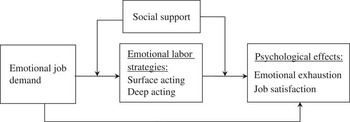
The discrepancies between EJD and its psychological effects have now been accounted for by adding the mediators of ELSs and the moderator of perceived social support. The hypothetical model to be tested in the present study is shown in Figure 1.
The hypothetical moderated mediation model

METHODS
Participants
The study participants were 679 employees in different companies from various sectors of the hospitality and retail industries in Henan, a province in central China. The size of assets, income scales and the rate of return on net assets also varied. All employees in these companies were required to interact with customers more or less.
Data were collected through a voluntary questionnaire survey, distributed to employees by their managers but returned anonymously. Of the 826 questionnaires distributed, 679 were returned, a response rate of 82.20%.
Of the 679 respondents, 415 were male (61.1%) and 264 female (38.9%). Most respondents were under the age of 40 (85.0%), with 318 in their 20s and 259 in their 30s. Only 15.0% were aged 41 or over, of which 19 were over 50. At the time of data collection, 420 respondents were married (61.8%), 243 (35.8%) were single and 16 (2.4%) were separated or divorced. A degree or higher qualification was held by 42.1%, while 57.9% had a vocational school education or lower. The monthly salary of 77.8% of the respondents was within the range RMB1,200–5,000, with an average monthly salary reported to be RMB 4,000 in China.
Measures
EJD
The scale was adapted from Chen, Ku, Shyr, Chen, and Chou’s (Reference Chen, Ku, Shyr, Chen and Chou2009) work to measure the EJD experienced in our respondents’ daily work. The EJD scale that we finally adopted was a single-factor scale comprising three items. The internal consistency reliability using Cronbach’s α coefficient in this research was 0.64.
EE
The degree of EE in employees was measured using five items extracted from the Maslach Burnout Inventory–General Survey (Maslach & Jackson, Reference Maslach and Jackson1986). An example statement is ‘I feel very tired to face the day’s work every morning when I get up.’ The Cronbach’s α coefficient was 0.81.
JS
The JS of our respondents was measured using a 5-item scale developed by Judge, Locke, Durham, and Kluger (Reference Judge, Locke, Durham and Kluger1998). An example statement is ‘I feel fairly well satisfied with my job.’ The Cronbach’s α coefficient was 0.64.
ELSs
Following Diefendorff, Croyle, and Gosserand (Reference Diefendorff, Croyle and Gosserand2005) and Brotheridge and Lee’s (Reference Brotheridge and Lee2002) approach, the ELS scale used in the present study contained 11 items measuring two factors: SA (seven items) and DA (four items). Examples of statements are ‘I fake a good mood when interacting with customers’ (SA) and ‘I work hard to feel the emotions that I need to show to customers’ (DA). The Cronbach’s α coefficient of DA was 0.69, and that of SA was 0.80.
SS
A single-factor, 5-item scale developed by Chen et al. (Reference Chen, Ku, Shyr, Chen and Chou2009) was used to assess the social support received by respondents regarding their work. Examples include ‘My colleagues express interest in my work-related questions’ and ‘My colleagues can help to reduce work pressure.’ The Cronbach’s α coefficient was 0.82.
Scoring
Except for social support, which was scored on a 7-point Likert scale (1=‘strongly disagree’ 7=‘strongly agree’), all questionnaire items were scored on a 5-point Likert scale (1=‘strongly disagree’ 5=‘strongly agree’).
Interaction terms
Interaction terms were formed by centering the means of respective independent variables and then taking the product terms.
Control variables
To rule out the potential confounding effects of demographic variables, several variables, namely gender, age, marital status and level of education, were controlled for.
Common method bias
Since all of the variables in this study were self-reported. Harman’s single-factor test (Harman, Reference Harman1967; Podsakoff, MacKenzie, Lee, & Podsakoff, Reference Podsakoff, MacKenzie, Lee and Podsakoff2003) was conducted to examine whether the results were plagued by common method bias. Both exploratory and confirmatory factor analysis were employed to conduct this test. For the exploratory factor analysis, the results showed that no single factor was identified by the unrotated exploratory factor analysis. In contrast, this procedure generated six factors accounting for 67.72% of the total variance.
The confirmatory factor analysis examined the construct validity of two models, i.e., the one-factor model and the fully differentiated six-factor model. The results showed that the one-factor model had a poor data fit (χ2=3,565.55, df=378, p=.00, RMSEA=0.112, GFI=0.64, AGFI=0.58) while the goodness of fit for the six-factor model was much better and reached an acceptable, though a little bit marginal, level of data fit (χ2=973.70, df=362, p=.00, RMSEA=0.05, GFI=0.91, AGFI=0.89).
In short, the single-factor model was rejected by both exploratory and confirmatory factor analysis, indicating that common method variance did not impair the findings of this study.
RESULTS
Descriptive, reliability and correlation analysis
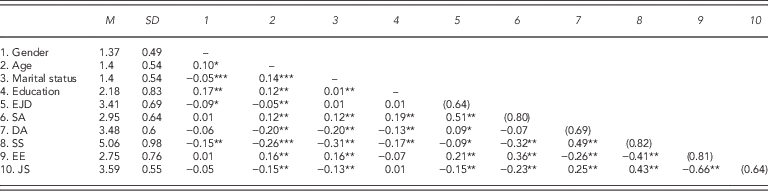
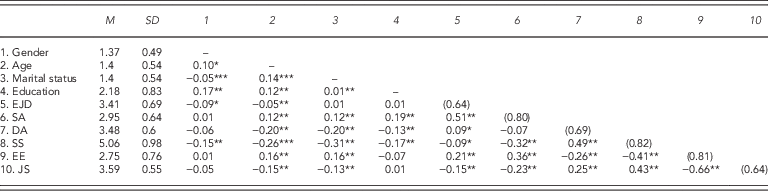
Descriptive statistics, namely means, standard deviations, correlations and reliabilities, for the subscales are presented in Table 1. Of the five factors scored on a 5-point Likert scale, JS, DA and EJD were rated relatively higher. Social support was also highly rated even after taking its 7-point Likert scale into consideration.
Correlations, descriptive statistics and reliability analyses
Note: DA=deep acting; EE=emotional exhaustion; EJD=emotional job demand; JS=job satisfaction; SA=surface acting.
*p<.05, **p<.01; Cronbach’s α in parentheses.
The Cronbach’s α coefficients were given in parentheses in Table 1, the coefficients of SA, SS and EE were above 0.80, and those of EJD, DA and JS were no less than 0.64. Although it is generally agreed that the Cronbach’s α coefficients should be higher than 0.70, researchers also suggested that the cut-off value depends on the sample size, the number of scale items and the nature of the study, and thus a minimum threshold α value of 0.60 is recommended (Nunnally & Bernstein, Reference Nunnally and Bernstein1994; Shrout, Reference Shrout1998; Narasimhan & Jayaram, Reference Narasimhan and Jayaram2008). Therefore, the results of reliability analysis indicated that all subscales used in the present study had acceptable reliabilities.
As shown in Table 1, most of the correlations between the variables were significant. No significant correlation was found between SA and DA, while EE was negatively related to JS, both of these correlations agreeing with the definitions of these terms. These results also demonstrated the construct validity of the scales.
Direct effects
The results of regression analyses indicated that when predicting EE and JS, the coefficients of EJD (EE: β=0.21, p<.001; JS: β=−0.16, p<.001) were significant, which indicated that EJD may lead to EE and less JS, and Hypothesis 1a and Hypothesis 1b were supported.
Mediation effects
Following Hayes and his colleagues’ (Preacher, Rucker, & Hayes, Reference Preacher, Rucker and Hayes2007; Hayes, Reference Hayes2012) approach, we conducted the PROCESS and calculated four equations: two for the mediators (DV: SA and DA), and two for the dependent variable (DV: EE and JS). After controlling for the effects of gender, age, marital status and level of education, EJD significantly predicted the mediators, (SA: β=0.49, p<.001; DA: β=0.11, p<.01). Furthermore, when simultaneously added in the equation, EJD, SA and DA all manifested strong predictive effects on EE (EJD: β=0.09, p<.05; SA: β=0.30, p<.001; DA: β=−0.25, p<.001) and JS (EJD: β=−0.11, p<.05; SA: β=−0.17, p<.001; DA: β=0.25, p<.001), which indicated that ELSs partially mediated the relationship between EJD and EE/JS. Hypothesis 2 were supported accordingly.
The mediation effects ware also examined by Sobel tests (Preacher & Hayes, Reference Preacher and Hayes2004) to verify the significance of the indirect effect of the mediator. The results of Sobel tests showed that all mediation effects were significant (DA–EE: statistic=−2.77, p<.01; DA–JS: statistic=2.76, p<.01; SA–EE: statistic=6.45, p<.001; SA–JS: statistic=−3.57, p<.001).
Moderation effects
Our hypothetical model is consistent with Edwards and Lambert’s (Reference Edwards and Lambert2007) first- and second-stage moderation model. That is, ELSs mediate the relationship between EJD and psychological effects on employees, and social support moderates the paths from EJD to ELSs and from ELSs to psychological effects on employees. Thus, the indirect effect of EJD is conditional on social support. Testing this model involves estimating the following equations:
 $${\rm DV}=b_{0} {\plus}b_{{\rm 1}} {\rm Control}{\plus}b_{{\rm 2}} {\rm EJD}{\plus}b_{{\rm 3}} {\rm ELSs}{\plus}b_{{\rm 4}} {\rm SS}{\plus}b_{{\rm 5}} {\rm ELSs}{\times}{\rm SS}{\plus}e.{\rm }$$
 $${\rm ELSs}=b_{0} {\plus}b_{{\rm 1}} {\rm Control}{\plus}b_{{\rm 2}} {\rm EJD}{\plus}b_{{\rm 3}} {\rm SS}{\plus}b_{{\rm 4}} {\rm EJD}{\times}{\rm SS}{\plus}e.$$
DV is the dependent variable, i.e. EE and JS, respectively. Control refers to the control variables for gender, age and level of education, and e is an error term. Substituting Equation 2 into Equation 1 gives equations for obtaining estimates for the conditional indirect effect (Edwards & Lambert, Reference Edwards and Lambert2007).
Edwards and Lambert (Reference Edwards and Lambert2007) recommended generating 95% bias-corrected bootstrapped confidence intervals to assess the significance of the conditional indirect effect. In the present study, Hayes’ (Reference Hayes2012) PROCESS for SPSS (Model 58) was used to estimate the equations above and obtain bias-corrected bootstrapped confidence intervals (using 1,000 bootstrap samples) for the conditional indirect effect. Predictors were mean-centered to enable the simple slope analysis suggested by Aiken and West (Reference Aiken and West1991).
Test of first-stage moderation
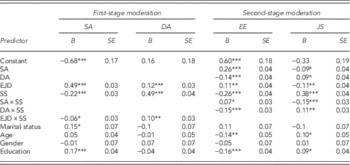
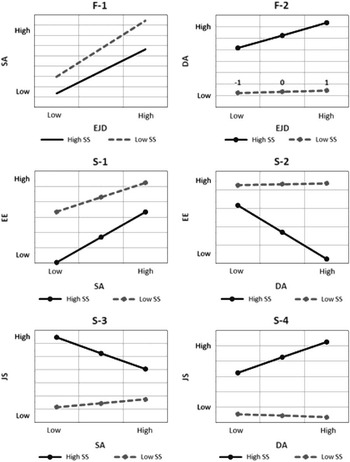
As shown in Table 2, the EJD×SS interaction was statistically significant for both models, using SA and DA, respectively as the mediator. The nature of the interactions was tested by calculating simple slopes at ±1 standard deviation of SS (Figure 2: F-1, F-2). EJD was positively related to SA for employees both with strong social support (B=0.42, SE=0.04, p<.001) and with weak social support (B=0.56, SE=0.05, p<.001). However, EJD was found to relate positively to DA for employees with strong social support (B=0.21, SE=0.04, p<.01) but not with weak social support (B=0.04, SE=0.05, p=ns). These results indicated that social support moderated only the EJD–DA relationship and not the EJD–SA relationship. That is, the higher the level of social support, the stronger the positive relationship between EJD and DA. However, the relationship between EJD and SA did not present significant difference under different levels of social support. Hence, Hypothesis 3b was confirmed but Hypothesis 3a was rejected.
Test of first- and second-stage moderation model

Note: DA=deep acting; EE=emotional exhaustion; EJD=emotional job demand; JS=job satisfaction; SA=surface acting.
*p<.05, **p<.01, ***p<.001.
Simple slope analyses for first- and second-stage moderation

Test of second-stage moderation
As shown in Table 2, the SA×SS and DA×SS interactions were statistically significant for both models, with EE and JS, respectively, as the dependent variable. The nature of the interactions was further examined by calculating simple slopes at ±1 standard deviation of SS (Figure 2). Figures S-1 and S-2 show the results for EE as the dependent variable, while Figures S-3 and S-4 show the corresponding results for JS.
As S-1 and S-2 of Figure 2 indicate, SA was positively related to EE for employees both with strong social support (B=0.31, SE=0.05, p<.001) and with weak social support (B=0.21, SE=0.05, p<.001); and DA was negatively related to EE only for employees with strong social support (B=−0.20, SE=0.05, p<.001) but not for those with weak social support (B=0.04, SE=0.05, p=ns). These results indicated that social support only moderated the DA–EE relationship and not the SA–EE relationship. That is, the higher the level of social support, the stronger the negative relationship between DA and EE. However, the relationship between SA and EE did not present significant difference under different levels of social support. Hence, Hypothesis 4b was supported but Hypothesis 4a was not.
As presented in S-3 and S-4 of Figure 2, SA/DA was negatively/positively related to JS only for employees with strong social support (SA: B=−0.25, SE=0.05, p<.001; DA: B=0.13, SE=0.05, p<.01) and not for those with weak social support (SA: B=0.03, SE=0.05, p=ns; DA: B=−0.05, SE=0.05, p=ns). These results indicated that social support moderated both the SA–JS and the DA–JS relationship. That is, under a higher level of social support, both the negative relationship between SA and JS and the positive relationship between DA and JS would become stronger. Hence, both Hypothesis 5a and Hypothesis 5b were supported.
Conditional indirect effects
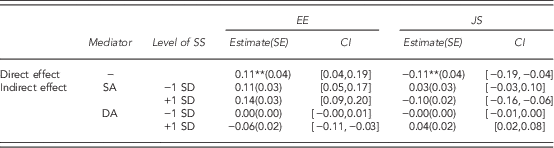
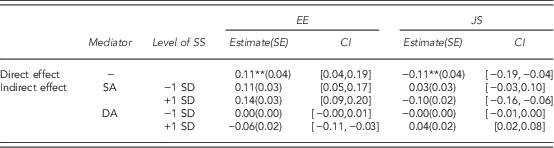
Following Preacher, Rucker, and Hayes (Reference Preacher, Rucker and Hayes2007), bootstrapping techniques were used to assess the significance of the conditional indirect effects. The estimates and bootstrapped 95% confidence intervals for the conditional indirect effects are presented in Table 3.
Estimates and bias-corrected bootstrapped 95% confidence intervals
Note: DA=deep acting; EE=emotional exhaustion; JS=job satisfaction; SA=surface acting.
**p<.01.
For the four models in Table 3, with SA/DA as the mediator and EE/JS as the outcome variable, confidence interval values at one standard deviation above the mean of the moderator (+1 SS) did not include zero, while those at one standard deviation below the mean of the moderator (−1 SS) included zero except for the model using EE as the outcome variable and SA as the mediator (hereafter referred to as Model 1). These results further indicated that except for Model 1, significant conditional indirect effects existed for employees in more supportive environments. Thus, Hypothesis 6 was partially supported. The conditional indirect effects were more apparent for the models that used DA as the mediator. The first row of Table 3 also shows that the significant direct effects of EJD in predicting EE and JS indicated the existence of partial mediation.
Discussion
Based on Hobfoll’s (Reference Hobfoll1989, Reference Hobfoll2002) conservation of resources theory, this study examined the relationships between EJD and its psychological effects on employees via the mediation of ELSs, with a particular focus on the moderation effects of social support. The results showed that ELSs (i.e., SA and DA) partially mediated the impact of EJD on it psychological effects (i.e., EE and JS). In addition, the results indicated that the positive effect of EJD on DA is stronger among employees under a more supportive environment, and that the negative/positive effects of DA on EE/JS are also stronger among those employees. Generally, the findings supported most of our hypotheses except for some moderation effect hypotheses relating to SA. These results shed light on what a service sector organization can do to motivate and retain its employees.
Theoretical implications
EJD was found to significantly relate to EE and JS in the expected directions, supporting the findings of some previous studies (e.g., Morris & Feldman, Reference Morris and Feldman1997; Peng, Wong, & Che, Reference Peng, Wong and Che2007; Bozionelos & Kiamou, Reference Bozionelos and Kiamou2008) and providing more evidence about the role of EJD in employees’ daily work. Employees can provide better service by managing their emotions. Although it benefits the bottom line of organizations, employees may become stressful and dissatisfied, or even intent to leave in the long term, which can turn the organizations into training schools instead of healthy, profit-making organizations (Hochschild, Reference Hochschild1983). As indicated in the conservation of resource theory, the threat to and the actual loss of resources, and a lack of resource regain lead to psychological stress and other symptoms (Hobfoll, Reference Hobfoll1989). Hence, EJD, as an important threat to resource loss, is harmful to the psychological well-being and JB of employee. Research on controlling the adverse effects of EJD on employees and the detail effects of each dimension of EJD, such as frequency, duration and intensity of emotional labor, is thus highly desirable.
The results of the mediation tests indicated that employees were more likely to use both of the ELSs (surface and DA) when EJD increased, but that adopting DA was good for the psychological well-being of employees while SA use was harmful. Thus, ELSs played a mediating role in the relationships between EJD and its psychological effects. These findings concurred with Peng, Wong, and Che (2007) work and were also consistent with Grandey’s (Reference Grandey2000) theoretical hypothesis that situational variables are antecedents of emotion regulation, and that emotion regulation processes such as SA and DA may adversely affect employee stress and organizational well-being in the long term. In addition, the use of DA or SA due to higher levels of EJD can be considered as employees’ attempt of saving resources. The results that DA leads to better psychological status than SA, according to the conservation of resources theory, can be interpreted as that the sincerity of DA user may facilitate the regain of valued resources and reduce stress.
The results of moderation tests showed that, under a more supportive environment, the positive impact of EJD on DA and the negative/positive effects of DA on EE/JS were stronger. These findings supported our hypotheses that a supportive environment would encourage employees to use more DA, and would in turn improve employees’ satisfaction with their jobs and help them to avoid exhaustion. The moderation tests also showed that under a more supportive environment, the negative effect of SA on JS was stronger, too. These findings indicated that employees using more SA felt more stress in a more supportive environment, with worsening JS. It can be concluded that social support is beneficial to the DA users while harmful for the SA users, which is consistent with Hobfoll’s opinion about social support. According to Hobfoll (Reference Hobfoll1989, Reference Hobfoll2002), social support itself does not necessarily belong to resource. Social support is a resource when it provides or facilitates the preservation of valued resources, and it cannot be seen as a resource when it does not provide proper conditions. Thus, the results relating to SA can be interpreted as that social support does not facilitate the SA users’ resource acquisition and preservation, because they feel stressful and guilty about that what they receive from others does not match what they devote at work. However, because the moderation effects of social support on the positive SA–EE relationship were not supported and there has been little research on these effects, more studies are required to determine whether this finding reflected the characteristics of Chinese service-sector employees or was caused by measurement choice or sample size.
All in all, this current study examined a moderated mediation model in light of the conservation of resources theory using a relatively updated method, i.e., PROCESS. The results showed that social support, as a particular kind of resources, could reduce the negative psychological outcomes of EJD when employees chose DA, but may increase the negative effects when employees chose SA.
Practical implications
The results have three implications for organizations and employee training. First, a conceptual shift is required. Organizations need to realize that while emotional labor appears to benefit them in the short term, it can be harmful to both organizations and their employees in the long term. Only when organizations are ready to create a supportive and caring environment, and employees are willing to improve their performance of emotional labor, will conflicts between the two be reconciled.
Second, DA is better than SA for performing emotional labor. DA can help employees to avoid unnecessary exhaustion while reducing complaints from customers detecting fake emotions (Groth, Hennig-Thurau, & Walsh, Reference Groth, Hennig-Thurau and Walsh2009). However, few employees have the innate ability to perform emotional labor well, and need to be trained to identify surface and DA and to learn how to use them. Employees should be encouraged to use DA, such as immediately diverting attention from a negative situation (Grandey, Reference Grandey2000), treating difficult customers as they would a baby, or regulating their emotions by recalling happy memories of the past (Austin, Dore, & O’Donovan, Reference Austin, Dore and O’Donovan2008). Meanwhile, organizations should not forbid SA use: SA is also an effective approach for dealing with EJD, and there are circumstances in which DA use fails.
Third, social support is, by and large, good for both employees and organizations. However, organizations aiming to build a supportive atmosphere in the workplace should consider the dual nature of social support. On the one hand, employees should be treated with care and a trust relationship should be promoted through initiatives such as Outward Bound activities. On the other hand, a supportive environment may become a stressor for employees adopting SA. Organizations should therefore guide their employees to benefit from the environment instead of allowing it to put additional pressure on the employees.
Limitations and suggestions for future research
A major limitation of the present study is the gender distribution of the sample. Of the 679 participants, 415 were male (61.1%) and only 264 were female (38.9%). According to some researchers (e.g., Taylor & Tyler, Reference Taylor and Tyler2000; Stevens, Reference Stevens2012), this is inconsistent with the typical gender distribution of employees in service sectors, in which females usually outnumber males. Even if the actual gender distribution was accurately reflected in the sample, further study is required to examine the possible influence of gender distribution.
Another limitation relates to the design and method of the present study. As a cross-sectional study using self-report measures, it is noted that the model tested in the present study is only an exploratory one. Other models may also serve to examine the relationship among the constructs of interest. It is suggested that future studies should use a longitudinal research design, which may help clarify the directionality of the regression paths.
In addition, the present study has controlled the effects of some demographic variables. Nonetheless, considering the characteristics of emotional labor, the relationships tested in this study might also have to do with individuals’ propensity to experience certain types of emotions. Therefore, future research is strongly recommended to further include positive and negative affectivity as control variables in order to avoid the possible effect of individual predisposition.
CONCLUSION
Despite the limitations, the findings of the present study lend credence to most of our hypotheses that ELSs can mediate the links between EJD and exhaustion and satisfaction, and that social support can moderate these relationships in the mediated model. These findings enrich the understanding about emotional labor in service sector and support the application of Hobfoll’s (Reference Hobfoll1989, Reference Hobfoll2002) conservation of resource theory. The study suggests a new way to examine the different natures of deep and SA, and identifies the dual nature of social support. According to these findings, it is argued that organizations should build a supportive environment and encourage their employees to use more DA, while ensuring that employees who are only adept at SA use are cared for rather than further pressured.
Acknowledgement
We are grateful to the anonymous reviewers for their invaluable comments on the previous versions of this paper.