Introduction
Cacao is cultivated throughout the humid tropics and approximately 71% of global production of cocoa beans is within West Africa (ICCO, 2016). In order to maintain a livelihood, farmers periodically need to rehabilitate their farms by replacing old trees with higher-yielding varieties. A particular challenge in West Africa is that the establishment of young trees can be hampered by the onset of the dry season, which typically occurs between December and February (Toxopeus, Reference Toxopeus1970a). The degradation of soils that have previously been planted with cacao exacerbates the challenge of establishment since the loss of soil organic matter reduces the water-holding capacity of the soil. For example, Ayanlaja (Reference Ayanlaja1983) has compared some edaphic parameters (pH, percent N and percent organic carbon) of old cacao soils with counterpart forest soils and found the former to have values significantly lower than those considered adequate for cacao. Furthermore, global climate change is resulting in a harsher dry season. Stanturf et al. (Reference Stanturf, Warren, Charnley, Polasky, Goodrich, Armah and Nyako2011) have reported an average increase in air temperature of 1 °C in Ghana since 1960. Moreover, dry season length and severity have increased in West African rainforest regions (Malhi and Wright, Reference Malhi and Wright2004). Where localised deforestation has occurred there is expected to be less buffering of the micro-environment. As a consequence of all of these factors, there is an increasing need for improved establishment methods and cacao varieties which are more tolerant to water deficit.
Cacao is relatively sensitive to water deficit (Raja Harun and Hardwick, Reference Raja Harun and Hardwick1988). The use of mulching has the potential to reduce losses during establishment if applied before the onset of the first dry season (Wasowicz and Havord, Reference Wasowicz and Havord1951). If properly applied, mulching will improve soil moisture status by reducing soil moisture evaporation. Mulching is capable of creating a porous, better-aerated soil layer with improved water-holding capacity, making the soil more suitable for the development of plant roots. In addition, organic mulches eventually break down to release variable but often significant amounts of plant nutrients, usually including nitrogen, phosphate and potassium as well as trace elements. Unlike inorganic fertilisers, organic mulches release their nutrients slowly as they decompose. Despite the numerous benefits of mulching, the practice is not widely used in West Africa, and only limited information on its effect on cacao establishment is available. An attempt was made in Ghana by Frimpong and Akuoko (Reference Frimpong and Akuoko1995) to study the combined effect of plantain pseudo-stems (used as a mulching material) and a water-absorbing polymer (‘Grow Soak 400’) on cacao seedling survival and growth under field conditions. The first year’s results indicated a 20% greater seedling survival under the ‘mulch-only’ treatment than under the control treatment where there was no application of mulch.
The use of irrigation provides another potential route towards improved establishment. Carr and Lockwood (Reference Carr and Lockwood2011) have reported that despite its known sensitivity to water stress there is a paucity of reliable, field-based published data of practical value on the responses of cacao to irrigation. The provision of overhead shade also contributes towards the success of cacao establishment, and attempts to reduce the cost of establishing cacao by reducing or eliminating ‘temporary’ shade have not shown consistent success. This is explained by the fact that cacao has a number of attributes that are typical of shade species. These include low photosynthetic rates (Daymond et al., Reference Daymond, Tricker and Hadley2011) and a high sensitivity to photoinhibitory stress (Galyuon et al., Reference Galyuon, McDavid, Lopez and Spence1996). Therefore, shade provided by companion plants to ameliorate physiological stress caused by high light intensities and high evapotranspiration is generally considered a requirement, especially for young cacao (Ahenkorah et al., Reference Ahenkorah, Akrofi and Adri1974). Acheampong et al. (Reference Acheampong, Hadley and Daymond2013) have conducted a nursery experiment to assess the shade requirement of four cacao clones and observed seasonal variations in the shade requirement of young cacao, with shade requirement being higher in the dry season. Here, the same clones have been combined into treatments of varying shade and mulch/irrigation during the dry season. Combining those important factors in one experiment was expected to provide further insight into the link between improved agro-ecological conditions and the field establishment of cacao.
The aim of this study was to establish whether simple mulching practices under field conditions can maintain enough soil water for the successful establishment of young cacao trees while shade is provided by other plant species. The mulching treatments were compared with a ‘control’ treatment (devoid of any intervention towards soil moisture management) as well as a comparison with irrigation to maintain soil moisture levels. The mulching/irrigation and control treatments were studied under three shade intensities. Furthermore, to what extent there is genotypic variation in establishment rates and whether cacao genotypes respond differently to the aforementioned treatments are considered.
Materials and Methods
Experimental site and soil analysis
An area (2.4 ha) at the Cocoa Research Institute of Ghana (6°13′34.46″ N; 0°21′37.92″ W; 220 m a.s.l.) was selected for the experiment. Although this work was done as a replant on a site that fell under the ideal soil type classification (based on geology and topography), the site had previously carried a number of cacao trials of various durations in succession without soil nutrient replenishment. Results from an initial soil nutrient analysis were compared with standard values for cacao soils (Smyth, Reference Smyth1966), and the soil phase (which usually depends on the previous history of land use) was rated as ‘sub-optimum’ for cacao establishment. The nutrient analysis showed that, whereas the pH level and available phosphorus were comparable with standard values, nitrogen, organic matter, carbon and the carbon/nitrogen ratio were low (Table 1). Land preparation (carried out between December 2006 and May 2007) involved clear felling of the site and stumping out the old cacao trees.
Soil fertility of experimental site compared with standard soil ratings for cacao (Smyth, Reference Smyth1966)

Plant material
Four cacao genotypes were used in the study: T 79/501, PA 150, SCA 6 (representing, respectively, a vigorous, an intermediate and a low-vigour genotype) and P 30 [POS], representing West African Amelonado, which is a traditionally cultivated cacao genotype in Ghana, used in this work as a control. The clonal material was propagated by side grafting onto a common 6-month-old seedling rootstock (T 60/887 × Amelonado). The scion was inserted below the point of attachment of the cotyledons of the rootstock to prevent chupons growing from below the graft union. The cacao was raised in large (320 × 375 mm) polythene bags 1.5 km from the experimental site. Each growing bag had been provided with a 35-mm-diameter drainage hole at the bottom and contained 12 kg of top soil. The bottoms of the growing bags were placed on a plastic sheet (0.13 mm thick) spread on the nursery floor to discourage seedlings rooting through the bottom and penetrating the soil underneath. Materials of the same age (6 months after grafting) and approximately the same size (girth = 8 mm; height = 360 mm) were selected for field planting.
Experimental design
The experiment was laid out as a split-plot with mulch as the main plot factor, and shade level × cacao genotype combinations as the sub-plot factors. There were four blocks each containing 48 sub-plots measuring 9 × 12 m. Each sub-plot contained six experimental cacao plants planted at 3 × 3 m spacing in June 2007, and these were surrounded by a guard row of cacao plants (shared by adjacent sub-plots). Results of the experiment were analysed (using Genstat) by analysis of variance, and significance among mean values was determined by least significant difference (LSD) values, where p = 0.05.
Field planting of cacao and temporary shade plants
A month before transplanting the cacao, the nursery shade was reduced gradually to acclimatise the seedlings until it was completely removed 1 week before transplanting. Three temporary shade regimes (light, medium and heavy) were created by planting Gliricidia sepium and plantains (Musa sapientum) in different arrangements. Like the cacao, the plantain suckers were planted at 3 × 3 m, and the Gliricidia stakes were planted as follows:
(1) The arrangement of the ‘light’ shade regime consisted of 1.5-m-tall Gliricidia sepium stakes and plantains planted in April 2007 at 3 × 3 m each.
(2) The ‘medium’ shade regime consisted of the ‘light’ shade treatment plus three stands of 0.5-m-tall Gliricidia sepium stakes planted (in August 2007) 0.6 m away from the cacao in a triangle to enclose the cacao.
(3) The ‘heavy’ shade treatment was the same in all respects as the ‘light’ shade except that, in relation to the position of the young cacao trees, the plantain suckers were planted towards the west and 0.6 m (instead of 1.5 m) away from the cacao plants.
Shade measurement
The proportion of light intercepted by the shade trees was measured twice in each of the three seasons (5 September and 22 October 2007; 17 December 2007 and 11 February 2008; 8 April and 2 June 2008 for minor rainy, dry and major rainy seasons, respectively) by means of a ‘SunScan’ Canopy Analysis System (SS1; Delta-T, Cambridge, UK). Measurements were taken around midday with the probe (light sensor) held just above the cacao plants, below the canopy of the nearest shade plants.
Mulch treatments
Considering irrigation as a mulch treatment (by reason of its enhancing effect on soil moisture as is the case with mulches in general), four ‘mulch’ treatments were applied as follows: (1) no mulch (control); (2) irrigation of experimental plants (positive control); (3) black polyethylene film (as plastic mulch) spread at the base of the cacao trees in October and removed in March the following year; and (4) 15 kg of decomposed coffee husk, split-applied around the base of cacao test plants in October and November.
The irrigation system was installed in December 2007. This consisted of a water pump which pumped water from a reservoir through an inlet pipe into a 3825-L-capacity plastic tank mounted on a 2.5-m-high concrete platform. Water from the overhead plastic container was distributed under gravity through a delivery system consisting of perforated 12.5-mm-diameter plastic pipes (Duraplast, Ghana Ltd.), which served individual experimental plants directly in designated plots. The pipes were buried (in a sub-surface system) to a depth of 150 mm beneath the soil surface to avoid damage during cultural operations. Water from the perforated pipes formed a continuous wetted area around the base of each irrigated tree. The outlet from the overhead tank was fitted with a metre to enable measurement of water supplied to the experimental plants. Each plant was supplied with 2.7 L of water (equivalent to about 12.5 mm of rainfall) twice a week during the 2007/8 dry season (December 2007 through to the end of February 2008), resulting in an area with a radius of about 400 mm around the young cacao being continually wet. This watering regime was repeated during the 2008/9 dry season.
After clean-weeding the plots, a 1-m-wide black polyethylene film (thickness = 0.13 mm) was spread at the base on either side of experimental plants (cacao and shade plants that were within the radius) in October 2007 as an inorganic mulch in designated plots to conserve soil water around the plants. Short wooden pegs were used to hold the polyethylene film in place. The polyethylene film was removed in March 2008 (the end of the 2007–8 dry season). It was spread again in October 2008 and removed in March 2009. For coffee husk mulch, 15 kg of decomposed coffee husk was split-applied in equal doses as a mulch to core cacao trees in designated plots in October and late November 2007.
Soil moisture determination
Soil moisture content of the experimental site was measured at four depths (0.1, 0.2, 0.3 and 0.4 m) by means of a 0.4-m-long soil moisture probe (Delta-T, Cambridge, UK; model PR2/4). The measurements were conducted twice in the dry season in January and February of 2008 and 2009 within the different mulch treatments.
Gas exchange measurements
Starting from September 2007, an infrared gas analyser (LC pro+, ADC Bioscientific, UK) was used to determine the rates of stomatal conductance and photosynthesis of the cacao trees within the different treatments. The measurements were carried out on two days in each of the three seasons of the 2007/8 crop year (from September/October 2007 for the minor rainy season; January/February 2008 for the dry season; March/May 2008 for the major rainy season) between 0900 and 1100 hours on three out of the six plants of each clone in all blocks under all the mulch and shade treatments. For each tree, measurements were conducted on the youngest fully expanded hardened leaf of a flush. These seasonal measurements, which were made at ambient environmental conditions, were repeated in the 2008/9 crop season. Mean PAR incident on the leaf surface for the major, minor and dry seasons was 729, 474 and 779 µmol m−2 s−2 in 2007/8 and 813, 578 and 1091 µmol m−2 s−2 in 2008/9, respectively. Mean air temperature for the major, minor and dry seasons was 37.5, 33.1 and 37.8 °C in 2007/8 and 35.5, 28.5 and 35.5 °C in 2008/9, respectively.
Microclimate measurements
Rainfall data were collected at a nearby weather station. In addition, data loggers (Tinytag, Gemini Data Loggers, UK) placed in Stevenson screens were used to record temperature and relative humidity at 15-min intervals in the three shade environments.
Plant growth, survival and yield
Stem diameter (at 0.2 m from ground level) and height measurements of all experimental cacao trees were conducted once every two months from September 2007. Measured values were transformed into stem volume indices using the formula: stem volume = (⅓)π(¼)(stem diameter)2 × height (Oliet et al., Reference Oliet, Plannelles, Segura, Artero and Jacobs2004).
Cacao tree survival rate was determined in September 2007 and during the last week of March 2008 and 2009. The numbers surviving were expressed as a percentage of the total number planted per treatment. The data were arc-sine-transformed before analysis.
Each year the pod index (the number of pods that give 1 kg of dried cocoa beans at 7% moisture) was determined for each of the four cacao genotypes. Pod harvesting was done every 3–4 weeks from the 6 trees within each 18 m2 core plots when the pods were ripe. The pod indices were used as the basis for determining the dry bean yield per treatment per year.
Results
Meteorological data
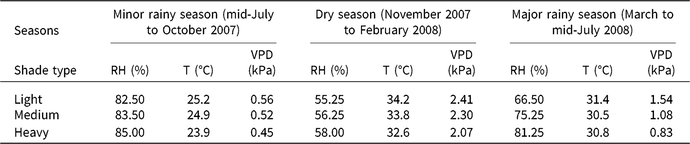
The mean daytime relative humidity, temperature and calculated vapour pressure deficit across the different seasons and under the shade treatments at the times of data collection are summarised in Table 2. The average vapour pressure deficit was 2.26 kPa in the dry season compared with 1.15 and 0.51 kPa in the major rainy and minor rainy seasons, respectively. Mean vapour pressure deficits under the light shade were 0.11, 0.34 and 0.71 kPa higher compared with the heavy shade treatment in the minor rainy, dry and major rainy seasons, respectively. Air temperatures were on average 2.6 and 8.9 °C higher in the dry season compared with the major and minor wet seasons, respectively (Table 2). Also, modulations were noted in mean daytime temperatures under the shade treatments: mean temperatures under light shade were 1.3, 1.6 and 0.6 °C higher compared with the heavy shade treatment in the minor rainy, dry and major rainy seasons, respectively. The major and minor rainy seasons of 2007 recorded 147.0 and 299.6 mm rainfall, respectively, while the rainfall during the dry season of the 2007–8 crop year was 33.8 mm. Rainfall was higher in the minor rainy season than the major rainy season, and this was unexpected for the cacao-growing belt of Ghana (Owusu and Waylen, Reference Owusu and Waylen2013). The major rainy season of 2008 experienced more rain (216.2 mm) compared with the major rainy season of 2007, but it was still lower than that of the 2007 minor rainy season.
Mean daytime (6 am to 6 pm) relative humidity, air temperature and vapour pressure deficit under different shade regimes and in different seasons

Each value represents the mean data recorded from three data loggers for each season.
Light transmitted by the overhead shade
The percentage of incident light transmitted by the overhead shade was 46–50%, 43–46% and 37–43% for the light, medium and heavy shade treatments, respectively.
Soil water content under the mulch treatments
Soil moisture content during the dry season of 2007/8 was significantly higher (p = 0.04) under the mulch treatments compared with the control (Figure 1). Generally, the soil water content was similar under the plastic mulch and the irrigation treatments, except at 0.1 m depth where it was higher under irrigation. Soil moisture was lower under the coffee mulch treatment than the plastic mulch and irrigation treatments, although still somewhat higher than the control. The effect of shade on soil water content was not measured.
Soil moisture under mulch treatments at different depths during the dry season of 2007/8. Each bar represents the mean value for two plots per treatment, each measured twice.

Stomatal conductance and photosynthesis
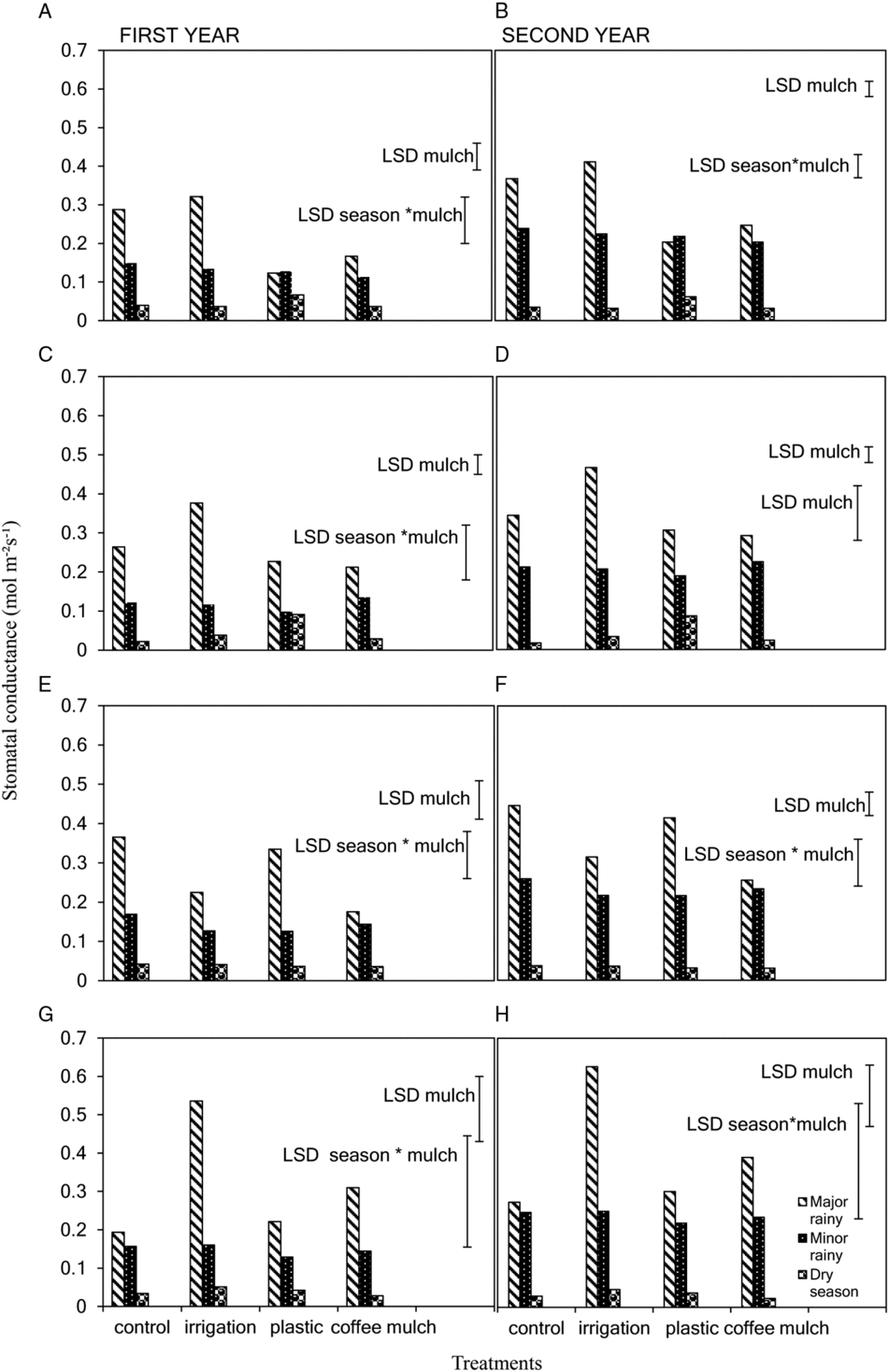
Stomatal conductance of the cacao trees was the highest during the major rainy season, lower during the minor rainy season and considerably supressed in the dry season (p = 0.006 for seasons) (Figure 2). Differences between mulch and irrigation treatments were proportionally greater during the major rainy season and for the clones SCA 6 and T 79/501 during the dry season compared with the minor rainy season (the season × mulch term was on the borderline of significance; p = 0.08). Overall, there were no significant differences between genotypes.
Stomatal conductance of four cacao clones (A and B: SCA 6; C and D: T 79/501; E and F: P 30 [POS]; G and H: PA 150) across the three seasons under different mulch treatments in the first year (A, C, E and G) and second year after establishment (B, D, F and H). Each bar represents the mean value of 12 plants.

There was significant (p < 0.001) seasonal variation in the rates of net photosynthesis; the mean photosynthetic rate in the major rainy season was 2.2 and 3 times greater than the rates in the minor and dry seasons, respectively (Figure 3). Considered over the whole period, only slight differences were found between the mulch treatments. However, there was a significant (p = 0.019) season × mulch interaction on photosynthesis. In the two rainy seasons there were no consistent trends between mulch treatments. However, during the dry season the photosynthetic rate under the zero mulch treatment (averaged across the four clones) was 9, 33 and 68% lower than the rates in plants provided with the coffee husk mulch, irrigation and plastic mulch treatments, respectively. On average, the rates of photosynthesis were similar between genotypes, although there was a significant mulch × genotype interaction (p = 0.025). No particular trend was observed between clones in the wet seasons (Figure 3).
Net photosynthesis of four cacao clones (A and B: SCA 6; C and D: T 79/501; E and F: P 30 [POS]; G and H: PA 150) across different seasons and under different mulch treatments in the first year (A, C, E and G) and second year after establishment (B, D, F and H). Each bar represents the mean value of 12 plants.

Tree survival
Overall, by the end of the second year, 74, 85 and 82% of the trees survived under the light, medium and heavy shade treatments, respectively (p = 0.016; Figure 4). Significant differences (p = 0.003) were observed on the survival rates of the cacao genotypes by the end of the second year; 76% of SCA 6, 78% of P 30 [POS], 85% of PA 150 and 86% of T 79/501 survived across the imposed treatments of shade and mulch/irrigation. With respect to the soil moisture management treatments, 70, 82, 91 and 94% of the trees survived under the zero mulch, coffee husk mulch, plastic mulch and irrigation treatments, respectively (p = 0.022). Relative losses under no mulch were greater for some clones than others, the clone × mulch interaction term being on the borderline of significance (p = 0.072). For example, at the end of the second year the percentage of trees surviving under no mulch conditions compared with irrigation were 80 and 98%, respectively for T 79/501, whereas the equivalent figures for P 30 [POS] were 45 and 90%, respectively (average across shade treatments). There was a general tendency of greater differences between shade treatments under no mulch treatment compared with other soil moisture management treatments (shade × mulch interaction p = 0.074). All other interactions were not significant.
Field survival of four cacao clones (A and B: SCA 6; C and D: T 79/501; E and F: P 30 [POS]; G and H: PA 150) under different mulch and shade treatments after one (A, C, E and G) and two (B, D, F and H) years of planting. Each bar represents the percentage of plants surviving out of 48 (=100%).

Stem volume
After the first year, plants that were subjected to the mulch interventions had larger (p = 0.006) stem volumes than those under no mulch. Plants that received the irrigation treatment had, on average, the largest stems followed by the plastic mulch, coffee mulch and zero mulch treatments, respectively. The mulch × genotype interaction was not statistically significant. The same pattern was observed after the second year (Figure 5); the stem volumes of cacao receiving the irrigation, plastic mulch, coffee husk and zero mulch were 716.4, 700.8, 671.5 and 655.9 cm3, respectively. Differences (p = 0.001) were also observed between clones in their stem volumes at the end of the second year (Figure 5). The largest genotype, PA 150 (average stem volume = 766.9 cm3), was 1, 20, and 31% larger than T 79/501, P 30 [POS] and SCA 6, respectively.
Stem volume of four cacao clones (A and B: SCA 6; C and D: T 79/501; E and F: P 30 [POS]; G and H: PA 150) under different mulch and shade treatments after one (A, C, E and G) and two (B, D, F and H) years of planting. Each bar represents the mean value for 24 plants.

Yield
Significant differences (p = 0.011) were recorded between the genotypes in dry cocoa bean yield in the first year of cropping (Figure 6). PA 150, T 79/501, SCA 6 and P 30 [POS] produced 201.4, 185.4, 170.3 and 161.5 kg of dry beans, respectively. Significant differences in yields were observed between the mulch/irrigation treatments (p = 0.001) such that the highest yields were observed under the irrigation and coffee husk treatments, with those under the plastic mulch and zero mulch treatments being considerably lower. No significant effects of shade were observed, nor were there significant interactions between the factors under study.
Dry cocoa bean yield of clonal cacao genotypes SCA 6 (A), T 79/501 (B), P 30 [POS] (C), and PA 150 (D) under different shade and mulching treatments.

Discussion
The observation that soil moisture was higher under the mulch treatments (Figure 1) is consistent with earlier reports on organic mulches, which have long been noted to improve soil water retention. The use of plastic film mulches for this purpose is more recent. However, such mulches have also been shown to be effective in retaining soil water for agricultural purposes (Jagoret and Jadin, Reference Jagoret and Jadin1992; Liu et al., Reference Liu, Jin, Zhou, Jia, Li, Xiong and Li2009). The observed higher stomatal conductance and, consequently, photosynthetic rates of trees subjected to the irrigation and plastic mulch treatments in the dry season (Figures 2 and 3) demonstrates that soil moisture, if adequate, may be associated with a partial amelioration of the suppressive effect of drought in cacao by improving the plant water status (Joly and Hahn, Reference Joly and Hahn1989a). The observation that stomatal conductance and photosynthesis of the cacao trees were much higher in the major rainy season compared with the dry season, irrespective of mulching (Figures 2 and 3), suggests that the photosynthetic rate was influenced by changes in vapour pressure deficit. With the high water vapour pressure deficit of the dry season (Table 1), tree water uptake probably did not match the rate of transpiration, resulting in a restriction of stomatal opening to reduce internal water deficit. A number of previous studies on cacao have demonstrated stomatal sensitivity to increased vapour pressure deficit (Balasimha et al., Reference Balasimha, Daniel and Bhat1991; Raja Harun and Hardwick, Reference Raja Harun and Hardwick1988).
Although stomatal limitation was essentially alleviated in the minor rainy season, the cloudy situation was likely to have contributed to the reduction in the rate of CO2 fixation compared with the major wet season (Table 1, Figure 3). This confirmed an earlier report that, in the minor rainy season, light becomes a limiting factor to CO2 fixation (Acheampong et al., Reference Acheampong, Hadley and Daymond2013). Furthermore, cooler temperatures were observed during the minor rainy season; such sub-optimal temperatures are known to suppress photosynthesis in cacao (Daymond and Hadley, Reference Daymond and Hadley2004). Thus, the conditions of the major rainy season of West Africa best support the realisation of high net photosynthesis. These include higher light intensity, low water vapour pressure deficit and increased soil water.
Tree growth rates, measured as stem volume, were higher under the mulch treatments (Figure 5), evidently as a result of the maintenance of higher rates of photosynthesis during the dry season (Figure 3). Water stress of sufficient intensity is capable of causing lasting disruption to the photosynthetic apparatus of young cacao (Joly and Hahn, Reference Joly and Hahn1989a). Here, we also observed higher survival rates when mulch treatments were imposed (Figure 4), the survival rate using the plastic mulch treatment being comparable with that of irrigation (positive control). In addition to conserving soil moisture, the mulch treatments could also have reduced stress by reducing root zone temperature, which, independently of air temperature, is known to influence the survival, growth and dry matter partitioning of field plants (Smith, Reference Smith1989). Leaf abscission in the dry season was noticeably lower in plants that grew under the mulch treatments (data not shown). Previous studies in cacao have shown that conserved soil moisture has a positive influence on leaf area duration (Joly and Hahn, Reference Joly and Hahn1989b).
There was a clear benefit to early yield of the coffee husk mulch treatment, which was comparable with trees grown under irrigation and higher than those grown with the plastic mulch (Figure 6). A likely explanation for this is that the coffee husk mulch would have added nutrients to the soil as well as conserved water. Where coffee husks are not available locally, many other potential mulching materials are readily available to the Ghanaian farmer. These include wood shavings, weeding trash, rotten plantain pseudostems, fallen litter such as dry cacao leaves, and, where phytosanitary issues will not arise, cocoa bean shells (e.g. Amoah et al., Reference Amoah, Opoku-Ameyaw, Osei-Bonsu and Oppong2005). Further research to determine the suitability of possible mulching materials for use during cacao establishment would be appropriate. Where organic materials are not available locally, the use of plastic mulching may provide a more cost-effective alternative since, firstly, they are considerably less bulky to transport and, secondly, they can be reused in subsequent years.
Currently smallholder cacao farmers use seed-derived planting materials in West Africa. The speed at which some farmers might move towards using clonal materials in the future is a subject of some debate. The results demonstrate that when grafted materials were used, high losses were incurred when no mulching treatment and only light shade was present (Figure 4). Furthermore, the fact that there were greater plant losses of some cacao genotypes under the zero mulch treatment suggests that, with respect to survival, some genotypes are better able to survive under conditions of low soil water. Under zero mulch treatment, P 30 [POS] and SCA 6 experienced greater losses compared with those under mulch treatments than T 79/501 and PA 150 (Figure 4), which were better able to survive under water-limited conditions, through a greater ability to either conserve water and/or extract water as a result of a more vigorous root system (note that it was not possible to look at the rooting system in the current study). Clonal differences in establishment were observed by Toxopeus (Reference Toxopeus1970b) in Nigeria, although that study used rooted cuttings rather than grafted materials.
The observation that plants subjected to heavier shade treatments survived better (Figure 4) may be explained in terms of the benefits that shade provides for young cacao (with little self-shading) especially in the dry season. The micro-meteorological data collected here are consistent with the views of Anim-Kwapong (Reference Anim-Kwapong2003) and Acheampong et al. (Reference Acheampong, Hadley and Daymond2013) that shade can ameliorate stressful conditions in the microenvironment through the reduction of daytime water vapour pressure deficit (Table 2). Other cited benefits of shade include protection against high photoinhibition, excessive transpiration and leaf abscission (Joly and Hahn, Reference Joly and Hahn1989b). The results presented here demonstrate an additive effect of mulching and shading on photosynthetic assimilation and a consequent impact on survival (Figures 3 and 4). Comparable synergistic effects on cacao have been reported to exist between irrigation and fertiliser application (Jadin and Jaquemart, Reference Jadin and Jacquemart1978).
Only slight differences were noted in plant growth under different shade intensities (Figure 5). Therefore, the increased survival of plants under heavier shade treatments more than compensated for any negative effects of competition from the shade plants. Nevertheless, good shade management is important to maximise growth and productivity. In particular, reduced shade may be important in the rainy seasons, when cloud cover is higher, to promote faster plant growth. Throughout the work, no clear differences were observed in the photosynthetic rates of the four genotypes (Figure 3). Most likely the differences in stem growth and yield are a reflection of differences in canopy architecture and/or the proportion of assimilate that is partitioned into stem growth, pod and bean production (Daymond et al., Reference Daymond, Hadley, Machado and Ng2002).
To conclude, this experiment showed that more vigorous clones establish better. It also showed that the application of irrigation or mulching can be used to maintain higher soil water levels during dry periods, thus improving early growth and survival of cacao. Furthermore, the experiment demonstrated that the use of appropriate shading can increase early survival rates and that there is a level of additivity between mulching and shading on plant survival and growth. In practice, while irrigation (2.7 L of water applied twice a week to each young cacao tree) was an effective intervention, this may not always be a practical option for many West African smallholder farmers, who may face limited access to water supplies and materials. There is an interest in the establishment of a small number of larger plantations in parts of West Africa, where the use of irrigation may be a viable option. In such circumstances, we would recommend its use at the establishment phase when atypical rainfall failure occurs in the traditional rainy seasons and in the dry season. The quantity needed should be adjusted according to prevailing climate conditions and soil types. In the absence of irrigation provision, which is the case on most smallholdings, mulching combined with appropriate shading provides an effective alternative to significantly improve establishment rates.
Acknowledgements
The authors are grateful to Hakeem Rashied and Godwin Addo of the Cocoa Research Institute of Ghana (CRIG) for providing technical support, and to the Cocoa Research Association (a UK-based non-profit scientific research organisation that is currently supported by Mars Wrigley Confectionery, Mondelez International and ICE Cocoa Futures Europe), the CFC and the Ghana COCOBOD for part-funding this work. This paper is published with the kind permission of the Executive Director of CRIG.
Financial support
None.