I.
This essay tells a story of endurance: the endurance of a person and the endurance of an object in an archive, both of which have survived despite their apparent fungibility and ephemerality. It focuses on a Jamaican veteran of the navy and merchant marine – one Edward Albert – who lost his legs while at sea and therefore took to working at various intervals as a crossing sweeper, beggar, shop-owner, and author in London and Glasgow. Albert should have been lost. His shipmates burnt his legs to the point of bursting, and his doctors presumed him to be dead following their amputation. I located Edward Albert initially in the pages of Henry Mayhew's massive, unwieldy, almost unnavigable archive, the four volumes of London Labour and the London Poor.Footnote 1 Mayhew interviews Albert in his home and then refers to a small chapbook Albert sells to accompany his begging. A simple WorldCat search led me to a copy of the book, housed at the University of Washington in Seattle. It had endured.Footnote 2
Endurance has a special significance to questions of race, to ideas of marginality, and to the archival traces of black Atlantic history. In a 1945 appendix to The Sound and the Fury, William Faulkner writes of the figures populating the fictional Yoknapatawpha County: “These others were not Compsons. They were black,” and later, “They endured” (1141). Endurance exists both in historical time and on a representational plane that extends beyond the subject's lifespan. John Ruskin describes color in terms of an enduring potency independent of an observer:
“Blue” does not mean the sensation caused by a gentian on the human eye; but it means the power of producing that sensation; and this power is always there, in the thing, whether we are there to experience it or not, and would remain there though there were not left a man on the face of the earth. Precisely in the same way gunpowder has a power of exploding. (Modern Painters III 5: 202)
Thus in Faulkner's work: black characters and their inherent power – a power deeply threatening in the southern American imagination – maintain a shadowy existence on the margins of the text. If blueness, as a power and a potentially explosive one, is always there, then race, particularly during and following the transatlantic slave trade, is as well. Albert's text is part of a potentially explosive, if latent, archive that might shatter the distance between the metropole and the colonial outpost in Jamaica in favor of an idea of circum-Atlantic proximity (Roach xi).Footnote 3
Albert and his place in the archive – made up of Mayhew's interview and Albert's own small book – share a history of endurance that is wrought out of particular strategic practices: those of flexibility and mobility that adhere in various but connected ways to Albert's human body and his book as a material entity. Disability theorist Robert McRuer identifies flexibility as a postmodern economic imperative of late capitalism, in which “the flexible subject is successful precisely because he or she can perform wholeness through each recurring crisis.” McRuer's formulation presupposes a state of perennial economic disaster as the prevailing condition of the neoliberal state (16-17). For the street-workers of Victorian London, there was no economic stability against which one might differentiate economic crisis; the normalization of crisis always requires a kind of flexibility. A black and disabled subject is doubly required to assume the kind of flexibility that enables survival. Placing an argument about a black British subject in nineteenth-century maritime history in the context of performance and disability studies admits an intersectional understanding not only of Albert's subjectivity but also of strategies of self-representation. In his autobiographical account, Albert embeds his singular self-representation within various generic conventions that reflect his shrewd understanding of how his work might circulate in a way that might be most advantageous for him. His promiscuous amalgamation of genres and tropes suggests the importance of fungibility and flexibility for the endurance of a poor, black, disabled street-worker in nineteenth-century London.
Flexibility is not a state from which the racialized or disabled or oppressed are excluded; in fact, their bodies are notably adaptable and therefore, under the terms articulated by Georges Canguilhem, “normal.”Footnote 4 Canguilhem explains that normalcy, in regards to health, is not a state but a relationship between the subject and its environment:
Taken separately, the living being and his environment are not normal: it is their relationship that makes them such. For any given form of life the environment is normal to the extent that it allows it fertility and a corresponding variety of forms such that, should changes in the environment occur, life will be able to find the solution to the problem of adaptation. . . .A living being is normal in any given environment insofar as it is the morphological and functional solution found by life as a response to the demands of the environment. (81-82)
I do not mean to suggest that this particular mode of normalcy – characterized by adaptability – serves as a moral imperative akin to McRuer's conception of “compulsory able-bodiedness,” a category that he derives from Adrienne Rich's “compulsory heterosexuality” (McRuer 6). Rather, this mode of normalcy is an economic imperative for street-workers, whose employment and employability are always in crisis. Albert's story should not be read as a sort of bootstraps narrative or instructional manual for something like gumption, determination, or moral rectitude. Rather, Albert's story allows one to think about adaptability and flexibility as performed states that Albert is particularly skilled in deploying in a bid to endure.
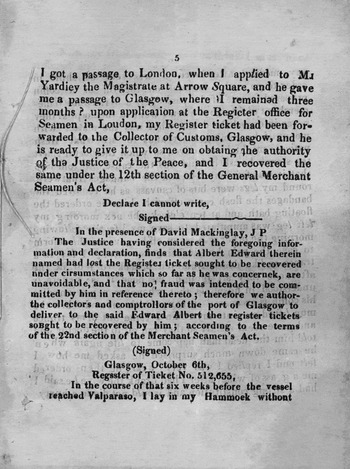
In his narrative, passed down through London Labour and the London Poor as well as in his own autobiographical chapbook, Edward Albert enacts endurance through persistent, if painful, mobility. When Mayhew encounters Albert, he is living in London with his wife, “a pleasant-looking ‘half-caste,’” and, as Mayhew describes their child, “the cheeriest little crowing, smiling ‘piccaninny’ I have ever seen” (2: 490).Footnote 5 Albert spends most of his time in Glasgow, “where the owners of the ship in which my legs were burnt off live” (2: 490). A nine-year veteran of the merchant marine and navy, a small business owner, an author, and a sometime pastry chef, Albert has been reduced to sweeping the streets, an occupation he is able to do only in the winter when the stumps of his amputated legs are less painful than they are in warmer weather. The story of Albert's disabling, told both in his own chapbook (riddled with printing errors that I have transcribed here) and to Mayhew, could not be more horrifying:
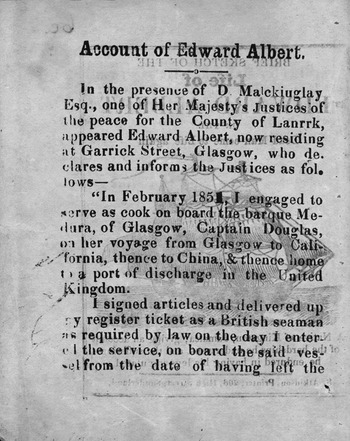
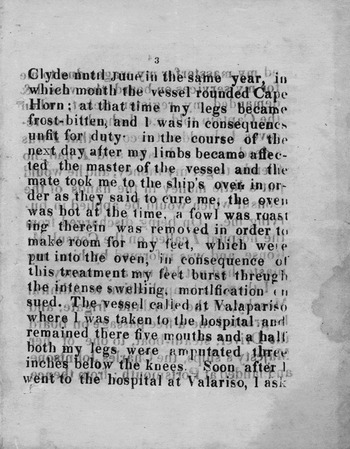
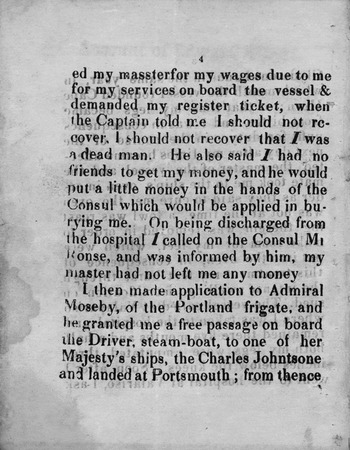
I signed articles and delivered up my register ticket as a British seaman as required by law on the day I entered the service, on board the said vessel [the Madeira] from the date of having left the Clyde nntil Juue in the same year, in which month the vessel rounded Cape Horn: at that time my legs became frost-bitten, and I was in consequencs unfit for duty. in the course of the next day after my limbs became affected the master of the vessel and the mate took me to the ship's oven in order as they said to cure me, the oven was hot at the time, a fowl was roasting therein was removed in order to make room for my feet, which were put into the oven, in consequence of this treatment my feet burst through the intense swelling, mortlfication en sued. The vessel called at Valapariso where I was taken to the hospital and remained there five months and a half both my legs were amputated three inches below the knees. Soon after I went to the hospital at Valariso, I ask ed my massterfor my wages due to me for my services on board the vessel & demanded my register ticket, when the Captain told me I should not recover, I should not recover, I should not recover that I was a dead man. (Albert 2–4)
By the time of the Napoleonic Wars, it was known that overheating frostbitten legs was deleterious, resulting in amputations if not death (Paton 100). The preferred treatment was slow warming, often using wet snow rubbed on the limbs. Debate about the practice of using ovens or other direct heat sources, however, wore on; as late as 1906, some scientists were recommending the use of ovens, though primarily for cases of chronic frostbite (Freeman 330). Whether Albert's shipmates would have known the commonly accepted method of warming is impossible to say, yet more telling than whether Albert's loss of his legs was the result of someone's blunder or a malicious joke is the way in which he was treated as disposable and, later, deemed undeserving of recompense. Suffering and particularly black suffering in the context and aftermath of the transatlantic slave trade cannot be divorced from collective historical malice.
Albert expands on this narrative, telling Mayhew,
I declare to you I can't describe the agony I felt when my legs were burst; I fainted away over and over again. There was four men came; I was lying in my hammock, and they moved the fowl that was roasting, and put my legs in the oven. There they held me for ten minutes. They said it would take the cold out; but after I came out the cold caught ’em again, and the next day they swole up as big round as a pillar, and burst, and then like water come out. No man but God knows what I have suffered, and went through.
By the order of the doctor at Valparaiso the sick patients had to come out of the room I went into; the smell was so bad I couldn't bear it myself – it was all mortification – they had to use chloride o’ zinc to keep the smell down. They tried to save one leg, but the mortification was getting up into my body. I got better after my legs were off.
I was three months good before I could turn, or able to lift up my hand to my head. . . .I was five months and a half in that place. (Mayhew 2: 491)
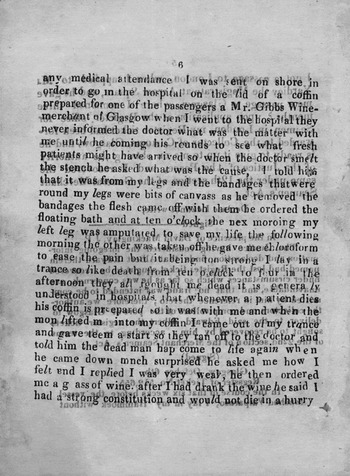
Adding to the grimness of the crossing-sweeper's account are the appearance and reappearance in it of a coffin, the lid of which first is used to transport the maimed sailor to shore and into which he is later placed, his doctors assuming that he has died during the amputation. He writes, “when the mon lifted m into my coffin I came out of my trance and gave teem a start so that ran off to the doctore and told him the dead man hap to come to life again” (6). The rush of “life water” that Albert lost in the bursting of his legs was somehow stopped.
Enduring black bodies are an uncomfortable counterpoint to dead black bodies. Endurance and survival are not synonymous: one can endure archivally, as Albert does, beyond one's physical survival. But the opportunity to endure depends on the ability to survive long enough to create such an archival item. Enduring black bodies literalize and embody survivor's guilt when death might have been just as likely theirs, as Albert's story demonstrates. While the dead mass together, washed away in a collective memory that has no room for individuation, the living retain their singularity. Living extends one's ability to represent oneself and circulate a fashioned self. What does endurance mean in the case of the self-representation of a black figure fighting against his own physical dissolution? This essay asks what strategies of representation – in terms of both genre and medium – are most conducive to its success. For example, James Baldwin, in a critique directed at Richard Wright's Native Son (1940) as well as Uncle Tom's Cabin (1852), explains how protest fiction fails to yield an enduring black subjectivity: “The failure of the protest novel lies in its rejection of life, the human being, the denial of his beauty, dread, power, in its insistence that it is his categorization alone which is real and which cannot be transcended” (18). Mayhew's work might be seen as similar to the protest novel insofar as it is fundamentally interested in categorization. I have, however, argued elsewhere that Mayhew is so deeply committed, perhaps against his own purposes, to individuation that the categories he asserts unravel before they are fully woven.Footnote 6 That Edward Albert is fundamentally individuated by Mayhew and by his own physical presence in an archive separates him from the effects of forgetting that come with generalization into an undifferentiated mass of black suffering.
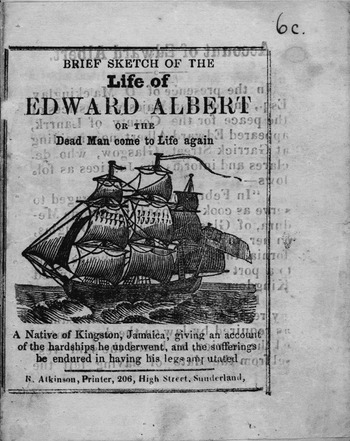
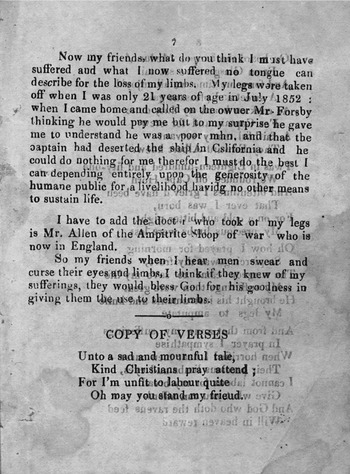
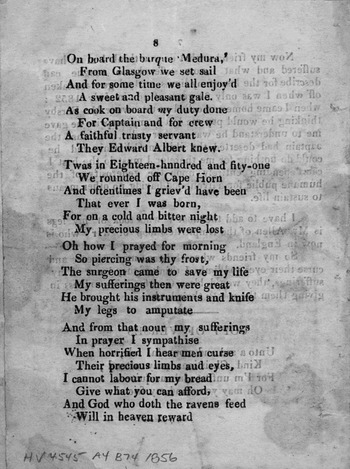
The tension between generalization and preservation troubles the archive, particularly in regards to this book, catalogued only as an individual item due to the assiduous work of the librarians at University of Washington (Figures 2–9). Sandra Kroupa, Book Arts and Rare Books Curator, told me that I was the only person who had ever requested to see Albert's chapbook. Like the color blue, the archival trace remains – filled with limitless potential, even potential explosiveness – with or without a reader to recover it. Though the provenance of the book is uncertain, Kroupa explained that it might have come bound in a group of chapbooks from a private donor from California who collected chapbooks written for children. Often, she said, the library receives leather bound books entitled “chapbooks” with little information about how and if the texts therein are related. Sometimes a volume might include chapbooks by the same publisher; sometimes a volume is bound by the similar size of its individual chapbooks. Kroupa and her colleagues have undertaken the monumental task of separating and cataloguing the works within these volumes, and their efforts have granted the power to endure and be rediscovered to texts like that of Edward Albert.
Edward Albert, Brief Sketch of the Life of Edward Albert (n.d.). Courtesy of the University of Washington Libraries, Call # HV4545.A4 / b B74 Special Collections.


Albert's book is about 4 x 5 inches, a slightly unusual size, and Kroupa suggested that it is likely 1/16 of a sheet, even though it has only eight pages. It differs from the copy Mayhew describes in significant ways that, if not providing answers, at least raise questions about its production and circulation. In the copy of the book to which Mayhew refers, the title page reads as follows:
BRIEF SKETCH OF THE LIFE OF
EDWARD ALBERT!
A native of Kingston, Jamaica
Showing the hardships he underwent and the sufferings
he endured in having both legs amputated.
HULL:
W. HOWE, PRINTER. (2: 490)
Printed in northern England, this copy of the chapbook bears a relatively unremarkable title, the exclamation point following Albert's name notwithstanding. The title page of the extant copy, however, adds the figure of the “Dead Man Come to Life”:
BRIEF SKETCH OF
The Life of
EDWARD ALBERT
or the
Dead Man Come to Life Again
A Native of Kingston, Jamaica, giving an account
of the hardships he underwent, and the sufferings
he endured in having his legs amputated.
The change in title, moreover, testifies to the document's endurance beyond a single printing. The copy at the University of Washington bears the imprint of another publisher, R. Atkinson in Sunderland. Given that Albert made his way between his residence in Glasgow and London, where Mayhew encountered him, it is possible that Albert had small runs printed as he traveled from town to town, so that the book went through multiple iterations. It is also possible that the book gained some kind of popularity and was subsequently pirated by various publishers. The question of whether Albert had multiple printings done himself or whether the book became marketable enough to be, in effect, stolen, is impossible to determine; one can, however, appreciate that the reproduction of the text has prevented it from becoming irrecoverably lost.
Albert and his book seem to have been made to be lost because they resist categorization and therefore risk miscategorization. Albert's book, much like his person, might have just as easily been lost in a sea of unclassified material, or material that is barely classifiable like so many of the subjects in London Labour and the London Poor. Mayhew, as he always does, attempts to fit Edward Albert into one of his infinitely divisible categories, but he does so in terms of Albert's labor as a crossing-sweep; the fact that he is a “negro crossing-sweep” might seem to suggest the emergence of another category, but that category never materializes because Albert is the only such person Mayhew interviews. Furthermore, Albert's work is part-time, contingent, part of a larger street performance in which he also begs, sells his book, and tells his story. He might just as easily be classified as a negro mendicant, or a chapman selling books, or a disabled veteran, or a sailor. Albert is at risk of becoming a sign, a representative of his category: black, colonial, poor, disabled. Because of Mayhew's choice of crossing-sweepers as the primary category under which Albert might be assimilated, he is not made to stand in for black subjects writ large. Therefore, Edward Albert, unlike Uncle Tom or Bigger Thomas, is able to transcend, if not race itself, than at least race as his sole social signifier.
This is not to say that Edward Albert is in some way “post-racial”; his story gains coherence through his racialized experience, his history as a Jamaican and colonial subject, and his frequent evocation of the tropes of American slavery around the time of the publication of Uncle Tom's Cabin (1852). Albert is not only able to adapt quickly to his environment, taking on local roles and tropes as needed, but he is also mobile, as his journey overseas and throughout Britain demonstrates. Paradoxically, disability in Albert's case checks his mobility on a local level: Mayhew reports that Albert is unable to work in the summer “as his legs feel ‘just like corns’ and he cannot walk more than a mile a-day” (2: 490). Beggars and street-workers, however, require mobility, as is evidenced by the repeated imperative in Bleak House for the hapless Jo – also a crossing-sweeper – to “move on” (Dickens, 308; pt. 6, ch. 19). Moreover, mobility is the fundamental condition of the black diaspora, a condition that Daniel and Jonathan Boyarin also link to an idea of the normal, arguing that it is “provisionally. . .a ‘normal’ situation, rather than a negative symptom of disorder” (5). Paul Gilroy explains the possibility that a conception of rootedness that displaces diaspora emerges only relatively late in the history of the black Atlantic, as “the acquisition of roots became an urgent issue only when diaspora blacks sought to construct a political agenda in which the ideal of rootedness was identified as a prerequisite for the forms of cultural integrity that could guarantee the nationhood and statehood to which they aspired” (112). For Albert, as a black and colonial subject in the nineteenth century, mobility is central to his diasporic identity.
Despite his attempt to plant English roots, Albert exists in a multiply diasporic space, characterized by removals, removals from removals, and return. In his flexibility and his mobility, Albert is able to endure and, moreover, to leave an archive that in turn has endured. Such flexibility is enacted in Albert's performance as an author, sweeper, and street-seller. Furthermore, he draws on these performances in a moment when the “performative,” made up of “fabrications manufactured and sustained through corporeal signs and other discursive means,” (Butler 136) and performance itself – theatrical performance most notably – become inextricable, as much as Victorians, invested in differentiating between deserving and undeserving, might wish them to be disentangled. Performing blackness and the flexibility that underlies performance, Albert discovers, is a means by which a black subject might survive. As political theorist Asma Abbas puts it, “Every performance of justice requires a performance of suffering” (10). To understand Albert's performed flexibility and mobility, it is necessary to consider the multiple contexts in which his work is inflected and through which it might be understood: tropes of American slavery and attendant ideas of property, Caribbean taxonomies and colonial types, the history and rhetoric of disability, Scottish oral traditions, maritime history, and circum-Atlantic circulation.Footnote 7 In addition, Albert's work is generically flexible, shifting between the literary and the reportage of autobiography, performance and poetry, truth claims and caricature. This generic flexibility comes from a complex amalgamation of diasporic cultural practices, defined by Kobena Mercer as “a powerfully syncretic dynamic which critically appropriates elements from the master-codes of the dominant culture and creolizes them, disarticulating given signs and rearticulating their symbolic meaning otherwise” (63). The disparate contexts and genres which Albert reworks to present himself as a diasporic subject make clear the extent to which he depends on the twin characteristics of flexibility and mobility to do the work endurance requires.
II.
Edward Albert's flexibility is most apparent both in his resistance to classification as well as his ability to move in and out of generic conventions and categories without making a decided commitment to any particular one. London Labour and the London Poor is, paradoxically, the most appropriate text in which Albert might appear because of its taxonomical failings. Classified broadly under the category of “Afflicted Crossing-Sweepers” and sandwiched in Mayhew's second volume between “The Most Severely Afflicted of All the Crossing-Sweepers” and “The Maimed Irish Crossing-Sweeper,” Albert seems to exist on a continuum of disabled experience as well as a racial continuum in which Irishness is also marked as other. It is worth noting that Albert's own relationship to the Irish suggests how disenfranchised subjects compete against each other in an interminable race to anywhere but the bottom. Albert tells Mayhew, “There are a great many Irish in this place. I would like to get away from it, for it is a very disgraceful place – it is an awful, awful place altogether. . . .it is not fit” (4: 293). Albert's anti-Irish sentiment is matched, if not provoked, by racist taunts from his Irish neighbors: “If you don't go out and drink and carouse with them, they don't like it; they make use of bad language – they chaff me about my misfortune – they call me ‘Cripple;’ some says ‘Uncle Tom’ and some says ‘Nigger’” (2: 293). With these names, they attempt to assign a category that will stick as vigilantly to him as “Irish” does to them.
Both Albert's autobiographical presentation and his depiction by Mayhew must not be read as documents representative of a larger class, even though Mayhew tells his readers that “I seek for no extreme cases. If anything is to come of this hereafter, I am well aware that the end can be gained only be laying bare the sufferings of the class and not of any particular individuals belonging thereto” (qtd. in Thompson and Yeo 127). Whatever Mayhew might profess, his treatment of Edward Albert attests to his primary interest in the representation of a person as a singularity, shaped by social conditions but self-shaping in response to them. A subject Mayhew interviewed, then, might be understood as similar to objects in nature that Ruskin demands to be individuated in the practice of drawing:
we have to show the individual character and liberty of the separate leaves, clouds, or rocks. And herein the great masters separate themselves finally from inferior ones; for if the men of inferior genius ever express law at all, it is by the sacrifice of individuality. (Elements 15: 116)
Edward Albert, I argue, endures only insofar as he is seen as a single rock. If an avalanche occurred, an individual rock might be removed, but it would remain intact. Similarly, in the tumble of Mayhew's print, individual stories and interviews emerge, not in spite of but because they are fungible, replaceable, extractable, and removable. More recently, Ta-Nehisi Coates tells his son of the importance of maintaining a commitment to singularity in understanding black diasporic history:
I have raised you to respect every human being as singular and you must extend that same respect into the past. Slavery is not an indefinable mass of flesh. It is a particular enslaved woman, whose mind is as active as your own, whose range of feeling is as vast as your own; who prefers the way the light falls in one particular spot in the woods, who enjoys fishing where the water eddies in a nearby stream, who loves her mother in her own complicated way, thinks her sister talks too loud, has a favorite cousin, a favorite season, who excels at dressmaking and knows, inside herself, that she is as intelligent and capable as anyone. (69-70)
Representation of Albert, then, is curiously paradoxical. Though Mayhew illustrates him as a singular figure within the broad category of crossing-sweeps – notably not black Britons, nor “those who cannot work,” nor disabled beggars – Albert simultaneously relies upon recognizable tropes, mostly drawn from cultural representations of the West Indies and American slavery, to display a body that is uniquely his own and whose suffering is far from typical. As Mayhew categorizes him, so Albert categorizes himself, only to slip out from under the label before its glue has dried. Moreover, to the extent that Mayhew does engage in the labor of individuation, Albert moves deftly between various types in order to offer a legible, recognizable self.
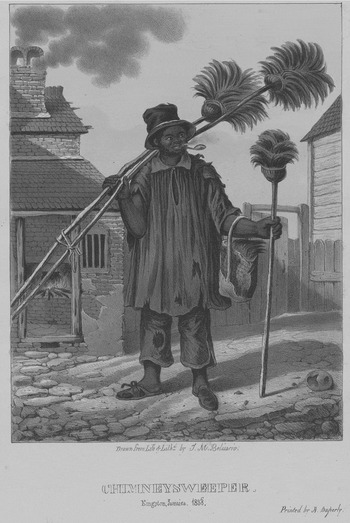
Mayhew's rendering of Albert and Albert's own self-representation might be fruitfully placed in conversation with an earlier visual-verbal text treating Jamaican street-workers, Isaac Belisario's Sketches of Character, In Illustration of the Habits, Occupation, and Costume of the Negro Population in the Island of Jamaica (1837-38), a visual compendium that anticipates Mayhew's intended project in its proto-anthropological purpose. Belisario – a Sephardic Jew returning to Kingston by way of England and thereby also a multiply removed diasporic subject – draws on the tradition of the Cries of London (to which Mayhew's work has also been compared) to include a series of lithographs of black Jamaicans, engaged mostly in Christmas festivities but also in labor (Figure 10).
Isaac Belisario, “Chimneysweeper.” Lithograph, from Sketches of Character (1838). Courtesy of the Yale Center for British Art.

The similarities between Isaac Belisario's lithographs and Mayhew's daguerreotypes – the latter ascribed to the studio of Richard Beard – reflect conventional portrayals of racial and occupational types, grounded in the truth claims of being “drawn from the life” or “from a daguerreotype,” respectively. Much like Mayhew claiming to “seek for no extreme cases,” Belisario attests to the representativeness of his work, despite its nostalgic tone. Even in reference to his lithographs depicting performance, Belisario claims to be capturing things as they are, and he does so (referring to himself in the third person) by disavowing the extraordinary or aberrant:
he purposes to furnish but ‘Sketches of Character,’ steering clear of Caricature: nature in her ordinary form alone, having been the source from whence all the original drawings were derived, and however amusing her accidental deviations from that course of moulding the human shape, may prove to the admirers of the ludicrous, it behoves not an Artist in this instance, to lend himself to the portraying of deformity. (np)
It is worth noting Belisario's rejection of deformity as a particular aesthetic strategy, as well as a reportedly social-scientific one. In Modern Painters III, Ruskin warns against practices in which an artist might “arrogate the right of rejection. . .until what he supposed to be nobleness of selection ends in narrowness of perception” (5: 58). For Ruskin, accuracy means the inclusion of anomalies and singularities, whereas Belisario seeks an alternative sort of accuracy, one that comes from a flattening of individualizing characteristics and difference. But, for Belisario, accuracy also means avoiding the stock tropes of caricature. If one understands Edward Albert to be engaged in a particularly literary mode of self-fashioning, he may, in contrast to Belisario's aims, want to make himself a caricature as much as a character, displaying a self sutured from fragmented popular images of black subjects. This may be an effect of distribution: Belisario's work intended to capture a vanishing way of life for his fellow Jamaicans (there is no evidence that his work was distributed outside Jamaica [Forrester 71]),Footnote 8 whereas Albert's work – and Mayhew's to a lesser extent – were intended to incite an audience to action. Albert, therefore, relies on stock tropes in his performance of deservingness in terms that his audience might understand.
Albert, in such self-representations, relies both on the modes of caricature that Belisario employs and the performance of the “American negro” as a living trope in the historical period between the end of Jamaican slavery in 1838 and emancipation in the United States. Reading Belisario in the tradition of the Cries, Kay Dian Kriz argues, “effectively collapses the figure of the ‘negro’ with that of the street-crier and performer” (168). The conjunction of blackness with the performative was in flux in nineteenth-century Britain. On the one hand, Andrew Halliday, Mayhew's collaborator in the fourth volume of London Labour and the London Poor, informs his readers that “The negro mendicant, who is usually an American negro, never studies the picturesque in his attire. He relies on the abject misery and down-trodden appearance, and generally represents himself as a fugitive slave” (4: 425). Black suffering, thus understood, is seen as a factual given; in effect, blackness and abjection become one and the same. At the same time, Lionel Rose attests that sympathy for black beggars led to street-folk “pretend[ing] to be a runaway slave from America, suitably madeup,” as “the publication of Harriet Beecher Stowe's Uncle Tom's Cabin aroused sympathy for the American negro in Britain and beggars with flattish noses found it profitable for a time to black-up” (31).
Mayhew's version of Albert's book contains a frontispiece made out of a tobacco-paper embellishment of a Jim Crow minstrel figure, “as is evidenced by the traces of a tobacco-pipe, which has been unskillfully erased” (2: 490). The Jim Crow negro, rendered in its most stereotypical form, is repurposed to function as a portrait ornamenting an autobiographical text, much like the engraving from a photograph of Mayhew by Richard Beard that serves as a frontispiece to London Labour and declares his authorship. But why a minstrel figure? Albert's multi-faceted production – including his book, which itself includes various genres, from the affidavit to the ballad – is assembled in the form of performance, similar to that of other beggars in Mayhew's work. For example, Halliday introduces his readers to a disabled former bricklayer, who lost use of both of his arms after falling off a scaffold. Failing to attract a paying audience to his acts of beggary, he reinvents himself, complete with a new wardrobe, on the advice of another disabled beggar. He becomes what was called a “disaster beggar,” drawing on topical events of the day in creating a more moving story: “picturesque” and “exciting” (Mayhew 4: 428). In other words, the beggar learns to dress for success, if not for the job he wants, the job he has been left able to do.
The minstrel image, then, should be read as an instance of topical costuming, given the popularity of “‘nigger’ minstrelsy” in nineteenth-century Britain (Pickering 1). More significant, however, is how Albert, a man who claims to be unable to read or write,Footnote 9 imagines himself in relation to one of the most popular literary productions of his time. In an unsigned 1852 editorial in The Times that explicitly ties Uncle Tom's Cabin to traditions of beggars’ narratives, a critic writes:
Uncle Tom's Cabin is at every railway book-stall in England, and in every third traveller's hand. The book is a decided hit. It takes its place with “Pickwick,” with Louis Napoleon, with the mendicant who suddenly discovers himself heir to 20,000l. a-year, and, in fact, with every man whose good fortune it has been to fall asleep Nobody, and to awake in the morning an institution in the land. It is impossible not to feel respect for Uncle Tom's Cabin. (“Uncle Tom's Cabin” 5)
As one of the taunts that Albert endures from his Irish neighbors proves, the text circulated widely even among illiterate consumers. Albert, highly aware of Uncle Tom as a legible form of blackness, opens a coffee house in Glasgow called none other but Uncle Tom's Cabin. Edward Albert taps into a market of sentimental feeling – feeling that James Baldwin condemns as “the mark of dishonesty” (12), but that might be lucrative nonetheless. In this way the sentimental ceases to be a genre in and of itself but rather a generic strategy by which Albert might solicit pity and, more important, alms. At the same time, the tropes of American slavery were often thought to be the trappings of an impostor. In the last volume of London Labour, Mayhew and his co-authors write, “There are but few negro beggars to be seen now. It is only common fairness to say that negroes seldom, if ever, shirk work. Their only trouble is to obtain it.” The working negroes whom they observe serve as deliberate contrasts with the “impostors. . .who go about giving lectures on the horrors of slavery, singing variations on the ‘escapes’ in that famous book ‘Uncle Tom's Cabin’” (4: 425). Albert must deftly shift between allusions to fiction and a carefully crafted articulation of autobiographical experience in order to present his case effectively to the passersby he encounters on the street.
Generic flexibility enlarges Albert's potential audience insofar as it allows him to create an unwieldy assemblage with something for everyone. The affidavit printed in the book and reprinted by Mayhew serves both Albert and Mayhew in their efforts to buttress their narratives with legalistic truth claims – necessary for distinguishing between the deserving and undeserving poor. To make a claim on his readers, it seems, Albert must make a legal claim as well, still hoping to receive the wages due to him for his work as a sailor. Albert's legal appeal attests to his book's flexibility in temporal terms. He begins with what seems to be an official legal appeal:
“In the presence of D. Malckiugaly Esq., one of Her Majesty's Justices o of the peace for the County of Lanrrk [most likely Lanark near Glasgow], appeared Edward Albert, now residing at Garrick Street, Glasgow, who declares and informs the Justices as follows.” (2)
Later in the document, however, he refers to David – now Mackinglay – as having responded already to his inquiry (5). This seeming inconsistency, I argue, is not necessarily erroneous, but rather a reflection of the way in which Albert must present both a coherent narrative of injustices done in the past and a pressing appeal for help.
The legal apparatus notwithstanding, Albert's chapbook is also self-consciously literary. He ends the book with a few pages of verse that largely recapitulate the prose narrative he has delivered for the previous six pages. The “Copy of Verses” addressed to “my friends” begins, “Unto a sad and mournful tale, /Kind Christians pray attend; / For I'm unfit to labour quite / Oh may you stand my friend” (7). As a crossing-sweeper and as the producer of this book, Edward Albert is indeed dependent on the generosity of passersby to make a living. But such a necessity does not mean that he is not working, only that the market value of his work is unstable and contingent. The poem – formally and narratively constructed as a ballad to be sung – continues with a highly condensed and poetically dreadful description of his travails and ends with “I cannot labour for my bread, / Give what you can afford,/ And God who doth the ravens feed/ Will in heaven reward.” Invoking Job, Albert presents himself as a man who has constantly been wronged, but rather than turn to God, he turns to members of a passing, shifting audience in hopes of the financial remuneration that will allow him to support his family. In addition to relying on biblical tropes, Albert borrows uses the conventions of ballad form to write his own song that might appeal to those he imagined to be his most immediate audience. While one cannot ascertain whether he ever performed the ballad on the street in this iteration or another (Mayhew tells us that he “never moves a muscle for the purpose of soliciting charity” [2: 490]), one can imagine its appeal to the passersby of Glasgow.Footnote 10 In tracing the significance of the ballad-theory of civilization, in which the ballad is seen as the earliest and purest poetic form, Meredith Martin explains the significance of ballad form to colonial self-imagining: “part of the ballad-theory of civilization is that the peripheral is elevated as the primitive and brought into the whole fabric of the nation” (348). By using this form, Albert demonstrates a generic flexibility that suits the needs of the multiply diasporic subject.
III.
Having been placed in his coffin before death, Albert risks becoming completely objectified; he, however, uses a text to provide himself with an opportunity to assert his subjectivity against such objectification. Fifty years earlier, before emancipation in Jamaica, Albert's text would have been of little use in the face of the utter objectification and forced abjection of chattel slavery, and the question of malice would be indisputable. James Gillray's 1791 print “Barbarities in the West Indias” exemplifies a pre-emancipation corollary to Albert's experience (Figure 11), even if we allow for the possibility that Albert's tormenters believed they were doing right by him by putting his legs in an oven.Footnote 11 In the satirical print, a slave driver boils a slave alive, by giving him “a warm bath to cure your Ague.” In the foreground, the slave is represented by the synecdoche of his emerging arms and legs, and behind the primary scene, a black arm, along with various varmints, is nailed to the wall. Albert's “curative” burning and dismemberment suggest the ways in which he too might become a barely sutured assemblage of detached parts. This form of fungibility in which the body is no more than the sum of its remaining parts is the dark side of flexibility in which bending begets breaking.
James Gillray, “Barbarities in the West Indias.” Hand-colored etching, 1791. Courtesy of the Lewis Walpole Library, Yale University.

Looking at Gillray's print, one can imagine that the arm nailed to the wall, like the surrounding “trophies,” will endure longer than the arms and legs suspended in the tub, head under water. Posthumous endurance – whether real or imagined – is a frequent thematic concern in Victorian literature, most notably in Dickens's Our Mutual Friend, wherein a presumably dead man “comes to life.” Even the most realist texts maintain a commitment to the idea of posthumous life – the way “the past is never dead. It's not even past” (Faulkner, Requiem 535). The posthumous figure is always lingering at the threshold, seemingly able to return and, moreover, able to solicit claims upon the living. So does the not-quite-dead past: how does one make the atrocities of history right? If you are living and profiting from the loss of the dead man, God help you if he comes to life. The dead man returns for justice. Albert lives in a state of perennial protest against the ship-owners whose men caused his dismemberment and then denied him his wages. The captain of the ship told Albert, “I should not recover. . .and that I was a dead man; and that he could not discharge a dead man,” implying that with no discharge, Albert was due nothing (Mayhew 2: 491). This statement presages the similar sentiment voiced by Gaffer Hexam, the dredger of the Thames, when he justifies his work of trawling for dead bodies:
Has a dead man any use for money? Is it possible for a dead man to have money? What world does a dead man belong to? T'other world. What world does money belong to? This world. How can money be a corpse's? Can a corpse want it, spend it, claim it, miss it? (Dickens, 16; book 1, ch. 1)
As is demonstrated in both Our Mutual Friend and Albert's narrative, a corpse might not be a corpse, and therefore he might have a very real claim on his money.
It is not surprising, however, that Gaffer Hexam or Edward Albert's captain might make things up as they go along when dealing with the “dead man come to life.” In his discussion of the social death of slaves, Orlando Patterson points to the particular problem they pose to the living: “Religion explains how it is possible to relate to the dead who still live. It says little about how ordinary people should relate to the living who are dead” (45). In placing Albert in the latter category, I do not mean to suggest that the life of an amputee is worse than or equivalent to death; rather, Edward Albert should be understood in terms of the social death that Patterson describes. Death as the ultimate signifier of suffering also fails to attend to the simultaneity of states of life and death: “death always stifles the suffering that lives and walks amid the dead and that would be much more complex [than death itself] to deal with,” Abbas writes (8). The simultaneity of life and death has particular significance in the history of slavery because of the ways in which the institution upended time, including but not limited to the ancestral time out of which slaves were wrenched. Sharon Holland writes of a “persistent sense of simultaneity until all fact, all knowledge of slavery, about history begins to exist as in-between” (2). And indeed, simultaneity shapes Albert's experience in the immediate post-slavery era in British colonies. Born in Jamaica before emancipation, the grandson of a slave named James, Albert exists in a space that is equally marked by slavery and shaped by the shaky and incomplete freedom of the post-emancipation years. Albert's son, half English, is named James Edward Albert in honor of his enslaved grandfather. In this act of naming, Albert attempts to retrieve ancestral time and to create a generational continuity that chattel slavery so often disallowed. The name James both integrates Albert's son into a past defined by enslavement while simultaneously demonstrating his own, ostensibly safe, distance from that history in which his grandfather's name is available for reclamation.
Albert is ironically immobilized in the middle of a much longer oceanic heritage of particular significance to black subjects, whose forced mobility begat voluntarily movement. Roach's term “circum-Atlantic” most accurately describes the wide range of Albert's travel, even though his journey intended to reach the Pacific. In attending to Albert's cultural production, one hopes to evade the trap to which Roach alludes: “The idea of circum-Atlantic cultural exchange does not deny Eurocolonial initiatives their place in this history – indeed, it must newly reconsider and interrogate them – but it regards the results of those initiatives as the insufficiently acknowledged cocreations of an oceanic interculture” (5). The circum-Atlantic nature of Albert's circulation attests to the significance of mobility to his endurance and simultaneously to the ways in which forced mobility – that of both slaves and the mendicants of London – is rendered strategic by those whom it would seek to displace. Albert lives also in a moment of historical liminality between two major emancipations – that achieved in Jamaica and that impending in the United States. For Albert, such liminality is most directly evident in his exclusion from the Merchant Seaman's Fund, into which sailors were required to pay. The Fund was discontinued in 1851, and by 1852 it had ceased paying for injuries (Mayhew 2: 492). In a Household Words article praising the intent of the Fund while damning its execution, James Hannay calls it a “blundering and imbecile system” (277), approving of its being “wound up” (274). He nonetheless expresses grave concern over the possible effects of the abolition of the Fund: “By-and-by, let us hope there will be no need for an old sailor to – ‘Shoulder his crutch and show how tars are done!’” (277). Hannay recognizes what Albert demands: that British society writ large owes something to its dismembered and maimed sailors.
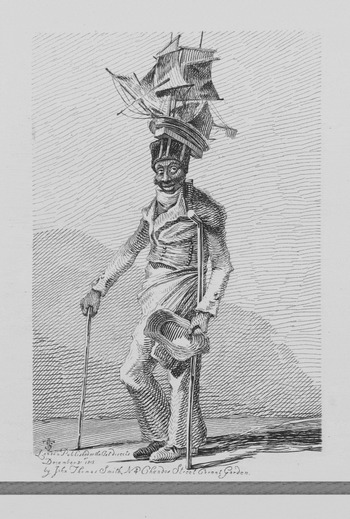
For black sailors, however, the experience of maritime culture was especially fraught. By the end of the eighteenth century, approximately one in four sailors in the British navy was of African descent, and for them “the experience of slavery was a powerful orientation to the ideologies of liberty and justice” (Gilroy 13). Peter Lindebaugh speaks to the “association between sailors and Black freedom fighters,” arguing that “the ship remained perhaps the most important conduit of Pan-African communication before the appearance of the long-playing record” (119). To say that Albert plays a role in any kind of global African network is to overstate the case. Because his archive is made up of Mayhew's observations and his own book, a book that most likely circulated in primarily white circles, it is difficult to read his work as a manifestation of Pan-African consciousness. The ship, however, was a significant part of black subjects’ street performances, a means of asserting their connection to the metropolis in all its colonial ambition. Joseph Johnson, for example, a black beggar and former slave who appears in John Thomas Smith's Vagabondiana (1817), “having been employed in the merchant service only, is not entitled to the provision of Greenwich. His wounds render him incapable of doing further duty of the ocean, and having no claim to any parish, he is obliged to gain a living on shore” (23-24). Johnson, a shrewd performer if there ever was one – and we are told that “black men are extremely cunning, and often witty” (25) – understands that “novelty [is] the grand secret of all exhibitions, from the Magic Lantern to the Panorama,” and he therefore wears a model of the ship Nelson on his head, by which “he can, by a bow of thanks, or a supplicating inclination to a drawing room window, give the appearance of sea-motion” (24). Smith's drawing of Johnson, “from the life,” he claims, is both highly racialized and evidently dramatic, as can be seen by Johnson's upturned eyes and mouth, smiling cheekily at the device on his head, a device that cannot possibly function as anything other than a costume (Figure 12).
J. T. Smith, “Joseph Johnson.” Engraving from Vagabondiana (1817). Courtesy of the Lewis Walpole Library, Yale University.

As it was for Johnson, the ship was for Albert a means of earning a living, and like Johnson Albert continues to use the ship to assert his rights to such a living. Despite his frequent use of ironic performance, however, the presence of the ship in his self-presentation is deadly serious. This seriousness can in part be attributed to Victorian moral earnestness, particularly in regards to beggars following the years in which, the “besome of societarian reform. . .is uplift with many-handed sway to extirpate the last fluttering tatters of the bugbear MENDICITY from the metropolis” (Lamb 193). Moreover, the sobriety of Albert's text derives from a need to tie his suffering to an extensive history of oppression, his being a new link in a long chain. While missing the tobacco paper wrapping to which Mayhew refers, the cover of the copy of the chapbook at University of Washington is graced with a picture of a ship, most likely a woodcut due to the cheapness of the publication. Despite Lindebaugh's assertion of the ship's role in creating Pan-African identity, the ship remains the site of the destruction of black bodies as much as of black self-invention. Moreover, the ship, instead of serving as a metonym gesturing to a larger history of the transatlantic slave trade, becomes a metaphor that dangerously masks human agency. Thus, in his treatment of Turner's Slave Ship, Ruskin can refer simply to the “guilty ship,” she who is “a slaver” (Modern Painters I 3: 572). The shift of the title of the painting, from Slavers Throwing Overboard the Dead and Dying, Typhon Coming on to the more commonly known The Slave Ship, reflects a similar effacement of moral responsibility by dislocating human agency. Coates explains how “racism is rendered as the innocent daughter of Mother Nature, and one is left to deplore the Middle Passage or the Trail of Tears the way one deplores an earthquake, a tornado, or any other phenomenon that can be cast as beyond the handiwork of men” (7). Further illustrating the denial of human involvement and further resembling Turner's Slave Ship, the ship on the cover of Edward Albert's book is empty. The refusal, whether advertent or not, to portray the agents of destruction renders the violence enacted on black bodies as somehow natural and, as such, inevitable.
The Victorian poet William Allingham challenges the idea of the violence of slavery being natural destruction in his poem “The Slave Ship”: “but a fiercer was there/ Than the sea or the fire, and more cruel than they;/ For Man took Death's side in that terrible fray!” (10-12). Albert similarly tries to assign responsibility by linking the ship to its owners and its owners to Britain. The Madeira, a former “West Indy trader,” Albert tells us (trader of what being the operative question), is en route to China by way of California, moving among four continents.Footnote 12 Albert moves between London and Glasgow, as well as several cities on the way, because, as Mayhew puts it, “he has been left destitute in what is to him almost a strange country, and has been denied what he terms ‘his rights’” (2: 490). The phrase “almost a strange country” reflects the relationship of a colonial subject to the metropolis. Estrangement, according to Stuart Hall, is essential to the Caribbean experience, in which “everybody is to some extent dislocated” (297). That said, Albert is profoundly tied to both England and Scotland and vows to never leave “‘until I get my rights’” (Mayhew 2: 491). Edward Albert recognizes Britain as his own because Jamaica “‘is an English place, sir, so I am counted as not a foreigner. I'm different from them Lascars’” (2: 490). Furthermore, the loss of his legs ties him to the metropolis: though he believes that he would have been treated more fairly had he lost his legs in Jamaica, he protests to Mayhew, “‘Many people tell me I ought to go to my country; but I tell them it's very hard – I didn't come here without my legs – I lost them, as it were, in this country’” (2: 492). Though the actual amputation took place in Chile, the ship forms its own society; and, as such, it belongs to Britain, as do its sins.
Albert must choose his location based on the particular rights he wishes to assert. Mayhew speaks of “the ‘property,’ so to speak, in a crossing, or the right to sweep a certain thoroughfare” (2: 465). The selection of such a spot was central to the success of street-sellers and beggars in the nineteenth-century. As Stephen Jankiewicz explains, “identity [of street sellers] was tied not only to the commodity they offered for sale, but also to their pitch, or the spot where they sold those goods. A pitch was something to be chosen carefully, an expression of knowledge and wisdom” (398). A well-chosen pitch, then, testifies to the street-smarts of its occupant while simultaneously setting the parameters of his or her work and self-presentation. In Our Mutual Friend, the one-legged villain, Silas Wegg, is particularly deft in his establishment of his pitch as a street-seller of ballads, standing outside one particular house: “he had established his right. . .by imperceptible prescription. He had never varied his ground an inch, but had in the beginning diffidently taken the corner upon which the side of the house gave” (52). Wegg uses this position to assert a relationship between that house and himself, as he claims, “he was one of the house's retainers and owed vassalage to it” (53).Footnote 13 Albert has difficulty establishing his pitch, as the police seem unsympathetic to his case: “The policeman said first, ‘You might go away,’ but I said, ‘I couldn't do anything else, and he ought to think it a charity to let me stop’” (2: 490). Whereas Wegg is bold enough to assert rights to his place, Albert is dependent on the discourse of charity when he makes his case.
A pitch asserts a claim to belonging and ownership. Edward Albert's pitch is, moreover, at once local and national: like any crossing-sweeper he has “the benefits arising from being constantly seen in the same place, and thus exciting the sympathy of the neighbouring householders, till small weekly allowances or ‘pensions’ are obtained” (London Labour 2: 465), but his pitch extends to the metropolis as a whole, which owes him something. Just as Silas Wegg returns again and again to the shop of Mr. Venus, the articulator of bones who is supposedly in possession of the bones of his severed leg, so is Edward Albert tied to the nation responsible for his dismemberment, desiring, as Silas Wegg puts it, to “collect myself like a genteel person” (Dickens, 88; book 1, ch. 5). (While gentility might not be Albert's goal per se, he is certainly invested in articulating a claim to dignity, most evident in his desire to differentiate himself from the Irish.) To collect one's belongings puts the subject in a masterful relationship to the object of his desire or ownership: such belongings are “property and portable” (Dickens GE 159). The body in itself would seem to be the most portable of any property; it is, in effect, like the poor, always with each of us. For Edward Albert, however, not only have his body parts become detached, but also he is inextricably connected to a history in which one's body might very well be someone else's portable property. Black bodies have historically been rendered personal property even when they are transfigured into something else. Elaine Freedgood writes in reference to Jane Eyre (1848): “Slaves – despite their problematic propensity to die in transit, to commit suicide from ships or once landed, to escape to what was left of the Caribbean forests and live as Maroons – are remembered, along with the mahogany that they cleared and to which brown and black people have since been likened endlessly, in the furniture Jane buys as the sign of her own independence and financial freedom” (50). Albert exists in a liminal moment in which his body is no longer the property of slaveholders but is similarly fungible and disposable and not quite his own, as is evidenced by the events surrounding the amputation of his legs.
With property comes the idea of belonging, but how can belonging be attained in a state of constant flux and mobility? Albert can never categorically belong to a place; therefore, he makes claims for bodily wholeness – something that rightfully belongs to him – while assigning responsibility to the owners of the ship for the so-called accident. He “belonged to” the Madeira (2: 490), indicating that even to the extent Albert can belong, such belonging is mobile and temporary, while his legs should have belonged to him indefinitely. Jamaica is an “English place,” Albert tells Mayhew, asserting his belonging within Britain; similarly, he married his wife “from where she belonged, in Leeds” (2: 492). (In asserting her belonging to Leeds, Albert attests that his wife has rights that Joseph Johnson, for example, does not: the parish to which she belongs is responsible for her support.) The notion of belonging is essentially an appeal to property rights rather than some broader idea of social justice, and Albert is careful to differentiate himself from a larger colonial population – one that might include “them Lascars.” One must remember, however, that Albert's book is short and his goals are limited. Rather than making a broad claim about racial and economic justice, Albert is asserting his nascent post-emancipation black subjectivity by claiming rights to his own body, even if it is in fragments. Unable to procure his body – to make himself whole once again – Albert demands what are functionally reparations, the financial equivalent of making one whole.
In the end, what endures and for how long? Albert lives past the point of his bodily mutilation and survives long enough to leave evidence of his life in an archive. The issue of archival durability and its sometimes ugly twin, ephemerality, complicates the understanding of human endurance. Albert, existing in an archive in which his belonging as well as his discoverability is contingent on the work of librarians and the intricate varieties of archival practice, might not have endured. The archives, like the dust-heaps in Our Mutual Friend, are strange places – places where things go to be kept only to be lost and found again. Things, facts, artifacts are not all that goes missing: people get lost as well, especially when those people and their accompanying objects are deemed unworthy of attention or display. There is no clear trajectory from here to there, from lost to found, however, when no one is looking. Objects, the dead – seemingly without the flexibility and mobility that characterized Albert in life – carry on in time and space even if there is no one there is to discover them, and there is no guarantee that they will be found again. The question that arises, then, is whether Albert's endurance is dependent on an archive for its meaning. T. S. Eliot ends The Wasteland by invoking “These fragments I have shored against my ruins” (431). Mayhew presents Albert's narrative in fragments, in service of a whole that is not Albert's but that might forestall the ruination that comes with being lost. Albert's book, however, poor though it may be, endures as a whole, even if a fragile one. And in reading it, perhaps we can make Albert whole in death in a way he was denied in life.