Implications
This study was conducted to evaluate the inclusion of chromium (Cr; at 0.05 mg/kg BW0.75) in starter feed of summer-exposed weaned dairy calves. Supplementing Cr tended to improve fecal consistency but had no beneficial effects on growth performance during the post-weaning period. Chromium is not recommended to be supplemented in starter feed of weaned calves when exposed to moderate environmental heat load.
Introduction
Summer exposure of dairy calves reduces feed intake and weight gain and increases economic losses, thus negatively influencing animal performance, welfare and long-term survival (Broucek et al., Reference Broucek, Kisac, Uhrincat, Hanus and Benc2008). High ambient temperature reduces the secretion of thyroid hormones (triiodothyronine (T3) and thyroxine (T4)) as an important growth promoters in animals (Yari et al., Reference Yari, Nikkhah, Alikhani, Khorvash, Rahmani and Ghorbani2010) and also insulin and IGF-I in dairy calves (Guo et al., Reference Guo, Monteiro, Weng, Ahmed, Laporta, Hayen, Dahl, Bernard and Tao2016). In addition, thermal stress stimulates the secretion of cortisol which results in increased glucose availability and then an initiation of lipid peroxidation in cell membranes (Chang and Mowat, Reference Chang and Mowat1992) which may impose oxidative stress. At weaning, calves are restless and vocalize (Jonasen and Krohn, Reference Jonasen and Krohn1991). Stress can compromise the immune system of calves for at least 2 weeks after weaning, making calves more susceptible to disease as well as compromising weight gain (Jonasen and Krohn, Reference Jonasen and Krohn1991; Quigley, Reference Quigley2001). Stressful situations may deplete serum-Cr with increased urinary excretion of the mineral in dairy cows/calves and increase Cr requirements (Yari et al., Reference Yari, Nikkhah, Alikhani, Khorvash, Rahmani and Ghorbani2010; Nikkhah et al., Reference Nikkhah, Mirzaei, Khorvash, Rahmani and Ghorbani2011).
Recently, the European Food Safety Authority (EFSA) recognized Cr as non-essential mineral for animals and humans, due to pharmacological effects of Cr3+ at supra-nutritional doses (EFSA Panel on Dietetic Products, Nutrition, and Allergies, 2014) and increased risk of Cr bio-accumulation and bio-magnification in some body organs of production animals (Dallago et al., Reference Dallago, Lima, Braz, da Silva Mustafa, McManus, do Prado Paim, Campeche, Gomes and Louvandini2016). Chromium at pharmacological doses (0.08 to 1 mg of Cr/kg of body mass daily or even more) acts as a second messenger and regulates carbohydrate, protein and fat metabolism by increasing insulin signaling (Vincent, Reference Vincent2015). In some previous studies, positive effects of supplemental Cr were seen on physiological and production/growth responses, especially during stressful periods. Examples include transportation in growing feeder calves (Chang and Mowat, Reference Chang and Mowat1992; Moonsie-Shageer and Mowat, Reference Moonsie-Shageer and Mowat1993; Mowat et al., Reference Mowat, Chang and Yang1993), the transition between gestation to lactation in dairy cows (Sadri et al., Reference Sadri, Rahmani, Khorvash, Ghorbani and Bruckmaier2012; Pantelić et al., Reference Pantelić, Jovanović, Prodanović, Vujanac, Đurić, Ćulafić, Vranješ-Đurić, Korićanac and Kirovski2018), postnatal period in dairy calves (Ghorbani et al., Reference Ghorbani, Sadri, Alizadeh and Bruckmaier2012) and high ambient temperatures in dairy cows/calves (Yari et al., Reference Yari, Nikkhah, Alikhani, Khorvash, Rahmani and Ghorbani2010; Nikkhah et al., Reference Nikkhah, Mirzaei, Khorvash, Rahmani and Ghorbani2011). In summer, increased dietary Cr provision to Holstein dairy calves reduced post-weaning starter feed intake and respiration rate with no changes in weight gain, which resulted from improved insulin function and altered glucose status (Yari et al., Reference Yari, Nikkhah, Alikhani, Khorvash, Rahmani and Ghorbani2010). Furthermore, increased provision of Cr to dairy cows undergoing coincident metabolic pressures of early lactation and heat stress improved insulin efficiency, feed intake and milk energy output (Nikkhah et al., Reference Nikkhah, Mirzaei, Khorvash, Rahmani and Ghorbani2011). However, the mechanism by which feed intake may be affected by supplemental Cr is not completely clear. Study of feeding behavior in calves supplemented with Cr is also required to clarify the mechanism of Cr effects on feed intake.
Our primary objective was to explore whether and how Cr supplementation can affect metabolism, antioxidant status, skeletal size, meal and rumination patterns, and growth performance of summer-exposed Holstein dairy calves undergoing weaning stress. An additional objective was to determine peripheral tissue response to increased Cr supply by conducting a glucose tolerance test (GTT) at the end of the study period. We hypothesized that supplemental Cr would increase blood glucose removal and encourage quicker return to eating and thereby increase feed intake. Furthermore, we also hypothesized that supplemental Cr would enhance growth performance of summer-exposed dairy calves, possibly through increased feed intake and improved insulin function.
Material and methods
Environment, animals, experimental treatments and management
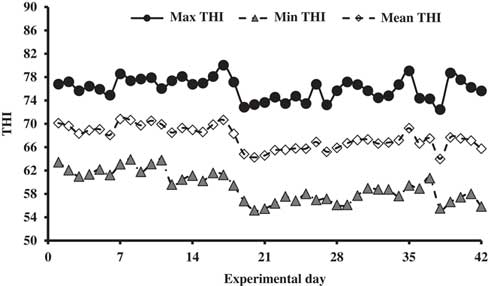
This study was performed at a local dairy farm (FKA Agri-Animal Production Co., Isfahan, Iran) during the period September to October 2015. All the animal procedures were approved by the Animal Care Committee of Shahrekord University by the Iranian Council of Animal Care (1995). During the study period, air temperature (T; °C) and relative humidity (RH; %) in the stall areas were recorded daily by Hobo Pro Series Temp probes (Onset Computer Corporation, Pocasset, MA, USA). Temperature–humidity index (THI; Figure 1) was computed according to Kargar et al. (Reference Kargar, Ghorbani, Fievez and Schingoethe2015) as following: THI = 0.8×maximum T+(minimum RH/100)×(maximum T−14.4)+46.4.
Temporal patterns of minimum (Min), mean and maximum (Max) temperature–humidity index (THI) over the experimental period. The averages for maximum THI, relative humidity and maximum temperature were 76.1, 14.2% and 33.7°C, respectively.

A total of 48 Holstein female calves (63 days of age; 77.0±1.45 kg of BW) were weaned, weighed and randomly transferred to individual pens (2.9m×1.1m×1.8 m; length×width×height). The bedding was sawdust and refreshed every 3 days but manure was discarded daily as needed to maintain pens visibly clean and dry. All calves were managed similarly pre-weaning and fed whole milk. Calves (n=24 per treatment) were randomly assigned to one of two dietary treatments: (1) a control group with no supplemental Cr (Cr−), and (2) a supplemental Cr group (Cr+). Chromium was supplemented as a Cr-methionine (Cr-Met) (MicroPlex 1000, provides 1000 mg of Cr/kg as Cr-Met (90% Met and 10% Cr, wt/wt); Zinpro Animal Nutrition Inc., Eden Prairie, MN, USA) into starter feed to provide 0.05 mg of supplemental Cr/kg of BW0.75. The Cr supplement was adjusted weekly based on BW over the experimental period. Calves had free access to both fresh and clean water and starter feed that was formulated according to the Cornell Net Carbohydrate and Protein System (CNCPS version 5.1) throughout the study period to permit at least 10% refusals. Ingredients and chemical composition of the basal diet are shown in Table 1.
Ingredients and chemical composition of the experimental calves’ starter diet on a dry matter (DM) basis

1 Palmac® 80–16 (IOI Oleochemical Industries Sdn Bhd, Prai, Malaysia). Product contained: 2% C12:0, 5% C14:0, 80% C16:0, 2% C18:0, 9% C18:1 and 3% C18:2.
2 Contained per kilogram of supplement: 975 000 IU of vitamin A, 750 000 IU of vitamin D, 1800 IU of vitamin E, 143 g of Zn, 76 g of Mn, 48.6 g of Cu, 19.5 g of Se, 18.4 g of Fe, 8 g of Ca and 1.3 g of Co.
3 Calculated from National Research Council (2001).
Data collection, sampling and analyses
Representative sub-samples of starter feed (n=8; two samples per week) were prepared (Nasrollahi et al., Reference Nasrollahi, Khorvash, Ghorbani, Teimouri-Yansari, Zali and Zebeli2012) and analyzed for Cr contents using flame photometry (GBC Integra EXL ICP, Melbourne, Australia). Experimental procedures (including average daily gain (ADG), feed efficiency, respiration rates, rectal temperatures, fecal score and body measurements) and details were previously reported by Pazoki et al. (Reference Pazoki, Ghorbani, Kargar, Sadeghi-Sefidmazgi, Drackley and Ghaffari2017). Behavioral data including eating, ruminating, resting, drinking, standing, lying and non-nutritive oral behaviors were monitored visually for each calf over a 12-h period over three consecutive days on days 86 to 88 of calf life (Kargar et al., Reference Kargar, Ghorbani, Khorvash, Kamalian and Schingoethe2013 and Reference Kargar, Ghorbani, Khorvash, Sadeghi-Sefidmazgi and Schingoethe2014).
Blood samples were taken 4 h post-morning meal into vaccum serum separator tubes containing clot activator on days 63, 77 and 91 of life and immediately placed on ice. An additional blood sample was taken on day 91 of calf life to measure blood hormones. The concentrations of blood metabolites (glucose, cholesterol, blood urea nitrogen, triglyceride, total protein, albumin, β-hydroxy butyric acid and malondialdehyde (MDA)) and hormones (insulin, T3, T4 and cortisol) were measured using commercially available kits as described earlier by Kargar et al. (Reference Kargar, Ghorbani, Fievez and Schingoethe2015). Concentrations of superoxide dismutase (Sun et al., Reference Sun, Oberley and Li1988), glutathione peroxidase (Lawrence and Burk, Reference Lawrence and Burk1976) and catalase (Goth, Reference Goth1991) also were measured.
The GTT was performed at the end of the post-weaning period using 20 calves (10 calves per treatment) according to the procedure described earlier by Yari et al. (Reference Yari, Nikkhah, Alikhani, Khorvash, Rahmani and Ghorbani2010). Pharmacokinetic variables in response to intravenous GTT for glucose and insulin including basal concentrations, the area under the curve (AUC; 0 to 120 min), relative clearance rate (%/min; 20 to 120 min), time to half-maximal concentration (T1/2; min) and insulin sensitivity were computed as described earlier (Hashemzadeh-Cigari et al., Reference Hashemzadeh-Cigari, Ghorbani, Khorvash, Riasi, Taghizadeh and Zebeli2015). The positive incremental AUC for glucose and insulin was calculated using the trapezoid rule with baseline subtraction.
Statistical analyses
Data were checked for normality using the UNIVARIATE procedure of SAS, and any parameter (except for data on fecal score) that was not normally distributed was logarithmically transformed. Data were subjected to ANOVA using the MIXED procedure of SAS (SAS 9.4; SAS Inc., Cary, NC, USA) with time (day or week) as repeated measures for intakes of Cr and starter feed, ADG, feed efficiency, rectal temperature, skeletal growth and blood metabolites. Data on fecal score were not normally distributed. Therefore, the GLIMMIX procedure of SAS was employed to fit Poisson distribution using a log-link function. In both MIXED and GLIMMIX models, the effects of treatment, time and treatment by time interaction were considered as fixed and calf as a random effect. Weaning BW and body structural measurements were considered as covariates for the final (day 91) BW and skeletal growth analyses, respectively. Data on BW, blood hormones, feeding and chewing behavior and insulin sensitivity were all analyzed using the same abovementioned model without the time effect. Differences between treatment groups were declared significant at P⩽0.05 and those from P>0.05 to P⩽0.10 were considered as trends.
Results
Environment, feed intake and growth performance
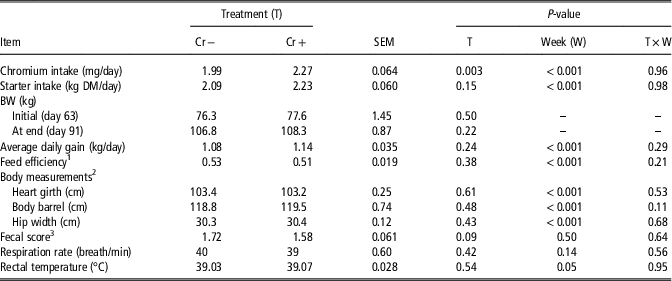
The averages for maximum THI, RH and maximum temperature were 76.1, 14.2% and 33.7°C, respectively, over the experimental period (Figure 1). Chromium supplementation did not affect variables related to calf growth (Table 2). Calves supplemented with Cr tended (P=0.09) to have lower fecal score as compared with Cr− calves. However, respiration rate and rectal temperature did not change between treatment groups.
Growth performance, body measurements and health status of heat-exposed weaned calves supplemented with (Cr+) or without (Cr−) chromium over 4 weeks of age post-weaning

DM=dry matter.1 Feed efficiency was calculated by dividing average daily gain by average total daily DM intake.
2 Body measurements including heart girth (circumference of the chest), body barrel (circumference of the bally before feeding) and hip width (distance between the points of hook bones) were measured according to Pazoki et al. (Reference Pazoki, Ghorbani, Kargar, Sadeghi-Sefidmazgi, Drackley and Ghaffari2017).
3 Fecal scores were recorded as firm and well-formed (score 1), soft and pudding-like (score 2), runny and pancake-like batter (score 3) and liquid and splatters (score 4) (Pazoki et al., Reference Pazoki, Ghorbani, Kargar, Sadeghi-Sefidmazgi, Drackley and Ghaffari2017).
Feeding and chewing behavior
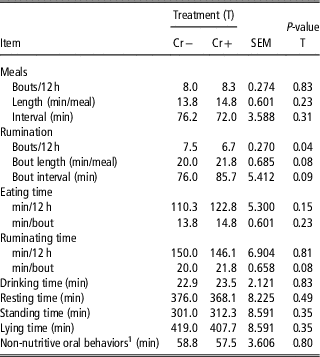
Rumination frequency decreased in Cr+ calves compared with Cr− calves (6.7 v. 7.5; P=0.04) (Table 3). However, rumination duration (P=0.08), rumination interval (P=0.09) and total time spent ruminating (minutes per bout; P=0.08) tended to increase in Cr+ calves. Other variables were not affected by Cr supplementation (Table 3).
Meal and rumination patterns, chewing activities and non-nutritive oral behaviors (days 86 to 88) of heat-exposed weaned calves supplemented with (Cr+) or without (Cr−) chromium over 4 weeks of age post-weaning

1 Non-nutritive oral behaviors are referred to licking any surface, tongue rolling and etc.
Blood metabolites, hormones and bio-markers of oxidative stress
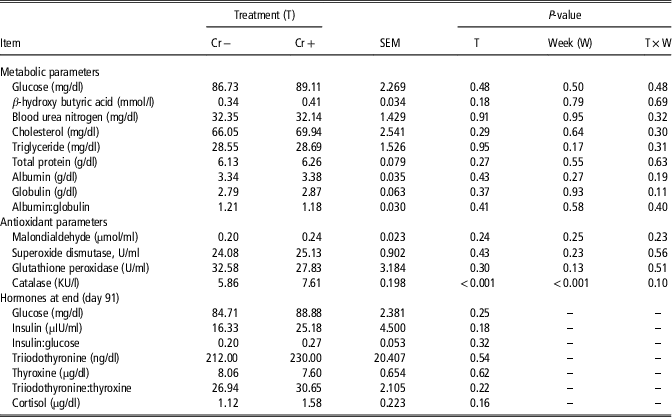
Serum concentration of catalase increased in Cr+ calves compared with Cr− calves (Table 4). However, concentrations of other metabolic and antioxidant variables and hormones were not affected by Cr supplementation (Table 4).
Blood metabolites, hormones and bio-markers of oxidative stress of heat-exposed weaned calves supplemented with (Cr+) or without (Cr−) chromium over 4 weeks of age post-weaning

Intravenous glucose tolerance test
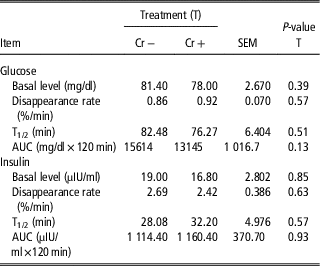
For both plasma glucose and insulin, we found no significant difference between treatment groups for the basal concentrations in plasma, relative clearance rate, time to reach half-maximal concentration (T1/2) and AUC at 120 min (Table 5).
Glucose and insulin responses to an intravenous glucose tolerance test in heat-exposed weaned calves supplemented with (Cr+) or without (Cr−) chromium

T1/2=time to half-maximal concentration; AUC=area under the concentration-time curve.
Discussion
Temperature–humidity index can exceed 80 from May through October in central Iran (Yari et al., Reference Yari, Nikkhah, Alikhani, Khorvash, Rahmani and Ghorbani2010; Beiranvand et al., Reference Beiranvand, Khani, Omidian, Ariana, Rezvani and Ghaffari2016). For this study, THI values of 76 to 78 were considered as mild degrees of environmental heat load for dairy calves (Beiranvand et al., Reference Beiranvand, Khani, Omidian, Ariana, Rezvani and Ghaffari2016). In previous studies, the effect of Cr supplementation on growth performance in calves has been controversial. Some researchers (Moonsie-Shageer and Mowat, Reference Moonsie-Shageer and Mowat1993; Ghorbani et al., Reference Ghorbani, Sadri, Alizadeh and Bruckmaier2012) reported a positive effect of Cr supplementation on weight gain, whereas others (Yari et al., Reference Yari, Nikkhah, Alikhani, Khorvash, Rahmani and Ghorbani2010; Kneeskern et al., Reference Kneeskern, Dilger, Loerch, Shike and Felix2016) did not observe. In a study by Yari et al. (Reference Yari, Nikkhah, Alikhani, Khorvash, Rahmani and Ghorbani2010), supplementing summer-exposed dairy calves with Cr decreased post-weaning starter feed intake but had no effect on ADG and feed efficiency, in agreement with our data. Spain and Spiers (Reference Spain and Spiers1996) indicated an upper critical temperature of 26°C, above which calves exhibit an increased respiratory rate. In the current study, the average maximum temperature was 33.7°C which was 7.7°C greater than the upper critical temperature, imposing an elevated rate of respiration in summer-exposed calves. Our data were comparable with results reported by Yari et al. (Reference Yari, Nikkhah, Alikhani, Khorvash, Rahmani and Ghorbani2010) in thermal stress and greater than those reported by Ghorbani et al. (Reference Ghorbani, Sadri, Alizadeh and Bruckmaier2012) in thermal neutral condition. Rectal temperatures of calves in the current study were in the physiological range (38.1°C to 39.2°C; Moran, Reference Moran2002) and consistent with those reported by Yari et al. (Reference Yari, Nikkhah, Alikhani, Khorvash, Rahmani and Ghorbani2010) for summer-exposed dairy calves. In general, at a THI of 76.1, there were no effects of supplementing Cr on post-weaning feed intake and growth.
Although rumination frequency decreased in Cr+ calves, an increase in rumination duration offset total time spent rumination in Cr+ calves compared to Cr− calves. The mechanism(s) by which Cr affected ruminating time and rumination patterns remain unclear. However, it is known that Cr is part of an insulin-potentiating pathway and there is an evidence that insulin has a stimulatory effect on ruminating activity by increasing glucose entry to cells and thereby reticulo-rumen motility (Bareille and Faverdin, Reference Bareille and Faverdin1996). However, blood serum concentrations of glucose and insulin, in the current study, were unchanged between treatment groups.
Chromium had little effect on blood glucose and insulin in calves under normal or heat stress conditions (Yari et al., Reference Yari, Nikkhah, Alikhani, Khorvash, Rahmani and Ghorbani2010; Ghorbani et al., Reference Ghorbani, Sadri, Alizadeh and Bruckmaier2012; Kneeskern et al., Reference Kneeskern, Dilger, Loerch, Shike and Felix2016). However, limited research has examined glucose and insulin dynamics in summer-exposed dairy calves.
In a study, Yari et al. (Reference Yari, Nikkhah, Alikhani, Khorvash, Rahmani and Ghorbani2010) performed the GTT in summer-exposed post-weaned dairy calves supplemented with Cr and showed a 30% reduction in AUC (0 to 120 min) of insulin post-glucose infusion without significant difference in AUC of glucose. Similar to glucose and insulin in the current study, Kneeskern et al. (Reference Kneeskern, Dilger, Loerch, Shike and Felix2016) reported no significant effects of Cr on glucose/insulin AUC after a GTT in beef steers. Overall, the limited effect of Cr on the GTT results may be due to factors including limited bioavailability of the Cr from Cr-Met, a lack of actual thermal stress during the GTT or that the degree of insulin resistance was too great for the amount of Cr to have a significant effect.
The lack of treatment effect on blood globulin and the albumin to globulin ratio may reflect no changes in demand and competition for amino acids between treatment groups and thereby no challenge to the hepatic synthesis of globulin, needed to maintain normal immune function. In the current study, blood cortisol was not affected by Cr supplementation. Inconsistent with our results, Yari et al. (Reference Yari, Nikkhah, Alikhani, Khorvash, Rahmani and Ghorbani2010) observed an increase in blood cortisol of post-weaned calves supplemented with Cr in summer. Moonsie-Shageer and Mowat (Reference Moonsie-Shageer and Mowat1993) and Ghorbani et al. (Reference Ghorbani, Sadri, Alizadeh and Bruckmaier2012) observed that Cr supplementation to stressed (transportation stress or birth stress) calves decreased blood cortisol; however, others were unable to confirm this response (Mowat et al., Reference Mowat, Chang and Yang1993). Likewise, our data did not support a reduction in serum cortisol in response to Cr supplementation. Therefore, the relationship between Cr and blood cortisol is warranted to be investigated further. Yari et al. (Reference Yari, Nikkhah, Alikhani, Khorvash, Rahmani and Ghorbani2010) reported an increase in the serum T3 to T4 ratio of summer-exposed dairy calves when supplemented with Cr at 0.02 mg/kg of BW0.75 as compared with at 0 or 0.04 mg of Cr. Furthermore, Ghorbani et al. (Reference Ghorbani, Sadri, Alizadeh and Bruckmaier2012) observed a greater T3 to T4 ratio of birth-stressed dairy calves (supplemented with 0.03 mg/kg BW0.75) raised in thermal neutral conditions. Accordingly, they suggested an improvement in the efficiency of the T4 conversion to T3 and possibly an increased T3 requirement for calves facing different stressful conditions (heat- and birth stress). However, our data did not support an increase in the serum T3 or blood T3 to T4 ratio in response to Cr supplementation under conditions of current study.
Increased serum concentration of catalase may reflect increased antioxidant capacities of Cr+ calves. However, this increase was in physiological range as supported by no changes in MDA (as an indicator of lipid peroxidation) concentration, which mainly depends on the availability of polyunsaturated fatty acids and antioxidant defense (Kargar et al., Reference Kargar, Ghorbani, Fievez and Schingoethe2015). Accordingly, we conclude that the antioxidant defence system of summer-exposed calves was not affected extensively by Cr supplementation, although serum concentration of catalase increased.
Conclusions
Results indicated no improvement in growth performance, metabolism and peripheral insulin efficiency of summer-exposed weaned calves when supplemented with Cr.
Acknowledgments
The authors express their kind appreciation to the farm staff at FKA Agri-Animal Production Company (Isfahan, Iran) for diligent animal care, and to Sana Dam Company (Tehran, Iran) for donating Cr-Met. The authors also express their appreciation to Keith Inskeep (West Virginia University) for editing the final English version of this manuscript.
Declaration of interest
The authors declare no conflicts of interest.
Ethics statement
All the animal procedures were approved by the Animal Care Committee of Shahrekord University by the Iranian Council of Animal Care (1995).
Software and data repository resources
The authors declare that no data or models are deposited in an official repository.