Introduction
In nature, almandine–pyrope garnet is a natural host for Y and REE (in particular, the HREE) in amounts ranging from the tens of ppm up to several thousand ppm (Yoder and Keith, Reference Yoder and Keith1951; Pyle and Spear, Reference Pyle and Spear1999; Carlson et al., Reference Carlson, Gale and Wright2014). This affinity of almandine–pyrope garnet for Y+REE has found a variety of applications. For example, Y exchange between garnet and co-existing xenotime has been calibrated as an empirical geothermometer (Pyle and Spear, Reference Pyle and Spear2000). This has led to additional studies, which investigate the Y content of garnet and local distribution of xenotime as a function of metamorphic grade (Pyle and Spear, Reference Pyle and Spear1999). Subsequently, Y zoning in metamorphic garnet has been used to help decipher the reaction history of metamorphic rocks with or without co-existing Y-bearing phases such as xenotime and monazite (Lanzirotti, Reference Lanzirotti1995; Yang and Pattison, Reference Yang and Pattison2006; Zeh, Reference Zeh2006). Yttrium zoning in garnet has been cross-correlated with δ18O zoning as a marker for both fluid flow as well as giving some idea as to the fluid composition responsible for the zoning (Skelton et al., Reference Skelton, Annersten and Valley2002; George et al., Reference George, Viete, Ávila, Seward, Guice, Allen and Harrower2024). The distribution of Y in garnet has also found application in structural geology and rheology. For example, the redistribution of Y and HREE along deformation structures in garnet including microfaults with horsetails, en echelon bands, and splaying features around the tips of fractures have been used to chart the stress experienced by the garnet in a closed system during eclogite-facies metamorphism (Røhr et al., Reference Røhr, Austrheim and Erambert2007). Measurement of Lu-Hf and Sm-Nd relative abundances in garnet are both important and widely used geochronometers both in tectonics and in metamorphic geology (Pollington and Baxter, Reference Pollington and Baxter2010; Cheng, Reference Cheng2019; Mark et al., Reference Mark, O’Sullivan, Glorie, Simpson, Ando, Barbarano, Stutenbecker, Daly and Gilbert2023). Grew et al. (Reference Grew, Marsh, Yates, Lazic, Armbruster, Locock, Bell, Dyar, Bernhardt and Medenbach2010) reported the existence of a Y-enriched garnet (menzerite-(Y)) from a felsic granulite, Parry Sound domain, Grenville Orogenic Province, Ontario, Canada (see also Marsh et al., Reference Marsh, Grew, Gerbi and Yates2012), which contains up to 16.9 wt.% Y2O3.
The role of fluids in the partial replacement of a mineral phase, which results in the genesis of a chemically altered version of the same mineral phase via a coupled dissolution–reprecipitation process (Putnis, Reference Putnis2002, Reference Putnis, Oelkers and Schott2009; Putnis and Austrheim, Reference Putnis, Austrheim, Harlov and Austrheim2013), has been explored in a series of mineral-metasomatism experiments involving apatite (Harlov et al., Reference Harlov, Wirth and Förster2005), monazite (Harlov et al., Reference Harlov, Wirth and Hetherington2011), xenotime (Harlov and Wirth, Reference Harlov and Wirth2012; Harlov, Reference Harlov2024), and zircon (Harlov et al., Reference Harlov, Anczkiewicz and Dunkley2023). In each of these cases the composition of the fluid phase is the key factor in initiating the alteration process with the P-T conditions of the experiment playing a more minor role. The results from these experiments indicate that apatite is highly reactive in the presence of low-pH fluids; monazite and xenotime are reactive with high-pH fluids and F-rich fluids; and that zircon is most reactive in the presence of F-bearing fluids and, to a lesser degree, with high-pH fluids.
The goal of this investigation is to demonstrate that Y, and a selection of REE (Sm, Eu and Lu), can be incorporated metasomatically into garnet via a series of coupled substitutions utilising a high-pH alkali-bearing solution (2N NaOH) under high-grade metamorphic conditions through partial replacement in the form of a coupled dissolution–reprecipitation reaction.
Experimental and analytical procedures
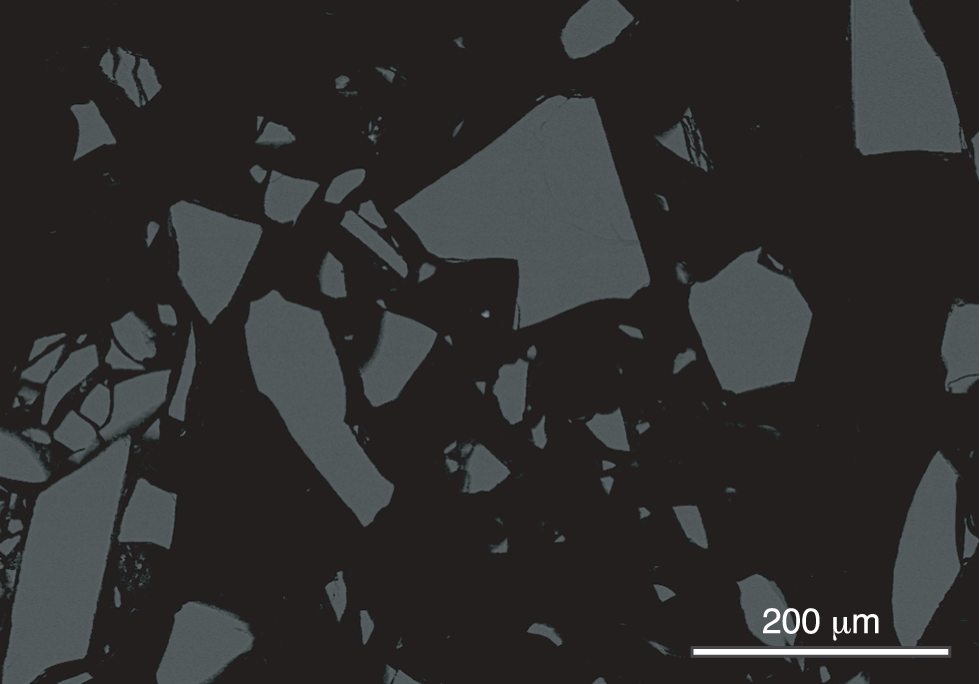
The garnet chosen for the experiments was taken from inclusion-free, 0.5–1 cm fragments of the Gore Mountain garnet (Bartholome, Reference Bartholome1960; McLelland and Selleck, Reference McLelland and Selleck2011). One of these fragments was crushed into 50–300 μm irregularly sized grains (Fig. 1). Foreign mineral phases, cloudy grain fragments, and any fragments with altered surfaces were picked out by hand using a binocular microscope and the remaining transparent, inclusion-free grain fragments washed in ethanol in an ultrasonic bath. High-contrast, back-scattered electron (BSE) imaging and electron microprobe (EMP) analysis reveal that the garnet grains are relatively homogeneous with an approximate composition of Alm46, Pyr43, Sp1, Gr10 (see results below and also Bartholome, Reference Bartholome1960).
High contrast back-scattered electron (BSE) image of the original Gore Mountain garnet fragments used in the experiment. The surrounding black material is epoxy.

The metasomatism experiments were carried out at 900°C and 1000 MPa using a two-piston cylinder apparatus as described by Johannes et al. (Reference Johannes, Bell, Mao, Boettcher, Chipman, Hays, Newton and Seifert1971) and Johannes (Reference Johannes1973). The experimental charge consisted of 10 mg of fragmented garnet, plus 2–5 mg of a Y+REE oxide or phosphate, plus 5 mg 2N NaOH. The experimental charge was placed in a 3 mm wide, 1 cm long Pt capsule, which was then arc-welded shut.
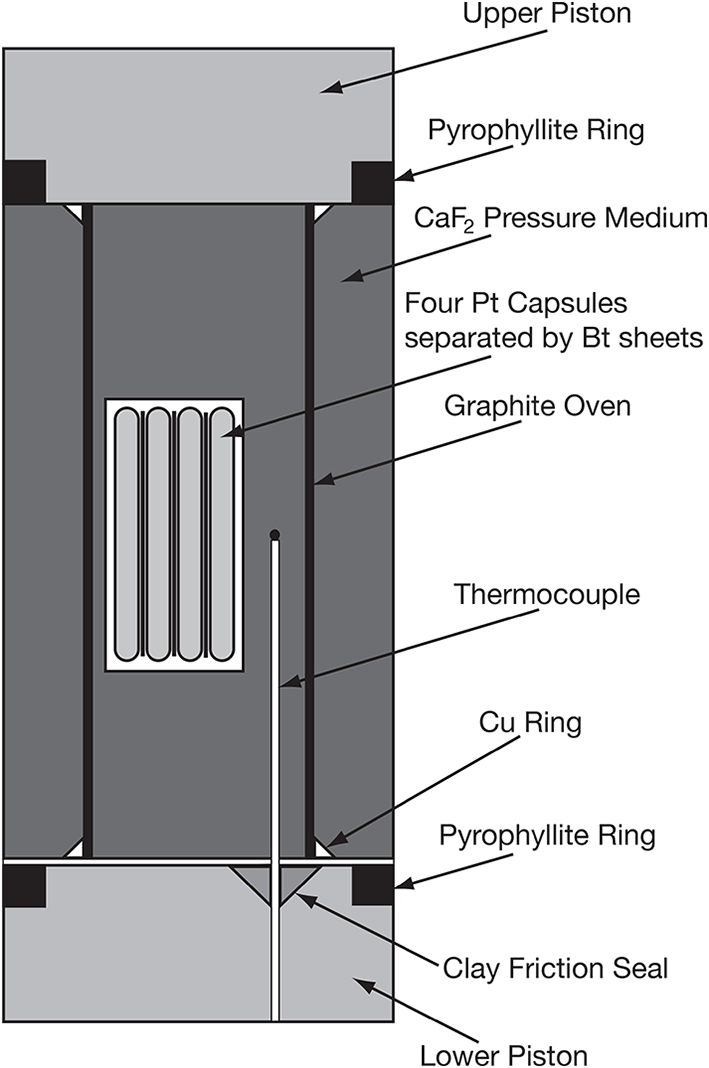
The flattened Pt capsules were then placed vertically in a CaF2 setup with a graphite cylindrical oven separated by leaves of biotite (Fig. 2). The thermocouple tip was placed such that it reached halfway up the side of one of the Pt capsules. The pressure measured during the experiment was corrected for friction, i.e. 75 MPa as determined for CaF2 by Harlov and Milke (Reference Harlov and Milke2002).
Sketch of the CaF2 assembly used in the experiments with the piston cylinder apparatus showing the location of the four Pt capsules separated by biotite sheets.

Isobaric quench to below 100°C was achieved within 10–15 s by turning off the current. The airtight pyrophyllite seals encircling each of the two pistons, coupled with the presence of the graphite oven at 900°C and 1000 MPa, imply that the experiment was buffered to C-CO-CO2 under relatively reducing conditions.
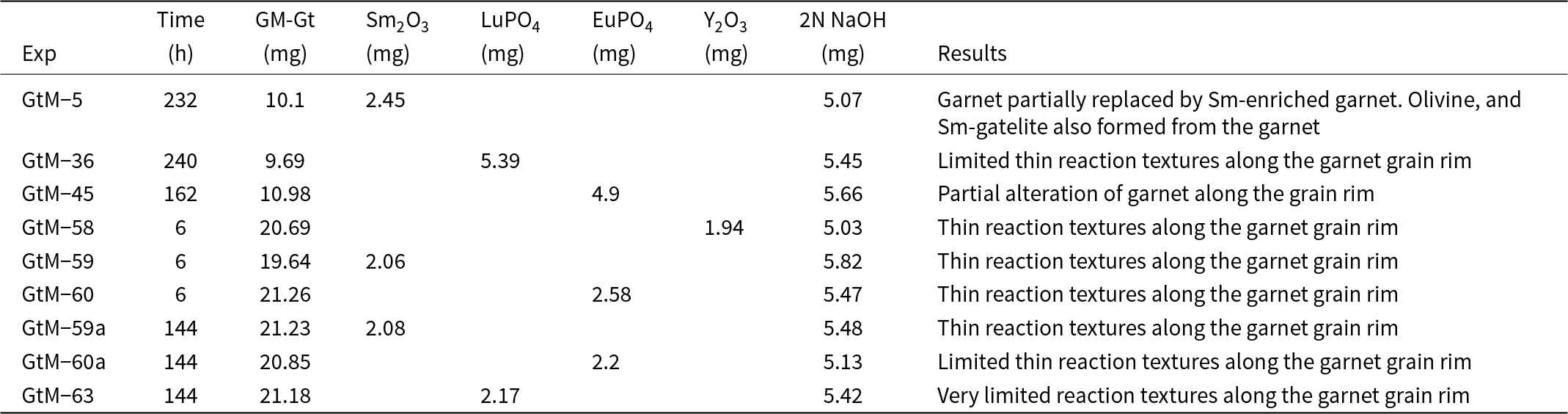
After the experiment, the Pt capsules were cleaned, weighed, and punctured. The Pt capsule was then dried at 105°C for several hours, and weighed again to determine fluid loss, which agreed approximately with the amount of fluid placed in the capsule. The charge was removed from the Pt capsule, mounted in epoxy, and then polished. The experimental conditions and results are given in Table 1.
Experimental conditions at 900°C and 1000 MPa

Scanning electron microscope (SEM) and electron microprobe (EMP) analysis
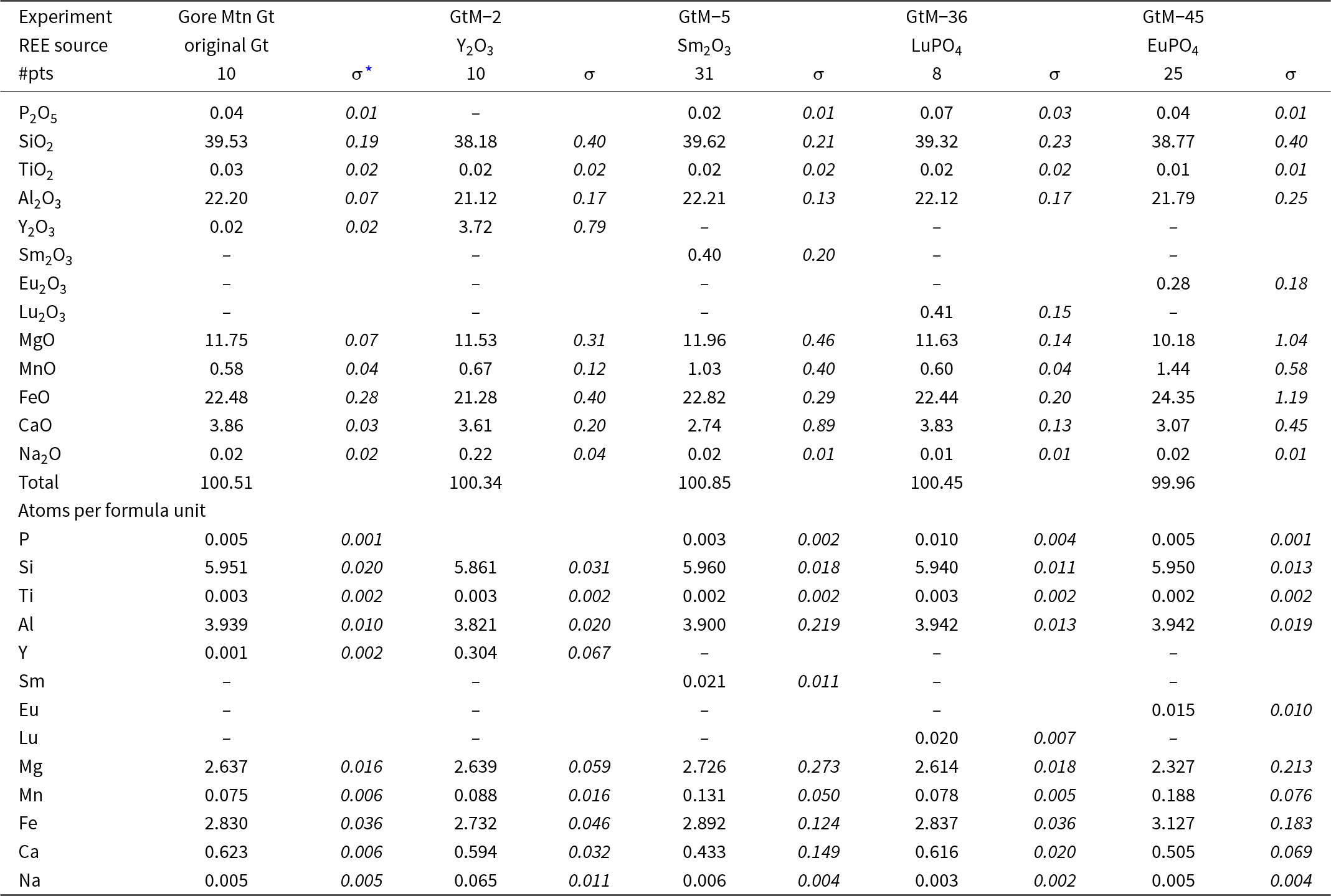
The experimental charge was first evaluated using high contrast BSE imaging on a Zeiss DSM-962 Scanning Electron Microscope at the GFZ Helmholtz Centre for Geosciences in Potsdam, with an accelerating voltage of 20 kV and a focused electron beam. Experimental charges were analysed at the GFZ Helmholtz Centre for Geosciences using a JEOL electron hyperprobe with a field emission gun. Elements analysed in the garnet included Si, Ti, Al, Y, Fe, Mg, Mn, Ca and Na (plus the relevant REE), with counting times of 20–120 s depending on the relative amount of the element. Standards for Si, Ti, Al, Fe, Mg, Mn, Ca, and Na were taken from the Smithsonian standards (Jarosewich et al., Reference Jarosewich, Nelen and Norberg1980). The standards for Y, Sm, Eu, and Lu were taken from synthetic REE phosphates prepared by Jarosewich and Boatner (Reference Jarosewich and Boatner1991). Individual spot analyses were made using a focused electron beam with a beam diameter of 1 μm. The accelerating voltage was 15 kV and the beam-current was 15 nA. Data reduction was done using software supplied by JEOL. Analytical errors depend on the absolute abundances of each element and the background estimation. Relative 1σ errors were estimated to be <0.5% at the >10 wt.% level, 15% at the 1–10 wt.% level, 10–20% at the 0.2 to 1 wt.% level, and 20–40% at the <0.1 wt.% level. These error ranges were determined by analysing the EMP standards. The garnet compositions are given in Table 2.
Garnet EMP compositions in oxide wt.% with corresponding cation values

Notes: #pts are the number of analytical points; – implies below the EMP detection limit.
* Sigma error mean values, in italics, for the mean EMP individual element analyses
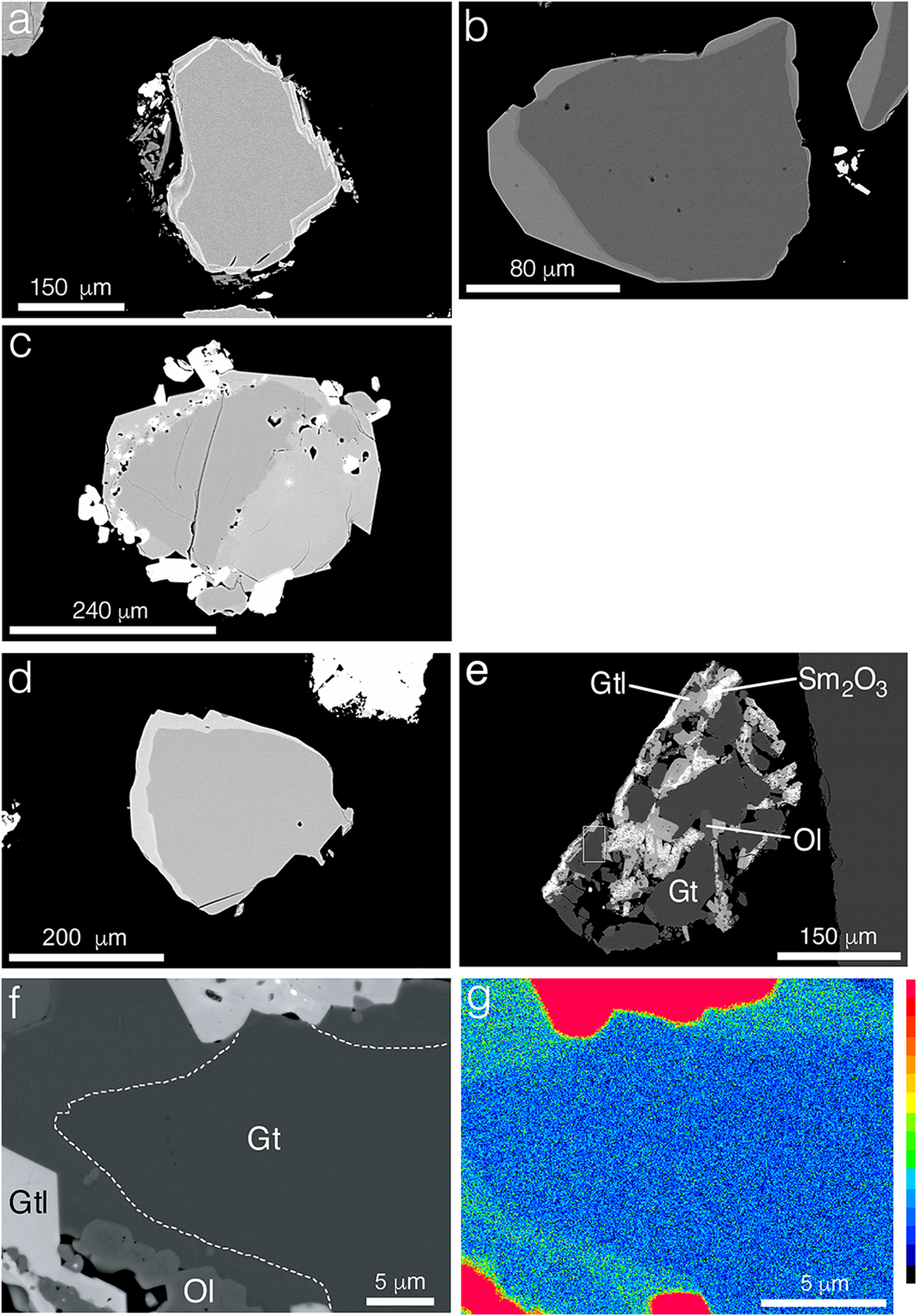
High-contrast BSE images of garnet metasomatism experiments involving Y2O3, EuPO4, LuPO4, and Sm2O3 are shown in Fig. 3a–e. Element-distribution maps were performed in WDS mode using a focused 1 μm electron beam (Fig. 3f). Analytical conditions for the Sm element map in Fig. 3f,g were 15 kV and 10 nA with dwell times of 300 ms and 400 ms. The element map was recorded in stage scanning mode with a pixel size of 1 μm × 1 μm.
High contrast BSE images of garnet fragments metasomatised in a series of REE-bearing, NaOH-bearing fluids. (a) Altered garnet from experiment GtM-58 (Y2O3). Light areas are enriched in Y. Bright grains are Y2O3. (b) Altered garnet from experiment GtM-45. Light areas are enriched in Eu. (c) Altered garnet from experiment GtM-63. Light areas are enriched in Lu. Bright grains are LuPO4. (d) Altered garnet from GtM-59a. Light areas are enriched in Sm. (e) Altered garnet from experiment GtM-5 showing minerals resulting from alteration during the experiment. ‘Gtl’ – Sm-gatelite (Sm4(Al,Mg,Fe)4[Si2O7][SiO4]3(O,F,OH)3); ‘Ol’ – olivine; ‘Gt’ – garnet. The small box outlines the area shown rotated in Fig. 3f. (f) Close-up of an area in the garnet from experiment GtM-5 (see Fig. 3e). The white dotted line outlines the boundary between the Sm-enriched and the original garnet. (g) Corresponding element map for Sm showing that the altered area is enriched in Sm compared to unaltered areas of the garnet. Interstitial and surrounding black material is epoxy.

Results and discussion
In the experiment involving Y2O3, altered areas formed along the rim of the garnet that are enriched in Y. In addition, small grains of Y2O3 also formed (Fig. 3a). Experiments involving EuPO4 resulted in areas along the garnet grain rim that are enriched in Eu with indication that some overgrowth occurred as evidenced by the occurrence of crystal faces (Fig. 3b). In addition, small secondary grains of EuPO4 also are found. Experiments involving LuPO4 resulted in areas enriched in Lu, of varying width with some porosity, forming within the garnet grain rim (Fig. 3c). In addition, secondary grains of LuPO4 occur both as inclusions in the altered areas as well as rim grains. In these three experiments, other than the garnet experiencing a little dissolution and some overgrowth, as well as the formation of altered areas enriched in the Y+REE added to the experiment, only grains of the added Y+REE phase formed. However, in experiments involving Sm2O3, while areas of the garnet were altered and subsequently enriched in Sm (Figs 3d,f,g), additional phases formed from the partial breakdown of the garnet during the experiment. These include Sm-gatelite (Sm4(Al,Mg,Fe)4[Si2O7][SiO4]3(O,F,OH)3) and olivine in addition to remnants of the Sm2O3 (Fig. 3e).
In the garnet crystal lattice, Y+REE can only substitute on the dodecahedral site with a strong preference for the HREE over the LREE (Carlson et al., Reference Carlson, Gale and Wright2014). In general, there are four known coupled substitutions involving the incorporation of Y+REE into garnet that are relevant to these experiments. These include the so-called YAG coupled substitution resulting in yttrogarnet (Yoder and Keith, Reference Yoder and Keith1951):
VIII(Y,REE)3+ + IVAl3+ = VIII(Fe,Mg,Mn,Ca)2+ + IVSi4+ (1)
a vacancy-coupled substitution (Carlson et al., Reference Carlson, Gale and Wright2014):
2VIII(Y,REE)3+ + VIII□ = 3VIII(Fe,Mg,Mn,Ca)2+ (2)
a sodic coupled substitution (Carlson et al., Reference Carlson, Gale and Wright2014):
VIII(Y,REE)3+ + VIIINa+ = 2VIII(Fe+Mg+Mn+Ca)2+ (3)
and lastly the menzerite-(Y) coupled substitution (Grew et al., Reference Grew, Marsh, Yates, Lazic, Armbruster, Locock, Bell, Dyar, Bernhardt and Medenbach2010):
VIII(Y,REE)3+ + VI(Fe,Mg)2+ = VIII(Fe,Mg)2+ + VI(Al,Fe)3+ (4)
In the experiments involving Y2O3, Sm2O3, EuPO4, and LuPO4, the garnet reacted with a 2N NaOH solution suggesting that Na via coupled substitution 3 could have played a significant role in the incorporation of these four REE into the garnet crystal lattice. However, this seems to be only the case for experiment GtM-2 involving metasomatic incorporation of Y into the reacted areas of the garnet. Though, on the cation scale, the amount of Na is too small (Table 2) to totally charge balance the amount of Y substituting on the dodecahedral site via coupled substitution 3. Hence, coupled substitutions 1, 2, and 4 probably also operated at the same time. This is not unusual because a series of independent coupled-substitution reactions can operate simultaneously in other mineral phases during metasomatically induced alteration. Examples include apatite (Harlov et al., Reference Harlov, Förster and Nijland2002; Harlov and Förster, Reference Harlov and Förster2002) and monazite (Harlov and Förster, Reference Harlov and Förster2003; Harlov et al., Reference Harlov, Prochazka, Förster and Matejka2008). The amounts of Sm, Lu, and Eu in the reacted garnet from GtM-5, GtM-36, and GtM-45, respectively, are quite low (Table 2) such that coupled substitutions 1–4 listed above are all possible to varying degrees though to what degree each of these coupled substitution reactions could have contributed to the incorporation of Sm, Eu, and Lu into the reacted areas of the garnet is relatively uncertain.
One example from nature where coupled substitution 3 is dominant is seen for one type of garnet from orthogneisses of the Su-Lu terrane, eastern China (Enami et al., Reference Enami, Cong, Yoshida and Kawabe1995). Here, incorporation of Y into an Al-rich garnet occurs via coupled substitution 3, whereas incorporation of Y into Fe3+-rich garnet occurs primarily via coupled substitution 4 similar to what is seen for menzerite. In addition, Enami et al. (Reference Enami, Cong, Yoshida and Kawabe1995) noted that coupled substitution 3 appears to be favoured with rising pressure.
As already noted above, the partial replacement of the original garnet by Y-, Sm-, Eu-, and Lu-enriched garnet occurred via coupled substitution–reprecipitation reactions 1–4 (cf. Putnis, Reference Putnis2002, Reference Putnis, Oelkers and Schott2009; Putnis and Austrheim, Reference Putnis, Austrheim, Harlov and Austrheim2013); each of which contributed to varying degrees. Coupled dissolution–reprecipitation is a fluid enhanced process during which a mineral might be either partially, or totally, replaced by the same mineral with a different composition while retaining the crystallographic information inherent in the original mineral or else be replaced by a completely new mineral phase while retaining the morphology of the original mineral (Putnis, Reference Putnis2002, Reference Putnis, Oelkers and Schott2009; Putnis and Austrheim, Reference Putnis, Austrheim, Harlov and Austrheim2013). A common example of the latter is pseudomorphism and fossilisation of what was originally organically derived material such as wood or bone, such that it is now replaced by silicate, carbonate, or sulfide minerals.
Thermodynamically, coupled dissolution–reprecipitation is a mineral–fluid chemical reaction driven by a reduction of the Gibbs free energy in a system where the rapid mass transfer necessary for this re-equilibration is enabled by the presence of fluids that are reactive with the minerals present. As the name implies, the actual mechanism occurs on the scale of the crystal lattice and consists of first dissolving a lattice plane from the original mineral and then precipitating a lattice plane of the mineral whose composition is in equilibrium with the change in P-T-X conditions; or by an entirely new mineral phase in equilibrium with the change in P-T-X conditions. The interface between the original lattice plane and precipitated lattice plane is characterised by a thin fluid film (generally on the nano-scale). The newly precipitated mineral phase tends to be characterised by an interconnected fluid-filled nano-porosity. This allows subsequent connection between the surrounding outside fluid and the thin fluid film between the two lattice planes allowing for fluid-aided dissolution of the original mineral phase and reprecipitation of the altered or new mineral phase (cf. Harlov et al., Reference Harlov, Wirth and Förster2005). Over the timescale of the reaction, this porosity can experience a sort of inverse Ostwald ripening during which a smaller population of micron-size pores evolves from a much larger population of nanometre-size pores (cf. Harlov and Wirth, Reference Harlov and Wirth2012). Both the nanometre- and micron-size pores can also serve as nucleation sites for the growth of mineral inclusions such as monazite in the case of fluorapatite (Harlov et al., Reference Harlov, Wirth and Förster2005), monazite and xenotime in the case of chlorapatite (Harlov et al., Reference Harlov, Förster and Nijland2002), or omphacite in the case of the garnets described below (cf. Pollok et al., Reference Pollok, Lloyd, Austrheim and Putnis2008). The thin fluid film, in conjunction with the fluid-filled nano-porosity, acts as a medium for rapid mass transfer between the dissolving original mineral phase and the newly precipitating re-equilibrated mineral phase while at the same time crystallographic information between the two mineral phases is transferred across the interface, though exactly how this is done is not completely understood. Many examples of this process for various mineral systems are given by Putnis (Reference Putnis2002, Reference Putnis, Oelkers and Schott2009) and Putnis and Austrheim (Reference Putnis, Austrheim, Harlov and Austrheim2013).
A more specific example of this process for garnets in nature is documented by Pollok et al. (Reference Pollok, Lloyd, Austrheim and Putnis2008). Here garnets, in eclogites formed along shear zones in granulite-facies rocks from the Bergen Arcs, western Norway, show different types of partial replacement due to an incomplete eclogitisation process. In this case the boundary between the altered areas and original garnet shows a limited compositional profile. Partial replacement patterns include concentric rim zoning, zoning along vein fillings coupled with trails of omphacite inclusions, and zoning bands without inclusions. Altered areas (eclogitic garnet) are characterised by being richer in Fe relative to Mg than the original unaltered granulitic garnet areas. Electron back-scattered diffraction (EBSD) analysis indicates no change in crystallographic orientation between the eclogitic and granulitic garnet compositions in the same garnet grain. Pollok et al. (Reference Pollok, Lloyd, Austrheim and Putnis2008) concluded that the partial replacement of granulitic garnet by eclogitic garnet is characteristic of a dissolution and reprecipitation reaction in an open system with limited fluid availability. The limited compositional profile between the original granulitic garnet and the eclogitic garnet is interpreted as a diffusional re-equilibration step after eclogite vein formation during subsequent retrograde metamorphism that obscured the initially sharp interface between the two garnet types.
Diffusion coefficients for Y in garnet, together with the other trivalent REE, at 700 to 900°C and 500 MPa have been demonstrated to be 0.5 to 1.5 log10 units smaller than the diffusion coefficients for divalent cations such as Fe, Mg, Ca and Mn (Carlson, Reference Carlson2012). The mechanism responsible for these dramatically slower diffusivities is the fact that the mobility of VIII(Y+REE) on the dodecahedral site in the garnet must be coupled either to another cation or a vacancy on the dodecahedral, octahedral, or tetrahedral site as charge balance must be maintained during diffusion through the garnet crystal lattice. In contrast, divalent cations, such as Fe, Mg, Ca and Mn, are not coupled to another cation on the dodecahedral site thereby allowing for much faster rates of diffusion. The implication from this is that incorporation into or transport of Y and other REE in garnet by simple diffusion is a relatively slow process under high-grade conditions compared to cations that are not paired with another cation. This would help to explain the excellent preservation of Y+REE zoning patterns in garnets from metamorphic terranes (Moore et al., Reference Moore, Carlson and Hesse2013). In such cases, Y+REE incorporation in garnet can effectively occur only during garnet growth as a function of the composition of the Y+REE-bearing fluids and/or melts present and the Y+REE partitioning coefficients between the growing garnet and the fluid/melt, and, to a lesser extent, as a function of the P-T conditions.
One important implication from this investigation involves Lu-Hf and Sm-Nd age determination in garnet (Pollington and Baxter, Reference Pollington and Baxter2010; Cheng, Reference Cheng2019; Simpson et al., Reference Simpson, Gilbert, Tamblyn, Hand, Spandler, Gillespie, Nixon and Glorie2021; Mark et al., Reference Mark, O’Sullivan, Glorie, Simpson, Ando, Barbarano, Stutenbecker, Daly and Gilbert2023; Farrell et al., Reference Farrell, Aerden, Baxter, Starr and Williams2024; Ribeiro et al., Reference Ribeiro, Kirkland, Smit, Musiyachenko, Korkonen and Evans2024). Namely, the results from these experiments, where Lu and Sm were metasomatically enriched in garnet, would imply that either geochronometer can be metasomatically reset or altered during metamorphism if the fluids involved have a relatively high pH. That is, age determination of altered areas in garnet involving Lu-Hf or Sm-Nd could either result in an erroneous age or else could conceivably give the age for a metasomatic event responsible for the alteration, assuming that either or both geochronometers were totally reset. More specifically, elements that behave in a similar fashion, such as the REE, would imply that the Sm-Nd geochronometer in the altered area of the garnet could be more easily reset and thus could give the age for a metasomatic event. In contrast, however, the chemistry of Lu and Hf are quite different, i.e. Lu3+ is an REE and Hf4+ is an HFSE. This could and probably would make any interpretations regarding metasomatic alteration of the Lu-Hf geochronometer more difficult to explain.
The basic conclusions from this investigation are relatively straightforward. Namely, incorporation of Y and other REE into garnet can be facilitated either during the growth of the garnet or by partial to total alteration of the garnet via a fluid-enabled coupled dissolution–reprecipitation process. The implications from this investigation with respect to the role of Y- and REE-bearing garnet in metamorphic rocks are widespread. If Y (and other REE) can be incorporated metasomatically into (or removed from) garnet, this would affect garnet–xenotime relations during regional metamorphism and the potential role of fluids regarding this relationship (Pyle and Spear, Reference Pyle and Spear1999). More specifically it implies that temperatures estimated from the empirical garnet–xenotime thermometer of Pyle and Spear (Reference Pyle and Spear2000) might not only represent prograde garnet growth events but could also record metasomatic events during metamorphism when the garnet re-equilibrates with accompanying xenotime due to changing P-T-X conditions. This also implies that Lu-Hf and Sm-Nd age determination in garnet could be affected by metasomatic events, and perhaps effectively give an age for these events. As oxygen bonds are being broken during the coupled dissolution–reprecipitation process, this would also have an effect on the coupling between the Y and δ18O signal in garnets described by Skelton et al. (Reference Skelton, Annersten and Valley2002) and George et al. (Reference George, Viete, Ávila, Seward, Guice, Allen and Harrower2024). More indirectly, the results from this experiment support the conclusions of Pollok et al. (Reference Pollok, Lloyd, Austrheim and Putnis2008) regarding the limited role of fluids and coupled dissolution–reprecipitation in the partial transformation of granulitic garnet to eclogitic garnet (and the resulting garnet textures) during the formation of eclogites along shear zones in granulites from the Bergen Arcs, western Norway. More generally, the results from these experiments demonstrate that elements, here Y+REE, may be incorporated into the garnet via the action of fluids while preserving the original prograde growth pattern of the garnet as opposed to the widely accepted idea that element incorporation into garnet can only occur during growth of the garnet or by cation diffusion through the garnet lattice.
Acknowledgements
Dieter Rhede is thanked for his great help in obtaining both the EMP garnet analyses as well as the Sm element maps. James McLelland is thanked for supplying samples of the Gore Mountain garnet. William Carlson is thanked for his excellent review of a much earlier version of this manuscript, which greatly improved my understanding of the implications from these experiments. Guest Editor Jesse Walters, and reviewers Jan Kulhánek and Besim Dragovic are thanked for their thoughtful and extensive reviews of the current manuscript, which definitely helped to improve it overall.
Competing interests
The authors declare none.