I. INTRODUCTION
In an effort to improve and find new devices for solid state energy conversion, much research has recently been dedicated to thermoelectric materials. These materials possess a unique ability to directly convert thermal energy to electrical energy via solid state processes. In commercial applications, thermoelectric modules are used. These modules use n- and p-type thermoelectric materials wired electrically in series and placed thermally in parallel. As a temperature gradient is maintained, a voltage difference will be created across both of the module legs. The voltage difference generated can then be used to do electrical work.
The efficiency by which a thermoelectric module generates electrical power from a temperature difference is constrained by the Carnot efficiency as well as the dimensionless figure-of-merit ZT, which is a quantity derived from the properties of fundamental materials: ZT = S 2σ/κ. S 2σ is defined as the power factor, where S is the Seebeck coefficient and σ is the electrical conductivity, and κ is the thermal conductivity of the material; consisting of both electronic and lattice contributions. The search for new high-efficiency thermoelectric materials generally begins with looking for materials comprised of heavy mass atoms, low electronegativity between those atoms, and large anharmonicity in the phonon spectrum; all of which lead to low lattice thermal conductivity.Reference Slack and Rowe1 PbTe, for example, fulfills these requirements and has proven to be one of the most efficient thermoelectric materials to date.Reference Biswas, He, Blum, Wu, Hogan, Seidman, Dravid and Kanatzidis2 However, both Pb, which has negative effects on the environment and is toxic to humans, and Te, which is not earth abundant, are not ideal for use in thermoelectric devices. New materials should therefore be found which can replace PbTe as a high-efficiency thermoelectric material.
Phase change materials are unique materials which emerged in the early 1960s.Reference Ovshinsky3 The materials can rapidly switch between the amorphous and crystalline phases and allow for the stable existence of both phases. There also exist large contrasts in the optical and electrical properties between the respective phases. By exploiting their unique crystallization kinetics and optical/electrical properties, phase change materials have been used for optical data storage in compact discs (CDs), digital versatile discs, and Blu-ray disks as well as nonvolatile electronic memory systems.Reference Wuttig and Yamada4 Phase change based storage media such as CDs use low-intensity laser or electrical pulses to induce small areas of crystalline regions within a thin amorphous layer.Reference Wuttig and Yamada4 These localized areas of crystalline material exhibit drastically different optical and electrical properties. Data can be stored by taking advantage of the property difference between the amorphous and crystalline phases. To reset the crystalline region, a short high-intensity electrical or laser pulse is sent to the area essentially melting and quenching the crystalline region back into the amorphous phase. The ability to quickly alternate between the amorphous and crystalline phases has been attributed to high levels of resonance bonding, which in turn is largely responsible for the low thermal conductivity found in phase change materials.Reference Skrabek, Trimmer and Rowe5
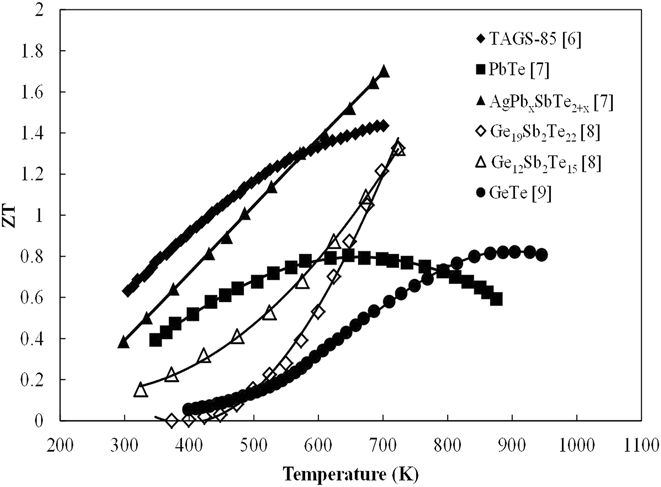
The pseudo-binary tie-line of (GeTe)x(Sb2Te3)1−x, which leads to today's state-of-the-art phase change materials, is anchored on either end by the two materials popularly used in thermoelectrics today, GeTe and Sb2Te3. Many of the phase change materials coming from the GeTe–Sb2Te3 tie-line exhibit adequate thermoelectric conversion, but have yet to be extensively researched and engineered for thermoelectric applications.Reference Tritt and Subramanian6,Reference Rosenthal, Schneider, Stiewe, Doblinger and Oeckler7,Reference Wood8,Reference Lencer, Salinga and Wuttig9 Some of these compounds can be seen in Fig. 1 along with a number of other high-efficiency thermoelectric chalcogenides including TAGS-85, AgPbxSbTe2+x, PbTe, GeTe, and two compounds from the GeTe–Sb2Te3 tie-line. While many of the compounds exhibit high ZT values, toxic and/or rare elements such as Ag and Pb should be avoided. Here we explore the compound Ge4SbTe5, a single-phase alloy from the ternary phase diagram of Ge–Sb–Te, and show that it exhibits low thermal conductivity and possesses a structural phase transition at high temperature which leads to increased power factor values and a high thermoelectric efficiency. This specific compound was chosen for its equal number of cations and anions and large unit cell, so as to avoid any anisotropic anomalies. Current research primarily focuses on the ferroelectric, optical, and structural properties of Ge4SbTe5, but no studies on the thermal and electrical properties have been conducted thus far.Reference Lee, Chin, Huang, Tung, Jeng, Chiang and Huang10,Reference Scheider, Urban, Leineweber, Doblinger and Oeckler11 These materials offer a Pb-free alternative to traditional PbTe-based thermoelectrics and in a more general sense suggests that phase change materials, as a class, may provide a promising new route to high-efficiency thermoelectric materials.
Thermoelectric figure-of-merit (ZT) versus temperature for some state-of-the art chalcogenide thermoelectric materials, including phase change materials from the (GeTe)1−x(Sb2Te3)x tie-line. References for data can be found in the key.

II. EXPERIMENTAL SECTION
Stoichiometric amounts of Ge, Sb, and Te (99.999% purity) were placed in quartz ampoules that were evacuated to ∼10−5 Torr. The ampoules were then sealed, suspended in a vertical furnace, and heated to 900 °C at 2 °C/min and held for 20 h. The melted mixture was then quenched in water held at room temperature. The phase and structure of the resulting ingot were analyzed using a Rigaku Miniflex x-ray diffractometer with Cu Kα radiation and a scanning angle from 20° to 90°.
The ingot was then ball-milled in a stainless steel SPEX vibratory mill for five minutes. The resulting powder was densified using a pulsed-electric-current-sintering method at 673 K and 60 MPa for 30 min. The density of the pellet, measured using an ethanol-based Archimedes method, was approximately 92% theoretical density. A diamond saw was used for cutting the sample into a thin disk, approximately 1 mm thick, and a parallelepiped, 8 mm × 4 mm × 4 mm, for laser-flash and transport property measurements, respectively. Cryogenic (80–300 K) electrical and thermal transport properties were measured using a custom built device which utilizes a linear four-probe method for measuring the electrical conductivity, Seebeck coefficient, and thermal conductivity. Low-temperature Hall measurements were performed on a Quantum Design Versalab, 3 Tesla cryogenic physical property measurement system. The electrical transport measurements at high temperature (300–873 K) were made using an ULVAC ZEM-3 (Chigasaki, Kanagawa, Japan). The thermal conductivity at high temperature was calculated using the following relation, κ = ρDC p, where ρ is the density, D is the diffusivity, and C p is the specific heat. D was measured using a Netzsch LFA-457 (Selb, Germany). The specific heat, C p, was measured using a Pegasus Maia DSC-200 F3 (Selb, Germany) with pierced aluminum crucibles and a sapphire standard from 323 to 873 K. Room temperature sample density was used for the thermal conductivity calculation. The error and uncertainty of the electrical resistivity and Seebeck coefficient is assumed to be ±5%, and the error of thermal conductivity measurements was assumed to be ±10%. Multiple samples were synthesized following the aforementioned synthesis method, two of which are shown in the results below.
III. RESULTS AND DISCUSSION
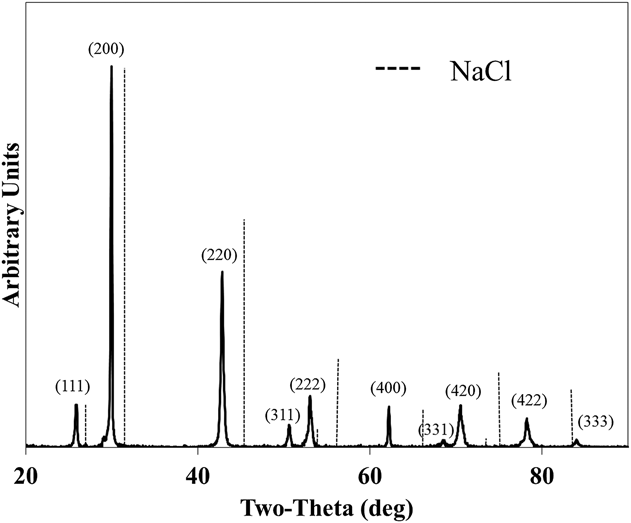
The x-ray diffraction pattern of Ge4SbTe5 after quenching from the melt revealed that the compound forms a rocksalt structure, which can be seen in Fig. 2. The pattern was indexed with respect to NaCl. The lattice parameter calculated from the diffraction pattern is 5.96 Å, with a theoretical density of 6.58 g cm−3. The cubic structure is common in chalcogenide semiconductors with high levels of resonance bonding such as PbTe, Ge2Sb2Te5, GeSb2Te4, and others, as discussed by Wuttig, et al.Reference Shportko, Kremers, Woda, Lencer, Robertson and Wuttig12 Resonance bonding is a chemical phenomenon originally defined by Pauling.Reference Pauling13 Hybridization of the s-orbital and p-orbital electrons in semiconductors such as Si, Ge, GaP, and others leads to covalently bonded atoms which results in the familiar diamond-like crystal structure and high thermal conductivity.Reference Morelli, Slack, Shinde and Goela14 Resonance bonding does not hybridize the s- and p-electrons but rather allows the p-electrons to loosely move between the bonds of neighboring atoms within the crystal lattice. The loosely bonded p-electrons lead to high levels of electronic polarization and high carrier degeneracy.Reference Lencer, Salinga, Grabowski, Hickel, Neugebauer and Wuttig15 The low thermal conductivity in PbTe, which contributes to its advantageous thermoelectric performance, has also been attributed to resonance bonding, which causes the long-range interaction of phonons within the material and the creation of a soft transverse-optical phonon mode. This phonon mode acts as an additional scattering mechanism and causes high levels of anharmonicity, which has been shown to correlate with low thermal conductivity.Reference Lee, Esfarjani, Luo, Zhou, Tian and Chen16,Reference Nielsen, Ozolins and Heremans17 While we have no direct evidence that resonant bonding is playing a role in Ge–Sb–Te phases, because of the similarity of crystal structure and the local bonding environment in Ge4SbTe5 and PbTe, we expect resonance-bonding type effects to play a role in this compound as well.
X-ray diffraction pattern of the rocksalt phase of Ge4SbTe5. Indexed with respect to NaCl.
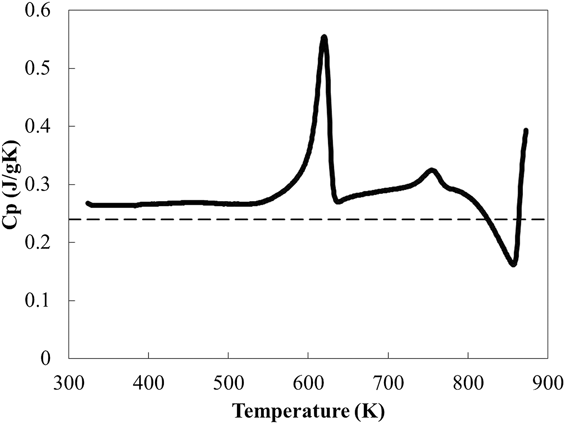
The heat capacity of Ge4SbTe5 above room temperature, which can be seen in Fig. 3, agrees well with the Dulong–Petit value except for an endothermic peak at 614 K. This peak corresponds to a structural phase transition, a common feature in many of the compositions in the Ge–Sb–Te phase change family. Ge–Sb–Te phase change materials will rapidly form an amorphous phase, if cooled sufficiently fast from the melt, then transition to a rocksalt phase upon heating, and finally go through a high-temperature phase transition to a rhombohedral/hexagonal phase.Reference Lyeo, Cahill, Lee, Abelson, Kwon, Kim, Bishop and Cheong18 Tellurium atoms occupy the anion site of the rocksalt structure, while Ge, Sb, and sometimes vacancies occupy the cation site in a random fashion. The ordering of Ge and Sb atoms on the cation site results in the transition of the rocksalt phase to the rhombohedral phase associated with phase change materials.Reference Siegert, Lange, Sittner, Volker, Schlockermann, Siegrist and Wuttig19
Heat capacity of Ge4SbTe5 as a function of temperature, measured from 350 to 873 K. Dulong–Petit value is indicated by the dashed line.
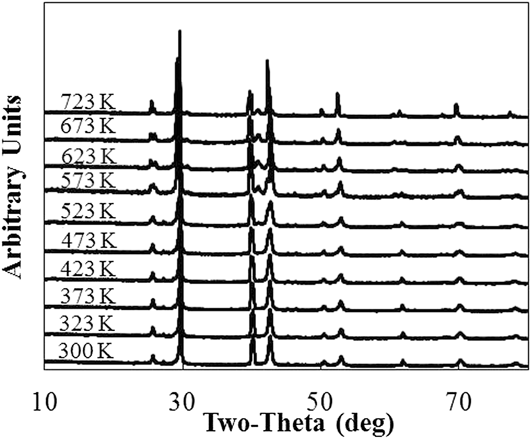
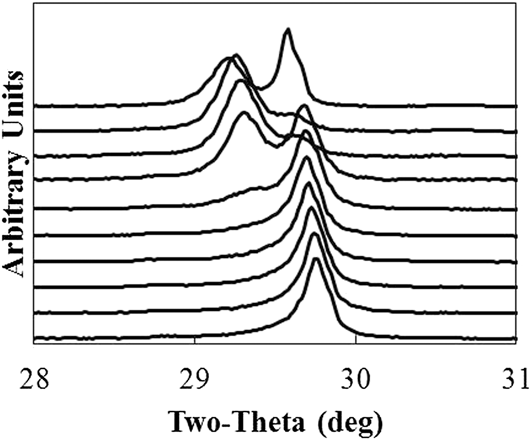
Ruiz et al. have shown that Ge4SbTe5 is a ferroelectric with a Curie temperature of 614 K, which also corresponds to a structural phase transition within the material.Reference Ruiz Santoz, Prokhorov, Espinoza Beltran, Trapaga Martinez and Gonzalez-Hernandez20 They have suggested that like many other phase change materials, Ge4SbTe5 also transitions from the rocksalt phase at room temperature to a nonreversible rhombohedral phase at the phase transition temperature. To further investigate this structural phase transition, temperature-dependent x-ray diffraction was carried out in intervals of 50 K from room temperature to 723 K. The diffraction patterns further verify that the cubic phase of Ge4SbTe5 transitions to a rhombohedral phase starting at 473 K; the results can be seen in Fig. 4. The compound does not return to the cubic phase when cooled again after heating, which implies that the phase transition is not reversible and the rhombohedral crystal structure is stable. Figure 5 displays the x-ray diffraction peak at 29° two-theta as a function of temperature starting at 423 K. The peak at higher two-theta corresponds to the cubic phase with the symmetry  $Fm\bar 3m$. Starting at 423 K, this peak begins to decrease in intensity and a second peak begins to grow at a lower two-theta. This second peak corresponds to the rhombohedral phase which belongs to the lower symmetry space group of
 $R\bar 3m$. As the phase transformation takes place both the cubic and rhombohedral phases coexist. With sufficient heat treatment, the rocksalt phase should no longer exist and the rhombohedral phase would dominate.
X-ray diffraction patterns as a function of temperature for Ge4SbTe5, starting at room temperature and warming to 723 K.
X-ray diffraction patterns of Ge4SbTe5 at the 2Θ peak of 29°. The peak at higher 2Θ corresponds to the rocksalt structure, which begins decreasing at 473 K. The peak at lower 2Θ, which corresponds to the rhombohedral phase, begins to grow upon heating.
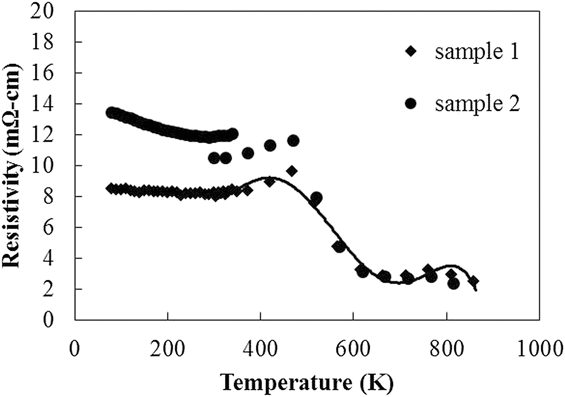
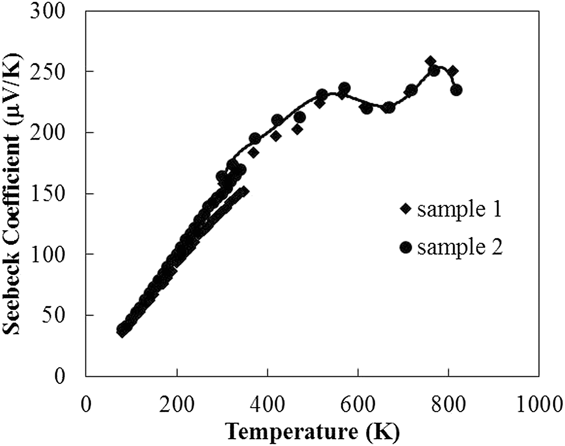
Below 500 K, the electrical resistivity exhibits a slight increase with increasing temperature, which agrees with Hall measurements that identify the Ge4SbTe5 system as a heavily degenerate p-type semiconductor. The hole concentration was measured to be approximately 1020 cm−3 with hole mobility values below 10 cm2 V−1 s−1. The electrical resistivity decreases abruptly by a factor of 4 at the phase transition temperature of 614 K (Fig. 6). The decrease in electrical resistivity is believed to be due to increased carrier mobility at the high-temperature phase transition. The driving force behind the increase in carrier mobility has been attributed to an ordering of Ge and Sb atoms on the cation site, which causes an increase in the mobility edge as a function of energy.Reference Siegrist, Jost, Volker, Woda, Merkelbach, Schlockermann and Wuttig21 The Seebeck coefficient, Fig. 7, exhibits a simple linearly increasing trend with increasing temperature, with a slight dip at the transition temperature. The drastic change in electrical resistivity and unchanged Seebeck coefficient implies that the carrier concentration is largely unaffected. The drop in electrical resistivity at the phase transition would therefore be the result of an increased hole mobility. The power factor, therefore, experiences an increase at the phase transition and reaches a peak value of 22 μW/cm K2.
Electrical resistivity as a function of temperature. Dramatic drop is due to the structural phase transition of Ge4SbTe5, which increases hole mobility within the system.
Seebeck coefficient of Ge4SbTe5 as a function of temperature.
The thermal conductivity (Fig. 8) displays an increasing trend with increasing temperature, which is surprisingly due to the low Debye temperature of the material. The Debye temperature was estimated using the procedure outlined by Slack, which uses the average atomic mass,  $\bar M$, the average volume per atom, δ, and the Debye temperature, θ3, and is all equated to a constant,
 $\bar M\delta {\theta ^3} = {\rm{constant}}$.Reference Ehrenreich, Seitz and Turnbull22 By relating the known values of PbTe (
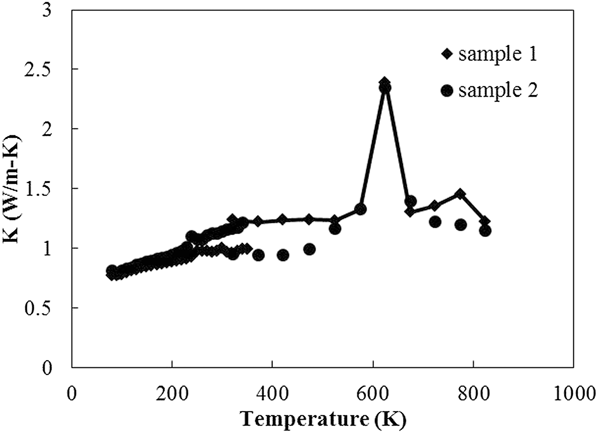
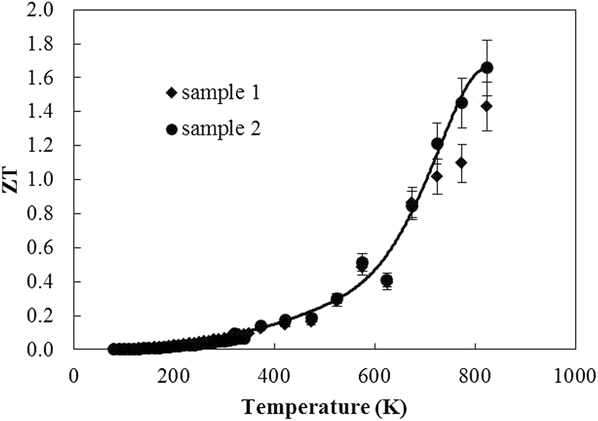
 $\bar M = 105\;{\rm{amu}}$, δ = 0.293 nm, θ = 105 K) to Ge4SbTe5 a Debye temperature of 126 K was estimated.Reference Shindé and Goela23 The increasing thermal conductivity with temperature, which occurs in many Ge–Sb–Te phase change materials, has been attributed to an increasing phonon velocity within the crystal lattice.Reference Lyeo, Cahill, Lee, Abelson, Kwon, Kim, Bishop and Cheong18,Reference Siegert, Lange, Sittner, Volker, Schlockermann, Siegrist and Wuttig19 The thermal conductivity at high temperature experiences a sharp peak at the phase transition, reflecting the behavior of the heat capacity, but returns to a value near 1 W/m K. This intrinsically low thermal conductivity combined with the unusual electrical properties yields a ZT value of ∼1.5 at 823 K. The endothermic peak in the heat capacity, which causes the large spike in thermal conductivity, is the reason for the dip in ZT around 556 K; this can be seen in Fig. 9.
Thermal conductivity as a function of temperature for Ge4SbTe5. Large peak at ∼600 K corresponds to the endothermic peak in heat capacity from the structural phase transition.
Figure-of-merit as a function of temperature for Ge4SbTe5. Represented here with 10% error bars.
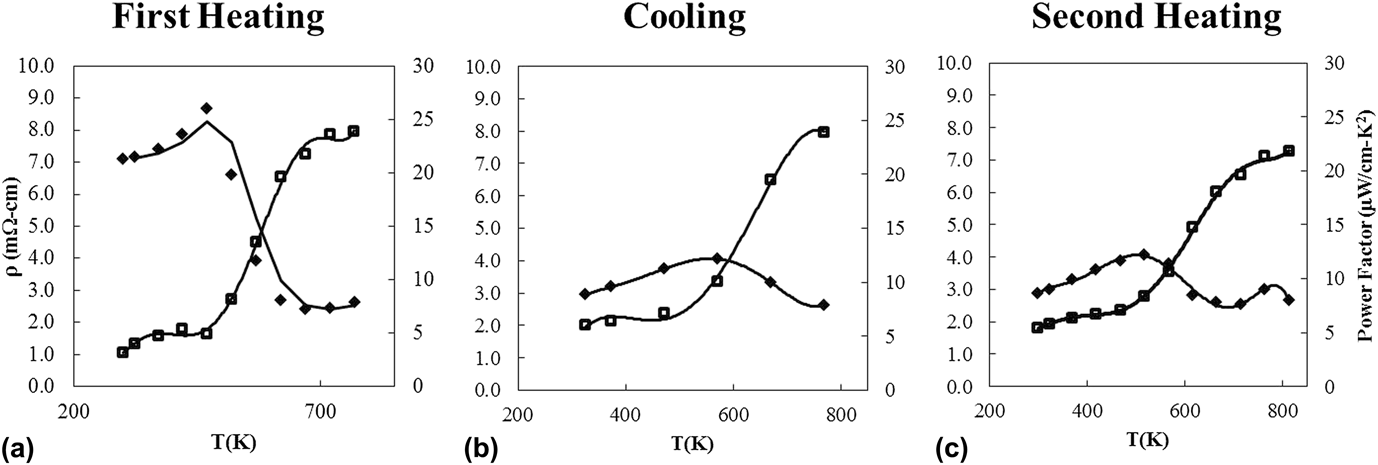
Despite the impressive ZT values of this material, the electrical properties reflect the structural nature of the nonreversible phase transition. To investigate this effect, the electrical resistivity and Seebeck coefficient were measured through multiple warming and cooling cycles using an ULVAC ZEM-3. Figure 10 shows the multiple measurements of the high-temperature properties. The initial run (a) shows the dramatic decrease in electrical resistivity which occurs at the phase transition. Upon cooling (b) the resistivity shows hysteresis and does not return to its original value but rather remains close to the original high-temperature value. The Seebeck coefficient follows the original curve within a 10% error. Upon reheating the sample (c) the resistivity remains quite low and mimics the cooling curve behavior with a slight drop at the phase transition temperature. The power factor at high temperature is not adversely affected by the nonreversible phase transition implying that the overall thermoelectric efficiency of these compounds will not be drastically affected by the nonreversible phase transition.
Multiple high-temperature runs on Ge4SbTe5. Electrical resistivity is represented by the closed diamond, ♦, and the power factor (S 2/ρ) is represented by the open square. (a) First heating phase. (b) The first cooling phase. (c) The second heating measurement.
IV. CONCLUSION
Ternary compounds from the Ge–Sb–Te phase change family typically form rocksalt compounds with large unit cells that contain many atoms. The compounds also exhibit high levels of resonance bonding which result in low thermal conductivities (<2 W/m K). Ge4SbTe5 is a phase change material that has yet to be analyzed for thermoelectric applications. This work, for the first time, has studied the electrical and thermal properties of stoichiometric, undoped Ge4SbTe5 and found that it is a degenerate semiconductor with a high-temperature phase transition from the cubic rocksalt phase to a rhombohedral phase. The phase transition also drives a sharp decrease in electrical resistivity, resulting in a large enhancement in thermoelectric power factor. The Seebeck coefficient and thermal conductivity were relatively unaffected which allows for a ZT = 1.5 at 823 K. Temperature-dependent x-ray diffraction revealed that the phase transition takes place over an extended period of time allowing for the coexistence of both phases simultaneously. The phase transition is driven by the ordering of Ge and Sb atoms on the cation site and results in an increase in carrier mobility at high temperature. Future work to lower the electrical resistivity through doping and also lower the thermal conductivity through isoelectronic substitutions and microstructural engineering are currently underway. Phase change materials, as suggested in this study, may prove to be interesting thermoelectric materials because of their complex structure and high-temperature phase transitions, though much work is still needed to engineer these materials for thermoelectric applications.