This story begins with artist Daniel Buren's Watch the Doors, Please!, which was realized at the Art Institute of Chicago and on display from October 1980 to June 1982. In this work, he posted his signature stripes on the doors of the Illinois Central Gulf commuter railroad that ran beside the institute's Morton Wing and apparently took down part of a brick wall so that the two-story window of the wing would reveal the passing train. Buren then posted the train schedule adjacent to the window to alert museum guests to their viewing opportunities. One could view the work from inside the museum, but the work itself lived in the world. Because the work was literally fixed to the trains, it made explicit the institute's connection to the larger city and region. Buren's early work tirelessly dealt with its context. In his view, the museum creates a sheltered space whereby protecting and interpreting works of art reinforces the authority of the institution, while also placing art in an idealized framework separate from the real world.Footnote 1 According to Buren, artwork displayed within this context implicates the artist “if it does not explicitly examine the influence of the framework upon itself.”Footnote 2 In her book New Art in the 60s and 70s, Anne Rorimer describes Watch the Doors, Please! thus: “It was a work that totally fulfilled Buren's aspiration for an art that, dispensing with the traditional canvas, does not hide the context in which aesthetic practice is conducted.”Footnote 3 The deftness with which this work addresses Buren's central question of the context's effect on the work of art is noteworthy. He produced an artwork that implicitly critiques the mechanisms that display and circulate it.
When museum visitors pass through this space now, there is no sign or mention of the former intervention, but there is a peculiar persistence that is the product of disruption. Although the view is no longer obstructed, sheer curtains now render the train yard a soft impressionist backdrop, unlike the unadorned windows that look directly into the institute's more manicured and architecturally intentional interior courtyard, for instance. By using the window to frame the outside of the museum within the museum, Buren interjected the fraught and living world within a display of visual art. Like Brancusi's sculptures that incorporate the pedestal, both acknowledging and frustrating the division between the sculptural object and the world, the work exposed the museum itself as a pedestal and consequently underscored the troubled boundary between art and life. For those who know the history of Watch the Doors, Please!, the window is a presence, and the train yard is always palpable. It was as if Buren rendered a museum wall translucent, breaking the spell of the institution.
This special issue of the Journal of American Studies is titled Inhabiting Cultures because we are interested in scholars and creative workers who are actively involved in producing the very cultures they research and critique. We wanted to highlight scholarship that was engaged in cultural participation and simultaneously point beyond the journal's status as a platform through its own framing mechanism. Like the window in the Morton Wing at the Art Institute of Chicago, this journal issue might be thought of as an institutional framework through which we see our contributors trafficking in the world in a manner that opens up the messiness of inquiry and its representations. We hope that pointing through the frame also makes the frame itself a subject of examination.
John Q is an idea collective. We attempt to trouble the differences between such things as art and scholarship, with a particular commitment to the boundary crossing inherent in public scholarship.Footnote 4 Some of our past work has been peer-reviewed, as here, and some of our work has taken the form of public actions and performances. The invitation to guest-edit was a generous challenge to imagine something different in scholarly production. While many of our contributors wrestled on various registers with how to produce texts that might challenge the boundaries of scholarly reach, John Q likewise tried to address what it means, for example, to write this essay as a collective that produces performance and public actions. In other words, how might we imagine writing itself as a publicly situated, collaborative practice? If John Q is committed to making knowledges with publics, how might we leverage that intention within a scholarly journal? Looking back at Buren's Watch the Doors, Please! today as a kind of equation that might be inverted, we wondered if, instead of continuing to watch from the window, we would rather be on the train.
In a 2008 lecture at the School of the Art Institute of Chicago, visual culture scholar Irit Rogoff stated,
For me, that is the trajectory of participation: from a kind of consciousness raising that moved us to becoming a critically conscious audience, to one which is mobilized into a kind of critical activity, to one in which our subjectivities were assumed to complete the works which we encountered, to I think where we are now in which …we have in a way become the work.Footnote 5
We suggest here that our practices in their own contexts might function as scholarship. What if institutions were not privileged arbiters of culture? What if it made more sense to be on a train than in a museum? The notion that we might ride a train as an editorial act appealed to our desire to translate our scholarly practice through public action. In a spirit of collaboration and participation, we undertook what we called our “training project,” a way of practicing what it might be like to undivide our claims from the methods that produce them and the way these things become subsequently represented and distributed. While John Q would be purposefully on a journey with each of our contributors, their relationships with each other would be more tenuous and renegade. We wanted to think of this project as a shared space where contributors would wander in at different times, some noticing each other passing through, some requiring our careful attention for more extended periods of time, others only sitting with us briefly as we blazed through more and less common territories. As a way of putting our own public actions in relation to our work as editors, we used the train to think through editing. On 17 August 2016, we rode the Chicago Transit Authority Red Line from end to end and back with no intention other than to ride the train as we might edit a journal. We rode a train to write this essay.
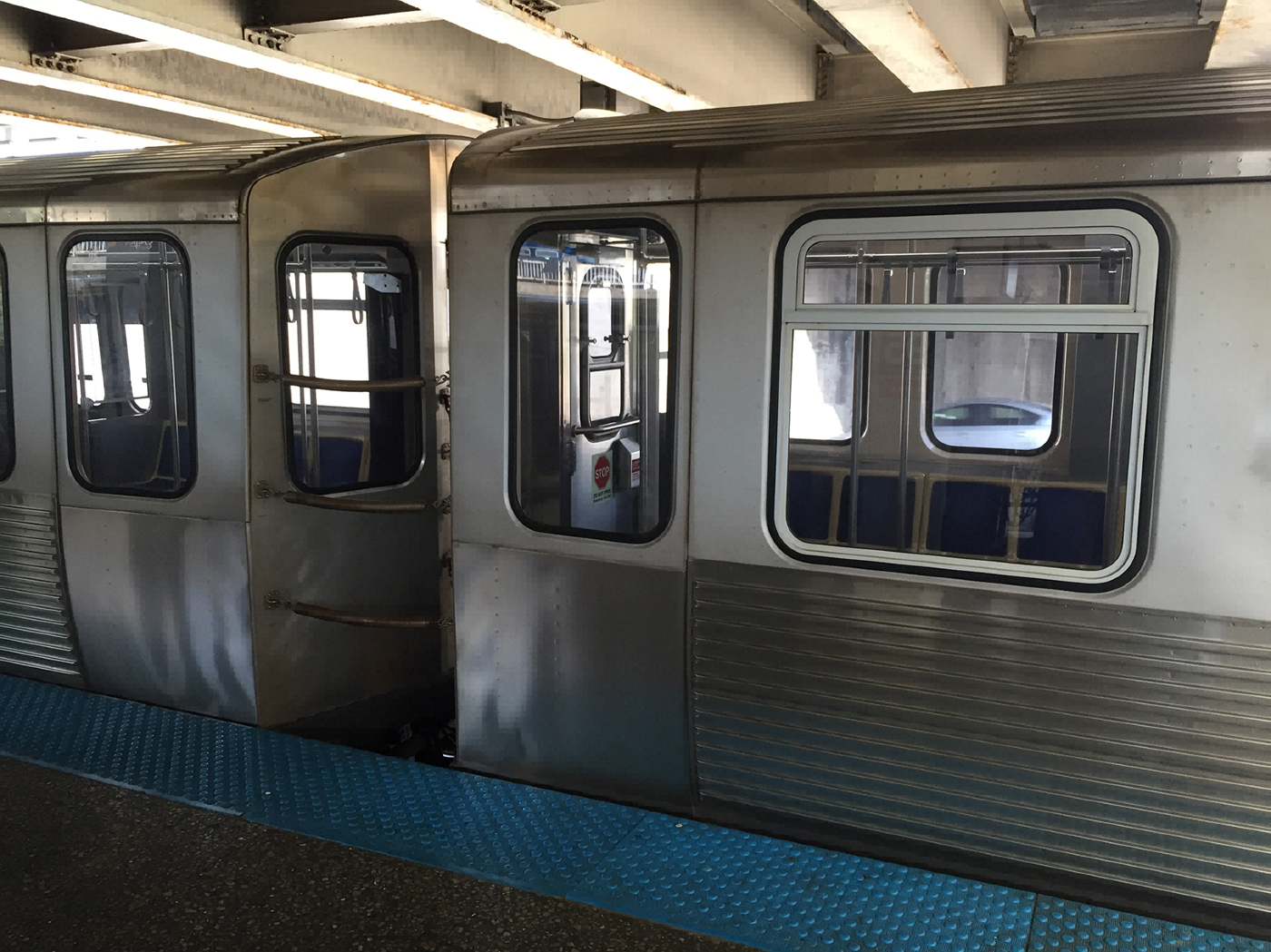
Train on the Red Line, Chicago, 17 August 2016. Photo: John Q.

At that time, one member of John Q was living in Chicago and so getting up, getting dressed, and taking this same train to work each day. The day of our training, he did the exact same things he always did, but it was different. There are at least two reasons for this difference. One was to bracket everyday life, to intentionally and consciously deploy it as a way of seeking knowledge. We codified this daily walk through the world, registering it as a method to find something out instead of as a way of getting somewhere. The second reason was to unfetter the ride from its usual banal, productive activity of getting to work, though this mode of transportation can also function as shelter, tourism, a space of personal and monetary exchange, and many other things. Although our task was eventually to write this essay, our activity was dictated only by being present on the train. There was no real, clear hypothesis. Simply riding the train was our guide. We were reminded of French literature and culture scholar Kristin Ross's early work on the Paris Commune, The Emergence of Social Space, in which she suggests that everyday life is, in fact, a spatial concept.Footnote 6 Or more explicitly in discussing philosopher Jacques Rancière's work, she states, “the usefulness that gains the worker a place in the city is what prevents him or her from doing anything other than his or her task – from being a citizen, for instance.”Footnote 7 So our labor that day was not marked by productivity in the sense it generally is. Being anonymous on a city train might short-circuit the shock of modernity if we are able to inhabit it as public citizens, a rare opportunity the two of us can occasionally manage by way of both our intentions and privileges.
In our exploration of the space between scholarship and art, the idea of intermedia introduced by Fluxus artist Dick Higgins seems relevant. For Higgins, the term refers broadly to work that falls between known media.Footnote 8 We would also point back to the blurring of art and life in US artist Allan Kaprow's practices, Happenings, and instructions. As part of the 2012 catalogue for the Brooklyn Museum's Materializing “Six Years”: Lucy R. Lippard and the Emergence of Conceptual Art exhibition, Catherine Morris describes Lippard's use of “Conceptual art methodologies” in the service of “critical writing, curating, and later, political activism.”Footnote 9 Although written about a specific history around particular exhibitions and innovations in the visual arts, this essay by Morris is some of the most cogent writing we have found about what she describes as “the extended intellectual applications of Conceptual art.”Footnote 10 It has been challenging and fun to explore something like conceptual scholarship, to imagine research in radically dematerialized ways so that what we produce here could in one way be seen as journal residue and ephemera of the methods that produced it, rather than as an ultimate goal achieved through those methods.Footnote 11 Just to push this to its intellectual limit, what if the scholarship were the pursuit of an idea and not the idea's written expression? Even though our writing and that of our contributors now circulate by way of a scholarly journal, the work that produced it may actually be more akin to pointing at you in the journal from our train. We are trying to avoid claiming the methods as either primary or belated in relation to the writing.
Of course, the reason for making distinctions between fieldwork and journal articles is precisely to give ourselves the time and space to get some distance on our practices, to hold them up against the theoretical and historical frameworks that make us accountable to the work of others and to ideas dissimilar from our own. In our discussions about our train riding, we reflected on how, after several stops, we might ask ourselves, who have I not yet noticed on this train and why? This is where we pry our own biases when gender, race, class, ability, age, and myriad other things intersect at odd angles with our past experiences, creating both highlights and blinders. And when we notice someone based on the directive to be aware of who we are not noticing, how does that factor in their subjectivities and potential for meaning-making in relation to our work? One of us liked a guy sipping a pink liquid from a chain coffee shop while dancing to his music. Noticing him was effortless, as was the enjoyment of this intimate spectacle, played out somewhere in the overlap of interior life and public space. In the midst of trying to be attentive to others on the train, the particular ease of such an attraction announces itself, standing in relief to the more difficult process of awareness of those we are not noticing. So we continued. From the north side to the south side, as in many cities, the most glaring shift was in race and class. And time was a factor, as well, as the mostly younger and well-dressed flooded the train toward nine-to-five jobs during morning rush hour. In practice we tried to keep ourselves attentive toward our contributors and future publics, but also to inhabit the train as an alternative relation to the journal and to our own contribution.
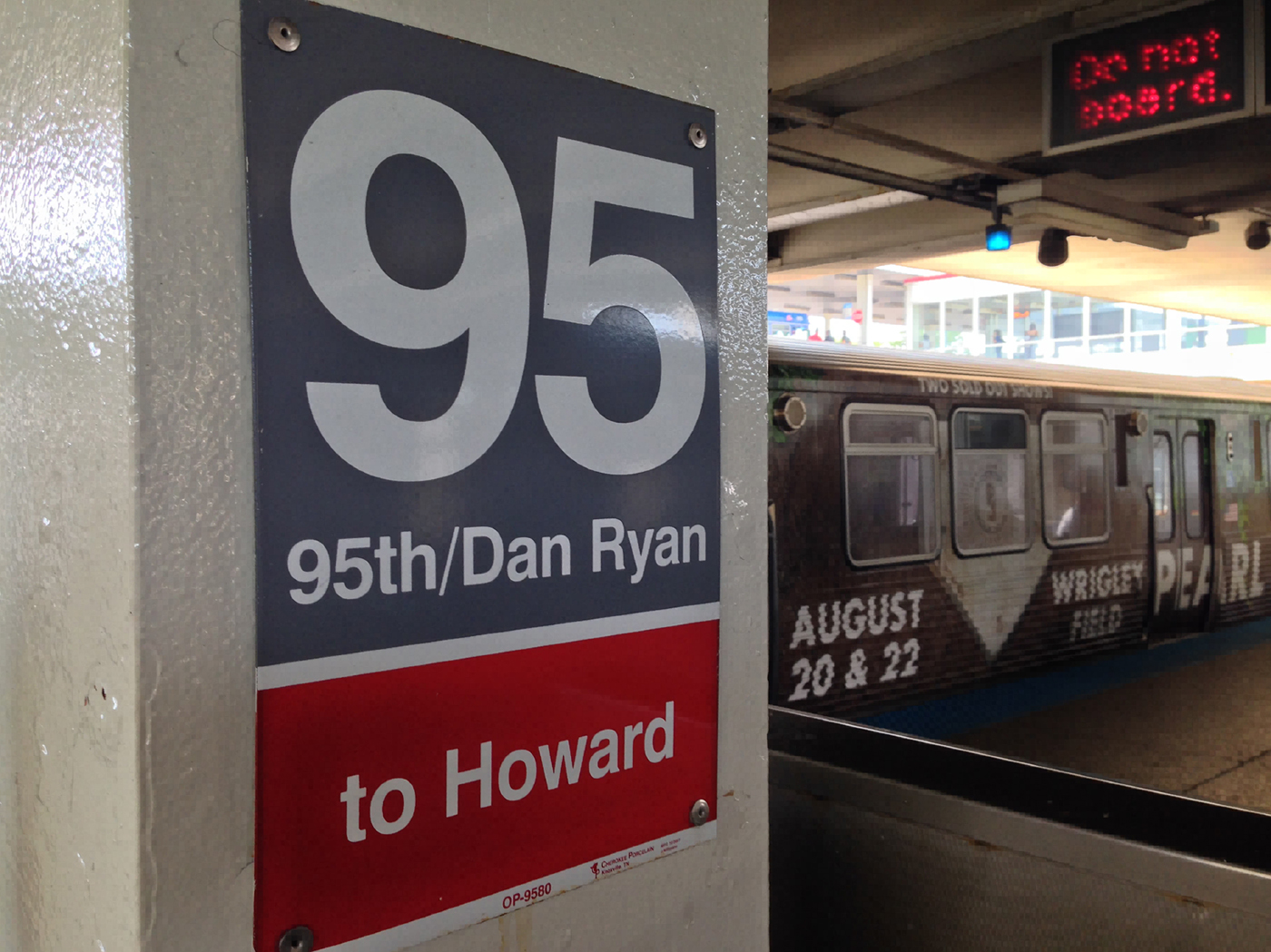
Red Line station, Chicago, 17 August 2016. Photo: John Q.

Our title for this issue, Inhabiting Cultures, is in part a coincidental nod to the thinking of Irit Rogoff. In Rogoff's contribution to Gavin Butt's edited volume After Criticism, she discusses a move beyond criticism into participation: “operating from an uncertain ground which, while building on critique, wants nevertheless to inhabit culture in a relation other than one of critical analysis; other than one of illuminating flaws, locating elisions, allocating blames.”Footnote 12 We are interested in the move to build on critique, but using the scene of writing to explore different kinds of relation. In his introduction, Butt eloquently describes writing the performative thus: “engaging in a performative modality of criticism: one which does not reproduce the object or event it addresses but instead enacts it through the very practice of writing.”Footnote 13 It is a statement that sets a bar so high as to make writing after its citation a nearly impossible task, one filled with gaps, limits, and failures. But we continue.
The relations this writing is thinking through are happening at multiple levels, variously among editors, contributors, publics, subjects, objects, institutions, and others. We hope not to uncomplicate these shifting relations, but to lateralize them on a playing field so that their values and positions shift with the formulation of each new practice and approach. And while we certainly appreciate the citational value of fixed scholarship, we would suggest that methods and practices may not always be intended as models for advancing knowledge, but knowledges themselves that may be enacted in any number of combinatory possibilities. The fact remains, however, that inviting you to ride trains differently may be what we accomplish here. Riding the train with empathy and critical attention throws into relief our attractions and our blind spots. Put another way, to inhabit culture is to recognize links between love and critique, and to put these links into practice.Footnote 14
In an early essay, “Love as the Practice of Freedom,” bell hooks observes, “In this society, there is no powerful discourse on love emerging either from politically progressive radicals or from the left.”Footnote 15 Indeed, it does not occur to us to theorize love here, nor to look to theory for ways to talk about it. Instead, we want to limn the relationship between love and critique, in practice. In his memoir Tropical Truth, the Brazilian musician and writer Caetano Veloso states, “To be sure, I was aware that we were being faithful to bossa nova in doing something that was its opposite.”Footnote 16 Veloso rejected bossa nova's synthesis by making collage and juxtaposition fundamental to his work, and further distanced his music from bossa nova's national identification by the scandalous incorporation of British and American rock influence. Yet he understood his work to be following from bossa nova all the same. Veloso's formulation – to be faithful to a form by doing its opposite – gets at something fundamental about critique as a practice of commitment and careful handling. We understand this issue's contributions to be in this tradition.
This essay might be a Foreword. Forewords are closures, of course. By the time of this writing, we have read and reread the contributions many times over. We have communicated with everyone individually. We have tried to articulate our own purposes to the editors-in-chief and to ourselves. You might say the Foreword is like a speech at a wrap party, the part that happens at the end of exciting work but only points back to it, making it past. It would be sensible to see the writing about the train as subsequent to riding the train, but we did not ride the train to describe what it is was like to ride the train. We rode the train as a writing. And now, we think through what it is to write as a form of riding with others, in space – although now, the space is that of writing itself. We would further suggest that our actions and those of our contributors – the methods – are the scholarship, and writing is simply one of its forms, connected to all of the other component parts of the process. Our present, embodied experience on the train was both real and discursive. However open we were at the time, the decision to leverage the experience prior to having it made it conscious and thus performative. We do not identify the train riding as primary and the essay writing as its scholarly or academic representation. Both are experiential and representational forms. Since we are also operating here as we were on the train, we will use the anteriority of the Foreword's placement to remind ourselves that closings are also openings. If the fundamental challenge of writing this essay is the jump between (train) riding and (essay) writing, this would be no time to settle into habitual writing as one might settle into a train commute with earbuds in, if you're lucky to get on sufficiently early or far enough out on the line to actually get a seat. We do not want to create an incoherent form here, but we simultaneously want to avoid reproducing formats that often erase the kind of work in this issue. We are keenly aware that these contributions emerge out of gaps that also threaten to dissolve them.
Although the equation might likely be riding-then-writing, we are going to try to resist this forward motion by surfing the gaps, trying to stay in them, knowing in advance that to make voids and tears visible is to fill them and displace them. In his own preface to the 1961 edition of History of Madness, Michel Foucault suggests that history is only visible against the absence of history, what he calls “a great space of murmurings that silence watches like its vocation and its truth.”Footnote 17 “A Land of Shadows” by Jason Francisco makes its visual claims in these very gaps. The work reimages a nineteenth-century California state commissioner's journal that catalogues immigrant Chinese laborers through photography and descriptive notes. The original source is a tedious and insidious example of administrative capture. Is the historical image maker creating a composite of “the Chinese rural immigrant,” or is he making evidential truth claims that could absolutely confirm the identity of particular undocumented individuals? In either event, the method is connected to eugenics and racial profiling. It reminds us that Francisco was in conversation with the late artist and photo-historian Allan Sekula for years. Sekula has described his 1986 essay “The Body and the Archive,” on the history of police photography as an investigation into the “most extreme rigorous, realist claims,” which he sees as an epistemological problem – the equation of a maximally detailed realism with truth claims.Footnote 18 In Francisco's own investigations into such juridical cataloguing, he interjects his own images of mostly empty, unpopulated landscapes that make nods to these lost histories without filling the void in knowledge or erasing the question of our inability to locate the subjects of the photographs. In fact, one of the most prominent visual tropes in Francisco's work is the deep seam running vertically down the center of each image. We might ignore the dramatic caesura since we immediately identify it as the journal's spine, but this is not only documentation. It is also a space in the photographic composition where the seam pulls the text and images down into its binding mechanism to pin it all together, at once fixing its meanings and evacuating its subjects. Francisco inhabits the text to critique it. In other words, he uses his own photographic and creative practices to interfere with the historical mechanisms that make these Chinese immigrants both visible and lost to us.
On the train as John Q, it is important to remember that one's collaborator is at times directly across from you, sharing expressions that confirm meanings, ask questions, or politely acknowledge that both of you are working now. Other times, however, although we knew the other was on the same train, or even one car down, our experiences and notes may not even be connected or referring to the same things. Francisco completed this work before we ever approached him. It is unlikely that both of us connected Sekula and Foucault, or at least at the same time or in the same ways, or how these interactions might have connected us, in our collaborative experiences, to Foucault's relevance to the practices of visual-culture historian Katherine Lennard. Her contribution examines a quilt made of fragments from Ku Klux Klan robes, and during this research she occupied all manner of personal and public repositories, shaking out “bad objects” and attracting attention that produces meanings across deep and troubled strata. If white-supremacist power becomes legible by making African Americans violently exterior to it, administrative power makes white supremacy institutionally and publicly present now, often for the purpose of historically interpreting it as part of the story of US civil rights, by exhibiting its artifacts.Footnote 19 While the researcher's body is in some ways produced by the very systems of power that traffic in these artifacts, Lennard's research, its organization, and her relation to her work, her subjects, and potential publics are all strands that can intersect differently and beyond her influence. Occupying multiple positions is a moving practice that is open to the shifting subject–object relationships inherent in deep study.
Lennard's moving practice not only refers to the multiple positions she occupies or otherwise activates, but also has to do with her own imagining of new relations of research method to writing. We read her essay title, “The Running Stitch,” as a reference to the connection of her own historical work to the lineage of the specific quilt stitching she is writing about. Her practice is an intrepid inquiry into her historical method alongside the production of material culture she is examining – closely reading objects she is trained to read, while trying to read her own work as critically and as closely. What are the fabrics of meaning they each produce? Do they dismantle harm, or reinstate it, even if in unintended and errant ways? She is clear about her own goals and that those of the quilter are not knowable, and she uses the quilter's labor as a way of investigating her own. She acknowledges that her labor is connected to an unruly network of public, private, and commercial makers and preservers, many of whose intentions her own scholarship works to undo. She also concedes that as another maker, she may not ultimately control some of the destinations of her own work.
The archive can also be a space of escape – from dis-spirit, from frantic activity with inadequate compensation, from the job market, from dreading the future, recriminating the past, and far worse. At the moment we write these words, the death toll from a chemical attack in Syria has reached seventy, including children, the attack itself widely believed to have been precipitated and countenanced in advance by remarks from the United States Secretary of State.Footnote 20 The knowledge of this event establishes itself as the immediate context for our writing now. Other events and knowledges are yet to come. Your apocalypse may look different from ours, but wherever and whenever it happens (and it happens, continuously), the work of scholarship, thinking, and writing is accountable not only to the judgments of peer review or of the historical record, but also to our anxiety about its comparative smallness in the face of suffering. Against this the archive beckons as a place of renewal. We practice research as if the past – and by extension the present – were, incredibly, impossibly, a space of potential as well as abject fear, imminent destruction, a cruelty all the more unimaginable for being so real. It makes little sense to question the archive without also acknowledging its succor. We trouble the archive because the archive can take it. And we trouble the archive because we love it. This is what it means to inhabit culture.
Paul Durica, like us, loves archival research. He loves it because of its openness: “it preserves but rarely interprets.” Durica details how, as a researcher, he seeks out and interprets archival materials, a selective process that underpins the coherence of his scholarship. However, he also preserves those details that may be less relevant to the main story but remain stubbornly attractive. This tension is reflected in Durica's medium. From 2010 to 2015, he produced public events, specifically reenactments of historical events in Chicago, under the name Pocket Guide to Hell. Durica's work is public scholarship, but he collapses the distinction so often taken for granted in that formulation. The organization and presentation of events with dramatic shape, taking place in and among the public, requires not only scholarly rigor but a kind of emotional integrity essential to the effect and understanding of these events. Similarly, his reenactments were not fixed accounts producing the deliverable of a conventional historical narration. Rather, they were sometimes messy events that enacted “the past as public space,” in which anyone can take part regardless of expertise. His reenactors are amateurs, volunteers, and people who are invested in this work for some priority other than historical verisimilitude. Some may even have undertaken it as a lark, but in the process of enacting the deaths of labor activists or police officers, for example, they experience a present-time connection to a past that shifts suddenly from unimagined to unforgettable. Central to Durica's project was the relation between careful advance planning and incorporation of unforeseen actions during his events. This collaborative approach extended even to spontaneous crashing of events by onlookers and other forms of participation unauthorized by the project's creator. He concludes his account with a story about his Haymarket riot reenactment, in which a self-described “ninth anarchist,” a young man “not in period attire and with large headphones over his ears,” climbed aboard the wagon of eight reenactors and attached himself to the unfolding narrative. In the moment, Durica honored the young man's participation over his previous design.
Pressure from an arts organization to employ professional actors in the commissioned project that Durica describes in his essay is but one detail in the story of how the Pocket Guide to Hell came to an uneasy compromise with an institution. This revealed to its author the limitations and impasses of his chosen form when it was enacted in a way that tamped down the element of collaboration with an unruly public. The sixth contributor to this issue – we'll call him Kevin – wrestled with his contribution for months, over several meetings designed to guide him through the process of not translating or changing his artistic work to suit his perceptions of what an academic journal audience would want. Our encouragement to Kevin, as with all our contributors, and ourselves when we needed it, was that we wanted what he does already. With this special issue we are not interested in translating forms, methods, or critical processes into disciplinary scholarship, but in enacting methods from outside this paradigm, methods that are already used as modes of knowledge. “The study already under way, among people,” as Fred Moten and Stefano Harney describe their idea of “black study”:
The notion of a rehearsal – being in a kind of workshop, playing in a band, in a jam session, old men sitting on a porch, or people working together in a factory … The point of calling it “study” is to mark that the incessant and irreversible intellectuality of these activities is already present. Most of this goes unrecognized because it does not take the form of “proper critique” …Footnote 21
Although we are interested in our practices as knowledges in their own right, still the journal exerts its pull. Kevin's struggle with not translating his work into scholarly language was palpable, as it was for all our participants. In his case, it felt as if he feared the context of the journal might extinguish his practice and even dissemble him. His eventual response was to silently exit the train. Unlike the self-announced “ninth anarchist” who inserted himself into Paul Durica's event, our sixth contributor removed himself from our project. We restore him here in the blank page following this one. If we are being experimental in our methods and approach, we must remember that failure is always on the table. As the ninth anarchist inserted himself into the past-as-present, we insert our sixth contributor to the journal-as-public space as acknowledgment that gaps and fissures cannot always be articulated.
We have suggested above that to inhabit culture is to contextualize one's practice in a field of critical attention, empathy, and affection. As Durica's project shows, relating archival pasts in the present through experimental collaborations with publics is a method for this inhabitation and also a mode of knowledge. As we write, the artist Dread Scott is preparing to present his Slave Rebellion Reenactment project in 2019.Footnote 22 The particular rebellion to be reenacted is a little-known 1811 action of wide implication – a well-planned attack by black slaves meant to seize the territory of Orleans and end slavery. Scott's interest inheres in the rebellion's implications for revolutionary potential. As he sees it, the slaves who revolted were not interested in becoming part of American democracy, or of fulfilling the promise of a Constitution that, after all, had codified slavery. Equally interesting to us here is Scott's account of how he came to know this particular historical event: on the one hand through a scholarly work of history with origins in an undergraduate thesis at Harvard, and on the other hand through an extensive engagement with the community researchers whose previous exhaustive work underpins the university-trained version and who learned about the rebellion as children from family members, before the history became more widely circulated. Scott's method for organizing his “army of the enslaved” as reenactors depends on word-of-mouth networking among the participants. This method matches the method of the original rebellion's organization, but also that of how its history was kept alive and disseminated.
We took several long rides with the collective I'm Making a Boy Band (IMMABB), which consists of Bora Kim, Karin Kuroda, and Samantha Y. Shao. This was mostly because both of us, as collectives that traffic in art production, were wrestling with our own work in the context of a peer-reviewed, academic journal. In some ways, IMMABB's project to leverage gender studies and postcolonial perspectives on the very activity of making a Korean pop boy band was the most fraught. They are K-pop fans who created a K-pop boy band with all-US members. It was originally conceived as an art project, but the mark of its success was commercial fan acceptance in South Korea. When we approached them, one of us had witnessed their band, EXP, in person at Art Basel Miami in 2015. The spectacle was grand. In between musical numbers, the band members would go still and the female members of IMMABB would freshen them up and redirect the action. They were clearly authoring the event. All three were based in New York, then. At this writing they and the band members have relocated to South Korea and are heavily involved in the production of music videos and other projects intended to make EXP a genuine commercial force in K-pop. IMMABB's contribution to the journal, a manual on how to create your own K-pop boy band, is written at what we take to be a transition point from a project primarily located in the field of art production to one whose artistic success is deeply tied to its commercial impact in the world of popular culture.
In our initial research to make sense of their project in this context, we looked to previous works that, for us, provided an intellectual framework. One was Benedict Anderson's work Imagined Communities, since nationhood and the sense of belonging to an abstract group was pivotal, as were critiques of imperialism. Another was Sianne Ngai's work on cuteness as an aesthetic category of late capitalism.Footnote 23 A third was Jimmy Cauty and Bill Drummond's The Manual (How to Have a Number One Hit the Easy Way). This pocket guide was authored by members of the band the KLF, variously known as the Justified Ancients of Mu Mu, the JAMs, and the Timelords. In fact, this band, subversively critical of pop music industry norms yet producing genuinely appealing recordings with international commercial success, is exemplary of our notion of inhabiting culture. We set out with the goal of seeing whether Bill Drummond would offer commentary on the making of a boy band. Instead of engaging in an interview or in any official, critical response, he challenged us with a series of twenty-three questions. The questions were as follows:
1 How long should a boy band last?
2 How old should a member of a boy band be, when he is first chosen to be in a boy band?
3 Why would any young man want to be in a boy band?
4 How fat can a member of a boy band be?
5 Is it good to have one member of a boy band openly gay?
6 Or two members, or three members, or all four members?
7 Does a young gay man have a better idea than a young straight man on how to present himself for the gaze of teenage girls?
8 Does having an Art overview of the process of creating and exploiting a boy band undermine the very purity and process?
9 How extreme can the political opinions of a boy band be?
10 Does brand endorsement of a boy band undermine their credibility with their audience?
11 Does this matter if the fee for the endorsement is bigger than what can be financially extracted from the core audience?
12 On Instagram, what ratio between followers and followings should a boy band have?
13 Is an Instagram following more important than a Twitter following for a boy band?
14 If a member of a boy band is seen to be thinning on top, should he shave his head immediately?
15 What drugs is it okay for a member of a boy band to take?
16 Should individual members of a boy band be allowed to Tweet?
17 What difference is there between a boy band of today compared with a boy band from five years in the future?
18 What was your all-time favourite boy band?
19 At what age should a young woman decide to no longer scream at her favourite boy band?
20 How long should a fan of a boy band be a fan of the same boy band before switching her allegencies?
21 Does every boy band need a bad boy, a funny boy, a cute boy, and a dumb boy?
22 Should members of a boy band draw straws to see which one of them is to get drunk on a long-hall flight?
23 What criteria should be used to call a halt on the career of a boy band?
Then, he added, “I forgot the word ‘shaved’ at the end of one of the questions.”
To which he later added, “And replace ‘dumb’ with ‘arty.’”
Drummond's past critical thinking about the music band as a cultural phenomenon is incisive, and his email exchanges were rapid and filled with razor-sharp wit. The questions above were posed to John Q, though we imagine IMMABB would have different reactions to the various questions – answering some succinctly from experience, while for others pointing to their own practice as ways of exploring some of the complicated dynamics that get comically collapsed in Drummond's questionnaire. Drummond's and IMMABB's very different perspectives and takes on culture, seen through their commitments to both critique and practice, show that the perilous and the comic often coexist in that gap and suggest that the gap itself is not a fixed space. Although the projects of Paul Durica, Dread Scott, and I'm Making a Boy Band draw respectively on histories of politics, slavery, and race that are of the utmost urgency, these projects nonetheless draw on a sense of play that only deepens their seriousness.
Here we point back to you from our position on the moving train. Earlier in this writing we said that we rode a train to write this essay. But we did not really ride the train in order to write this essay. We rode the train and wrote this essay. We are still fussing over the relationship between the doing and the writing-things-up because the writing is not simply a report on the results of our methods, but one method among many, and we want to intentionally not privilege this essay over things like riding trains, reenacting histories, or making boy bands. All of these activities contributed every bit as much to scholarly activity as writing did. This is not meant to disparage writing. In fact, we wrote for the same reason we rode the train, to learn something. Writing does not want this undue attention, anyway. It is asking too much of writing for it to be or represent all that we do. Writing is generally privileged because it begets privilege, shoring us up into “academics,” “professors,” and “curators” instead of practitioners who traffic in a plethora of activities in our critiques and inquiries.
We have, therefore, attempted to write about our practices, and those of our contributors, in a manner that keeps focus on the doing. We began with a story from the Art Institute of Chicago as a way of pointing to the Journal of American Studies, acknowledging this work's institutional context. But it is not a one-to-one analogy. Does the museum represent the journal, and the train our editorial work, or is it more nuanced than this? The metaphor eventually fails us. So we can call citational scholarship fixed and then attempt to resist its fixity with talk about gaps and fissures. Or alternatively we can suggest that it is perhaps not as fixed as it seems, but simply another method to be experienced in our play with knowledge and power. In any event, we have reached a limit now.
By beginning with Buren's work we may have set up a divide: inside the institution and outside the institution. We want to suggest that this could be approached as an artificial divide, for the institution does not live outside the world. To think only of pushing against it from the outside is not an adequately complex model. The most effective institutional workers may very well be those who are most comfortable with the institution's possibility of failure. True critical work would not shore up its own platform, but rather pursue its inquiry with the understanding that democratic institutions do not exist to preserve themselves over the freedoms they purport to strengthen. The reason for riding the train, and by extension the reason for editing this issue, was to hold ourselves accountable to those around us, and to hold our institutions accountable as well. We know that, in the end, all institutions are really only answerable to their constituents, and all groups are exclusive. So empathy is a skill that requires exercise and practice, and we see this as an issue of urgency. The process of riding the train and writing this essay was an exercise in developing our own empathy as a politics. After all, empathy is also a strategy for organizing across interest groups. Institutional circulation and preservation may seem monolithic at times, but they are only as secure as the tenacity of the living culture in which they are inscribed.
Now the Foreword comes to its conclusion, and we are trepidatious. We want to avoid beautiful, wide-sweeping statements. A large scholarly claim would only serve to cauterize the writing off from other methods. We neither possess nor have access to a dominant view, anyway. These last few paragraphs were not written from the mountaintop, nor do we suspect were any of the other contributions here. We are still talking about riding trains – being in public with one another. Our name, John Q, underscores the fact that whenever we are working, we are always identifying as members of the public. We talk about public scholarship as if there exists, anywhere in the world, any scholar or institutional worker who is not also a member of some public somewhere. The difference between scholarship and public scholarship is a political and ethical commitment. We are interested in how building knowledges underscores some things, but erases others, and we are committed to the accessibility of our research, even when writing for peer-reviewed journals. We are also interested in the politics of research and its circulation.
During our train rides, we were at times part of a majority race and class and at others part of a minority. There were people asking for money. There were people selling “squares” – single cigarettes, in this case out of a box of Newports. Selling loosies was the reason Eric Garner was approached before being murdered by a New York Police Department officer in 2014. We detected no danger or threat to ourselves or anyone else. One man in his mid- to late twenties was wearing salmon-colored pants and a checkered shirt and reading a book. He rode the train to the south part of Chicago's Loop, then transferred. One person seemed fidgety, while another seemed ruffled and disquiet. Our reactions to others were at times dictated by our hormones and pheromones, at others by a curiosity or by the luxury of doing nothing more than watching the world. There were reflections through the windows that showed people and signs from other trains and things happening behind or adjacent to us, confusing the sense of where we were in relation to others and the spaces we were speeding through. In addition to observing, we also necessarily opened ourselves to the gaze and consideration of others. Investing in the subjectivity of others occasionally means offering oneself up as an object of scrutiny. When we were done, we were hungry. Now ending, we wonder if we leave you with the sense of arrival, the sound of our work moving off into the distance. But then there is always the street outside, the walk home, the next essay, another body, a different voice.
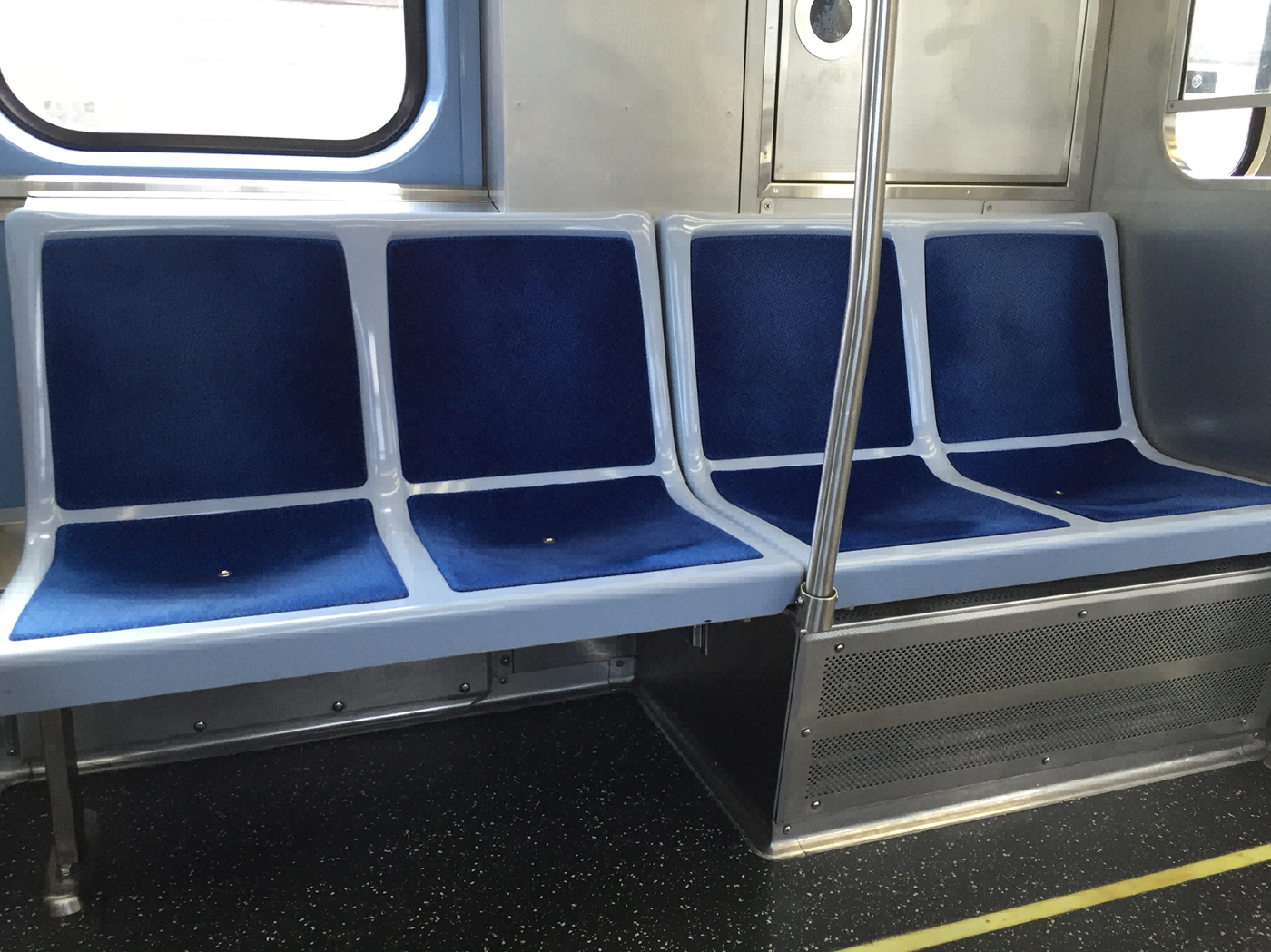
Empty seats on the Red Line, Chicago, 17 August 2016. Photo: John Q.

We have decided to end here with the empty seats on the train. Who is seated there that we could not see? They may be spaces in the discourse that we were not able to recognize, or given our time and resources were not able to make present. They could have been places this journal has addressed in the past that have relationships with this issue. They could even be legitimate works and resources that John Q simply does not know enough about to make visible. The empty seats are ghosts, or maybe the non-present presence of other possibilities, pasts, and alterities, spaces left empty simply because, given all that is going on in all of our struggles the world over, someone just happened to miss this particular train.