INTRODUCTION
Workplace bullying is a widespread problem in contemporary working life (Nielsen, Matthiesen, & Einarsen, Reference Nielsen, Matthiesen and Einarsen2010; Einarsen, Hoel, Zapf, & Cooper, Reference Einarsen, Hoel, Zapf and Cooper2011a). International and industry comparisons, however, are notoriously difficult owing to a variety of definitions and operationalisation, and the use of different measuring tools. A meta-analysis by Nielsen, Matthiesen, and Einarsen (Reference Nielsen, Matthiesen and Einarsen2010) of the prevalence rates published in 86 different sources indicated that the mean prevalence rates of workplace bullying varied between 11 and 18%. By comparison, there are only a handful of New Zealand studies although these do indicate that New Zealand workplaces are not immune to the problem of workplace bullying.
Early prevalence studies conducted in the New Zealand health sector by Foster, Mackie, and Barnett (Reference Foster, Mackie and Barnett2004) and Scott, Blanshard, and Child (Reference Scott, Blanshard and Child2008) indicated workplace bullying to be a problem. A survey of key industry informants in two industries by Bentley, Catley, Gardner, O'Driscoll, Trenberth, and Cooper-Thomas (Reference Bentley, Catley, Gardner, O'Driscoll, Trenberth and Cooper-Thomas2009a) reported that bullying was an ‘everyday occurrence’ in the health sector, and centred upon a few hotspots in the hospitality sector (e.g., the kitchen). In the largest study to date of workplace bullying in New Zealand, Bentley et al. examined responses from 1,733 people from across four industries – health, education, hospitality and travel (Bentley et al., Reference Bentley, Catley, Gardner, O'Driscoll, Trenberth and Cooper-Thomas2009b; O'Driscoll, Cooper-Thomas, Bentley, Catley, Gardner, & Trenberth, Reference O'Driscoll, Cooper-Thomas, Bentley, Catley, Gardner and Trenberth2011). Using the Negative Acts Questionnaire to measure bullying, O'Driscoll et al. (Reference O'Driscoll, Cooper-Thomas, Bentley, Catley, Gardner and Trenberth2011) reported that 17.8% of the sample had been bullied in the last 6 months. As O'Driscoll et al. (Reference O'Driscoll, Cooper-Thomas, Bentley, Catley, Gardner and Trenberth2011: 402) concluded, if the industries in this sample are typical of New Zealand organisations, then the results indicate that workplace bullying may be somewhat more prevalent in New Zealand than in other countries.
Consistent with international research (e.g., Agervold & Mikkelsen, Reference Agervold and Mikkelsen2004; Djurkovic, McCormack, & Casimir, Reference Djurkovic, McCormack and Casimir2008; Einarsen et al., Reference Einarsen, Hoel, Zapf and Cooper2011a), data from New Zealand employees indicate that workplace bullying has negative effects on both the target of the bullying and the organisation. O'Driscoll et al. (Reference O'Driscoll, Cooper-Thomas, Bentley, Catley, Gardner and Trenberth2011) reported that targets had significantly higher levels of strain and lower emotional well-being, took more days off, and had reduced job satisfaction, organisational commitment and work motivation than non-targets. Targets were also more likely than non-targets to express an intention to leave the organisation. Finally, there were the opportunity costs of time and effort being displaced to help targets cope with bullying incidents, and the costs associated with investigations and potential court action.
Along with extending the evidence base on the extent and impact of workplace bullying in New Zealand workplaces, this paper also turns attention to issues of prevention and management. Specifically, the aims of the study were to: (i) determine the perceived extent and nature of workplace bullying within participating organisations; (ii) understand the perceived impacts of bullying on the organisation; and (iii) determine the nature of workplace bullying prevention activities within organisations. The study also sought to explore the relationship between these variables and prevention activity levels.
THE NATURE OF WORKPLACE BULLYING
Researchers have used a wide range of definitions for workplace bullying depending on their research perspective or professional interest (Rayner & Cooper, Reference Rayner and Cooper2006). A common feature, however, is that bullying at work is about systematic, interpersonal abusive behaviour that may cause severe social, psychological and psychosomatic problems in the target (Einarsen et al., Reference Einarsen, Hoel, Zapf and Cooper2011a). Bullying may be work related or person related, and enacted either overtly or covertly. Work-related behaviours include imposing unreasonable deadlines and/or unmanageable workloads, excessive work monitoring and assigning meaningless or degrading tasks (Einarsen et al., Reference Einarsen, Hoel, Zapf and Cooper2011a). Person-related bullying includes insulting remarks, excessive teasing, gossip and/or rumours, persistent criticism, practical jokes and intimidation (Einarsen et al., Reference Einarsen, Hoel, Zapf and Cooper2011a). Rayner and Cooper (Reference Rayner and Cooper2006) also contend that the behaviours that bullies do not do such as withholding task-related information (e.g., minutes, meeting times, emails) from the target are also important.
However, leading reviews emphasise that it is the persistent exposure to unwanted behaviours, as well as the nature of the behaviour, that gives bullying its destructive force (Leymann, Reference Leymann1996; Rayner & Cooper, Reference Rayner and Cooper2006; Einarsen et al., Reference Einarsen, Hoel, Zapf and Cooper2011a). Thus, it is the persistent exposure to bullying behaviours that is the key criterion differentiating workplace bullying from similar concepts such as workplace violence and (general) conflict (Hoel & Beale, Reference Hoel and Beale2006; Rayner & Cooper, Reference Rayner and Cooper2006; Einarsen et al., Reference Einarsen, Hoel, Zapf and Cooper2011a). To constitute bullying, exposure to the negative behaviours must occur frequently and be experienced by the target over a period of time. However, there is variation and considerable debate over the operational thresholds for measuring workplace bullying (see Nielsen, Notelaers, & Einarsen, Reference Nielsen, Notelaers and Einarsen2011 for an extensive overview). Yet, as Rayner and Cooper (Reference Rayner and Cooper2006: 127) write, ‘typically, the experience of weekly behaviours in the last 6 months is judged to be bullying in academic studies’.
Although there is no consensus, the issue of intent behind the negative behaviours tends not to be an essential component of most definitions (Rayner & Keashly, Reference Rayner and Keashly2005; Rayner & Cooper, Reference Rayner and Cooper2006; Einarsen et al., Reference Einarsen, Hoel, Zapf and Cooper2011b). As Einarsen et al. (Reference Einarsen, Hoel, Zapf and Cooper2011b) explain, intent can be linked to both the intentionality of the negative action and the outcome of the behaviour. It is, therefore, nearly impossible to independently verify the presence of intent, and almost all bullies would deny intent (Rayner & Keashly, Reference Rayner and Keashly2005; Rayner & Cooper, Reference Rayner and Cooper2006; Einarsen et al., Reference Einarsen, Hoel, Zapf and Cooper2011b). In addition, as Einarsen et al. (Reference Einarsen, Hoel, Zapf and Cooper2011b) point out, the presence or absence of intent does not change the situation for the target nor the damage done. What may change, however, is whether an individual labels their experience as bullying or not (Einarsen et al., Reference Einarsen, Hoel, Zapf and Cooper2011b).
As with intent, the centrality of a power imbalance between the bully and target is not without debate. For Leymann (Reference Leymann1990, Reference Leymann1996), a power imbalance, where the target is forced into a defenceless or helpless position against the bully is one of the key characteristics that demarcates bullying from conflict. That is, in contrast to a more general conflict situation, the target perceives they have little recourse to retaliate in kind against the bully. As Einarsen (Reference Einarsen1999: 18) reports, these ‘inescapable interactions’ may contribute as much to the anxiety, misery and suffering experienced by the target as the actual behaviour does. Furthermore, the inability to defend oneself is argued to play a role in forming the target's perception of whether the behaviour should be regarded as bullying (Einarsen, Reference Einarsen1999). In contrast, concern has been expressed that drawing a sharp distinction between bullying and conflict is no longer useful (Rayner & Cooper, Reference Rayner and Cooper2006), that emphasising a power imbalance only serves to confuse the situation and the behaviour, or that the understanding of power is too general (Hoel, Rayner, & Cooper, Reference Hoel, Rayner and Cooper1999) or limited (Rayner & Keashly, Reference Rayner and Keashly2005). Despite these concerns, the imbalance of power is a common element in studies investigating the prevalence of workplace bullying, especially in those studies that use self-labelling to investigate bullying.
Drawing on these definitional characteristics, and borrowing from Lutgen-Sandvik, Tracy, and Alberts (Reference Lutgen-Sandvik, Tracy and Alberts2007), this paper defines workplace bullying as a situation where a person feels they have repeatedly experienced negative actions from one or more people persistently over a period of time, in a situation where it is difficult for the target to defend themselves against these actions. These negative actions could be physical or non-physical (e.g., verbal abuse). A one-off incident is not defined as bullying.
WORKPLACE BULLYING: MANAGEMENT AND PREVENTION
A significant amount of research has sought to investigate the antecedents of workplace bullying. At the individual level, a number of bully and target characteristics have been examined including: age, gender, organisational status, personality, social competencies, organisational performance and coping strategies (see Zapf & Einarsen, Reference Zapf and Einarsen2011 for an extensive overview). In recent years there has been a growing focus on the organisational antecedents of bullying – what is often termed the ‘work environment hypothesis’. From this perspective, attention is drawn to the role of the work environment and the organisation of work in providing conditions conducive to workplace bullying. As with the individual antecedents, a number of organisational and job-level factors have been examined, including: organisational leadership, organisational change, workplace culture, remuneration and performance systems, and job design (see Salin & Hoel, Reference Salin and Hoel2011 for an extensive review).
Importantly, research into the antecedents of workplace bullying indicates that there is no one simple explanation. Workplace bullying is likely to flourish when individual and organisational antecedents are present in combination (Einarsen, Reference Einarsen2000). Also relevant will be environmental factors such as the extent to which legislative and regulatory frameworks recognise bullying and provide redress (Sperry, Reference Sperry2009). As Zapf and Einarsen (Reference Zapf and Einarsen2011: 195) write, ‘there are many possible causes and probably often multiple causes of bullying, be they causes within the organisation, within the perpetrator, within the social system, or within the victim’. However, despite the likelihood of multiple causes an employer can still play a proactive role in preventing and managing workplace bullying.
Strategies for the prevention and management of workplace bullying are typically categorised as primary, secondary or tertiary preventions (Vartia & Leka, Reference Vartia and Leka2011). As Vartia and Leka (Reference Vartia and Leka2011) explain the three categories, primary preventions are proactive and aim to prevent the negative effects occurring by minimising the risk of exposure. Secondary preventions seek to reverse, reduce or slow the progression, prevent recurrence, and increase the resources of individuals to cope. Tertiary preventions are rehabilitative, aiming to reduce the negative impacts and restore individual and organisational health and well-being. These different preventative measures can also be targeted at different levels of the organisation: individual, job and organisational (Vartia & Leka, Reference Vartia and Leka2011).
Workplace bullying is not addressed explicitly in New Zealand's health and safety legislation but is covered under the general requirements for employers to identify, assess and control hazards at work (Department of Labour, 2009). Under the Health and Safety in Employment Act 1992, New Zealand employers are required to take all practicable steps to ensure that employees are not harmed while at work. Included in that requirement is to ensure that an employee does not harm others. It would therefore be a reasonable expectation as a foundation for preventative measures to find that organisations have formally identified bullying as a potential ‘hazard’ in their workplace.
In terms of specific interventions, a widely recommended primary prevention strategy is to work towards establishing an anti-bullying culture where such behaviour is deemed unacceptable (Needham, Reference Needham2003; Yamada, Reference Yamada2008; Duffy, Reference Duffy2009). Yamada (Reference Yamada2008) contends that the necessary components of such a culture include a genuine organisational commitment to culture change, effective education and policies, and attentiveness to people and behaviour. The development and enforcement of a clear policy on workplace bullying is also widely discussed as part of such a commitment and as a key primary prevention measure (Djurkovic, McCormack, & Casimir, Reference Djurkovic, McCormack and Casimir2006; Holme, Reference Holme2006; Duffy, Reference Duffy2009; Pate & Beaumont, Reference Pate and Beaumont2010; Rayner & Lewis, Reference Rayner and Lewis2011). As Rayner and Lewis (Reference Rayner and Lewis2011) write, an organisational policy exists to serve two central functions: to communicate the organisation's intent and to summarise the processes in relation to workplace bullying.
However, a workplace bullying policy is unlikely to be effective, or to be seen by employees as tokenistic, if left to operate in isolation (Duffy, Reference Duffy2009). As Duffy (Reference Duffy2009) contends, policy initiatives need to be embedded in a larger workplace programme that provides management and staff with ongoing education and training about the importance and value of a positive workplace culture and the behavioural indicators of such a culture. While the specifics of a training programme will vary depending on the requirements of the organisation and the needs of those being trained (Fox & Stallworth, Reference Fox and Stallworth2009), a range of potential topics has been identified. Training topics for employees and supervisors could include: awareness and recognition of the problem; psychological and economic consequences of bullying; definition and clarification of dysfunctional behaviours; prevention and reporting procedures; and effective and fair responses at individual, team, organisational and other relevant levels (Ferris, Reference Ferris2009; Fox & Stallworth, Reference Fox and Stallworth2009). Training topics for managers could entail recognising bullying situations, options open to bullies and targets, a manager's responsibilities, handling interviews, reasons for non-reporting and preventative strategies (State Services Commission, 2003). Managers could also benefit from training in conflict management, interpersonal communication, negotiation, stress management, team-building (Leymann, Reference Leymann1996; Resch & Schubinski, Reference Resch and Schubinski1996; Sheehan, Reference Sheehan1999; Gardner & Johnson, Reference Gardner and Johnson2001) and managing low performance without being accused of bullying (Holme, Reference Holme2006). Training can therefore have a primary, secondary or tertiary preventative focus.
Another primary prevention strategy suggested by some is to use staff selection systems to screen out those with undesirable traits or motives (Gardner & Johnson, Reference Gardner and Johnson2001; Glendinning, Reference Glendinning2001; Blackman & Funder, Reference Blackman and Funder2002; Fodchuk, Reference Fodchuk2007; Lutgen-Sandvik, Namie, & Namie, Reference Lutgen-Sandvik, Namie and Namie2009) or to select those with desirable qualities such as integrity (Ferris, Reference Ferris2009) or emotional intelligence (Yamada, Reference Yamada2008). In this regard, psychological testing, behavioural interviewing techniques and reference checking are identified as methods for pre-employment screening (Lutgen-Sandvik, Namie, & Namie, Reference Lutgen-Sandvik, Namie and Namie2009). However, as Fodchuk (Reference Fodchuk2007) warns, these approaches should be used with care owing to their potential for adverse impacts and unfairness. All selection measures must be valid and job-related. Furthermore, selection should be used to primarily assess job-related knowledge, skills and abilities rather than to address bullying by identifying either potential bullies or targets (Fodchuk, Reference Fodchuk2007).
Despite a number of interventions posited as being effective, there are serious barriers to their implementation and potential effectiveness. As bullying can be subtle, procedural and open to debate around interpretation and meaning, it is less amenable to regulation and workplace intervention than more overt forms of harassment, discrimination and violence (McCarthy & Barker, Reference McCarthy and Barker2000). HR and occupational health and safety (OHS) professionals may also have considerable difficulties managing workplace bullying where bullies are senior to them in the organisation. The result can be targets who are left to deal with bullies alone or resorting to other solutions such as leaving the organisation (Rayner, Reference Rayner1998, Reference Rayner1999; Hoel & Beale, Reference Hoel and Beale2006). Management may be reluctant to address workplace bullying when bullies are otherwise perceived as effective and productive, and bullies may even be rewarded with promotion (Leck & Galperin, Reference Leck and Galperin2006). Consequently, targets’ only option may be to enact grievance procedures, exposing themselves to lengthy and uncertain processes with possibilities of further victimisation and stress (McCarthy & Barker, Reference McCarthy and Barker2000). Finally, and perhaps most disturbingly, management may not understand the nature of bullying, nor how it should be prevented, with the inevitable result that employers are failing in their duty of care towards employees.
PREDICTING THE MANAGEMENT AND PREVENTION OF WORKPLACE BULLYING
While many studies have described the extent of the workplace bullying, relatively few have focused on the management of bullying in organisations. In the New Zealand context, Bentley et al. (Reference Bentley, Catley, Gardner, O'Driscoll, Trenberth and Cooper-Thomas2009b) interviewed senior managers and individuals responsible for human resources and/or OHS. Bentley et al.'s (Reference Bentley, Catley, Gardner, O'Driscoll, Trenberth and Cooper-Thomas2009b) research included the finding that organisations commonly had no formal bullying policy although a number of them included bullying in their harassment policy, and that many had no reporting system for bullying – key primary intervention strategies (Vartia & Leka, Reference Vartia and Leka2011). Moreover, the concept of bullying was not well communicated and understood in some organisations, while managers’ perceptions of the extent of workplace bullying were inconsistent with employees’ (from the same organisations) reports of bullying.
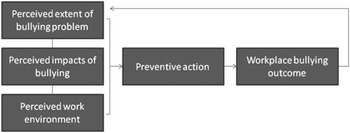
Building on the insights of Bentley et al. (Reference Bentley, Catley, Gardner, O'Driscoll, Trenberth and Cooper-Thomas2009b) and the extant literature, Figure 1 depicts the relationships explored in the present investigation of the occurrence of workplace bullying and the perceptions of the preventive actions taken by the organisation and their perceived outcomes. Our departure point is that management activity or inactivity to control workplace bullying is related to a number of potential determinants: the perceived extent of bullying in the organisation (Bentley et al., Reference Bentley, Catley, Gardner, O'Driscoll, Trenberth and Cooper-Thomas2009b reported that almost all managers who were interviewed believed that their organisation had no bullying problem); the perceived impacts of bullying on the organisation (direct and indirect costs to the organisation); and the work environment in relation to bullying (including understanding of bullying, tolerance of bullying, HR response to bullying, top management attitudes to bullying).
Relationship between perceptions of bullying and preventive action in organisations

As Figure 1 suggests, preventative actions may be more likely where a bullying problem is perceived and thought to have negative impacts on the organisation. The work environment of the organisation is argued to be a further factor in whether or not prevention practices are in place and whether bullying is experienced within the organisation. Finally, bullying outcomes in the organisation may themselves influence preventive action as they raise awareness of the problem among management. The present study builds on the earlier work of Bentley et al. (Reference Bentley, Catley, Gardner, O'Driscoll, Trenberth and Cooper-Thomas2009b) to examine how bullying is understood and managed in New Zealand organisations, and the role of possible predictor variables (as shown in Figure 1) in relation to whether organisations are taking steps to reduce workplace bullying.
METHOD
Sample and procedure
A sample of 252 participants was obtained from ∼400 attendees at a series of four industry workshops held for OHS practitioners and others with a responsibility for OHS in organisations in New Zealand. With the agreement of the workshop organisers, the researchers invited participants to complete a paper-based questionnaire at the conclusion of each workshop. A total of 252 individuals provided useable completed survey forms. While all respondents had some level of responsibility for OHS, many were employed in non-managerial roles (n = 91; 36%). The remainder of the sample were employed as first-line supervisors (45; 18%), middle managers (85; 34%) and senior managers (28; 11%). Respondents were relatively experienced, having occupied their current role for a mean duration of 4.7 years (SD = 5.3), with 77% in an OHS role for 2 years or more and 27% for 5 years or more. Respondents had worked for their current organisation for a mean period of 6.6 years (SD = 6.7). A wide range of industry sectors were represented in the study with the largest representation of respondents from the health sector (30%) followed by agriculture, forestry and fishing (15%), administration and support services (13%), and manufacturing (10%).
Respondents were told that the survey was confidential and that they were under no obligation to participate. They were also given an information sheet providing details of the study, along with a verbal explanation of its purpose and some background information on the nature of workplace bullying. The questionnaire took ∼15 min to complete, and all participants completed the survey in the room where the workshop had taken place.
Survey measures
The questionnaire comprised a definition of workplace bullying preceding three sections of questions. The first section contained 17 Likert-type items that sought respondents’ perceptions of the extent and direction of bullying in their organisations and the perceived organisational impacts (as shown in Figure 1). Items were derived from the literature, and respondents were asked to indicate on a 5-point scale (0 = ‘not at all’, 4 = ‘to a very large degree’) the extent to which they agreed or disagreed. Examples of items include: ‘Workplace bullying of staff by managers is a concern’; ‘Your organisation has an effective reporting system that allows employees and management to report cases of bullying’; ‘Bullying in your organisation has a negative impact on staff motivation’. A further standalone item asked respondents to what extent they agreed that ‘workplace bullying is a problem in your organisation’.
The second section contained five questions related to organisational activities to manage bullying (measured on a ‘yes’/‘no’/‘unsure scale’). The questions in this section were designed to elicit respondents’ perceptions and understanding of workplace bullying in relation to ‘best practice’ interventions as articulated in the research literature, and focused on organisational policy, hazard management, training and personnel selection. The five items asked were: ‘Are you aware of any cases of bullying in your organisation within the last 2 years?’, ‘Does your organisation have a policy and procedures for workplace bullying?’, ‘Is bullying formally recognised as a hazard in this organisation?’, ‘In the last 2 years, has your organisation arranged any training for management or staff in regards to workplace bullying?’, ‘Does your organisation take specific steps to attempt to prevent employing individuals who may be bullies?’. The final section asked for basic demographic information. This section asked respondents for information pertaining to their organisational role and tenure, and the industry sector they worked in.
Data analysis
Means and standard deviations were calculated for all items in Section 2 of the questionnaire, and frequency distributions were produced for all categorical variables. Factor analysis was performed on the 17 perceptual items contained in Section 1, and logistic regression analyses were conducted with the three new sub-factors produced from the factor analysis included as predictor variables, along with ‘tenure in role’ and ‘role’. The criterion variables for the two logistic regression analyses were: (1) incidents of bullying within the organisation over the previous 2 years (yes/no); (2) prevention active (yes/no).
RESULTS
Perceptions of the extent and nature of workplace bullying
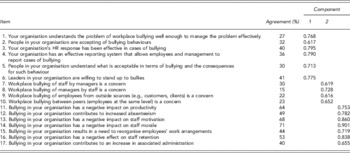
A total of 29% of respondents either ‘agreed’ or ‘strongly agreed’ with the item, ‘workplace bullying is a problem in your organisation’. However, 70% of respondents responded positively to a subsequent item ‘are you aware of any cases of bullying in your organisation in the last 2 years’. Table 1 provides a breakdown of the proportion of respondents who ‘agreed’ or ‘strongly agreed’ with each of the 17 items described, along with the results of the factor analysis (discussed below).
Agreement with the 17 perceptions of bullying items and factor analysis of the 17 perceptions of bullying items

Note. Rotation method: Varimax with Kaiser normalisation. Factor loadings <0.4 were suppressed. Note item 3 was reversed for the factor analysis.
The work environment
Items 1–6 in Table 1 related to the organisational environment in relation to bullying. A little more than a quarter of respondents (27%) agreed that the organisation understood workplace bullying well enough to effectively manage the problem. Responses also suggested a lack of confidence in the organisation's HR response to bullying and a perceived absence of effective reporting systems. Furthermore, only 41% of respondents indicated that leaders in their organisation were willing to confront bullies.
The direction of bullying in the organisation
Respondents typically indicated a low level of concern about any particular source of bullying in their organisation. Where concern about a particular source and direction was expressed, respondents perceived workplace bullying by managers to staff to be of most concern, followed by peer-to-peer bullying and bullying by outsiders (e.g., customers or clients). Bullying of managers by staff was of least concern (Table 1, items 7–10).
Impacts of workplace bullying
In relation to the perceived impacts of bullying, ratings of items 11−17 were relatively high. In particular, respondents noted the perceived negative impact on staff morale, motivation and productivity. Many respondents (40%) also felt that bullying in their organisation contributed to an increase in associated administration, suggesting both employee and management productivity are likely to be impacted by workplace bullying.
Preventive activity to control workplace bullying
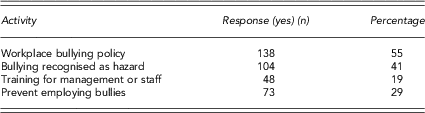
Respondents were asked four questions that related to the management and prevention of workplace bullying in their organisation (Table 2).
Perceived bullying prevention activity in organisations
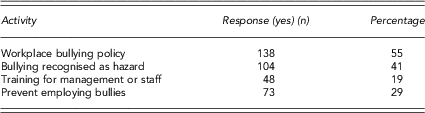
Just over one-half of respondents reported the presence of a formal policy for workplace bullying, although it is not known whether this policy was specific to bullying or part of a wider harassment policy or some other form of general OHS policy in the organisation. Only 41% of respondents reported that their organisation recognised bullying as a hazard, and just 19% reported that their organisation had any form of training for management or staff on the topic of bullying.
Factors best predicting workplace bullying prevention active organisations
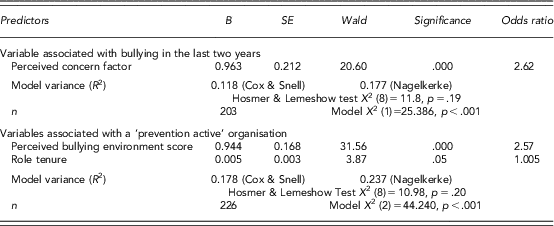
Factor analysis (principal component analysis with varimax rotation) was applied to the 17 perception items, revealing three sub-factors: (1) perceived bullying environment; (2) perceived level of concern in relation to bullying; and (3) perceived negative impact of bullying (Table 1). Based on this factor analysis, regression weighted, summed composite ‘scores’ were calculated for each of these three factors. These three composite variables along with tenure in role and role were entered into two separate logistic regressions (forward stepwise entry), with the two dichotomous criterion variables being: bullying in the organisation in the past 2 years (yes/no); and prevention active/inactive (active = two or more of the four preventive activities in place). Table 3 presents the significant findings for the two logistic regression models.
Results of the two logistic regression analyses predicting bullying in the organisation in the past 2 years (yes/no) and whether the organisation was prevention active or inactive (active = two or more of the four preventive activities in place)
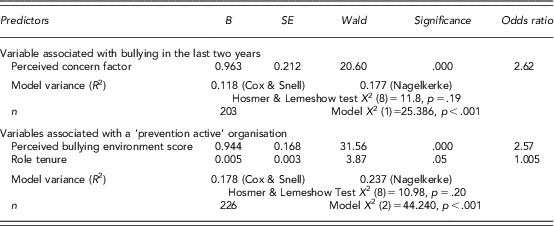
The only significant predictor of whether the organisation had experienced workplace bullying was perceived level of concern in relation to bullying. Specifically, the odds ratio demonstrates that when participants perceived level of concern in relation to bullying increases, they were 2.6 times more likely to have reported incidents of bullying in their organisation in the past 2 years. Significant predictors of whether the organisation was prevention active or inactive were ‘perceived bullying environment’ and, to a lesser extent, the role tenure of the respondent (longer tenure associated with more reporting of preventive activity). Again, the odds ratio demonstrates that when participants’ perceptions of the environment increased, that is, the environment was more focused towards reducing/managing bullying, these participants were 2.5 times more likely to be from an organisation that was reported to be ‘prevention active’.
DISCUSSION
It is well established internationally that bullying in the workplace has a significant negative impact on the individual exposed to bullying and on the organisation in which bullying takes place (Einarsen et al., Reference Einarsen, Hoel, Zapf and Cooper2011a). As a result, workplace bullying has commanded the attention of employers, labour organisations and regulatory agencies as a problem of significant concern (Beale & Hoel, Reference Beale and Hoel2010). In line with Bentley et al.'s (Reference Bentley, Catley, Gardner, O'Driscoll, Trenberth and Cooper-Thomas2009b) recent survey of New Zealand workers that reported relatively high levels of workplace bullying (17.8%), this study found that New Zealand OHS personnel also perceived workplace bullying to be a problem in their organisations. Indeed, the majority of respondents reported cases of bullying during the past 2 years, therefore providing further evidence that workplace bullying is a pervasive problem in New Zealand.
Somewhat inconsistent with the finding that the majority of respondents reported cases of bullying during the past 2 years, respondents expressed a relatively low level of concern about workplace bullying, regardless of its direction. Bullying by a supervisor was perceived as being of most concern and upwards bullying (i.e., staff to managers) was perceived as being of least concern. While this concern about the direction of bullying may fit with a ‘common sense’ understanding where a superior bullies a weak and defenceless target, we would exercise caution in reinforcing this as the only way a bullying interaction is played out. Studies investigating the relationship between bullying and organisational status indicate that bullying can involve people from throughout the organisational hierarchy. Hoel, Cooper, and Faragher (Reference Hoel, Cooper and Faragher2001) reported that the majority (74.7%) of respondents reported that the bully was a superior while a substantial minority (36.7%) reported that they had been bullied by a colleague. Similar results have been reported by O'Moore, Seigne, McGuire, and Smith (Reference O'Moore, Seigne, McGuire and Smith1998) and Rayner (Reference Rayner1998) while Einarsen and Skogstad (Reference Einarsen and Skogstad1996) found that superiors and colleagues equally bullied employees. On the basis of a meta-analysis of 40 published samples, Zapf, Escartín, Einarsen, Hoel, and Vartia (Reference Zapf, Escartín, Einarsen, Hoel and Vartia2011) concluded that bullying is not simply a top-down process but occurs across all organisational levels.
A major focus of this study was the preventive activity management directed to control workplace bullying and factors that predict whether this activity occurred. As Keashly and Neuman (2004) maintain, organisational efforts to respond to workplace bullying will depend on an assessment of the extent and nature of the problem within the organisation. Unfortunately, this study highlights that in many organisations, staff who are likely to play a leading role in preventative initiatives perceive many of the ‘building blocks’ to such interventions to be absent, or perhaps inadequate. It would seem that organisational efforts to respond more effectively to workplace bullying will be hindered unless these areas are addressed.
A key area for attention would appear to be around ‘organisational understanding’. In this study, despite 70% of respondents reporting at least one case of workplace bullying in the last 2 years and other research indicating relatively high levels of bullying in New Zealand organisations, only around a quarter of respondents felt their organisation had an adequate understanding of the problem of workplace bullying, while less than one-third believed people in their organisation understood what is acceptable in terms of bullying behaviour. Having managers and staff well versed in understanding the concept, dynamics and impacts of bullying would seem an essential first step. In particular, organisational members should have the knowledge to be able to differentiate inappropriate workplace behaviours from legitimate performance management. Training would also therefore seem an essential area to address. As Duffy (Reference Duffy2009: 258) argues, increased education and training for employees along with a general consciousness-raising about workplace bullying are likely to be basic ingredients of organisational accountability and change processes. Similarly, Fox and Stallworth (Reference Fox and Stallworth2009) contend that if cultural change is to be effected, training needs to be organisation-wide. It is of concern, then, that in the present study very few organisations provided any form of training to management or staff on workplace bullying. However, training and policy initiatives need to be careful to avoid viewing workplace bullying as simply a problem of individual differences between a target and perpetrator. Such a framing potentially risks ignoring or minimising the responsibility of the organisation to prevent and provide a systematic and comprehensive response to workplace abuse and harassment.
The work of Bentley et al. (Reference Bentley, Catley, Gardner, O'Driscoll, Trenberth and Cooper-Thomas2009b) indicated that a number of factors might determine whether strategies for bullying prevention are put in place. In this present study, several predictor variables (Figure 1) were examined in relation to whether prevention activity was undertaken. We found no support for the proposition that preventive activity is likely to be determined by managers’ perceptions of the extent of the problem or the perceived impact of bullying on the organisation. The perceived work environment was significantly related to prevention activity, however. Thus, factors such as staff and management understanding of what is acceptable behaviour, an effective reporting system and an effective HR response, and leadership intolerance of bullying, appear to be related to the likelihood of preventive action. It is therefore of concern that respondents expressed relatively low levels of agreement with statements attesting to the effectiveness of these factors.
While much has been written about the role of the work environment in preventing and reducing bullying (for an overview see Skogstad, Torsheim, Einarsen, & Hauge, Reference Skogstad, Torsheim, Einarsen and Hauge2011), particular attention is being paid to the role of leadership. It is therefore a further concern that only 41% of the sample in this study indicated that they perceived leaders to be prepared to confront bullying behaviour. The concept of leadership is emerging as an important factor in understanding the prevention and tolerance of workplace bullying (Einarsen, Raknes, & Matthiesen, Reference Einarsen, Raknes and Matthiesen1994; Matthiesen & Einarsen, Reference Matthiesen and Einarsen2007; Skogstad et al., Reference Skogstad, Torsheim, Einarsen and Hauge2011). Hoel, Glasø, Hetland, Cooper, and Einarsen (Reference Hoel, Glasø, Hetland, Cooper and Einarsen2010) report that a leadership style where punishment was meted out independent of a target's behaviour was the strongest predictor of self-perceived exposure to workplace bullying. The absence of a participative leadership style and the presence of laissez-faire leadership were also associated with perceptions of bullying (Hoel et al., Reference Hoel, Glasø, Hetland, Cooper and Einarsen2010). Hoel et al.'s (Reference Hoel, Glasø, Hetland, Cooper and Einarsen2010) findings are not an isolated case with autocratic, tyrannical and laissez-faire leadership styles common leadership deficiencies associated with bullying (Nielsen, Matthiesen, & Einarsen, Reference Nielsen, Matthiesen and Einarsen2005). Subordinates can feel directly bullied by autocratic leadership that is authoritarian, rule based and inflexible (Vartia, Reference Vartia1996; Agervold & Mikkelsen, Reference Agervold and Mikkelsen2004) but also indirectly through perceptions of injustice or betrayed expectations (Agervold & Mikkelsen, Reference Agervold and Mikkelsen2004; Strandmark & Hallberg, Reference Strandmark and Hallberg2007). Laissez-faire leadership may be seen as bullying in itself (Hoel et al., Reference Hoel, Glasø, Hetland, Cooper and Einarsen2010) but perhaps, more importantly, can be seen as providing the conditions in which bullying can flourish.
Results indicating that targets of workplace bullying evaluate their work environment more negatively than non-targets are common in the literature (Skogstad et al., Reference Skogstad, Torsheim, Einarsen and Hauge2011). Along with leadership, targets have reported negatively on such indicators as: role ambiguity, job insecurity and job satisfaction (Hauge, Skogstad, & Einarsen, Reference Hauge, Skogstad and Einarsen2007); lack of control over work tasks, time and behaviour (Agervold & Mikkelsen, Reference Agervold and Mikkelsen2004; Ferris, Zinko, Brouer, Buckley, & Harvey, Reference Ferris, Zinko, Brouer, Buckley and Harvey2007); and high workloads, negative social relationships and a negative organisational climate (Agervold & Mikkelsen, Reference Agervold and Mikkelsen2004; Branch, Ramsay, & Barker, Reference Branch, Ramsay and Barker2007; Hauge et al., Reference Hauge, Skogstad and Einarsen2007). However, the extent to which all employees in the workplace share this negative assessment of the work environment is often not clear (Skogstad et al., Reference Skogstad, Torsheim, Einarsen and Hauge2011). While this study does not provide a clear answer to this important question, it does indicate that a negative assessment of the work environment is also likely to be held by key organisational members who are not themselves targets of workplace bullying.
CONCLUSION
This study reinforces the assertion that workplace bullying in the New Zealand context is not ‘harmless fun’ or ‘tough management’ but a series of acts that have a negative impact on the targets of bullying, and the organisation where the bully is employed. Given the high impact of bullying on a range of factors – notably productivity and morale – it is clear that investment in creating ‘bully-free’ workplaces is a small price to pay in relation to the negative human and financial outcomes of inactivity in this area. This study has also added to the very limited literature on the prevention of workplace bullying. Clearly, organisations represented in this study had limited prevention measures in place, despite relatively high levels of reported bullying and high perceived impact on the organisation of such behaviours. A factor in determining whether such activity takes place appears to be a supportive work environment, although further work is required to better understand this relationship. Most importantly, research is necessary to identify the efficacy of interventions to manage workplace bullying in different industry and organisational contexts, if this costly workplace problem is to be controlled effectively.
Research should further investigate the anti-bullying measures that organisations put in place, and how these relate to other organisational systems. Research should also consider the role of individual, environmental, cultural and structural factors in determining whether organisations will implement effective preventive activity. Barriers to preventive activity should also be explored further, as the present study suggests that an unsupportive work environment is an important contributor to bullying experiences and consequences.
Acknowledgement
The authors would like to thank those individuals who gave their time to participate in this research. The authors are also grateful to the Accident Compensation Corporation (ACC) for their support and permission to access the workshops.