INTRODUCTION
Foxtail millet (Setaria italica (L.) P. Beauv.) is one of the oldest domesticated crops in the world. It has been cultivated as a food and fodder crop for thousands of years in China, as well as in other parts of Asia and in Africa. At present, foxtail millet is usually grown on marginal agricultural land due to its low productivity and inferior palatability as a food crop; however, it has attracted extensive attention as a new model crop for genomic studies (Dwivedi et al. Reference Dwivedi, Upadhyaya, Senthilvel, Hash, Fukunaga, Diao, Santra, Baltensperger and Prasad2012; Lata et al. Reference Lata, Gupta and Prasad2013). In foxtail millet production, lodging of the stems occurs frequently because it is sown at high density and has a weak culm. In northern China, where summer foxtail millet is grown, heavy rainfall accompanied by strong winds often results in lodging. Stem-based lodging occurs when the stem buckles and it is regarded as an important yield-limiting factor for this cereal crop, as it also results in blighted grain and reduced harvest index, and complicates crop harvest. The impact of stem-based lodging on yield depends on the severity of lodging and the stage of development when lodging occurs (Fischer & Stapper Reference Fischer and Stapper1987; Tripathi et al. Reference Tripathi, Sayre, Kaul and Narang2004). Although there have been no direct estimates of yield reductions due to lodging for foxtail millet, up to 40% yield loss has been reported in wheat (Triticum aestivum L.) when severe lodging occurred (Easson et al. Reference Easson, White and Pickles1993; Kelbert et al. Reference Kelbert, Spaner, Briggs and King2004a ).
Numerous studies have reported variation in lodging resistance among genotypes of cereal crops, such as wheat (Easson et al. Reference Easson, White and Pickles1993; Crook & Ennos Reference Crook and Ennos1994; Berry et al. Reference Berry, Spink, Gay and Craigon2003a , Reference Berry, Spink, Sterling and Pickett b ; Kelbert et al. Reference Kelbert, Spaner, Briggs and King2004a , Reference Kelbert, Spaner, Briggs and King b ), barley (Hordeum vulgare L.) (Wang & Du Reference Wang and Du2001) and rice (Oryza sativa L.) (Ookawa & Ishihara Reference Ookawa and Ishihara1992; Kashiwagi et al. Reference Kashiwagi, Hirotsu, Ujiie and Ishimaru2010), as well as foxtail millet (Tian et al. Reference Tian, Wang, Zhang, Li, Wang and Li2010). In addition to genetic factors, damage from insects and/or diseases, together with rain and wind, can also increase the severity of stem-based lodging. Over-application of nitrogenous fertilizers and high seeding rates can result in weak culms, which increases the severity of lodging in wheat (Stapper & Fischer Reference Stapper and Fischer1990; Easson et al. Reference Easson, White and Pickles1993). In vascular crops, the stem not only provides mechanical support for other parts of the plant, but also serves as a storage and transportation organ for the nutrients and water that ensure proper plant development.
Lodging does not occur consistently under natural conditions, so selection for lodging resistance is difficult. Improvement in lodging resistance in crops can be realized by indirect selection for lodging-associated traits. Thus, an understanding of the relationship between lodging and other crop traits is a pre-requisite for genetic improvement of lodging resistance. Lodging in cereal crops has been associated with certain morphological traits, anatomical characteristics and chemical components of the culm (Dunn & Briggs Reference Dunn and Briggs1989; Kokubo et al. Reference Kokubo, Kuraishi and Sakurai1989; Kelbert et al. Reference Kelbert, Spaner, Briggs and King2004b ; Zhu et al. Reference Zhu, Shi, Li, Kuang, Li, Wei, Bai, Hu and Lin2004; Wang et al. Reference Wang, Zhu, Lin, Li, Teng, Li, Li, Zhang and Lin2006; Yao et al. Reference Yao, Ma, Zhang, Ren, Yang, Yao, Zhang and Zhou2011; Kong et al. Reference Kong, Liu, Guo, Yang, Sun, Li, Zhan, Cui, Lin and Zhang2013). Correlations between lodging resistance and certain anatomical characteristics of the culm, such as the width of sclerenchyma layer (mechanical tissue) and culm walls, have been observed in wheat (Kelbert et al. Reference Kelbert, Spaner, Briggs and King2004b ; Kong et al. Reference Kong, Liu, Guo, Yang, Sun, Li, Zhan, Cui, Lin and Zhang2013). The unit number of large vascular bundles in a culm had a positive correlation with the mechanical strength of the stem in wheat (Wang et al. Reference Wang, Zhu, Lin, Li, Teng, Li, Li, Zhang and Lin2006). Lodging-resistant wheat genotypes had higher levels of carbohydrates (such as, lignin and cellulose) in the cell walls of the culm, but the effects of lignin and cellulose concentrations on lodging resistance appear to be different (Zhu et al. Reference Zhu, Shi, Li, Kuang, Li, Wei, Bai, Hu and Lin2004; Wang et al. Reference Wang, Zhu, Lin, Li, Teng, Li, Li, Zhang and Lin2006). Wang et al. (Reference Wang, Zhu, Lin, Li, Teng, Li, Li, Zhang and Lin2006) described that the most important anatomical and chemical properties for the selection of lodging-resistant wheat cultivars were the ratio of culm wall thickness to outer radius, the proportion of sclerenchyma tissue in the culm, and the unit number of large vascular bundles.
Most studies on lodging in cereal crops with a soft culm have been carried out in wheat, rice and barley. Little is known about the association between stem-based lodging and the properties of the culm in foxtail millet (Tian Reference Tian2013). A number of methods have been developed to measure lodging in cereal crops (Baker et al. Reference Baker, Berry, Spink, Sylvester-Bradley, Griffin, Scott and Clare1998; Berry et al. Reference Berry, Spink, Sterling and Pickett2003b ; Sterling et al. Reference Sterling, Baker, Berry and Wade2003). Lodging coefficient (LC) proved to be a useful indicator for estimating stem-based lodging in the field, as there was a good correlation between the LC and natural lodging (Wang & Du Reference Wang and Du2001). Lodging coefficient is determined by plant height (PH), biomass (BM) of above-ground parts, stem failure moment (SFM) and root weight (RW). A cultivar with a low LC is expected to have reduced risk of lodging. The use of a LC to determine variation in stem-based lodging in cultivars and landraces of foxtail millet has been demonstrated: Tian et al. (Reference Tian, Wang, Zhang, Li, Wang and Li2010) found that stem-based lodging of foxtail millet was associated with stem-breaking strength (SBS), SFM (mechanical strength of stem) and the BM of above-ground parts and the roots. Plant height and internode length were closely related to stem-based lodging in the landraces, but not in the modern improved cultivars. Nevertheless, the association between stem-based lodging and the anatomical parameters and carbohydrate components in the cell walls of the culm has not been determined in foxtail millet. The present study was carried out to understand the association between anatomical and chemical properties of the culm and stem-based lodging in foxtail millet.
MATERIALS AND METHODS
Plant material and experimental design
The study included 35 Chinese commercial foxtail millet cultivars, which have been released during the past three decades and/or used in national yield trials of summer foxtail millet in 2011/12. Lodging coefficients were used to create two groups for analysis of culm anatomical and chemical properties. Group 1 consisted of six cultivars Canggu 3, Yugu 18, Baogu 19, Jigu 19, Jigu 31 and Yugu 19, which had low LC. Group 2 included six cultivars Xiaoxiangmi, Baogu 18, Hangtianlvgu Zheng 07-1, Jigu 18 and 200 475, which had high LC.
During the cropping seasons in 2011 and 2012, field experiments were carried out on a clay loam textured soil at a site in Cangzhou, Hebei province, China (33°13′N and 116°47′E, 6–10 m a.s.l.). The preceding crop in both years was winter wheat. The seeds were sown on 30 June 2011 and 19 June 2012. A compound fertilizer (containing 15% nitrogen, phosphorus and potassium each, w/w) was applied at a rate of 600 kg/ha before sowing to supply the demands of plant growth. A randomized complete block design with three replications was used. Each plot consisted of four rows 5 m long with a row spacing of 40 cm. At the 5-leaf-stage (growth stage (GS) 15, Zadoks et al. Reference Zadoks, Chang and Konzak1974), plants were thinned to 3 cm apart. At the late milk stage (GS 77), ten randomly selected plants were selected to measure the parameters investigated.
Measurements of the traits associated with lodging coefficient
Plant height, leverage force (LF), head weight (HW), RW and BM of the above-ground tissues, including spike, culm, leaves and sheaths were recorded for the ten randomly selected plants in each plot. Roots within the top 40 cm of soil were removed from the soil, washed clean of soil and weighed to determine the BM of roots. Basal internode length (INL) and fresh and dry weights of the internodes were determined for the basal 3–5 internodes. The ratio of root to above-ground tissue weight was determined by dividing the BM of above-ground tissues by RW. To determine SBS, the pull force required to break each 3- to 5-internode segment was determined using a digital pull-push force gauge (model 9500, Aikoh Engineering Co. Ltd., Osaka, Japan). Based on the above traits assessed in the field experiments, SFM and LC were determined using the following equations (Wang & Du Reference Wang and Du2001; Berry et al. Reference Berry, Spink, Gay and Craigon2003a ):
 $${\rm SFM = SBS}\displaystyle{{{\rm INL}} \over {\rm 4}}$$
 $${\rm LC}= \displaystyle{{{\rm PH \times BM}} \over {{\rm SFM \times RW}}}$$
Assessments of the anatomical traits of the culm
A determination of anatomical characteristics of the culm was performed on the fourth basal internode of three additional randomly selected plants within each plot at GS 73. The diameter of the culm (the average of the two diameters from the longest and the shortest axis of the culm) was measured with vernier callipers. The middle portions of the fourth internodes were cut with a plant microtome (Model MTH-1, Nippon Medical & Chemical Instruments Co., Ltd., Japan) to produce transverse sections of c. 10 μm thick. Under a light microscope, the widths of the culm wall (from the epidermis to the cavity), epidermis, sclerenchyma tissue, large vascular bundle sheath and diameter of small vascular bundles (samples of ten per culm) were measured. The numbers of small and large vascular bundles per unit area within culm tissues were counted.
Analysis of cellulose and lignin
The histochemical localization of cellulose in the cell walls at the middle portion of the fourth basal internodes was examined under a fluorescence microscope (Olympus C41, Tokyo, Japan) after calcofluor staining by immersion of the culm sections (~10 μm in thickness) in a 0·005% aqueous solution of calcofluor (fluorescent brightener 28, Sigma) for 2 min (Li et al. Reference Li, Qian, Zhou, Yan, Sun, Zhang, Fu, Wang, Han, Pang, Chen and Li2003). The Wiesner staining reaction was used to histochemically localize lignin (Nakano & Meshitsuka Reference Nakano, Meshitsuka, Lin and Dence1992). The culm sections were incubated for 2 min in phloroglucin solution (1% in 95% ethanol, Sigma) on a glass slide, mounted in 35% hydrochloric acid (HCl) and examined under a light microscope.
Cellulose and lignin concentrations in the fourth basal internodes collected 10 days after flowering were determined using methods described previously (Updegraff Reference Updegraff1969; Dence Reference Dence, Lin and Dence1992). The internode samples (200 mg each) were ground into a fine powder in liquid nitrogen with a mortar and pestle, washed three times with a phosphate buffer (50 mmol/l) and extracted twice with 70% ethanol at 70 °C for 1 h. After drying the cell wall extracts in a vacuum, an anthrone reagent was used to determine cellulose concentrations (Updegraff Reference Updegraff1969). Lignin concentration was assayed using the Klason method as described by Dence (Reference Dence, Lin and Dence1992). The fine powder of culm samples (200 mg) were extracted four times in ethanol, dispersed in 72% sulphuric acid (H2S2O4) for 3 h at room temperature and in 1 mol/l H2S2O4 and heated at 100 °C for 2·5 h. The insoluble materials were recovered by filtration, washed with hot water (90 °C) to remove the acid and dried at 105 °C overnight. The lignin concentration was measured as the percentage of original weight of cell wall residues.
Statistical analysis
The analysis of variance (ANOVA) was performed on individual experiments and data combined over years for the traits examined using SAS general linear model (Version 8.01; SAS Institute Inc., Cary, NC). An F-test was used to determine significance of each source of variation. The comparison of significance between the means of each trait was conducted using Fisher's LSD method. Correlation analysis was performed to determine the relationships between the traits investigated. Path analysis, based on multiple regression analysis, can be used to decompose the relationships among complex variables (Wonnacott & Wonnacott Reference Wonnacott and Wonnacott1972). Therefore, path analysis was conducted to evaluate the importance of the traits that contributed to stem-based lodging.
RESULTS
Lodging coefficients and associated traits
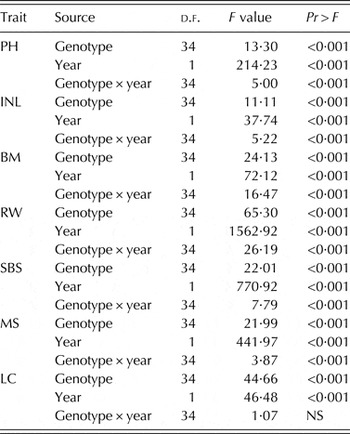
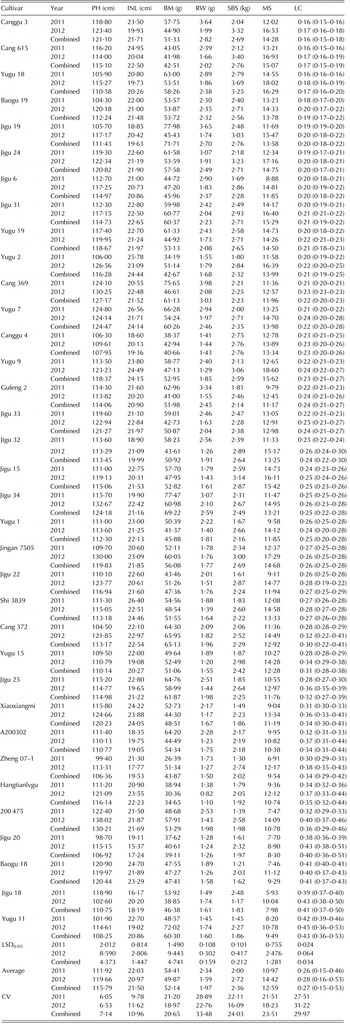
The analysis of variance of the LC and associated traits demonstrated that the differences for genotype and year were significant for all the traits examined (P < 0·001) (Table 1). The effects of genotype × year interactions were significant for all the traits (P < 0·001), except for the LC. Table 2 shows the means of the lodging traits obtained from 35 foxtail millet cultivars grown in the 2011 and 2012 cropping seasons, as well as their combined means for both years.
Summary of ANOVA for LC and associated traits across the 2011 and 2012 cropping seasons

PH, plant height; INL, length of basal 3- to 5-internode; BM, biomass of the above-ground stem and head; RW, root weight; SBS, stem-breaking strength; SFM, stem failure moment of culm; LC, lodging coefficient; NS, not significant.
Lodging coefficients and associated traits in 35 foxtail millet cultivars in the cropping seasons of 2011 and 2012 and their pooled analysis

PH, plant height; INL, length of 3- to 5-internode; BM, biomass of the above-ground stem and head; RW, root weight; SBS, stem-breaking strength; SFM, stem failure moment of culm; LC, lodging coefficient; CV, coefficient of variation. Data in the brackets are the range of lodging coefficients of a cultivar.
Differences in the LC of the 35 cultivars tested were significant in each year and over years (P < 0·05), demonstrating that there were consistent differences in lodging resistance among these cultivars (Table 2). The mean LC across all the cultivars was 0·27 ± 0·081 with a range from 0·15 to 0·53. Significant differences were also detected in PH, INL, BM of above-ground parts, RW, SBS and SFM (P < 0·05). Although the mean values of LC-associated traits varied between 2011 and 2012, the mean LCs for 2011 (0·26 ± 0·070) and 2012 (0·28 ± 0·088) were close (Table 2).
Path analysis was performed to examine the effects of the above-mentioned traits on LC (Table 3). Stem-breaking strength of the culm and RW had greater direct and indirect effects on LC than PH, INL and BM of the above-ground parts. This resulted in significant correlations of the breaking strength of the culm and RW with LC (r = −0·83 and −0·66, respectively, P < 0·001). Because both direct and indirect effects of PH, INL and BM of the above-ground parts were small, the correlation coefficients between these traits and LC were weak and not significant (r = −0·18, −0·24 and −0·21, respectively). The results from path analysis indicated that SBS is the major above-ground factor that affects the LC.
Path analysis of LC and its associated traits in foxtail millet cultivars

PH, plant height; INL, length of basal 3- to 5-internodes; BM, biomass of the above-ground stem and head; RW, root weight; SBS, stem-breaking strength of culm.
Association between stem-breaking strength and plant morphological traits
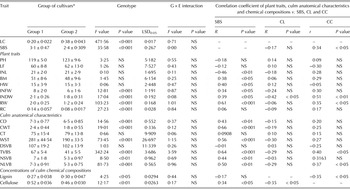
The results of ANOVA indicated that the genotype × environment interactions for LC, SBS, and all the parameters of plant traits, culm anatomical characteristics and concentrations of culm chemical compositions were not significant for the two groups of cultivars, allowing further analysis with combined data sets (Table 4). The difference in LCs was significant between the two groups of cultivars. The mean for the LC of Group 1 cultivars (0·20 ± 0·022) was significantly smaller than that of the Group 2 cultivars (0·38 ± 0·043, P < 0·001), indicating that the cultivars in Group 1 were less prone to lodging than those in Group 2. This was supported by the observation that the mean SBS for Group 1 cultivars (3·07 ± 0·469) was significantly greater than that of Group 2 cultivars (2·40 ± 0·299, P < 0·001). Measurements of the morphological traits of plant, such as PH, basal INL, LF, BM of the above-ground parts (BM) and HW, showed that the two groups of cultivars did not differ for those traits, which indicated that they had different relationships with the LC. Plant height and LF were not correlated with SBS, but INL, BM of the above-ground parts and HW were significantly correlated with SBS (r = −0·46, 0·38. and 0·34, respectively, P < 0·05 or 0·01) (Table 4). The fresh (INFW) and dry weights (INDW) of the basal internodes, RW, ratio of root to above-ground tissue weight (RC) of Group 1 cultivars were higher than those of Group 2 cultivars (P < 0·05). They were significantly correlated with SBS (r = 0·34, 0·39 and 0·61, respectively, P < 0·05 or 0·001), except for ratio of root to the above-ground tissue weight (r = 0·06).
Mean values (±s.e.) of different LCs and the correlation coefficients of plant traits, culm anatomical characteristics and lodging associated traits based on all the cultivars across Groups 1 and 2 that differ in LCs

LC, lodging coefficient; SBS, stem-breaking strength (kg); PH, plant height (cm); LF, leverage force (cm); INL, length of basal 3- to 5-internodes (cm); BM, biomass of the above-ground stem and head (g); HW, head weight (g); INFW, fresh weight of 3- to 5-internodes (g); INDW, dry weight of 3- to 5-internodes (g); RW, root weight (g); RC, ratio of root to canopy; CD, culm diameter (mm); CWT, culm wall thickness (μm); CT, cuticle thickness (μm); WST, width of sclerenchyma tissue (μm); DSVB, diameter of small vascular bundle (μm); TVBS, thickness of large vascular bundle sheath (μm); NSVB, number of small vascular bundle; NLVB, number of large vascular bundles; CL, concentration of lignin (%); CC, concentration of cellulose (%); NS, not significant.
* Group 1: cultivars Canggu 3, Yugu 18, Baogu 19, Jigu 19, Jigu 31 and Yugu 19 with smaller lodging coefficients; Group 2: cultivars Xiaoxiangmi, Baogu 18, Hangtianlvgu, Zheng 07-1, Jigu 18, and 200 475 with greater lodging coefficients.
Association between stem-breaking strength and culm anatomical traits
Among the anatomical parameters of the culm examined, only cuticle thickness (CT) and the diameter of the small vascular bundles (DSVB) did not significantly differ between the two groups of cultivars, nor were they correlated with SBS (r = 0·09 and −0·01, respectively) (Table 4). The two groups of cultivars displayed significant differences in culm diameter (CD), culm wall thickness (CWT), width of sclerenchyma tissue (WST), numbers of small (NSVB) and large vascular bundles (NLVB), and thickness of the large vascular bundle sheath (TVBS) (Table 4). The mean values of these traits for Group 1 cultivars were greater than those for Group 2 cultivars. These parameters were correlated with SBS, as indicated by their significant correlations (r = 0·43 to 0·66, P≤0·01).
Association between stem-breaking strength and the chemical composition of the culm
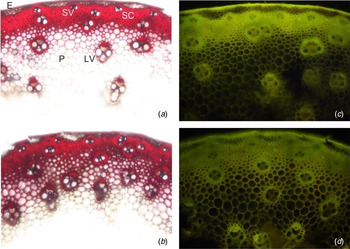
The Wiesner staining reaction produced a purple-red colour in lignin-containing structures (Fig. 1(a) and (b)). The cell walls of sclerenchyma tissues below the epidermis, small vascular bundles, and large vascular bundles within the parenchyma tissues reacted strongly with phloroglucinol–HCl and stained a deep purple-red colour, while the parenchyma tissues displayed only a faint purple-red colour. The cultivars with different LCs differed in their responses to the Wiesner reaction for lignin. Group 2 cultivars with greater LCs had stronger reactions to Wiesner reagents than Group 1 cultivars with smaller LCs, as indicated by difference in the intensity and the extent of the areas stained purple-red colour (Fig. 1(a) and (b)). The fluorescent signals of cellulose were observed in the culm sections after Calcofluor staining. The sclerenchyma layers and large vascular bundles displayed strong fluorescent signals. The intensity of fluorescence for Group 1 cultivars appeared to be stronger than that of Group 2 cultivars (Fig. 1(c) and (d)).
Wiesner's reaction (A and B) and autofluorescence after calcofluor staining (C and D) showing lignin and cellulose in the foxtail millet cultivars Jigu 19 (LC = 0·20) (A and C) and Xiaoxiangmi (LC = 0·34) (B and D). Lignin in the cell walls of culm tissues were stained purple-red, and cellulose was observed by strong autofluorescent signals. E, epidermis; SC, sclerenchyma; SV, small vascular bundle; LV, large vascular bundle; and P, parenchyma.

The mean concentrations of lignin (CL) and cellulose (CC) as determined by the Klason method differed significantly between the two groups of cultivars (P < 0·05). Group 1 cultivars had a greater mean level of cellulose concentration and a lower mean level of lignin concentration compared to Group 2 cultivars (Table 4). The effects of lignin and cellulose on SBS were different. Lignin concentration was not significantly correlated with SBS (r = −0·17). In contrast, cellulose concentration was positively correlated with SBS (r = 0·34, P < 0·05). The lignin concentration was negatively correlated with the cellulose concentrations (r = −0·35, P < 0·05). Both lignin and cellulose concentrations were correlated significantly with the dry weight of internodes, but the direction of the response was reversed (r = −0·42 and 0·51, P < 0·05 and 0·01, respectively). Lignin concentration was not correlated with any of the anatomical characteristics of the culm; but the cellulose concentration was correlated with large vascular bundle, in terms of both the thickness of the sheaths and unit number (r = 0·37 and 0·40, P < 0·05, respectively).
DISCUSSION
Variation in stem lodging resistance was observed in the foxtail millet cultivars and breeding lines used in the present study, as manifested by their different values for LC, SBS and SFM. Since the LC is determined by SBS, understanding of the relationship between this trait and the morphological, anatomical and carbohydrate compositional properties of the culm will be useful for determining the critical characteristics that are associated with stem-based lodging in foxtail millet. A thorough understanding of lodging in cereal crops has been accumulated from studies on crops such as wheat, rice and barley, but the parameters associated with stem-based lodging of the culm in foxtail millet are still poorly understood. Thus, the present study provides the first experimental information on lodging associated traits in this old, domesticated cereal crop.
The association between PH and lodging resistance is clear in wheat (Kelbert et al. Reference Kelbert, Spaner, Briggs and King2004b ), although a negative correlation between PH and lodging resistance has been reported in some studies (Crook & Ennos Reference Crook and Ennos1994; Navabi et al. Reference Navabi, Iqbal, Strenzke and Spaner2006). The identification and incorporation of dwarfing genes has greatly improved lodging resistance in wheat and rice, leading to the Green Revolution (Khush Reference Khush2001). In barley, differences in INL have been associated with lodging resistance (Stanca et al. Reference Stanca, Jenkins and Hanson1979; Dunn & Briggs Reference Dunn and Briggs1989). Reductions in PH might increase lodging resistance by reducing the LF; however some other studies reported that PH was not a dominant factor in lodging resistance (Hua et al. Reference Hua, Hao, Shen, Zhang, Wang, Wang and Ma2003; Tripathi et al. Reference Tripathi, Sayre and Kaul2005). Results from both previous and current studies with different genotypes of improved foxtail millet cultivars have demonstrated that PH and INL did not have a major effect on SBS (Tian et al. Reference Tian, Wang, Zhang, Li, Wang and Li2010). In the present study, PH, INL and LF of foxtail millet were not correlated with SBS. This indicates that these traits do not directly affect stem-based lodging in improved foxtail millet cultivars. Thus, reducing PH and INL is not a priority for developing lodging-resistant foxtail millet cultivars.
In contrast, the BM of foxtail millet plant, including above-ground BM, HW, fresh and dry weight of basal internodes were significantly correlated with SBS. These BM parameters contribute to the establishment of a stronger plant. Wei et al. (Reference Wei, Li, Wang, Qu and Shen2008) and Yao et al. (Reference Yao, Ma, Zhang, Ren, Yang, Yao, Zhang and Zhou2011) reported that the lodging and SFM in wheat were associated with the dry weight of basal internodes. Similar results were observed in rice (Li et al. Reference Li, Zhang, Yang, Ge, Ma, Wei, Dai, Hou and Xu2012).
In foxtail millet, the diameter of the basal internodes and CWT were significantly correlated with SBS. This indicates that the cultivars with large culm diameters and thick stem walls may have greater SBS, which in turn, may improve lodging resistance. In other cereal crops such as wheat and rice, the impact of culm diameter and CWT on lodging was inconsistent. A close relationship between culm diameter, as well as CWT, and lodging resistance was reported in wheat and barley (Dunn & Briggs Reference Dunn and Briggs1989; Zuber et al. Reference Zuber, Winzeler, Messmer, Keller, Keller, Schmid and Stamp1999; Xiao et al. Reference Xiao, Zhang, Yan, Zhang, Hai and Guo2002), while in other studies, culm diameter was not regarded as an important factor for lodging resistance in rice and barley (Kokubo et al. Reference Kokubo, Kuraishi and Sakurai1989; Kashiwagi & Ishimaru Reference Kashiwagi and Ishimaru2004).
Similar to other cereal crops, the structure of the culm of foxtail millet consists of epidermis, sclerenchyma tissues (mechanical tissues), vascular bundles, parenchyma tissues and inner cavities. These structures have different effects on lodging in foxtail millet. The WST, and the number and sheath width of the large vascular bundles played a significant role in improving SBS, whereas the width of epidermis and diameter of the small vascular bundles were not correlated with SBS. In rice, a correlation between vascular bundle number and culm strength was observed (Duan et al. Reference Duan, Wang, Wang, Wang and Cai2004). The thickness of sclerenchyma tissue was shown to have a close association with lodging resistance in barley and wheat (Dunn & Briggs Reference Dunn and Briggs1989; Kelbert et al. Reference Kelbert, Spaner, Briggs and King2004b ).
The lignin concentration appears to be less associated with stem-based lodging in foxtail millet, as evidenced by a lack of correlation between lignin concentration and SBS (r = −0·17). Greater lignin concentration has been associated with more stalk breakage in maize (Zea mays L.) (Li, personal communication). The association between the concentrations of lignin and cellulose in culm tissue and lodging resistance was not consistent in wheat. In earlier studies, lignin concentrations and cellulose concentrations were associated with greater lodging resistance in wheat (Zhu et al. Reference Zhu, Shi, Li, Kuang, Li, Wei, Bai, Hu and Lin2004; Wang et al. Reference Wang, Zhu, Lin, Li, Teng, Li, Li, Zhang and Lin2006). When tested in other Chinese wheat genotypes, no significant differences in these chemical components were observed between the genotypes with different lodging resistance (Kong et al. Reference Kong, Liu, Guo, Yang, Sun, Li, Zhan, Cui, Lin and Zhang2013).
In conclusion, stem-based lodging in foxtail millet varied among different genotypes. Lodging-resistant cultivars were associated with specific culm characteristics such as more large vascular bundles, wider culm diameter, increased CWT and an increased width of the sclerenchyma ring. These anatomical properties of the culm ensure higher SBS, and in turn, greater resistance to lodging. The concentrations of lignin and cellulose in the cell walls had different effects on SBS in foxtail millet. High levels of cellulose in culm cells were associated with greater SBS. A cultivar with high level of lignin concentration in the culm might still be prone to stem lodging. Stem-breaking strength and greater BM of above- and below-ground tissues were conducive for reducing stem-based lodging. The new findings of the present study on the relationship between the anatomical and chemical properties of the culm and lodging will be useful for the genetic improvement of lodging resistance in foxtail millet.
The authors thank Dr R. L. Conner of Morden Research Station, Agriculture and Agri-Food Canada for his critical review of this manuscript. The financial support provided by the Ministry of Agriculture of China (CARS-07-12.5-B1) is gratefully appreciated.