INTRODUCTION
Not a single example is known of the arms of Henry ii of England (d. 1189), nor is there any historical description of them, but this vacuum of information is partially filled by our knowledge of the arms of his father, Geoffrey of Anjou (d. 1151), of his brother, William fitz Empress (d. 1165), and of his sons, Richard Plantagenet (d. 1199) and John (d. 1216). Geoffrey of Anjou bore azure, semy of lions rampant or, which is the earliest datable heraldic shield, historically attested to have been presented to Geoffrey when he was made a knight in 1128, and represented on the famous Le Mans enamel plaque.Footnote 1 William fitz Empress from his seal of 1156–64 bore a single lion rampant, tinctures unknown on his shield and two lions rampant on his horse trappers (one at the front; another at the rear).Footnote 2 John, as count of Mortain, by 1185 was using two lions passant, tinctures unknown.Footnote 3 His older brother, Richard Plantagenet, on becoming Richard i in 1189, bore a lion rampant, as known from his great seal and confirmed by a literary account of the banner that he carried during the Third Crusade of 1190–91.Footnote 4 Between 1197 and early 1198 Richard changed his arms to gules three lions passant guardant or. Footnote 5 After weighing up the available evidence, Adrian Ailes suggested three possibilities for the arms of Henry ii: his father’s arms; a single lion rampant; or two lions passant.Footnote 6 As the evidence derived from seals, Ailes did not ascribe tinctures to the latter two options.
CLUES TO THE FORM OF THE ARMS OF HENRY II
Gerard Brault has summarised the literary evidence on the colouring of the arms. The earliest source which he identified was a work of Benoît de Sainte-Maure commissioned by Henry ii c 1174, in which William the Conqueror (r. 1066–89) was ascribed golden lions on a field azure.Footnote 7 Early Arthurian texts ascribe to Sir Tristan golden lions on a field gules, regarded as a form of flattery to the Plantagenet dynasty. Since the earliest surviving versions date to 1226, it seems that the author had in mind the arms devised by Richard i, which by then had become well established as the royal arms of England. Other sources significantly later than the reign of Henry ii ascribe to Sir Tristan the arms gules a lion rampant or. Evidence that these arms are most unlikely to have been used by Henry ii will be cited below. Gerald of Wales (c 1146–c 1223) recorded that on his deathbed Henry ii gave to his illegitimate son Geoffrey, bishop of Lincoln, his much-loved ring charged with ‘a panther’.Footnote 8 Perhaps in this passage Gerald was hoping to amuse his fellow cognoscenti, since the panther was an oft used metaphor for life everlasting in the resurrected Christ. A rather wonderful poem about the animal was at the time widely known from the ancient literary source the Physiologus.Footnote 9 In this work, Christ was expressly named as the true panther, since the animal was believed to retire to its cave for three days after feeding before returning to the world, echoing Christ’s resurrection from the tomb. It is very likely that this ring was in fact charged with the lion of Anjou, which, given the artistry of the day, might justifiably have been called a panther.Footnote 10
We cannot know the form of Henry ii’s ring, but we do have three twelfth-century heraldic objects that might shed some light on the matter. The first is the well-known Folkingham brooch, which depicts a lion rampant on a shield of a shape that had fallen out of use by the end of the twelfth century. The form of the lion’s head is stylistically early, primitive and typical of that century. Nicholas Vincent has speculated that this might be a Plantagenet livery badge.Footnote 11 The second object is the Le Mans version of Pliny the Elder’s Natural History, which art historians perceive as having strong stylistic connections both with the English Winchester Bible and with the Le Mans plaque of Henry ii.Footnote 12 The Pliny manuscript is believed to date from the 1150s, and has a page showing Pliny dressed as a medieval knight presenting a copy of his work to the Emperor Vespasian (r. ad 69–79).Footnote 13 Above this is an illustration of Pliny writing his work, to the side of which are the arms of the person for whom the manuscript was created on a kite-shaped shield, azure a lion rampant argent with a border or. The shield is very reminiscent of the Folkingham brooch, where the lion also sits within a border. From charter evidence, William fitz Empress was frequently at the side of his brother wherever he travelled in the Angevin empire.Footnote 14 He had extensive lands in England, in Normandy and elsewhere. In 1157 he was one of only two witnesses to a charter of Henry ii confirming a gift from their brother Geoffrey, Count of Nantes, to the abbey of Notre Dame de Chateau l’Hermitage, located just south of Le Mans. It seems that all three brothers retained a strong interest in this monastery, which had been founded by their father in 1144.Footnote 15 It is doubtful that the arms here are those of Henry ii, but distinctly plausible that they might be those of Henry ii’s brother, William fitz Empress.Footnote 16 It is possible that Geoffrey, Count of Nantes, bore azure a lion rampant argent as the middle brother, to which William might have added a border as an additional mark of difference. If so, this would be the earliest example of the addition of a border by a younger brother.
AN INTRIGUING NEW FIND
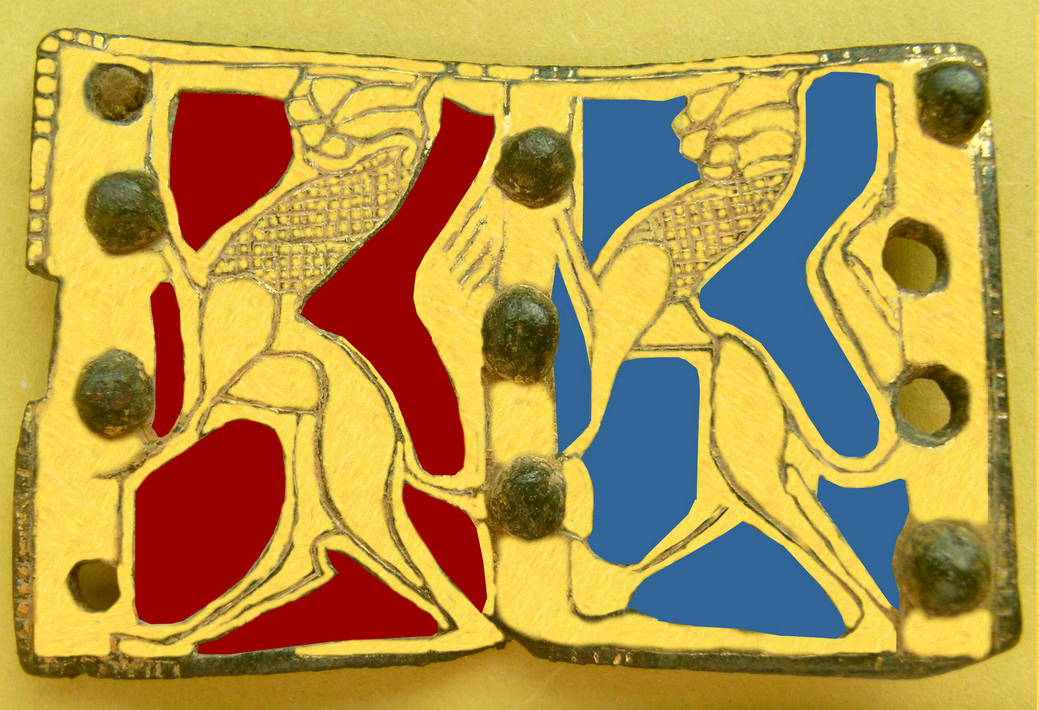
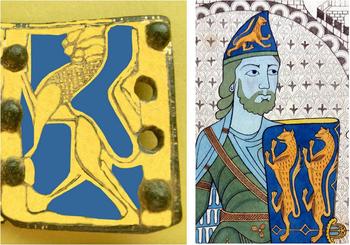
The third object, also stylistically belonging to the reign of Henry ii, has never been published, and was purchased by the author on the antiquities market, having entered another collection in 1990, before the Treasure Act 1996 and the setting up of the Portable Antiquities Scheme (fig 1). Unfortunately, its find-spot is not known.Footnote 17 What survives is the left-hand fitting for a belt or strap, with a slot for the prong of the lost buckle to the right. A not dissimilar object that is slightly more complete and which displays two fleurs de lis was reported in 2009.Footnote 18 The new object is gilded and enamelled copper alloy depicting two golden lions rampant in archaic form, apparently placed on banners. The dexter lion is on a field gules, and the sinister on a field azure. These colours can be clearly discerned through a microscope as traces of enamel, as restored (fig 2). The cross-hatching on the necks of the animals gives the impression of a mane, suggesting that these would be lions rather than leopards. If this were worn as a belt, the lion with the red background would have been central, and was possibly to have been mirrored with a matching plate on the other side of the buckle. The lions are somewhat reminiscent of the lions on the Limoges enamel plaque (fig 3) found on the tomb of Geoffrey of Anjou in the cathedral of St Julien (in Le Mans). Traces of ancient leather adhere to the back of the plate, which at some stage in its existence has received a sharp impact that has left a discernible dent. The rampant pose of the lions puts them securely in a heraldic context, at a point in history when heraldry was still largely confined to the baronial class.
The belt or strap fitting as it appears today (scale 4:1). Traces of enamel can just be seen at this magnification, specifically the red enamel below and behind the left-hand lion. Photograph: the author 2018.

The fitting with the gilding and enamelling restored digitally by the author. Photograph: the author 2018.

Comparison between the fitting (left) and a detail from the shield of the Le Mans plaque of Geoffrey of Anjou (right), reproduced from Stothard 1817. Photographs: (left) the author 2018; (right) from Stothard 1817, pl 2.

There is a plausible context for an object to have been decorated with two heraldic banners in the late twelfth century, one gules a lion rampant or, and the other azure a lion rampant or. The first of these arms apparently belonged to the Aubigny family, earls of Arundel and hereditary chief butlers of England. William iii d’Aubigny (d. 1193), who acceded in 1176, carries a shield charged with a lion rampant on his equestrian seal, and has a lion passant regardant on his non-heraldic counter-seal. Birch dated the charter to which the seal is attached to c 1180, which seems to be about right as d’Aubigny bears the title earl of Sussex, given to him by Henry ii in 1177.Footnote 19 Since he bore the same name as his father, he might well have recycled his father’s seal, of which no impression or record has been preserved. All that survives now of the original legend is part of the name William. The tinctures of the Aubigny arms were recorded by Matthew Paris for William iv d’Aubigny (d. 1221).Footnote 20
The single golden lion on an azure field, as occurs on the cap of Geoffrey of Anjou on the Le Mans plaque, was not used again until the later thirteenth century, which is surprising given the frequency with which arms were recycled in the medieval era.Footnote 21 The Aubignys were not only important members of the royal household, but were on close terms with Henry ii. William ii d’Aubigny commanded the royal army in Normandy in August 1173 against Henry’s rebellious sons: Henry the Young King (1155–83); Geoffrey ii, Duke of Brittany (1158–86); Richard Plantagenet; and John. A month later, in September that year, William ii d’Aubigny was once again in action against Henry’s enemies in Suffolk. His son, William iii d’Aubigny, was also close to Henry ii and was with the king when he died at Chinon, in Touraine, in 1189.Footnote 22 As an expression of their loyalty, either one of the two earls might well have placed his personal arms side by side with those of Henry ii. Azure a lion rampant or could be either the royal livery badge or the actual royal arms. If it is accepted that the belt fitting depicts two banners, then it would be singular to have a badge on a banner in this early period of heraldry.
The use of the single lion rampant by Richard i from the outset of his reign lends further support to the contention that by the end of the reign of Henry ii the royal arms contained only a single lion rampant. Leaving aside the issue of what prompted Richard to change his arms in 1195 to gules three lions passant guardant in pale or, the most puzzling aspect of the change is that of the field colour from azure to gules. Quite possibly Richard, being a younger son, adopted arms with a field gules. For a younger son to change the field colour of his paternal arms became a popular method of differencing in the thirteenth century. The arms which he bore cannot have been gules a lion rampant or, since these were already the arms of Aubigny, a contention supported by the belt fitting. The alternative explanations for the fitting are twofold: either this was just a pretty design not meant to be heraldic, or we have here side by side the banners of Richard Plantagenet and his father. The first option seems improbable on the basis that the lions are clearly heraldic, and the maker would surely not have risked usurping a royal prerogative. The second option also seems improbable on two grounds: first, the fact of the Aubigny arms and, second, the adversarial relationship that existed between Richard and his father. It is possible that Richard was simply reverting in 1195 to the arms he bore before his father’s death. His brother John was using two lions passant from 1185.Footnote 23 It should not be forgotten that the brothers would have needed their father’s permission to adopt versions of the royal arms, and Richard, as the elder, might have been permitted more lions than John.
It would hardly stretch the available evidence to conclude that the belt fitting might be the only surviving example of the lost later arms of King Henry ii, arms inherited by his son Richard, who used it for a further six years. The ascription of multiple golden lions on a field azure to William the Conqueror by Benoît de Sainte-Maure in the early 1170s suggests that Henry ii continued to use his paternal arms, but, by the end of his reign, favoured their reduction to a single lion. This left the original arms free to be adopted by Henry ii’s natural son, William Longspee, 3rd Earl of Salisbury (c 1176–1226).
ORIGIN OF THE ARMS OF BOHUN
There is an additional piece of evidence that must be brought to bear at this point. Sometimes the arms used by families preserve a memory of arms that have otherwise been forgotten, and those of Bohun provide one such example. In 1238 Humphrey v de Bohun (d. 1273) bore the arms azure a bendlet argent between six lions rampant or, as is evident from his seal.Footnote 24 Before 1259 – and presumably for purely aesthetic reasons – he added golden cotises to the bendlet.Footnote 25 An earlier record of the arms was recently uncovered by Nicholas Vincent in the form of an equestrian seal of Henry de Bohun (d. 1220), 1st Earl of Hereford.Footnote 26 The charter to which it is appended Vincent dates to c 1200. Henry’s shield shows a bend between two lions rampant, but the space did not really permit the carving of any more lions. Other examples exist of the phenomenon of increasing or reducing the number of heraldic charges depending on the space available, which has been termed multiplicative and reductive extractive armifery by D’Arcy Boulton.Footnote 27 What we effectively have here are the arms of Geoffrey of Anjou with a white bendlet placed across them. This is the white staff of office borne by the most senior officers of state, and the message would have been easily read by contemporaries as the arms of a senior household officer of Henry ii. This is exactly what Humphrey iv de Bohun (d. 1181) and his son Henry de Bohun (d. 1220) were, as hereditary constables of England.Footnote 28 This office passed to the Bohuns by 1166.Footnote 29
CONCLUSIONS
In summary, therefore, it is proposed that the two lions fitting was created either for William ii d’Aubigny (d. 1176), for his son, William iii d’Aubigny (d. 1193), or for William iv d’Aubigny (d. 1221), placing the personal arms of the earl next to those of Henry ii, or just possibly Richard i prior to 1195, as a mark of loyalty and as an indication that the bearer was a senior officer of the Crown.
ACKNOWLEDGEMENTS
The author would like to thank those who considered the lion fitting and its historical context and offered their personal insights, notably Nigel Ramsay, Marion Campbell, John Cherry, Steven Ashley and Nicholas Vincent. He is also grateful to Tom Higham for his advice (regretfully to the negative) as to whether current technology might provide a means of more precisely dating the manufacture of the artefact; and to Christos Tsirogiannis and James Ede for confirming that the surviving documentation from the Robin Symes Collection can provide no additional information.
ABBREVIATION AND BIBLIOGRAPHY
Abbreviation
- BL Add Ch
British Library Additional Charter