Chemical, biological, radioactive, and nuclear weapons (CBRNW) have existed throughout history. The use of these weapons even in a single attack could endanger the lives of millions of people, Reference Reynolds1 put enormous burdens on the health resources of societies, Reference Sandström, Eriksson and Norlander2 and threaten health safety. The effects of CBRNW attacks on public health have been described as direct effects (mortality, injuries, and disabilities), psychological trauma (for both patients and medical staff), overload of health system (depletion of supplies, exhaustion of medical staff, and increased bed occupancies), socioeconomic effects (disorder of social structures and families, displacement, disabilities, and unaccompanied children), and environmental effects (air, food, and water contamination, and animal and plant poisoning). Overload of health systems and socioeconomic effects include less availability and low quality of health care, effects on health-care management, less access to health care, and effects on health financing. The final result of all these effects is explained as the deterioration of individual and social health. Reference Ekzayez, Flecknoe and Lillywhite3
Despite that the use of CBRNW has been perceived as unfavorable in the international arena and many measures have been taken, the presence of these weapons has become increasingly more significant. Reference Doğanalp4
In the literature, it is mentioned that health systems and health professionals in many stages are not prepared or competent about the subject, Reference Barbosa5 and it is emphasized that health-care professionals in particular would qualify as a link in the management of such disasters. Reference Gautam, Sharma and Sharma6 The key strength of nurses, doctors, paramedics, and public health professionals in such circumstances is particularly important. Reference Kako, Hammad and Mitani7 In the case of a CBRNW attack, health-care professionals should have good knowledge, attitude, and skills in many subjects like communication, cooperation, leadership, and status awareness, and it is necessary to be prepared for complex responses in areas like triage, monitoring, diagnosis, decontamination, and self-protection. Reference Hu, Chen and Yu8 Regardless of the type of weapon used, rapid and focused medical intervention is essential for the victims, both during pre-hospitalization and hospitalization. Such circumstances refer to sudden changes in the routines in hospitals. Reference Hu, Chen and Yu8
Turkey is located at the intersection of 3 very important and just as unstable regions, the Balkans, the Caucasus, and the Middle East, and continues to display a consistent image in policies toward CBRNW and disarmament. Turkey has ratified the 3 most comprehensive conventions for combatting the proliferation of CBRNW: the Treaty on the Non-Proliferation of Nuclear Weapons (1980), the Chemical Weapons Convention (1997), and the Biological and Toxin Weapons Convention (1974). Reference Yılmaz9 Considering the countries that are known to possess CBRNW and their close proximity to Turkey, the awareness and preparedness of Turkey becomes a state policy.
In Turkey, health-care education is given at universities, following 8 y of basic education. Doctors complete their training in 6 y, nurses and midwives in 4, and paramedics and medical laboratory personnel in 2. The universities appear in 3 different structures as state, foundation, and private. Each is affiliated with a higher education institution. Although they have common curricula in basic vocational education and training, some contents may still differ in terms of quality and quantity. Public health courses are mandatory in some universities and elective in others. The subject of CBRNW is included within the curriculum for Public Health courses. However, the content of this subject has no common base and varies between universities, which tends to affect the knowledge, attitude, behavior, and skills of health-care personnel, who should be equipped on this issue.
The purpose of this study was to determine the awareness levels and approaches of senior students at different stages of health education regarding CBRNW (doctors, nurses, midwives, paramedics, and medical laboratory technicians) and to compare them based on certain characteristics.
Methods
Study Design
This study was designed as a quantitative cross-sectional research. The data were collected by face-to-face group interviews.
Population and Sample
The population of the study consisted of 471 senior students at Giresun University, 24 from the faculty of medicine, 174 from the faculty of health sciences (113 from the department of nursing and 61 from the department of midwifery), and 273 from the vocational school of health services (167 from the department of paramedics and 106 from the medical laboratory techniques program). No sample was selected and all senior students who volunteered to participate in the research were included. The number of participants was 413 (87.68% responsiveness rate). A post-hoc test was carried out on the 413 participants for the chi-squared test using the G*Power 3.1.9.2 software. Effect size was taken as 0.3 and the 1-β err probe value (power) was determined as 0.99. The participation rates according to the departments were 83.33% for the faculty of medicine, 90.26% for the department of nursing, 90.16% for the department of midwifery, 81.43% for the department of paramedics, and 94.33% for the medical laboratory program.
Data Collection Tools
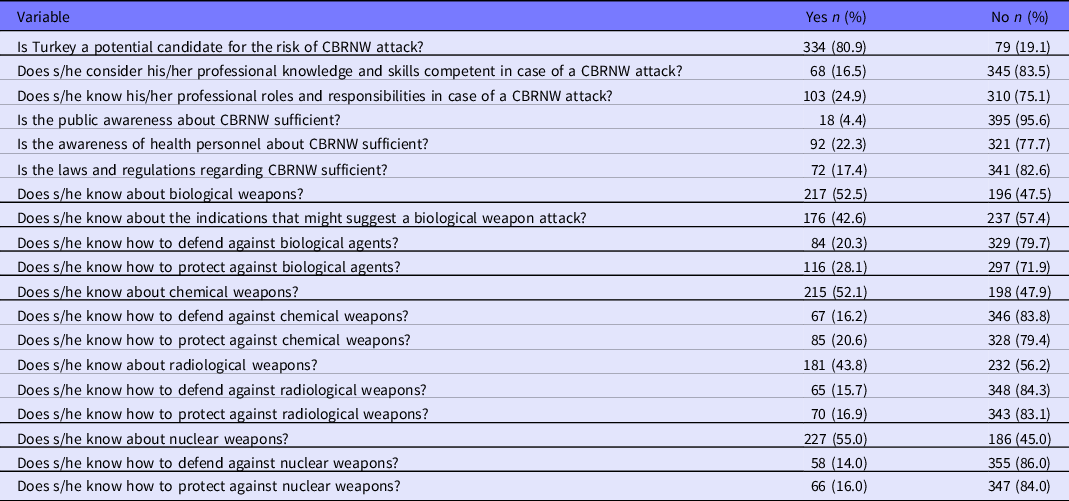
The survey form used here was developed by the researcher to inquire qualitative characteristics regarding the subject. Table 1 shows the independent variables (age, sex, department, additional training/courses about CBRNW, etc.). Table 2 shows the dependent variables (perception on Turkey’s risk for a CBRNW attack, perception on self-competence for professional knowledge and skills, etc.). The form was collected by the researcher during the last 5 min of any lesson. Ethical permission for the conduct of the research was obtained (90139838-000-E.32493), participants were informed about the study, and their verbal consents were taken. The independent variables of the study were the demographic characteristics of the participants and dependent variables were the questions that aimed to measure their CBRNW awareness.
Socio-demographic characteristics of the participants (N = 413)

Perceptions of participants about CBRNW (N = 413)

With the information text provided at the top of the research form according to the criteria of the Helsinki Declaration, the data were collected from “volunteer participants who reported not having any psychiatric illness diagnosed by a physician.” All participants gave their informed consent in line with the principle of volunteering.
Statistical Analyses
The SPSS 22 software was used for the analyses, error checks, and creating the tables. Descriptive data are presented as number and percentage distributions. The chi-squared test was used for data analysis and P < 0.05 was accepted as the level of significance.
Results
The mean age of the participants was 21.55 ± 2.42 y (median: 21 y. min-max: 18-42 y). 4.8% of the participants studied at the faculty of medicine, 38.0% at the faculty of health sciences, and the rest at the vocational school of health-care services. The participation rates according to departments were compatible with the rates in the population.
Table 1 lists some of the socio-demographic characteristics of the participants. As it turns out, most of the participants chose the profession themselves and their families or immediate environment were not effective in this choice.
Table 2 shows the perceptions of the participants about CBRNW. It was found that 80.9% of the participants considered Turkey under the threat of CBRNW, 16.5% considered their professional knowledge and skills sufficient in case of a CBRNW attack, and 4.4% believed that the social awareness about this issue was sufficient. A total of 52.5% stated that they were knowledgeable about biological weapons, 52.1% about chemical weapons, 43.8% about radiological weapons, and 55.0% about nuclear weapons, with various information sources (lectures, symposiums, courses).
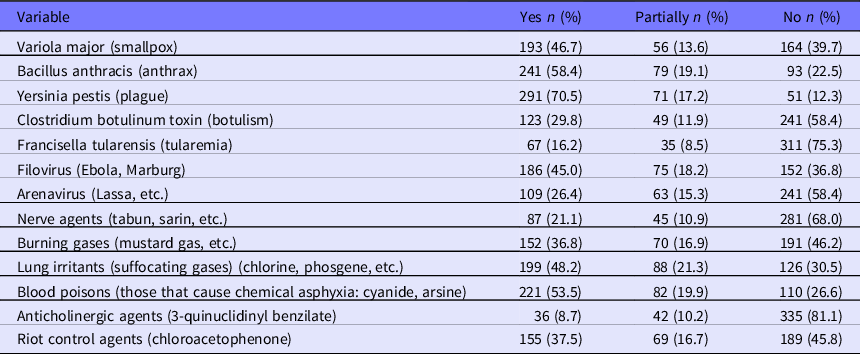
Table 3 demonstrates the distribution of the participants according to their knowledge of biological and chemical weapon agents. Approximately 1 in 2 participants knew some types of biological and chemical weapons.
Distribution of participants according to their knowledge of biological and chemical weapon agents (N = 413)

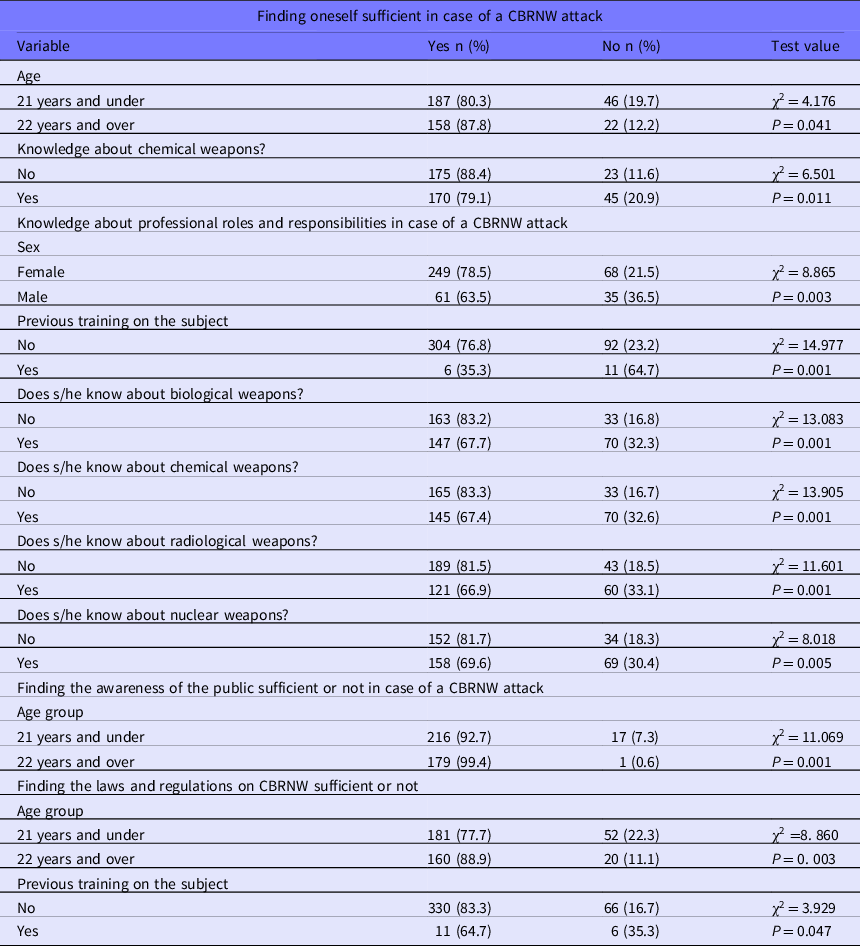
The dependent variables were compared according to age, length of education, sex, professional commitment, previous education about the subject, and knowledge about CBRNW. Table 4 shows the variables that created a difference, so the remaining variables showed no significant difference among groups (P > 0.05). The students’ current departments and their professional commitment were found to have no significant effect on their perceptions about CBRNW (P > 0.05).
Distribution of the CBRNW perceptions of the participants according to certain variables (N = 413)

* Row percentages were considered.
Limitations
Although this research provides data on the knowledge of a group of students in health education on CBRNW, it also has limitations. First, the data used in the study were based solely on health-care students’ self-report and involved only 1 interview with each participant. Second, the data that we used are relatively few, and consists of 1 school in total, which may limit our findings in terms of their generalizability to a broader scope of schools across Turkey. The third limitation is that the data were collected through questionnaires. End, all the participants to the survey were volunteers.
Discussion
Recently, pandemic attacks have been experienced in many countries of the world, and there has been a considerable increase in related concerns. Reference Gautam, Sharma and Sharma6 The past biological attacks reported in the world history occurred in the United States of America (USA), Germany, and France in 2018; chemical attacks in the United Kingdom, USA, and France in 2018; radioactive attacks in North Korea in 2017; and nuclear attacks in Indonesia. 10 These incidents revealed whether countries were prepared for these circumstances. For instance, in a study by Barbosa investigating whether emergency departments and health-care workers in hospitals in Italy were prepared for a CBRNW attack, it was stated that less than 20% of the hospitals were ready and health-care professionals had problems in various circumstances. Reference Barbosa5 No matter if a country is developed or not, CBRNW is a threat for all countries in the world. Reference Reynolds1 Even though such attacks have been experienced many times in the past century, there are still significant deficiencies.
This study was conducted to determine the awareness of health education students within a university sampling in Turkey and who would be employed within 2-3 mo about CBRN weapons and to find out whether certain characteristics would create differences in their awareness.
A single use of a CBRNW could cause human casualties in numbers corresponding to repeated uses of conventional weapons and could lead to further negative effects after the attack. Reference Kaya11
An article reported by Galatchi mentioned particularly Turkey, Romania, Greece, and Bulgaria as candidates for CBRNW attacks. Reference Galatchi12 Although a high rate (80.9%) of participants considered Turkey under the threat of CBRNW, those who believed that they had sufficient professional knowledge and skills in this regard were much fewer (16.5%). This is believed to stem from the fact that not all participants received education on CBRNW. Aslan Huyar and Esin conducted a research on nursing students in Turkey and found that 94% of the participants received no training on CBRNW, and 91.7% did not wish to receive such training, believing that nurses’ intervention is not required in CBRNW cases. Reference Aslan Huyar and Esin13 Another study focused on the knowledge and views of emergency unit nurses on bioterrorism and revealed that 57.8% knew about the concept of bioterrorism, but considering our country in a risky position, they wanted to receive a more comprehensive education on the matter. Reference Sarıtaş, Kızıl and Sarıtaş14 Consistent with the literature, students seem to have a negative attitude, as well as an increasingly more awareness toward this subject during their education. In a study conducted in Poland, 78% of nurses perceived their country to be under threat of bioterrorism. Reference Renn-Żurek, Łopacińska and Tokarski15 One research investigated officers working in institutions that will intervene in case of a CBRNW attack/threat in Turkey and found that only 5.9% received training on this subject during their university education. Reference Doğan16
As presented in Table 2, the participants perceived their roles and responsibilities at high percentages, but the awareness level of the public at lower rates. The most notable finding was that the participants considered the active health-care personnel insufficient in terms of CBRNW attacks. However, Turkey faces a more likely threat of CBRNW compared to other countries due to its geostrategic location, intercontinental transportation in international energy transportation, the nuclear power plants in neighboring countries, irregular urbanization, and other risks brought by industrialization. This puts the society at high risk, necessitating preparation. In this regard, creating awareness on CBRNW and providing the necessary basic education will reduce potential damages in case of a possible threat in both the country where this research is conducted and in other geographies with similar positional characteristics.
The participants had similar percentages in terms of knowledge on CBRNW weapons, except for a higher knowledge on radiological weapons. This finding was because the participants had received detailed training on radiology.
Another finding of the study was the varied perceptions of the participants about CBRNW. It was important to see that their field of education did not create any difference. In Turkey, the period of training differs among professions. Although these differences could be acceptable based on the differences in both the education period and the contents, the reasons could be the importance and priority given to treatment and rehabilitation and the superficial importance attributed to preventive health services within these education programs. The subject of CBRNW is taught as a part of Public Health courses on a theoretical basis in all these professions. Almost all the participants in this study (95.9%) stated that they had not received training on the subject. Another notable result was that professional commitment did not make a difference in terms of CBRNW perceptions. This finding supports the approach mentioned above. In a study conducted by Sevinç et al. on paramedics, 38.5% stated that they did not receive training on disaster medicine. Here, it was demonstrated that the percentages of having received training on disaster medicine among physicians and nurses were close to the percentages of paramedics. Reference Sevinç, Güner and Ayşen17
In this study, 68.0% of the participants stated that they did not know about nerve agents, 46.2% about burning gases, 30.5% about lung irritants, 81.1% about anticholinergic agents, and 45.8% about riot control agents. Nerve agents and blood poisons have lethal effects, burning gases cause tissue damage, lung irritants cause physical damage to the respiratory system, anticholinergic gases could cause psychosis and serious mental deficiencies, and riot control agents cause rapid and temporary loss of capacity. Reference Erkekoğlu and Koçer-Gümüşel18,Reference Wiesner, Kappler and Shuster19 Footer et al. examined the matter on Syrian health-care workers who had suffered a chemical weapon attack and highlighted the significance of training, even when given from a distance. Reference Footer, Clouse and Rayes20
In the present study, the variable of age created a difference in perceiving one’s professional knowledge and skills as competent in case of a CBRNW attack. It was observed the percentage of finding oneself incompetent was higher at ages 22 y and older. Also, it was determined that participants who stated that they did not know about chemical weapons had higher percentages for perceiving themselves as incompetent. Valkanova et al. investigated whether physicians and nurses knew their roles and responsibilities in case of a CBRNW threat and found that 79% of the participants aware of the hospital plan, 69% were aware of their role in this plan, and 71% stated that they had the ability to collect information and perform analysis in case of a threat. Reference Valkanova, Kostadinov and Etova21
Another study reported that only 7.1% of participants felt ready to intervene in case of a CBRNW attack. The same cohort noted a very low level of preparedness for the institutions where they worked. Reference Doğan16 In this study, it was observed that knowing one’s professional roles and responsibilities in case of a CBRNW attack differed according to sex, previous training on the subject, and knowledge about each type of CBRNW weapons. The percentage of not knowing one’s professional roles and responsibilities was higher among those who did not know about CBRNWs. Some studies in the literature emphasize the importance of receiving long-term training on CBRNW. Reference Kızılkaya22 Öner compared awareness regarding CBRNW among family physicians and paramedics and found a significantly higher level of knowledge on biological weapons in non-physician health-care personnel (paramedics and emergency medical technicians). Reference Öner23 Wiesner et al. demonstrated the importance of receiving educational training on disaster medicine in a cohort study. Reference Wiesner, Kappler and Shuster19 Demirağ et al. Reference Demirağ, Hintistan and Dsğan24,Reference Atakro, Addo and Aboagye25 found that 45.1% of paramedic students had no knowledge about bioterrorism. In another study comparing whether nurses and medical staff were prepared for a bioterrorism attack, it was found that paramedics were better prepared than nurses, although both groups were found to be insufficient. Reference Atakro, Addo and Aboagye25 Arslan mentioned that emergency personnel should be provided with training on CBRNW, that in-service training was not performed in some hospitals, and that decontamination units were not suitable. Reference Özdem and Karahan26
The CBRNW regulations were enforced in Turkey in 2012. 27 According to this regulation, the Ministry of Health and all its affiliates are authorized and assigned at all stages from the management of the event to its treatment and rehabilitation. The percentage of finding laws and regulations about CBRNW insufficient was higher in the age group for 22 y and older and among those who did not receive any training on the subject.
Conclusion
The awareness of the participants regarding CBRNW was found to be very low. It was notable that whether they loved their profession or not did not make any difference. It was observed that variables such as age, sex, previous education on the subject, and knowledge about CBRN weapons made a difference in terms of CBRNW perceptions. Giving importance and priority to raising awareness and increasing training and practices on the subject should be considered not only an educational requirement, but also as a state and public policy. Contributions should be made to the literature about these deficiencies with further national and international research and with different cultures and structures.
Conflict(s) of interest
The authors declare no conflicts of interest.
Ethical standards
The research was approved by the research ethics committee of the university (protocol number: 90139838-000-E.32493-20-06/2019). Participation was voluntary. All subjects received previous information about the content of this research.