Introduction
Killer whales (Orcinus orca) are found in all world oceans but are most abundant in coastal temperate and polar areas with high productivity (Baird Reference Baird2001). They are widely distributed in Pacific waters from tropical to Arctic regions (Forney and Wade Reference Forney, Wade, Estes, Brownell, DeMaster, Doak and Williams2006) and throughout the Bering Sea, where they occur year-round, although their distribution there is limited by sea ice in winter and spring (Leatherwood and others Reference Leatherwood, Bowlens and Reeves1986, Reference Leatherwood, Reeves, Perrin and Evans1988; Dahlheim Reference Dahlheim1997; Dahlheim and White Reference Dahlheim and White2010). Killer whales are less common north of Bering Strait, but are historically known in the region (Scammon Reference Scammon1874; Bailey and Hendee Reference Bailey and Hendee1926; Bee and Hall Reference Bee and Hall1956) (Fig. 1). Killer whales occur in the Alaskan Beaufort Sea (Leatherwood and others Reference Leatherwood, Bowlens and Reeves1986; Lowry and others Reference Lowry, Nelson and Frost1987) and are seen annually around Barrow, Alaska, during summer (George and others Reference George, Philo, Hazard, Withrow, Carroll and Suydam1994). They are also widely distributed in the western Chukchi Sea (Sleptsov Reference Sleptov1961). Whales probably move south through Bering Strait ahead of newly forming winter ice and return after breakup in the summer (Leatherwood and others Reference Leatherwood, Reeves, Perrin and Evans1988).
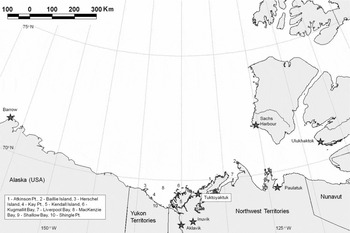
Map of the Canadian Beaufort Sea showing Alaskan, Yukon, Northwest Territories and Nunavut coasts, communities in the region, and locations of killer whale sightings listed in Table 1.

Banfield (Reference Banfield1974) considered killer whales to be rare summer visitors to the Canadian Beaufort Sea (Fig. 1), and some published distribution maps show their presence there (for example Jefferson and others Reference Jefferson, Stacey and Baird1991; Dahlheim and Heyning Reference Dahlheim, Heyning, Ridgway and Harrison1998). There is an Inuvialuktun word (aarlu) for killer whale, and while residents of the Mackenzie Delta region historically knew of this species, it was rarely seen (Byers and Roberts Reference Byers and Roberts1995; Harwood and Smith Reference Harwood and Smith2002). Killer whales have not been observed by marine mammal researchers despite four decades of extensive marine mammal survey work in this area (Baird Reference Baird2001; Higdon and others Reference Higdon, Hauser and Ferguson2011). COSEWIC (2008) considered any killer whales observed in the Canadian Beaufort Sea to be extralimital animals from the Bering Sea (Dahlheim Reference Dahlheim1997; Baird Reference Baird2001).
In the eastern Canadian Arctic, Inuit knowledge, historical research and anecdotal evidence suggest that killer whale occurrence is increasing (Higdon and others Reference Higdon, Hauser and Ferguson2011), possibly in response to reductions in summer sea ice (Higdon and Ferguson Reference Higdon and Ferguson2009). Similarly, killer whale sighting frequency in the waters off the Chukotka Peninsula, Russia, may be increasing with decreasing sea ice concentration (Melnikov and others Reference Melnikov, Zagrebin, Zelensky and Ainana2007). It has been suggested that reductions in summer ice cover might lead to killer whales expanding their range into the Beaufort Sea (Carmack and MacDonald Reference Carmack and MacDonald2002). Killer whales can be substantial predators of marine mammals (for example Springer and others Reference Springer, Estes, Van Vliet, Williams, Doak, Danner, Forney and Pfister2003; Ferguson and others Reference Ferguson, Kingsley and Higdon2011), and Arctic people are concerned about impacts to marine mammal species they rely on for subsistence (Higdon Reference Higdon2007; Ferguson and others Reference Ferguson, Higdon, Chmelnitsky, Ferguson, Losetto and Mallory2010, Reference Ferguson, Higdon and Westdal2012a). We summarise observations of killer whales from the Canadian Beaufort Sea, compiled mostly from traditional ecological knowledge (TEK) interviews and workshops. The killer whale observations reported here are part of a larger Canadian Arctic-wide database and some have been included in previous compilations of large-scale trends (Higdon Reference Higdon2007; Higdon and others Reference Higdon, Hauser and Ferguson2011). In this summary we include additional records and provide more detailed discussion on killer whale presence, distribution and ecology in the western Canadian Arctic. These results provide a baseline to assess future changes that may occur with changing sea ice regimes, as has occurred elsewhere (Higdon and Ferguson Reference Higdon and Ferguson2009; Melnikov and others Reference Melnikov, Zagrebin, Zelensky and Ainana2007).
Methods
Extensive efforts to collect killer whale sightings in the Canadian Arctic started in 2006, but research efforts have focused on the eastern Arctic, primarily Nunavut, given Inuit reports of increasing sightings and increased predation on marine mammals (see Higdon Reference Higdon2007; Higdon and Ferguson Reference Higdon and Ferguson2009; Higdon and others Reference Higdon, Hauser and Ferguson2011). An extensive literature review was conducted, including peer-reviewed journals, newspapers, technical and consulting reports, and western Canadian Arctic sightings were compiled as part of this effort. A killer whale sighting form (see Higdon Reference Higdon2007) was developed for distribution to communities in Nunavut. Researchers from the Department of Fisheries and Oceans (DFO) in Winnipeg have taken these sighting report forms on community visits to the Inuvialuit Settlement Region, and two completed forms provided observations from the Canadian Beaufort Sea. Requests for sightings were also solicited from DFO employees stationed in the western Arctic, staff at other government departments (Parks Canada, etc.), community Hunters and Trappers Committees, and other researchers (marine mammal biologists in Alaska, researchers with ArcticNet and/or International Polar Year projects, etc.).
In 1993, Byers and Roberts (Reference Byers and Roberts1995) conducted semi-directed interviews and group discussion meetings to collect TEK of beluga whales. A total of 119 individuals participated in three Inuvialuit communities, 41 in Tuktoyaktuk, 40 in Aklavik, and 38 in Inuvik. Interviewees were mostly (74%) male, and 55% were defined as elders (> 50 years old), with the remaining interviewees ranging from 19 to 49 years of age. Byers and Roberts (Reference Byers and Roberts1995) include some records of Beaufort Sea killer whale sightings, and other records were included in the raw data collected (T. Byers, unpublished data, 1993). These records were included and briefly discussed in Canadian Arctic-wide summaries (Higdon Reference Higdon2007; Higdon and others Reference Higdon, Hauser and Ferguson2011: 450 records the database, which included 18 records (4%) in the Beaufort Sea-Amunsden Gulf ecoregion), but are presented in more detail here.
More recently, DFO staff collected and mapped TEK to identify ecologically and biologically significant areas (EBSA) in the Beaufort Sea, and included some sightings (Hartwig Reference Hartwig2009). Observations were collected from all six communities in the Inuvialuit Settlement Region (Fig. 1) during three series of workshops. The first was held in Inuvik, Northwest Territories in November 2006 and included two representatives from each community. In February-March 2007 all six communities were visited, and in August 2007 two additional workshops were held in Inuvik and Aklavik (128 total participants) (Hartwig Reference Hartwig2009).
Results
Killer whale observations in the Canadian Beaufort Sea are summarised in Table 1. We compiled 31 records in total, of which 18 could be assigned to a year or decade and 13 that had no temporal information, and included reports such as ‘seen occasionally’. The majority of sighting reports are from TEK interviews with Inuvialuit residents (Byers and Roberts Reference Byers and Roberts1995; T. Byers, unpublished data, 1993; Hartwig Reference Hartwig2009). Although four observations were made near Barrow, Alaska by Canadian Inuvialuit hunters (Byers and Roberts Reference Byers and Roberts1995; T. Byers, unpublished data, 1993); they were not included in this summary. Only 15% (18 of 119) of the interviewees in Byers and Roberts (Reference Byers and Roberts1995) had ever seen killer whales, and half of them were residents of Aklavik (22.5% of the community participants). Six Tuktoyaktuk (14.6%) and three Inuvik (7.9%) interviewees also reported observing killer whales (T. Byers, unpublished data, 1993). Hartwig (Reference Hartwig2009) mapped only eight records provided in workshops with 128 different residents in the six communities. Half of the observations came from Tuktoyaktuk (four sightings reported by 19 participants), with one sighting each from Aklavik (28 participants), Inuvik (29), Ulukhaktok (13), and Sachs Harbour (13), and no reports from the 26 Paulatuk participants. These records have not been included in previous summaries of the killer whale sighting database (Higdon Reference Higdon2007; Higdon and others Reference Higdon, Hauser and Ferguson2011). Overall, most observations were provided by residents of Tuktoyaktuk and Aklavik.
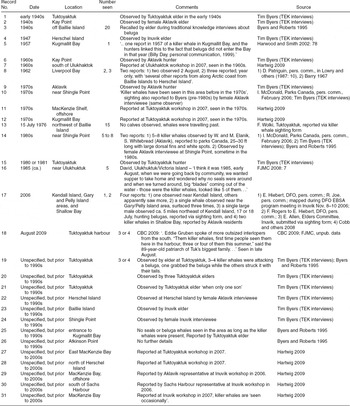
Reports of killer whales (Orcinus orca) in the Canadian Beaufort Sea.

Several records were reported by multiple sources but considered to represent the same observation. Barry (Reference Barry1967) reported three killer whales in Liverpool Bay in 1962, and noted several other reports along the coast from Baillie Islands to Herschel Island; and Lowry and others (Reference Lowry, Nelson and Frost1987) similarly reported that two whales were seen in Liverpool Bay on 2 August 1962 (record 8, Table 1). Two 1980s reports of killer whales near Shingle Point were considered to represent the same sighting (record 14, Table 1), given that they were provided by the same observer, and a 1970s report in the same general location (record 10, Table 1) was similarly reported from several sources, but provided by the same observer. Most recently, residents of Inuvik and Aklavik have provided four different reports from summer 2006 (three observations of a single whale, and one report of two whales in Cobb and others (Reference Cobb, Fast, Papst, Rosenberg, Rutherford and Sareault2008), which we assume to represent repeated observations of the same whale or whales). The 13 records with no temporal data (Table 1) may also include some overlapping reports of the same whales.
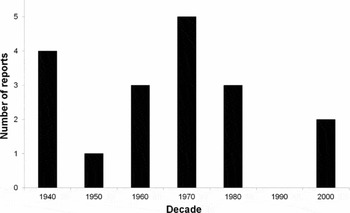
The 18 sighting records that could be assigned to a particular decade span from the 1940s to the 2000s (Fig. 2), with no records from the 1990s. Killer whale sightings are rare and sporadic in the Canadian Beaufort Sea (range 0–5 per decade, mean 2.6, median 3 [mean and median both 3 if the zero record from the 1990s is excluded]), and there is no recent increase in sighting frequency. While rare, sightings are widely distributed throughout the region, ranging from Ulukhaktok in the east to Herschel Island in the west (and further west into Alaska). Nine records included an estimate of killer whale group size. A single value was assigned for summary analysis, following the method in Higdon and others (Reference Higdon, Hauser and Ferguson2011). Specifically, the lower number was used when a range of two sequential numbers was reported (for example 1 or 2, 3 or 4), and the median value was used (rounded-up) when a group included a larger size range. Reported group sizes ranged from 1–20, with a mean of 6.3 whales and a median of 3. Small groups of one to four whales were most common, although two observations were of larger groups (15 and 20 whales). Few records include information on month or date of sightings, although killer whales are typically observed in summer, with reports in both July and August. Killer whales have been observed hunting beluga whales, and hunters have observed that belugas and seals will avoid areas when killer whales are present (Table 1) (also see Byers and Roberts Reference Byers and Roberts1995; Harwood and Smith Reference Harwood and Smith2002).
Number of reported killer whale observations per decade for the Canadian Beaufort Sea, for the 18 (of 31) records with temporal data (see Table 1).

Discussion
Previously, killer whales have been considered to be rare or sporadic in the Canadian Beaufort Sea (Banfield Reference Banfield1974; Byers and Roberts Reference Byers and Roberts1995; COSEWIC 2008). We present the most comprehensive summary of killer whale observations in this region to date, and have found no evidence that sighting frequency is increasing. Workshops were conducted in 2006 and 2007 in all six local communities (Hartwig Reference Hartwig2009), but the most recent dated observation found was from the 1970s (although there have been several reported sightings in the late 2000s). On the contrary, areas in the eastern Canadian Arctic have been reporting increases in killer whale observations in recent years. For example, in the Hudson Bay region, Higdon and Ferguson (Reference Higdon and Ferguson2009) and Ferguson and others (Reference Ferguson, Higdon, Chmelnitsky, Ferguson, Losetto and Mallory2010) documented an increase in killer whale occurrence, from no observations prior to the 1900s, to few observations, to sporadic or occasional observations, to annual and regular observations in recent decades. Sighting frequency and maximum western distribution (that is farther into the region) have coincided with declining summer ice concentration in Hudson Strait (Higdon and Ferguson Reference Higdon and Ferguson2009), suggesting that killer whales may have new access to areas with abundant marine mammal prey (also see Melnikov and others Reference Melnikov, Zagrebin, Zelensky and Ainana2007).
Killer whale sightings were located in coastal areas across the entire Canadian Beaufort Sea, but were most common in the Mackenzie Delta area. Only three observations occurred east of Cape Bathurst and Baillie Island: a 1960s observation south of Ulukhaktok, another in the mid-1980s in the same general area, and an undated sighting south of Sachs Harbour (FJMC 2008; Hartwig Reference Hartwig2009; Ferguson and others Reference Ferguson, Asselin, Loseto, Higdon, Barber, Tjaden, Leitch, Barber and Chan2012b). No participants in Paulatuk reported killer whale sightings (Hartwig Reference Hartwig2009). Researchers with the IPY Circumpolar Flaw Lead project conducted traditional knowledge interviews in these three communities (in 2009), and never received any information on killer whales (S. Meakin, Inuit Circumpolar Conference, Ottawa, ON, personal communication, 15 August 2011; C. Furgal, Trent University, Peterborough, ON, personal communication, 17 August 2011). The distribution of sightings suggests that Bering Sea killer whales sometimes explore the near-shore areas of the Mackenzie Delta, perhaps following beluga whales, but seldom move farther east. The species is also not mentioned in any of the six community conservation plans (for example Community of Inuvik, Wildlife Management Advisory Council (NWT), and the Joint Secretariat 2008).
Month or season was reported for only four records: two records from July, one from August, and one from ‘summer’. In the eastern Canadian Arctic, most sightings occur during the open-water season and killer whales are generally considered to be pagophobic (Reeves and Mitchell Reference Reeves and Mitchell1988; Higdon Reference Higdon2007; Higdon and others Reference Higdon, Hauser and Ferguson2011; Matthews and others Reference Matthews, Luque, Petersen, Andrews and Ferguson2011). Killer whales are also most frequently observed in the Bering and Chukchi seas during the summer, and although they are occasionally observed in heavy ice, the frequency of this behaviour is unknown (Leatherwood and others Reference Leatherwood, Bowlens and Reeves1986; Lowry and others Reference Lowry, Nelson and Frost1987). George and others (Reference George, Philo, Hazard, Withrow, Carroll and Suydam1994) noted that killer whales are not recorded during the ice-based census for bowhead whales near Barrow (April to June), but that some are observed each year during July and August.
Beluga whales, a probable prey item for Beaufort Sea killer whales, migrate eastward through offshore leads and arrive off the west coast of Banks Island in late May and early June (DFO 2000; Harwood and Smith Reference Harwood and Smith2002). In mid-July the offshore area is typically characterised by heavy pack ice, with a thin belt of open water and reduced ice (1–6/10ths concentration) along the coast (CIS 2002, 2011). Open water (< 1/10 ice) occurs throughout the near shore area, with a mix of ice and open water conditions offshore and along the Banks Island flaw lead. Beluga whales enter the Mackenzie Estuary when the landfast ice barrier breaks up in late June or early July and aggregate in shallow nearshore waters (Harwood and Smith Reference Harwood and Smith2002). Most killer whale sightings are made in this nearshore region where beluga whales aggregate, and where local hunting occurs (Byers and Roberts Reference Byers and Roberts1995; Harwood and Smith Reference Harwood and Smith2002), increasing sighting effort. By mid-August the entire near shore area is typically open and killer whales would be able to access the waters near all six regional communities. Belugas begin their westward migration in late August, with some traveling along the coastline and others far offshore, sometimes through heavy ice (Richard and others Reference Richard, Martin and Orr2001; Harwood and Smith Reference Harwood and Smith2002).
The timing of break-up and beluga migration patterns would suggest that Beaufort Sea killer whales, if they tend to avoid heavy ice conditions, would have a narrow window to access beluga whales in the area. However, there is evidence of an increasing length of the open water season (Regehr and others Reference Regehr, Hunter, Caswell, Amstrup and Stirling2010) and earlier spring arrival of beluga whales (Asselin and others Reference Asselin, Barber, Stirling, Ferguson and Richard2011). In summer 2011, beluga whales near Paulatuk were traveling very near the coastline, passing close to town, and were easier to hunt than usual, leading local hunters to speculate that killer whales were present, although none were seen (S. Ruben, FJMC, personal communication, 18 January 2012). Killer whales were observed near Kugluktuk, in the central Arctic, in 2011 (S.H. Ferguson, unpublished data, Reference Ferguson, Kingsley and Higdon2011), and Paulatuk residents suggest that they may have come through the Beaufort Sea.
The group sizes reported for nine observations ranged from 1 to 20 (mean 6.3, median 3), which were generally representative of mammal-eating (transient) killer whales (see review in Higdon and others Reference Higdon, Hauser and Ferguson2011). In northwestern Alaska, killer whales have been observed preying on a variety of marine mammal prey items (Frost and others Reference Frost, Lowry and Burns1983; Lowry and others Reference Lowry, Nelson and Frost1987; George and Suydam Reference George and Suydam1998), and predation on beluga whales has been reported in the Canadian Beaufort (Table 1, Byers and Roberts Reference Byers and Roberts1995; Cobb and others Reference Cobb, Fast, Papst, Rosenberg, Rutherford and Sareault2008). George and Suydam (Reference George and Suydam1998) reported that one pod of killer whales observed in 1991 east of Point Barrow may have been consuming whitefish (Coregonus spp.) and chum salmon (Oncorhynchus keta), although this was not confirmed. The Bering Sea region is home to both resident (fish eating) and transient (marine mammal eating) killer whale populations with largely overlapping distributions, occurring along the southeast coast and the Aleutian Islands and ranging into the southern Bering Sea. The Alaska resident stock includes 2,084 whales identified from photographs, and the Gulf of Alaska, Aleutian Islands, and Bering Sea transient stock includes 552 photo-identified individuals (Allen and Angliss Reference Allen and Angliss2011). Given the available (but limited) information on Beaufort Sea killer whale group sizes and prey items, it seems likely that the whales occasionally seen in this region are extralimital animals from the Bering Sea transient stock (Dahlheim Reference Dahlheim1997; Baird Reference Baird2001; COSEWIC 2008).
Acknowledgments
This research was funded by the Beaufort Sea Shelf Ecosystem Research Initiative (BSS-ERI) and the International Polar Year (IPY) Circumpolar Flaw Lead project. We thank C. Furgal, L. Harwood, E. Hiebert, R. Joe, I. McDonald, S. Meakin, S. Ruben, F. Wolki and the Fisheries Joint Management Committee for assistance and helpful advice, and the many people who assisted with or participated in the interviews and workshops conducted. This manuscript was improved by helpful comments from L. Harwood, S. Petersen, and L. Quakenbush.