Atherosclerotic disease remains the leading cause of death worldwide. Early monitoring of atherosclerosis is recommended for the younger generation. To this end, new technologies in the area of genetics and arterial physiology have been applied.Reference Natarajan and O’Donnell 1 – Reference Sorokin, Kotani, Bushueva and Polonikov 3 We have previously shown an association between some single nucleotide polymorphisms of antioxidant-related genes and the cardio-ankle vascular index – a recent measure of arterial stiffness – in young Russians. A different view from this studyReference Sorokin, Kotani, Bushueva and Polonikov 3 is that there can be many other gene polymorphisms related to arterial physiology – for example, gene polymorphisms of molecules that are more tightly related to arterial homoeostasis. Our present study further investigated the association between such candidate gene polymorphisms – that is, vascular growth factors and matrix metalloproteinases (MMP), as well as glutathione/xenobiotic detoxification components – and the cardio-ankle vascular index in healthy young Russians.
Methods
Clinical characteristics of the study subjects and the measurement method of cardio-ankle vascular index have been previously described.Reference Sorokin, Kotani, Bushueva and Polonikov 3 This study was approved by the Ethics Committee of Kursk State Medical University, and each participant provided written informed consent. In brief, genomic DNA was isolated from peripheral blood samples using the phenol/chloroform procedure. The following genes were genotyped using a TaqMan Single Nucleotide Polymorphism Genotyping Assay (Applied Biosystems, Foster City, California, United States of America) on the CFX96™ Real-Time PCR Detection System (Bio-Rad Laboratories, Hercules, California, United States of America) – vascular endothelial growth factor A (VEGFA) gene, rs3025039 (+936C>T/+813C/T), rs833061 (−460C>T/−1498C>T), rs25648 (534C>T,−7C>T, S178S), and rs699947 (−2578C>A/−2055A>C); MMP gene, rs243865 (−1306 C/T), rs3025058 (−1612 5A/6A), and rs17577 (2003G>A); and glutathione reductase (GSR, rs2551715, T/C), glutathione synthetase (GSS, rs1801310, A/G), γ-glutamyltransferase 1 (GGT1, rs4820599, A/G), and solute carrier family 7 member 11 (SLC7A11, rs7674870, A/G). The primer sequences are available upon request.
Data were expressed as mean±SD. Differences between the groups and the Hardy–Weinberg equilibrium were examined by t-test, one-way analysis of variance – with Tukey’s multi-comparison test – or χ2/Fisher’s exact test, as appropriate. When adjusting for confounders, we used all the measured variables such as age, gender, smoking status, body mass index, heart rate, and blood pressure using general linear models; p<0.05 was considered to be significant.
Results
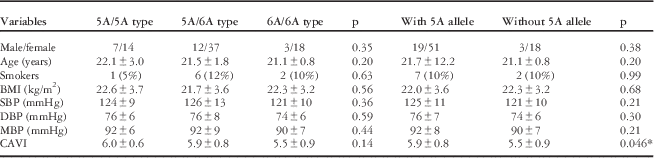
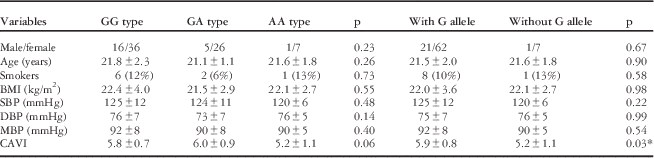
The cardio-ankle vascular index level was not significantly different between genders (male versus female: 5.9±0.8 versus 5.8±0.8, p>0.05). The distributions for all the genotype frequencies were in Hardy–Weinberg equilibrium. Significant associations were detected between polymorphisms in the MMP3 (p=0.046) and the GGT1 (p=0.03) genes and the cardio-ankle vascular index levels (Tables 1 and 2). Significantly lower cardio-ankle vascular index levels were seen in carriers of the 6A/6A genotype of MMP3 compared with non-carriers. Similarly, lower cardio-ankle vascular index levels were seen in AA homozygotes of GGT1 than in non-carriers. These differences remained significant even after adjusting for confounders. We did not observe significant associations between the cardio-ankle vascular index and the other gene polymorphisms. Comparison for the present versus absent minor allele was as follows: VEGFA, rs3025039 (5.8±0.8 versus 5.7±0.4), VEGFA, rs833061 (5.8±0.8 versus 6.2±0.6), VEGFA, rs25648 (5.8±0.8 versus 6.1±0.9), VEGFA, rs699947 (5.8±0.8 versus 6.2±0.7), MMP, rs243865 (5.8±0.8 versus 5.6±1.3), MMP, rs17577 (5.8±0.8 versus 5.2±0.0), GSR (5.8±0.8 versus 5.8±0.9), GSS (5.8±0.8 versus 5.8±0.8), and SLC7A11 (5.9±0.8 versus 5.5±0.6), with p>0.05 in all cases.
Matrix metalloproteinase 3 5A/6A polymorphism and the cardio-ankle vascular index (CAVI).

BMI=body mass index; DBP=diastolic blood pressure; MBP=mean blood pressure; SBP=systolic blood pressure
The 6A/6A genotype subjects had significantly lower CAVI levels than those with the 5A allele – with 5A/5A and 5A/6A genotype. The difference in CAVI levels among the groups with and without the 5A allele remained significant after an adjusted analysis that was entered into the co-variables (p=0.04)
*p<0.05: a significance level
γ-Glutamyltransferase 1A/G polymorphism and the cardio-ankle vascular index (CAVI).

BMI=body mass index; DBP=diastolic blood pressure; MBP=mean blood pressure; SBP=systolic blood pressure
The AA genotype subjects had a significantly lower CAVI level than those with the G allele – with GG and GA genotype. The difference in CAVI levels among the groups with and without the G allele remained significant after an adjusted analysis that was entered into the co-variables (p=0.03)
*p<0.05: a significance level
Discussion
This study revealed MMP3 and GGT1 gene polymorphisms to be associated with arterial stiffening, as measured by the cardio-ankle vascular index in young Russians, with lower cardio-ankle vascular index levels in subjects having the MMP3 6A/6A genotype and GGT1 AA genotype. These data may prompt an initial strategy of arterial disease prevention for the younger generation of this population, taken together the previously reported relationship between the antioxidant-related gene polymorphisms and cardio-ankle vascular index.Reference Sorokin, Kotani, Bushueva and Polonikov 3
MMP3 (stromelysin-1) is a protein involved in arterial wall re-modelling by modulation of the extracellular matrix protein collagens, proteoglycans, and fibronectin.Reference Beilby, Chapman, Palmer, McQuillan, Thompson and Hung 4 A gene polymorphism, rs3025058, located in the MMP3 promoter region has one allele of five (5A) and the other of six adenine nucleotides (6A). The 5A allele is responsible for increased matrix and elastin degradation, and, as a consequence, the 5A/5A genotype is reported to be associated with arterial wall damage and cardiovascular complications.Reference El-Aziz and Mohamed 5 , Reference Medley, Kingwell, Gatzka, Pillay and Cole 6 Although these are reported in older populations, it would be important to examine the association between the 5A allele and the higher cardio-ankle vascular index levels even in the younger population in this study.
GGT1 plays a key role in the synthesis and degradation of glutathione and xenobiotic detoxification. A common polymorphism, rs4820599, located at a transcription factor binding site, is responsible for gene transcription and may be involved in arterial functions.Reference Dahboul, Leroy and Maguin Gate 7 The possible association of the G allele with arterial stiffness and cardiovascular complications has been reported in both healthy (mean 50 years)Reference Jung, Yu and Bae 8 and diseasedReference Kweon, Shin and Nam 9 , Reference Li, Iso and Cui 10 populations. The data presented here are consistent with these studies.Reference Jung, Yu and Bae 8 – Reference Li, Iso and Cui 10
A major limitation of this study is the cross-sectional design. Of notice, the small sample size was limited to the definitive conclusion. For instance, we detected the between-group difference in cases of 5.5 versus 6.0 of the mean cardio-ankle vascular index level and 0.8 of its standard deviation with 0.05 of the α level and 0.8 of the 1-β level with about 40 subjects needed in each group. The groups with and without the minor allele of most gene polymorphisms measured in the study did not include enough subjects. Therefore, our preliminary study requires further investigation of the gene polymorphisms associated with the cardio-ankle vascular index.
In summary, we found an association of the MMP3 5A allele and GGT1 G allele with increased arterial stiffness, as measured by the cardio-ankle vascular index, in young healthy Russians. This information may provide additional understanding with regard to the prevention of arterial disease for a young generation.
Acknowledgements
The authors express their sincere gratitude to all the study participants for their time and patience.
Financial Support
This research received no specific grant from any funding agency, commercial or not-for-profit sectors.
Conflicts of Interest
None.
Ethical Standards
The authors assert that all procedures contributing to this work comply with the ethical standards of the relevant national and institutional committees on human experimentation and with the Helsinki Declaration of 1975, as revised in 2008.