Introduction
Insomnia is a common psychiatric complaint among elderly individuals. Previous studies have reported that insomnia affects 6% to 44% of all elderly individuals (Liu et al., Reference Liu2000; Su et al., Reference Su, Huang and Chou2004; Makhlouf et al., Reference Makhlouf, Ayoub and Abdel-Fattah2007; Bonanni et al., Reference Bonanni2010). In South Korea, Yang et al. (Reference Yang, Yoo, Joo and Hahn1997) and Yoon et al. (Reference Yoon, Shin and Kim1999) reported 58% and 22% respectively. However, their results for South Korea cannot be generalized because they employed small samples and localized data, had low response rates, and considered vague definitions of insomnia. In this regard, the present study investigates the prevalence of insomnia among elderly individuals in South Korea through a nationwide survey.
The reported prevalence of insomnia varies widely across studies because there is no general consensus on the definition of insomnia. The DSM-IV criteria for insomnia reflect the following three symptoms: difficulty in initiating sleep (DIS), difficulty in maintaining sleep (DMS), and non-restorative sleep (NRS) (American Psychiatric Association, 2000). In addition, early morning awakening (EMA) has been considered a basic symptom of insomnia (Liu et al., Reference Liu2000; Ohayon and Hong, Reference Ohayon and Hong2002; Rocha et al., Reference Rocha, Guerra and Lima-costa2002; Roth et al., Reference Roth, Jaeger, Jin, Kalsekar, Stang and Kessler2006; Xiang et al., Reference Xiang2008).
Previous studies have produced mixed results for the relationships between various sociodemograhic correlates and insomnia among elderly individuals (Su et al., Reference Su, Huang and Chou2004; Makhlouf et al., Reference Makhlouf, Ayoub and Abdel-Fattah2007; Bonanni et al., Reference Bonanni2010). This indicates a need for a better understanding of relationships between various sociodemographic variables and insomnia among elderly individuals. However, few epidemiological studies have explored the relationships between insomnia and sociodemographic correlates by controlling for an individual's medical history.
This study investigates the prevalence and sociodemographic correlates of insomnia by considering a community sample of elderly individuals in South Korea. In addition, the study examines the relationship between the lifetime history of physical illness and insomnia.
Methods
From June 2008 to December 2008, a nationwide epidemiological study was performed to estimate the prevalence of dementia and associated risk factors by considering a community sample of elderly individuals in South Korea aged 65 years and over (Kim et al., Reference Kim2011). We employed a multistage design based on cluster sampling. To obtain the sample, we considered six major administrative districts, including the Seoul metropolitan area and five provinces, and from these we selected 15 catchment areas (seven metropolitan districts, six districts representing medium-sized cities, and two rural counties). From these catchment areas, we randomly selected villages to obtain a minimum population of 5,000 elderly individuals based on the residential roster and then identified 10% of these individuals as the participants by systematic random sampling. The total number of participants was 8,199 (Kim et al., Reference Kim2012b). This study was approved by the institutional review board of Seoul National University College of Medicine. We informed all participants about this study's purpose and methods, and all voluntarily signed an informed consent form.
Data collection
From the 15 catchment areas considered, we selected five for the study. These five areas included four urban areas (Seoul, Incheon, Daegu, and Gwangju) and one rural area (Yeoncheon). We selected a total of 3,074 elderly individuals for the study. Among these, 1,985 completed a Korean version of the Mini-Mental Status Examination (MMSE-KC) (Lee et al., Reference Lee2002), a Korean version of the Geriatric Depression scale (GDS) (Bae and Cho, Reference Bae and Cho2004), a questionnaire for sleep in the last month (Kim et al., Reference Kim2012b), a four-item Restless Legs Syndrome (RLS) Questionnaire (Allen et al., Reference Allen, Picchietti, Hening, Trenkwalder, Walters and Montplaisir2003), and a ten-item questionnaire for the review of systems (Kim et al., Reference Kim2012b) through face-to-face interviews, indicating a 64.6% response rate.
The interviewers, including nurses, social workers, and medical students, who had experience with psychiatric epidemiologic surveys and were familiar with the study area, were recruited at each research center. All of the interviewers received a one-day training session that included didactic sessions concerning general interview skills and interview instruments, mock interviews, and role-playing exercises using the standard protocols and training materials. Throughout the training sessions, the trainers monitored the interviews and gave feedback to the interviewers.
Sociodemographic and clinical variables
We assessed the sociodemographic variables. Some items focused on age, gender, the level of education (years), marital status (married/separated or divorced/widow(er)/single), smoking behavior in the last year (packs/day), and alcohol consumption within the last year.
One drink was equivalent to a glass of wine, half a pint of beer, or a single measure of spirits (Kim et al., Reference Kim2011). We defined excessive alcohol use as at least three glasses of alcohol per day (Ohayon and Hong, Reference Ohayon and Hong2002) and defined cognitive impairment as 1.5 standard deviation below MMSE-KC norms (Lee et al., Reference Lee2004) adjusted for age, gender, and education. Originally the GDS is composed of 30 items, yet we used 15 items of the Korean version of the short-form of GDS, which has been validated by Bae and Cho (Reference Bae and Cho2004). We used a cut-off score of 8 as suggested by Bae and Cho (Reference Bae and Cho2004). We diagnosed RLS when an individual answered “yes” to all the four RLS items (Allen et al., Reference Allen, Picchietti, Hening, Trenkwalder, Walters and Montplaisir2003).
Assessment of sleep quality
To assess the quality of sleep, we used a questionnaire from the Korean Epidemiologic Catchment Area Study Replication (KECA-R) (Kim et al., Reference Kim2012a). The questions about insomnia were as follows:
1. “During the past month, how often have you had trouble sleeping due to difficulty in falling asleep?” (DIS)
2. “During the past month, how often have you had trouble sleeping because you wake up too often after you have gone to sleep?” (DMS)
3. “During the past month, how often have you had trouble sleeping because you wake up too early and cannot get back to sleep?” (EMA)
4. “During the past month, have you ever woken up feeling tired and not refreshed?” (NRS)
5. “How much of a problem has having difficulty in sleeping been for you with respect to your daytime activities (i.e., fatigue, trouble in work or study, concentration difficulty, depressed mood)?”
The response options for DIS, DMS, EMA, and NRS included “none,” “less than two days per week,” “three or four days per week,” and “almost every night,” and those for daytime consequences included “none,” “a little,” “a lot,” and “severely.” We defined the presence of DIS, DMS, EMA, or NRS as three or more episodes of the symptom in the last month (Kim et al., Reference Kim2012a). We defined insomnia as presence of at least one of the four sleep complaints. Since the diagnostic criteria in the fourth edition of the Diagnostic and Statistical Manual of Mental Disorders (DSM-IV) (American Psychiatric Association, 2000) consider significant distress or impairments in an individual's daytime function as one of the major diagnostic criteria for insomnia, we identified the presence of this distress or impairment by the response “a lot” or “severely” to the item for daytime consequences (Rocha et al., Reference Rocha, Guerra and Lima-costa2002; Kim et al., Reference Kim2012a). We defined insomnia accompanied by daytime consequences as the presence of at least one of the four sleep complaints accompanied by moderate to severe daytime consequences.
The lifetime history of physical illness
Information about the lifetime history of physical illness was assessed using binary questions for each of the following ten disease categories: head trauma (with loss of consciousness for more than 10 min), hypertension, diabetes mellitus, hyperlipidemia, stroke, heart disease, atherosclerosis, anemia, renal disease, and depression. We defined the presence of a lifetime history of physical illness as having at least one of these ten disease categories except for depression because depression is a type of psychological illness that can disturb sleep.
Statistical analysis
In all analyses we used weights designed to account for unequal selection probabilities and adjustments for independent population controls and nonresponses. In addition, we used post-stratification weights to adjust the sample estimates based on gender, age, population, and nonresponses.
We conducted an independent t-test for a bivariate analysis using sociodemographic variables, RLS, MDD, and the lifetime history of physical illness. We conducted a multiple logistic regression analysis for each of the five outcomes (DIS, DMS, EMA, NRS, and insomnia) to determine their relationships with sociodemographic and clinical correlates. In addition, we investigated relationships with insomnia and the medical review of systems through a logistic regression analysis by controlling for sociodemographic variables and clinical correlates. We adjusted all variables based on age, gender, education, marital status, living arrangements, alcohol consumption, smoking behavior, MMSE scores, RLS, and current depression.
We excluded missing data from the analyses. We considered a p-value lower than 0.05 as significant. All analyses employed SPSS 12.0 (SPSS Inc., Chicago, IL).
Results
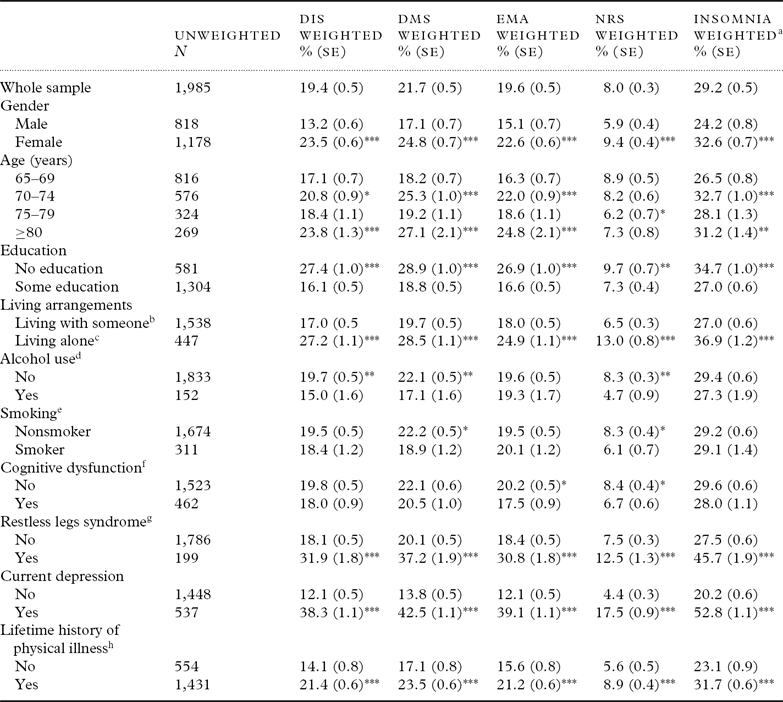
Table 1 shows the prevalence of four sleep complaints and insomnia according to sociodemographic and clinical correlates. DIS, DMS, EMA, and NRS were reported by 19.4% (95% CI = 18.4–20.3), 21.7% (95% CI = 20.8–22.7), 19.6% (95% CI = 18.7–20.5), and 8.0% (95% CI = 7.4–8.6) of the participants, respectively, and insomnia, by 29.2% (95% CI = 28.2–30.3). In addition, insomnia accompanied by daytime consequences was reported by 17.1% (95% CI = 16.3–18.0). Figure 1 shows the results for all four sleep complaints and insomnia for each age group. The results indicate complex relationships between age and each of the four sleep complaints (Table 3). The prevalence of DIS, DMS, EMA, and insomnia increased slightly with age whereas that of NRS decreased slightly.
Prevalence of insomnia symptoms according to sociodemographic and clinical correlates

DIS: Difficulty in initiating sleep; DMS: Difficulty in maintaining sleep; EMA: Early morning awakening; NRS: Non-restorative sleep; SE: Standard error.
Data were weighted by gender, age, and the population of five areas.
Each value was compared with the lowest value in the same column.
aPresence of insomnia was defined as having at least one of the four insomnia symptoms.
bMarried or in a common-law relationship.
cSingle, a widow(er), separated, or divorced.
dAt least three glasses of alcohol per day in the last year.
eIn the last year.
f1.5 standard deviation below MMSE-KC norms adjusted for age, gender, and education.
gThe cut-off value for the GDS was 8.
hThe lifetime history of physical illness was defined as having at least one of the nine medical conditions (except for depression) in the medical review of systems.
*p < 0.05, **p < 0.01, ***p < 0.001.
Prevalence of insomnia symptoms (DIS, DMS, EMA, and NRS) and insomnia occurring three nights per week or more according to age groups were weighted by sex, age, and the population of five areas.
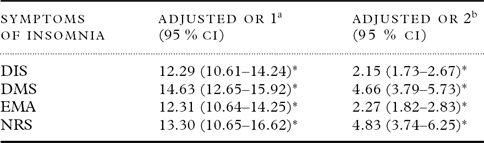
The results indicate that 75.1% and 58.6% of the participants reporting insomnia in the last month complained of daytime consequences and moderate to severe daytime consequences respectively. The participants with a lifetime history of physical illness were more likely to report daytime consequences than those without (37.0% vs. 31.0%, p < 0.001). All four sleep complaints were significantly related to moderate to severe daytime consequences (Table 2).
Relationships between insomnia symptoms and daytime consequences for moderate to severe levels
DIS: Difficulty in initiating sleep; DMS: Difficulty in maintaining sleep; EMA: Early morning awakening; NRS: Non-restorative sleep; OR: Odds ratio; CI: Confidence interval.
aEach insomnia symptom was considered to be an independent variable, and the presence of moderate to severe daytime consequences was considered to be a dependent variable. The odds ratio was adjusted for age, gender, education, marital status, alcohol consumption, smoking behavior, MMSE scores, restless legs syndrome, current depression, and lifetime history of physical illness.
bA hierarchical logistic regression model was employed. In the first step, sociodemographic and clinical variables (age, gender, education, marital status, alcohol consumption, smoking behavior, MMSE scores, restless legs syndrome, current depression, and lifetime history of physical illness) were entered. In the second step, sleep outcome variables (DIS, DMS, EMA, and NRS) were entered simultaneously, and the backward elimination method was used to identify significant variables.
*p < 0.001.
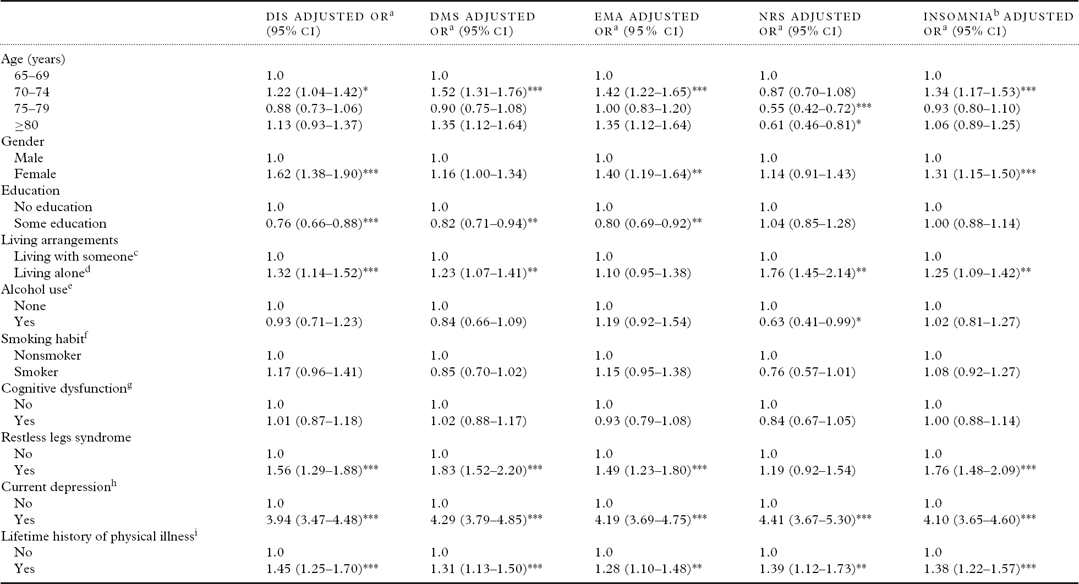
Table 3 shows the relationships between clinical correlates and insomnia by adjusting for age, gender, education, marital status, alcohol consumption, smoking behavior, cognitive dysfunction, RLS, current depression, and a lifetime history of physical illness. Female participants were significantly more likely to report DIS, EMA, and insomnia, and there were significant relationships between a lack of education and DIS, DMS, and EMA. Those participants living alone were significantly more likely to report NRS and insomnia, and alcohol use had a significant negative relationship with NRS. RLS was significantly related to DIS, DMS, EMA, and insomnia (p < 0.001), and current depression and a lifetime history of physical illness were significantly related to all four sleep complaints and insomnia (p < 0.001). Education, alcohol consumption, smoking behavior, and cognitive dysfunction did not have a significant relationship with insomnia.
Relationships between insomnia symptoms and sociodemographic and clinical correlates
DIS: Difficulty in initiating sleep; DMS: Difficulty in maintaining sleep; EMA: Early morning awakening; NRS: Non-restorative sleep; OR: Odds ratio; CI: Confidence interval.
Data were weighted by gender, age, and the population of five areas.
aThe odds ratio was adjusted for age, gender, education, marital status, alcohol consumption, smoking behavior, MMSE scores, restless legs syndrome, current depression, and the lifetime history of physical illness.
bPresence of insomnia was defined as having at least one of the four insomnia symptoms.
cMarried or in a common-law relationship.
dSingle, a widow(er), separated, or divorced.
eAt least three glasses of alcohol per day in the last year.
fIn the last year.
g1.5 standard deviation below MMSE-KC norms adjusted for age, gender, and education.
hThe cut-off value for the GDS was 8.
iThe lifetime history of physical illness was defined as having at least one of the nine medical conditions (except for depression) in the medical review of systems.
*p-value of the odds ratio < 0.05.
**p-value of the odds ratio < 0.01.
***p-value of the odds ratio < 0.001.
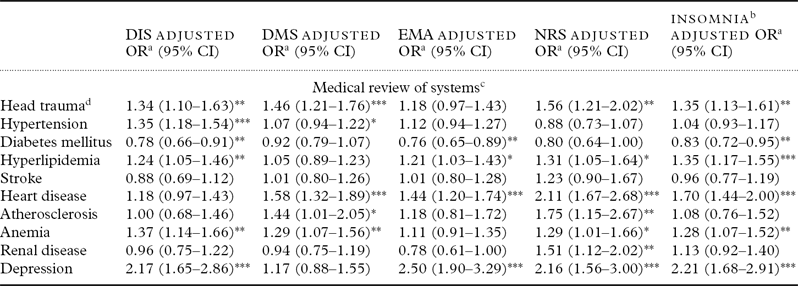
We examined the relationships between the lifetime history of physical illness and the four sleep complaints by adjusting for age, gender, education, marital status, alcohol consumption, smoking behavior, MMSE scores, RLS, and current depression (Table 4). Head trauma, hyperlipidemia, heart disease, anemia, and depression had significant relationships with insomnia, whereas the relationships for the others varied across the four sleep complaints. On the other hand, diabetes mellitus had significant negative relationships with DIS, EMA, and insomnia (p < 0.01).
Relationships between insomnia symptoms and the medical review of systems
DIS: Difficulty in initiating sleep; DMS: Difficulty in maintaining sleep; EMA: Early morning awakening; NRS: Non-restorative sleep; OR: Odds ratio; CI: Confidence interval.
Data were weighted by gender, age, and the population of five areas.
aThe odds ratio was adjusted for age, gender, education, marital status, alcohol consumption, smoking behavior, MMSE scores, restless legs syndrome, and current depression.
bPresence of insomnia was defined as having at least one of the four insomnia symptoms.
cThe lifetime history.
dHead trauma with loss of consciousness for more than 10 min.
*p-value of the odds ratio < 0.05.
**p-value of the odds ratio < 0.01.
***p-value of the odds ratio < 0.001.
Discussion
This study provides the first nationwide investigation of the prevalence of insomnia among elderly individuals in South Korea. The results indicate that insomnia was a common psychiatric complaint among the participants. That is, it was prevalent and related to various medical conditions.
The prevalence of insomnia for the participants was higher than for Korean general population (29.2% vs. 19.0%) (Kim et al., Reference Kim2012a). The prevalence of insomnia accompanied by daytime consequences was higher than for Korean general population (17.1% vs. 3.8%) (Kim et al., Reference Kim2012a). In addition, the participants were most likely to report DMS (21.7%), followed by EMA (19.6%), DIS (19.4%), and NRS (19.4%). However, any direct comparison of these results with the findings of previous studies should be implemented with caution because of differences in definitions of insomnia (e.g., the frequency of symptoms, the number of episodes in the last month, and the presence of at least one of the four sleep complaints) and interview methods (Roth et al., Reference Roth, Jaeger, Jin, Kalsekar, Stang and Kessler2006). Previous studies have reported that 6% to 44.2% of elderly individuals experienced insomnia; 10% to 65% DIS; 14% to 65% DMS; 17% to 30% EMA; and 19% to 51% NRS (Liu et al., Reference Liu2000; Su et al., Reference Su, Huang and Chou2004; Makhlouf et al., Reference Makhlouf, Ayoub and Abdel-Fattah2007; Bonanni et al., Reference Bonanni2010).
After adjusting for age, gender, education, marital status, alcohol consumption, smoking behavior, MMSE scores, RLS, current depression, and a lifetime history of physical illness, we found that all four sleep complaints were significantly related to daytime consequences. According to the hierarchical logistic regression model, NRS had the strongest relationship with daytime consequences, whereas DIS had the weakest relationship. Previous studies have found the strongest relationship between NRS and daytime consequences for the general population (Demyttenaere et al., Reference Demyttenaere2004; Kim et al., Reference Kim2012a), which is consistent with the present study's results. This may be explained by the similarity between the definition of NRS and that of daytime consequences. Although the participants were twice as likely to report DIS, DMS, and EMA as NRS, NRS had the strongest relationship with daytime consequences.
Insomnia is widely considered to increase with age, but previous epidemiologic studies have produced mixed results. Some studies have found a significant relationship between age and insomnia (Makhlouf et al., Reference Makhlouf, Ayoub and Abdel-Fattah2007; Bonanni et al., Reference Bonanni2010), whereas others have reported no such relationship (Ohayon, Reference Ohayon1997; Su et al., Reference Su, Huang and Chou2004). This inconsistency may be explained by medical and psychiatric disorders related health burdens and methodological issues (Bonanni et al., Reference Bonanni2010). In the present study, the prevalence of DIS, DMS, EMA, and insomnia increased slightly with age, whereas that of NRS decreased slightly. Kim et al. (Reference Kim2012a) considered the general population in South Korea and found a U-shape relationship between DIS and age, positive relationships between DMS/EMA and age, and a negative relationship between NRS and age, suggesting that the relationships between age and DIS, DMS, EMA, and NRS for the general population can be extended to the elderly population.
Previous studies have suggested that females are significantly more likely to experience insomnia (Bonanni et al., Reference Bonanni2010; López-Torres et al., Reference López-Torres, Navarro, Párraga, Andrés, Téllez and Boix2011). Kim et al. (Reference Kim2012a) examined the general population of South Korea and found that females are more likely to experience insomnia. However, Su et al. (Reference Su, Huang and Chou2004) considered elderly individuals and reported no significant relationship between females and insomnia. Voderholzer et al. (Reference Voderholzer, Al-Shajlawi, Weske, Feige and Riemann2003) explained the gender difference in the prevalence of insomnia by that in the prevalence of anxiety and depression.
In the present study, participants living alone were significantly more likely to report NRS and insomnia. Many studies have reported a significant relationship between being single, widowed, or divorced and insomnia for elderly individuals (Su et al., Reference Su, Huang and Chou2004; Makhlouf et al., Reference Makhlouf, Ayoub and Abdel-Fattah2007; López-Torres et al., Reference López-Torres, Navarro, Párraga, Andrés, Téllez and Boix2011). Kim et al. (Reference Kim2012a) suggested that for the general population, being single, widowed, or divorced is more likely to encourage bad sleeping habits such as irregular bed hours or late-night drinking than being married.
The results of the present study indicate a significant relationship between lack of alcohol use and NRS but no such relationship for alcohol use (at least three glasses of alcohol per day in the last year). In general, alcohol use contributes to poor sleep (Neubauer, Reference Neubauer1999). Alcohol use before bedtime accelerates the onset of sleep, increases the amount of slow-wave sleep, reduces the amount of rapid eye movement (REM) sleep, and disrupts sleep during the second half of the sleep period in young men (MacLean and Cairns, Reference MacLean and Cairns1982). This suggests a need for an examination of the effects of alcohol use on sleep complaints or insomnia in elderly individuals.
Current depression was significantly related to all four sleep complaints and insomnia (Roth et al., Reference Roth, Jaeger, Jin, Kalsekar, Stang and Kessler2006). In general, depression has a complex relationship with insomnia, and insomnia may be an epiphenomenon or early symptom of depression (Roberts et al., Reference Roberts, Shema, Kaplan and Strawbridge2000).
The lifetime history of physical illness was a significant predictor of all four sleep complaints and insomnia. Many studies have reported a significant relationship between physical illness and insomnia (Sutton et al., Reference Sutton, Moldofsky and Badley2001; Ohayon and Hong, Reference Ohayon and Hong2002). Somatic pain, medication, and decreased physical activity can cause sleep problems (Bolge et al., Reference Bolge, Doan, Kannan and Baran2009). In this study, history of head trauma, heart disease, atherosclerosis, anemia, renal disease, and depression was significantly related to insomnia. This suggests that those elderly patients reporting any of these medical conditions should be carefully reviewed for the presence of insomnia. Consistent with the findings of Kim et al. (Reference Kim2012a), who considered the general population in South Korea, NRS had the strongest relationship with the medical histories and was more sensitive and less specific than the other symptoms. This suggests that when a patient complains of NRS, the physician should consider the possibility of some comorbid or past physical illness. In this study, diabetes mellitus had a significant negative relationship with insomnia. However, previous studies have generally reported no such relationship for elderly individuals (Su et al., Reference Su, Huang and Chou2004; Bonanni et al., Reference Bonanni2010). In addition, Kim et al. (Reference Kim2012a) found no significant relationship between endocrine-metabolic problems and insomnia for the general population in South Korea. Disorders of glucose metabolism have an association with breathing-related sleep disorder that causes hypersomnia (Bulcun et al., Reference Bulcun, Ekici and Ekici2012). However, to our knowledge no study has examined the relationships between diabetes mellitus, breathing-related sleep disorders, and insomnia in elderly individuals. Future research should examine the relationship between diabetes mellitus and insomnia among elderly individuals by considering various breathing-related sleep disorders.
This study contributes to the literature in several ways. First, the study considers four symptoms of insomnia based on the DSM-IV criteria and describes them separately to compare this study's results with the findings of previous studies as well as to better analyze insomnia. Second, the study provides a diagnosis of insomnia and insomnia accompanied by daytime consequences by considering the DSM-IV-TR criteria. Most studies have diagnosed insomnia based on self-developed criteria. Third, the study employs face-to-face interviews because this method can generate more accurate data than through telephone or letters. In addition, because elderly individuals are more likely to have some disease or disability (e.g., hearing loss) or a low level of education, face-to-face interviews can be better for such individuals than other interview methods. Finally, the study provides the first nationwide investigation of the prevalence of insomnia among elderly individuals in South Korea.
There are several limitations to this study. First, there might have been a selection bias. During the sampling process, we randomly selected villages to obtain a minimum population of 5,000 elderly individuals based on the residential roster and then identified 10% of these individuals as the participants by systematic random sampling, and this study was conducted at only five areas among 15 catchment areas. Second, we could not examine the causal relation between insomnia and sociodemographic variables or physical illness in elderly individuals since this study was a cross-sectional study. Third, the lifetime history of physical illness was assessed using binary questions instead of medical record. Also, we did not research comorbid medical illness. It is unclear whether a lifetime history of a medical illness holds the same association with insomnia as a comorbid medical illness.
Sleep problems are very common in elderly and closely related to histories of physical illness. Healthcare providers should take physical illness into consideration when caring elderly individuals who complain of insomnia. Differences between sociodemographic variables and insomnia signify the heterogeneous characteristics of insomnia in elderly individuals. Moreover, further investigations will be necessary to examine the reasons for discrepancies with other studies in the sociodemographic variables in elderly adults.
Conflict of interests
The authors declare that they are no competing interests.
Description of author's roles
W. H. Kim and J. N. Bae designed the study, analyzed the data, and wrote the paper. M. J. Cho supervised data collection and analysis. B. S. Kim, S. K. Kim, S. M. Chang, and D. W. Lee collected the data and assisted with writing the paper.
Acknowledgments
This work was supported by a research grant from the Ministry of Health, Welfare and Family Affairs of South Korea (Grant No. 07-2008-0270).