Introduction
Dementia is often associated with older age. Although young onset dementia (YOD) is not as prevalent as late onset dementia (Harvey et al., Reference Harvey, Rossor, Skelton-Robinson and Garralda1998), approximately 6%–9% of all people with dementia develop symptoms of the disease before the age of 65 (World Health Organization, 2012). YOD causes specific social and medical problems for patients themselves and their families (Sampson et al., Reference Sampson, Warren and Rossor2004). YOD caregivers experience high levels of psychological suffering and problems related to their phase in life, including relational difficulties, family conflict, and employment and financial issues (van Vliet et al., Reference Van Vliet, de Vugt, Bakker, Koopmans and Verhey2010b).
Children of patients with YOD are confronted with a parent who has a progressive disease that causes changes in personality, behavior, and cognition. These changes usually take place at a younger developmental stage, the children may be in their teens or even younger, which is a crucial time in their development (Gelman and Greer, Reference Gelman and Greer2011). Because young carers often assist in caregiving tasks, they risk to prematurely fulfill parental roles before they are emotionally or developmentally able to manage these adult responsibilities (Valleau et al., Reference Valleau, Bergner and Horton1995). In the long run, this situation may impede normal development (Barnett and Parker, Reference Barnett and Parker1998) and may lead to insecure attachment (Bowlby, Reference Bowlby1973) due to the lack of availability of both parents and the responsibility for care. Furthermore, caring at a young age may increase the risk of social, behavioral, and emotional difficulties because of continuous demands for support from the family (Allen et al., Reference Allen, Oyebode and Allen2009). Children may have difficulties achieving emotional and financial independence (Allen et al., Reference Allen, Oyebode and Allen2009), restrictions on peer relationships (Aldridge and Becker, Reference Aldridge and Becker1993a), and difficulties with educational achievement (Dearden and Becker, Reference Dearden and Becker2004).
Previous research on the experiences and needs of young caregivers in general has revealed that this population has not received appropriate attention (Underdown, Reference Underdown2002) and many families receive no external support (Dearden and Becker, Reference Dearden and Becker2004). These young carers were defined as younger individuals who provide a substantial amount of care on a regular basis to others (Department of Health, 1996). Healthcare services rarely concentrate on the needs of the entire family and are not fully aware of the challenges these young people face (Underdown, Reference Underdown2002). Furthermore, it is shown that young people wish to avoid drawing attention to their situation (Frank et al., Reference Frank, Tatum and Tucker1999) due to embarrassment about their responsibilities or fear of portraying their parent as inadequate (Frank, Reference Frank1995).
Research on the impact of a parent with YOD is scarce (van Vliet et al., Reference Van Vliet, de Vugt, Bakker, Koopmans and Verhey2010b; Gelman and Greer, Reference Gelman and Greer2011). The few existing studies indicate that caring for a parent with YOD may be a significant stressor (Allen et al., Reference Allen, Oyebode and Allen2009, Svanberg et al., Reference Svanberg, Stott and Spector2010; Gelman and Greer, Reference Gelman and Greer2011). One study showed that a third of children in this situation suffered from mood disorders and more than half of the children scored above the cut-off for high burden levels (Svanberg et al., Reference Svanberg, Stott and Spector2010). Dementia appeared to have a major impact on well-being of the children. “One day at a time” was an overarching theme, reflecting a way of seeing life and coping with the fear of severe threats in the future (Allen et al., Reference Allen, Oyebode and Allen2009). These studies have investigated the consequences of the disease and the way children address these consequences, and have recommended that children of people with YOD require adequate support. However, not all studies have specifically focused on the needs of children of people with YOD, which is essential for developing adequate support programs and guidelines for clinical practice. Therefore, attention to YOD caregivers is needed. The aim of the present study is to explore the experiences of children living with a young parent with dementia with a specific focus on the children's needs.
Methods
Participants
The present study is part of the Needs in Young onset Dementia (NeedYD) study. The aims and design of this two-year follow-up study are extensively described elsewhere (Van Vliet et al., Reference Van Vliet, Bakker, Koopmans, Vernooij-Dassen, Verhey and De Vugt2010a). The NeedYD study recruited 215 patients and their families through memory clinics at the Maastricht University Medical Center (MUMC) and the VU University Medical Center (VUMC) in the Netherlands, regional hospitals, regional mental health services, and specialized day care services. For this study, baseline qualitative interviews were used to explore the children's experiences and needs. Children were recruited through their parents and were approached if they were still living at home at the time of inclusion. For ethical reasons, inclusion was restricted to children older than 14 years. There was a total of 35 eligible children living in 29 families. Fifteen children agreed to participate in the study. Several children did not live at home permanently or were not available at the time of inclusion. Furthermore, some children refused because their parents were afraid it would be to demanding.
Data collection
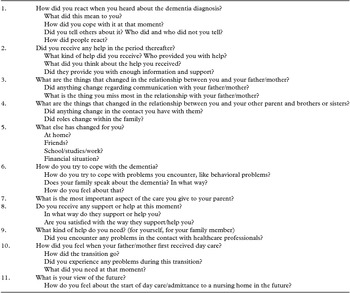
Written informed consent was obtained prior to participation in the study. A semi-structured interview (appendix) with topics derived from clinical practice and the relevant literature was conducted and audiotaped at the children's homes. The interview included topics such as the children's reactions to the diagnosis, the help they received after the diagnosis, and the resulting changes in their lives. The interview consisted of various sections with open questions and specific sub-questions. The children were encouraged to describe their thoughts and feelings about the issues that emerged. When necessary, the interviewer asked the children to elaborate or to clarify their answers. In addition to the qualitative interview, the children were asked how many hours of contact they had with their parent, how many hours per week they spent caring for their parent with dementia, and what type of care they provided. Furthermore, information about age, gender, and education was collected. Additional information from the NeedYD study about the parent was used, including gender, age, type of dementia, and disease duration from symptom onset to study inclusion. The severity of the dementia was assessed with the Global Deterioration Scale (GDS; Reisberg et al., Reference Reisberg, Ferris, de Leon and Crook1982). The GDS is a seven-point scale (1–7) ranging from “no cognitive decline” (1) to “very severe cognitive decline” (7). The GDS is a widely used instrument that has been validated for behavioral, neuro-anatomic, and neurophysiologic measures, for which significant correlations have been found (Reisberg et al., Reference Reisberg, Ferris, de Leon and Crook1982).
Data analysis
We used a qualitative analysis method to thoroughly explore the experiences and needs of the children. This method allowed us to study complex and interacting topics in the interviews (Boeije, Reference Boeije2005). The audiotapes of all interviews were transcribed verbatim and analyzed independently by two researchers (DvV and JM) using ATLAS.ti 7 software (Friese, Reference Friese2012). Both researchers applied an inductive content analysis (Elo and Kyngäs, Reference Elo and Kyngäs2008), in which themes and categories emerge from the data through the use of inductive reasoning as a result of the researchers’ careful examination and continual comparison. The process includes open coding in which codes are written in the margin of the text to describe all aspects of the content of the transcribed material (Hsieh and Shannon, Reference Hsieh and Shannon2005). Following this open coding, codes referring to the same phenomenon are grouped into categories, and these categories are grouped into higher-order themes. The purpose of creating these categories and themes is to combine particular observed instances into general statements to describe the phenomenon. After analyzing all 14 interviews, we established that saturation of the data occurred because no important new information was obtained in the last interviews (Guest et al., Reference Guest, Bunce and Johnson2006). The content of the various categories and the relationships between them were developed and refined over the course of the analytical process. After thorough discussion between the researchers, consensus was reached regarding the categories and themes.
Results
Participants
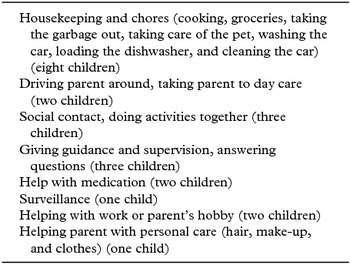
The group of children consisted of six males and eight females, with an average age of 21.0 years (SD 3.6, range 15–27), drawn from 11 families. Participants 1 and 2 belong to the same family as well as participants 4 and 5 and participants 11 and 12. In three cases, the mother had dementia. The mean age of the parent was 53.6 years (SD 4.5, range 47–62). Five of the parents had Alzheimer's disease, four had frontotemporal dementia (two with the behavioral variant and two with primary progressive aphasia), one had vascular dementia, and one had dementia not otherwise specified. Most of the parents with YOD were having mild or moderate dementia (GDS score range 3–6). The mean duration from symptom onset to inclusion was 6.0 years (SD 3.1, range 2–11). The mean duration of the disease from diagnosis to inclusion was 2.1 years (SD .33, range one month to four years). The type of care the children provided for their parent included housekeeping tasks, such as cooking, cleaning, or grocery shopping, supervision, and social contact (Table 1).
Caring tasks of the children

Interviews
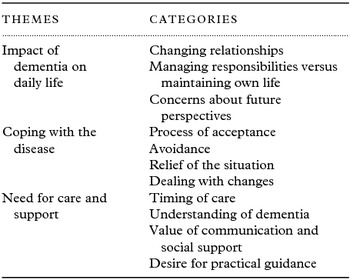
The analysis of the qualitative data resulted in three major themes: (1) the impact of dementia on daily life, (2) coping with the disease, and (3) the need for care and support. An overview of the categories and themes is provided in Table 2.
Overview of categories and major themes

Impact of dementia on daily life
For 11 children, the diagnosis of dementia was unexpected; they did not notice many changes in their parent at first, nor did they consider the first symptoms abnormal.
“At that moment, I did not think anything was wrong. I just thought he was in a bad mood, which happens to anyone at times” (participant 11, female, age 19, father with YOD).
When these changes became evident, they affected not only the children's relationships with the parent with dementia but also with the other parent and with their siblings. Six of the children felt that the child–parent bond was inverted as their parent became increasingly dependent.
“You miss them being a parent. Normally you are father and child, but now we are on the same level because he does not think like an adult anymore” (participant 4, female, age 19, father with YOD).
In addition, several children mentioned that there was more tension at home due to the stress of the caring process and the changes in their parent with dementia.
“I notice it in all of us, that we are more stressed, which is mainly caused by my father's problems” (participant 7, male, age 27, father with YOD).
The children witnessed the strain on their healthy parent, they had difficulties adjusting to the behavioral, cognitive, and personality changes in the parent with dementia, and they had to contribute more to the household, which sometimes caused friction. One child stated that she sometimes felt like a prison guard in her own house because of the constant supervision that her parent required. In contrast, five children indicated that the other family members were closer than before because of the shared problems.
“My mom and I have to take over more chores in the household since my father can not do everything anymore, which causes some friction sometimes” (participant 1, male, age 19, father with YOD).
Furthermore, it was evident that many children felt that they were needed and were concerned about their parent with dementia but also about their healthy parent. This had a big impact on their lives since they witnessed the strain in their healthy parent who often had difficulties accepting the diagnosis and the accompanying changes in their spouse and who had to deal with the additional responsibility of taking care of the other family members. To cope with these problems, the children tried to support them emotionally and practically as much as they could.
“I try to comfort and to support my mother when my father is being difficult. He used to be the one comforting her but now he does not see when she needs him, therefore it is my job now ” (participant 7, male, age 27, father with YOD).
This dedication to providing care often clashed with their own wishes and future perspectives because they prioritized the needs of their parents above their own needs. Consequently, three children did not feel comfortable leaving home and postponed their plans to move out.
“I planned to move out a while ago, but now I feel like I cannot leave anymore since my mother will be alone with him. I did not tell her that because I do not want her to feel guilty” (participant 7, male, age 27, father YOD).
Maintaining the self-esteem of their parent with dementia and avoiding negative emotions seemed to be essential. The aspects of care they described as most important were treating their parent as normally as possible, allowing their parent do things by themselves, protecting their parent from harmful comments from others, and helping their parent do the things he/she wanted to do. This sense of responsibility caused concerns about the future. The children worried about when their parent would be institutionalized and what impact that would have on both parents. Therefore, it was considered important to manage the care for their parent with dementia together with their healthy parent for as long as possible.
“We will always try to take care of him, unless it is really not possible anymore. We try to do as much as we can as long as we are able to do so” (participant 1, male, age 19, father with YOD).
The children soon realized that admission to a nursing home would eventually become inevitable. Furthermore, almost all of the children stated that the most difficult part of the future was not knowing what would happen and the sense of uncertainty about the progression of the disease.
“I worry about where we will end up. People around me ask me how we will continue and how it will end. I tell them we just have to wait and see and that only time can tell” (participant 3, male, age 26, father with YOD).
Coping with the disease
From the interviews, it became apparent that the children used different strategies during the disease process to manage the consequences. These ways of coping were connected to their ability to process what was happening around them and the impact the disease had on their lives. Especially in the beginning, several children showed avoidant ways of coping because they did not know how to address the disease and the changes occurring around them. Coping appeared to be challenging since they were not able to fully understand what was happening or they were frightened by the information they found.
“My sister tells me my mother could pass away and then I think: I do not want to know! Things have to remain pleasant around here so we don't have to talk about it” (participant 10, female, age 23, mother with YOD).
Also, later on in the disease process when difficulties were encountered at home, some children would leave to avoid confrontations and discussions. Even the children who were comfortable and who did not feel the need to escape their home situation, occasionally felt the need to withdraw and to give themselves a time out.
“Most of the time when something happens, I just want to go outside so I will not have to think about it. Usually I call some friends or I go to my girlfriend, and then it just disappears” (participant 5, male, age 17, father with YOD).
Sometimes the children felt it was better to avoid confrontation with their parent. However, at other times they tried to correct the inappropriate behavior or openly expressed their frustrations even though they knew this was not helping. These ways of coping were not always successful and caused tension. Always avoiding confrontations was not possible and correcting their parent was difficult because they did not understand what they were doing wrong. In addition, expressing their frustrations sometimes led to unintentional spiteful comments. Talking about the disease and their frustrations appeared to be difficult and therefore several children chose to hide their feelings from time to time because talking about it made them feel even worse; they preferred to focus on other aspects of their life as a distraction.
The problems were not always dealt with by means of avoidance. More children attempted to address the changes through adaptive coping, in which they adjusted to their parent's needs and supported their parent when necessary. They felt that it was important to stay positive and to be patient.
“You try to pay attention to your parent's needs as much as possible, whatever is happening you try to adapt your life to his needs” (participant 3, male, age 26, father with YOD).
Eight children stated that it was important to rest and to attempt to live their lives as normally as possible to reduce the strain of caring and the emotional problems and worries.
“You try to continue with your life as normal as possible without things influencing you” (participant 4, female, age 19, father with YOD).
When there were problems at home, they tried to avoid feeling frustrated, and they stressed the importance of open communication. However, not all families communicated openly about the disease at home. Many found it difficult to talk about the disease, especially in front of their parent with dementia, or they did not want to talk about it. Immediately after the diagnosis, some of the children were open about the diagnosis only with a select group of people, which subsequently expanded.
“Not everyone has to know. Maybe if it gets very bad I might tell them because I most likely have to be at home more often or I might need help. However, for now, it is fine as it is. Only my boyfriend knows” (participant 10, female, age 23, mother with YOD).
In contrast, some of the children were glad that other people knew so they could talk about it and people would understand if there were any problems. The interviewees mentioned that it was sometimes easier to confide in someone other than their healthy parent to avoid burdening them.
Need for care and support
This theme relates to the care needs of the children. One important issue was the timing of care. It seemed to be important that the care was offered at the pace of the children because they needed time to adjust to the idea that their parent had dementia. When the children received help immediately after the diagnosis, this was often perceived as unnecessary, whereas later on, they needed more support.
“In the beginning, the symptoms were not that obvious since he received the diagnosis quite early, so it did not bother me that much. However, because of the deterioration, I find it more and more difficult to accept the diagnosis” (participant 11, female, age 19, father with YOD).
Later in the disease process, time was needed to become accustomed to the changes in the family and the changing needs of the parents and children. Ten of the children did not feel that they were in need of professional help yet, but five of them could imagine needing some type of help in the future.
“ For now I do not need help, but I think if it deteriorates we will need it. We will need guidance to see how to continue so we can prepare for when it gets worse” (participant 6, female, age 24, father with YOD).
Two children were offered the opportunity to talk to a psychologist at the memory clinic, who also provided their parents with support. They went once for information and found it reassuring to have the opportunity to go there again whenever they had the need.
Another issue was the need for more information about the diagnosis. Not all of the children were included in conversations with the healthcare professionals after the diagnosis. Consequently, five children talked about how they searched for information independently on the Internet or in folders.
“When they came home and I asked them how it went, they told me it was Alzheimer's. I had no clue what it was, so I went looking for information” (participant 2, male, age 20, father with YOD).
All of this information was sometimes overwhelming or was not specific to YOD or their parent's particular diagnosis.
“I went looking for information on the Internet, and it was frightening to read what could happen” (participant 8, female, age 26, father with YOD).
Seven children mentioned the specific need for practical information to help them with the problems they faced when dealing with their parent. For instance, they wondered about the extent to which they should confront their parent about his/her behavior or whether they should allow their parent to perform tasks with the risk of making errors.
“Especially in the beginning, you do not know how to handle certain situations. How do you react if he is really stubborn? You can get mad, you can walk away or try to solve the problem, but my mom and I had to find our own ways. Some guidance would have been welcome” (participant 3, male, age 26, father with YOD).
Some children mentioned their own irritability and frustration as a result of their parent's behavior. In one family, the individual family members used different care management strategies, which caused tension between them. Moreover, there was an overall need to talk to people with specific knowledge about dementia because these people could understand the issues that the children faced and could provide practical solutions.
“It would be nice to talk to someone who knows what we can expect so that we'll know what we can do for my father to make it easier for him and, at the same time, more bearable for us” (participant 11, female, age 19, father with YOD).
For some of the children, it was important that the person who provided help was familiar with their parent and with the situation at home. One child described how every week a social worker came to visit, and the child got to know her very well. She felt comfortable talking to the social worker about her daily life, whereas talking to other healthcare professionals made her feel very irritated due to what she perceived as an impersonal approach.
“At the psychologist, we only talked about my problems; there was no room to talk about nice things, and I felt really uncomfortable discussing everything with someone I don't know. All of a sudden you have to talk about your problems, and then you can go home again. I don't like that at all” (participant 12, female, age 19, father with YOD).
This need to talk to someone familiar was also illustrated by the fact that three of the children particularly valued the help and advice they received from friends or acquaintances who had experience with dementia in their own family or who were professionally involved in the care of people with dementia.
“Fortunately, I have a friend who works with elderly people with dementia who I can talk to. She can also give me advice, which helped me a lot” (participant 1, male, age 19, father with YOD).
There was only one child who mentioned the need for peer contact. She stated that she would like to know how other people handled the disease and what to expect in the future because she did not know anyone who had experience with dementia.
Discussion
The goal of this study was to explore the experiences and needs of children living with their young parent with dementia, with a specific focus on the children's needs. The analysis of the interviews revealed three major themes. The first theme indicated the impact of dementia on daily life, which included the changing relationships within the family, the children's difficulties managing all responsibilities while maintaining a life of their own, and the children's concerns about their future. The second theme reflected the different ways the children coped with the disease, including the process of acceptance, avoidance, searching for relief from the situation, and actively dealing with the changes. The third theme revealed the need for care and support. Many children wanted to know more about dementia but received little information after the diagnosis from either their parents or healthcare professionals. In addition, they wanted practical guidance in dealing with their parent. It seemed that most of the children valued communication and social support, which was sometimes lacking.
Our findings suggest that most children were more focused on the needs of their parents as opposed to their own. They often felt responsible for the well-being of their parent, and they worried about the strain on their healthy parent caused by the caring process. Consequently, many children provided not only instrumental care, such as cooking, cleaning, or grocery shopping, but also emotional care because they often had to comfort their healthy parent, mediate conflicts, and protect and support their family members. According to Jurkovic et al. (Reference Jurkovic, Jessee and Goglia1991), it is important for children to receive support and recognition for their part in caretaking; otherwise, the demand for this adult-like behavior may become harmful. Emotional parentification, in which the child feels responsible for the emotional well-being of their parents, is difficult to identify. Consequently, it is perceived as more detrimental than instrumental parentification, which involves the child completing physical tasks that would normally be provided by a parent (Jurkovic et al., Reference Jurkovic, Jessee and Goglia1991). Therefore, specific attention is needed for the potentially overwhelming demands that are placed on these children. These demands may be harmful over a long period of time and may be associated with a range of psychological difficulties, such as depression, anxiety, shame, and social isolation (DiCaccavo, Reference DiCaccavo2006), if they are not addressed properly. Feelings of abandonment or loneliness are not always expressed because of children's fear of alienating or offending their parents (DiCaccavo, Reference DiCaccavo2006).
It appears that managing the stress and emotions that result from the caring process and the changes in the parent with dementia was a frequent part of the children's lives. According to Greenberg et al. (Reference Greenberg, Seltzer, Krauss and Kim1997), the provision of information and advice and participation in social activities is important because social support is an essential part of coping (Kleinke, Reference Kleinke1991). Most children received support and sympathy in their environment, but not all of the children were able to confide in others, or they did not want to talk about their problems and feelings. Therefore, not all of the children may have received the social support they needed to be able to cope with the disease.
In addition, several children tended to apply avoidant coping strategies when faced with stressors. The use of avoidant strategies indicates that the child fails to attempt to alter the situation and uses denial or wishful thinking to avoid the situation (Pakenham et al., Reference Pakenham, Chiu, Bursnall and Cannon2007). Better adjustment is associated with less reliance on avoidant coping (Thomsen, Reference Thomsen2000). Furthermore, research has indicated that the continuous use of avoidant coping strategies can be a risk factor for psychological dysfunction if the crisis at hand is not directly confronted (Moos and Schaefer, Reference Moos, Schaefer and Moos1984). The interviews suggest that the avoidance displayed by some of the children may be partly explained by ignorance about the disease. The children did not want to think about the possible consequences of the disease because it made them feel worse. On the other hand, not all children precisely knew what it meant to have dementia at a young age since searching for the information themselves could be very confronting, therefore they chose to avoid learning more about the disease. Providing these children with more information may assist them in dealing with the disease. The provision of information may be especially important after the diagnosis because several of the children in our study had to search for information independently and found non-specific or overly confrontational information. Likewise, it may be helpful to educate these children about the course of the disease and the challenges they may face in the future so that they are better prepared for what they might encounter. Many children were concerned about the uncertain future and avoided thinking about upcoming events. In addition to information about the disease itself, there is a need for practical information to help them with the everyday problems they face when dealing with their parents.
There was a remarkable duality in the reported needs. Although several children mentioned the need for practical help and information for a better understanding of the disease, when explicitly asked, most children were quite resistant to professional help. This finding is in line with findings of Dearden and Becker (Reference Dearden and Becker2004), which showed that services were sometimes refused in families with young caregivers. Aldridge and Becker (Reference Aldridge and Becker1994) found that parents of young caregivers were not always aware of their child's needs, possibly explaining why they were less likely to ask for support. In addition, professionals who were in contact with families often failed to identify the children as providers of informal care because they did not ask about their caring role (Aldridge and Becker, Reference Aldridge and Becker1993b). Furthermore, young carers may be reluctant to discuss their caregiving tasks. Several studies have shown that young people wish to avoid drawing attention to their situation (Frank, Reference Frank1995; Frank et al., Reference Frank, Tatum and Tucker1999). For example, embarrassment about their responsibilities might be a reason for them to avoid talking about their caring role (Frank, Reference Frank1995). There might also be the fear of portraying their parent as inadequate (Frank, Reference Frank1995) which could raise concerns about the capability of their parents to remain at home. Moreover, the currently offered services may not suit the needs of these children. Several of the interviewees stated that they preferred to talk with someone familiar rather than sporadically visiting healthcare professionals, which felt too impersonal.
The research in this study was exploratory in nature and was restricted to the availability of the children in the sample of the NeedYD study, which provided only a limited amount of interviews. However, because no important new codes emerged in the last interviews, sufficient information was available for saturation of the data to occur (Guest et al., Reference Guest, Bunce and Johnson2006). In addition, because of the high rate of refusals the sample may be biased. This could have caused an underestimation of the needs since it is likely that the children that were not included found it too demanding or did not want to talk about their experiences. Another limitation of the study was that only children older than 14 years were included, and the mean age in our sample was relatively high. To investigate the caretaking role in the development of these children, more information is required from children of younger age groups. Therefore, further research is needed to investigate the impact of having a parent with YOD on children's development to illustrate possible future consequences.
Conclusion
This study illustrates the impact of having a parent with YOD and the specific needs of the children involved. Although most children are initially reluctant to seek professional care, several of them expressed the need for practical guidance to address the changing behavior of their parent. In addition to this practical information, specific attention should be directed toward providing these children with more specific information about YOD after their parent receives the diagnosis. This information will provide a better understanding of the disease and may prevent avoidant coping styles. Not all children communicate openly about the disease with their parents or know where to find specific information, suggesting the need for more accessible information. A more family-centered approach in which service providers focus on the needs of the entire family is preferred because children are mainly concerned about the needs of their parents as opposed to their own and may be reluctant to search help. Furthermore, the children feel more comfortable talking to someone who is familiar with their situation and who has specific knowledge on YOD and available services. Therefore, the children may benefit from a more personal approach with a case manager, for example, who can gradually establish a relationship of trust and who is familiar with their home situation. A case manager can evaluate the needs of the whole family and help with the organization of specific care. This will relieve some of the strain in the healthy parent which is important to reduce the pressure on the children.
Conflict of interest
None.
Description of authors’ roles
J. K. Millenaar performed the qualitative analyses and wrote the paper. D. van Vliet designed the study, collected parts of the data, and performed part of the qualitative analysis. M. E. de Vugt supervised data collection. M. E. de Vugt, F. R. J. Verhey, and R. T. C. M. Koopmans supervised and supported the process of formulating the research questions, designing the study and they reviewed the paper. C. Bakker and M. J. F. J Vernooij-Dassen provided support with methodology and reviewed the paper.
Acknowledgments
This study was supported by a grant from the Dutch Alzheimer's Society and a grant from the Florence Care group in the Netherlands.
Questions asked at the interview with children of people with YOD