Implications
The profitability of dairy farms requires production methods to be optimised and technical factors to be successfully controlled. Young dairy cattle are non-productive and, in some cases, receive less attention from farmers. The study provides some detailed information on the effects of proper first calving management on milk production and on the productivity of the dairy cows in Wallonia.
Introduction
In order to reduce rearing costs, heifers can calve at between 22 and 24 months of age without negative effects on milk yield and animal health during their lifetime (Hoffman, Reference Hoffman1997; Nilforooshan and Edriss, Reference Nilforooshan and Edriss2004), even where later calving is sometimes proposed for specific breeds or management systems (Le Cozler et al., Reference Le Cozler, Peccatte, Porhiel, Brunschwig and Disenhaus2009). Calving too early is often detrimental to milk performance as the heifers are not physically developed enough at the start of their first lactation and are more susceptible to dystocia (Hoffman and Funk, Reference Hoffman and Funk1992). In intensive herds, however, delayed calving because the animal has not been inseminated on time carries the risk of excessive fattening and restricts mammary gland development (Silva et al., Reference Silva, VandeHaar, Whitlock and Radcliff2002). Other considerations are that a longer rearing phase increases the costs (e.g. feed, housing) and the carbon footprint (Hörtenhuber et al., Reference Hörtenhuber, Lindenthal, Amon, Markut, Kirner and Zollitsch2010). In order to optimise dairy farm profitability, it is therefore advisable to aim for early calving (Hultgren et al., Reference Hultgren, Svensson and Pehrsson2011) while ensuring that the animals are sufficiently developed. According to the dairy replacement herd model developed by Tozer and Heinrichs (Reference Tozer and Heinrichs2001), reducing the average age at first calving (AFC) by 1 month in a 100-cow dairy herd lowered the cost of a replacement programme by $1400 (4.3%). This model was applied for an AFC of between 21 and 29 months and assumed that all heifers had the same milk production ability and sufficient physical development at calving.
On the basis of physical development assessed by heifer girth (Heinrichs and Losinger, Reference Heinrichs and Losinger1998; Porhiel et al., Reference Porhiel, Brunschwig and Jegou2005), first calving (FC) at 24 months appears to be perfectly feasible on most farms in Wallonia, a largely pastoral region in the south of Belgium (Picron et al., Reference Picron, Turlot, Froidmont and Bartiaux-Thill2009), although it is currently about 30 months. This mean shows that most of the farmers tend not to get their heifers inseminated at 15 months of age.
The calving season is also likely to affect milk production (Barash et al., Reference Barash, Silanikove and Weller1996; Coulon and Pérochon, Reference Coulon and Pérochon2000). According to Nianogo et al. (Reference Nianogo, Amos, Froetschel and Keery1991), this effect is not only due to the type of feeding in early lactation, but can also stem from other factors such as heat stress or photoperiod (Dahl and Petitclerc, Reference Dahl and Petitclerc2003). In Israel, Barash et al. (Reference Barash, Silanikove and Weller1996) found that milk production was stimulated by autumn calving and reduced by spring calving; these observations are hard to explain in physiological terms and more research is needed.
Breeding criteria in dairy farming have focussed both on enhancing product quality and quantity (milk, milk solids) and on functional characteristics (mastitis resistance, ease of calving, etc.; Chesnais, Reference Chesnais2007). Selection for increased milk yield, however, has been associated with reduced efficiency of reproduction (Dobson et al., Reference Dobson, Smith, Royal, Knight and Sheldon2007), which is a major reason for culling (Sewalem et al., Reference Sewalem, Miglior, Kistemaker, Sullivan and Van Doormaal2008; Brickell and Wathes, Reference Brickell and Wathes2011). Few data are available, however, on the reduced longevity of dairy cows in Europe over a period of 15 to 20 years.
In Wallonia, milk production from the animals in the recording scheme has been recorded for 40 years. This involves 4- or 6-weekly visits to farms. Between 17% (1990) and 22% (2010) of farmers use this service, representing 23% and 31% of Walloon dairy cows, respectively (P. Mayeres, personal communication). The figures collected represent the largest database available for the regional dairy sector.
From these data, the study sought to determine (1) the association between the FC age and season on milk productivity in the first and second lactation and over the life of the animals and (2) to assess the performance trends since 1990.
Material and methods
An initial database of 459 743 Holsteins, raised in Wallonia and registered for milk recording, which had their FC between 1 January 1990 and 31 July 2010, was used for the purpose of the study. The date of birth and calving dates, the culling date if applicable, the duration of each lactation and the average milk composition (milk fat and CP content) per lactation were available for each animal. At a practical level, individual milk production was recorded using milk meters (Tru-Test, Auckland, New Zealand) and individual milk samples were taken for composition analysis using mid-infrared spectrometry (Milkoscan, Foss, Denmark). Only cows that had calved at least once were included in the study.
Animals with incomplete data or which did not complete their first lactation when data were extracted were eliminated from the study. Similarly, animals calving before the age of 18 months or after 42 months were rejected. We considered only those animals calving 12 months before or after the average AFC for the region. Those whose first lactation exceeded 730 days were discarded from the database, as it is possible in these cases that the owner might have forgotten to register a calving date. Those animals with a fat- and protein-corrected milk (FPCM) production greater than 90 l/day were also discarded from the database. This limit was a little higher than the value (85 l/day) proposed by Mayeres et al. (Reference Mayeres, Gillon and Gengler2003) to detect outliers during individual examination of extremely high-producing animals for Walloon dairy breeding.
After this screening exercise, 411 844 animals were included in the study of first lactation parameters (group 1). Animals for which a second calving date was available were selected next. After removing second lactation outliers following the same criteria as in the first lactation and the data for animals in their second lactation, a second database (group 2, n = 279 861 animals) was formed for the study of second lactation parameters.
After that, the animals that had calved before 1 January 2005 and been culled (group 3, n = 149 979) were selected for the lifetime data analysis. The assumption was that after that date many of the cows could still be in the productive phase (third lactation or higher).
Calculations and statistical analyses
The FPCM was calculated according to the Centraal Veevoeder Bureau (CVB, 1990) equation:
 $${ {\rm{FPCM}}\:{\rm{ = }}\:{\rm{[0}}{\rm{.337}}\:{\rm{ + }}\:{\rm{(0}}{\rm{.116}}\,\times \,{\rm{milk}} \ {\rm{fat}} \ {\rm{content,}} \ {\rm{\% )}}\:\cr\quad{\rm{ + }}\:{\rm{(0}}{\rm{.06}}\,\times \,{\rm{milk}} \ {\rm{protein}} \ {\rm{content,}} \ {\rm{\% )]}}\cr\quad\times \,{\rm{milk}} \ {\rm{production,}} \ {\rm{kg}} $$
Distribution curves were plotted from the data from group 1 to highlight the age variation at FC and the distribution of calving over the year.
In the three databases, the data for AFC and year of FC (YFC) were divided into classes. Six AFC classes (AFC classes 1 to 6, respectively): 18 to 22 months, 22 to 26 months, 26 to 30 months, 30 to 34 months, 34 to 38 months, 38 to 42 months and four YFC classes (YFC classes 1 to 4, respectively): 1990 to 1994, 1995 to 1999, 2000 to 2004, 2005 to 2010 were defined. Because of the selection method developed here above, there was no 2005 to 2010 class for lifetime data. The start of each season was considered to be: summer (21 June), autumn (21 September), winter (21 December) and spring (21 March).
For the three databases, the parameters for milk production (milk quantity and composition), lactation length, calving interval, number of lactations and longevity were analysed using GLM (Statistical Analysis Systems, SAS Institute Inc., 2008), focusing on three variation factors (AFC class, FC season and YFC class) and their interactions. Least square means were compared using the Student–Newman–Keuls test (Dagnelie, Reference Dagnelie2011). As in major databases, statistical significance was easily reached (P < 0.05) and had little practical importance. For factors with P-values indicated as ‘<0.001’, it was not possible to determine the factor's importance. Then, we used the F-ratio (Fisher–Snedecor ratio) value to weight the effect of each factor and their respective interactions (Christensen, Reference Christensen1998, Dagnelie, Reference Dagnelie2011). A large F-ratio signifies a small probability that the null hypothesis is true. Therefore, the higher the F-ratio, the lower is the probability.
Results and discussion
For both the first and second lactation production and the lifetime production, no third-order interactions were significant (P > 0.05). The statistical analysis was therefore restricted to second-order interactions. Although some of them reached the significance level, the associated F-values were systematically very low compared with the F-values of the main factors. Because of the small effect of these interactions on the variables considered, they are not discussed further.
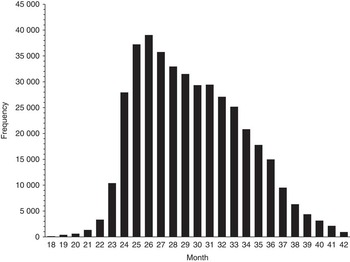
Most of the FCs occurred at the end of the year, from September to December (Figure 1). In Wallonia, up to 3 or 4 years ago, milk produced in winter was better paid (Service Public de Wallonie (SPW), 2011b). Farmers therefore tended to concentrate calvings in the autumn.
Numbers of first calving, according to month, in Holstein dairy heifers registered by the Walloon Association of Breeding between 1990 and 2010.

Almost 76% of Holstein cows in Wallonia had an AFC above 26 months (Figure 2), well after the recommended age of 24 months (Hoffman, Reference Hoffman1997; Nilforooshan and Edriss, Reference Nilforooshan and Edriss2004). Only 24% had a FC before 26 months, whereas 29% had a FC after 32 months. These results show that the management of dairy heifers is far from optimal in Wallonia. Farmers are often reluctant to change their practices. Two main reasons were identified (P. Picron, personal communication) as a result of farm audits from a previous study (Picron et al., Reference Picron, Turlot, Froidmont and Bartiaux-Thill2009). First, they cited various technical factors such as late insemination due to blue tongue, group management and heifers in pasture. Second, they mentioned psychological factors, an example of this being their fear that early calving will lead to a shorter lifespan or will reduce first lactation milk production, as shown by Pirlo et al. (Reference Pirlo, Miglior and Speroni2000). We hypothesise that family farming, with small-scale production units, could be a major factor in this reluctance to change as suggested by United States Department of Agriculture (USDA, 2002). Indeed, a dairy farm in Wallonia produced on average 318 747 l/year of milk and has 46 dairy cows, all breeds included (SPW, 2011a).
Distribution of age at first calving (months), in Holstein dairy heifers registered by the Walloon Association of Breeding between 1990 and 2010.

Analysis of first lactation
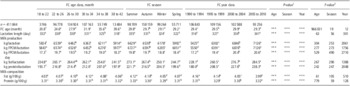
The AFC class, the FC season and the YFC class significantly affected the first lactation parameters (Table 1). The first lactation length was shorter with an AFC of more than 34 months. As suggested by Wathes et al. (Reference Wathes, Brickell, Bourne, Swali and Cheng2008), poorly growing animals required more services to conceive, calved later and subsequently performed badly. Milk production during first lactation was maximised with an AFC between 22 and 26 months. Compared with this optimum, calving before 22 months caused a drop in milk production of about 11% in the first lactation. This accords with the findings of Ettema and Santos (Reference Ettema and Santos2004), who reported that a FC before 23 months compromised milk yields and milk components during the first lactation and impaired reproductive performance. FPCM production dropped gradually in animals calving after 30 months. The milk fat and protein content varied little with AFC class, whereas quantities of fat and protein produced followed a similar trend to milk production. A more detailed analysis of the optimum AFC by Ettema and Santos (Reference Ettema and Santos2004) showed that fat and protein production in the first lactation increased by 6% and 4%, respectively, as AFC increased from 22.4 to 26.0 months.
Impact of age class, season and year class of FC on first lactation parameters

FC = first calving; FPCM = fat- and protein-corrected milk.
Within a row, mean values related to the same independent variable with different superscript alphabets are significantly different (P < 0.05).
1Significance level ***P < 0.001, **P < 0.01, *P < 0.05, ns = not significant (P > 0.05).
2The higher the F-value of a parameter, the higher its incidence on the variable.
First lactation was longer when FC took place in summer and then shortened with the changing seasons to reach a minimum for winter and spring calvings (Table 1). The time lag in order to concentrate the second calving at the end of the year only partly accounts for the differences in first lactation length. First lactation milk production was found to be lower when FC was in winter (−7%) or spring (−10%) compared with a summer FC. The length of lactation, and the grazing during the initial lactation phase, could explain these seasonal differences. Such findings are specific to the climatic conditions of Western Europe. A different seasonal effect has been noted in Arizona (Ray et al., Reference Ray, Halbach and Armstrong1992), where the summers are very hot, and in Eastern Europe (Maciuc, Reference Maciuc2009). Milk composition, however, differed little in absolute terms from one season to another.
The AFC varied little over time (Table 1), whereas it dropped steadily in the United States (Hare et al., Reference Hare, Norman and Wright2006a), falling below 26 months in 2004. According to USDA (2002), mean AFC was inversely related to herd size in the United States. The difference could be due to the existence of smaller-scale production units in Belgium. The length of the first lactation increased by 25 days between 1990 to 1994 and 2005 to 2010 (Table 1). Over the same period, the first lactation and milk solids production levels both increased by about 30%. With regard to milk composition, the first lactation milk fat content dropped by 4% over the period, but protein content remained stable.
Although the effects of AFC class and FC season were not negligible, the F-values (Table 1) suggested that YFC class was the most significant factor affecting milk production performances during the first lactation in the database. This trend over time probably reflects progress in genetic selection observed between 1992 and 2007 (Walloon Association of Breeding, 2011) as much as the dairy farmers’ management skills.
Analysis of second lactation
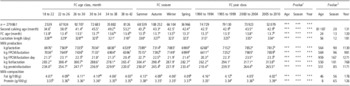
The F-values (Table 2) suggest that AFC and YFC classes have a dominant effect on milk production during the second lactation. The effect of FC season, however, is smaller.
Impact of age class, season and year class of FC on second lactation parameters

FC = first calving; FPCM = fat- and protein-corrected milk.
Within a row, mean values related to the same independent variable with different superscript alphabets are significantly different (P <0.05).
1Significance level ***P < 0.001, **P < 0.01, *P < 0.05, ns = not significant (P > 0.05).
2The higher the F-value of a parameter, the higher its incidence on the variable.
The percentage of animals tracked in their first lactation and calving for the second time ranged between 60% and 70%, depending on AFC class. Early calving, as young as 22 months, did not appear to adversely affect the cull rate after one lactation. These percentages were, however, lower than in the United States (74% in 2000; Hare et al., Reference Hare, Norman and Wright2006b).
AFC class had little effect on the time interval between the first two calvings (Table 2). Thus, the earlier the FC, the younger the second calving age. As with the first lactation, the second lactation was shorter in animals with a late AFC.
Second lactation milk production was maximised with an AFC between 22 and 26 months. The advantage of a FC at that age is therefore not confined to the first lactation, but persists afterwards, as shown by Ben Gara et al. (Reference Ben Gara, Bouraoui, Rekik, Hammami and Rouissi2009). The farmer effect should not be ruled out, however, bearing in mind that those who perform best in terms of productivity also achieve the best herd fertility management. The earlier the FC, the greater the FPCM production improvement in the second lactation compared with the first (+4.0, +3.4, +3.0, +2.6, +2.3 and +2.1 l FPCM/day of lactation for AFC classes 1 to 6, respectively, Tables 1 and 2). These differences were 0.5 to 0.7 l lower when the analysis was performed only with animals from group 2 (data not shown), but the same trend persisted. The detrimental effect of too early calving on the milk production during the first lactation therefore tapers off in successive lactations, as noted by Nilforooshan and Edriss (Reference Nilforooshan and Edriss2004).
A summer or autumn FC improved milk production in both the first and second lactation. The seasonal effect was partly due to richer winter feed during a period that is more representative of lactation than winter or spring calving. Increasing the photoperiod also helped to improve milk production (Dahl and Petitclerc, Reference Dahl and Petitclerc2003), but did not seem to counteract the feeding effect of spring calving.
The second calving age rose between the 1990 to 1994 and 2000 to 2004 year classes, reflecting the longer lactations and longer calving intervals. Second lactation milk production increased by more than 20% in 2000 to 2004 compared with 1990 to 1994, but there was no further improvement in 2005 to 2010. The milk fat content decreased steadily in the latter years, but the protein content increased slightly. As reported by Delaby et al. (Reference Delaby, Peyraud and Delagarde2003), these developments reflected a change in feeding practices, particularly the increasing use of concentrate supplementation for dairy cows. This could also be the case in Belgium, where the number of dairy cows fell from 593 788 to 503 796 in 2000 to 2009 (Statbel, 2012), but consumption of concentrates by dairy cattle rose from 421 224 to 504 832 t over the same period (Association Professionnelle des Fabricants d'Aliments Composés pour Animaux (APFACA), 2012).
Analysis of lifetime data
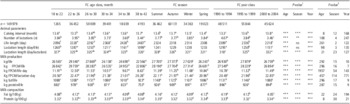
AFC class had little effect on the average calving interval (Table 3). A FC between 22 and 26 months maximised the number of lactations and the number of lactation days in an animal's life. These results accord with those reported by Meyer et al. (Reference Meyer, Everett and Van Amburgh2004), who recommended a FC at 23 months in order to maximise the number of lactation days. In addition, the animal's lifespan correlated positively with AFC class. By increasing longevity and reducing the total number of lactation days, a later-than-optimum FC therefore had a considerable impact upon the animal's productive phase. This represented 60.0%, 57.7%, 54.6%, 51.0%, 47.9% and 44.3% of the animal's lifetime for classes AFC classes 1 to 6, respectively. These figures resemble those obtained by Nilforooshan and Edriss (Reference Nilforooshan and Edriss2004), who found that the productive lifespan is less than the length of the breeding phase when the latter exceeds 30 months. As shown by Meyer et al. (Reference Meyer, Everett and Van Amburgh2004), milk production expressed by day of lactation, day of life or over an animal's whole lifetime is maximised when the FC takes place between 22 and 26 months. Chester-Jones and Linn (Reference Chester-Jones and Linn2005) found that reducing the AFC optimised milk production per day of an animal's life, provided that the animal was mature enough at FC. Of course, this has its limitations. An AFC at 20 months with sufficient BW requires an average daily gain of 1.0 kg/day throughout the breeding period. Such a growth rate may affect the development of mammary parenchyma (Hoffman and Funk, Reference Hoffman and Funk1992). As noted for first lactations, the milk fat and protein content were little affected by the AFC and YFC classes and the quantities of milk solids produced followed a similar trend to that of milk production.
Impact of age class, season and year class of FC on life production parameters

FC = first calving; FPCM = fat- and protein-corrected milk.
Within a row, mean values related to the same independent variable with different superscript alphabets are significantly different (P < 0.05).
1Significance level ***P < 0.001, **P < 0.01, *P < 0.05, ns = not significant (P > 0.05).
2The higher F-value of a parameter, the higher its incidence on the variable.
The FC season did not affect the animals’ longevity and, generally, had little effect on the calving interval, number of lactations or average lactation length (Table 3). The effect on milk production over an animal's life was more marked, being greater in animals whose FC was in summer and then dropping progressively to 5% lower milk production for animals whose FC was in spring. This difference is essentially due to lower daily milk production, which in turn was probably due to differences in average feeding from one lactation to another. Animals that calve in summer or autumn are in fact in production throughout the winter period and therefore receive higher energy feed on average during their lactation than winter or spring calvers. Given that the average calving interval is just over a year, these animals will be in production during the wintering period in their successive lactations.
Several studies have reported a longer calving interval in recent years than before, including studies in Canada (Murray, Reference Murray2003), Spain (González-Recio et al., Reference González-Recio, Pérez-Cabal and Alenda2004), the Netherlands (Nederlands Rundvee Syndicaat (NRS), 2005) and the United Kingdom (Wall et al., Reference Wall, Brotherstone, Woolliams, Banos and Coffey2003). According to Hare et al. (Reference Hare, Norman and Wright2006a), the increase is about 1 day per year for Holsteins. The same tendency was observed in this study, where the calving interval increased by 12 days between 1990 to 1994 and 2000 to 2004. On the one hand, lactations were longer over time but, on the other, number of lactations, number of days’ lactation and longevity all decreased significantly over that period, reflecting a higher cull rate over time. As a result, the average FPCM lifetime production of a cow was lower in 2000 to 2004 than it had been previously. This was mainly due to the decrease in the number of days of lactation as production per day of life or per day of lactation increased steadily over time (Table 3), reflecting intensive genetic selection. The number of lactations (Table 3), however, was higher than the average of 2.94 noted by Hare et al. (Reference Hare, Norman and Wright2006b) in the United States between 1980 and 1994. That study also reported that the number of days’ production was only 994 on average for the period, much lower than in Wallonia (Table 3). Between 1990 to 1994 and 2000 to 2004, the milk yield rose from 6617 to 7734 kg FPCM per lactation, equivalent to an annual increase of 112 kg FPCM per lactation. This is similar to the value reported by Hansen (Reference Hansen2000) for the United States for 1990 to 1996 (115 kg milk per lactation). The protein content was relatively stable as an absolute value, whereas the milk fat content decreased slightly as daily production increased, probably because the cows were being fed more concentrate.
Conclusion
Controlling the AFC is a key factor to be addressed to ensure good lifetime milk production and efficient animals able to produce more milk in less time. The implications are both economic and environmental. The animal-related parameters (number of lactations, longevity, etc.) are affected by AFC class and YFC class. The impact of the latter reflects not only the genetic improvement that has taken place, but also the adaptation of management methods related to the increase in production (higher cull rate, longer lactation, etc.). The effect of FC season on these parameters is smaller, although still significant.
Acknowledgements
The authors would like to thank the Service Public de Wallonie, Direction du Développement et de la Vulgarisation, for the subsidies granted in the context of their research into dairy heifer growth and first lactation milk production.