1 Introduction
The English language spoken in Ireland, often referred to as Irish English, has been influenced by three dominant factors: the variety of English spoken in England (and particularly the west of England), the Scots dialect (which mostly affected northern Ireland), and Irish (Wells Reference Wells1982b: 417). There are a number of phonological features that are prominent in (Southern) Irish English, in all its three major dialectal areas (the East Coast, the South and West, and the Midlands; see Hickey Reference Hickey2004 for the dialectal division of Southern Irish English). These common features include rhoticity; the realization of standard English /Θ/ and /ð/ as dental or sometimes alveolar plosives, [t̪ t] and [d̪ d]; or the distinction of pre-rhotic short vowels, with fern pronounced as [feɹn] and turn as [tʌɹn] (see for instance Hickey Reference Hickey1986). This study addresses another prominent feature of the English language spoken in Ireland, the phonetic variation of the fortis (voiceless) plosive /t/, a sound which manifests considerable variability across the English speaking world.
In the rest of this section, we will first illustrate the variability of the voiceless plosive /t/ in various varieties of English focusing on three major allophonic variants – namely aspiration, flapping, and glottalization – as well as some less frequent variants. The following subsection will focus specifically on /t/ in Irish English.
1.1 The realization of /t/ in varieties of English
The voiceless plosive /t/ may well be a consonant whose manifestations in speech vary the most throughout the English-speaking world. Some variants are present in many dialects, others are rarer. The former certainly includes aspiration, which occurs typically at the beginning of a stressed syllable (e.g. tall as [tʰɔːl], unless preceded by [s] (stall as [stɔːl]). Stress-initial aspiration is well-attested in most British and American English varieties; however, aspiration is described as weaker in upper class speakers of Standard Southern British English (Wells Reference Wells1982b: 282; Hughes, Trudgill & Watt Reference Hughes, Peter and Dominic2013: 42–43), as well as in Northern English accents (Wells Reference Wells1982b: 370) and in Scottish English (Wells Reference Wells1982b: 409; see also Watt & Yurkova’s Reference Watt and Jillian2007 study of Aberdeen English speakers). Aspiration is closely related to affrication, and especially so with the alveolar /t/; while the former refers to noise originating at the laryngeal level, the latter concerns noise originating in the given place of articulation (compare [tʰɔːl] with [tsɔːl]; see, for instance, Bauer & Warren Reference Bauer and Paul2004 regarding New Zealand English). Aspiration before stressed vowels is absent in Indian English (Wells Reference Wells1982c: 625; Gargesh Reference Gargesh2006) as well as in other Southeast Asian varieties like Singaporean or Philippine English (Bautista & Gonzales Reference Bautista and Gonzales2006), in South African English spoken by white speakers (Bowerman Reference Bowerman2004), or in Māori English (Kiesling Reference Kiesling2006). The absence of aspiration is also reported in Cajun Vernacular English in Louisiana (Dubois & Horvath Reference Dubois and Horvath2004). Note that weaker aspiration or the absence of aspiration in phonologically voiceless plosives may be accompanied by a more negative voice onset time (VOT, i.e. pre-voicing) in their phonologically voiced cognates, so that the contrast between words like tent and dent is not neutralized (see Watt & Yurkova Reference Watt and Jillian2007 for Aberdeen English).
Another variant of /t/, also shared by a larger number of English varieties, is the voiced alveolar flap or tap, sounds which lack a closure but rather consist in a quick, ballistic movement of the tongue. A flap is produced by moving the tongue tangentially toward the alveolar ridge and striking it in passing, whereas a tap is produced by moving the tongue upwards and lightly touching the alveolar ridge (Ladefoged & Maddieson Reference Ladefoged and Ian1996: 231). The phonetic environment that is most conducive to the occurrence of flaps and taps is the coda of a stressed syllable or, in other words, the post-tonic position; the word water may be pronounced [ˈwɔːɾɚ] and the phrase get it [ˈɡeɾ‿ɪt]. The flap is one of the characteristic features of most American English (Boberg Reference Boberg, Marnie and Levis2015) and also Australian English (Horvath Reference Horvath2004) varieties, but occurs also in Hawaiian Creole (Sakoda & Siegel Reference Sakoda and Jeff2004) and is reported by Hughes et al. (Reference Hughes, Peter and Dominic2013) in several dialects of British English (in Leicester, Hull, Liverpool or Lancashire) and more recently even in Standard Southern British English (SSBE; Gavaldà, Reference Gavaldà2016). Most importantly for the purposes of the present study, flapped /t/ occurs in Irish English (Hickey Reference Hickey2004: 42; Kallen Reference Kallen2013: 52–57; see Section 1.2 below for more details). In addition, flapping is believed to have entered Northern Irish English from Southern Irish English (McCafferty Reference McCafferty2007).
The third variant is similar to flapping in the phonetic context in which it appears: T- glottalling is also largely associated with the post-tonic position. One may thus expect little overlap between flapping and glottalling varieties of English. By glottalling varieties we mean those where /t/ is completely replaced by a glottal sound, though its precise phonetic nature may be surprisingly variable (see e.g. Docherty & Foulkes Reference Docherty and Paul1999). As noted by Trudgill (Reference Trudgill1999: 136), T-glottalling is ‘one of the most dramatic, widespread and rapid changes to have occurred in British in English in recent times’. Fabricius (Reference Fabricius2002, quoting Wells Reference Wells1997) outlines the development of this feature, with glottalling starting in pre-consonantal contexts (e.g. got me [ˈɡoʔ mi], football [ˈfʊʔbɔːl]) in the middle of the 20th century and spreading towards the century end into pre-vocalic contexts. Glottalling in this latter context (i.e. in words like better [ˈbeʔə], bottle [ˈbɒʔl̩]) is described as ‘sharply stigmatized’ but undergoing ‘widespread dissemination’ by Wells (Reference Wells1982a: 261); it was associated mostly with working-class male speakers. Only twenty years later, Fabricius (Reference Fabricius2002) reports little difference between the use of glottalling between male and female speakers, hypothesizing that glottalling has lost (or is losing) its stigma; the receding of stigmatization is mentioned also by Hughes et al. (Reference Hughes, Peter and Dominic2013: 67). More recently, Gavaldà (Reference Gavaldà2016) shows T-glottaling to be quite frequent in speakers of SSBE and Schleef (Reference Schleef2021) in London and Edinburgh. Though mostly associated with British English varieties, including ethnic varieties like British Creole (Patrick Reference Patrick2004) or London West Indian (Hughes et al. Reference Hughes, Peter and Dominic2013: 81), T-glottalling is attested in American English (Eddington & Channer Reference Eddington and Cindy2010, Ostalski Reference Ostalski, Ewa and Shockey2013, Seyfarth & Garellek Reference Seyfarth and Marc2020) and Australian English (Horvath Reference Horvath2004) as well, albeit to a much lesser extent. Huber (Reference Huber2004) also mentions that Ghanaian English speakers may replace syllable-final /t/ with a glottal stop. Finally, T-glottalling has also been studied in non-native English (see Drummond Reference Drummond2011 for a study on Polish speakers based in Manchester).
One of the less frequent variants of /t/ consists in ejective articulation, [tʼ], where the sound of the release is ‘fortified’ by raising the larynx during the closure. According to Ogden (2009: 163), ejectives ‘occur in a good number of British English varieties, though remarkably little is known about which ones’. The most typical context for ejectives to occur in English is word- and especially utterance-finally, as in Look at that! being pronounced [ˈlʊk‿ət ̚ ˈðӕtʼ]; Stuart-Smith (Reference Stuart-Smith2004) reports ejectives in the same context in Scottish English.
In some varieties of English, one can come across the replacement of /t/ by the approximant [ɹ]. This seems to be limited to specific lexical items in specific phonological and morphological contexts, such as getting [ˈɡeɹɪŋ], get off [ɡeˈɹɒf], put on [pʊˈɹɒn], but he [bəɹi], got a job [ˈɡɒɹə ˈdʒɒb], matter [ˈmӕɹə]. This T-to-R change is attested in Northern English dialects (Beal Reference Beal2004), West Midlands (Clark Reference Clark2004), in Liverpool English (Clark & Watson 2011; Hughes et al. Reference Hughes, Peter and Dominic2013: 113), and also in Irish English (Kallen Reference Kallen2013: 56).
The final allophone to be mentioned here is pre-aspiration (e.g. cutting [ˈkʰʊʰtɪŋ]), which has been reported relatively recently in some varieties of British English, for instance in Tyneside varieties (Docherty & Foulkes Reference Docherty and Paul1999), in Manchester (Hejná & Scanlon Reference Hejná and Jane2015), Welsh English (Hejná Reference Hejná2016) as well as Welsh (Morris & Hejná Reference Morris and Míša2020), or in the English spoken in the Hebrides islands (Clayton Reference Clayton2017).
1.2 The description of /t/ in Irish English
This section will return to some of the variants of /t/ mentioned in Section 1.1 which also appear in Irish English and introduce one which is characteristic specifically for Irish English. The specificities of Irish English /t/ are strongly related to the syllabic coda. In syllable onsets, the variability is comparable to that in many other varieties of English. It is realized as aspirated [tʰ] in the onset of a stressed syllable (e.g. tick [tʰɪk]; see Hickey Reference Hickey2009) and as [t] when /s/ precedes (e.g. stick [stɪk]). Hickey (Reference Hickey2004: 93) mentions that slight affrication may appear in ‘fashionable Dublin English speakers’ (i.e. [tsɪk]).
When /t/ is syllable-final (see Wells Reference Wells2008: xxvii for the syllabification adopted here), it is typically realized as a fricative, in what Hickey (Reference Hickey2004: 84) describes as ‘the clearest phonetic feature of southern Irish English’. The resulting fricative is identical to the underlying [t] in everything but its closure, and it can thus be labelled as a voiceless apico -alveolar fricative. It has also been called the slit-T and it appears in words like water or sit. Hickey (Reference Hickey1984: 234), who has addressed the Irish English [t] in a number of his studies, claims ‘there is no IPA symbol for this sound’ and devises his own, [〭]. Pandeli et al. (Reference Pandeli, Eska, Ball and Joan1997) provide a list of fifteen different ways of symbolizing slit-T in transcription; Hickey’s (Reference Hickey1984) proposal is not mentioned, but they do list the IPA symbol [t̞] (i.e. a more open or lowered articulation). For greatest transparency, we will adopt this IPA symbol in the study (which is also in line with the recommendation of Kallen Reference Kallen2013: 53). Today, the presence in Irish English of the slit-T realization is ascribed to a process of ‘lenition as a phonological directive from Irish’ (Hickey Reference Hickey2004: 81), but see Hickey’s earlier interpretations of the origins of [t̞] (Hickey Reference Hickey1984, Reference Hickey1986). It should be pointed out that the slit-T is not exclusive to Irish English: this fricative realization of /t/ is regarded as the traditional word-final variant of /t/ (e.g. hit [hɪt̞]) in Newfoundland English (Clarke Reference Clarke2004: 378), for which 19th-century Irish English is the most important source (Hickey Reference Hickey2002, Kallen Reference Kallen, Peter, Frans and Kerswill2005), and Kallen (Reference Kallen2013) lists the presence of a similar sound also in other varieties of English.
In the supra-regional variety of Southern Irish English, the slit-T constitutes the only weakened allophone of /t/. In colloquial urban varieties, and particularly in Dublin, lenition is reported to extend beyond the apico-alveolar fricative realization (Hickey Reference Hickey1996). The progressive weakening begins with the T-to-R change mentioned in Section 1.1 (Hickey Reference Hickey1999, Kallen Reference Kallen, Peter, Frans and Kerswill2005), which appears mainly in sandhi contexts (e.g. get up [ɡeˈɹʊp]), but also in the post-tonic position within words (water [ˈwɑːɹɚ]). The next stage consists in the removal of the lingual gesture; this typically results in what was described above as T- glottalling (e.g. [ˈwɑːʔɚ], what [wɑʔ]). The second possibility which involves the loss of the lingual gesture is using the glottal fricative [h] (e.g. [ˈwɑːhɚ]). Sources, summarized in Kallen (Reference Kallen2013: 55), differ in how frequent this realization is. The ultimate stage in the progressive lenition is elision of the /t/, or null realization (Ø); this seems to appear mostly in word-final contexts (e.g. sit [sɪ], what [wɑ]). In few specific words, a given lenition stage seems to have been lexicalized; most sources mention the example of Saturday [ˈsӕhɚde]. According to Hickey (Reference Hickey2009), the realizations introduced in this paragraph – that is, those that are weaker than slit-T – bear social relevance and serve as sociolinguistic markers, while the slit-T is a stable indicator of Irish English in general.
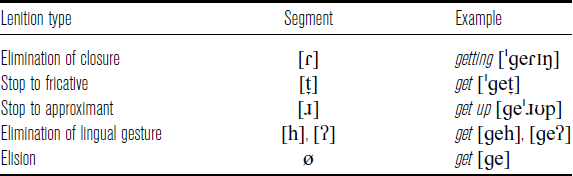
As in many other varieties of English (see Section 1.1 above), the alveolar flap [ɾ] may also appear for /t/ in Irish English, in words or phrases like letter [ˈleɾɚ], city [ˈsɪɾi] or out of [ˈa͡ʊɾəv]. Hickey (Reference Hickey2009) treats the flap as a lenition process as well, proposing five types of lenition in Irish English /t/, as summarized in Table 1.
Typology of /t/ lenition in Irish English (modified according to Hickey Reference Hickey2009: 126).

This section has shown /t/, canonically defined as a voiceless alveolar plosive, to be an extremely variable sound in English in general and in Southern Irish English in particular. This study will analyze /t/ occurring in the syllabic coda in spontaneous and read speech of 21 speakers from Southern Ireland and show that there is even more variability in the phonetic realizations of /t/ allophones than was hitherto reported.
2 Method
The present study is based on the speech of 21 native speakers of Irish English (15 female, six male; mean age 31 years) who were working or studying at the University of Limerick, Ireland. Based on their self-report, they can all be regarded as belonging to the middle class. Of these, 13 speakers originally came from the Irish Midlands (and most of them from Limerick county), six speakers from the South and West dialectal area, and two from the East Coast but not from the city of Dublin (Hickey Reference Hickey2004). Although no significant differences between these dialectal areas regarding the realization of coda /t/ are mentioned by Hickey, the effect of speakers’ origin will be examined.
The recordings were obtained in a quiet room at the University of Limerick using a high-quality portable recording device, Zoom H2, at 44.1 kHz sampling frequency and 16-bit resolution; the in-built microphones were used. The subjects were asked to perform two speaking tasks. First, they read the well-known fable ‘The Boy Who Cried Wolf’, proposed by Deterding (Reference Deterding2006) as suitable for studying the pronunciation of English sounds. The reading took approximately two minutes on average. Second, the subjects engaged in a spontaneous dialogue about their life and hobbies with the second author of this study for approximately ten minutes.
The read-out texts were analyzed in their entirety, and a two-minute passage was cut from the middle portion of the spontaneous recordings. The passages were orthographically transcribed and automatically segmented using the P2FA forced aligner (Yuan & Liberman Reference Yuan and Mark2008). The target variants of /t/ – i.e. those appearing in the syllable coda position – were subsequently analyzed using careful auditory analysis supported by visual inspection of spectrograms in Praat (Boersma & Weenink Reference Boersma and David2017); the analysis was conducted by the second author, and all uncertainties (less than 40 items or 3
 $\%$
) were settled in joint analysis of both authors. The individual variants were coded in Praat TextGrids, including details about the position of the sound within a word (medial or final) and about the word’s semantic status (lexical vs. grammatical words)Footnote
1
and length (in number of syllables). We also noted whether the target /t/ appeared in the coda of a stressed syllable (e.g. cat or better) or an unstressed syllable (e.g. parasite); see Section 1.2 for a note on syllabification. To examine the effect of word frequency in lexical words, we used the frequency per million words in the spoken part of the British National Corpus (Leech, Rayson & Wilson Reference Leech, Paul and Andrew2001). Note that we did not consider unreleased realizations of /t/ (e.g. the phrase get together pronounced [ˈɡet̚ təˈɡed̪ɚ]). In total, we analyzed 1,338 items of /t/, which corresponds to a little over 60 items per speaker. The resulting data were then processed using the R programme (R Core Team 2017) and visualizations performed in the ggplot2 package (Wickham Reference Wickham2009).
3 Results and discussion
The analyses will be presented in two sections. The first one will focus predominantly on the major trends; in other words, we will introduce the prevailing /t/ variants which were represented to a substantial degree in our data, focusing on the effect of speech style and neighbouring phonetic context. At the end of the first section, we will briefly concentrate on the less typical realizations in our data (albeit reported in literature). The second section will discuss phonetic detail of some of the realizations of Irish English /t/, introducing some new phonetic variants.
3.1 Major trends in the realizations of /t/
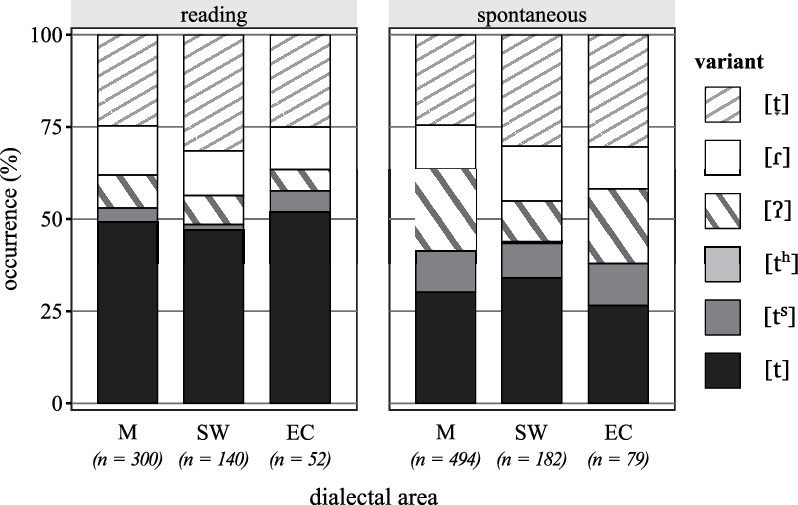
Our first aim was to examine whether speakers’ dialectal origin influences their realization of coda /t/. Figure 1 shows the distribution of the most frequent allophones of /t/ in the three dialectal groups depending on speech style (read and spontaneous speech). The results show that the distribution of the realizations is very similar across the three dialectal areas, in both speaking styles. The non-significance of between-dialect differences is confirmed by chi-square tests: χ(8) = 5.28, p > .5 for read speech; χ(8) = 13.37, p > .05 for spontaneous speech. That is why, in subsequent analyses, speakers from the three dialectal areas will be pooled.
The occurrence of the most frequent allophonic realizations of /t/ according to the speakers’ dialectal origin, separately for read and spontaneous speech.

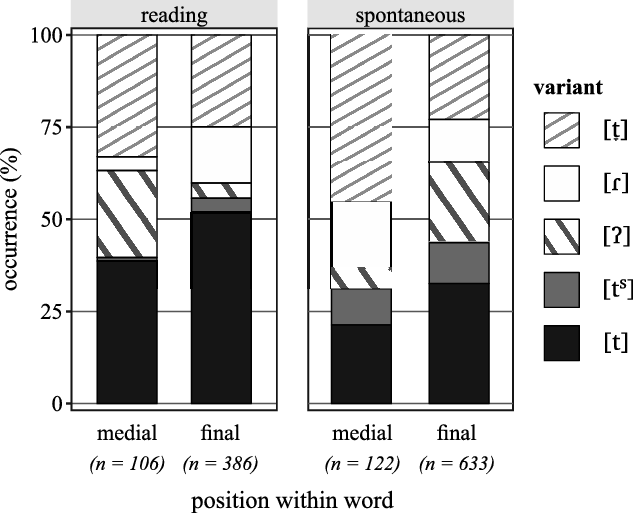
The occurrence of the most frequent allophonic realizations of /t/ according to its position in a word, separately for read and spontaneous speech.

In Figure 2, we examine the overall results for the most frequent allophones of /t/ depending on the position in the word (medial and final) and speech style (read and spontaneous speech). In total the figure represents 1,247 items; some of the less frequent variants are discussed in the following section. It is apparent that the realizations differ to some extent in the positions, as well as in the two speech styles. A ‘plain’ [t] (i.e. a phonetically voiceless, unaspirated alveolar plosive) is the most frequent variant overall (n = 473) and occurs slightly but insignificantly more in read than in spontaneous speech (χ(1) = 2.82, p > .05). The typical fricative realization of Irish English, [t̞], is the second most frequent variant (n = 331), and there is only little difference between read and spontaneous speech (χ(1) = 0.0009, p > .9); this lends support to Hickey’s (Reference Hickey2009) claim that slit-T is a stable indicator in Irish English, rather than a marker of, for instance, formality of the communicative situation. Slit-T is slightly more frequent in the medial (e.g. water) than final (e.g. hot) position, while the opposite applies to the ‘plain’ [t] realizations. The other weakened realizations of /t/ – the flap and the glottal stop – occur slightly less in our sample. It should also be noted that the glottal fricative [h] appeared very rarely as a realization of /t/ in our data and will be briefly discussed towards the end of this section.
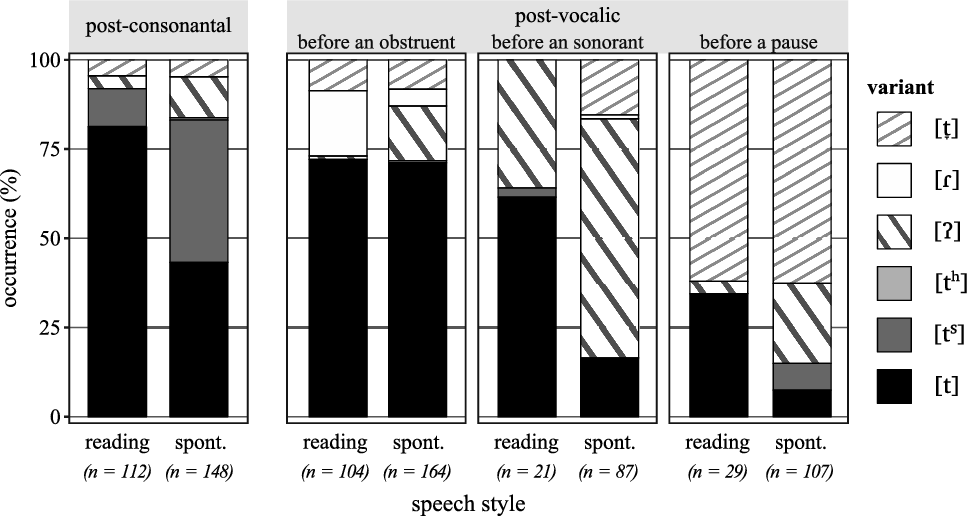
It is natural that the realization of /t/ strongly depends on the phonetic context, as shown in Figure 3; since word-medial contexts (when further broken down into subgroups) were rare in our data, the figure depicts only word-final items of /t/. We can see in the left panel of the figure that a preceding consonant (in phrases like last year) to a large extent blocks the use of the weakened variants (glottalling, flap, and slit-T). In both read and spontaneous recordings, a great majority of the post-consonantal items were predictably realized as a plain alveolar [t] or with a noise component (typically affricated [ts]); a more detailed look shows that this is especially the case when the preceding consonant is an obstruent. The other variants are always conditioned by the following – as well as preceding – context. Glottalization occurred when the preceding consonant was a sonorant, in phrases like don’t want in spontaneous speech or in short while in reading. The slit-T variant occurred only when the preceding consonant was [ɹ], also in short while.
The occurrence of the most frequent allophonic realizations of word-final /t/ in post-consonantal and post-vocalic contexts, divided by speech style.

The distribution of the major realizations of post-vocalic /t/ depending on the following phonetic context is shown in the three right panels of Figure 3; note that intervocalic items are treated separately below. It is clear that the vowel–/t/–obstruent context favours plain [t] realizations. In the flapped realizations in reading, the following obstruent was always [h] (e.g. that he, get home). The glottal realizations in spontaneous speech occurred most frequently in grammatical words like it, not or that. The vowel–/t/–sonorant context in reading is only represented by one phrase, not long; the results show that most of our speakers produced the /t/ as plain or glottalized (i.e. [nɒt lɒŋ] or [nɒʔ lɒŋ]). Glottalization is even more frequent in spontaneous speech, for instance in phrases like but really, get one or a bit more. Prepausally (i.e. at the end of a major prosodic phrase), there is a strong prevalence of slit-T realizations in both read and spontaneous speech.
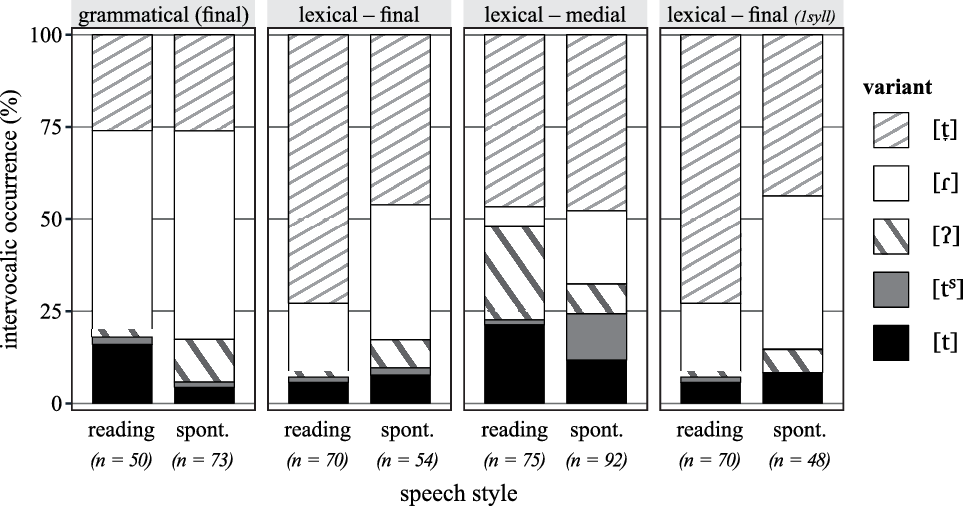
Results for the intervocalic position, as shown in Figure 4, are also divided according to the semantic status of the word. Note that /t/ only appears word-finally in grammatical words (e.g. at, it, but). Naturally, the flapped word-final realizations of /t/ – which are, at the same time, intervocalic – by definition involve sandhi effects; in other words, the final /t/ will be linked to the following vowel (e.g. out of [a͡ʊɾ‿əv], bit about [bɪɾ‿əˈba͡ʊt̞]). It is immediately apparent that lenition type differs between grammatical and lexical words (χ(4) = 56.72, p < .0001), with the flapped variant more frequent in grammatical words and the fricative variant in lexical words. The fricative [t̞] is the dominant variant in lexical words regardless of position. The relatively frequent glottalized variant in the medial position in read speech can be accounted for by the specific words: threaten and little, when not pronounced with a syllabic consonant, were often realized [Θreʔən] and [lɪʔəɫ], respectively. It should be pointed out that what may appear to be an effect of the words’ semantic status could in fact be an effect of word length: nearly 95
 $\%$
of the grammatical words are also monosyllabic. However, as shown in the rightmost panel of Figure 4, when only word-final /t/ in monosyllabic lexical words is included, the distribution of variants is practically identical. It seems, therefore, that the observed effect does relate to semantic status, presumably in combination with higher word frequency in grammatical words.
The occurrence of the most frequent allophonic realizations of word-final /t/ in intervocalic contexts, divided by semantic status of the word, position in the word and speech style. The last panel shows only monosyllabic lexical words for comparison (see text).

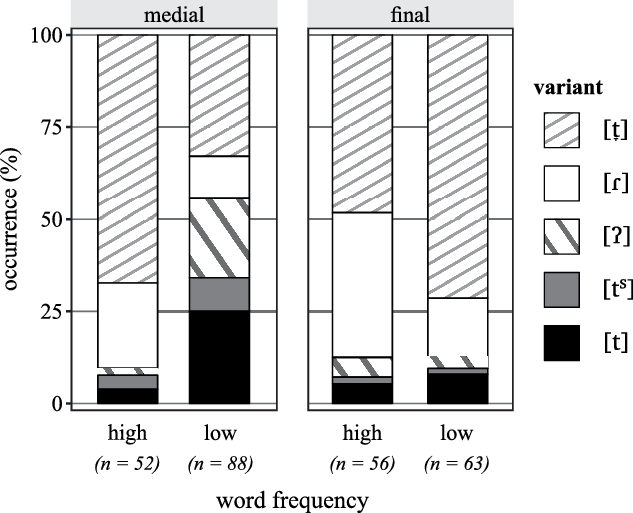
Indeed, word frequency does play a role in the realization of /t/, as shown in Figure 5 for intervocalic occurrences of /t/ in lexical words. There were 259 instances of these items for which an entry in the spoken part of the BNC was found. We used 100 words per million words as a somewhat arbitrary threshold to divide the words into the high- and low-frequency group. It is clear from the figure that word frequency also interacts with position. In the word-medial position, intervocalic /t/ is almost always weakened in the high-frequency group, whereas ‘plain’ [t] and affricated [ts] realizations are more frequent in the low-frequency group; the difference in variant distribution in the two groups defined by word frequency is highly significant in medial positions: χ(4) = 29.93, p < .0001. The occurrence of weakened variants in final positions is similar, with more flapped realizations in the high-frequency group; overall, the difference in variant distribution is only marginally significant (χ(4) = 9.32, p = .054).
The occurrence of the most frequent allophonic realizations of word-final /t/ in intervocalic contexts in lexical words, divided by word frequency (see text) and position in the word.

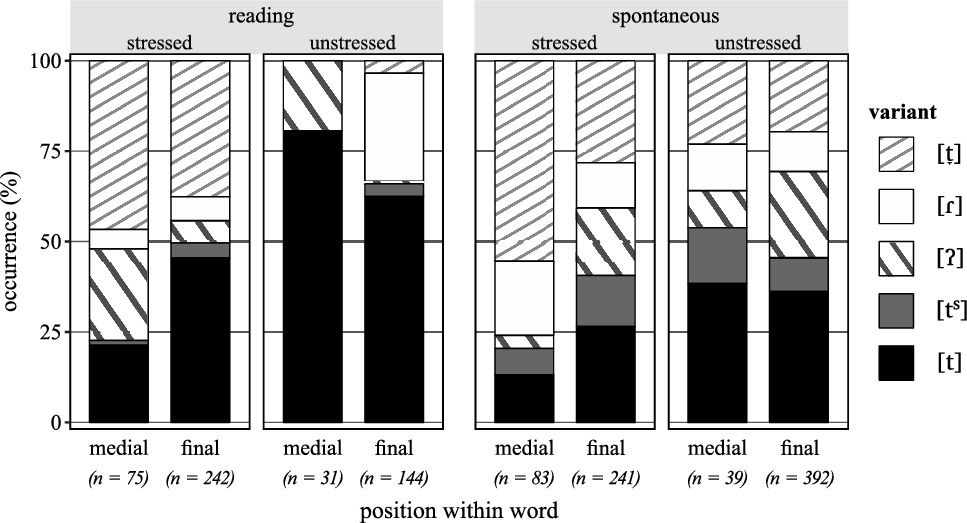
What remains to be discussed is the effect of lexical stress on the realization of coda /t/. The results depicted in Figure 6 confirm previous findings that it is especially /t/ in the coda of a stressed syllable, in the post-tonic position, which is prone to weakened realizations (i.e. glottalling, flap, and slit-T). When we add the effect of position, more weakened realizations occur in stressed codas within words, in the medial position (e.g. water), than in word-final positions (e.g. hot); variant distribution differs with high significance (χ(4) = 29.42, p < .0001). Finally, lexical stress affects the way /t/ is pronounced more in read than in spontaneous speech.
The occurrence of the most frequent allophonic realizations of word-final /t/ in the coda of stressed and unstressed syllables, divided by position in the word and speech style.

Until now, we have focused on those variants which were sufficiently represented in our data to be discernible in the bar charts. For the sake of completeness of our description, we will also mention two variants which appeared less frequently. First of all, there was only one of the 21 speakers who realized /t/ as glottal fricative [h]; this male speaker from the Irish Midlands pronounced [h] in spontaneous speech, three times in the word Saturday (see Section 1.2 above) and once in kilometres. Pronunciation of /t/ as an ejective [tʼ] was mentioned in Section 1.1 for a number of British English dialects, but has not, to our knowledge, been attested in Irish English. Our data feature 37 instances of [tʼ], most of them in reading and in pre-pausal (phrase-final) contexts (one half of them occur in the words forest and feast).
Overall, the results presented in this section are in agreement with what was reported for the realization of /t/ in Irish English mostly by Hickey (Reference Hickey2004, Reference Hickey2009) and Kallen (Reference Kallen, Peter, Frans and Kerswill2005, Reference Kallen2013), although some new details have emerged. For instance, the slit-T has been described as occurring in high-sonority environments; our data feature [t̞] also in the context of one or even two voiceless fricatives (e.g. almost right [ˈɔːlməst̞ ˈra͡ɪt̞], just football [dʒəst̞ ˈfʊt ̚bɔːl], though such instances are, of course, rare. Some of the new findings concern especially the role of the semantic status of the word. Finally, it is interesting to note that the lenition of /t/ to [h] was exceptional in our speakers, when compared with reports in literature; this is most likely caused by the relatively high socioeconomic status of our speakers, who are all closely associated with the university setting.
Waveform and spectrogram of the sequence [hɑːt̞‿ӕf] from the phrase hot afternoon, illustrating the voiceless apico-alveolar fricative, pronounced by speaker 12 in the reading passage. The f0 track is indicated in light blue colour.

Waveform and spectrogram of the sequence [hɑːť̞‿ӕf] from the phrase hot afternoon, illustrating the voiced apico-alveolar fricative, pronounced by speaker 14 in the reading passage. The
 $f_0$
track is indicated in light blue colour.

Waveform and spectrogram of the sequence [bəť̞‿ɛː] from the hesitation sequence but ehm, illustrating the voiced apico-alveolar fricative pronounced by speaker 8 in spontaneous speech. The
 $f_0$
track is indicated in light blue colour.

Waveform and spectrogram of the sequence [bəť̞ʔ] from the hesitation sequence but I, illustrating the voiced apico-alveolar fricative, pronounced by speaker 10 in spontaneous speech. The
 $f_0$
track is indicated in light blue colour.

Waveform and spectrogram of the word cat [kהt̞ ̻], illustrating the voiceless lamino-alveolar fricative, pronounced by speaker 1 in spontaneous speech.

Waveform and spectrogram of the word shouting [ʃa͡ʊɾ̞ɪŋ], illustrating the fricative flap, pronounced by speaker 6 in the reading passage. The red arrow indicates the brief lingual closure.

3.2 Phonetic detail in less frequent realizations of /t/
First of all, we will address in more detail the most characteristic Irish English variant of /t/, the slit-T; it was described in Section 1.2 as a voiceless apico-alveolar fricative. A typical example of [t̞], with the continuous noise characteristic of a voiceless fricative sound, is shown in Figure 7; note that the sounds corresponding to the displays shown in Figures 7–12 may be found in the supplementary materials online.Footnote
2
There are a few milliseconds of voicing continuation into the fricative, which is due to the fact that phonatory activity (i.e. vibration of the vocal folds) is not fully synchronized with articulatory activity (i.e. articulatory gestures in the oral cavity); see Ohala (Reference Ohala and Peter1983) or Fuchs (Reference Fuchs2005) for more detail. Otherwise, the fricative is completely voiceless, as evidenced by the absence of fundamental frequency (
 $f_0$
, marked in light blue in the spectrogram).
Naturally, this realization of slit-T was most frequent in our data. However, there were 25 instances in our database when the fricative was realized as a voiced sound. Importantly, the voiced slit-T appeared in 11 different speakers (eight female, three male), 14 of them appeared in the read text and 11 in spontaneous speech. What is, to the best of our knowledge, a previously unreported variant of /t/ in Irish English therefore does not seem to be a one-off realization. We propose to mark the voiced realization of slit-T [ť̞], with the IPA symbol for a ‘voiced’ sound placed above the primary symbol to avoid a clash with the symbol for more open articulation. Figure 8 shows an example of this sound in the same phrase as that in Figure 7 above for easier comparison but from a different speaker. Apart from the uninterrupted
 $f_0$
track in light blue, the presence of voicing is obvious especially from the periodicity in the waveform; the energy of the
 $f_0$
band in the spectrogram tends to be rather weak in voiced fricatives. In Figure 9, the voicing is clearly visible even in the spectrogram, and the noise component is relatively weaker; this figure shows one of the examples from spontaneous speech, pronounced as part of a hesitation phenomenon but ehm.
Most of the instances of voiced slit-T occur in the intervocalic position. Figure 10 shows an example of [ť̞] appearing in the phrase but I, where the two words are not linked but separated by glottalization [bəť̞ʔa͡ɪ]. It is not surprising that phonetic voicing does not extend over the entire duration of the fricative but only to its middle, given the following voiceless context; on the other hand, this is not comparable to the short (purely physiologically based) voicing continuation visible in Figure 7, and the partial voicing is clearly audible in the accompanying recording. Of the 23 items of voiced slit-T, our data include five that are not intervocalic.
The slit-T was defined above as an apico-alveolar sound, and the fricative realizations so far presented in all the examples, in Figures 7–10, manifest noise in a broad frequency range, extending from about 3 kHz or 3.5 kHz all the way to the upper range of 7 kHz displayed in the spectrograms. Our dataset revealed the presence of another variant: there are eight items of word-final /t/ which seems to involve laminal articulation and is perceptually very similar to the lamino-alveolar fricative [s]. An example of this realization is illustrated in Figure 11, and one can compare how the noise characteristics clearly differ from those presented for the dominant apico-alveolar variant: the noise formant is much more clearly defined as a relatively narrow frequency band between 4.5 kHz and 6.5 kHz. The much sharper sound resembling [s] is clearly audible in the recording featured in the supplementary materials online. Since using the [s] symbol in transcription would result in lower transparency, we recommend that it should be transcribed as a slit-T with laminal articulation, [t̞ ̻]. (Note that the Unicode keyboard layout does not offer the possibility of placing the ‘laminal’ diacritic above the primary symbol.) This lamino -alveolar slit-T was pronounced by three different female speakers and it occurs almost exclusively before a pause, or at least at the end of a prosodic phrase (for instance, one response of speaker 14 to the interviewer’s question was ‘yeah, a little bit, a little bit’, with a prosodic break between the two repetitions).
It is worth pointing out that there seems to be some indication in the literature of the existence of this sound. According to Hughes et al. (Reference Hughes, Peter and Dominic2013: 144), fricative /t/ ‘can often sound very [s]-like’. Kallen (Reference Kallen2013: 56) quotes Henry (1958), who mentions ‘a transitory following s’ in the traditional dialect; Kallen provides the word hat as an example and transcribes it [hat̞s]. We believe that the impression of an [s]-like slit-T is caused by the laminal, rather than apical articulation, which should then be reflected in transcribing this variant of /t/ in Southern Irish English.
The last variant of Irish English /t/ found in our recordings must probably be regarded as a one-off realization. At the same time, however, we believe that it is phonetically very interesting and deserves to be mentioned, in spite of its rarity. This variant involves a combination of a ballistic movement which is characteristic of the alveolar flap with a fricative realization characteristic of the slit-T. The resulting sound may be defined as a more open flap or a fricative flap, hence its proposed transcription [ɾ̞]. An example is shown in Figure 12 below: the brief touch of the tongue tip against the alveolar ridge is indicated by the red arrow, while the accompanying friction lasts throughout the sound. The fricative flap occurs three times in our data, pronounced by three different speakers (two females, one male) in the recordings of read speech. Apart from the example in Figure 12 (shouting [ʃa͡ʊɾ̞ɪŋ]), the other two contexts were thought up [Θɔːɾ̞‿ˈʌp] and that a [d̪əɾ̞‿ə].
What is particularly interesting about this one-off realization of Irish English /t/ is its remarkable phonetic similarity to the famous ř sound in Czech; the reader may compare the spectrogram of Irish English [ɾ̞] in the word shouting (Figure 12) and that of Czech [r̝] in the word kuře ‘chicken’ (Figure 13), as well as the corresponding recordings in the accompanying supplementary materials. (Note that the Czech ř used to have its own symbol in the IPA, but is now transcribed as a raised, more close [r] sound.) The Czech [r̝] is typically described as a fricative trill but, as noted by Skarnitzl, Šturm and Volín (Reference Skarnitzl, Pavel and Jan2016: 59), is today mostly realized with a single tap of the tongue (i.e. as seen in Figure 13) and sometimes even as a fricative, with no tap of the tongue. In the latter case, it sounds quite similar to the Irish English voiced slit-T described above, [ť̞].
Waveform and spectrogram of the Czech word kuře [kur̝ɛ], illustrating the fricative trill with one tap of the tongue, pronounced by a male native speaker of Czech.

4 General discussion and conclusions
The alveolar stop /t/ was described in Section 1.1 as a very variable consonant in the English language. The aim of this study was to further contribute to the description of this amazing richness of /t/ variants throughout the English-speaking world, specifically in Southern Irish English. The dataset of over 1,350 items presented here features ten different variants of /t/.
Our analysis of 21 speakers of Southern Irish English focused on the distribution of different phonetic realizations of /t/ in the syllabic coda. Most research endeavours concern the lenition of Irish English /t/, that is, its different weakened realizations. Unfortunately, in this respect, the results of our study examining the major variants of Irish English /t/ (Section 3.1) are not directly comparable to previously reported data. Although Kallen’s (Reference Kallen2013: 55) summary provides frequencies of occurrence of individual variants according to four different studies, he himself points out that the studies were ‘conducted with different methodologies’ (Kallen Reference Kallen2013: 56), specifically using different types of speech material. The present study took into account the neighbouring phonetic context, lexical stress, word frequency, as well as the semantic status of the word, and all these factors turned out to considerably affect the realization of /t/. This is perhaps most noticeable in the word-final position, where the flap was the most frequent variant of /t/ in grammatical words and the slit-T in lexical words (see Figure 4). Our results seem to diverge most from the studies reported in Kallen (Reference Kallen2013) in the proportion of the weakened realizations corresponding to the glottal fricative [h]. While three of the four studies report [h] as frequent, our data feature only four items of [h], all pronounced by one speaker. In at least one of the studies mentioned by Kallen, this may be caused by the speaker sample analyzed: Kallen reports his own earlier study of inner-city Dublin teenagers and, as mentioned in Section 1.2, lenition beyond the slit-T was reported especially in colloquial urban varieties.
The most interesting results of this study are presented in Section 3.2. Our analyses revealed the existence of what, to the best of our knowledge, are previously unreported or, at the very least, insufficiently described phonetic variants of the weakened /t/ in Irish English. Apart from the illustrations of the speech signal, they may be heard in the supplementary materials. The first one concerned the voiced variant of slit-T, [ť̞]. The process of phonetic voicing of a phonologically voiceless obstruent in the intervocalic position is not surprising in the context of lenition. In fact, this has been reported as a spontaneous synchronic process, as well as a productive diachronic process in English (Honeybone Reference Honeybone, Terttu and Elizabeth Closs2012), as well as in Spanish (Chappell 2011) and other Romance languages (Hualde, Simonet & Nadeu Reference Hualde, Miquel and Marianna2011) or in Basque (Nadeu & Hualde Reference Nadeu and José2015). Scheer (Reference Scheer2016) describes this process specifically as one of lenition, and Gurevich (Reference Gurevich, Marc, Ewen, Hume and Keren2011) as the second most frequent lenition process (see also Lavoie Reference Lavoie2009). It also appears that what was reported in the previous section as a one-off realization, the fricative flap [ɾ̞], may be related to the voiced slit-T; in addition to [ť̞], it would involve a ballistic movement of the tongue articulated with a slightly greater force, resulting in the accompanying friction of the flap. The last weakened variant of /t/, the fricative articulated with the tongue blade rather than tongue tip [t̞ ̻], has been mentioned in passing in some sources (see Section 3.2) but rather vaguely (e.g. ‘[s]-like’). We believe that its main distinguishing feature is the positioning of the tongue as the active articulator, a claim which is supported by its perceptual similarity to the ‘true’ alveolar fricative [s]. However, it should be pointed out that this realization was also quite rare in our dataset and, moreover, limited in its distribution to the phrase-final and pre-pausal position.
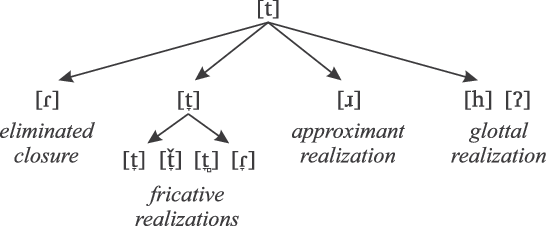
Based on this discussion, we may therefore propose an enhanced typology of the weakening of Irish English /t/ (see Table 1 above). This proposal is shown in Figure 14 (note that the figure only shows lenition in the form of substitution and not elision). In the flap [ɾ], the full-fledged alveolar closure of [t] is replaced by a ballistic tongue movement against the alveolar ridge. All the fricative realizations are best conceptualized as variants of slit-T [t̞], since there does not seem to be any difference in terms of their distribution. The modification of the ‘primary’ slit-T thus may involve voicing as a further step in the lenition process [ť̞] (see above), the fricative flap [ɾ̞] whereby a brief closure is created during the fricative articulation, or (rarely) laminal rather than apical articulation [t̞ ̻]. The realization of /t/ by the approximant [ɹ] (the T-to-R change) constitutes a lenition which involves the loss of obstruent articulation; this substitution was not found in our data, presumably due to lexical and stylistic factors (see Section 1.1), as well as the socioeconomic status of the speakers analyzed here. Finally, the glottal realizations involve the loss of lingual articulation altogether (also referred to as debuccalization), resulting either in a fricative [h] (which occurred quite rarely in our data) or in a glottal stop [ʔ], the so-called T-glottalling. Generally, the proposed typology is in agreement with the lenition hierarchy described by Gurevich (Reference Gurevich, Marc, Ewen, Hume and Keren2011).
Phonetic realizations of weakened /t/ in Southern Irish English.

From a broader perspective, our data seem to support Kingston’s (Reference Kingston, Laura and Jeffrey2008) proposal that lenition concerns greater acoustic and perceptual continuity within larger prosodic units (in other words, lenition reduces the extent to which a consonant – a complete stop, in our case – interrupts the flow of speech). Indeed, this is the case for all of the weakened variants of /t/ documented in this study as well as in literature. The argument undoubtedly holds for the fricative and approximant realizations (where the former also includes [h]). While the glottal stop may, with its articulatory closure, be regarded as contradicting the argument, one should keep in mind that glottalization is frequently realized, rather than as a complete glottal closure, as (more or less continuous) creaky voice (Docherty & Foulkes Reference Docherty and Paul1999, Ashby & Przedlacka Reference Ashby and Joanna2014); based on informal observations, creaky realizations were not exceptional in our data. Even many glottalized realizations of /t/ may thus be considered as facilitating acoustic and perceptual continuity.
To conclude, the alveolar plosive /t/ and its realizations throughout the English-speaking world are likely to continue fascinating experts and laypersons alike. This sound may be substituted by a number of phonetically diverse sounds – from affricated sounds and lingual fricatives to approximants and sounds which involve no lingual articulation at all. Many of these occur in Irish English, and it is our hope that this paper has demonstrated hitherto unidentified phonetic details especially in the fricative realization of /t/ in this variety of English.
Acknowledgements
This study was supported from European Regional Development Fund-Project Creativity and Adaptability as Conditions of the Success of Europe in an Interrelated World (No. CZ.02.1.01/0.0/0.0/16 019/0000734). The authors would also like to thank Peter Dooley from the University of Limerick for his assistance during recording acquisition, as well as the anonymous reviewers for their helpful suggestions.