

Introduction
The neo-liberal agendas reinforced by the Washington Consensus emphasised less role of the state in welfare provisioning, so the importance of social protection as a policy to reduce poverty and vulnerability was less during the 1990s and early 2000s (Cook & Kabeer, Reference Cook, Kabeer, Cook and Kabeer2011). The financial crisis of 2007 increased poverty across many countries, forcing governments and international donor agencies to rethink their welfare policies (Deacon, Reference Deacon2013). After the crisis, social protection emerged as a dominant policy agenda to address poverty and proliferate rapidly in terms of policy response (Desai & Rudra, Reference Desai and Rudra2019; Devereux, Reference Devereux2016). The expansion of social protection in developing countries can be attributed to factors like worsening income inequality, the potential threat of social unrest, and to tackle old-age poverty (Nikolov & Bonci, Reference Nikolov and Bonci2020). However, considerable variability in social spending across developing countries can be observed, and the poorest tend to be better off in countries that spend more on social protection as a percentage of GDP (Margitic & Ravallion, Reference Margitic and Ravallion2019).
Countries in the global south face issues such as weak fiscal resources and limited institutional capacity to manage social protection programmes, which reduces the coverage of social protection programmes and limits their effectiveness (Mumtaz & Whiteford, Reference Mumtaz and Whiteford2017). Consequently, in many countries of the global south, informal networks, such as religious organisations, extended family, friends, communities, and non-governmental organisations (NGOs; local and international) are assisting a sizeable segment of the neglected poor population through informal social protection. Some major sources of informal social protection, as discussed in the literature, include informal networks, kin and non-kinship relations, community support mechanisms, the support provided by NGOs and religious organisations (Bilecen & Sienkiewicz, Reference Bilecen and Sienkiewicz2015; Mohanty, Reference Mohanty2012; Mumtaz, Reference Mumtaz2021).Footnote 1 Despite being a major source of welfare in the global south, few studies have been undertaken to determine the usefulness of informal social protection provided by religious institutions to households. In addition, comparing and evaluating the usefulness of informal social protection vis-a-viz formal social protection at the household level in a developing country context remains an under researched field. Therefore, in this exploratory study (Brink & Wood, Reference Brink and Wood1998; Stebbins, Reference Stebbins2001),Footnote 2 we will compare formal and informal social protection through utilising a case study of informal social protection received by poor and vulnerable households through religious institutions such as madrassas in a lower-income country such as Pakistan. We will explore questions that in a lower-income country, like Pakistan, what form of social protection, i.e. formal or informal, as provided by madrassas, is found to be more useful by the poor and vulnerable households, and why and which form of social protection is more accessible to them.
The article is structured as follows; (1) Section 2 provides a brief review of the literature on formal and informal social protection (2) Section 3 develops a framework for comparing formal and informal social protection; (3) Section 4 provides an overview of social protection in Pakistan, including a discussion of welfare support provided by the madrassas; (4) Section 5 discusses research design, methodology and ethical considerations regarding data collection, and then discusses the results and limitations of the study; (5) Section 6 presents the conclusions and their policy implications and identifies the scope for future research.
Formal and informal social protection
The purpose of the following discussion (Hart, Reference Hart2018, p. 31) is to distinguish previous research undertaken on formal and informal social protection from what is done in this study. This methodology will be useful in the identification of gaps in the existing literature on the relationship between formal and informal social protection.
Formal social protection
Formal social protection has been defined extensively and variously in the literature by scholars as well as by international donor agencies. As a starting point, we use the influential approach adopted by the World Bank more than two decades ago (Holzmann & Jorgensen,Reference Holzmann and Jorgensen1999, p. 1008) that defines social protection as
“The set of public interventions aimed at supporting the poorer and more vulnerable members of society, as well as helping individuals, families and communities to improve their risk administration.”
According to the World Bank (2015), social protection has three broad components: (1) social assistance that includes public non-contributory transfers aimed at reducing poverty and vulnerability; (2) social insurance, including health insurance and pensions, for providing support during risks and shocks; and (3) labour market measures for skill training and safeguarding decent working conditions.Footnote 3 To analyse the extensive literature on the global south’s social protection, three major themes were identified. The literature in the first theme explains the role, purpose and use of social protection. The second theme centres on analysing social protection programmes to evaluate their effectiveness, and the literature in the third theme is critical of formal social protection.
The first theme relates to the role, purpose, and usage of social protection.Barrientos and Hulme (Reference Barrientos, Hulme, Barrientos and Hulme2008) argue that the poor are most vulnerable to risks and lack appropriate risk management measures, constraining their ability to engage in activities that can help them move out of poverty. The idea of social protection is grounded in social risk management aimed to prevent individuals from falling into poverty, protect them from shocks, and help them in building human capital (Holzmann & Jorgensen, Reference Holzmann and Jorgensen1999). Social protection can contribute to poverty reduction, empower marginalised people and be socially transformative (Devereux & Sabates-Wheeler, Reference Devereux and Sabates-Wheeler2004). Social protection mechanisms such as social insurance and labour market measures allow workers to make investments and upgrade their skills because they have confidence derived from secure income and employment that eventually increases their productivity (Estevez-Abe, Iversen, & Soskice, Reference Estevez-Abe, Iversen, Soskice, Peter and David2001; Osabohien et al., Reference Osabohien, Onanuga, Aderounmu, Matthew and Osabuohien2020). In the wake of the COVID-19 pandemic, governments can use existing social protection programmes to identify and assist vulnerable groups who are otherwise harder to reach (Gerard, Imbert, & Orkin, Reference Gerard, Imbert and Orkin2020).
The literature on the second theme relates to the implementation and evaluation of social protection programmes. For example, Hidrobo et al. (Reference Hidrobo, Hoddinott, Kumar and Olivier2018) conducted a meta-analysis of social protection programmes. They found that social protection improves the quantity and quality of food consumed by beneficiaries, and the magnitudes of the effect sizes are meaningful. Miller and Tsoka (Reference Miller and Tsoka2012) examined the impact of monthly cash grants targeted on ultra‐poor households designed to reduce poverty and found that cash transfers to poor households had a positive impact on reducing poverty. Molina-Millan et al. (Reference Molina-Millan, Barham, Macours, Maluccio and Stampini2016) reviewed the long-term impact of conditional cash transfers programmes in Latin America and found these programmes had a positive effect on improving the educational outcomes and incomes of beneficiary households.
The third strand of this literature is more critical of social protection. Tanzi (Reference Tanzi2002) argues that social protection programmes in the global south face coverage challenges, which result in the exclusion of deserving people from attaining the benefits of these schemes. Pal et al. (Reference Pal, Behrendt, Leger, Cichon and Hagemejer2005) argue that international assistance is essential for the success of social protection programmes in low-income countries because they do not have the financial capacity to fund such programmes. Monchuk (Reference Monchuk2014), in contrast, argues that social protection schemes are poorly targeted, resulting in low coverage of the poor relative to the size of the poor population. Kidd (Reference Kidd2017) argues that social protection schemes’ ineffectiveness can be attributed to institutional weaknesses in the identification and registration of beneficiaries, the payment of transfers, and enforcement of conditions.
Informal social protection
The analysis of informal social protection mechanisms is more related to disciplines such as anthropology and sociology rather than to economic analysis or studies of political institutions. It has been explained in terms of informal risk sharing measures, social networks, community groups, family, kin and non-kinship relations, and NGOs (Oduro, Reference Oduro2010). The existing literature on informal social protection provides some broad categories and sources of informal social protection. For example, Calder and Tanhchareun (Reference Calder and Tanhchareun2014) identified three broad categories of informal social protection: (1) sharing and helping between immediate, extended family and friends; (2) informal cooperation and mutual assistance aimed at production and livelihood practices and (3) kinship-based networks to support during major life transitions and crises. Stavropoulou et al. (Reference Stavropoulou, Holmes and Jones2017) identified four important mechanisms through which informal social protection is provided: (1) collective rules and mechanisms, such as lending livestock to poor households; (2) reciprocity networks or gift exchange arrangements, such as sharing food with another household and loaning out agricultural tools; (3) semi-formal support mechanisms, such as burial societies and rotating savings and credit associations (ROSCAs)Footnote 4 and (4) the support provided by religious organisations in the shape of provision of food, temporary shelter and other welfare services.
One of the important sources of informal welfare mentioned in the literature are religious organisations such as churches, Buddhist temples, and madrassas (Mumtaz, Reference Mumtaz2021). Such institutions not only provide cash or in-kind assistance to meet the consumption needs but also participate in risk management and labour market support. For example, churches from preindustrial Europe till now are helping poor households by providing them with cash and in-kind assistance for meeting their consumption needs (Van Leeuwen, Reference Van Leeuwen1994; Van Kersbergen & Manow, Reference Van Kersbergen, Manow, Castles, Leibfried, Lewis, Obinger and Pierson2010). Similarly, Buddhist temples traditionally offer food and temporary shelter to the poor and needy in Southeast Asia (Stavropoulou et al., Reference Stavropoulou, Holmes and Jones2017). In most Islamic countries, madrassas are present on a vast scale, mostly run-on private charities, and they support the needy by providing them with cash or in-kind assistance in addition to teaching (Butt, Reference Butt2012). Religious organisations in many countries also support the vulnerable during emergencies (Agadjanian & Sen, Reference Agadjanian and Sen2007). For example, during the 2004 tsunami emergency in Indonesia, religious organisations were among the first to respond to the immediate humanitarian needs of affected people long before international organisations were able to provide relief assistance (Ferris, Reference Ferris2005). These institutions are also active in public health campaigns to provide free healthcare services to manage health risks (Haakenstad et al., Reference Haakenstad, Johnson, Graves, Olivier, Duff and Dieleman2015). In Pakistan, religious organisations provide health care facilities to students studying in madrassas (Minhaj-ul-Quran, 2018). Religious organisations are also instrumental in providing skill training helpful for unskilled people to get a job or start a small business. For example, religious organisations impart skill training helpful for acquiring a job in many African countries (Dimelu et al., Reference Dimelu, Salua and Igbokwe2013). In Nairobi, religious organisations provide skill-training programmes for homeless youth to improve their skills for the job market (Ferguson et al., Reference Ferguson, Dortzbach, Dyrness, Dabir and Spruijt-Metz2008).
The findings of this literature can be summarised as follows: (1) a key difference between these two forms of social protection is that formal social protection is publicly provided and regulated by the state, whereas informal social protection is informally privately provided (contributory or non-contributory) with almost little or no regulation by the stateFootnote 5 ; (2) an essential mechanism of informal social protection are religious organisations present alongside formal social protection and are meeting the welfare needs, such as assisting in cash or in-kind transfers for fulfilling the consumption needs, managing risks through the provision of health services, support for burial, and labour market measures through skill training of the poor and vulnerable population and (3) determining the usefulness of informal social protection vis-a-vis formal social protection and investigating the accessibility of former by the poor and vulnerable population at a country level remains an under-researched area. In the next section, we utilise the framework provided by Mumtaz (Reference Mumtaz2021) to compare formal social protection with informal social protection for determining the usefulness and accessibility of the latter.
Framework for comparing formal and informal social protection
In order to undertake a meaningful comparison between formal and informal social protection, it is essential to define informal social protection into similar attributes to that of formal social protection. Therefore, we use Mumtaz (Reference Mumtaz2021) conceptualisation of informal social protection that defines informal social protection as:
“The set of informal private interventions by the family (extended and immediate), religious organizations, NGOs (local and international) and neighbourhood, friends, and village communities aimed not only for supporting the poor and more vulnerable members of the family for meeting their basic needs but also helping them to improve their risk administration and assisting them towards building their human capital by acquiring skill or technical training.”
This definition not only identifies the mechanisms of informal social protection, such as extended family friends and community members, religious organisations and NGOs but also highlights their role in providing informal assistance for supporting the poor to meet their basic consumption needs; informal insurance aimed at improving risk management and labour market measures for building human capital. The three components of informal social protection, i.e. informal assistance, informal insurance and informal labour market measures, mirror the three components of formal social protection identified by the World Bank (2015) and explained in the previous section. The purpose of doing this is to compare formal social assistance with informal social assistance, formal insurance with informal social insurance, formal labour markets interventions with informal labour market interventions, overall usefulness of formal and informal social protection and measure them in similar terms. This methodology was used to devise a survey questionnaire to compare and measure formal and informal social assistance in terms of meeting the consumption needs of households; formal and informal insurance was measured in terms of its usefulness in managing risks and shocks, such as health and periods of unemployment; formal and informal labour market interventions were measured in terms of their usefulness in getting a job. Before explaining the methodology of data collection for the study, it is important to provide a brief overview of the scope of social protection in Pakistan, where this study was conducted.
Overview of social protection in Pakistan
With a population of over 220 million people, Pakistan is one of the most populous countries in the world (The World Bank, 2021). The country has one of the lowest welfare outcomes in South Asia with around 39 per cent of the population is poor as per multi-dimensional poverty index (MPI), United Nations Development Programme (UNDP), Human Development Index (HDI), ranking in 2018 was 152 out of 189 countries, child mortality below the age of 5 years is 69 per 1,000 births; malnutrition, stunting and wasting under the age of five children in 2017 was 20.5, 37.6 and 7.1 per cent, respectively; chronic and infectious diseases such as hepatitis, polio, tuberculosis, malaria and HIV/AIDS are common in some parts of the country and literacy rate was estimated at 62.3 per cent in 2018, and only 35.3 per cent of the population was using safe drinking water in 2017 (ADB, 2021; Ministry of Finance, 2021; The World Bank, 2021; UNDP, 2016).
Prior to the formulation of the national social protection strategy in 2007, two forms of social protection programmes existed in Pakistan, and these were marked by significant problems (Khan & Qutub, Reference Khan and Qutub2010). The first category of programmes included the employee social security schemes, old age benefit institutions and the workers welfare fund were meant for formal sector employees and the retired labour force. These programmes did not provide coverage to the agricultural and informal sector workforce, comprising 67 per cent of the total labour force (Mumtaz & Whiteford, Reference Mumtaz and Whiteford2017). The second category designed to cover the extremely poor and vulnerable consists of cash assistance programmes, such as Zakat, Pakistan Bait-ul-Mal and various public works programmes. Both categories of programmes were fragmented, their budgets never increased more than 0.5 per cent of GDP and had little known or discernible impact on poverty (Mumtaz & Whiteford, Reference Mumtaz and Whiteford2017).
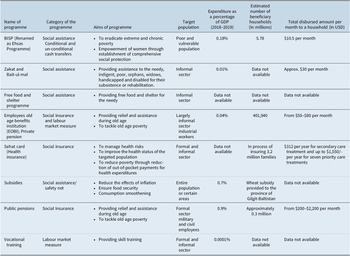
In 2007, with the assistance of the World Bank, the national social protection strategy was formulated, and Benazir’s income support programme (BISP, renamed as Ehsas Programme): the largest social protection programme in Pakistan’s history, aimed at safeguarding the vulnerable population against transient and chronic poverty, and improving the income package to the poor for increasing their consumption, was launched. Despite being the flagship social protection programme in the country designed to target the impoverished and vulnerable population, the total expenditure on BISP never exceeded more than 0.2 per cent of the GDP (including the administrative costs) till now. In addition, several other public social protection programmes are running in the country, including Zakat and Bait-ul-Mal, Sehat card (health insurance), public pensions, employees old age benefits (private pension scheme) and vocational training programmes (Further details are provided in Table 1).
Social protection in Pakistan.

Data for free food and shelter (langar and panagah) and youth loan is not available.
Abbreviation: BISP, Benazir’s income support programme.
Source: Compiled from Ministry of Finance (2021).
Total expenditure on social protection in Pakistan, excluding health and education, is less than 2% of the GDP, and this low level of expenditure is also not well targeted (Table 1). For example, the defined benefit public pension system that caters only for formal public sector retired judicial, military and civil officers and staff amount to about 0.9 per cent of the GDP that is the highest social protection spending in the country on any sector (Ministry of Finance, 2021 and Table 1). Judicial, military and formal public sector officers also benefit from in-service perks such as high salaries, free housing, health insurance, travel allowances, paid sick leave, study and maternity leave, free transport, and other facilities such as free drivers, gardeners, cooks, washermen and so on that take a heavy toll on budgetary expenditure. This indicates approximately 1.1 per cent of GDP’s expenditure is targeted towards 65 per cent of Pakistan’s population employed in the informal sector of the economy (Table 1). These factors of low social spending, poor targeting of social protection programmes and the high share of spending on small formal sector serving and retired judicial, military and civil officers lead not only to the low coverage of the poor and vulnerable population but also contribute to the poor social outcomes in the country. These factors, to an extent, contribute to the growth of informal welfare mechanisms, such as extended family, religious organisations, local and international NGOs, on which the poorest and vulnerable rely in times of need.
The religious educational institutions in Pakistan are commonly known as “madrassas”, and they or their predecessors date back to the earliest period of Islam. At the time of independence in 1947, there were only 137 madrassas in Pakistan. In the early 1990s, this number increased, and the estimated madrassas in the province of Punjab were more than 2,500 (Zaman, Reference Zaman1999).Footnote 6 In 2015, an estimated 3.5 million students were enrolled in 35,337 madrassas registered with the Ittehad-e-Tanzeemat-e-Madaris-e-Deeniya PakistanFootnote 7 (Khalil, Reference Khalil2015). There are also many madrassas operating in Pakistan that are not registered with the federal government’s Ministry of Religious Affairs.Footnote 8 Hence, their accurate figures are difficult to predict. Apart from imparting free religious education, madrassas are also an important source of informal welfare in Pakistan. Largely poor and vulnerable households send their children to madrassasFootnote 9 (Butt, Reference Butt2012). Various benefits such as shelter (boarding facilities), meals, monthly stipends for deserving students, conducting marriage ceremonies, burial expenses, financial assistance for health care for its students and technical education in some cases is provided by madrassas (Minhaj-ul-Quran, 2018).
The enrolment in individual madrassas is quite substantial, for example Jamia Ashrafia is a madrassa in Lahore district of Punjab province has over 3000 day scholars and boarders who are provided with daily meals.Footnote 10 This madrassa has a large residential campus that can accommodate over 1,000 boarders and has its own health facilities. The madrassas also provide support to poor families during festive seasons such as during Ramadan and Eid. One of the main functions of this madrassa is to provide masters and graduate degrees in Islamic education and in Arabic to its students; this helps them to become leaders of a mosque or teachers of Islamic education in a school or college. Expertise in Arabic is also useful in getting employment in Gulf countries. In addition, the madrassa also provides technical training to its students, in addition to religious instruction. However, not all religious institutions provide such significant benefits, and madrassas especially in remote and poor areas may only impart religious education.
In most cases, madrassas are financially independent (Berkey, Reference Berkey2010) and are financed by Zakat and charity from private sources. The only regulatory control government exercise over the madrassas in Pakistan is to conduct examinations (Nizami et al., Reference Nizami, Hassan, Yasir, Rana and Minhas2018). The government does not exercise any control over these institutions when it comes to providing informal welfare. It is for these reasons that we have categorised madrassas as providers of informal social protection in Pakistan. In the following section, we will explain the research design, methodology of data collection and how ethical concerns regarding the study were managed.
Research design, methodology, data collection and ethical considerations
We have used an exploratory research methodology to answer the research questions. An exploratory research design is most useful when researchers have little or no knowledge of group processes, activity or situation that requires examination (Stebbins, Reference Stebbins2001; Swedberg, Reference Swedberg2020). The process of literature review provides the information that little or no work has been done on the issue under consideration and that an open-ended approach to data collection is therefore justified (Stebbins, Reference Stebbins2001). This research design is different from confirmatory research, where statistical treatment of data and hypothesis testing reigns supreme, while exploratory research aims to make generalisations or create hypotheses (Stebbins, Reference Stebbins2001). In exploratory research, researchers can conduct quantitative surveys, in addition to qualitative data gathering techniques, as part of their investigation (Stebbins, Reference Stebbins2001). The literature review of this paper has shown that comparison of formal vis-a-viz informal social protection to determine the usefulness and accessibility of latter remains unexplored territory. Therefore, an exploratory methodology will best suit to answer the research questions: what form of social protection, i.e. formal or informal, as provided by madrassas is found to be more useful by the poor and vulnerable households, and why, and which form of social protection is more accessible to them in a lower-income country, such as Pakistan.
There is no formal/public or private data source available in Pakistan or elsewhere containing the details of the poor and vulnerable households receiving informal social protection, and their identification was the biggest challenge of this study. We, therefore, examined various sources of informal welfare, such as remittances, community groups, family, kin and non-kinship networks, NGOs, and religious organisations prevalent in Pakistan, as identified in the literature. We searched the government and international organisations data base such as the Pakistan Bureau of Statistics, BISP, the World Bank, Asian Development Bank, UNDP and search engines such as Web of Science, Google Scholar, and Scopus for the identification of households who are recipients of informal welfare, and found no source contains such details. Although, various studiesFootnote 11 have used aggregate level government data of formal social protection, remittances and so on in their projects. In addition, informal sources of welfare, such as kin or non-kin networks, community networks, such as ROSCAs, are scattered and operate more privately, making it hard to locate such sources across the country. Therefore, we had chosen madrassas as our sampling strategy because (1) they are prevalent across the country; (2) they are one of the biggest providers of informal welfare in Pakistan, as discussed in the previous section; (3) largely poor and vulnerable households send their children to madrassas and (4) they contain the records of the families who sent their children to madrassas.
A multistage sampling methodology was used for the survey conducted in 14 cities of Pakistan as follows (Arnab, Reference Arnab2017; De Vaus, Reference De Vaus2014): In the first stage, all cities of Pakistan were divided into various clusters based on MPIFootnote 12 as follows: cluster 1 included cities with MPI of 1–10, cluster 2 included cities with MPI of 11–20, cluster 3 included cities with MPI 21–30 and so on. In the second stage, 1–2 cities were randomly selected from every cluster for the survey, and a total of 14 cities were randomly selected from 9 clusters.Footnote 13 In the third stage, from the list of madrassas present within each city,Footnote 14 a total of five to eight madrassas were randomly selected from each city.Footnote 15 In the fourth stage, the list of households that send their children to madrassas were obtained from each madrassa. From that list, 8–10 households were randomly selected, and 660 survey questionaries were handed over by the chief researcher to households. The same methodology was used for selecting participants for semi-structured interviews. A total of 90 semi-structured interviews were conducted in 14 cities, which allowed us to triangulate the survey data and was useful for an in-depth analysis.
As the study’s participants were vulnerable, therefore, necessary ethics approval was obtained from the University.Footnote 16 Ethical concerns were managed as follows: First, to avoid any psychological harm (Israel & Hay, Reference Israel and Hay2006), no children were interviewed for the study. Second, informed consent (Engel & Schutt, Reference Engel and Schutt2014) was obtained and ensured through providing an information sheet explaining the details of the study and in a case where the households were illiterate, a script was read aloud to them at the time of the distribution of the survey. It was explained in detail that completing the questionnaire would not provide them with any direct benefits. Third, there was a risk that participants may be deprived of the welfare they are receiving from the madrassas by answering the survey. This issue was addressed by maintaining the confidentiality and anonymity of the participants and avoiding questions in the questionnaire or interviews such as risk attached with receiving the madrassa welfare (Israel & Hay, Reference Israel and Hay2006). The primary researcher directly delivered the survey questionnaire to the households, and the heads of the madrassas were not informed about the identity of the participants. On the information sheet, it was mentioned their views would remain strictly confidential, and their names or addresses will not appear in surveys or any type of report or publication. This also reduced the element of potentially biased answers. The survey questionnaire was delivered to them in a stamped envelope with a return address written on it to also ensure the anonymity of the participants (Mangione, Reference Mangione1995). Finally, as many surveyed households were illiterate, therefore, to reduce the stress of filling the survey questionnaire, the primary researcher provided the option to fill the forms, and an adequate number of participants accepted the offer, which also increased the survey response rate.
The survey questionnaire for the data collection had two parts. The first part was designed to provide information about whether the surveyed households are poor and vulnerable or not. This part included questions to capture the socio-economic conditions, risks and shocks faced by households. The second part of the survey questionnaire was related to the formal and informal social protection received by households through various sources and whether they consider them useful or not. Informal social protection mechanisms included madrassas, extended family, friends or community, employer, landlord, remittances sent by immediate family members from overseas, local and international NGOs. Formal/public sources of welfare included public programme of Zakat/Bait-ul-mal, BISP, retirement pension (public and private), free public education, free technical education received from a government vocational training institute, free health treatment from a government dispensary or hospital, health insurance (Sehat card), youth loan and free food and shelter programme. The survey also included questions about the knowledge of various formal social protection programmes and whether participants of the study are receiving the benefits of those programmes or not.
Results and discussion
Socioeconomic conditions of the surveyed households
Reflecting the exploratory design of this research, the survey questionnaire had a substantial number of questions and yielded over two hundred variables. Five hundred and seventy households returned the survey questionnaire with the response rate of 85 per cent. The scale of measurement of the collected data was mainly categorical with only a few variables measured on an interval scale, limiting the presentation of results to percentages or averages only.Footnote 17 In addition, the purpose of this study is not to draw any causal inferences or to test any hypothesis therefore statistical significance tests were not used. We also used the data collected through semi-structured interviews to triangulate the results of the survey and in-depth analysis.
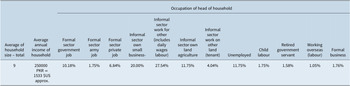
The results of the first part of the survey indicate that many of the surveyed households are extremely poor, with an average annual per capita income of $171 that is well below the national annual per capita income of $1,482 (Table A1 and The World Bank, 2020). The average surveyed household size is 9, and most are employed in low paid informal sector daily wages jobs such as street vendors, hawkers, and agriculture tenants. In some cases, child labour (1.75 per cent of the households had no adult as the head of the household) was prevalent that restricts their access to formal credit markets (Table A1). Formal insurance does not cover such forms of employment, and labour market measures, such as minimum wage and decent work conditions, are largely absent. In terms of living conditions, the average number of rooms in a house is two, and the living density is approximately five persons per room (Table A1b). In addition, approximately 48 per cent of households live in either a partially bricked, mud house or temporary shelter (Table A1b). 63 per cent of the households had no land holdings, and 18 per cent had less than one acre of land (Table A1c). Approximately 55 per cent of the households do not own any livestock or poultry. The households that own livestock or poultry mainly use it for domestic purposes, with only 6 per cent of the households using it for their work. (Table A1c). An overwhelming 79.9 per cent of households do not have bank accounts showing their non-accessibility to formal credit (Table A1c).
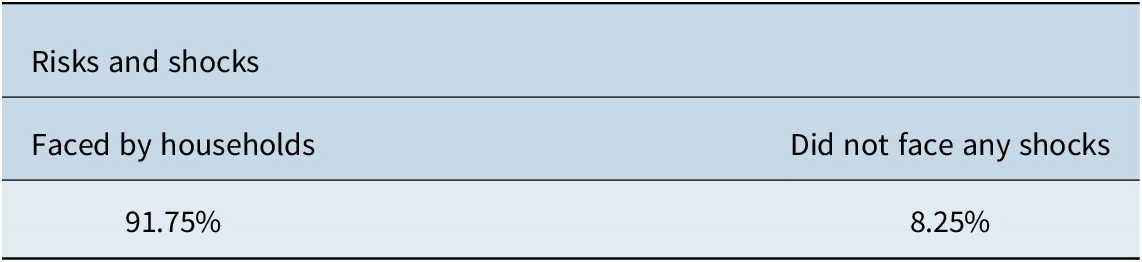
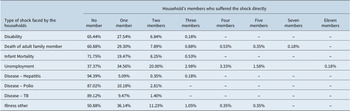
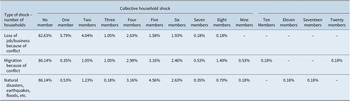
In terms of the risks and shocks, 91 per cent of households faced shocks such as disability, the death of an adult family member, resulting in loss of income, infant mortality, unemployment, diseases including Hepatitis, Polio, Tuberculosis and other kinds of illness hampering their ability to work (Table A1d,e). Unemployment, disability, infant mortality and death of an adult family member are the most common shocks faced by at least one member of the household (Table A1e). Diseases like Hepatitis, Polio, and Tuberculosis were also prevalent among the surveyed households (Table A1e). Several households also faced collective shocks, such as loss of job/business due to conflict, migration because of conflict, natural disasters, such as an earthquake or flood, resulting in loss of lives or assets etc. (Table A1f). For managing the risks and shocks, 19.6 per cent of households required no assistance, and only 1.9 per cent received government support (Table A1g). 3.1 per cent of the households sold their assets, 16.3 per cent of the households received support from the community, 20.7 per cent of the households received informal credit (loan) from the employer, landlord, friends or community, 8.07 per cent of the households resorted to informal insurance arrangement such as committee,Footnote 18 5.09 per cent of the households received help from immediate family member or relatives, 1.2 per cent of the households relied on their savings and 1.4 per cent of the households receive some sort of help from local and international NGO’s to manage the shocks (Table A1g). These poor socio-economic standards were further substantiated during the semi-structured interviews, as explained by one of the interviewees:
… “I am a brick kiln worker, and we are a family of eight. My wife and two children work with me because we must repay the loan of 100000 PKR ($800 US approximately) that we took from the owner of the kiln for my medical treatment of tuberculosis three years back. Whatever we earn, most of it goes for the repayment of the loan, and we are left with nothing to eat. I have sent two of my kids to a madrassa in another city, where they are fed, provided shelter, and given a monthly stipend. So, it is a big relief for me. We do not own any assets and live in a temporary shelter on someone’s else land.”
The socio-economic conditions of the surveyed households indicate multiple forms of deprivation and vulnerabilities faced by them. This sample is an accurate representation of the poor and neglected population of the country. The surveyed household’s average annual per capita income is much below the national per capita income, and many households do not hold substantial assets. Informal sector employment restricts their access to the formal credit market. Communicable and chronic diseases are also common among the surveyed households, and some live-in areas prone to natural and man-made disasters, such as conflicts. To manage the risks and shocks, the surveyed households relied mostly on informal sources, although their poor socio-economic conditions justified their need for formal welfare interventions by the state.
In the succeeding section, we will use the framework provided previously to compare the three components of formal social protection: social assistance, social insurance and labour markets measures with three components of informal social protection: informal assistance, informal insurance and informal labour market measures received through various sources by the surveyed households. Finally, we will compare the overall usefulness of formal social protection with the overall usefulness of informal social protection received by the beneficiary households.
Formal and informal social assistance
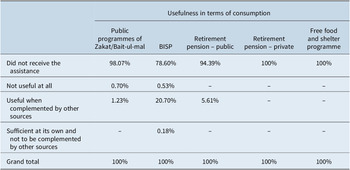
In the survey questionnaire, we measured formal and informal assistance in terms of its usefulness in meeting the consumption needs of households. Despite being extremely poor and vulnerable, most surveyed households are not receiving the benefits of formal social assistance programmes showing their inadequate coverage (Table 2). Only 21.4 per cent of households received the benefits of the country’s largest social assistance programme, BISP, and only 1.9 per cent of the households received the benefits of public programmes of Zakat/Bait-ul-mal. A small percentage (0.1 per cent) of the households considered assistance received by BISP useful on its own, and 20.7 per cent considered it useful when complemented by the other sources (Table 2) because monthly transfers received through such schemes are less, which hardly assist the households in fulfilling their consumption needs, as explained by one of the interviewees:
…. “I am a widow and I get approximately 4500 PKR (approximately 30 USD) on quarterly basis from BISP. I have to feed four kids, and the amount I receive is so little that I can hardly use it for buying consumption items of a week.”
Formal social assistance.

Abbreviation: BISP, Benazir’s income support programme.
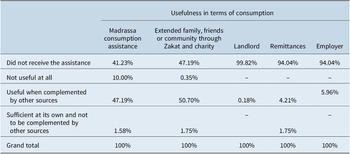
In contrast, the coverage and usefulness of consumption assistance received from informal sources were much higher (Table 3). 58.7 and 52.8 per cent of households received consumption assistance from madrassas, extended family, friends respectively. A total of 47.1 and 50.7 per cent of households considered consumption assistance received from madrassas and extended family and friends useful when complemented by other sources. We triangulated these results through semi-structured interviews, and found households consider informal consumption assistance useful because (1) extended family kin and non-kin networks, and madrassas have better knowledge of the deserving households in a community, and therefore can better target them; (2) assistance provided by informal sources in times of need is sufficient to fulfill the consumption needs and (3) there are no criteria which the households must fulfill to qualify to receive the assistance. One of the participants explained:
.…. “Few years back I suffered from stroke, because of which the right portion of my body got paralysed. I had to sell everything on my treatment and to fulfill my family expenditures. Now, I live in a small house of my relative and they do not charge any rent from me. I have sent my two kids to madrassa where they are provided with food shelter and clothing. The community of my village also helps me by providing wheat, rice and the Zakat money, but I did not receive any welfare from the government because three years back I had a shop and at that time I was not eligible for welfare benefits.”
Informal social assistance.

The results suggest three major inferences. First, the amount received by the surveyed households through the country’s flagship social protection programme, i.e. BISP, marginally fulfills the consumption needs of the households. Second, informal sources such as madrassas and extended family and friends not only better target but also fulfill the consumption needs of a large segment of the poor and vulnerable neglected population in Pakistan, considered useful by them vis-a-viz formal welfare sources (Tables 2 and 3). Last, households consider both formal and informal welfare more useful when complemented by other welfare sources (Tables 2 and 3).
Formal and informal insurance
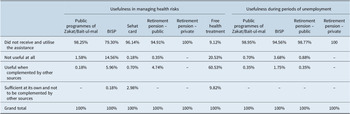
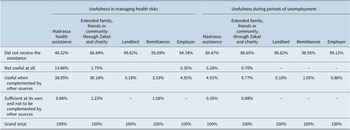
We have measured the usefulness of informal and formal insurance in terms of managing health and unemployment risks. Although the coverage of health insurance among these surveyed households is low (only 5.09 per cent), the households receiving the benefits of the health insurance scheme consider it useful because they can get the free treatment of their choice (public or private) up to a certain amount (Table 4 and participant interview). In terms of getting free treatment from government hospitals/dispensary, most households (90 per cent approximately) have access to such facilities, but 20.5 per cent of households consider such benefits not useful at all because conditions of government health facilities in rural and remote areas are depleted (Table 4 and participant interview). In addition, basic health centres in such areas had little or no medicines and doctors. Consequently, patients had to travel long distances for medical treatment, and in some cases, death occured enroute to the hospital (participant interview). It was noted that some households (20.7 per cent) are using the income received through social assistance schemes like BISP for managing the health risks, and 14.5 per cent considered it not useful at all (Table 4). However, various informal welfare sources are available to surveyed households to manage health risks which they consider useful, but their coverage is less than formal sources (Table 5). For example, 53.6 per cent of the households were receiving the benefits from madrassas to manage health risks. 38.9 per cent considered such benefits useful when complemented by other sources, and only 0.8 per cent of households consider it useful on their own.
Formal insurance.

Abbreviation: BISP, Benazir’s income support programme.
Informal insurance.

As there is no public unemployment insurance scheme in Pakistan, households utilised the income received through social assistance programmes to meet their needs during periods of unemployment (Table 4). The only social insurance schemes available to households are public and private pensions, normally catering for formal public and private sector employees. However, households consider the benefits of public pensions useful because the monthly transfers are substantial and provide an effective safety net for old age (Table 4 and participant interview). Comparatively, surveyed households received some benefits from informal sources during periods of unemployment. They considered them useful more than the formal sources because the assistance received was sufficient to bear the shock of unemployment (Table 5 and participant interview). More important among these sources are remittances and madrassas because timely assistance greatly reduces the effects of a shock (participant interview).
From the above discussion, the following inferences can be drawn; (1) various informal sources, such as madrassas, providing informal assistance, are also managing the health and unemployment risks of the surveyed households, although their coverage for managing health risks is lesser than the formal sources. However, the coverage is more in case of assistance provided during unemployment; (2) while the coverage of formal social insurance schemes, including health insurance and public pensions, is low, but their effectiveness is better than informal sources because generous monthly assistance is provided through these schemes (Tables 4 and 5) and (3) households consider assistance received during periods of unemployment from informal sources, such as madrassas, and remittances more useful because they are timely provided, better targeted, and the assistance received is sufficient to manage the effects of the shock.
Formal and informal labour markets
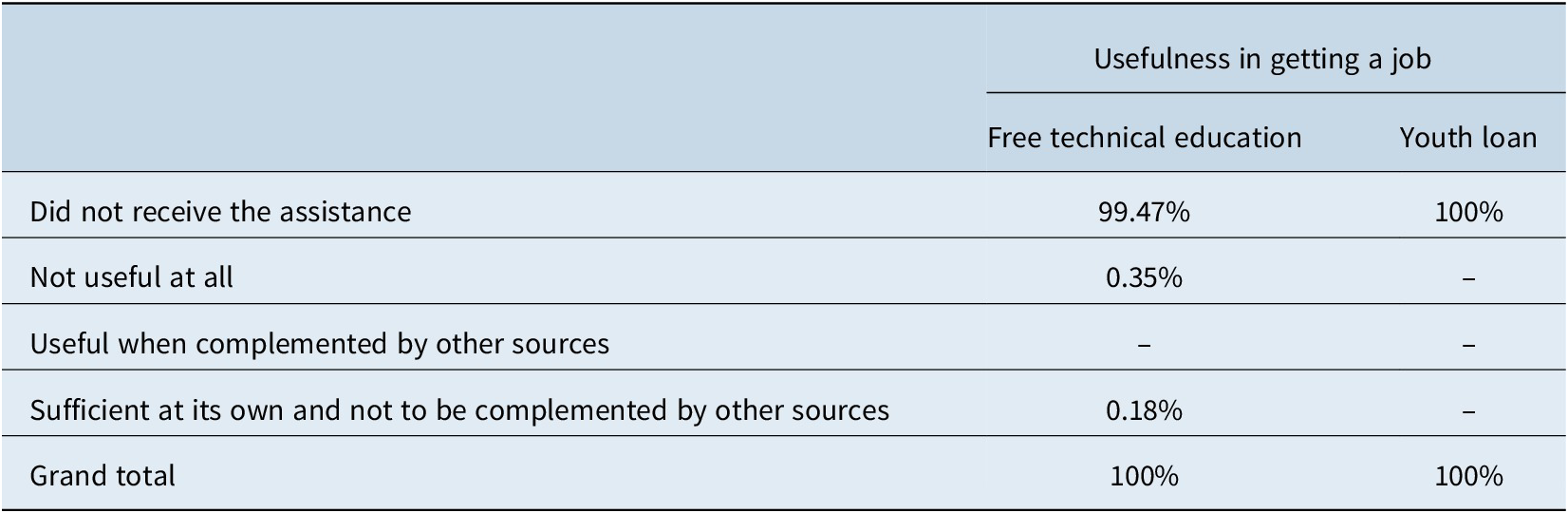
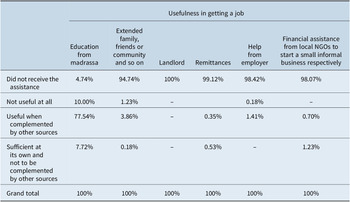
Formal and informal labour markets interventions were measured in terms of their usefulness in getting a job. Most households had little or no access to government labour market programmes (Table 6), while several informal sources available to the surveyed households were utilised by them, either in getting a job or starting a small business (Table 7). The two major sources of formal labour market assistance included free technical education and youth loans. Less than half of one per cent of the households were receiving the benefits of free public technical education and no household was the recipient of a youth loan (Table 6). Unsurprisingly, a very small percentage (0.18%) of the households considered formal free technical education as useful.
Formal labour markets measures.

Informal labour markets measures.

Abbreviation: NGO, non-governmental organisation.
Whereas approximately 86 per cent of households consider education received from madrassas as useful in getting a job (Table 7). The Arabic language and religious education provided in madrassas are useful for becoming mosque leaders and religious teachers and helped them in overseas employment in Gulf countries (participants interviews). Approximately 4, 0.7, 1.4 and 2 per cent of the households consider assistance of extended family, friends, community and so on remittances, employer and NGOs, respectively, as useful (Table 7). The presence of local NGOs is observed in disaster and conflict-prone areas, where they provided assistance in the form of small loans to the households for starting a small business after the crisis (participant interviews).
From this discussion, the following conclusions are drawn; (1) similar informal sources, such as madrassas, except for NGOs that provided social assistance and informal insurance to the surveyed households, also provide labour market measures. Most prominent among them are the madrassas that provide education to the households helpful for them in getting a job with the market; (2) informal sources of labour market measures are useful in getting a job or setting a small business, mostly in the informal sector of the economy and (3) coverage of informal labour market measures is substantially higher than the formal labour market measures.
The overall usefulness of formal and informal social protection
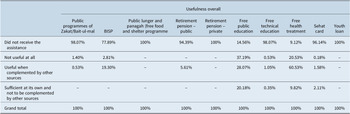
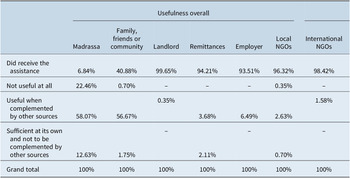
Lastly, we have compared the overall usefulness of formal social protection programmes with the overall usefulness of informal sources and found that the coverage of informal social protection is not only greater than formal social protection, but the households consider them to be more useful (Tables 8 and 9). The government operates several social protection programmes such as social insurance, social assistance and labour market measures (Table 8). It is important to note that the BISP is the largest social protection programme in the country, and its coverage among the surveyed households is only 21 per cent (Table 8). Only 19 per cent of the household considered the benefits of BISP useful only when complemented by the other sources, and no household considered its benefits useful on its own.
Overall usefulness of formal social protection.

Overall usefulness of informal social protection.

Abbreviation: NGO, non-governmental organisation.
However, the surveyed households consider the coverage and usefulness of informal sources much greater. For example, madrassas are providing various welfare benefits to approximately 93 per cent of the surveyed households. Approximately 70 per cent of the households considered these benefits useful when complemented by other sources, and 12.6 per cent of the household considered them useful on their own. Another benefit associated with informal social protection is households do not have to meet any bureaucratic eligibility criteria to receive that assistance (participant interviews). In addition, different kinds of informal sources are available within a community in times of need, whereas formal sources are present but hard to access (participant interviews). The discussion indicates (1) the coverage of informal social protection is much more than the formal social protection; (2) the beneficiary households do not have to meet any eligibility criteria to access informal social protection and (3) the coverage of madrassas is the highest among all informal sources, and most households considered their benefits useful.
As this is the first study at a country level where informal social protection is directly compared with formal social protection, there are several limitations of this paper. First, the scale of the measurement of collected survey data was categorical, which limited the use of any kind of statistical significance test on the data, but this was not the purpose of the study. Therefore, results are presented in percentages and averages. Second, informal social protection is considered useful by a majority of the surveyed households, but whether this form of social protection provides an effective pathway out of poverty? This is a question that has not been explored in this research. Last, this paper has not investigated the risk implications attached with formal and informal social protection.
Conclusions, policy implications and scope of future research
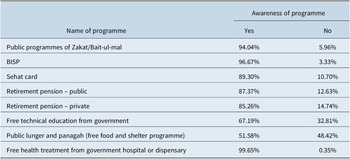
The data collected for the study shows that most of the surveyed households were eligible to receive the benefits of formal social protection programmes, but the results indicate that majority of them were not receiving these benefits, although they were aware of such programmes (Table A1h).
We conclude that in a lower income-country such as Pakistan, a large segment of the neglected poor and vulnerable population meet their welfare needs through informal social protection received through sources such as madrassas because the income benefits of formal social protection programmes are inadequate and their coverage is low. The certain eligibility criteria for formal social protection appears to be seen as limiting access to these programmes. The accurate targeting of the poor remains an unaddressed issue. In contrast, informal social protection is considered more useful by the beneficiary households because (1) it is provided on a timely basis in periods of need (reliability); (2) beneficiaries do not have to meet any bureaucratic eligibility criteria to receive the benefits (increased coverage and better identification/targeting); (3) the assistance received is sufficient to manage their risks and shocks (adequacy) and (4) various sources are available to beneficiaries, allowing them to use different options (flexibility). These factors contribute to making informal social protection more useful than formal social protection. Incorporating such strategies in social policy making will result in the better formulation and implementation of welfare policies for many other global south countries.
The dominant discourse in the literature suggests that social protection is considered an effective policy option for combatting poverty in developing countries (Barrientos & Hulme, Reference Barrientos, Hulme, Barrientos and Hulme2016; The World Bank, 2015). However, as observed in this study, the effectiveness of social protection programmes in a low-income country such as Pakistan is constrained by the poor financial situation of the country. This does not allow low-income countries adequate fiscal space to spend substantial amounts on social protection; this reduces not only the coverage of these programmes but also very little income is received by households. Such low transfers are not sufficient to help the poor to move out of poverty or build their human capital. However, we also observed that the benefits of social insurance schemes such as public pensions and health insurance are considered useful because their benefits are generous, but the coverage is very limited. Therefore, we conclude that any policy intervention directed towards poverty reduction needs to provide adequate support to households. In the face of fiscal constraints, this can lead to a trade-off between low coverage and enhanced income transfers.
We found that several programmes provide formal social protection through social assistance, social insurance and labour market measures (Table 1). As these programmes are administered separately, they incur substantial administrative costs. However, it was noticed that the benefits of one programme are utilised by the beneficiary households for the purpose it is not intended for (Tables 2, 4 and 6. In comparison, a single informal source such as madrassas are able to provide a range of benefits such as informal assistance, informal insurance and informal labour market measures (Tables 3, 5 and 7), and their benefits are considered more useful by the surveyed households. A possible policy implication of this is that instead of having several formal social protection programmes dealing with different issues and requiring substantial administrative costs, all the formal social protection programmes could be merged under the umbrella of one single administrative body to reduce administrative costs or provide more comprehensive support. This may not only decrease administrative costs, but could also be useful in facilitating the better integration of social protection strategies.This is particularly important for the countries of global south because the majority of such countries are faced with similar financial constraints (Akyüz, Reference Akyüz2013), as well as administrative issues that reduce the effectiveness of social protection programmes.
Another implication of this study is the need for better data on poor households and their use of informal social protection. This article has shown that no comprehensive data on poor households receiving informal welfare exist in Pakistan. We have presented a novel methodology where madrassas can be used as an important source to create data sets for future research. This methodology can be adopted by other studies or international organisations for building datasets where other sources of informal welfare exist.
The final implication of this exploratory study relates to the role of informal actors in the policy making processes of a country. We have found that welfare benefits provided by informal actors and institutions are considered useful by a large segment of the neglected population in Pakistan. In addition, these benefits are considered more useful by the households where there is a complementary mix of welfare from various sources. It can therefore be important to involve and integrate these informal actors and institutions in social policy making processes for improving the overall effectiveness of social protection within a country. How this integration can be achieved is a topic of future research.
Pakistan is classified as a less effective informal security regime in the social policy literature (Abu Sharkh & Gough, Reference Abu Sharkh and Gough2010; Wood & Gough, Reference Wood and Gough2006). Informal security regimes are characterised by institutional arrangements where people predominately meet their welfare needs by relying on community and family relationships (Cruz-Martínez, Reference Cruz-Martínez2019; Wood & Gough, Reference Wood and Gough2006). This institutional landscape provides some informal security, and poor people trade some short-term security in return for longer-term vulnerability and dependence (Wood & Gough, Reference Wood and Gough2006). The results of the study indicate that arrangements such as madrassas provide security and insurance to a large segment of poor and vulnerable population who have no other means of accessing formal welfare. However, the risks attached with this type of welfare, and whether this form of informal welfare creates long-term dependence and vulnerability in breeding extremist ideologiesFootnote 19 is a question not explored in this research. Based on the results of this survey, we can hypothesize madrassa welfare does not create long-term dependence and vulnerability that can be tested in future research.
As mentioned previously, Pakistan has seen a substantial increase in the growth of madrassas over the years. As argued by Van Kersbergen and Manow (Reference Van Kersbergen, Manow, Castles, Leibfried, Lewis, Obinger and Pierson2010), “We need further research on the hypothesis that the state’s retreat or structural weakness … created a social policy void in which Islamic charities and movements … have stepped in to provide the missing social services (including health care and education), (p.276). At this stage, our research cannot answer questions about the dynamics of madrassa development in Pakistan. However, it seems clear that madrassas in Pakistan are filling substantial gaps by providing informal social protection mechanisms.
Disclosure statements
No potential conflict of interest was reported by the authors.
Notes on contributors
Zahid Mumtaz, PhD candidate at the Crawford School of Public Policy, Australian National University, Canberra.
Peter Whiteford, Professor in the Crawford School of Public Policy at the Australian National University, Canberra.
Appendix: Surveyed cities and their MPI

Characteristics of households surveyed income and employment status.

Average per capita income per day of the surveyed households.

Assets.

Assets.

Risks and shocks.

Risks and shocks.

Abbreviation: TB, tuberculosis.
Risks and shocks.

Risks and shocks means to manage the risks and risks.

Abbreviation: NGO, non-governmental organisation.
Awareness of programmes.

Abbreviation: BISP, Benazir’s income support programme.