Recent studies cast doubt on long-standing beliefs about the pivotal roles particular countries, agreements, and institutions play in the evolution of world trade. Accominotti and Flandreau argue persuasively that nineteenth-century Britain did not actually merit its reputation as a free trade exemplar because it was only one among several states that liberalized unilaterally in the 1840s.Footnote 1 Nye concurs, arguing that French tariffs were lower than those of Britain at the time.Footnote 2 Accominotti and Flandreau also find that the much-heralded Cobden-Chevalier treaty did not precipitate the widespread tariff cuts long attributed to it.Footnote 3 Examining the postwar era, Rose finds that neither the General Arrangement on Tariffs and Trade (GATT) nor its successor, the World Trade Organization (WTO), raises trade between its members.Footnote 4
Traditional historical accounts typically claim that the trade blocs that arose in the wake of World War I and the Great Depression exerted strong negative effects on both trade and great-power cooperation. The fact that the blocs privileged trade between their members at the expense of trade between members and nonmembers, they argue, exacerbated the political tensions that eventually erupted into World War II. The question we address in this study is whether this interpretation is robust to rigorous empirical tests of the kind that have revealed the impotence of other equally salient interstate trade agreements. We find that it is not: the blocs made much less difference to trade than commonly assumed and the claim that they adversely affected political ties reverses the causal chain that linked them.
Using an original data set that includes 35,000 observations from fifty-four countries between 1919 and 1938, we show that most blocs did not actually influence trade flows at all. None of them raised trade between their members as a whole; indeed, some sought to preserve rather than expand their preexisting trade. Nor do we find any evidence of the infamous beggar-thy-neighbor effects long attributed to them—that is, none diverted trade to member states from nonmembers. To this extent, our work is consistent with recent skepticism about the utility of trade accords, as well as with the findings of two earlier empirical studies of the interwar era.Footnote 5
However, our results are not wholly consistent with the recently expressed skepticism. We find, for example, that two prominent blocs led to significant shifts in trade among their members. The Imperial Preference System (IPS) increased trade between London and its dominions but left trade between the dominions unchanged. The Reichsmark (RM) bloc maintained preexisting trade between Germany and smaller member states but sharply reduced trade between the latter.
The effects we report are endogenous to the politics of the era and, in particular, to the determination of the great-power hubs in both the IPS and the RM bloc to secure imports of essential goods in a world in which another war seemed all too imminent. The great-power politics that prevailed between the wars gave rise to the bloc system as a whole and to the composition and effects of the blocs. Political tensions between the great powers of the era also created a pattern of political-military alliances that would become notorious among students of international relations because of its patent inability to counter the rising Nazi threat. Trade between alliance members actually fell, because the security externalities it produced were negative rather than positive.
Thus, an accurate estimate of the determinants of trade requires taking politics explicitly into account. Politically powerful states can create agreements and institutions and implement them using rules of the game that have as their raison d'être the production of heterogeneous effects across their members. Neglecting the relevant politics can lead to efforts to assess the success of international accords in terms of the increase they produce in aggregate trade between their members. Doing so, however, takes at face value the proposition that the purpose of international institutions is to produce uniform effects across their members.Footnote 6
Trade and Currency Blocs
The genesis of the bloc system lies in the shifts in resources and in the distribution of power at home and abroad that World War I induced. As Rogowski observes, the war wrote “an abrupt and fiery coda to the preceding century's unremitting expansion of trade.”Footnote 7 It wreaked “havoc on global commodity and capital markets” and accelerated the dissolution of the Austro-Hungarian, Russian, and Ottoman Empires.Footnote 8 Findlay and O'Rourke concur: in their view, the war led to so many “changes that the history of the international economy over the succeeding twenty years can only be interpreted as a working out of the forces” it set in motion.Footnote 9
The transformed balance of power within countries politicized their pursuit of domestic economic stability. Under the gold standard, payments imbalances triggered changes in the money supply that restored stability both at home and abroad. Prewar elites viewed the associated changes in output and employment as the price of prosperity.Footnote 10 Widespread exchange-rate floating during the war, and the advent of different “political and social landscape[s]” after it, sparked intense struggles over the distribution of adjustment costs.Footnote 11 To reverse the intrusion of politics into the process and restore economic stability, governments returned to gold. But they set their rates at levels inconsistent with market values: Britain, Denmark, Norway, Sweden, and Switzerland set rates too high; Belgium, Czechoslovakia, France, and Poland set them too low.Footnote 12
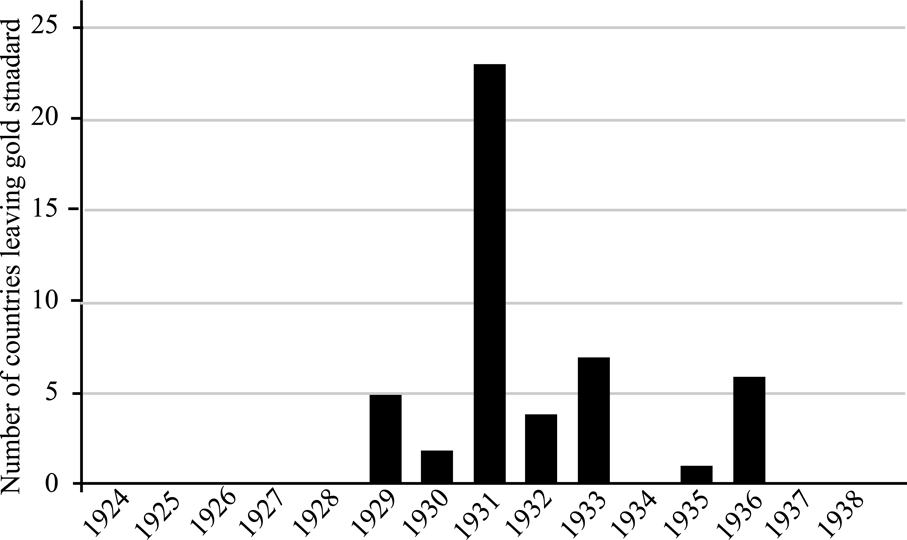
Remaining on gold became prohibitively costly for many states after 1929, when the constraints that fixed rates imposed on macroeconomic policy disabled the most effective defense nations had against the Great Depression. Most governments continued to hew to the prevailing wisdom that dictated spending cuts and higher taxes, refusing to rend their “golden fetters” even as the depression lengthened.Footnote 13 A coordinated reflation could have raised output and employment, but great-power conflicts of interest torpedoed any such effort: after 1918, the United States retreated into isolation, the Russians withdrew into autarky, the war debts and reparations imbroglio contributed to European and trans-Atlantic tensions, and Anglo-French conflicts over the future of Germany grew. In the end, payments deficits, capital flight, and bank failures forced an exodus from gold that began in 1929, but, as Figure 1 shows, gathered steam only in 1931.
Year countries left the gold standard

Existing political tensions meant that self-help would govern efforts to combat the effects of the Great Depression. Unable to agree on a global reflation, states sought to revive domestic demand by forming currency blocs to stabilize exchange rates among their closest trading partners. The gold bloc, as its name implies, consisted of countries that retained their pegs to gold until relatively late in the game and also abjured exchange controls.Footnote 14 Its members—Belgium, Italy, the Netherlands, Poland, and Switzerland—entered the bloc because their dominant trading partner, France, remained on gold. As other currencies depreciated, gold-bloc members added trade controls to defend their rates against a flood of cheap imports. Paris, for example, levied a 15 percent surcharge on imports and also adopted import quotas. The bloc dissolved when the left-wing French government left gold in 1936.Footnote 15
Germany and the small central and southeastern European countries also remained on gold longer than most. To maintain their pegs and protect themselves against the onslaught of cheap imports and foreign-currency shortages, states trading heavily with Berlin adopted strict foreign-exchange controls. They also signed bilateral clearing arrangements with each other. As in the case of their gold-bloc counterparts, states in the exchange-control bloc—Austria, Bulgaria, Czechoslovakia, Denmark, Germany, Greece, Hungary, Italy, Poland, Romania, and Turkey—adopted trade barriers to reduce pressure on their currency pegs.
In contrast, other countries opted out of gold several years earlier. Argentina, Australia, and New Zealand did so even before the European banking crisis set off the large capital outflows that led Britain to float the pound in September 1931. When London left gold, it precipitated a string of departures among countries that depended heavily on its market. Denmark, Egypt, Finland, Japan, Norway, Portugal, and Sweden pegged their currencies to and held their reserves largely in the pound, creating what became known as the sterling bloc.Footnote 16
As this makes clear, the various currency blocs had much in common. States in the gold, exchange-control, and sterling blocs each pegged to the currency of their single largest trading partner to remain competitive in its market. Otherwise, they risked a rise in their currency values in an era in which finding alternative export markets seemed destined to fail. As such, the currency blocs were endogenous to preexisting trade flows, more likely to preserve preexisting trading patterns than to create new ones. They were also likely to conform to the assumption of unit homogeneity—that is, they promised to produce uniform effects across their members.
In contrast, the trade blocs seemed much less likely either to maintain the status quo ex ante or to satisfy the assumption of unit homogeneity. Politics intruded much more deeply into the creation of the IPS and the RM bloc than into the construction of the currency blocs. Each of their great-power hubs had political interests that motivated them to tie the smaller spoke countries more tightly into their economic orbits, interests that bore the imprint of World War I and the all-too-likely prospects of another great war.
In Britain, the route to the IPS became navigable when the October 1931 general elections produced a historically unprecedented landslide that gave the Conservative Party a major victory. Its representatives took 470 of the coalition's 554 seats, enabling them to pursue their goal of tightening links between Britain and the Commonwealth countries.Footnote 17 They believed that a more integrated Commonwealth would enhance London's “political, diplomatic and even military status”Footnote 18 and help to ensure its supply of critical raw materials and food in the event of war.Footnote 19
Shortly after the election, Britain passed the Abnormal Importations Act, its first “full-fledged” tariff legislation.Footnote 20 The legislation empowered the Board of Trade to impose a 50 percent tariff on twenty-three types of goods.Footnote 21 The Import Duties Act that followed levied a 10 percent ad valorem tariff on imports other than basic foodstuffs and those shipped from the dominion and colonies.Footnote 22 While extending unconditional exemptions to its colonies, Britain made preferences for products from the dominions (South Africa, Canada, Australia, and New Zealand) and India conditional on the outcome of the next imperial economic conference.Footnote 23
Held at Ottawa, Canada, in July and August 1932, the conference attracted more than half of British cabinet officials. Hoping to preempt a Commonwealth drift “into the orbit of the United States or another large power,”Footnote 24 they were intent on increasing trade between London and the dominions and between the dominions themselves. Their attempt to induce higher trade between the dominions would founder, however, because each of them had raised trade barriers to spur infant-industry growth and because their relatively similar factor endowments meant that their exports tended to be substitutes rather than complements.
In the end, the dominions maintained the protection they had already extended to their home producers. They agreed, however, to raise their tariffs on the products of other countries while keeping their levies on British imports constant. Given their “fierce competition” to supply the British market and their “overlapping production,” none “wanted Britain to generalize concessions extended to a particular export from a particular dominion.”Footnote 25 The Ottawa conference, therefore, produced a “series of bilateral mutual agreements between Britain and the individual Dominions.”Footnote 26 As a result, any increase in IPS trade seemed more likely to occur between Britain and the dominions than between the dominions themselves.Footnote 27
An increase in trade between London and its dominions also seemed likely because the British political stake in securing Commonwealth unity induced London to concede more than it received in exchange.Footnote 28 London could have raised its tariffs against the dominions to exploit its “near-monopsonist position” in global meat, dairy, wheat, and timber markets, a position that the Great Depression had only enhanced. Instead, London opted to use bribes rather than to extract rents from the dominions.Footnote 29 Retaining its exemptions on their goods, it imposed new quotas on imports from other countries that competed with them and assured them access to any concessions it might later offer other states.Footnote 30 That Britain was aware of but chose not to exploit its market power in Ottawa is implied by the hard bargaining it engaged in during subsequent market-access negotiations with the Scandinavian countries and Argentina.Footnote 31
Its belief in the critical role of imperial preferences did not waver even as the approach of World War II made closer Anglo-American relations imperative. The importance London assigned to the IPS and “the delicate network of financial relations which held it together” led it to reject the U.S. demand to eliminate preferences.Footnote 32 The IPS supported the role of sterling in international exchange, giving London some hope of challenging U.S. primacy in world financial markets. Its privileged access to the dominions could also enable its industries to exploit the scale economies in production that had given U.S. goods an edge in global trade.Footnote 33 While improving its relations with the United States was also crucial, Britain recognized that this was a two-way street. As such, it could try to protect the IPS and retain its great-power status without endangering its relationship with Washington.
Politics played an equally dominant role in the creation and operation of the RM bloc. Pending the realization of lebensraum, the Nazi regime initiated an economic offensive to secure the supplies of food and raw materials it would require in the event of another war despite its turn toward autarky more generally. Its targets were the small central and southeastern European countries—Austria, Bulgaria, Czechoslovakia, Greece, Hungary, and Romania.Footnote 34 The disproportionately large fall in the prices of their primary products, their dependence on raw materials and semi-manufactured goods for most of their export earnings, and the sharp decline in their access to foreign capital after 1929 made them acutely vulnerable to Nazi overtures.Footnote 35 Absent any viable alternative, these states became reliable suppliers of “strategically necessary goods” to Berlin.Footnote 36
In the process, they obtained higher returns on their exports than they had previously received. Germany, anticipating a repetition of the World War I Royal Naval blockade,Footnote 37 offered 30 percent above prevailing market prices to lock the small central and southeastern European states into its economic orbit.Footnote 38 Berlin, like London, was a “monopolist in export markets and monopsonist in import markets.”Footnote 39 And, like London, it declined to use its market power to extract rents from its smaller trade partners. Instead, Germany traded off the real-income gains that would accrue to it from tariffs against the gains that it believed would accrue to it from its effort to bind countries politically to it. Nazi offers of “favorable trade relations”Footnote 40 were “but a prelude to political and military domination.”Footnote 41
Thus, politics played a much more important role in the IPS and RM blocs than in the currency blocs. And, as in the IPS, the creation of the RM bloc portended intrabloc shifts rather than an aggregate increase in trade—that is, unlike the currency blocs, it seemed very likely to generate heterogeneous effects across its members. The prices Berlin offered made trade between the spoke countries in the RM bloc much less profitable than was their trade with Nazi Germany.Footnote 42 Also as in the IPS case, intrabloc bargaining occurred on “a strictly bilateral basis” between Germany and each spoke state, and the bargains they struck involved exchanges of German manufactured goods for the raw materials and foodstuffs of the spoke states.Footnote 43 As in the IPS, almost all RM countries also pegged to the hub-country currency.
The Existing Literature
Much of the traditional historical literature argues that beggar-thy-neighbor policies motivated both the formation of the blocs and the trade they generated.Footnote 44 It also attributes to them the “severe breakdown in the multilateral trade and payments system” that occurred between the wars.Footnote 45 Many accounts also indict the blocs because they exacerbated the tensions among the great powers that would eventually erupt in World War II. Thus, Findlay and O'Rourke, for example, argue that “the breakdown of the interwar economic system was one important factor” that precipitated that war.Footnote 46
The consensus among historians is at odds with more recent analyses that test the impact of the blocs using available data. In their 1995 paper, Eichengreen and Irwin find that the blocs are endogenous to preexisting trade flows among their members, reflecting rather than increasing their trade. They also find that the blocs did not exert the beggar-thy-neighbor effects traditionally attributed to them.Footnote 47 Wolf and Ritschl, using more varied specifications and techniques, concur: they report that the blocs' effects on trade between members and other states never “even come close to significance.”Footnote 48 The authors of both papers use as their indicator of bloc efficacy the increase in aggregate trade between bloc members as a whole.
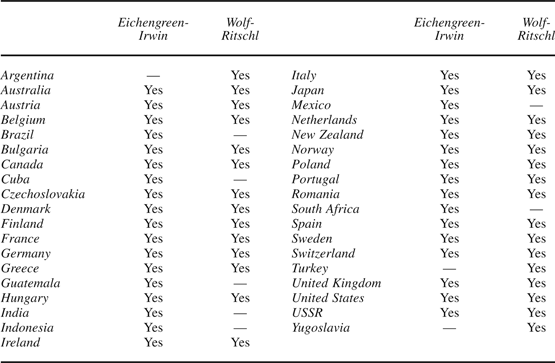
The difference between our conclusions and theirs is due partly to the fact that they rely on a small fraction of the observations in our data set. Using statistics compiled under the auspices of the League of Nations and recording two observations per country pair, Wolf and Ritschl analyze 870 observations in each of three years: 1928, 1935, and 1938. Their sample includes most European nations as well as Australia, Canada, New Zealand, Turkey, and the United States. Eichengreen and Irwin add seven countries to the Wolf and Ritschl sample—Brazil, Cuba, Guatemala, India, Indonesia, Mexico, and Japan—to examine between 360 and 435 observations from each of the same three years.
The methods both studies use to analyze their data also differ from each other as well as from ours. Eichengreen and Irwin estimate a gravity model in each of the three years in their analysis—1928, 1935, and 1938—using seemingly unrelated regressions (SUR) and controlling for exchange-rate variability. Wolf and Ritschl estimate difference-in-differences models and specifications that include group-specific, importer and exporter, and year fixed effects. They also use a technique that matches treatment and control countries according to their propensity to join a trade or a currency bloc.
Both studies also implicitly assume that the blocs would exert homogenous effects across their members. As Bagwell and Staiger argue, however, the value added of trade agreements inheres in their ability to resolve the prisoners' dilemma (PD) that states with market power confront.Footnote 49 Yet, in the case of the interwar trade institutions, only one state in each bloc could exercise market power broadly construed. As such, no bloc should have been expected to increase aggregate trade. In addition, some sought only to preserve their preexisting trade while others sought to raise trade among some but not all of their members. As such, they were unlikely to conform to the assumption of unit homogeneity that Eichengreen and Irwin and Wolf and Ritschl make. Rather, it seemed much more likely that the effects of the blocs, if they affected trade at all, would vary across their members.
Empirical Analysis
Data and Estimation
We used national historical yearbooks and League of Nations publications to construct our data set that includes about 35,000 observations on the trade of fifty-four countries between 1919 and 1938.Footnote 50 We add annual observations for the countries in the Wolf and Ritschl and Eichengreen and Irwin samples, and we record trade data for Chile, China, Colombia, Costa Rica, El Salvador, Honduras, Nicaragua, Paraguay, the Philippines, and Venezuela. The Appendix provides more information about the data.Footnote 51
We use the Global Financial DatabaseFootnote 52 to convert the trade data to U.S. dollars. It records daily or monthly information about exchange rates for most states as early as the 1800s.Footnote 53 We obtain average annual data by selecting the annual option and period average. For data on Costa Rica for 1919 and 1920, we use the Federal Reserve volume, Banking and Monetary Statistics, 1914–1944. When an inconsistency exists between the Global Financial Database and other sources, we substitute data from the Global Financial Database because it conforms more closely to trends evident in the data.
To estimate the determinants of interwar trade, we use the gravity-model specification that is the industry standard. The dependent variable is the log of the value of imports of one country from another in a given year. We include directed-dyad fixed effects to control for constant unmeasured country-pair attributes that can affect the propensity of particular nations to engage each other in trade.Footnote 54 This controls for the bias that endogeneity might otherwise create if, for example, countries selected into blocs as a function of their preexisting trade.Footnote 55 Dyadic variables that are constant across time—for example, distance and language—drop out of the analysis. In all estimations, we cluster the standard errors at the directed-dyad level to correct for serial correlation and heteroskedascity.
As recent theoretical work recommends, we also include importer-year and exporter-year dummy variables to control for time-varying factors that affect a nation's trade costs but are not observable.Footnote 56 These are proxies for country-level variables in any given year that can affect a nation's trade with all other countries but are not easily measured.Footnote 57 They control for annual changes in several standard gravity-model variables (for example, gross domestic product (GDP), per capita output, and population) and in exchange rates. Because these variables control for annual changes in a state's aggregate imports, they are perfectly collinear with the sum of trade creation and diversion. Thus, we cannot estimate these two effects simultaneously.Footnote 58 Instead, when we examine trade diversion, for example, we estimate only member-nonmember trade, using all covariates except the bloc indicators.
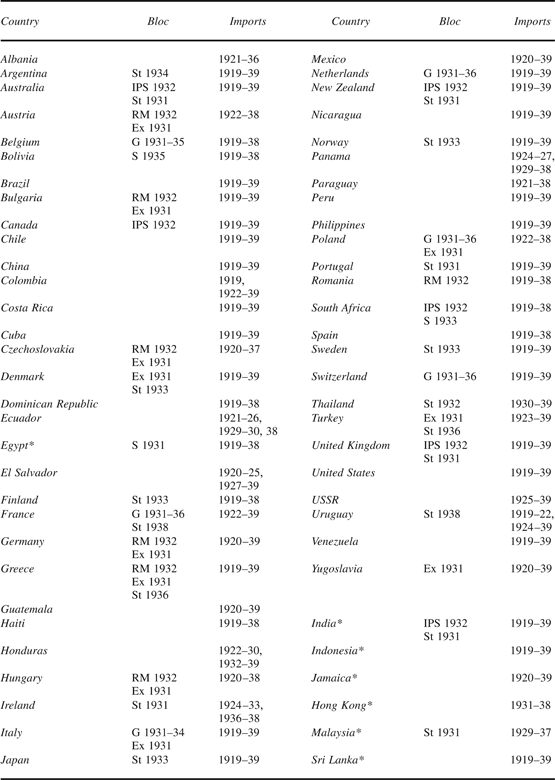
In the first specification, we control for membership in the gold, IPS, sterling, RM, and exchange-control blocs. As in earlier studies, we include both trade and currency blocs because, as we noted, currency blocs also adopted trade barriers that discriminated against goods from nonmember countries. Trade and currency-bloc membership also sometimes overlap, so omitting either can bias the estimates on the other. In our first analysis then, we include a variable that assigns a value of 1 to every dyad in every year that includes two countries that belong to the same bloc; it is 0 otherwise. Thus, for example, the IPS variable indicates all country-pairs in which both states belong to the IPS; it is 0 otherwise. Table A2 lists bloc entry dates and, where applicable, exit dates.Footnote 59
Finally, we control for two political variables that other studies have repeatedly shown affect bilateral trade in the post-1945 world but have not been included in earlier studies of the interwar era: joint democracy and alliances.Footnote 60 As is standard, we use the Polity IV data set to code regime types. It measures the extent of political participation, the competitiveness of executive recruitment, and constraints on executive autonomy.Footnote 61 Each government in the data set receives an annual score ranging between 0 and 10 on each of the democracy and autocracy scales. As in other studies, we measure democracy by subtracting a regime's score on the autocracy scale from its score on the democracy scale. Following the Polity IV project, we code a democratic dyad as existing if each of its members in a given year receives a score of at least 6.Footnote 62 About 16 percent of the observations in our sample include two democracies. Because of their relative affinity for open markets, two democracies are expected to trade more with each other than do other states.Footnote 63
The data set that Leeds and others assembled is our source for information about alliances.Footnote 64 It defines them as accords between “official representatives of at least two independent states … that include promises to aid a partner in the event of military conflict, to remain neutral in the event of conflict, to refrain from military conflict with one another, or to consult/cooperate in the event of international crises that create a potential for military conflict.”Footnote 65 We create a dichotomous variable to measure alliance effects. It assumes a value of 1 when countries in a dyad belong to a common alliance; it is 0 otherwise.
In analyses of post-1945 trade, the alliance coefficient is typically positive and significant. This finding has been attributed to the security externalities trade generates.Footnote 66 That is, a state is better off if it trades with its ally than with an adversary: trade increases an ally's income, increasing its potential power and therefore the power of the alliance as a whole. These externalities induce higher trade between allies on average.
Results
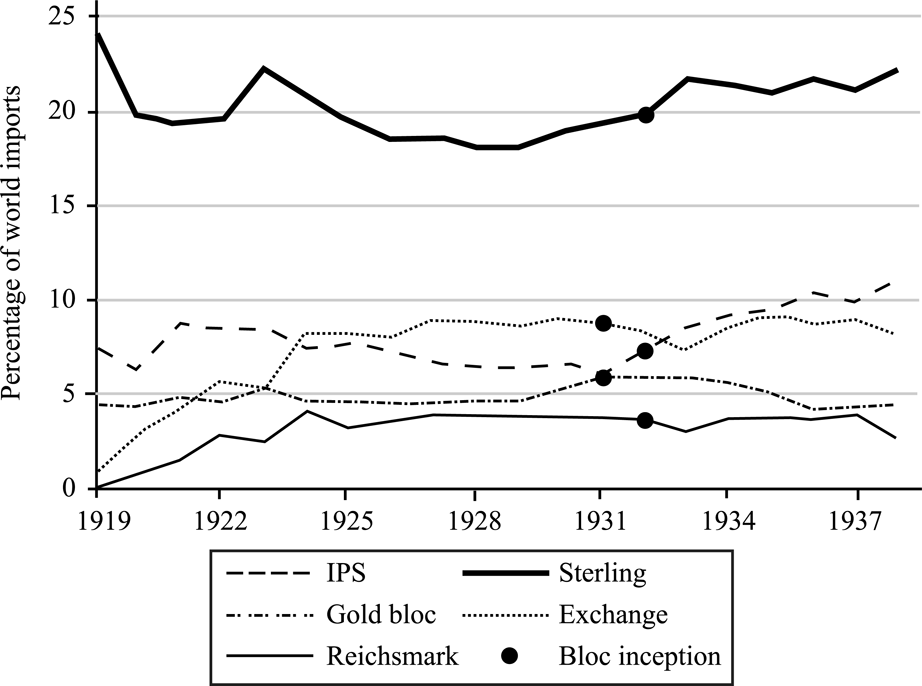
Our discussion of the results begins with a picture. Figure 2 graphs the percentage of world trade that each bloc accounts for in each year between 1919 and 1938. The dots indicate the year of bloc inception. The figure suggests that bloc effects are quite small. Trade within both the IPS and sterling bloc seems to rise slightly even before either takes effect. Figure 2 is only suggestive, of course, because it does not reflect the impact of other variables that affect trade.
Bloc imports as percent of total imports
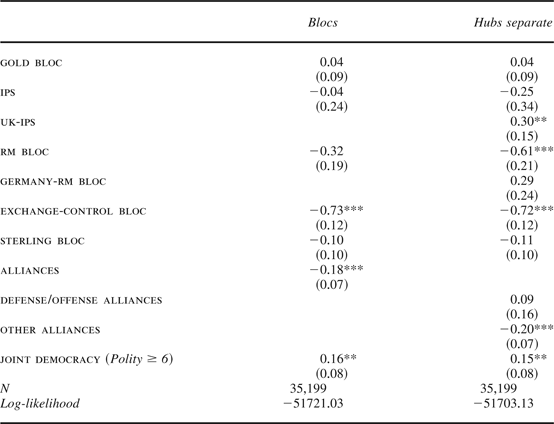
In Table 1, we present the results of estimating a specification that includes directed-dyad fixed effects and importer- and exporter-year dummy variables. The results in column (1) show that no bloc exerts a positive and significant effect on trade among its members as a whole. In the case of the gold and sterling blocs, this finding is consistent with the endogeneity that seems clear in historical accounts of the interwar system and that also emerges in the work of Eichengreen and Irwin and Wolf and Ritschl. However, trade between members of the exchange-control bloc falls by half (p-value ≤ .01), consistent with the autarkic policy the Nazi regime adopted.Footnote 67
Interwar trade
Notes: All models include the Latin Monetary Union (LMU), directed dyad, importer-year, and exporter-year fixed effects. The dependent variable in both cases is the log of imports. IPS = Imperial Preference System; RM = Reichsmark.
** p < .05;
*** p < .01.
The results in column (1) of Table 1 also show that politics do matter. They are consistent with findings about democratic dyads in the postwar era. Members of these country-pairs trade about 17 percent more with each other than do other states, a significant difference (p-value ≤ .05). This is not surprising: the coexistence of democracies and market economies makes trade at home and abroad more likely than it is elsewhere. In striking contrast to post-1945 analyses, however, the results in column (1) show that alliances exert a negative and significant impact on trade between their members: they trade about 16 percent less than do states in the base group (p-value ≤ .01).
For reasons we explained previously, the results in column (1) of Table 1 may not capture the determinants of interwar trade as precisely as possible. The politics that motivated the formation of both the IPS and RM blocs made a reorientation of trade along hub-and-spoke lines more likely than a wholesale increase in intrabloc trade. To examine whether trade shifted within the blocs, we create four sets of discrete variables: a dummy variable that takes on a value of 1 in cases in which IPS (RM-bloc) dyads include Britain (Germany) as a member and is 0 otherwise. We also create a variable that assumes a value of 1 in other cases of IPS (RM) dyads and is 0 otherwise. In accord with the interests of their great-power hubs, we expect that the coefficients on the variables distinguishing subsets within the blocs will have opposite signs.
Similarly, it seems inappropriate to assume that alliances exert uniform effects on trade between the wars. As we noted, the interwar era is unique among modern international systems because of the striking lack of commitment its security coalitions display. Rampant conflicts of interest made states reluctant to commit even on paper to aid each other in the event of war. They rendered futile, for example, French efforts to persuade either Britain or the United States to pledge to defend it against a German attack. While defense pacts account for about 67 percent of Cold War alliance observations, almost 85 percent of alliance dyad years between 1919 and 1938 consist of neutrality, nonaggression, or consultation pacts.
The literature that links alliances to trade assumes that capability aggregation motivates coalition formation, endowing their members with a stake in each other's welfare.Footnote 68 Yet, a rise in the income of a partner may not always make its ally better off. A nonaggression pact, for example, reflects a concern that in its absence one signatory might otherwise join in a third-party attack against another. This was certainly true of the 1939 Molotov-Ribbentrop agreement. In its absence, Berlin feared that the Soviet Union would not stand idly by when it attacked Poland. Berlin itself, of course, breached the agreement less than two years later. In this case and others like it, a state's welfare can vary inversely with its ally's income: if one ally seeks to deter another from attacking it, neither has an interest in increasing the other's income. The security externalities that trade between them produces, therefore, can be negative rather than positive.
In our next analysis, therefore, we disaggregate alliances. We include two dichotomous variables. The first assumes a value of 1 when countries in a dyad are members of a common defense or offense pact; it is 0 otherwise. A defense pact typically pledges each signatory to come to the aid of another in the event that a third party attacks it. Signatories of offense pacts, in contrast, “promise active military support in circumstances not precipitated by military attack on an alliance member.”Footnote 69 A second variable takes on a value of 1 when nonaggression, neutrality, or consultative agreements link states; it is 0 otherwise, including cases in which states belong to a common defense or offense pact. These agreements pledge their members to consult with each other in the event of a third-party attack and/or not to use a third-party attack as an invitation to pile on. We expect the coefficients on different types of alliances to diverge.
The results in column (2) of Table 1 show that it does make sense to abandon the assumption of unit homogeneity: disaggregating both trade blocs and alliances shows clearly that their effects vary across their members. The results show that intrabloc and cross-alliance effects differ. Trade between Britain and other IPS members increases by about 35 percent, a large and statistically significant shift (p-value = .05). IPS spoke-spoke trade, however, does not change as a result of bloc inception (p-value = .47). This difference reflects the bilateral agreements that Ottawa produced and the tariff concessions London extended to the dominions to secure the primary-product supplies it would require in the event of war. It also reflects the dominions' unwillingness to offer each other increased market access. The rise in trade between Britain and the Commonwealth countries also helps to explain the deep-seated U.S. opposition to the IPS: rising hub-spoke trade presumably substituted for U.S. exports of manufactures to the dominions and of primary products to Britain.
RM-bloc effects also vary among its members in accord with the political interests of its great-power hub. The above-market prices Berlin offered for spoke-state exports sustained hub-spoke trade in an era in which the autarkic policy Nazi Germany had adopted decreased its trade with exchange-bloc members. This result speaks to Berlin's anticipation of a second world war and its effort to insure itself against any future British embargo. It is not surprising, therefore, that the inception of the RM bloc opens a large and statistically significant gap between hub-spoke trade and spoke-spoke commerce (p-value ≤ .01): trade between the spokes themselves drops almost in half, but their trade with Berlin remains intact.
The results in column (2) of Table 1 also show that alliance effects vary. No significant relationship exists between trade and defense or offense pacts (p-value = .58) This is consistent with the fact that the successor states of the Austro-Hungarian Empire account for almost 25 percent of defense-dyad years yet adopted import-substituting industrialization policies that protected their markets against each other's exports. Most interwar alliances, however, actually reduce trade: signatories of nonaggression pacts, neutrality agreements, and ententes witness a fall of about 18 percent in their trade relative to other states, a significant decline (p-value ≤ .01). That alliance effects vary as a function of whether they seek to aggregate the power of their members or deter war between them shows that security externalities need not always be positive.
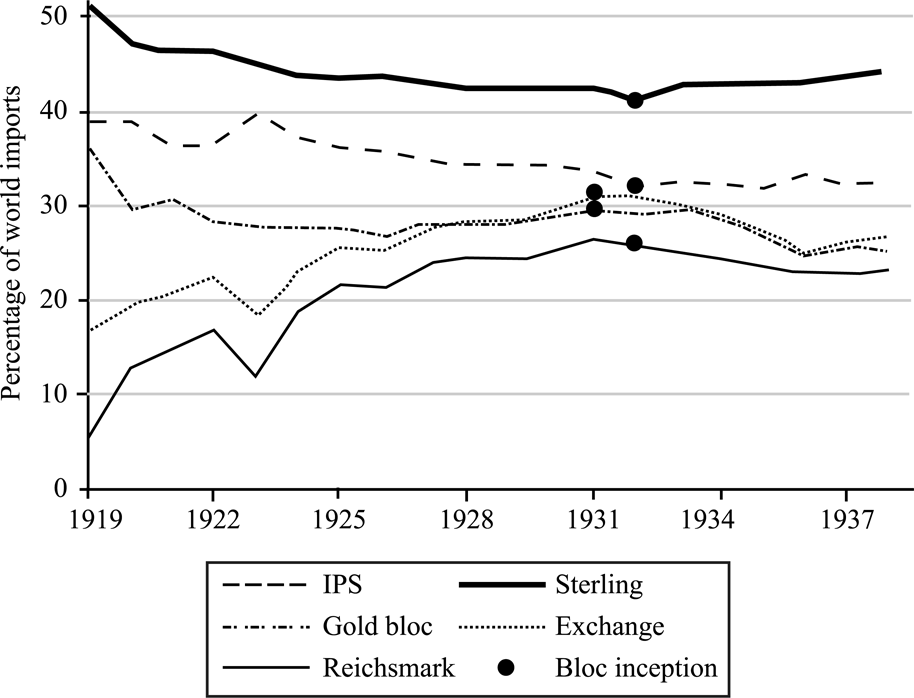
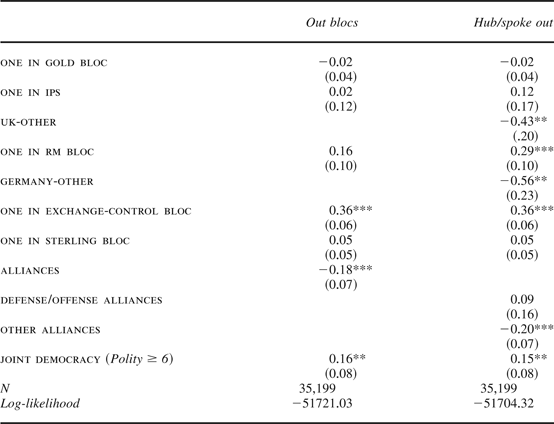
Next, we assess one of the principal counts in the indictment against the blocs—that is, that they encouraged trade between their members at the expense of trade between their member states and nonmembers. Figure 3 suggests that beggar-thy-neighbor effects were negligible: little change is apparent in member-nonmember trade across time. In the multivariable analysis, we drop the bloc dummies because of the perfect collinearity that would otherwise arise and include a series of dichotomous variables that equal 1 in any year in which only one country in a dyad belongs to a given bloc; it is 0 otherwise. As before, the analysis includes directed-dyad fixed effects, importer- and exporter-year dummies, and other variables included in the first specification.
Out bloc imports as percent of total imports
The results in column (1) of Table 2 show that only one significant change in member-nonmember trade occurs. In striking contrast to historical accounts of the interwar trade system, however, the change is positive: trade between exchange-control bloc members and nonmembers actually rises by about 43 percent, a significant increase (p-value ≤ .01).Footnote 70 This is consistent with the fact that the principal trading partner of these countries, Germany, adopted a policy of autarky under the Nazi regime, forcing exchange-control member states to import from and export to other countries. That there is no evidence of beggar-thy-neighbor effects is consistent with the results Eichengreen and Irwin and Wolf and Ritschl report. More importantly, it is consistent with the fact that none actually raised trade between their members as a whole.
Beggar-thy-neighbor trade?
Notes : All models include the Latin Monetary Union (LMU), directed dyad, importer-year, and exporter-year fixed effects. The dependent variable in both cases is the log of imports. IPS = Imperial Preference System; RM = Reichsmark.
** p < .05;
*** p < .01.
Given the marked differences that exist between subsets of the IPS and RM blocs, we also examine whether the trade diversion associated with them varies accordingly. To do so, we create an indicator that assumes a value of 1 when dyads include Britain and an IPS nonmember. We do the same for observation that pair Germany and states outside the RM bloc. A similar set of variables controls for trade between IPS or RM spokes, respectively, and nonmembers. As the results in column (2) of Table 2 show, these distinctions matter. Trade between Britain and other states falls sharply, dropping by about 35 percent (p-value = .03). Trade between IPS spokes and other states does not change (p-value = .48). This reflects the fact that London, but not the dominions, substituted trade with Commonwealth countries for trade with other states. The Nazi policy of autarky is consistent both with the sizeable and significant 43 percent decline in trade between Berlin and RM-bloc nonmembers (p-value < .02) and the significant increase in RM spoke trade with nonmember states (p-value < .01).
Robustness Tests
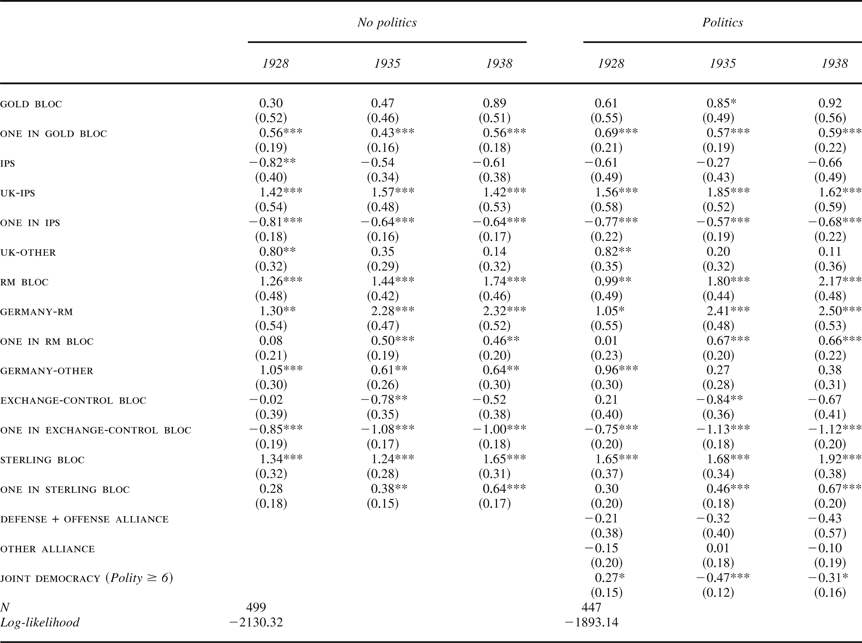
First, we explain the differences that exist between our results and those that earlier analyses report. We begin with the Eichengreen and Irwin study. Using the states in their sample and their method of analysis, we first add controls for the subsets of IPS and RM-bloc members.Footnote 71 The results in Table 3 show that RM-bloc hub-and-spoke trade rises significantly between 1928 and 1935. They also show that trade falls between 1928 and 1935 within the exchange-control bloc and between Berlin and nonmembers of the RM bloc. Next, we add controls for alliances and joint democracies. This eliminates the significance of the RM-bloc hub-spoke coefficient in 1928 and reduces the parameter estimate on trade between Berlin and RM-bloc nonmembers. The coefficient on democratic dyads becomes negative in 1935, a significant change.
Eichengreen-Irwin countries, blocs, and methods with additional covariates
Notes: Seemingly unrelated regression using Eichengreen-Irwin 1995 sample of countries and bloc definitions. GDP, GDP per capita, distance, and contiguity are included but not shown in table. Dependent variable is the log of imports. IPS = Imperial Preference System; RM = Reichsmark.
* p < .10;
** p < .05;
*** p < .01.
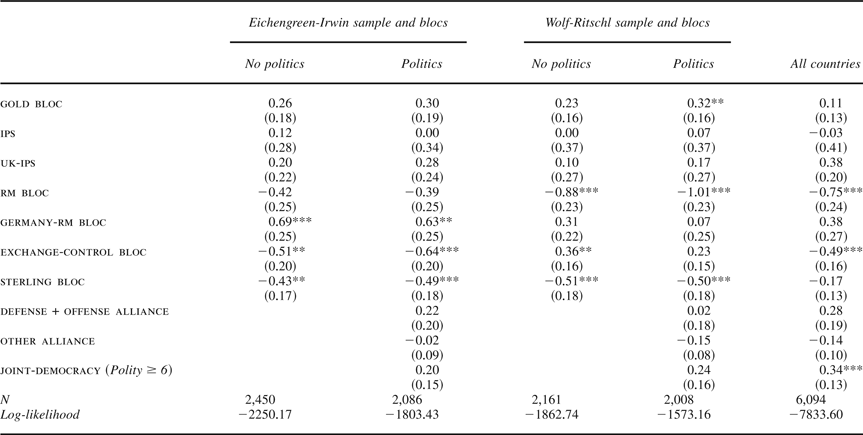
Still using the Eichengreen and Irwin sample, we next pool their three years of data and analyze them using the specification employed to analyze our data set. As Table 4 shows, only RM-bloc hub-and-spoke trade increases significantly; significant reductions occur in sterling and exchange-control bloc trade. This is so irrespective of whether we include the political variables. Finally, if we use our data and method but limit the sample to the three years in the Eichengreen and Irwin analysis, we again find three significant changes: IPS hub-spoke trade rises, while exchange-control bloc and Reichsmark bloc trade both fall. It seems clear that the results we report are not due to respecifying the model Eichengreen and Irwin estimate but are due instead to our use of a much larger data set.Footnote 72
Comparison with existing studies
Notes: All models include directed dyad, importer-year, and exporter-year fixed effects. The dependent variable in all models is the log of imports. Years are restricted to 1928, 1935, and 1938. Columns (1) and (2) include the countries and bloc definitions in Eichengreen and Irwin 1995; columns (3) and (4) include the countries and bloc definitions in Wolf and Ritschl 2011; column (5) includes all countries in our data. IPS = Imperial Preference System; RM = Reichsmark.
** p < .05;
*** p < .01.
The same is true of the Wolf and Ritschl analysis. We add controls for intrabloc trade and a gravity model with dyadic and importer- and exporter-year fixed effects. The results show that RM-bloc spoke-spoke trade falls significantly; no change occurs in either RM hub-spoke or in intra-IPS trade. The coefficient on the exchange-control bloc is now positive and significant; the parameter estimate on sterling is negative and significant. Adding the political variables eliminates the significant coefficient on the exchange-control bloc but produces only a marginally significant negative coefficient on the alliance variable. Thus, as in the case of the Eichengreen and Irwin study, our results and those Wolf and Ritschl report vary because of the size and composition of our data set.
Our analysis includes annual observations for each country as well as observations about a larger set of states. Both earlier studies are dominated by European countries. Of the thirty-three countries in the Eichengreen and Irwin sample, twenty-two are in Europe. Of the thirty countries in the Wolf and Ritschl study, twenty-three are European. In contrast, less than half of the fifty-four countries we include in our study are European. In addition, the non-European states the earlier studies include are skewed toward former British colonies—that is, the United States, Canada, Australia, and New Zealand. Very few Latin American or Asian countries are included. Thus, our data set is not only more comprehensive in its coverage but it is also more representative of the population of countries involved in trade at the time. This makes it possible for the contrast between trade involving European states, almost all of which are bloc members, and other states to emerge more clearly.
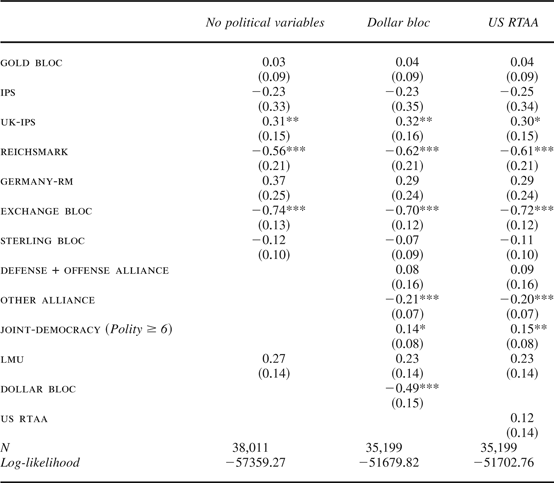
We also conducted a series of robustness tests. Table 5 shows that dropping the political variables does not affect our bloc results. The same is true if we control for the British Empire after 1931, as colonies of Britain were also exempt from its import levies;Footnote 73 for states in Latin America that pegged to the dollar; or for the twenty-two trade agreements the United States concluded before 1940 pursuant to the adoption of the Reciprocal Trade Agreements Act (RTAA).Footnote 74
Robustness checks
Notes: All models include directed dyad, importer-year, and exporter-year fixed effects. The dependent variable in all models is the log of imports. Colonies are excluded from column (1). IPS = Imperial Preference System; LMU = Latin Monetary Union; RM = Reichsmark; RTAA = Reciprocal Trade Agreements Act.
** p < .05;
*** p < .01.
Finally, in recent studies that examine post-1945 trade, it is common to replace missing and 0 values of trade with small positive values. IMF data makes this reasonable, because the IMF estimates unreported values using past values of dyadic trade or the value of imports of one state in a country-pair. Thus, it makes sense to infer that the remaining gaps are actually small or 0. In many cases in the period we examine, however, states report either the aggregate value of their trade with a group of other countries (for example, Australasia) or record exchanges with their major trading partners only, making it impossible to infer the value of the trade of specific dyads. As a result, we cannot tell if unrecorded trade flows are actually zeroes.Footnote 75
Conclusion
Our article shows that the effects of interwar trade institutions vary both within and across them. In some cases, their members intended to and did preserve their preexisting trade despite the depreciating currencies of countries outside the bloc. In contrast, shifts in intrabloc trade occurred as a result of the political interests of their great-power hubs. The effects of political-military agreements also vary between the wars. When states sought to deter rather than defend their allies, trade between them dropped. None of these findings emerge in other studies of the interwar era because they neglect the heterogeneity that the intervention of politics can induce in the effects of institutions.
That none of the blocs increased trade among its members as a whole reinforces the skepticism recent studies express about agreements and institutions. Yet, this should have been obvious ex ante in the case of the blocs. Economists maintain that substituting an organization for the decentralized actions that typically prevail in a self-help system can raise trade if it deters states from exploiting their market power. It can do so, however, only when negotiations under its auspices engage two or more large states—that is, states with sufficient power to influence their terms of trade. This implies that no interwar bloc was likely to increase trade between its members as a whole because none conformed to the canonical case involving large states.
Finally, many historical studies argue that the interwar economic system exacerbated great-power tensions. Our work reverses this causal chain. The interwar economic order and, we would argue, its postwar counterpart, were endogenous to contemporaneous patterns of great-power conflict and cooperation. The deep divisions that prevailed among the great powers after 1918 made a collective response to the Great Depression infeasible despite its potential to short-circuit the downward spiral in domestic output and international trade. The realization of U.S. policymakers that European stability after 1945 required active U.S. involvement gave rise to the Bretton Woods institutions. It was as one tool in the U.S. arsenal to secure what became known as the “long” peace that the GATT/WTO emerged to govern postwar trade. Neglecting the great-power politics that influence trade, therefore, seems likely to generate misleading estimates of the value added of the agreements they generate. It is rare indeed that the play of power politics creates institutions that privilege efficiency over distribution.
Appendix: Import Data Coding and List of Countries
For each country the main source of import data is national-level trade yearbooks. Most yearbooks provide detailed information about a country's trade with other countries and trade by commodity (and sometimes trade with other countries by commodity). A list of publications that we consulted for each country is available upon request. When no yearbook existed, we relied on other sources (for example, Spanish trade yearbooks do not exist between 1936 and 1938). Our second source was country statistical yearbooks. Although usually not as detailed as the trade yearbooks, many yearbooks at least contain information about trade with major trading partners.
Countries in Eichengreen-Irwin (1995) and Wolf-Ritschl (2011), for years 1928, 1935, and 1938
When national level sources were unavailable, we relied on aggregate level sources. The League of Nations published bilateral trade data for a relatively small number of countries for most of the interwar period. We rely on League data for the following countries:
Panama 1924–27
Ecuador 1926
Paraguay 1925
Honduras 1922–24
Absent both country yearbooks and League data, we filled in the following gaps with Barbieri's data:Footnote 76
Canada 1919–24
Spain 1923, 1936–38
Portugal 1935
Germany 1921–22
Belgium 1934–37
Hungary 1937
Czechoslovakia 1934–36
Italy 1934–37
Finland 1934–38
List of countries in the sample, bloc membership, and data availability
We note some potential problems. The first is distinguishing between country of origin or production and the country of shipment or consignment. During the interwar period, some countries measured imports based on their country of production or origin while other countries valued them according to the country of consignment or the country from which the imports were shipped. Some countries changed from the country of consignment to the country of origin in the middle of the period. By the 1930s, most countries listed imports from the country of origin.
For this analysis, differences between country of origin and country of production are not very large. For the larger countries covered in this study, the country-of-origin data tends to be very similar to the country-of-production data. In general, smaller countries with weak or nonexistent transportation systems are the ones that show a large difference between the country of origin and country of shipment. When a publication listed both the country of origin and the country of shipment, we used data on the country of origin. We also collected information, when possible, on whether the imports were measured by country of origin or by country of shipment.
A second issue is the definition of countries. Many trade publications were very specific about trading partners, including data from parts of larger countries (for example, breaking out Scotland, Wales, and England). In general, we have combined any trade data from an exporter the Correlates of War (COW) regards as part of another country while keeping trade from colonies separate. So, for example, trade reported from Scotland, Northern Ireland, or Wales has been added to the trade of the United Kingdom; trade from areas such as Jamaica or Kenya remain separate. Besides the UK components, we add the Canary Islands to Spain's trade; the Azores and Madeira to Portugal; we also combine Asian and European Turkey, Memel and Lithuania, Asian and European Russia, and Belgium and Luxembourg. Eventual states of the United States that were still colonies at the time (that is, Hawaii and Alaska) were kept separate.