





1. Introduction
Language is both a cognitive system and a social practice: speakers not only store and retrieve linguistic forms in memory but also encounter, use and interpret them in context. Research has shown that our experience with linguistic forms can influence how we process them (Bybee, Reference Bybee2006; Kroll et al., Reference Kroll, Van Hell, Tokowicz and Green2010; inter alia). This is particularly relevant for morphology, which is one of the most challenging components of language to acquire (Ravid, Reference Ravid2019; Wulff & Ellis, Reference Wulff, Ellis, Miller, Bayram, Rothman and Serratrice2018), due to its complex interaction of form and meaning, lower perceptual saliency, and higher cognitive load. Nevertheless, frequent use of and exposure to linguistic forms has been shown to facilitate morphological processing by shifting speakers away from morphological decomposition and toward whole-word processing, or chunking, thereby reducing cognitive load (e.g., Bybee, Reference Bybee2012; Caramazza et al., Reference Caramazza, Laudanna and Romani1988; Durand-López & Garrido-Pozú, Reference Durand-López and Garrido-Pozú2025; Ellis, Reference Ellis2002a, Reference Ellis2002b).
This relationship between experience and morphological processing is especially relevant in contexts of linguistic innovation. One such innovation is gender inclusive language in Spanish, which replaces the traditionally masculine gender suffix -o with the alternative gender neutral morpheme -e to refer to mixed-gender groups, the focus of the current study (Guidotti-Hernández, Reference Guidotti-Hernández2017; Papadopoulos, Reference Papadopoulos2022).
Within this broader innovation, however, not all -e forms are equally frequent or familiar. Pronominal tod-e-s (‘everyone-inc-pl’ cf. tod-o-s ‘everyone-m-pl’) is often recognized as one of the first widespread instantiations of the -e morpheme in Spanish. Though much of its early diffusion was marked by jocular or dismissive uses (López, Reference López2018; Rodríguez, Reference Rodríguez2021), todes became a societally recognizable form, even if not always employed with inclusive intent (González Camaño & Brown, Reference González Camaño and Brown2022). This familiarity, alongside the already high frequency of its masculine counterpart todos as a form for both referring to and directly addressing mixed-gender groups, has contributed to making this instantiation of the -e morpheme in todes more frequent than in other grammatical categories (Martínez, Reference Martínez2019).
In light of these considerations, in this article we investigate how frequency of exposure to and use of inclusive language forms with -e influences their processing in Spanish while also exploring whether processing differs by grammatical function through a comparison of todes, a relatively frequent and socially salient pronominal instantiation of the inclusive -e morpheme, with less frequent inclusive -e adjectives among first-language Spanish speakers.Footnote 1
2. Background
2.1. Gender and inclusive language in Spanish
Spanish grammatical gender classifies nouns as masculine or feminine (Alarcos Llorach, Reference Alarcos Llorach1994), and regular inanimate nouns follow morphological rather than semantic assignment. Those ending in -o are masculine (e.g., escritorio ‘desk’) while those ending in -a are feminine (e.g., ventana ‘window’). Exceptions such as la mano (‘the.f hand’) and el día (‘the.m day’) belong to a small class of nouns which deviate from expected gender patterns. In contrast, for animate nouns, grammatical gender generally maps onto sociocultural gender. Many personal and professional terms reflect this distinction (e.g., enfermer-o ‘nurse-m’ vs. enfermer-a, ‘nurse-f’).
Gender marking becomes especially consequential when referring to groups of people. Although Spanish distinguishes masculine and feminine forms in many animate nouns, plural mixed-gender groups have traditionally been referred to with the so-called ‘generic masculine,’ where the masculine plural is used to refer to groups of multiple genders (e.g., los enfermer-o-s ‘the.m nurse-m-pl’). This convention has become a central focus of inclusive language proposals in Spanish, with some accounts suggesting that it reinforces the association between grammatical and sociocultural gender, particularly through common masculine/feminine alternations (e.g., herman-o/herman-a ‘brother/sister’) (Bender et al., Reference Bender, Beller and Klauer2018; Casado et al., Reference Casado, Palma and Paolieri2021).
Over the past half century, the generic masculine has been increasingly debated, with opponents arguing that it reinforces both gender biases and the gender binary (Papadopoulos, Reference Papadopoulos2022). This concern is supported by empirical psycholinguistic evidence: readers and listeners of Spanish tend to interpret the generic masculine as male-referring rather than as truly generic, with corresponding processing costs when this interpretation conflicts with contextual or stereotypical information (Vela-Plo et al., Reference Vela-Plo, De Pedis and Ortega-Andrés2025; see Heap, Reference Heap2024, for a review of the Spanish and French empirical literature). Comparable male biases associated with the generic masculine have also been documented in other Romance and Germanic languages, including French (Gygax et al., Reference Gygax, Gabriel, Lévy, Pool, Grivel and Pedrazzini2012), as well as German (Stahlberg et al., Reference Stahlberg, Sczesny and Braun2001). These critiques have led to several proposals for alternative language forms, including coordinated masculine and feminine forms (e.g., tod-o-s y tod-a-s ‘everyone and everyone’) or epicene noun phrases (e.g., todo el mundo ‘everyone’). Orthographic dual-gender options such as -o/a and -@ emerged (Guidotti-Hernández, Reference Guidotti-Hernández2017). More recent strategies have moved toward gender neutrality, incorporating symbols such as -x to more explicitly detach gendered associations from morphological endings (Salinas & Lozano, Reference Salinas, Lozano, Murillo, Delgado Bernal, Morales, Urrieta, Ruiz Bybee, Muñoz, Saenz, Villanueva, Machado-Casas and Espinoza2021).
One proposal that has been gaining more recent traction is the use of the -e suffix as a non-gendered alternative. Inclusive -e can be used to refer to a specific nonbinary individual in the singular, with -e appearing on the noun and on agreeing determiners and adjectives (e.g., le maestr-e dedicad-e ‘the.inc dedicated-inc teacher-inc’), as well as for generic use for groups that are mixed-gender, nonbinary or otherwise not represented by the masculine generic (e.g., le-s maestr-e-s dedicad-e-s ‘the.inc-pl dedicated-inc-pl teacher-inc-pl’). Here, we focus on the latter.
Supporters of inclusive -e point to its phonological and morphological coherence with pre-existing structures in Spanish, such as estudiante (‘student’) and cantante (‘singer’) (Barrera Linares, Reference Barrera Linares2019; Cabello Pino, Reference Cabello Pino2020; Fábregas, Reference Fábregas2023; Muelas-Gil, Reference Muelas-Gil and Pfalzgraf2025), which belong to a class of human-referring nouns that do not alternate between gendered morphological inflections.Footnote 2 Nevertheless, inclusive -e is not endorsed by the Real Academia Española (RAE), the language’s foremost prescriptive authority. This lack of institutional support shapes the ideological landscape in which speakers encounter inclusive language (see González Rivera, Reference González Rivera2025).
Recent corpus-based work documented usage patterns of inclusive morphology in Spanish. One of the earliest large-scale studies examined 128,649,761 tweets from Argentina between 2007 and 2020 (Kalinowski, Reference Kalinowski2020). This study examined both the singular and the plural of coordinated forms (e.g., amig-o y amig-a ‘friend-m and friend-f’), slash forms (e.g., amig-o/a ‘friend-m/f’) and forms marked with -@, −x and -e morphology. Results revealed that these inclusive forms remained quantitatively limited (225.68/million words) and were concentrated among just a few lexical items. Even in 2019, the year of highest use, only slightly over 0.35% of tweets contained any inclusive form. Another recent study examined 3,510 instances of first-person plural Spanish subject morphology on Twitter, finding that masculine (nosotr-o-s ‘we-m-pl’) and feminine (nosotr-a-s ‘we-f-pl’) forms accounted for 55.8% and 33.87% of the tokens, respectively (Samples, Reference Samples2024). The remaining 10.33% of tokens included forms utilizing the -@, −x and -e variants, including just 0.6% (n = 21) with the -e morpheme.
Existing work also suggests that inclusive morphemes are unevenly distributed across lexemes and syntactic categories. In their study of educational communities on Twitter, Núñez-Román et al. (Reference Núñez-Román, Gómez-Camacho and Hunt-Gómez2023) found that, apart from the lexical item alumnado (‘student body’), −x appeared most frequently in pronominal tod-x-s (‘everyone-inc-pl’) when referring to groups of students. The same marker was attested less often with other lexemes, such as alumn-x-s (‘student-inc-pl’). Similarly, our search of the Spanish Web corpus esTenTen23 (Kilgarriff & Renau, Reference Kilgarriff and Renau2013) returned 14,259 instances of todes, compared with only 336 instances of -e across a sample of 15 adjectives (see Supplementary Appendix A for full table of our corpus queries).
2.2. Usage-based grammar and morphological processing
In usage-based models of grammar, frequency is a central mechanism of both language learning and language variation (Bybee, Reference Bybee2006, Reference Bybee2012). Crucially, token frequency and type frequency support different kinds of linguistic generalization: token frequency refers to the number of occurrences of a particular linguistic unit, whereas type frequency refers to the number of different forms that follow a particular pattern. In other words, repeated exposure to the same form strengthens familiarity with that particular item, while exposure to the same pattern across many different forms provides evidence that the pattern can be generalized. This distinction is especially relevant to inclusive -e, which is unevenly distributed across Spanish. A form such as todes, for example, may be encountered relatively often, providing speakers with repeated experience with that particular lexical item. By contrast, encounters with -e across different lexical items provide evidence that -e functions as a broader morphological pattern. Thus, token and type frequency provide complementary ways of characterizing the distributions of inclusive -e in Spanish. Whereas token frequency reflects how often particular forms occur, type frequency reflects how broadly -e is distributed across different lexical items.
These two frequency measures are expected to have different consequences for linguistic representation and processing. When the same form is encountered repeatedly, its representation becomes stronger, or more entrenched, in memory (Langacker, Reference Langacker1987). As a result, high-token-frequency forms may become increasingly familiar and can be processed more readily as whole units, or chunks, rather than being analyzed into their component parts on each encounter (Bybee, Reference Bybee2012; Ellis, Reference Ellis2002a, Reference Ellis2002b; Gobet et al., Reference Gobet, Lane, Croker, Cheng, Jones, Oliver and Pine2001), a process also described as automatization (Diessel, Reference Diessel, Dąbrowska and Divjak2015). When the same morphological pattern occurs across many different lexical items, it provides evidence for a more abstract representation of that pattern, which can support the interpretation of less familiar or novel forms. In usage-based accounts, this ability to extend a pattern beyond the individual forms in which it has been encountered is referred to as morphological productivity (Bybee, Reference Bybee1985, Reference Bybee1995). Thus, while high token frequency primarily strengthens the representation of particular lexical items, high-type frequency supports the representation of a broader morphological pattern. For this study, this distinction means that the relatively high token frequency of todes may facilitate the processing of that particular form, whereas the processing of less frequent -e adjectives may depend more heavily on the extent to which -e is represented as a broader morphological pattern.
Experimental evidence further supports the role of frequency in morphological learning. For example, Endress and Hauser (Reference Endress and Hauser2011) found that participants learned exceptional affixation patterns more successfully as the token frequency of those exceptions increased. This distinction is central to this study because while the aforementioned documented distribution of inclusive forms in Spanish tells us how often particular forms occur, it does not reveal how broadly the inclusive -e morpheme extends as a productive pattern across the grammar. Thus, even if a specific form such as todes is relatively frequent, its frequency does not necessarily show that speakers have generalized -e as a productive strategy for inclusive language in Spanish.
These usage-based predictions about entrenchment and productivity connect to a broader question in morphological processing about whether complex forms are decomposed into morphemes or accessed as whole lexical units during language processing. Decomposition-based accounts propose that complex words are parsed into their constituent morphemes before lexical access (Taft, Reference Taft2004), whereas whole-word accounts propose that complete forms can be stored and retrieved directly, with more frequent forms benefiting from stronger lexical representations (Butterworth, Reference Butterworth and Butterworth1983).
In line with usage-based approaches, the present study draws on hybrid models, particularly the Augmented Addressed Morphology Model (Burani et al., Reference Burani, Salmaso and Caramazza1984; Burani & Laudanna, Reference Burani, Laudanna, Frost and Katz1992; Caramazza et al., Reference Caramazza, Laudanna and Romani1988), which proposes that speakers may rely on either whole-word retrieval or morphological decomposition depending on factors related to language experience, such as lexical frequency. Under this account, high-frequency words develop stable lexical representations and can be accessed as whole units, whereas low-frequency or novel forms are more likely to be decomposed into morphemic components and recombined during recognition. Evidence from first-language speakers supports this frequency-sensitive account, showing greater evidence of whole-word processing for high-frequency forms and greater reliance on decomposition for less frequent forms (Domínguez et al., Reference Domínguez, De Vega and Barber2004; Giraudo et al., Reference Giraudo, Dal Maso and Piccinin2016; Lehtonen & Laine, Reference Lehtonen and Laine2003). This model is particularly relevant to the present study because it links morphological processing to patterns of exposure, allowing for predictions about whether inclusive -e forms are accessed as productive morphological combinations or as more item-specific lexical forms.
2.3. Online processing of novel morphology in Spanish
This aforementioned distinction between whole-word retrieval and morphological decomposition provides the basis for interpreting online processing studies of inclusive morphology in Spanish, where slower or faster reading times (RTs) may reflect this difference. Studies in this area have had a range of results, and interpreting them requires attending carefully to differences in dependent variables, experimental manipulations and participant populations.
For instance, Nadal and Bove (Reference Nadal and Bove2024) found that Spanish gender doublets (e.g., niños/as ‘children-m-pl/f-pl’) produced longer RTs than generic masculine forms, suggesting that some inclusive strategies increase processing effort. Examining a different inclusive strategy, Zarwanitzer and Gelormini-Lezama (Reference Zarwanitzer and Gelormini-Lezama2023) found that monolingual Rioplatense Spanish speakers read sentences including lexical items with -e and -x forms (e.g., hij-e-s and hij-x-s ‘offspring-inc-pl’), more slowly than those with generic -o. In a related study, Stetie and Zunino (Reference Stetie and Zunino2024) used RTs in a task in which inclusive -e appeared on stereotyped role nouns (e.g., les niñeres ‘the-inc-pl nanny-inc-pl,’ les marineres ‘the-inc-pl sailor-inc-pl’). Unlike Zarwanitzer and Gelormini-Lezama (Reference Zarwanitzer and Gelormini-Lezama2023), they parsed RTs into distinct regions and found a semantic bias effect only at the spillover word, with no significant differences in total sentence RTs. This regional analysis led them to conclude that processing difficulty associated with -e is local and does not extend to global sentence RTs. Also, the authors attributed the longer RTs for female-biased role nouns in part to the lower frequency with which the -e morpheme tends to co-occur with such nouns in naturalistic usage, suggesting that distributional frequency shapes local processing difficulty even when global computation remains unaffected.
Román-Irizarry et al. (Reference Román-Irizarry, Beatty-Martínez, Torres and Kroll2025) extended this work to inclusive pronouns, including anaphoric quantifiers much-x-s/much-e-s (‘many-inc-pl’) versus much-o/a-s (‘many-m/f-pl’). They found processing costs for inclusive forms at the critical and spillover regions, with -x producing the longest RTs, followed by -e, −a and -o. These costs did not affect comprehension accuracy, suggesting a measurable but limited disruption. Importantly, participants’ prior exposure and gender/sex diversity beliefs moderated processing, where more gender-normative beliefs were associated with longer RTs. Complementing this work, Román-Irizarry and Guzzardo Tamargo’s (Reference Román-Irizarry and Guzzardo Tamargo2025) eye-tracking study found that -x pronouns were more costly than -o across early and late measures and more costly than -a in some measures, again without reducing comprehension accuracy. They also found evidence that positive attitudes toward gender-inclusive language were associated with faster processing of -x.
Together, these studies suggest that the processing of inclusive morphology in Spanish is not altogether straightforward and that apparent discrepancies across studies may reflect genuine differences tied to linguistic context, scope of analysis and participant characteristics. Therefore, in this work, we explore the potential roles of syntactic category, comparing adjectives and the pronominal quantifier todes in addition to reported usage patterns in the processing of inclusive -e, in order to contribute to the growing understanding of the complex mechanisms underlying how inclusive -e forms in Spanish are processed.
3. The study
Although inclusive language in Spanish has existed for some time, its recent growth has outpaced research on how first-language speakers process these forms online. Existing studies report mixed findings regarding the processing costs of inclusive morphology during sentence comprehension (Marchesini, Reference Marchesini2019; Román-Irizarry et al., Reference Román-Irizarry, Beatty-Martínez, Torres and Kroll2025; Stetie et al., Reference Stetie, Martínez Rebolledo and Zunino2024; inter alia). Key questions therefore remain concerning how adults represent and process these forms: as relatively fixed lexicalized items, as instances of a productive morphological pattern or through some combination of lexical and morphological representations, and how processing is shaped by lexical frequency, morphosyntactic context and individual exposure.
The present study builds on our previous work on the processing of Spanish adjectives marked with inclusive -e among first-language speakers of Spanish (Durand-López & Dickinson, Reference Durand-López and Dickinson2025). That study not only found longer self-paced reading task RTs for inclusive -e adjectives than for their generic masculine -o counterparts but also found that reported frequency of inclusive language use modulated these costs. Specifically, speakers who reported the highest frequency of use of inclusive language showed no difference in processing times between -e and -o adjectives.
These findings are limited in two respects. First, they concern a single syntactic category. Second, --e has lower token frequency in adjectives than in other forms, including pronominal quantifiers such as todes. The present study therefore examines the processing of inclusive -e in todes alongside plural adjectives. Todes is a particularly useful case because its generic masculine counterpart todos is already widely used for collective reference and as a vocative, allowing speakers to refer to or address groups of people. As an inclusive alternative, todes is structurally familiar, communicatively useful in contexts involving multiple or unknown gender identities and socially salient in media, education and social networks (González Camaño & Brown, Reference González Camaño and Brown2022; López, Reference López2018; Rodríguez, Reference Rodríguez2021). These factors may increase speakers’ exposure to the form and contribute to its lexical entrenchment.
Building on the theoretical questions and methodological concerns described above, the present study contributes to our understanding of language in that it (a) assesses gender agreement with the inclusive -e suffix between a plural subject (a mix of names typically associated with men and women) and coreferential pronominal quantifier, (b) compares the processing burdens of inclusive language forms with the -e morpheme across grammatical functions (adjective vs. pronominal quantifier) and (c) includes frequency of use of inclusive language as a predictor to explore whether exposure to the -e suffix modulates how this form is processed and potentially represented in adulthood. As such, the present work addresses the following research questions:
RQ1a: Does the inclusive pronominal quantifier todes impose greater processing costs than the generic masculine todos during sentence comprehension among first-language Spanish speakers?
RQ1b: Do inclusive plural adjectives with -e impose greater processing costs than the generic masculine plural adjectives with -o during sentence comprehension among first-language Spanish speakers?
RQ2a: Does self-reported inclusive language use modulate the processing of todes?
RQ2b: Does self-reported inclusive language use modulate the processing of plural inclusive adjectives?
RQ3: Do inclusive adjectives with lower token frequency impose relatively greater processing costs than the higher token frequency form todes, when compared to their generic masculine counterparts?
Because the present study examines how established inclusive forms such as todes and -e adjectives are in speakers’ processing systems, we treat processing cost as an indirect measure of the relative ease with which these forms are accessed during comprehension. Rather than assuming a categorical distinction between acquired and nonacquired forms, we adopt a gradient view in which reduced processing costs may reflect greater familiarity and entrenchment, whereas greater processing costs may reflect less established representations or a greater reliance on morphological analysis. We predict that both todes and plural -e adjectives will yield longer RTs than their generic masculine counterparts, consistent with prior work suggesting that inclusive morphology can incur processing costs (e.g., Marchesini, Reference Marchesini2019; Román-Irizarry et al., Reference Román-Irizarry, Beatty-Martínez, Torres and Kroll2025; Zarwanitzer & Gelormini-Lezama, Reference Zarwanitzer and Gelormini-Lezama2023). However, we also predict that todes, as a high token frequency item, will be processed more quickly than lower-frequency -e adjectives. This prediction follows from usage-based and hybrid models of morphological processing, which suggest that high-frequency items become entrenched in memory and are more likely to be accessed holistically (Burani & Laudanna, Reference Burani, Laudanna, Frost and Katz1992; Bybee, Reference Bybee2012; Caramazza et al., Reference Caramazza, Laudanna and Romani1988; Diessel, Reference Diessel, Dąbrowska and Divjak2015). By contrast, lower-token-frequency but higher-type-frequency - e adjectives may require morphological decomposition, increasing processing cost. Finally, we predict that participants’ self-reported use of inclusive language will modulate processing times for both todes and -e adjectives, with more frequent users showing reduced RTs. Together, these analyses provide insight into the learnability of inclusive morphology and the role of frequency in adult acquisition of novel grammatical forms, as well as the productivity of the inclusive -e morpheme across the grammar.
4. Methods
4.1. Participants
A total of 62 first-language Spanish speakers residing in majority Spanish-speaking countriesFootnote 3 participated in the study.Footnote 4 Half of the participants (n = 31) reported never using the inclusive morpheme -e, while the remaining half reported using it to varying degrees (Table 6). Participants ranged in age from 19 to 57 years (M = 29.52, SD = 6.91). They came from across the Spanish-speaking world, with the largest groups from Argentina (n = 32, 51.6%) and Mexico (n = 12, 19.4%), as well as Bolivia, Chile, Colombia, Costa Rica, Ecuador, Peru, Spain and Venezuela. In an open-ended gender question, 31 participants identified as female (50%), 25 as male (40.3%), 3 as nonbinary (4.8%), 1 as trans feminine (1.6%) and 2 as gender fluid (3.2%). See Supplementary Appendix B for additional participant information.
4.2. Materials and procedure
Before completing the study instruments, all participants reviewed informed consent documentation explaining their rights. After consenting, participants completed a self-paced reading task in Spanish followed by a sociolinguistic questionnaire. The study was completed remotely on participants’ personal devices, with instructions provided regarding browser and technical requirements. Participants were compensated for completing all parts of the study. All study materials, data and code for analysis are available via an open repository. Please see Supplementary Appendix C to access study materials.
4.2.1. Self-paced reading task
The self-paced reading task, conducted in PsychoPy (Peirce, Reference Peirce2007), used a noncumulative moving-window paradigm. Each trial began with a fixation cross displayed for 1 s, followed by a Spanish sentence that participants advanced word by word by pressing the space bar. After the final word, participants answered a yes/no question targeting content unrelated to the study’s critical regions to ensure comprehension. PsychoPy recorded word-by-word RTs and comprehension accuracy.
A total of 92 sentences (excluding three practice items presented at the beginning of the experiment) were divided into two counterbalanced lists, each containing 16 pronominal sentences, evenly divided between todes and todos; 16 adjectival sentences, evenly divided between -e and -o forms; and 14 filler sentences. Items were pseudorandomized within each list to avoid consecutive presentation of the same condition or structure. The number of items per condition (8) follows common recommendations in psycholinguistic experimental design (Jegerski, Reference Jegerski, VanPatten and Jegerski2014).
All sentences contained 12 words. In the adjectival condition, each sentence began with a carrier phrase (e.g., Dicen que ‘they said that’), followed by a sentential subject consisting of four names: two traditionally masculine names (e.g., Pedro, Néstor) and two traditionally feminine names (e.g., Carmen, Ana), presented in alternation. These names were followed by the verb están (‘they are’) followed by the critical position. This critical item was an adjective with generic masculine -os or inclusive plural -es marking in the plural (e.g., content-o-s ‘happy-m-pl’ or content-e-s ‘happy-inc-pl’). The sentences ended with a prepositional phrase. A sample sentence can be found in (1).
Pronominal stimuli began with a sentential subject, following the same four-name structure described above. These were followed by a third-person plural transitive verb in the present tense transitive verb (e.g., bailan ‘dance-3pl.pres’) and its direct object (e.g., cumbia ‘cumbia’). The second sentence included the subject tod-o-s (‘everyone-m-pl’) or tod-e-s (‘everyone-inc-pl’), the verb están (be-3pl.pres) and a prepositional phrase (e.g., en el bar ‘at the bar’). A sample base sentence can be found in (2).
(1)
Dicen
que
Luis,
María,
Jorge,
y
Julia
están
content-o/−e-s
say
that
Luis
María
Jorge
and
Julia
are
happy-m/inc-pl
con
su
trabajo.
with
their
work.
‘They say that Luis, María, Jorge, and Julia are happy with their work.’
In this study, the areas of interest within sentences included the N-1 position (the pre-critical region; the word cumbia in the sample sentence), the N position (todos/todes) and the N + 1 position (the post-critical word; están). We analyzed data from the N-1 position to confirm that both conditions required equal processing effort before encountering the critical word. This allowed us to ensure that any differences observed at N are not simply the result of spillover effects from the preceding word. Similarly, we analyzed RTs from the N + 1 position to examine potential spillover effects.
(2)
Luis,
María,
Jorge,
y
Julia
bailan
cumbia;
Tod-o/e-s
están
Luis,
María,
Jorge,
and
Julia
dance
cumbia
all-m/inc-pl
are
en
el
bar.
in
the
bar.
‘Luis, María, Jorge, and Julia dance cumbia. They are all in the bar.’
4.2.2. Sociolinguistic questionnaire
To facilitate the examination of how processing relates to individual characteristics and experiences with inclusive language, participants completed an online questionnaire (Qualtrics, n.d.). The first section collected demographic information, including age, gender, education level, place of origin and residence. Participants then answered questions about their familiarity with inclusive language, their use of -e across modalities (e.g., writing, speech) and contexts (e.g., con amigos ‘with friends’) as well as when they first heard or began using inclusive -e. When asked whether they used inclusive -e, participants were instructed that any amount of use counted, from frequent to infrequent use. Those who affirmed using inclusive language then indicated how often they used it, selecting between con poca frecuencia (‘rarely’), a veces (‘sometimes’), con mucha frecuencia (‘often’) or siempre que puedo (‘as much as I possibly can’). This measure served as an individual-difference predictor of self-reported habitual use.Footnote 5
4.3. Statistical methods
Following standard procedures for self-paced reading studies (e.g., Futrell et al., Reference Futrell, Gibson, Tily, Blank, Vishnevetsky, Piantadosi and Fedorenko2021; Jegerski, Reference Jegerski, VanPatten and Jegerski2014), trials with RTs shorter than 200 ms or longer than 3,000 ms were excluded, as these values likely reflect accidental key presses, lapses in attention or distraction. All data visualization was performed using the `ggplot2` package (Wickham, Reference Wickham2016) in R (R Core Team, 2026). All descriptive statistics and figures are presented in milliseconds to facilitate interpretation. However, due to the positive right skew typical of RT data, RTs were log10-transformed prior to inferential analysis. Additionally, because the adjectival and pronominal stimuli differed structurally, most notably in critical-word length, the two datasets were analyzed separately. This approach avoids confounds related to word length and sentence position while allowing the same preprocessing steps, model-building strategies and potential predictors to be applied to both datasets.
Following standard procedures in the psycholinguistic literature for the self-paced reading method (e.g., Jegerski, Reference Jegerski, VanPatten and Jegerski2014), we analyzed RTs at the N-1 position, the N position and the N + 1 position for both datasets. For each position in each dataset (adjectives, todos vs. todes), we constructed a series of nested mixed-effects linear regression models using the ‘lme4’ package (Bates et al., Reference Bates, Mächler, Bolker and Walker2015), with log-transformed RT as the dependent variable. Potential fixed effects included grammatical gender, participant age, participant gender, and self-reported use of inclusive language. In addition to simple effects, we also tested an interaction between reported inclusive language usage frequency and gender morpheme (--e vs. -o). This interaction was motivated by the usage-based account outlined in Section 2, according to which greater experience with a linguistic form or pattern strengthens its representation and can facilitate processing. Our research questions ask whether the processing difference between inclusive -e and generic masculine -o varies as a function of participants’ reported inclusive language use.
Grammatical gender was treatment-coded, with -o adjectives and todos serving as the generic masculine reference levels. Other categorical predictor variables were sum coded, because this coding scheme allows lower-order effects to be interpreted as average effects across the levels of the other predictors, rather than as effects evaluated at a single reference level. This approach preserves the theoretically motivated comparison between inclusive and generic masculine forms while avoiding reference-level interpretations for the remaining predictors involved in interactions. Furthermore, we included a random intercept for each participant to account for individual variation in reading behavior and repeated measures. We also included random intercepts for item and participant country of origin.Footnote 6
Nested models were compared using likelihood ratio tests via the anova function. For the selected models, marginal and conditional R 2 values were calculated following Nakagawa and Schielzeth (Reference Nakagawa and Schielzeth2013). When models included interactions, conditional effects were examined using estimated marginal means with the ‘emmeans’ package (Lenth & Piaskowski, Reference Lenth and Piaskowski2026). Pairwise comparisons were conducted from the fitted models rather than raw means, allowing contrasts to reflect the fixed- and random-effects structure.
Finally, we compared the adjectival and todos/todes datasets by calculating the relative RT increase for inclusive forms within each word type: -e adjectives relative to -o adjectives and todes relative to todos. Because this measure expresses the inclusive-form cost relative to each word type’s own generic masculine baseline, it reduces the influence of absolute RT differences attributable to word length and syllable count. For each participant and grammatical function, we calculated these relative increases and then derived a difference score, subtracting the pronominal increase from the adjectival increase, to assess whether inclusive adjectives imposed a greater processing cost than todes on average across participants.
To assess the reliability of this difference, we used a nonparametric cluster bootstrap with 5,000 resamples. Because the data included repeated observations from the same participants, resampling was conducted at the participant level: on each iteration, participants were sampled with replacement, and the mean adjectival–pronominal difference score was recalculated. This procedure preserves the participant-level dependency structure while estimating sampling variability directly from the data (Efron & Tibshirani, Reference Efron and Tibshirani1993). The resulting bootstrap distribution was used to derive a 95% confidence interval and evaluate whether the observed difference reflected a robust pattern across participants.
5. Results
5.1. Todos and todes
5.1.1. Overview of the data
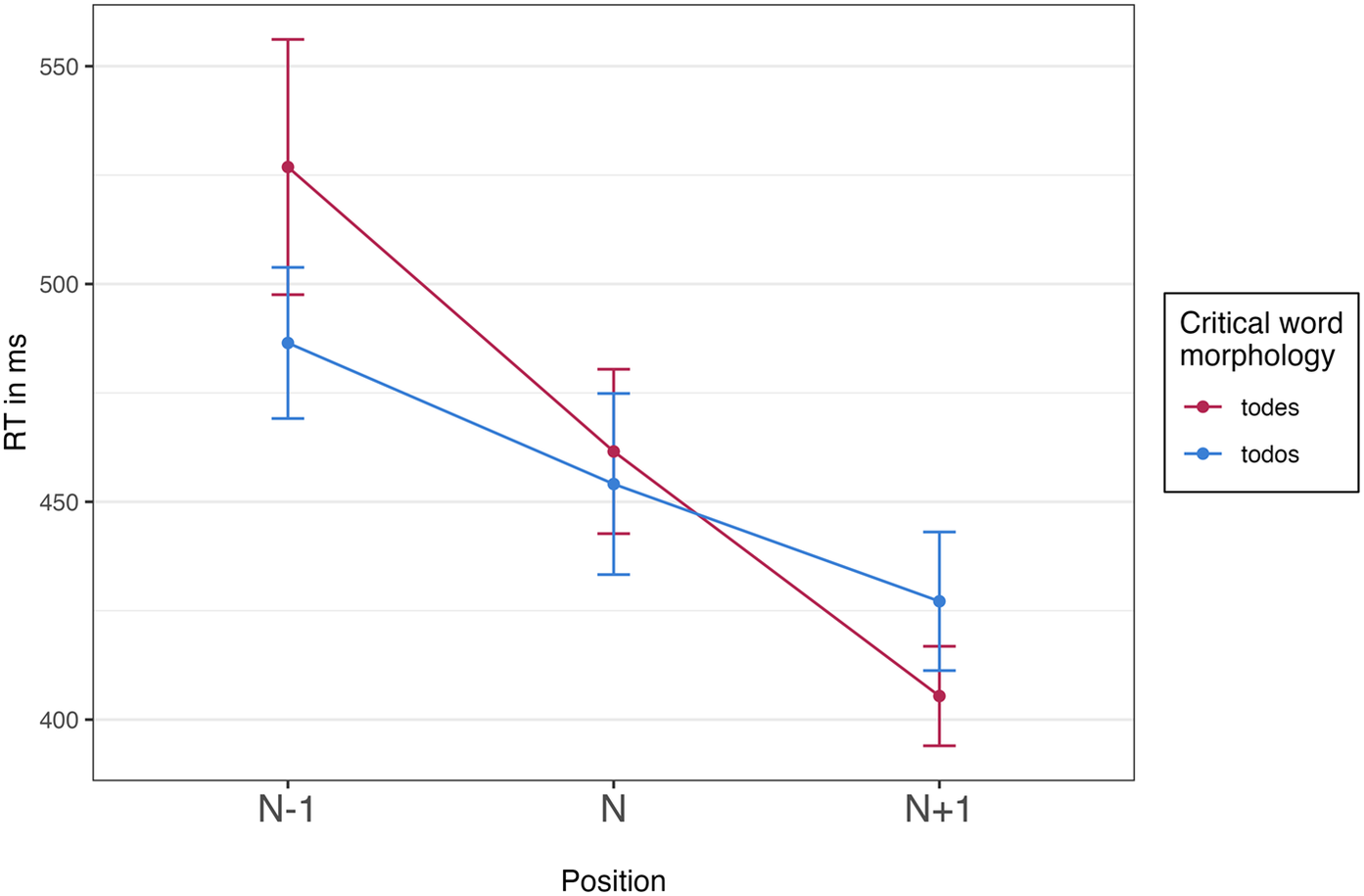
The present analysis focuses on 966 critical word RT measures for todos (n = 489) and todes (n = 477). Descriptively, RTs were nearly identical across conditions. Specifically, participants took 461.56 ms (SD = 206.08 ms) on average to read todes, compared to 454.08 ms (SD = 229.85 ms) for todos, as visualized in Figure 1.
Average RTs for the precritical, critical and postcritical words by gender condition for pronominal data. Note: Error bars represent approximate 95% confidence intervals around the mean.

Figure 1. Long description
A line graph compares mean reading times in milliseconds for the pronominal forms todes and todos at the pre-critical (N-1), critical (N), and post-critical (N+1) positions. Mean reading times decrease across positions for both forms. At N-1, todes is about 527 ms and todos about 486 ms. At N, the means are similar, about 462 ms for todes and 454 ms for todos. At N+1, the pattern reverses: todes is about 405 ms and todos about 427 ms. Error bars show approximate 95% confidence intervals and overlap at all three positions.
5.1.2. Inferential analysis of the todos and todes dataset
We first examined the pre-critical region (N-1) to ensure that any critical-word effects were not driven by earlier differences between conditions. The null model, including only random intercepts for participant, country and item, provided the best fit and the model including grammatical gender showed no reliable effect of condition (Table 1).Footnote 7 Thus, we found no evidence for a difference between the two conditions prior to the critical word.
Output of the linear model including gender for pronominal data at the N − 1 position

Table 1 Long description
Table 1 presents coefficients from a linear model of pronominal reading times at the N-1 position. The intercept estimate is 2.63901 (SE = 0.02234, t = 118.147). With todos as the reference level, the estimate for todes is 0.01314 (SE = 0.01421, t = 0.924), indicating little difference between conditions at the pre-critical position.
The same pattern emerged at the critical word position. The null model provided the best fit, and the model including grammatical gender showed only a negligible difference between RTs associated with todes relative to todos (Table 2).Footnote 8 Thus, we found no evidence that todes incurs a processing cost relative to todos. Additionally, marginal R 2 was 0.001, indicating that the fixed effects explained ~0% of the variance. Conditional R 2 was .361, showing that including random intercepts increased the explained variance to ~36.1%. Most of this additional variance was attributable to differences between participants, with the country contributing a smaller share.
Output of the linear model including gender for pronominal data at the N position

Table 2 Long description
Table 2 presents coefficients from a linear model of pronominal reading times at the critical N position. The intercept estimate is 2.60977 (SE = 0.01807, t = 144.435). With todos as the reference level, the estimate for todes is 0.01073 (SE = 0.01348, t = 0.796), indicating little difference between conditions at the critical position.
The postcritical region (N + 1) also showed no evidence of spillover effects. Words following todes were read in 405.41 ms on average (SD = 124.85), compared to 427.16 ms (SD = 175.31) for words following todos. The null model again provided the best fit, and the model including grammatical gender showed no reliable effect of the preceding form (Table 3).Footnote 9
Output of the linear model including gender for pronominal data at the N + 1 position

Table 3 Long description
Table 3 presents coefficients from a linear model of pronominal reading times at the post-critical N+1 position. The intercept estimate is 2.59341 (SE = 0.01592, t = 162.929). With todos as the reference level, the estimate for todes is -0.01395 (SE = 0.01074, t = -1.299), indicating a small difference between conditions at the post-critical position.
Overall, the pronominal data show no meaningful effect of morphological gender at the precritical, critical or postcritical region. Nevertheless, questions remain as to the role of other factors in this finding, namely, the degree to which this pattern aligns with or differs from the RTs associated with adjectival inclusive language forms.
5.2. Adjectives
5.2.1. Overview of the dataFootnote 10
The present analysis focuses on 950 critical word RT measures for generic masculine adjectives (n = 481) and inclusive adjectives (n = 469). Overall results show observably longer RTs for inclusive adjectives compared to their generic masculine counterparts. Specifically, participants took 518.49 ms (SD = 301.32 ms) on average to read generic masculine adjectives, compared to 612.19 ms (SD = 396.57 ms) on average for inclusive forms, as visualized in Figure 2.
Average RTs for the precritical, critical and postcritical words by gender condition for adjectival data. Note: Error bars represent approximate 95% confidence intervals around the mean.

Figure 2. Long description
A line graph compares mean reading times in milliseconds for inclusive -e and generic masculine -o morphology at the pre-critical (N-1), critical (N), and post-critical (N+1) positions. At N-1, the two conditions are nearly identical at about 450 ms. At N, mean reading time rises to about 612 ms for -e and 518 ms for -o. At N+1, reading time decreases to about 526 ms for -e and 458 ms for -o. Error bars show approximate 95% confidence intervals. The largest separation between conditions occurs at N, with a smaller difference persisting at N+1.
5.2.2. Inferential adjectival analysis
We first examined the precritical region (N–1) to ensure that critical-word effects were not driven by earlier differences between conditions. Words preceding generic masculine adjectives had a mean RT of 451.07 ms (SD = 214.28, n = 481), while words preceding inclusive adjectives had a mean RT of 448.59 ms (SD = 178.18, n = 487). The null model provided the best fit, and the model including grammatical gender showed no reliable effect of condition (Table 4).Footnote 11
Output of the linear model including gender for adjectival data at the N − 1 position

Table 4 Long description
Table 4 presents coefficients from a linear model of adjectival reading times at the pre-critical N-1 position. The intercept estimate is 2.596028 (SE = 0.020304, t = 127.857). With -o as the reference level, the estimate for -e is 0.007776 (SE = 0.013259, t = 0.586), indicating little difference between conditions at the pre-critical position.
We then followed the same procedure to construct a series of models for the critical word (N) position. The best-fit model for these data included a simple effect of word gender (--o vs. -e), as well as an interaction between word gender and participant-reported frequency of inclusive language use. The output of this model is shown in Table 5.Footnote 12
Output of the linear model including gender for adjectival data at the N position

Table 5 Long description
Table 5 presents coefficients from a linear model of adjectival reading times at the critical N position. The intercept estimate is 2.634594 (SE = 0.032002, t = 82.326). With -o as the reference level, the estimate for -e is 0.056629 (SE = 0.020681, t = 2.738). Reported -e use estimates are -0.005788 for Never, -0.007136 for Rarely, -0.037654 for Sometimes, and 0.021015 for Often. Gender-by-use interaction estimates are -0.009011 for Never, 0.033294 for Rarely, 0.014062 for Sometimes, and 0.031270 for Often.
The results of the best-fit model indicate a positive effect of grammatical gender at the critical word position. Because inclusive language frequency was sum-coded, the coefficient for grammatical gender represents the average contrast between inclusive -e adjectives and generic masculine -o adjectives across levels of reported inclusive language use. Relative to generic masculine adjectives, inclusive adjectives were associated with longer RTs overall (β = 0.056629, SE = 0.020681, t = 2.738), corresponding to an approximate average increase in the processing time of 14%Footnote 13 for inclusive adjectives with -e, suggesting a general processing cost for inclusive adjectival morphology.
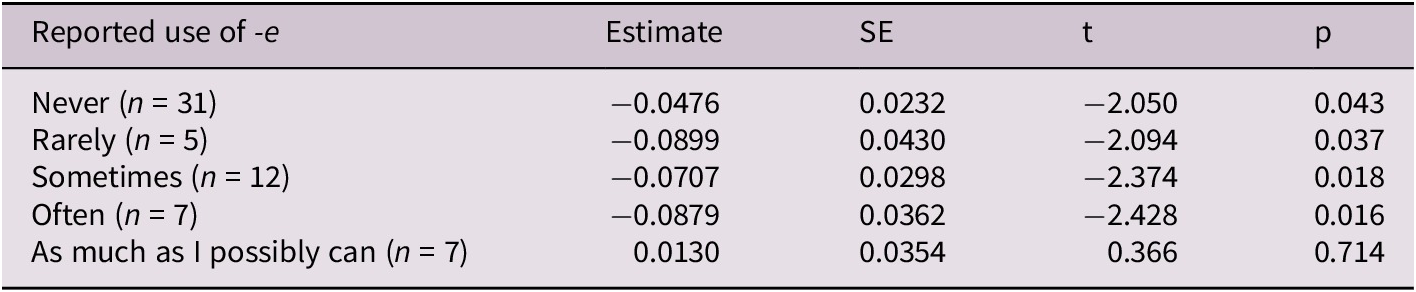
Because frequency of inclusive language use was sum-coded, the fixed-effect coefficients compare each level of use to the grand mean rather than providing direct comparisons within each use-frequency group. To make the pattern more interpretable, we conducted pairwise comparisons of gender morphology within each level of reported inclusive language use (Table 6). Negative estimates indicate slower RTs for -e adjectives relative to -o adjectives.
Pairwise comparisons of gender morphology RTs within levels of reported -e use

Table 6 Long description
Table 6 presents pairwise comparisons of -o versus -e adjective reading times within five levels of reported -e use. Negative estimates indicate slower reading times for -e relative to -o. Significant differences were observed for Never (estimate = -0.0476, p = .043), Rarely (-0.0899, p = .037), Sometimes (-0.0707, p = .018), and Often (-0.0879, p = .016). For participants reporting use of -e as much as possible, the contrast was not significant and was slightly reversed (estimate = 0.0130, p = .714).
Note: Planned simple-effects comparisons examined the -o versus -e contrast separately at each frequency level. Frequency level was specified as the by factor in the ‘emmeans’ package. Thus, multiplicity adjustments were defined relative to each frequency-level group rather than jointly across all frequency levels. Because each group contained only one -o versus -e contrast, no additional multiplicity adjustment across frequency levels was applied.
Pairwise comparisons in Table 6 show that -e adjectives were read significantly more slowly than -o adjectives in all groups except the highest-use group. Among participants who reported using inclusive language ‘as much as I possibly can,’ the contrast was not significant and numerically reversed, with -e adjectives read slightly faster than -o adjectives (p = .714). Thus, the processing cost for inclusive adjectival morphology was present across most use-frequency groups but absent among the most frequent users.
The postcritical region showed spillover effects. Words following inclusive adjectives were read more slowly than those following generic masculine adjectives, 526.32 ms (SD = 248.04, n = 493) versus 458.09 ms (SD = 177.00, n = 487). The best-fit model again included a simple effect of grammatical gender as shown in Table 7,Footnote 14 consistent with the elevated RTs following inclusive adjectives in Figure 2.
Output of the linear model including gender for adjectival data at the N + 1 position

Table 7 Long description
Table 7 presents coefficients from a linear model of adjectival reading times at the post-critical N+1 position. The intercept estimate is 2.63019 (SE = 0.01582, t = 166.277). With -o as the reference level, the estimate for -e is 0.0511 (SE = 0.01407, t = 3.633), indicating longer reading times for inclusive -e adjectives at the post-critical position.
Overall, these results indicate that inclusive adjectival morphology (−e) incurs a measurable processing cost relative to generic masculine forms (−o). This effect is visible both at the critical word itself and in the subsequent spillover region, suggesting that readers require additional time to integrate the inclusive form during sentence processing. At the same time, the interaction between gender and self-reported inclusive language use suggests that experience with inclusive forms may modulate this cost for some speakers. Critically, the expanded dataset replicates the core pattern reported in Durand-López and Dickinson (Reference Durand-López and Dickinson2025), confirming with additional data that inclusive adjectives are processed more slowly than their generic masculine counterparts while also revealing individual variation related to participants’ familiarity with inclusive language.
5.3. Comparing grammatical functions
We next compared the effect of inclusive -e morphology across grammatical functions by contrasting the adjectival data with the todos/todes data. Because both datasets came from the same participants and used the same experimental procedures, this comparison reduces the risk that differences reflect methodological variation. However, raw RTs were not directly comparable because the adjectives were trisyllabic, whereas todos/todes are disyllabic. We therefore compared relative processing costs within each grammatical function: -e versus -o adjectives and todes versus todos.
To assess whether this difference was reliable, we conducted a nonparametric cluster bootstrap with 5,000 participant-level resamples on the log-transformed data. For each participant, we calculated the inclusive-noninclusive RT difference within each grammatical function, converted it to a percentage increase, and then subtracted the pronominal difference from the adjectival difference. The bootstrap distribution yielded a mean difference of 11.5 percentage points in processing cost between inclusive adjectival forms and todes. The 95% bootstrap confidence interval was [4.08%, 19.46%], indicating that the processing burden was reliably greater for -e adjectives than for todes (Figure 3).
Bootstrap distribution of the processing burden between adjectival and pronominal forms with 5,000 resamples.

Figure 3. Long description
A density plot shows the bootstrap distribution of the difference in processing burden between adjectival and pronominal forms across 5,000 participant-level resamples. The distribution is centered above zero, with a mean near 0.042 marked by a solid vertical line. Dashed vertical lines mark the 2.5th and 97.5th percentiles of the bootstrap distribution. The confidence interval lies entirely above zero, indicating that the processing burden was reliably greater for adjectival than for pronominal inclusive forms.
In combination with the descriptive comparisons, the results of the bootstrap analysis indicate that the effect of grammatical gender was systematically stronger for adjectives with -e than for the pronoun todes.
6. Discussion
We investigated whether inclusive -e morphology imposes processing costs during sentence comprehension among first-language Spanish speakers, and whether such costs vary by grammatical function, lexical frequency and speaker experience. To this end, we compared the processing of todes with generic masculine todos, plural inclusive -e adjectives with generic masculine -o adjectives and examined whether self-reported inclusive language use modulated processing in each context. We also compared the relative processing burden of lower-token-frequency inclusive adjectives with that of the higher-token-frequency form todes. This line of research is especially relevant in light of the increasing use of inclusive morphology in Spanish and the limited empirical evidence on how adult first-language speakers process forms that were not part of their linguistic input during childhood acquisition. Existing studies have produced mixed results, and key factors such as grammatical category and lexical frequency remain underexplored. Investigating these factors can help determine how frequency and experience shape the representation and processing of new morphophonological cues such as -e during real-time comprehension.
Our findings provide partial support for our predictions. We predicted that first-language speakers (a) would take longer to process todes compared to the generic masculine todos, (b) would process the inclusive -e morpheme in todes faster than in adjectives, given the relatively high frequency of -e in this pronominal quantifier and (c) would process inclusive forms differently depending on their reported frequency of inclusive language use. While inclusive -e morphology was associated with longer RTs in adjectival forms, only a trivial difference on average for todes over todos (<8 ms) was found. Additionally, the adjectival data revealed that the magnitude of the -e processing cost varied as a function of speakers’ reported use of inclusive language, an effect not present in the pronominal data.
One plausible explanation for this difference involves lexical frequency and distribution. Prior research has shown that inclusive forms in Spanish have not diffused evenly across lexical items or syntactic categories (Núñez-Román et al., Reference Núñez-Román, Gómez-Camacho and Hunt-Gómez2023). Corpus evidence from the Spanish Web Corpus esTenTen23 supports this pattern in the present study: todes appeared 14,259 times, whereas the inclusive adjectives used in our stimuli were far less frequent, often appearing fewer than 100 times or not at all. For example, content-e-s (‘happy-inc-pl’) occurred 89 times, cansad-e-s (‘tired-inc-pl’) 69 times and molest-e-s (‘annoyed-inc-pl’) did not occur at all. Even more tellingly, when each inclusive form was calculated as a proportion of the combined masculine and inclusive tokens, the proportion of todes was approximately twice the highest adjective-specific proportion and nearly 24 times the pooled proportion across all adjective pairs (0.17% vs. 0.007%; see Supplementary Appendix A for the full results). This distributional asymmetry suggests that speakers are more likely to have encountered todes repeatedly than to have encountered many individual inclusive adjective forms, and the proportional comparison indicates that this advantage cannot be attributed solely to the much higher baseline frequency of todos. The reduced processing cost for todes may therefore reflect greater familiarity with, and item-specific entrenchment of, this specific lexical item.
This interpretation is consistent with usage-based models of grammar, which posit that frequency of exposure strengthens mental representations and facilitates processing (Bybee, Reference Bybee2006, Reference Bybee2012; Ellis, Reference Ellis2002a, Reference Ellis2002b; Langacker, Reference Langacker1987). Under this view, high-token-frequency forms are more likely to become entrenched and processed as familiar units, while lower-frequency forms may rely more heavily on morphological analysis. The present findings align with this account: todes, as a relatively frequent and socially salient form, appears to be processed with relative ease among our participants, whereas inclusive adjectives show a clearer processing burden. This pattern also converges with experimental evidence showing that token frequency can strengthen representations of particular forms and facilitate their processing (Endress & Hauser, Reference Endress and Hauser2011).
Beyond differences in processing speed, our experimental findings may also reflect differences in how these inclusive language forms are stored in memory and processed. Usage-based models predict that frequent forms like todes are more likely to develop strong lexical representations that permit whole-word access, while less frequent forms may rely more heavily on online morphological analysis (Bybee, Reference Bybee2012; Diessel, Reference Diessel, Dąbrowska and Divjak2015; Ellis, Reference Ellis2002a, Reference Ellis2002b; Gobet et al., Reference Gobet, Lane, Croker, Cheng, Jones, Oliver and Pine2001). Hybrid models of morphological processing (Burani & Laudanna, Reference Burani, Laudanna, Frost and Katz1992; Caramazza et al., Reference Caramazza, Laudanna and Romani1988) similarly posit that high-frequency forms tend to bypass morphological decomposition and are instead retrieved directly from the mental lexicon. In contrast, low-frequency forms, especially those that are morphologically regular but novel, may be processed through decomposition and recombination, potentially increasing processing demands. Thus, although todes and the inclusive adjectives both utilize the same novel -e morpheme at the surface, their processing profiles may diverge in ways that can be explained by frequency-driven entrenchment mechanisms (Bybee, Reference Bybee2012; Langacker, Reference Langacker1987). This interpretation should be treated as provisional, however, since self-paced reading cannot directly distinguish whole-word retrieval from decomposition. Future work using masked priming, eye-tracking or event-related potentials (ERPs) could test these processing mechanisms more directly.
Beyond lexical frequency, this study examined how individual patterns of reported inclusive language use relate to RTs. Adjectival -e forms were sensitive to participants’ reported frequency of inclusive language use, whereas todes showed no meaningful processing cost. This contrast is consistent with todes being entrenched as an individual lexical item but does not necessarily indicate that speakers represent -e as a productive morphological pattern across other lexical items. Overall, these findings support usage-based accounts in which repeated exposure and use promote entrenchment and reduce cognitive load during comprehension. From this perspective, slower processing of inclusive adjectives among infrequent and nonusers is consistent with lower familiarity and weaker entrenchment. Although the reduced cost among frequent users could in principle reflect facilitation from individual lexical entrenchment, our adjectival stimuli sampled a wide range of lexical items, which makes it less likely that this effect is driven primarily by repeated exposure to those specific tested forms. This pattern is more consistent with facilitated access to -e as a recurring morphological cue across items than with retrieval of prestored whole-word representations, though our data cannot adjudicate between a fully productive, structurally integrated schema and a more diffuse, item-general familiarity effect that falls short of complete grammatical integration (Bybee, Reference Bybee2012; Ellis, Reference Ellis2002a, Reference Ellis2002b).
The contrast between adjectival -e forms and todes suggests that the latter may have stabilized as a lexicalized form that does not impose meaningful additional processing demands. This pattern likely reflects the comparatively high frequency and broader recognizability of todes: speakers may be more likely to have encountered todes than any given inclusive adjective. In contrast, exposure to individual inclusive adjectives is more variable and more strongly tied to frequency of inclusive language use, such that frequent users are more likely to have encountered the -e morpheme across a wider range of adjectival forms. In usage-based terms, todes may therefore benefit from high token frequency and item-specific entrenchment, whereas experience with -e across multiple adjective types could support a broader morphological schema.
Our results also show that inclusive morphology should not be treated as a single processing phenomenon. The absence of a cost for todes does not mean that inclusive -e morphology is uniformly easy to process, just as the cost for adjectives does not mean that all -e forms are equally difficult. Rather, processing appears to depend on a combination of factors, including form frequency, grammatical function, lexical distribution, and speaker experience. This interpretation aligns with the finding that processing costs for nonbinary morphemes are shaped not only by structural novelty but also by social-cognitive factors such as gender beliefs, working memory and language dominance (Román-Irizarry et al., Reference Román-Irizarry, Beatty-Martínez, Torres and Kroll2025).
These findings have important implications for the acquisition of novel morphological forms by first-language Spanish speakers. They suggest that high token frequency can facilitate lexical entrenchment before a fully productive morphological rule emerges, while schema-level generalization likely requires repeated exposure across multiple lexical items (Baayen & Lieber, Reference Baayen and Lieber1991; Bybee, Reference Bybee1995, Reference Bybee2012; Ellis, Reference Ellis2002a, Reference Ellis2002b). More broadly, the results are compatible with adult speakers integrating noncanonical forms into real-time processing routines when exposure and communicative relevance are sufficient, an outcome broadly consistent with accounts in which speakers’ grammars can continue to change incrementally across the lifespan (Blythe & Croft, Reference Blythe and Croft2021). Although prescriptive norms may shape attitudes toward inclusive language, they do not appear to fully constrain what speakers learn, use or process. The potential uptake of the -e morpheme among the high-frequency user group of our participants raises the possibility that adult first-language speakers can gradually incorporate novel functional morphology into established processing routines. We stress, however, that our data speak to facilitated online processing rather than to a confirmed structural reorganization of the grammatical system. Whether this reflects primarily lexical entrenchment, the emergence of a broader morphological schema or some combination of the two remains an empirical question that the present design cannot resolve.
These findings must be interpreted within the study’s limitations. First, the largest proportion of our participants came from Argentina, a country with comparatively high visibility of inclusive language, which may limit generalizability of our findings to other regions of the Spanish-speaking world. Second, the study did not model grammatical function and lexical frequency in a unified statistical framework, instead relying on comparisons across separately run analyses. Finally, our stimuli presented a mix of traditionally gendered names. If participants associated todes primarily with nonbinary reference, integrating it with a context composed of stereotypically gendered names may have created a referential mismatch and increased RTs; a broader inclusive interpretation may have produced little or no such cost. Clarifying how the -e morpheme is processed in different contexts remains an important area for future research.
Nevertheless, the findings of the present work point toward a broader question about the diffusion of novel morphology. Building on Bybee’s (Reference Bybee2012) exemplar-based account of grammatical meaning, which emphasizes the role of frequency and context in diachronic morphological change, these results suggest that high-frequency tokens within an exemplar network may help create conditions for the later generalization of new morphological patterns. In this view, high-frequency exemplars such as todes could act as entry points for novel morphology, supporting later generalization to broader paradigmatic contexts. Although the present study does not test this developmental sequence directly, it identifies a processing pattern consistent with its initial, item-specific stage.
In the present data, todes is consistent with this possibility. Despite being morphologically innovative, its relatively high frequency and use in vocative or group-reference contexts may make it especially likely to become entrenched and readily processed. By contrast, inclusive adjectives with the -e morpheme, such as bonit-e-s (‘beautiful-inc-s,’) remained more difficult to process, suggesting that the entrenchment of one form does not necessarily entail full productivity across the morphological system. Rather, frequent lexical items that contain novel morphology may provide speakers with salient exemplars that facilitate familiarity with a new pattern, while broader productivity likely depends on repeated exposure across a wider range of lexical and grammatical contexts. When supported by social salience and repeated use, such exemplars may help scaffold the extension of novel forms into related morphological schemas.
This possibility generates several directions for future research. In the specific case of inclusive -e in Spanish, other high-frequency inclusive forms used in address or group-reference contexts, such as chiqu-e-s (‘young person-inc-pl’) and amigu-e-s (‘friend-inc-pl’), may show similar processing advantages among first-language speakers. More broadly, future work could test whether entrenched and socially salient lexical items facilitate the uptake and processing of novel morphology beyond their original lexical contexts.
7. Conclusion
The present study examined the processing of the inclusive pronominal quantifier todes in comparison with masculine todos and contrasted these findings with earlier results comparing inclusive -e adjectives and their generic masculine counterparts. The results suggest that the processing consequences of inclusive morphology are not uniform across grammatical contexts: while inclusive -e adjectives incurred a significant processing cost relative to generic masculine adjectives, todes did not require significantly greater RTs than todos. A direct comparison between word types further indicated that the effect of inclusive morphology on RTs was stronger for adjectives than for pronominal quantifiers.
These findings contribute to growing evidence that lexical frequency and patterns of use modulate the processing of innovative forms, consistent with usage-based models in which exposure promotes entrenchment and facilitates online comprehension. More broadly, the reduced processing burden of todes suggests that high-frequency exemplars may serve as entry points for emergent morphological categories, supporting later generalization to broader paradigmatic contexts. At the same time, variability across participants underscores that the diffusion of inclusive morphology is not uniform but mediated by differences in experience and usage. Future research should further examine the social and cognitive dimensions of inclusive-form processing, including factors such as language ideologies and working memory (see Román-Irizarry et al., Reference Román-Irizarry, Beatty-Martínez, Torres and Kroll2025), and test whether frequent, socially salient exemplars facilitate the uptake and extension of novel morphology across languages and morphological systems.
Supplementary material
The supplementary material for this article can be found at http://doi.org/10.1017/langcog.2026.10112.
Data availability statement
Anonymized data, as well as reproducible R codes and study materials can be found here: https://osf.io/zg7vj/.
Funding statement
This work was supported by internal departmental funds provided to the authors by Rutgers University and the College of Charleston.
Competing interests
The authors declare none.
Ethical standards
All procedures performed in this study had been approved by the Institutional Review Boards at Rutgers University (Protocol number: Pro2023000742) and the College of Charleston (Protocol number: 2023-02-014) prior to data collection.









 Open access

