Introduction
The enlargement of the European Union (EU) in 2004 extended rights to live and work in other EU Member States to nationals of the Accession 8 (A8) countries.Footnote 1 Consequently, over one million Central and Eastern European (CEE) migrants entered the UK to take up paid work. Estimates indicate that around half of this number remains in the UK whilst the others have since either returned to their countries of origin or relocated elsewhere (Pollard et al., Reference Pollard, Latorre and Sriskandarajah2008). The UK proved to be a popular destination for these new European citizens for several reasons. First, although transitional arrangements allowed for a phasing-in period for the extension of full EU citizenship rights to A8 nationals, the UK was one of only three among the existing 15 EU Member States that granted A8 migrants immediate access to the paid labour market. Additionally, a long period of sustained economic growth (which has now ended), a favourable disparity in wage earning potential between A8 migrants’ countries of origin and the UK, alongside a comparatively low and regressive tax system all made the UK an attractive proposition for A8 migrants looking to exercise their new rights to freedom of movement as EU citizens (Stenning et al., Reference Stenning, Champion, Conway, Coombes, Dawley, Dixon, Raybould and Richardson2006). For A8 migrants, the expansion of the EU opened up possibilities for a diversity of new migratory movements, across a spectrum ranging from permanent residence in another Member State to more fleeting, circulatory and multiple short-term moves (Ryan et al., Reference Ryan, Sales, Tilki and Siara2009). The latter led some to invoke a ‘turnstile’ rather than a ‘floodgate’ imagery of contemporary A8 migration (Pollard et al., Reference Pollard, Latorre and Sriskandarajah2008). Nonetheless, A8 migrants have had a noticeable impact within the particular local UK neighbourhoods where they reside. In urban settingsFootnote 2 these have typically been inner-city neighbourhoods, many of which are characterised by high levels of social deprivation and are home to ethnically diverse established communities (Amas, Reference Amas2008).
Rights to live and work in host Member States conferred by EU citizenship are subject to individuals meeting specified conditions. All EU nationals who wish to reside in another Member State for more than six months must be employed, self employed or hold student status and have access to sufficient resources and health insurance to ensure they can maintain themselves without recourse to the host state's benefit/welfare system; or be a family member of a person who fits the three noted categories. Additionally, for an initial seven-year transitional period (until May 2011), the EU citizenship rights of A8 nationals were further compromised as EU15 Member States were allowed ‘to decide the conditions under which EU8 [i.e. A8] and EU2 nationals access employment in their territories’ (Currie, Reference Currie2008: 17). The UK government stipulated that A8 nationals were required to register with the Workers Registration Scheme (WRS) in order to legally live and work in the UK. As workers who contribute through the taxation system, A8 migrants were able to access certain social security benefits, but their entitlements were, before May 2011, subject to specific rules. Throughout the transitional period, as soon as they started to work, A8 migrants who had registered with the WRS had the right to access child benefits and tax credits. However, in order to become eligible for income-related benefits, A8 workers needed to have worked continuously for a period of one year (CPAG, 2010).
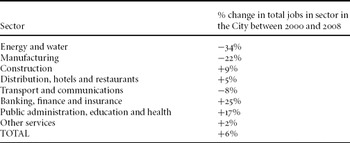
Significant changes in ‘the City's’ paid labour market by sector 2000–08

Source: Annual Business Inquiry (Office for National Statistics, 2009).
Following an outline of the methods employed to generate the original data that informs the subsequent discussion, this paper initially considers competing evidence about the impact of A8 migration upon employment opportunities and housing provision in the inner-city communities that host many new migrant groups. Although some research argues that A8 migration has brought many positive gains, using new data from a study in a northern city alongside wider available literature this paper presents evidence that many members of the established communities who live alongside A8 migrants believe that their opportunities have been adversely affected by the arrival of the new migrants. It is then argued that the perceptions and reactions of established communities are best understood in terms of ‘defensive’ and ‘proactive’ citizenship engagement as outlined by Ellison (Reference Ellison2000). As A8 migrants proactively engage with their newly acquired EU citizenship rights to live and work in the UK, they engender a form of defensive citizenship among established communities who often perceive newly arrived A8 migrants as being in direct competition with themselves for certain local jobs and welfare resources.
Study outline and methods
The qualitative data presented in this paper was generated in a study concerned with the needs, perceptions and experiences of A8 migrants and established communities in a northern English city. In the past twenty years, this former industrial city has attracted significant investment and, at the time of the study (prior to the economic downturn of 2009), featured a diverse and dynamic service-based economy, with retail, call centres, office work and media all important to the local labour market. The city retains sizeable low-skilled and low-paid labour market sectors, i.e. hospitality, construction, manufacturing, food-processing (see Table 1 for recent size changes in different sectors of the PLM (paid labour market)). The parts of the city that are characterised by poverty and multiple deprivation are also shaped by ethnic, racial and class dynamics, and the city's history of migration, particularly from the South Asian continent, has contributed to its current demographic profile. New, more recent, waves of immigration (including refugees and A8 migrants) have led to greater diversity among the city's population.
A qualitative methodology was chosen because we wanted to explore how A8 migration was perceived and experienced by both A8 migrants and the established local communities in the localities where many CEE migrants reside. Qualitative research is about exploring and understanding ‘people's own accounts of situations and events, [and] with reporting their perspectives and feelings’ (Hakim, Reference Hakim1987: 8). People's perceptions and feelings about others may be based on any number of factors (for example, limited or flawed information, political rhetoric, public policy, hearsay, bigotry, etc.); nonetheless, attempting to explore and understand perceptions, particularly in relation to issues such as migration, is important as ‘concerns have to be tackled and misperceptions have to be cleared up, without presenting an overly optimistic view of the migration challenge’ (Canoy et al., Reference Canoy, Beutin, Horvath, Hubert, Lerais, Smith and Sochacki2006: 4).
Purposive sampling was used to recruit 89 respondents. A8 migrants and established community members were recruited following contacts with local community centers and key informants and service providers identified after discussions with the project's sponsor. In total eleven focus groups, with between six and nine respondents, and ten semi-structured interviews with key informants (e.g. recruitment agencies, employers, community support workers) were undertaken. Semi-structured question guides were developed and piloted/refined in initial sessions.
Focus groups were chosen as the main research instrument because they allow for differences of opinion and experience within groups to emerge but also facilitate a collective understanding of the particular social norms and values that a specific group brings to the research (Morgan, 1993). Three focus groups with A8 migrants (i.e. Polish men, Polish women and Slovak mixed gender) were convened in local community centers. We initially intended to hold a focus group with Roma migrants; however, it was necessary to modify our original approach to gain their trust. They agreed to participate provided that interviews were conducted in their homes and not audio recorded. Four parallel focus groups were also conducted with members of established West Indian, Pakistani (differentiated by gender) and ‘white’ host communities in neighborhoods that had experienced the arrival of significant numbers of A8 migrants. Additionally, three further focus groups were held with agencies involved in the provision and/or administration of local public services, e.g. City Council services, primary care trusts, housing providers and schools.
Two basic principles – informed consent and anonymity – underpinned the fieldwork. Information and consent sheets were translated as necessary and participants were briefed about the aims of the research. Experienced interpreters were present as required. Interviews were routinely recorded on audiotape, transcribed verbatim (translated into English by interpreters as appropriate) and analysed using grid analysis and thematic coding techniques (Ritchie and Spencer, 2003).
Exploring the local impact of A8 migration on jobs and housing
The overall positive economic benefits of increased migration into the UK in recent years have been widely recognised and should not be easily dismissed (DCLG, 2008; Pollard et al., Reference Pollard, Latorre and Sriskandarajah2008). A8 workers were welcomed by many British employers, who prior to the economic downturn, struggled to fill ‘dirty, dangerous and dull’ jobs with locally available workers (Favell, Reference Favell2008). However, the impact of increased migration on the UK labour market remains the focus of much debate. Coats argues (2008: 5), there is little evidence ‘to suggest that migration is having a significant negative impact on the UK labour market’. Lemos and Portes (Reference Lemos, Portes and 2008) similarly assert that A8 migration has had no noteworthy impact on claimant unemployment, no adverse effect on vulnerable sub-groups within the working-age population (such as young people and low-skilled workers) and perhaps only a limited impact on wages. Although many agree that there is limited evidence to suggest migration has a significant, general long-term negative impact on the employment rates or wages of established workers, a number of commentators argue that A8 migration may, in the short term, have more damaging effects for the most disadvantaged groups within the established workforce, particularly those with histories of long-term unemployment (TUC, 2007; HoLSCEA, 2008; Jurado, and Bruzzone, Reference Jurado and Bruzzone2008; Reed and Latorre, Reference Reed and Latorre2009). As Goodhart notes, even if much analysis highlights that, generally, increased migration has been beneficial to the UK, ‘not everyone benefits from high levels of low-skill immigration’ (2006: 38).
Andrews et al. (Reference Andrews, Boyne, Meier, O'Toole and Walker2009: 32) analysis, exploring the quality of English local authorities’ delivery of public services, notes that ‘results suggest that [A8] worker migration is significantly associated with worse service performance and citizen satisfaction’. They go on to argue that local authorities experiencing a sudden influx of people from CEE states, faced with the subsequent increases in both the quantity and variety of needs to be met within a locale, struggle to maintain service standards. This is likely to mean, particularly when constrained budgets are the norm, that existing services to established communities have to be cut to meet these new needs and/or that available resources have to be spread more thinly, leading perhaps to resentment among more established groups. Andrews et al. (Reference Andrews, Boyne, Meier, O'Toole and Walker2009) clearly believe that A8 migration presents challenges for certain local communities and those local authorities who are charged with managing needs and delivering services in what are increasingly ethnically diverse populations.
Evidence from our study tends to support the views of more pessimistic commentators who argue that A8 migration may have had a negative impact on the job opportunities and services available to established host communities. Across all of the focus groups we conducted with members of established communities, the consensus was that they were in direct competition with newly resident A8 migrants for any available, low- and semi-skilled jobs. The chef below (who was unemployed when interviewed), and others who participated in discussions, linked their situation to employers’ wider exploitation of migrant labour in order to reduce costs.
R1: I am a bar chef . . . ten years ago my job, the certain skills involved, were worth more than they are now because Eastern European people come in and do my job cheaper than I'll do. I don't know how they live and support themselves because you know £5–£6 an hour is not a good amount of money . . . people will do jobs cheaper. So the kind of jobs I can do to support myself – there's less of them about . . . That's how I'm uncomfortable with it. But if we're in a European Union with open borders, then it's like anything else. They are closing factories, call centres here and sending them to India.
R2: They've been brought in and it keeps the wages down . . . There are a lot of jobs that they will take, for low wages. It's like, if I could get you, as an employer, for £5 an hour or pay somebody English £10 an hour, and you could do the same job, I'd have you for £5. (FG8Footnote 3 white residents)
R1: Most of our kids cannot get a job and these people [A8 migrants] do a job for £2–£4 an hour. Kids born in this country won't take a job for £4. The minimum wage is £5 something, so these people are taking their jobs. (FG5 Pakistani men)
Members of established communities clearly believe not only that they are losing out to A8 migrants in local labour markets, but that the new arrivals are reducing the wage levels for low- and semi-skilled work. Indeed, new migrants are often identified by employers as hard working and cheap, not only in terms of wages but also in respect of the costs of the reproduction of labour (Spencer et al., Reference Spencer, Ruhs, Anderson and Rogaly2007). This view is endorsed by several employers in our study who commented on A8 migrants’ superior ‘work ethic’ and their willingness to ‘go the extra mile’ (KI4 logistics/distribution company). For employers, looking for a competitive advantage within a flexible economy, the availability of new migrant labour from CEE, that is often willing to work hard for less than the locals, is too good an opportunity to miss (MacKenzie and Forde, Reference MacKenzie and Forde2009).
Housing: the most contentious issue?
Amas's (Reference Amas2008: 17) assertion that ‘competition over scarce resources, and specifically housing, in socio-economically deprived neighbourhoods is at the heart of tensions between established communities and new migrant groups’, highlights another contentious area that consistently featured in discussions with established community members. In a situation where local demand for accommodation outstrips supply, participants routinely outlined the view that A8 migration had negatively impacted on their local housing options. Newly arrived migrants were consistently blamed for pushing up neighbourhood house prices and inflating private sector rental costs.
Houses have got more expensive because of them. Prices of houses have risen, rent is more expensive. (FG6 Pakistani women)
Rent is going up . . . a lot of private landlords, getting on the bandwagon. (FG8 West Indians)
The potential for housing-related issues to fuel resentment between established communities and their newly arrived neighbours was further emphasised when members of the established white community discussed social housing. Central to their concerns was a strongly held perception that A8 migrants were receiving preferential treatment in respect of accessing social housing and allied support.
R1: Some moved into the estate where I am . . . a few of the families were a bit narked off because you were seeing all these vans turn up and they were getting the houses totally kitted out. It caused a bit of an atmosphere, to put it nicely . . . Then we found out talking to them, ‘Yes the council have got all this for us.’
R2: They were getting that provision from the social, the council and everything but anybody else from here, from England, was getting told, take your little social grant or whatever and buy second hand. (FG8 White residents)
Further debate revealed that the newly arrived migrants in question were not A8 migrants, but asylum seekers housed and supported under the separate system UK Borders Agency system. Nonetheless, the data above are important for two reasons. First, it is indicative of a widespread lack of knowledge about rights to housing and welfare for migrants that have arrived in recent years. Such misunderstandings are hardly surprising given the complicated rules that govern varied entitlements to social housing (Rooney, Reference Rooney2008; Garner, Reference Garner and Sveinsson2009). Second, it illustrates how access to, and the allocation of, scarce public resources can breed resentment among established residents who perceive their rights and needs to be secondary to those of new arrivals.
Such sentiments are not unique to our study. Hostility and resentment among sections of established communities in the East End of London, particularly the white working class, towards the Bangladeshi community are noted elsewhere (Dench et al., Reference Dench, Gavron and Young2006). In a later piece written to defend his work in the face of fierce criticism (see Moore, Reference Moore2008), Dench notes that the perceived prioritisation of the needs of newcomers above and beyond the claims of established community members is:
regarded with great suspicion by most people with local family connections, including international migrants who had been living there long enough to have experienced its consequences. (2008: 340)
However, available evidence on the occupancy of social housing challenges the perception that new migrant groups are likely to be allocated social housing before more established residents. Robinson's (Reference Robinson2007) analysis shows that less than 1 per cent of social rented lettings across England are allocated to A8 nationals. The majority of A8 migrants do not have sufficient priority housing needs to qualify for social housing (ICoCo, 2007) and decisions on A8 nationals’ applications for housing and homelessness support (including those deemed to be ineligible) represented only 0.5 per cent of local authorities’ total judgements in the period May 2004 to June 2008 (UKBA, 2008).
Nationwide, A8 migrants typically live in privately rented properties and make little use of social housing (Amas, Reference Amas2008). Many, initially, live in housing provided by an employment agency, but often quite rapidly exit this to seek out privately rented accommodation that is cheaper or of a better standard. This additional demand for housing may push up rents and house prices which, as noted above, many ‘locals’ see as detrimental. Additionally, our study confirms that the majority of A8 migrants have problems accessing social housing due to limited eligibility, the general shortage of social housing stock and long waiting lists.
Rutter and Latorre (Reference Rutter and Latorre2009) similarly found that foreign migrants were not being given preferential access to social housing. However, they also acknowledge the persistent belief among many established communities that new migrants are afforded preferential treatment – a view reiterated in our research:
There is a perception that if you come in as an immigrant group, and A8s are a big group at present, you will get preferential treatment for services . . . I don't think we could build enough to meet demand [even] without the additional pressure of people coming to [city]. This causes a lot of conflict. If the son/daughter of someone who has lived on an estate for 20 years can't access a property, it breeds resentment and frustration . . . Many of the emails I see about discrimination are usually people perceiving the letting system as an unfair process. Ultimately, this is because housing goes to the person with most priority, based on housing need. (SP1, Social housing provider)
Media scare stories play their part and the sale of former council housing stock to private landlords, which is subsequently privately let to new migrants, may also fuel misconceptions (Rutter and Latorre, Reference Rutter and Latorre2009). However, as affordable social housing stock in many urban neighbourhoods has diminished in recent decades, simultaneously those same neighbourhoods have become home to increasingly diverse populations. Some additional demand for local social housing is bound to occur when new migrant groups, including A8 migrants, become eligible for social housing. Many established white and minority ethnic communities, therefore, view themselves as competing with recently arrived migrants for scarce housing resources. The additional demands generated by new migrant groups on the available social resources of certain neighbourhoods and the needs emerging from the ‘super diversity’ emerging in the UK's larger cities need to be acknowledged (Vertovec, Reference Vertovec2007).
Debates about recently arrived migrants having to compete with established communities for scarce, local resources, such as jobs and housing, have a long history. Burney's (Reference Burney1967) study highlights the disadvantages and discrimination faced by ‘Commonwealth immigrants’ in London trying to secure reasonable accommodation against a backdrop of a local housing shortages. She provides a strong critique of allocation mechanisms (often based on of length of residence and local connection) that prioritise ‘local people's’ rights to social housing above the often greater needs of newcomers.
Banton's (Reference Banton1983) rational choice approach to understanding how different ethnic groups compete for scarce resources and how discriminatory and racist practices may be invoked as one group seeks to defend what it regards as its interests and entitlements against those of others is also relevant here. Central to Banton's theory is the idea that it is in the process of competing for scarce resources that ethnic and racial groups coalesce and assume significance. Individuals find common ground with those they view as being like themselves whilst excluding ‘others whom they define as ineligible to belong to their group’ (1983: 106). Banton's discussion specifically highlights the housing and employment markets as two sectors where competition for resources are routinely played out between groups. He is also aware that it is often the poorer sections of majority populations that are most likely to resort to exclusive tactics, as it is almost certainly they who will be most affected by increased competition, and they often lack the social and cultural capital to pursue other options.
Discussions in this paper indicate that the boundaries between groups are not always mobilised around simple white/non-white divides. Boundaries can be articulated around residence, locality or a perceived lack of appropriate prior contribution (Garner, Reference Garner and Sveinsson2009). Those deemed to lack a legitimate claim for scarce local resources may also be white, as is the case with many A8 migrants. Similarly, the exclusive rhetoric among disadvantaged urban communities is not solely limited to white populations. Although, as Garner (Reference Garner and Sveinsson2009) reports, the white working class see themselves as the ‘exclusive victims’ of local disempowerment and abandonment, our study perhaps illustrates that these feelings are also a feature of other non-white established communities’ perceptions and that they too are fearful that A8 migration may negatively impact on the already limited local resources they are able to access. The social change occurring in certain neighbourhoods as a result of A8 migration is played out against the backdrop of past migration and the common structured disadvantages faced by established white and minority ethnic working-class communities.
A question of citizenship?
The arrival of unprecedented numbers of A8 migrants has triggered unease among some members of the more established communities who live and work alongside their new neighbours. Two linked factors have been identified as central to their concerns. First, increased competition for scarce resources – more specifically, jobs and housing. Second, a perception that new migrants are given preferential treatment, often to the detriment of more established citizens, when accessing those resources. It has been widely acknowledged that such issues can play a role in promoting resentment and intergroup tensions, particularly in relatively deprived urban settings, across the UK (Zetter et al., Reference Zetter, Griffiths, Sigona, Flynn, Pasha and Beynon2006; Amas, Reference Amas2008; Jurado and Bruzzone, Reference Jurado and Bruzzone2008). The key question of how we might best understand the attitudes and concerns raised by the members of established communities remains. A consideration of discussions related to citizenship is required.
A8 migration into the UK came about as a direct result of the 2004 enlargement and the extension of EU citizenship rights to A8 nationals. This opened up new opportunities for many CEE Europeans to exercise the mobility inherent in their newly acquired (supra-national) EU citizenship status. In the past, citizenship status and the social rights that subsequently ensue have been closely linked to membership of a nation-state. Today local, national and supra-national communities are all important sites in which people seek to exercise their citizenship status (Faist, Reference Faist2001). Any meaningful understanding of the tensions that A8 migration may engender between established white and minority ethnic locals and A8 migrants needs to take into account both the plurality and contested character of contemporary citizenship (Joppke, Reference Joppke2007).
Proactive and defensive citizenship engagement
As Ellison (Reference Ellison2000: 1.1) notes, contemporary citizenship is characterised by changing modes of participation and belonging, where citizen engagement is played out in a range of spaces from local to global: ‘Rapid change transforms the nature of citizen participation and “encourages” engagement, willing or not, in the pursuit, or defence, of particular interests and/or social rights.’ Making a distinction between two different types of citizen activity, Ellison notes that ‘proactive engagement’ occurs when specific groups are able to utilise a particular set of social resources and conditions to enhance their interests (or those of others). In contrast, ‘defensive engagement’ is often triggered as citizens, in the face of ongoing economic, social and political change, mount a defence against ‘the erosion of their social rights’ (Ellison, Reference Ellison2000: 1.4). In short, proactive engagement is often linked to the expansion of citizenship and an extension of the rights that citizenship brings to others, whilst defensive engagement routinely occurs when certain citizens are looking to preserve or maintain their existing entitlements and interests.
How useful is this insight when considering the local impact of A8 migration and the, at times, exclusive response of host communities? This paper primarily focuses on the ways in which established communities experience and make sense of the local impact of migration within their neighbourhoods. Nonetheless, a brief discussion of the motivations underpinning A8 respondents’ decisions to migrate to the UK, and the ways in which they look to access health services is important in illustrating how A8 migrants are able to proactively engage with EU citizenship to enhance their interests. A desire to find work, reinforced by a favourable disparity in wage-earning potential between their countries of origin and the UK, was the pre-eminent motivation across all the A8 migrant groups we interviewed.
There're no jobs in Slovakia and wages are very low. One week's wage is as much as one month's in Slovakia. (FG1 Slovaks)
We're doing easy work for small money. But small money here is big money in Poland. If we did the same in Poland – we would have no money. (FG2 Polish men)
From 2004, the relative economic advantages available, for the first time, to A8 nationals looking for work in a booming UK labour market were undoubtedly a strong pull factor in many initial decisions to migrate. Among the Roma participants within our study, this was also augmented by a strong desire to escape the endemic persecution and discrimination they faced within in their country of origin.
I came to England to escape the racism in Slovakia . . . We are normal human beings, but [in Slovakia] I could not work in a restaurant, people would not take food from me. (Roma 2, Mother)
This position was endorsed when two other Roma participants described previous, unsuccessful attempts to relocate their families to the UK by claiming asylum prior to EU enlargement. All the Roma families intended to settle permanently in England and rebuild their lives.
Within our study, A8 respondents were registered with local doctors and had used hospital services when required. However, the level of additional demand from A8 migrants for health services appears to be relatively low, for two reasons. First, many migrant workers are young and healthy. Second, the majority of A8 migrants consistently preferred to return to their home country to more quickly access familiar and, in their view, more appropriate healthcare services:
When we go home on holidays we all see doctors, especially the dentist. (FG1 Slovaks)
R1: When I go to Poland I always have three visits; to the dentist, the doctor for me, and with my kids and the gynaecologist.
R2: Like all Poles, we go to Poland for medical treatment.
R3: I went to the doctor here and he advised me to take Paracetamol four times a day. So next week I am going to Poland to see a specialist. (FG4 Polish women)
The vast majority of them still go back for dental care, for any operations because they believe it's better and they don't have to wait so long. (KI5a human resources manager, logistics/distribution company).
This brief consideration of the motivations that underpin A8 migrants’ movements is important because it illustrates the particular type of proactive engagement EU expansion has made possible for A8 nationals. A8 migrants exercise their new rights as EU citizens to live and work in a host member state whilst simultaneously utilising their status as national citizens of a particular state in order to access what they consider to be better healthcare services in their country of origin. These movements are indicative of a distinct type of citizenship engagement where individual migrants make a series of proactive choices about how their particular needs may be best served by the opportunities EU expansion has offered them. It is not, at present, about identifiable groups demanding collectivised social rights.
Mobile A8 nationals are proactively engaging with their newly acquired rights to free movement within the EU. For many, relocation offers certain financial and lifestyle advantagesFootnote 4 (Cook et al., Reference Cook, Dwyer and Waite2011). As new EU citizens they are, quite legitimately, looking to exploit the tangible benefits that their new opportunities for mobility may bring. However, the unprecedented and largely unpredicted numbers of A8 citizens who subsequently chose to exercise their rights to live and work in the UK caught the British government by surprise and evidence suggests that in particular locations this movement has a significant impact on local job markets, housing and certain public services (ICoCo, 2007; TUC, 2007).
Against the backdrop of A8 migrants proactively engaging with their new supra-national rights, members of established local host communities start to engage defensively to protect what they perceive to be a threat to their rights to local jobs and housing. In doing so, they consistently seek to justify their stance by legitimatising the exclusion of newly arrived A8 migrants on the basis that jobs and welfare should be reserved primarily for those national citizens who are seen as having previously contributed to the common good of the national community.
R1: I don't care what colour, creed anybody is but it does seem sometimes to be a little bit hypocritical. When you've got so many things over here already that the government won't help with.
R2: All the tax that people have paid from this country . . . That [pointing to a cup] will only hold so much. If you start trying to take more and more out of it, you can't because it's not there. Why should we support all these people, when we've got plenty of our own people to support? (FG8 White residents)
There's too many people here and it's difficult to get houses and it's very difficult to get work . . . First priority for jobs and things should be to the people who are residents of England. (FG6 Pakistani women)
Underpinning such attitudes is the view that the social rights of established community members are being usurped by newcomers whose claims are seen as less valid. Established residents are seeking to defend their position by invoking a restricted understanding of social citizenship tied to a principle of reciprocity, where claims to collective entitlement demand prior contribution (Dwyer, Reference Dwyer2000; Taylor-Gooby, Reference Taylor-Gooby2005). Allied to this is an underlying fear that the already limited resources available to local host communities will diminish further still if the claims of new arrivals are allowed.
R1: There are people that are genuine. They come over here, pay their taxes, pay their dues. Then there's people who come over here and live on benefits. There is in every culture, English, Muslim, Eastern European, but there's got to be a balance.
R3: We're in this country. We want to be included.
R1: It's not so much excluded as ignored . . . There is only a pot so big, like you mentioned . . . it's perceived they get more. If we feel we're being ignored, then we're going to make a stink about it. Because that is when we start thinking, it's our country, they shouldn't be here. I don't think it's because of racism. I think it's because we are British. (FG8 White residents)
As A8 migrants actively look to assert their new supra-national (EU) rights, established community members, who feel their needs are subsequently being marginalised, seek to defend their local rights to goods and services by invoking a national logic of territorialised prioritisation and concern (Morley, Reference Morley2000).
Much work highlights racism, particularly white racist hostility and violence, as a continuing problem for members of the diverse ethnic minority communities resident in Britain. Hemmerman et al. (Reference Hemmerman, Law, Simms and Sirriyeh2007) point out the complex ways in which racism is played out in inner-city communities and also racists’ propensity to explain away, or deny, racist intent when defending exclusive opinions. Similarly, both cultural and economic factors have been identified as key elements in the discourse of those white Britons who seek to justify prejudice (Valentine and McDonald, Reference Valentine and McDonald2004). Elsewhere, work also highlights that racially motivated harassment is part of the everyday experience of many A8 migrants; particularly those of Roma origin with darker skin (Cook et al., Reference Cook, Dwyer and Waite2012). The continuing existence of overtly racist views, and the contrived ways in which they operate within some majority white communities, is graphically illustrated by one of our Roma respondents who explained that he had few problems with his neighbours – once they had realised he was not of Pakistani origin.
First, they think we're Muslim. When they find out I'm from Europe and Christian, it's fine. (Roma 1)
Within the white residents’ focus group, participants were keen to state that racism had little to do with their concerns about the impact of A8 migration. However, it needs to be recognised that, on occasions, some within this group drew upon racist stereotypes to justify their position. Most notably, one person referred to the criminal tendencies of some Eastern Europeans and cited the ‘robust action’ of the Italian authorities (following a murder of an Italian national) to support his view that migrants involved in criminal activity should face deportation.
It is not our intention to make excuses for racists, or to downplay the impact of racism. However, despite the examples noted above, it would be wrong to view the concerns expressed by the majority of respondents as simple expressions of xenophobic intolerance. Across the focus groups with established community members, the most dominant concern was that new migrants ultimately increase competition for the limited jobs and finite welfare resources available to local residents. Fearing that A8 migration would be detrimental to their future needs (as the finite resources within the citizenship ‘pot’ become more thinly spread), many members within establish communities embark on a defensive engagement of what they perceive to be the primacy of ‘their’ claims, as established local residents, by prioritising ‘their’ rights as national citizens above and beyond any supra-national rights that may accrue to A8 migrants by virtue of their new European citizenship status.
Conclusions
Recent migration into the UK has consequences for established populations living in the specific local areas where new A8 migrants are concentrated (HoLSCEA, 2008). In spite of certain evidence which suggests a disjuncture between established communities’ perceptions and the impact of A8 migration, the concerns of the established residents who took part in our study have been more widely acknowledged (TUC, 2007; Amas, Reference Amas2008; Jurado and Bruzzone, Reference Jurado and Bruzzone2008). The belief that newly arrived A8 migrants are in competition with established communities for finite local jobs and housing remains a central issue for established residents; many of whom originally migrated to the UK and/or are members of established black and minority ethnic communities.
Although it has been asserted elsewhere that there is ‘no evidence that migration from A8 countries has had any adverse impact on native workers’ (Lemos and Portes, Reference Lemos, Portes and 2008: 3), many in established communities believe that the arrival of A8 migrants enabled employers to contain or reduce the wages paid to unskilled/semi-skilled workers. Additionally, established residents believe that they have to compete directly with A8 migrants for available local jobs. Similarly, there is a belief that the increased demand for housing pushed up prices in the private sector. Also, despite convincing evidence to the contrary, there is a strongly held misconception that A8 migrants receive preferential access to social housing. In a situation where social housing stock is in short supply, and long waiting lists ensue, social housing is the cause of much discontent. An allied issue for established communities is the principle by which access to social housing is governed. Social housing is allocated according to priority need, assessed according to criteria that may vary between different local authorities. This sits uncomfortably alongside the reciprocal principle (where claims for welfare are linked to prior contribution), as emphasised by the majority of established community members in our study.
Given the ongoing global recession and attendant rising unemployment, it is likely that the concerns of members of the established, and relatively deprived, communities that host A8 migrants will intensify (Jurado and Bruzzone, Reference Jurado and Bruzzone2008; German Marshall Fund, 2009). It is hard for any government to make a convincing case for encouraging high levels of migrant labour as redundancies among the established workforce increase. In the UK, building on the restrictive approach of New Labour (Cheong et al., Reference Cheong, Edwards, Goulbourne and Solomos2007), the Coalition government has implemented strict immigration quotas for non-EU labour migrants (UKBA, 2010). Perhaps established communities are taking a lead from the rhetoric of politicians in respect of non-EU labour migration into the UK. However, the EU is an increasingly important policy actor that limits the ability of individual Member States to set their own parameters in relation to citizenship and migration policy (Lister, Reference Lister2008). In some ways, therefore, the mobility at the heart of EU citizenship that is the focus of host community concerns runs counter to more exclusive UK government policies which seek to curtail rights of entry for non-EU nationals.
Certain commentators are highly critical of recent work which utilises simplistic, racialised discourses that emphasise different ethnic groups competing for scarce communal resources (Sveinsson, 2009). Too much focus on the ethnic differences that exist between groups of commonly marginalised citizens can obscure the wider class-based inequalities that structure the lives of poor citizens regardless of their ethnicity (Bottero, Reference Bottero and Sveinsson2009). It is vital to ensure that debates about the implications increased migration may have on the resources available to disadvantaged citizens do not merely repeat the misinformed view of some commentators that the white working class ‘are the losers struggling for scarce resources, while minority ethnic groups are the winners – at the direct expense of the white working class’ (Sveinsson, 2009: 5). Class remains central to understanding how people are able to access decent jobs and housing in the UK. Even in recession, Britain is a rich nation, but one which finds it harder to share resources between groups; this in turn promotes a politics of mistrust and fear of others (Dorling, Reference Dorling and Sveinsson2009), including newly arrived A8 migrants.
The enlargement of the EU and the resultant extension of EU citizenship rights to A8 nationals generated a significant and largely unexpected wave of migration into the UK. Overall, this migratory movement bought substantial economic gains for the UK. Equally, it is crucial to appreciate that this new migration triggered significant localised challenges for local authorities and the often disadvantaged and ethnically diverse, established communities living in the areas where the majority of new A8 migrants live. The local narratives of established communities about new migration should be listened to and understood, not least to challenge some of the assumptions that can, if left unacknowledged, quickly lead to hostility being directed towards newcomers (Robinson, Reference Robinson2007).
In the changed circumstances of an enlarged and expanding EU, it is vital national governments acknowledge that, when European citizens from new Member States seek to actively engage with their new rights by relocating to work in other EU states, such movements are likely to impact on the citizenship rights and resources available to host country nationals – particularly poorer citizens, many of whom are likely to be members of established black and minority ethnic communities. We should not, therefore, be surprised if those most likely to be negatively affected by A8 migration (that is, established communities working in the lower echelons of the PLM and/or living in deprived areas) then seek to evoke exclusive and constrained notions of national citizenship in defence of a perceived ‘outside’ threat to their relatively disadvantaged circumstances. The ability and willingness of mobile EU citizens to negotiate contributions and rights, across geographical and social space, raises a number of challenges for the EU and the labour markets and welfare systems of Member States (Ackers and Dwyer, Reference Ackers and Dwyer2004). These challenges are most visible within the local neighbourhoods where A8 migrants and established communities live side-by-side. A8 migration is, therefore, a vivid example of how the complexities of contemporary citizenship engagement play out ‘around the persistent (re)interpretation of interests, demands and entitlements in a transformed public sphere’ (Ellison, Reference Ellison2000: 8.1).