Introduction
Prior neuropsychiatric disturbances are risk factors for stroke (Barlinn et al., Reference Barlinn, Kepplinger, Puetz, Illigens, Bodechtel and Siepmann2015). They account for a larger coefficient of association with stroke onset than those estimated for diabetes mellitus, tobacco smoking, and obesity (O’Donnell et al., Reference O’Donnell2016). Prestroke neuropsychiatric symptoms may also be associated with greater stroke severity (Aron et al., Reference Aron, Staff, Fortunato and Mccullough2015), discharge to long-term institutional care (Nuyen et al., Reference Nuyen, Spreeuwenberg, Groenewegen, Van Den Bos and Schellevis2008), and persistent functional disability after home discharge (Sharrief et al., Reference Sharrief2017).
Traditionally, evidence for the risk profile and outcome of neuropsychiatric disturbances in stroke survivors, especially with regards to before-the-stroke psychoemotional syndromes, have been based on findings from depression research (Stulberg et al., Reference Stulberg2019). Through complex biological mechanisms (Loubinoux et al., Reference Loubinoux2012), including effects on stress regulation (Villa et al., Reference Villa, Ferrari and Moretti2018), depression may directly affect functional recovery after a stroke (Stuller et al., Reference Stuller, Jarrett and Devries2012). Some translational research findings (McCann et al., Reference McCann2014) suggest that identification and antidepressant treatment of depression in persons at risk of stroke provide protection around the time of stroke onset, and may improve poststroke rehabilitation outcomes, including greater odds of own home as against nursing home discharge (Stulberg et al., Reference Stulberg2019). The stroke-related risk profile and impact of other neuropsychiatric symptoms on stroke outcomes including disability and mortality have not been carefully examined (Castellanos-Pinedo et al., Reference Castellanos-Pinedo2011; Nuyen et al., Reference Nuyen, Spreeuwenberg, Groenewegen, Van Den Bos and Schellevis2008).
Either alone or as part of a syndrome occurring before stroke onset, some patients may experience anxiety, sleep disturbances, apathy, irritability, aberrant motor behavior, appetite change, agitation, disinhibition, delusions, and hallucinations (Klimiec et al., Reference Klimiec2017). Similar to depression, these symptoms are associated with substantial psychological stress (Castellanos-Pinedo et al., Reference Castellanos-Pinedo2011; Wong et al., Reference Wong2014). Better understanding of the variety of neuropsychiatric antecedents to stroke, their stroke-related correlates, and association with stroke outcomes are desirable. This should be of particular interest to poststroke rehabilitation efforts as well as policy regarding the identification and treatment of prestroke health conditions in the population at increased risk of stroke. Studies of the variety of neuropsychiatric antecedents to stroke are relevant globally, but especially so in sub-Saharan Africa (SSA) where the burden of stroke is substantially increased (Owolabi et al., Reference Owolabi2015).
In the present study, we aim to investigate the prevalence and correlates of 12 neuropsychiatric symptoms occurring in the 1 month before the onset of a first-ever stroke and their association with poststroke depression (PSD), disability, and mortality outcomes at 3 months. Our starting hypotheses are that (1) in the population of stroke survivors, stroke-related risk factors will be salient correlates of prestroke neuropsychiatric symptoms and (2) prestroke neuropsychiatric symptoms will be associated with PSD, disability, and mortality.
Methods
The study is a longitudinal observation of prestroke neuropsychiatric symptoms in Nigerian survivors of a recent (first week) stroke. Participants were residents of Ibadan and surrounding communities, and was admitted for acute stroke care at the University College Hospital (UCH) Ibadan, Southwestern Nigeria. Ibadan is inhabited by about 3.5 million people, who are mostly Yoruba speaking. The UCH is the main referral hospital serving Ibadan and surrounding communities. Ethical approval was obtained from the University of Ibadan/UCH ethics committee (Approval number: UI/EC/13/0358).
Subjects
Consecutive adult ischemic or hemorrhagic stroke survivors were recruited after they had been reviewed by a consultant neurologist primarily responsible for their care. The diagnosis of stroke was confirmed based on neuroimaging and clinical examination criteria (Sacco et al., Reference Sacco2013). Written consent was obtained from all eligible stroke survivors and/or their spouses or adult children after the procedure of the study was explained to them either in English or the local Yoruba languages. We excluded patients in immediate need of medical attention or those having a condition that would limit participation in follow-up assessments. Also excluded were those who were unable to communicate reliably (usually because of aphasia or severe dementia). Patients with mild or moderate cognitive impairment (MMSE ≥ 15) (Hendrie et al., Reference Hendrie2001) were included only after full assessment for the capacity to consent. Baseline data were collected between May 2017 and March 2019.
Measures
Prestroke neuropsychiatric symptoms
Information on neuropsychiatric disturbances occurring in the 4 weeks prior to stroke symptoms was obtained using the proxy-reported version of the Neuropsychiatric Inventory (NPI-Q) (Kaufer et al., Reference Kaufer2000). The neuropsychiatric symptoms assessed by the NPI-Q include delusions, hallucinations, agitation/aggression, depression, anxiety, elation, apathy, disinhibition, irritability, aberrant motor behavior, nighttime disturbance, and appetite change. The measure has been previously validated in patients with stroke or TIA with a sensitivity of 74.1%, specificity of 79.5%, and Cronbach’s alpha = 0.76 (Wong et al., Reference Wong2014).
Outcomes
Assessment of motor disability
Motor disability was assessed at baseline, 1, and 3 months poststroke using the modified Rankin Scale (mRS) (van Swieten et al., Reference Van Swieten, Koudstaal, Visser, Schouten and Van Gijn1988). The mRS is a clinician-reported measure of global disability that has been widely applied for evaluating recovery from stroke. Although it does not provide a comprehensive assessment of ADL, it correlates strongly with the Barthel index and other measures of physical functioning (Kwon et al., Reference Kwon, Hartzema, Duncan and Min-Lai2004). The mRS includes five operationally defined degrees of disability ranging from slight to severe disability, with higher scores corresponding to more severe motor disability.
Assessment of poststroke depression (PSD)
PSD was assessed at 1 and 3 months poststroke using the 10-item Centre for Epidemiologic Studies – Depression Scale (CES-D 10) (Andresen et al., Reference Andresen, Malmgren, Carter and Patrick1994). The tool was developed from CES-D 20 (Radloff, Reference Radloff1977) and is originally validated for depression screening in the older population. The CES-D 10 is well validated and widely used, including in West Africa (Sarfo et al., Reference Sarfo2017), to assess the number and duration of depression symptoms in populations with cerebrovascular diseases. Compared with the diagnostic and statistical manual of mental disorders criterion, a CES-D 10 cutoff score of ≥10, which was used in the present study, has a sensitivity of 80% for detecting PSD: specificity of 71% and area under the receiver-operator curve = 0.82 (95% CI: 0.75–0.89) (Wang et al., Reference Wang, Meyer, Graham and Whooley2018).
Other data collection
The following information was obtained from all participants using a standardized questionnaire: demographic data, marital status, years of formal education, personal history of smoking, alcohol consumption, medical history of hypertension, diabetes, and other comorbid medical conditions. We ascertained economic status using asset-based measures relevant to developing countries (Ferguson et al., Reference Ferguson, Tandon, Gakidou, Murray and Evans2003).
Judgements about global cognitive functioning were made using results from the Mini-Mental State Examination (MMSE) (Folstein et al., Reference Folstein, Folstein and Mchugh1975). The Informant Questionnaire for Cognitive Decline in the Elderly (IQ-CODE) (Jorm, Reference Jorm1994) was used to screen participants for the possibility of cognitive deterioration in the years up to 1-month before-the-stroke event. The severity of stroke was ascertained using the stroke levity scale (SLS) (Owolabi and Platz, Reference Owolabi and Platz2008). The average of two blood pressure (BP) measurements was recorded. Records of other relevant risk factors for stroke were also made. These include fasting blood glucose, serum urea, and creatinine profiles.
Definition of risk factors
Stroke survivors with at least 1 year of formal education were categorized as educated. BP measurements of ≥140/90 mmHg for up to 72 h after stroke, a history of hypertension, or the use of antihypertensive drugs before stroke or more than 72 h after stroke were regarded as indicators of hypertension. Diabetes was defined as a history of diabetes, use of drugs for diabetes, or a fasting blood glucose concentration >7.0 mmol/L. Due to small samples of some categories in the risk factors investigated, alcohol users were categorized into ever and never users of any alcoholic drink. Smoking status was defined as ever and never smokers of a tobacco product. Similarly, economic categories were classified into low/average and higher. Participants with >1 comorbid medical condition with the stroke were classified as having multimorbidity.
Statistical analyses
We summarized prestroke neuropsychiatric symptoms, sociodemographic, and stroke risk factor variables using frequency and percentage while mean and standard deviation (SD) were calculated for age and other continuous variables. Participants were considered to have reached an endpoint if they were available for outcome assessments at 3 months follow-up, or when research supervisors have been reliably informed of their death.
We examined in separate analyses the association of having any, and each, prestroke neuropsychiatric symptoms with demographic, prestroke, and immediate poststroke risk factor variables. These associations were conducted by first comparing stroke survivors who had neuropsychiatric symptoms with those who were free of such symptoms. We estimated odds ratios (OR) of associations using regression analyses. We first conducted unadjusted analyses. Next, we adjusted for age and gender. We controlled for family-wise type I error rates using the simple Bonferroni correction. For this, we considered symptoms in the NPI-Q as one family in the regression models.
The same methods were used in the investigation of the association of prestroke neuropsychiatric symptoms with cognitive, functional, and mortality outcomes. The results of the associations are presented as standardized mean differences (SMD) and OR, as appropriate, with 95% confidence intervals (CI). We computed SMD by dividing mean differences in the relevant outcomes by the pooled SD of their measurement in the entire sample. Analyses were conducted using Stata version 15.0 (Stata Corp, 2013). A level of significance of p < 0.05 was set for all analyses.
Result
Subject characteristics
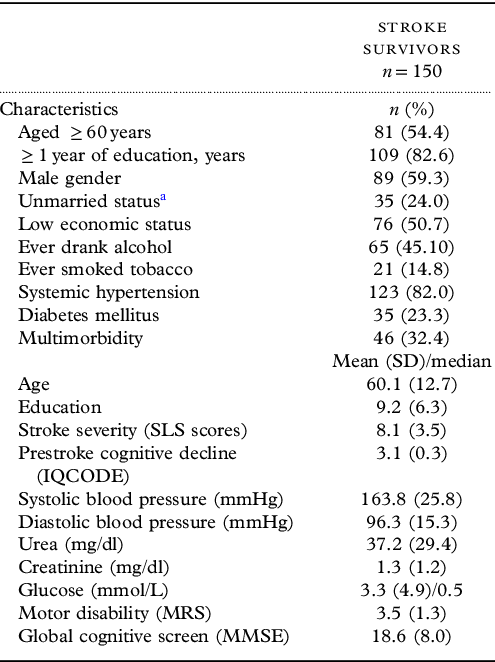
Characteristics of the baseline sample are presented in Table 1. Of the 150 stroke survivors in the sample, 82 (54.7%), 58 (38.7%), and 10 (6.7%) had ischemic, hemorrhagic, and hemorrhagic-infarct stroke subtypes, respectively.
Baseline characteristics of stroke survivors

Abbreviations: IQ-CODE, Informant Questionnaire for Cognitive Decline in the Elderly; SLS, Stroke Levity Scale; MMSE, Mini-Mental State Examination; MRS, Modified Rankin scale.
a Death or divorce.
The mean age of caregivers who provided information about prestroke statuses of participants was 38.7 (±12.8) years. The majority were women (68.6%), with at least high school education (92.7%), who rated their general health good (99.2%). All, but one (Friend), were family members of the stroke survivors. They included 61 spouses, 38 daughters, 31 sons, 12 siblings, 3 mothers, 2 grandchildren, and 1 son-in-law. Ninety-two (61.2%) of the caregivers lived with the stroke survivor or saw them daily.
Prestroke neuropsychiatric symptoms
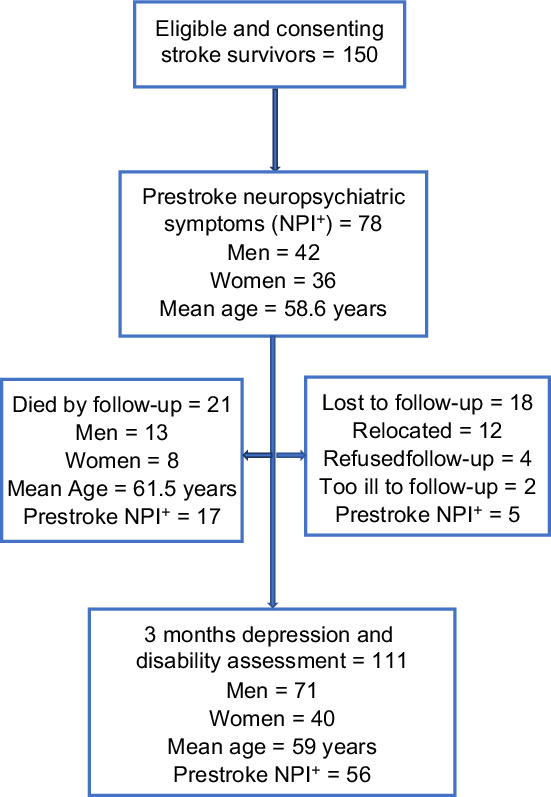
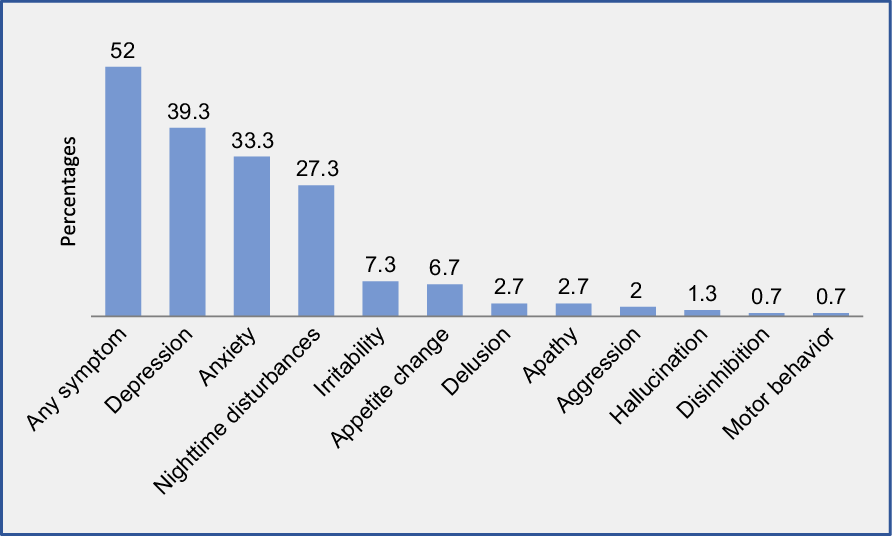
A total of 78 (52%) stroke survivors were reported to have had a prestroke neuropsychiatric symptom (Figure 1). Rates of prestroke neuropsychiatric symptoms were higher in men (53.8%) than women (46.2%). The frequency distribution of the various neuropsychiatric symptoms is presented in Figure 2. Notably, no stroke survivor was reported to have prestroke elation symptoms. In Table 2, systemic hypertension was independently associated with sleep symptoms (OR = 5.39, 95% CI = 1.70–17.08). Also, see Table S1 published as Supplementary material online attached to the electronic version of this paper for the relationship between having any neuropsychiatric symptoms with demographic and stroke-related risk factors.
Flowchart for the study of prevalence, predictors, and prognoses of prestroke neuropsychiatric symptoms in recent stroke survivors.

Frequency of prestroke neuropsychiatric symptoms.

Baseline predictors of prestroke neuropsychiatric symptoms

The number of participants with other neuropsychiatric symptoms was too small to allow for meaningful inclusion in regression models.
* Critical p < 0.01 after partial correction for family-wise type 1 error.
a Based on logistic regression analyses.
b Adjusted for age and gender.
Association with stroke outcomes at 3 months
Of the 150 stroke survivors in the baseline sample, 21 died by 3 months, while 18 were lost to follow-up for reasons such as relocation from study catchment area (n = 12), refusal of further participation (n = 4), and becoming too ill for meaningful follow-up assessments (n = 2). Those who survived and were assessed for the cognitive and functional outcome at 3 months had a mean age of 59 (±13.4) years.
Poststroke depression (PSD)
Forty-seven (31.3%) participants had PSD at 3 months. Baseline stroke severity and MMSE scores were the main correlates of PSD (see Table S2 published as Supplementary material online attached to the electronic version of this paper). In the same table, 20 (42.6%) stroke survivors with prestroke depression symptoms were assessed as having PSD. There was no statistically significant association between prestroke depression symptoms and PSD.
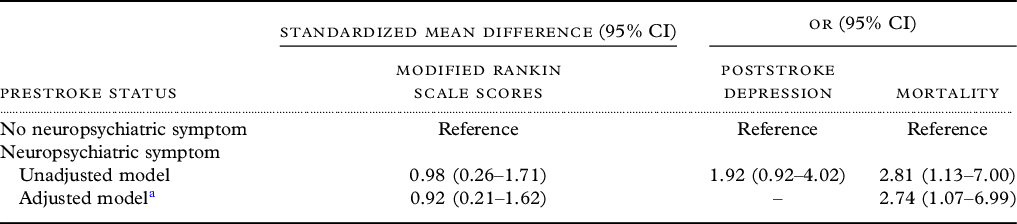
In regression analyses adjusting for the effects of age and gender (Table 3), prestroke neuropsychiatric symptoms independently predicted worse motor functioning scores (SMD = 0.92, 95% CI = 0.21–1.62) as well as greater odds of poststroke mortality (OR = 2.7, 95% CI = 1.1–7.0) at 3 months.
Multivariate association of prestroke neuropsychiatric symptoms with 3 months outcomes in stroke

a Adjusted for age and gender.
Discussion
In this sample of adult Nigerians assessed within 7 days of surviving a first-ever stroke, we found a prevalence of 52% for neuropsychiatric symptoms occurring in the 4 weeks preceding stroke onset. The prestroke clinical picture in stroke survivors with prior psychopathology was dominated by depression (39.3%), anxiety (33.3%), and sleep disturbances (27.3%). Prestroke sleep disturbance was independently associated with systemic hypertension. Having a neuropsychiatric symptom before stroke onset predicted poor motor functioning and mortality at 3 months poststroke.
The 52% estimated prevalence of prestroke neuropsychiatric symptoms in the present study is higher, but not substantially so, than 46.1% reported in the only previous study (Castellanos-Pinedo et al., Reference Castellanos-Pinedo2011), as far as we know, to have used before-the-stroke assessments procedures similar to those of the present study. In the prior study, Castellanos-Pinedo and colleagues (Castellanos-Pinedo et al., Reference Castellanos-Pinedo2011) evaluated neuropsychiatric symptoms in 89 stroke survivors within 48 h of admission to a Spanish hospital using the neuropsychiatric inventory (Cummings, Reference Cummings1997). Similar to the present study, the prestroke clinical picture in Spanish stroke survivors with prior psychopathology was dominated by depression, anxiety, and sleep disturbances (Castellanos-Pinedo et al., Reference Castellanos-Pinedo2011). A key difference between the two studies, where in Castellanos-Pinedo et al. (Reference Castellanos-Pinedo2011), IQ-CODE data were used to exclude patients with possible prestroke cognitive decline but not in the present study, may have resulted in the minor variation observed in the prevalence of prestroke neuropsychiatric symptoms in Spain and Nigeria. These exclusion criteria resulted in a patient sample with better cognitive functioning in the Spanish study (mean MMSE score = 21.6) (Castellanos-Pinedo et al., Reference Castellanos-Pinedo2011) compared with the present study (mean MMSE = 18.6). It is reasonable to expect patients with poorer cognitive functioning to have a higher neuropsychiatric burden (Baiyewu et al., Reference Baiyewu2012).
We found statistical links between prestroke sleep disturbances with systemic hypertension, a key index of high cardiovascular risk profile, and stroke (O’Donnell et al., Reference O’Donnell2016; Owolabi et al., Reference Owolabi2018). This finding is important in the context of stroke risk factors among Africans and may enhance early identification of persons with sleep disturbances who are at an additionally increased risk of stroke. Another area in which our study improves on the literature is in demonstrating large and clinically meaningful independent effects of prior psychopathology on, not only poststroke disability, but also poststroke mortality. These results are important as, for example, prestroke neuropsychiatric symptoms are rarely listed among the modifiable risk factors for poststroke mortality (Bell et al., Reference Bell2013). This may be partly due to limited published literature investigating the link between prestroke psychopathology and poststroke mortality (Nuyen et al., Reference Nuyen, Spreeuwenberg, Groenewegen, Van Den Bos and Schellevis2008). In a previous Dutch study (Nuyen et al., Reference Nuyen, Spreeuwenberg, Groenewegen, Van Den Bos and Schellevis2008) where general practice database was used to identify stroke survivors with prestroke mental health conditions, before-the-stroke psychiatric diagnoses were not associated with a significantly increased risk of dying within a median of 11 days of in-hospital observation. Notably, mental health conditions are substantially underdiagnosed in general practice settings globally (Sinnema et al., Reference Sinnema, Terluin, Volker, Wensing and Van Balkom2018). A situation that limits generalizability of the Dutch study (Nuyen et al., Reference Nuyen, Spreeuwenberg, Groenewegen, Van Den Bos and Schellevis2008) to other populations, including Nigeria and SSA.
We note that similar to the present investigation, several studies (Schottke and Giabbiconi, Reference S chottke and Giabbiconi2015; Taylor-Rowan et al., Reference Taylor-Rowan, Momoh, Ayerbe, Evans, Stott and Quinn2019) in the global literature did not find a statistical link between prestroke depression and PSD. Yet, some studies (Storor and Byrne, Reference Storor and Byrne2006; Taylor-Rowan et al., Reference Taylor-Rowan, Momoh, Ayerbe, Evans, Stott and Quinn2019) report a significant association between the two emotional disorders. Given previous evidence (Loubinoux et al., Reference Loubinoux2012; Robinson and Jorge, Reference Robinson and Jorge2016) suggesting that PSD is a unique disorder with distinct biological underpinnings from depression in the general population. It is well feasible that our failure to find a significant relationship between prestroke depression and PSD in the present study is due to our assessment of PSD within 3 months of stroke. This period may have been too early for the substantive mechanism (Loubinoux et al., Reference Loubinoux2012) underlying PSD to have fully evolved in some of the participants. The short duration of follow-up also precluded robust acquisition and analysis of time to event data necessary for estimating mortality hazards of prestroke neuropsychiatric symptoms.
Our study has other limitations. First is that many prestroke neuropsychiatric disturbances are subjectively experienced. In this way, proxy-reported symptoms as required by the NPI-Q may be influenced by factors unrelated to the stroke survivor. For example, although over 90% of caregivers in the present study rated their general health as good, caregivers’ rating of patients’ symptoms may still be influenced by the rater’s own state of burden (Ojagbemi and Owolabi, Reference Ojagbemi and Owolabi2017), which was not measured in the present study. Conversely, florid stroke symptoms including the altered level of consciousness, motor, and cognitive disturbances may affect the interpretation of patient’s self-report of prestroke neuropsychiatric symptoms assessed in the acute phase. Second, the NPI-Q in the present study was not sensitive to some prestroke symptoms, for example, elation, disinhibition, and aberrant motor behavior. However, this observation might also have arisen because such symptoms are truly rare in the period antecedent to a stroke. We note that estimates derived from in-depth clinical interviews (Kessler et al., Reference Kessler2004; Wing, Reference Wing1996) may more likely reflect the actual prevalence of prestroke neuropsychiatric conditions in the general (non-stroke) population. Future studies pursuing a line of research similar to ours may wish to combine in-depth clinical interviews with caregiver ratings. Third, our comparison of stroke-related risk factors with 12 neuropsychiatric symptoms increases the chance of type I error. This was partially controlled for using the simple Bonferroni corrections.
In conclusion, we have found that about half of the stroke survivors in this African sample had a prior neuropsychiatric symptom to stroke onset. Prestroke psychopathology predicted poor functional outcome and mortality at 3 months poststroke. Prestroke sleep disturbances were specifically linked to systemic hypertension, an important index of high cardiovascular risk profile and stroke. Prestroke depression also appears to be a distinct phenomenon from PSD in this population, with results showing no statistical association between the two. The finding from the present study is important to energize early identification of persons with mental health symptoms (especially sleep disturbances) who have additional multiple risks of stroke. Such persons may benefit from stroke risk reduction management. Future studies may wish to investigate the relationship between prestroke neuropsychiatric symptoms and longer term outcomes of stroke.
Source of funding
This work was supported by the Medical Education Partnership Initiative-Junior Faculty Research Training Program under Fogarty International Grant (D43TW010140).
Description of authors’ role
AO, MO, and OB conceived the work, procured funds, produced the first draft of the manuscript, revised the final draft, and approved it for publication; TB carried out the statistical analyses and approved for publication.
Conflict of interest
None.
Acknowledgments
Medical Education Partnership Initiative-Junior Faculty Research Training Program.
Supplementary material
To view supplementary material for this article, please visit https://doi.org/10.1017/S1041610220003816.