Rashid al-Din’s Jāmiʿ al-tavārīkh or Compendium of Chronicles—the subject of this essay—is significant for a host of reasons. The text, compiled over the first decade of the 1300s, is the first universal chronicle that does not present the cultures and historiographies of other regions simply as extensions of its own geographic and epistemological world but attempts to incorporate them on their own terms.Footnote 1 The preface relates an official account of its composition.Footnote 2 Ghazan (r. 1295‒1304), seventh Ilkhanid ruler of Iran and Iraq, asked Rashid al-Din to compose a history of Genghis Khan and his family from miscellaneous folios (awrāq), scrolls (ṭawāmīr), registers (jarā’id) and notebooks (dasātīr). But before copying was completed, the sultan died unexpectedly on 11 Shawwal 703/17 May 1304. So instead Rashid al-Din presented the rough draft and clean copy to Ghazan’s brother and successor Öljeitü (r. 1304‒16), who had been enthroned two months later on 11 Dhu’l-Hijja/19 July. After Öljeitü had perused the text, the new ruler offered various corrections and reorganizations and ordered that this history of the Mongols be dubbed the Blessed History of Ghazan (Tārīkh-i Mubārak-i Ghāzānī) in honor of his deceased brother. At the same time Öljeitü asked his vizier Rashid al-Din to expand the chronicle, adding a second volume on the non-Mongol peoples of Eurasia and a third one on geography. This expanded three-volume version, completed c. 1310, became known as the Jāmiʿ al-Tavārīkh or Compendium of Chronicles.Footnote 3
The Arabic manuscript divided between Edinburgh University Library (Or. ms. 20) and the Khalili Collection in London (ms. 727), is the earliest dated copy of this expanded version of the Compendium of Chronicles to survive.Footnote 4 It contains about one-half of the long second volume containing the histories of the ancient kings of Persia and Arabia and of the Islamic lands up to the time of the Mongols, followed by sections on other peoples of the world, including the Chinese, the Indians and the Jews. Inscribed with the date 714/1314‒15, this manuscript was made 700 years ago and was thus a fitting subject for a fine exhibition held at Edinburgh University Library 2 August‒31 October 2014 and the occasion for the lecture on which this essay is based.Footnote 5
The Arabic copy of the Compendium of Chronicles is furthermore important as one of the few manuscripts made under the auspices of its author. To prove this, we can compare it to several other signed and dated codices commissioned by Rashid al-Din, including a copy of his theological compendium, Majmūʿa al-Rashīdiyya, in the Museum of Islamic Art, Doha (ms. 6/1998).Footnote 6 Colophons within the theological manuscript show that it was transcribed in mid-711/December 1311‒January 1312, and the colophon to one section on folio 161b mentions that the copyist Muhammad ibn Mahmud ibn Muhammad al-Baghdadi, known as zūd-nivīs (“the speedy-writer”), finished transcribing the treatise entitled Miftāḥ al-Tafāsir (“The Key to Commentaries”) in the city of Tabriz. It is the only manuscript made for Rashid al-Din that specifies Tabriz as the place of production. The similarities in size, format, layout, illumination, margins and rubrics between it and the Arabic copy of the Compendium of Chronicles divided between Edinburgh University Library and the Khalili Collection suggest that the latter was also made under the author’s supervision.Footnote 7
These two manuscripts (the theological treatise dated 711/1311‒12 and the Arabic copy of the Compendium of Chronicles dated 714/1314‒15) as well as several others represent Rashid al-Din’s increasing interest in the production and dissemination of his work. To do so, the vizier established a pious foundation outside of the capital Tabriz in a quarter known as the Rabʿ-i Rashidi where he underwrote the annual copying of books.Footnote 8 The holograph text of the endowment (waqfnāma) has been preserved in the Central Library in Tabriz (ms. 3693), and Nourane Ben Azzouna has recently shown how the endowment was not a single bequest but rather evolved over a space of four years.Footnote 9 In an initial phase dated 709/1309, Rashid al-Din ordered the annual transcription of two texts (the Qurʾan and a collection of Hadith), both manuscripts to be done in large “full-baghdadi” format with neat writing and careful collation. In a first appendix added a year or two later (c. 710/1310‒11), the author stipulated that four of his own works also be copied yearly in the same style: two theological treatises, a scientific one and the historical Compendium of Chronicles. And in a second appendix dated 713/1313‒14, Rashid al-Din added yet two more titles to the yearly quota and expanded the pedagogical mission and the number of places where these works would be copied from the original site at the Rabʿ-i Rashidi to twenty-one institutions in various cities around the kingdom. Just as the text of the Compendium of Chronicles evolved from a history of the Mongols to a history of the world, so too Rashid al-Din’s vision of the aesthetic and didactic role of books expanded in size and scale.Footnote 10 The Arabic copy of the Compendium of Chronicles dated 714/1314‒15 belongs to the apex of production and dissemination of Rashid al-Din’s works a year after he had completed the various additions to his endowment.
There are therefore at least three reasons to examine the Arabic copy of the second volume of Rashid al-Din’s Compendium of Chronicles from the point of view of text and codicology: the text is the first world history related from a global perspective; this manuscript is the first dated copy to survive; and it was one of a handful of manuscripts made under the supervision of the author and patron Rashid al-Din. But the Arabic copy of the second volume of the Compendium of Chronicles is of major significance for art historical reasons as well. It now contains ninety paintings (seventy in the Edinburgh portion and twenty in the Khalili portion), as well as fifteen pages with pictures of Chinese emperors. This is one of the longest and fullest cycles of paintings to survive from the Ilkhanid period. Furthermore, this manuscript is the one for which we have the most information about production and patronage, including date, patron and function.Footnote 11 Illustrated books had been produced earlier in the region, but they were very limited in number and subject matter. This was the time when the illustrated manuscript came to the fore as one of the most important arts in the region,Footnote 12 and the Arabic manuscript of the Compendium of Chronicles is therefore of major importance in understanding how and why illustrated books on all subjects began to proliferate in Iran from this period onwards.
Not all or perhaps even most copies of the Jāmiʿ al-Tavārīkh were planned to have illustrations. For example, a handsome copy now in the Majlis Library in Tehran (ms. 2294) contains the first third of the opening volume on the history of the Mongols, the Blessed History of Ghazan.Footnote 13 It has fine illumination and several genealogical trees but no pictures.Footnote 14 The text contains an early version of the history of the Mongols, with the most accurate transcription of Mongolian names known from any manuscript. The Japanese scholar Kazuhiko Shiraiwa has argued that this very codex was the presentation copy that Rashid al-Din gave to Öljeitü and then corrected with the emendations offered by the sultan himself.Footnote 15 Her proposed attribution of it as the remnant of the presentation copy begun around 704/1304‒5 and presented to Öljeitü, however, is not plausible because the proportions and colors of this manuscript show it to be a later fourteenth- or even a fifteenth-century copy of an earlier one.Footnote 16 But in any case it represents the earliest type of manuscript of Rashid al-Din’s Compendium of Chronicles: elegant, finely written and nicely illuminated but not illustrated (that is, it has fine rubrics and marginal rulings but no pictures).
In light of this and other copies of Rashid al-Din’s history of the Mongols that have no illustrations, one is provoked to ask why Rashid al-Din decided to include pictures—and so many of them at that—in the copy of his chronicle made under his supervision in 714/1314‒15 and in the two Persian copies in the Topkapı Palace Library made slightly later.Footnote 17 Adding so many paintings was time-consuming and expensive, especially if multiple Topkapı Palace copies of the text were to be produced annually. So we need to investigate why these illustrations were so important and what their function might have been.
One of the reasons for the florescence of illustrated manuscripts in Iran at the turn of the fourteenth century, especially those on historical subjects, was the Ilkhanids’ increased connections with their Mongol compatriots in China. The reign of Öljeitü coincided with a general peace among the various Mongol princes, a time when diplomatic relations between the Yuan and Ilkhanid courts were amicable and strong. Embassies arrived in Iran from China in 1304, 1306, 1308, 1310 and 1314, bringing both gifts and personnel.Footnote 18 Scholars have long recognized that Chinese illustrations were fundamental sources for the section on the history of China in Rashid al-Din’s Compendium of Chronicles.Footnote 19 Illustrated scrolls dealing with historical subjects had been made in China for centuries, but Khubilai (r. 1260‒94), founder of the Yuan dynasty, had a particular interest in the exemplary conduct of China’s past rulers. After the fall of the southern Song capital at Hangzhou in 1276, he had the pick of the former Song royal collection, including books, scrolls and ritual vessels, brought north to Dadu (Beijing). There, a scholar-official made a list of the 228 finest works of calligraphy and painting selected for the Yuan treasury.Footnote 20 The list included portraits of all the Song emperors as well as Yan Liben’s handscroll of Thirteen Emperors, now in the Museum of Fine Arts, Boston (31.643).Footnote 21 This very scroll recording exemplary kingship from the Han and Six Dynasties and illustrated with depictions of the individual emperors, therefore, belonged to the Yuan treasury.
The acquisition of Yan Liben’s handscroll shows how Khubilai and his Mongol successors in China were interested in using the past to justify and legitimize their rule in the present, and Rashid al-Din’s Compendium of Chronicles confirms that the Mongol court in Iran adopted a similar position on the uses of history.Footnote 22 The section on the history of China in the Arabic manuscript of Rashid al-Din’s Compendium of Chronicles is illustrated with portraits similar to the type painted by Yan Liben, in which individual emperors are posed in three-quarter view, wearing ceremonial dress with long sleeves and mortarboards and flanked by two ministers or attendants. The same general arrangement holds in the Arabic manuscript, with a central figure wearing a mortarboard and flanked by two attendants wearing caps with tails. Yan Liben’s depictions were intentionally anachronistic: he shows idealized emperors, all dressed in similar clothing with similar faces, rendered with shading and heavy outlines.Footnote 23 Rashid al-Din’s artists did the same.
But this Tang-period scroll could not have served as the immediate model for artists in Rashid al-Din’s atelier, for it remained in China until the early twentieth century. Rather, as Basil Gray pointed out many years ago, the immediate source for the images in Rashid al-Din’s history of China was probably a woodblock-printed book.Footnote 24 But in adapting the Chinese model for the Arabic manuscript, the artists in Rashid al-Din’s atelier made various changes. They rearranged the three figures of each set, distributed them symmetrically about the page, and in the case of this manuscript separated them by ruled lines despite the fact that the scenes typically depict the emperor in the center flanked by his attendants, who should be part of the same ensemble. Indeed other Persian copies of the same text omit such rulings separating the characters.Footnote 25 Furthermore, the many mistakes in composition and attributes show that the artists in Rashid al-Din’s atelier were using unfamiliar material that they did not completely understand. They often confused sartorial details, replacing the imperial mortarboard with a tailed cap or covering the hands of the attendants but leaving the emperor’s hands uncovered.
Woodblock-printed books displaying portraits of Chinese emperors have not survived, and Rashid al-Din’s Compendium of Chronicles can thus provide evidence for Chinese art no longer extant. Scrolls on silk and paper, especially those by famous artists such as Yan Liben, were preserved in imperial collections and often survived in better condition than many block-printed books, which were literally read to tatters. So part of the difference in survival rates of various media can be explained by costliness. But part of the loss of Yuan material was also deliberate destruction. As Mongol rulers of China, the Yuan were considered alien.Footnote 26 Under the Yuan’s successors, the native Ming, a chauvinist backlash sometimes occurred and many Yuan works were destroyed or purposely re-dated to other periods.Footnote 27 Japan has turned out to be the repository for some Chinese works destroyed in their native homeland as well as copies of them, and Persian painting can be an alternative source to reconstruct lost Yuan originals.
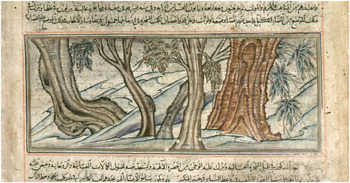
But Chinese sources were important not just for the history of China in the Arabic copy of Rashid al-Din’s Compendium of Chronicles; they also served as sources for some of the paintings illustrating the histories of other peoples.Footnote 28 One well-known example is “The Tree of Enlightenment” from the eighteenth section of the history of India (Figure 1). The text relates that one day when in the grove of Jetavana a disciple named Shariputra entreated his master Shakyamuni to recount the prophesies about another prophet (i.e. Maitreya, the Buddha of the Future). Shakyamuni replied that the future Buddha and some 84,000 of his peers would go into the wilderness where they would lie down in the shade of a mighty tree. The line of text above the illustration says that each of them would receive from Heaven a staff (ʿaṣan), bowl (qaṣʿa), cloak (thawb) and patched robe (khirka). The branches of the tree above them would be fifty parasangs high, whereas the other trees reached only six parasangs. According to the text continuing below the painting, Maitreya would settle in the shade of this giant tree and receive divine revelation.
“The Grove of Enlightenment,” from the Arabic copy of Rashid al-Din’s Jāmi al-tavārikh, dated 714/1314–15. London, The Nasser D. Khalili Collection of Islamic Art, ms. 727, fol. 37b. Courtesy of the Khalili Family Trust.
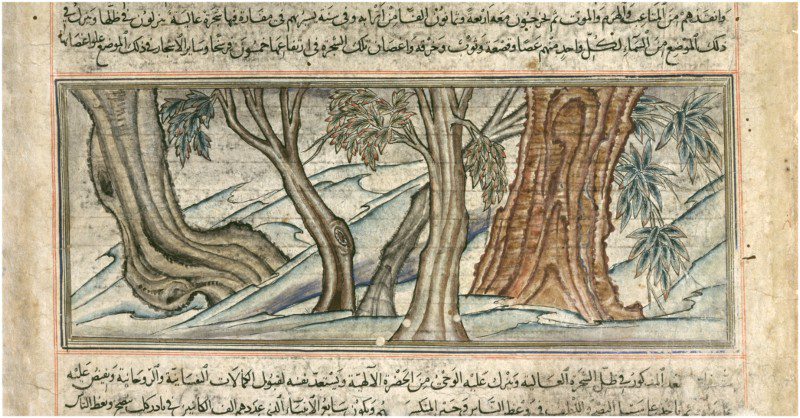
The picture is often identified as “The Grove of Jetavana,” mentioned incidentally at the beginning of the story as the place where the conversation between Shakyamuni and his disciple took place.Footnote 29 As the Indologist Dragomir Dimitrov has pointed out, however, it is much more likely to represent the tree under which Maitreya would achieve enlightenment, as described in the text immediately around the painting.Footnote 30 The image depicts five trees. The one to the right is much larger, is painted a different brownish color, and has a set of niches in the trunk. It must represent the tree under which the Buddha sat, identified as the Naga tree in the Sanskrit text Maitreyavyākaraṇa, on which Rashid al-Din’s description is based.Footnote 31
The scene of Maitreya seated beneath the Bodhi tree was a familiar one in Chinese painting and even served as the basis for metaphorical interpretations. We can compare this painting of “The Tree of Enlightenment” from Rashid al-Din’s text to a contemporary scene from a handscroll painted by one of the greatest masters of Yuan painting, Zhao Mengfu (1254‒1322), principal architect of the Yuan renaissance in painting and calligraphy.Footnote 32 Born to a branch of the Song imperial family from the city of Huzhou near Lake Tai, Zhao moved north where he joined the Yuan court at Dadu, but then returned home to southern China. There, in 1304, Zhao painted this handscroll, rendered in ink and colors on paper and depicting “A Red-robed Western Monk.” The monk’s physiognomy, pose and accouterments, as well as the tree behind him identify the scene as the Buddha’s enlightenment beneath the Bodhi tree, but perhaps recast in a contemporary mode and even possibly a covert portrait of the contemporary Sakya lama Danba.Footnote 33 In addition to their similar subject matter, the two paintings from Zhao’s handscroll and the Arabic manuscript of the Compendium of Chronicles share many stylistic features, including dark outlines delineating the shaggy tree trunks, hanging leaves, receding planes and the like.
What sets the painting from Rashid al-Din’s manuscript apart, however, is the lack of the protagonist. It and another painting from the same section of the manuscript depicting “The Mountains of India” (Khalili collection, ms. 727, fol. 21a) are the earliest landscape scenes known in Persian painting. We can only speculate why the painter(s) of these two images decided to omit the figures. In the case of “The Mountains of India,” the omission of figures makes sense, as the section of the text is entitled “The Mountains and River of India,” exactly what is depicted in the image and in later copies.Footnote 34 But it is more difficult to explain in the case of Maitreya’s enlightenment, for he is the main subject of the incident. Certainly there was no objection to portraying the Buddha, for he is shown offering fruit to the devil in the illustration preceding the scene of his enlightenment (Khalili collection, ms. 727, fol. 34a). Perhaps the painter(s) of this illustration took inspiration solely from the text above the space left for the illustration, which describes the trees. Only in the lines below the illustration does the text continue that it is there that the Maitreya would achieve enlightenment.
Many of these stylistic features for depicting landscape had already been incorporated into Chinese painting during the late Song and Jin periods, but the similarity of subject matter in the two contemporary works made for different branches of the Mongols provokes one to investigate more deeply the connections between the two regions. In addition to the question of sources, we need to ask how much the painters in Rashid al-Din’s atelier understood of the works that might have served as models, whether they were just imitating composition, technique and style or whether they appreciated, either firsthand or with the help of intermediaries, some of the implications of the sources they were copying. Lengthy commentaries added to Chinese scrolls allow us to understand some of the metaphorical meanings behind the Chinese painting, but in the case of the illustrations to Rashid al-Din’s Compendium of Chronicles, we can only suggest possibilities based on the illustrations themselves.
Here, I would like to examine three paintings from the Edinburgh portion of the Compendium of Chronicles to look at different ways that Rashid al-Din and the painters in his scriptorium adopted and adapted Chinese models.Footnote 35 Chinese sources were certainly not the only ones available to the artists in Rashid al-Din’s atelier. Many materials were readily obtainable in this metropolitan capital, but I concentrate here on the Far Eastern material.Footnote 36 In doing so, I want to investigate not only how painters added illustrations to the Compendium of Chronicles, but also more broadly to suggest reasons why the patron might have wanted them to do so, examining possible roles these paintings played in such historical manuscripts, various Chinese visual sources that might have inspired them, and how these subjects continued to resonate in Iran.
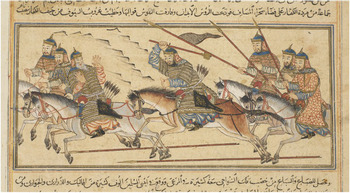
My first example represents a type of scene, of which we can use the painting of “Ilak Khan Tughan putting the heathens to flight” (Figure 2) as exemplar. There are two similar battle scenes in the Edinburgh portion of the Compendium of Chronicles and nine more in the Diez albums in Berlin, some thought to have been detached from fourteenth-century copies of the first volume of the Compendium of Chronicles containing the history of the Mongols.Footnote 37 Like the scene of Ilak Khan’s pursuit, all are rectangular and show a group of warriors entering from the right and bearing down on another group of figures fleeing to the left. One figure on the left glances back in horror, typically with his hands raised or a look of terror on his face. Weapons and/or body parts litter the foreground.
“Ilak Khan Tughan putting the heathens to flight,” from the Arabic copy of Rashid al-Din’s Jāmi al-tavārikh, dated 714/1314–15. Edinburgh University Library Or. ms. 20, fol. 133b. Reproduced with permission form the Edinburgh University.

These battle scenes represent much of medieval warfare, in which the real slaughter occurred often, or even mostly, when one side retreated in a pell-mell fashion, losing its structure and frequently jettisoning armor and weapons along the way. The Mamluk historian Reuven Amitai described such a process at ʿAyn Jalut, with the Mamluks chasing the defeated Mongols and mowing them down.Footnote 38 The same scenario would have held true for the Mongols pursuing their enemies. The weapons littering the foreground in the painting are not only pictorial devices to fill the empty space but also reflect contemporary practice where the discarded implements served to impede the enemy.
This painting, like most of those in the manuscript, is a rectangle that occupies one-quarter to one-third of the written area. Such a format had already been used in the single Persian manuscript that predates the Mongol period: a copy of Ayyuqi’s romance, Warqa and Gulshāh (Istanbul, Topkapi Palace Library, H. 841). It can be attributed to Anatolia or northwestern Iran c. 1250 on the basis of the name of the artist who signed one of the paintings, ʿAbd al-Muʾmin ibn Muhammad, the painter of Khoy (al-naqqāsh al-khuwayyī), as he is also mentioned in the endowment text of the Karatay madrasa in Konya (651/1252‒53).Footnote 39
But the illustrations in Rashid al-Din’s manuscript differ from the earlier manuscript in several important ways. As Robert Hillenbrand has noted in his survey of the arts of the book in the Ilkhanid period based on extant manuscripts, “Nothing in earlier Islamic painting foreshadows the striking innovations found in the next major surviving manuscript, the Compendium of Chronicles of Rashid al-Din.”Footnote 40 One new feature is the wash-like technique that differs from the opaque pigments used in earlier painting. Another new feature is the inclusion of landscape elements and pictorial depth, not found before the Ilkhanid period. As has been pointed out repeatedly, the paintings in the Warqa and Gulshāh manuscript are tied closely to earlier pictorial traditions, notably the enameled (mina’i) and luster ceramics produced in the thirteenth century.Footnote 41 They have simple, often symmetrical compositions with a few large figures that are set in a single line near the bottom of the composition. Landscape elements are typically limited to a few large plants that serve mainly as framing devices.Footnote 42 There is no indication of pictorial depth, shown in the Rashid al-Din painting by the inclusion of mountains and even more dramatically in the scene of the “Tree of Enlightenment” and other paintings by receding hills and other devices.
A third feature that distinguishes the Rashid al-Din paintings is the truncation of figures by the margin. In the case of the battle scene (Figure 2), the head of the horse on the left disappears behind the margin. In the “Tree of Enlightenment” (Figure 1), the trees grow beyond the top of the painting. In contrast, in the Warqa and Gulshāh paintings, the figures are deliberately contained with the frame, with figures that face inward set at the edges or bodies deliberately curved backwards so that they do not extend beyond the frame.Footnote 43
The inclusion of landscape and depth and the cutting off of the figures create a sense of movement within space, which typically travels from right to left, the direction of reading. That sense of impending movement is enhanced in the battle scenes by the diagonal thrust of the overlapping figures and their lances. They form waves of motion. Even the mountains in the background of this scene are drawn in parallel diagonal ridges. The rider on the left who recoils in horror provides a counterpoint that interrupts—and heightens—the dramatic flow.
These battle scenes in manuscripts from Ilkhanid Iran, it seems to me, reflect the kinds of illustrations in a type of narrative handscroll known for centuries in East Asia. The closest contemporary comparisons are the emaki or picture scrolls made in Japan.Footnote 44 Several thirteenth-century examples depict the violence and heroism of warriors in battle based on the war tales (gunki monogatari) that were both written down and related orally at that time. The most graphic depictions of the devastation of war can be found in the Tale of the Heiji Rebellion (Heiji monogatari ekotoba), a handscroll in the Museum of Fine Arts, Boston (11.4000) that depicts the night attack on the Sanjo Palace.Footnote 45 Done in ink and color on paper, it measures over twenty-five feet in length including the endpapers and jiku. Details show the horsemen bearing down from right to left, a direction that makes sense as the scrolls are always unrolled from right to left, the direction of reading in Japan, as in the Arabic- and Persian-speaking worlds.
An even closer comparison to the battle scenes from the Compendium of Chronicles is proved by a set of two scrolls depicting the Mongol invasions of Japan in 1284 and 1291 and commissioned by Takezaki Suenaga, a Japanese warrior who participated in the battles.Footnote 46 The scrolls, now in the Tokyo Imperial Collection, have suffered over time. They were reportedly dropped in water, and the texts have been separated from the pictures. They have since been restored and remounted as scrolls but not in the correct order. The historian Thomas Conlan has tried to reestablish the original sequence and imaginatively recreated the scrolls on the web.Footnote 47 Like the warriors in the Arabic copy of the Compendium of Chronicles, the warriors are clad in the lamellar armor typical of the Mongol period, although the individual participants have been altered to emphasize the pivotal role played by the patron in repulsing the enemy, who were overtaken at sea.
It is again highly unlikely that such large and expensive paper scrolls from East Asia were available at the Ilkhanid court in Tabriz, but they represent the outgrowth of a type known for centuries there. A likely intermediary is the type of woodblock-printed books with the typical format of illustration above/text below (shangtu/sizwen). This format of illustration above/text below seems to have originated late in the Six Dynasties period (220‒589). The earliest extant example is an eighth-century Japanese paper handscroll with the biography of Shakyamuni, E Ingakyō (Illustrated Sutra of Cause and Effect) preserved at Nara, whose style suggests that it was based on a Chinese model.Footnote 48 This format was used in ninth- and tenth-century scrolls and booklets found at Dunhuang, including several illustrated versions of the Guanyin Sutra as well as similar woodblock-printed prayer sheets dated 947.Footnote 49
By the Song period the standard method of binding such woodblock-printed books was the butterfly binding.Footnote 50 The text was printed on one side of large sheets of paper, which were folded down the middle. The leaves were then assembled in alternating order so that that every other spread showed two blank pages. This format slowed down reading, for it meant turning a blank page to reach the next page with the story, but it allowed for illustrations, which were always printed in a rectangular frame at the top of each page above the text, a horizontal format typical of the images from Rashid al-Din’s Compendium of Chronicles.
Indeed, one of the rare instances of facing illustrations in the surviving sections of the Arabic copy of the Compendium of Chronicles shows exactly this layout, with the scene of “Mahmud crossing the Ganges” occupying the upper one-third of the right-hand page facing “Mahmud seizing the fortress of Asi in India” occupying the upper one-third of the left.Footnote 51 The connection between these two images, which illustrate the spread following the one with the scene of “Ilak Khan Tughan putting the heathens to flight,” is emphasized by the bridge across the Ganges, which moves the viewer’s eye diagonally upwards from the right-hand side across the bound book’s gutter towards the fortress on the other page, from which a mounted rider emerges.
By the Song period woodblock-printed books in butterfly bindings with illustration above/text below were used for a variety of practical manuals on a wide range of subjects including agriculture, wine, tea, cattle and medicine. At the end of the Song period or the beginning of the Yuan, a new subject matter was introduced: quanxiang pinghua (fully illustrated plain[ly told] tales) that relate popular dramas and stories from the past.Footnote 52 The oldest extant story, recounting the adventure of the historical monk Xuangzang (d. 664), is dated c. 1280, and most of the early vernacular narratives date from the Yuan period. The largest extant set was printed by a certain Mr. Yu between 1321 and 1323 at Jian’an, Fujian, in southeast China. Five of at least eight volumes survive, mainly in Japan. All deal with historical periods or military figures, with the top one-third of the page devoted to representations of characters in the narrative. Illustrations such as “Yue Yi plotting against Qi” from the Chronicles of the Warring States show pursuit scenes markedly similar to the type used to illustrate the Compendium of Chronicles.Footnote 53 Furthermore, like the Compendium of Chronicles, the texts in these pinghua are compiled, rather than composed, as their style varies from terse classicism to colloquial speech, suggesting that they, like the text and illustrations in Rashid al-Din’s universal history, were assembled from a range of materials—written, oral and visual.
The historian Robert Hegel has written eloquently about the reasons for adding illustrations to these popular stories, and his suggestions may help us understand why Rashid al-Din had images added to his universal chronicle. In the pinghua, text and image are not equal or equivalent: the images occupy the top one-third of the pages, approximately the same proportion as in the pages from the Compendium of Chronicles. The illustrations in the pinghua do not relate a continuous story or plot. Rather, they depict successive events, moments of high drama and, as Hegel suggests, they help the reader to visualize the events narrated therein.
Furthermore, like the illustrations from Rashid al-Din’s Compendium of Chronicles, the illustrations in the pinghua are often conventionalized to create a standard visual language with repetitive architectural and landscape details, figures and animals to help the reader understand the subject matter immediately. The action scenes are also standardized and repeated as types. In both Chinese and Persian traditions, the scene of mounted warriors in headlong flight with one or more figures glancing apprehensively backward continues to be standard over time, even as the size of the illustration increases at the expense of the text.Footnote 54 In both Chinese and Persian traditions, figures consistently move toward the left, consonant with the reader’s eye. Gestures to the right against the flow heighten surprise and in the Chinese tradition have even been shown to indicate improper or criminal activity.Footnote 55 Each illustration, at least in the post-Rashid al-Din tradition, is also equipped with an identifying label or caption.
As to the function of the illustrations in the pinghua, Hegel concluded that
a picture, specifically a Chinese picture consisting of familiar, conventionalized—and emotionally charged—elements, transcends time; its effect is not only to suspend time but further to unite times and events long past with those of the present, to re-create by invocation rather than any mere representation the emotional power and even the moral significance of a human situation, to identify the viewer with the artist as he participated in the (re-)creation of the human experience depicted or implicit in the painting.Footnote 56
One could say the same for some of the illustrations added to manuscripts of Rashid al-Din’s Compendium of Chronicles, which were supposed to have been produced yearly at various sites around the Ilkhanate. Mongol rulers, both in Iran and in China, evoked the past to justify the present, and pictures would have enhanced that connection and transcended time. In China, woodblock printing was a quick and efficient means of making multiple copies of popular texts, whether sutras or narratives, but woodblock printing had been a failure in Iran when introduced in 1294 during the reign of Geikheitu for the printing of banknotes.Footnote 57 Rashid al-Din knew and wrote about the Chinese technique of block printing, probably using information supplied by his local informant Bolad Chingsang. Perhaps the idea of copying of books yearly at multiple scriptoria was the closest method of reproduction Rashid al-Din could devise that would work in Iran. But like the introduction of block-printed money in Iran, Rashid al-Din’s program was a failure in the short run, as it does not seem that his artists could keep up with the pace, and the illustrations in the later Ilkhanid copies of the Compendium of Chronicles were never completed.Footnote 58
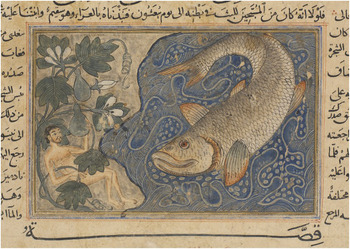
Battle scenes like “Ilak Khan putting the heathens to flight” in the Arabic copy of Rashid al-Din’s Compendium of Chronicles indicate, therefore, that the artists in Rashid al-Din’s atelier may have borrowed from scrolls, books and other portable objects for format, compositions and motifs. Looking at several other paintings from the manuscript suggests, furthermore, that painters in Iran also knew about and even reinterpreted some of the underlying connotations of the individual elements that they borrowed. Such borrowing and possible interpretation can be seen in another painting in the Edinburgh fragment showing “Jonah and the Whale” (Figure 3). Unlike many illustrations in the manuscript, this one is a square set in the center of the written surface at the end of the subsection on Yunus (Jonah), one of the ancient Prophets sent to save mankind. The text describes how Jonah was sent to warn the people of the Assyrian capital at Ninevah. When they did not repent, he departed in anger (the beginning of Qurʾan 21:87 in large letters at the top of the page above the painting mentions his angry departure). Jonah boarded a ship, but the people on board considered him a sinner and threw him into the sea. There, he was swallowed by a whale (al-ḥūt), and in the darkness of its stomach Jonah grew fearful and repented his error by acknowledging God’s omnipotence (the large letters two lines above the painting contain Jonah’s profession of faith from the end of Qurʾan 21:87). The whale then spat him out on a barren shore where an exhausted Jonah was nurtured by a gourd plant (yaqṭīn), mentioned at the end of the line directly above the painting.Footnote 59
“Jonah and the Whale,” from the Arabic copy of Rashid al-Din’s Jāmi al-tavārikh, dated 714/1314–15. Edinburgh University Library Or. ms. 20, fol. 23b. Reproduced with permission form the Edinburgh University.
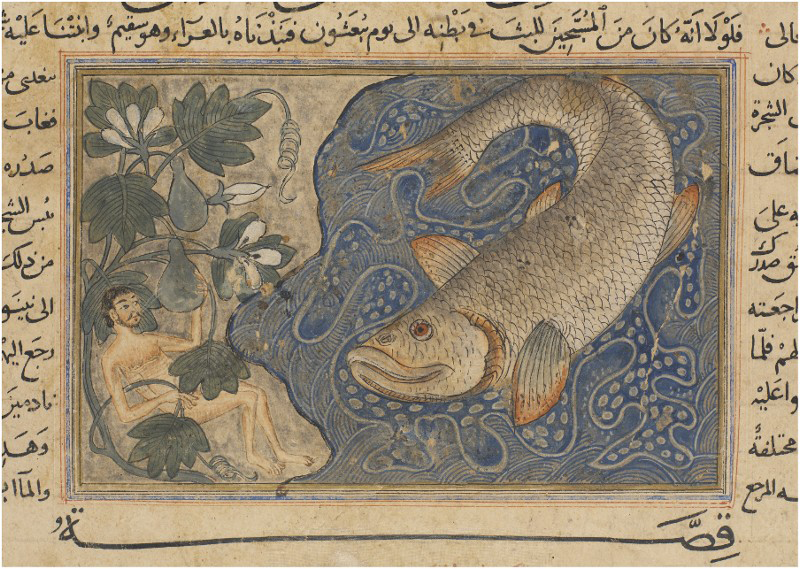
The painting illustrates the story’s denouement as recounted directly above, with a limp and emaciated Jonah half-hidden under a large gourd plant drawn with a hard black outline. Most of the image, however, is filled with a giant fish, rendered naturalistically with pink shading on its fins and tail. D. S. Rice traced the image of Jonah and the gourd to Christian iconography,Footnote 60 but the whale is definitely inspired by Chinese models.
China is the world’s oldest and largest practitioner of aquaculture, the farming of fish and other aquatic life in enclosures such as ponds, lakes and tanks or cages in rivers and coastal waters. Aquaculture began there around 3500 BCE with the raising of the common carp, native to China and both easy to farm and good to eat. By the Song period, Chinese painters commonly depicted playful carp-like fish in flora-filled water, as in a long handscroll attributed to Liu Cai (fl. 1080‒1120), a court painter renowned for representing his subjects down to the “very scales of a fish’s tail.”Footnote 61
The subject of carp-like fish cavorting in the water among vegetation remained widespread during the Yuan period and later, and for good reason. The fish was a popular Daoist theme, as shown by the inscription on a handscroll painted by Zhou Dongqing in 1291: “Not being fish, how do we know their happiness?,” an allusion to a well-known story in the fourth-century BCE Daoist classic, Zhuangzi.Footnote 62 Buddhist monks also painted the subject, as in a hanging scroll attributed to the priest Laian.Footnote 63 Both Yuan scrolls depict a large fish with twisted scaly body, protruding eye and forked tail, much like the one in the paintings of “Jonah and the Whale” from Rashid al-Din’s Compendium of Chronicles, not only the one in the Edinburgh fragment dealing with the ancient prophets, but also in the similar scene in the Khalili fragment (ms. 727, folio 59a and 299a of the reconstructed manuscript) from the section on the ancient kings of Persia where Jonah is depicted still in the mouth of the whale, again shown as a writhing carp with scaly body, protruding eye, multiple fins and forked tail.Footnote 64
In addition to its religious connotations, the fish was also a popular motif in China, for the word is also a rebus.Footnote 65 The word for fish (yu 鱼) is a homonym for the word for abundance and affluence (yu 余), and so the fish came to represent wealth and prosperity. Paintings of fish are often used to illustrate the auspicious expression, “May there be abundance year after year (年年有余).” Hence, such fish became common motifs, not just on scrolls made for literati but on all sorts of other portable objects, including ceramics. Celadon bowls and dishes often had paired fish, sometimes said to represent marital happiness.Footnote 66 These types of bowls and dishes must have been widespread and widely exported, for they were imitated on a smaller scale in Iran, where the number of fish sometimes increased to three.Footnote 67 And with the development of blue-and-white porcelains at Jingdezhen in the 1330s, paired fish with writhing scaly bodies, forked tails and protruding eyes became a common subject to fill the center of large Yuan chargers, including at least one example that came to Iran and belonged to the royal collection once stored in the shrine at Ardabil and now in the National Museum in Tehran.Footnote 68 These early Yuan blue-and-white dishes exhibit superb brushwork, with dense and layered decoration, and may be derived from the draft sketches of Yuan-dynasty painters, objects that might have been among the folios, scrolls, registers and notebooks consulted by Rashid al-Din in compiling his universal chronicle and perhaps available to artists in his scriptorium.
The design of the serpentine scaly fish with protruding eye, fins and forked tail next to the large gourd plant sheltering a weak Jonah continued to resonate in Iran, as in a painting showing the same subject from a historical manuscript made about a century later.Footnote 69 Painters in Iran then were clearly inspired by the image of the fish depicted in numerous media in China. What is unclear is whether any of the connotations of the carp-like fish—Daoist, Buddhist or simply propitious—transferred from China to Iran. The fish swallows Jonah, but it also saves him. The painters in Rashid al-Din’s atelier may have considered it his means of deliverance, and in this sense they could be seen to have been commenting on the text in the way that painters in China “commented” on the texts that they were illustrating.Footnote 70
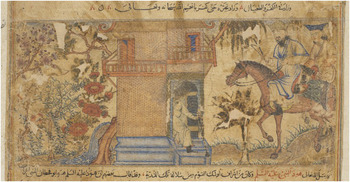
Such a suggestion of implicit meaning is even more likely when we examine a final illustration from the Arabic copy of Rashid al-Din’s Compendium of Chronicles, “The Wonderful Garden of Iram” (Figure 4), for it shows that in at least some cases painters in Rashid al-Din’s atelier not only adopted motifs from Chinese sources but also understood some of the implications that these motifs carried. The painting, the first surviving in the acephalous manuscript (and hence rather damaged and covered by a gauze that obscures some of the detail), illustrates the section about the miraculous city of Iram, the earthly paradise built by Shaddad ibn ʿAd in South Arabia. According to the text above the painting, Shaddad used the gold, silver and jewels amassed during conquests in Iran and Egypt by his relatives who included Zahhak and Goliath! Shaddad continued construction for 300 years and shaped the city in a form no human could have made. As the Qurʾan states in the large letters above the painting, Iram was the city of lofty pillars, the likes of which were not produced in all the land (Qurʾan 89: 7‒8). Mightily proud of his project, Shaddad grew more ungrateful and rebellious, increasing in tyranny and oppression until, according to the line just above the illustration, he denied the good things of God. So God sent the Prophet Hud, who would destroy all of ʿAd with a mighty cold wind (rīḥ ṣarṣar), as described in the lines below the painting.
“The Wonderful Garden of Iram,” from the Arabic copy of Rashid al-Din’s Jāmi al-tavārikh, dated 714/1314–15. Edinburgh University Library Or. ms. 20, fol. 1a. Reproduced with permission form the Edinburgh University.

The painting of “The Wonderful Garden of Iram” from Rashid al-Din’s Compendium of Chronicles occupies the typical rectangular format, with three distinct parts. Two mounted figures enter on the right. The larger one wears a crown and is followed by an attendant wearing a different hat. The crowned figure is likely Shaddad, builder of Iram, or possibly the Prophet Hud, its destroyer mentioned below the painting. The two figures approach the palace in the center, its wooden balcony decorated with upturned eaves in the Chinese manner. A male figure emerges from its doorway, his face badly damaged, perhaps from the tarnishing of silver paint. The left third of the composition is filled with a garden with flowering plants.
It was this image of “The Wonderful Garden of Iram” that first provoked my interest in addressing the nature of Chinese sources for some of the iconography in the Compendium of Chronicles. When perusing a book on Chinese architecture, I had come across a wall relief of a woman looking out of a doorway painted on the interior of a Jin-period tomb for the Duan family in Ma village, Jishan, Shanxi province in north-central China.Footnote 71 The motif of a figure peering out of a doorway immediately reminded me of the central figure in “The Wonderful Garden of Iram.” The text describing the Chinese mural stated that “Some believe this last scene [of the figure peering from the doorway] symbolizes the passage between the world of the living and the world of the tomb.” In response to my question to the editor, my colleague Nancy Steinhardt elaborated that Chinese art includes many such figures walking through doorways, all of them funerary, dating back to the Han period, and reiterated the point made in the architectural survey that they represented passage across a liminal divide between life and death.Footnote 72 Many scholars of Chinese art assume that the figure emerging from the doorway is always female, and Paul Goldin has even argued that the motif had sexual significance, concluding that such a figure represented the liminal space not just between life and death but also between desire and fulfillment.Footnote 73
Noting that the figure in the doorway in the Persian painting was male, not female, and seeing no sexual connotations to the image, I dropped the idea of connections between China and Iran until a further paper on the subject by Professor Fei Deng caused me to reevaluate.Footnote 74 Professor Deng traced the imagery of the figure in a half-opened doorway back not only to Han China but also to Roman art, leaving open the speculation of another instance of contact along the Silk Road at that early period.Footnote 75 She also expanded the range of imagery from burial chambers to pagoda and sutra pillars in many areas of northern China and to daily objects including pillows, incense burners and mirrors, the kinds of portable objects that might well have been taken to Iran. She noted that the figure was sometimes a male or a child, so that gender was not fixed. She concluded that the figure in the half-opened door was used in various funerary and religious situations to indicate passage to another world, an interpretation that would fit very much with the figure emerging from the doorway in the painting of “The Wonderful Garden of Iram” from the Compendium of Chronicles.
A painting detached from the first volume of the Compendium of Chronicles and now mounted in an album in Berlin demonstrates that the artists in Rashid al-Din’s atelier clearly understood the liminal connotations of the figure emerging from the half-open door. The detached illustration is the left half of a double-page spread depicting the Gunbad-i ʿAli, the tomb of the Ilkhanid ruler Ghazan in Tabriz.Footnote 76 It shows the domed tomb in the center of a walled dodecagonal enclosure with three doorways, each with open double doors. A figure, identifiable as a male because he wears a turban, emerges from the left side of the central doorway, looking outward towards the viewer and extending his arm around the door. He is exactly the kind of figure that Deng showed was used so frequently in tombs and on other objects in China to beckon the viewer to enter the world beyond. For the scene of “The Wonderful Garden of Iram,” the artist(s) adapted the figure, having him step out from the doorway carrying a mace, but as with the figure in the scene showing the Gunbad-i ʿAli, he too emerges from a half-open double doorway to welcome viewers.
The depiction of the garden beyond the palace at the left of “The Wonderful Garden of Iram” strengthens the association of the figure emerging from the half-open doorway with the other world. Growing behind the palace is a gnarled, bent tree depicted in a Chinese manner like the ones in “The Tree of Enlightenment” (Figure 1). Behind the trunk are a decidedly Chinese-looking fungus and a flowing stream that demarcates a garden with various flowering plants and shrubs. Like the fish, the flowering plant also has a long history in Chinese art and remained popular during the Yuan period. The plant closest to the stream is a hollyhock of the type depicted in a polychrome silk scroll by the Uighur artist Bian Lu (d. 1356) showing a peacock in front of multi-petalled hollyhocks.Footnote 77 Even more relevant is the flowering tree on the far left of “The Wonderful Garden of Iram.” Its five-petalled flowers show it to be a member of the rose family (Rosaceae). This too was a popular motif in contemporary Chinese painting, as in Qian Xuan’s paper handscroll of c. 1280 showing a blossoming tree as an allegory of fading beauty.Footnote 78 The largest genus within the large rose family is Prunus, a genus that includes plums and peaches. The peach (tao 桃) was one of the most popular motifs in Chinese art, and the peach blossom became a symbol of immortality.Footnote 79
Together, the stream and flowering prunus evoke “The Peach Blossom Spring,” a story written in 421 by the Six Dynasties poet Tao Qian about the discovery of an ethereal utopia that became “the locus classicus of the ideal of the garden as timeless paradise.”Footnote 80 The story was an instant favorite, with the promise of a garden as the beautiful and secluded place apart from this mundane world, suspended in time and space. In short, a Paradise on earth, exactly the subject of the painting in Rashid al-Din’s Compendium of Chronicles.
Once again, expensive silk or paper scrolls were not the only method by which the motif of the stream and flowering tree as a symbol of paradise on earth might have reached Iran. The flowering tree was a common motif on many portable objects, ranging from lacquer, as in an octagonal dish of black lacquer with mother-of-pearl inlay showing birds on a flowering branch,Footnote 81 to various types of ceramics. A popular type of Chinese vase is known as meiping (literally “prunus blossom”), because it was meant to hold a single branch of tree blossoms or wine from those blossoms. The meiping itself is often decorated with flowering plants, as in an octagonal example with depictions of the Eight Immortals who may serve as guides to the other world.Footnote 82
As with the image of “Jonah and the Whale,” the motifs of the figure in a half-opened doorway and the flowering tree entered the repertory of Persian painting. They were repeated in the most ambitious manuscript of the next generation, the Great Mongol Shāhnāma, produced at Tabriz in the 1330s.Footnote 83 These motifs also seem to have maintained some of their funerary and paradisial connotations, as suggested by the painting of “Faridun mourning his son Iraj.”Footnote 84 Faridun, seated in a portico in front of his palace, weeps over his son’s head. In the foreground, servants cut down the blooming trees. In the rear right a figure, probably again male to judge from his robe and boots, departs through the doorway, literally to the interior of the palace but metaphorically to the next world.Footnote 85
Motifs such as the figure in the half-open doorway and the flowering prunus tree may have been imported from China to Iran, where cultural brokers like Bolad Chingsang would have been able to explain some of the many associations they carried in Chinese culture.Footnote 86 Because these motifs were visual rather than literary, they could be transferred between cultures, although it remains to be investigated how long they maintained their meanings after their original explicators were no longer on the scene.
In sum, Rashid al-Din may well have had illustrations added as part of his efforts to disseminate his text and increase the appeal of his manuscripts. This would have been especially helpful for those members of the Ilkhanid court who did not read Arabic or Persian well. Illustrations brought the past to life, and through them contemporary viewers could identify with events and heroes of the past. They did the same with epic poems such as the Shāhnāma, for this was the same period when illustrated copies of the national epic began to be produced in large numbers.Footnote 87 Artists in Rashid al-Din’s atelier, confronted with illustrating unfamiliar subjects, looked to all and any sources at hand, books of various sorts and portable objects of the kind brought by the many embassies to the Ilkhanid court. In some cases, the artists drew from western models, but in others they looked to Far Eastern ones. Artists not only adopted the pictures but also seem to have understood some of the metaphorical meanings behind the images and, like their contemporaries elsewhere, used the paintings to comment on and enhance the text.