Paediatric heart failure is an emerging field. Although guidelines have been published, Reference Kantor, Lougheed and Dancea1,Reference Kirk, Dipchand and Rosenthal2 the level of evidence for diagnostic and management recommendations, especially for therapy, remains low. Thus, practitioners often rely on anecdotal experience for decision-making. The lack of high-quality, evidence-based guidelines in paediatric heart failure management may lead to substantial variation in the delivery of care, yet this has not been described.
We sought to understand variation in paediatric heart failure management through administration of a rigorously developed survey as an initial step to develop more robust guidelines in the field. Survey data provide generalisable information about the current state of paediatric heart failure practice and help to identify areas in management where there may be conflicting evidence, knowledge gaps, or low consensus among practitioners. Therefore, our aim is to develop and administer a scientifically rigorous survey to describe current patterns and variations in practice among practitioners who care for children with heart failure. The survey covers the entire spectrum of management, from diagnosis to treatment to monitoring. Only the management of systolic dysfunction from dilated cardiomyopathy is covered as this is the most common type of heart failure. Reference Lipshultz, Law and Asante-Korang3
Methods
Survey development
We convened a research team of paediatric heart failure specialists, along with health services researchers with survey design expertise to create the survey. The goal of the survey was to be comprehensive and cover all aspects of diagnosis, treatment, and monitoring of acute and chronic paediatric heart failure due to dilated cardiomyopathy. We also chose to focus on the current practice patterns of clinicians versus asking hypothetical questions; therefore, respondents were asked to “think of your routine practice when answering questions.” The survey expert team members and the lead author (YML) reviewed the initial draft to identify problematic items based on several criteria: content validity, item comprehension, information retrieval, decision and response processes, and general survey structure. Items and the survey structure were appropriately revised by the research team.
Cognitive interviews
The research team then identified 11 paediatric practitioners from 5 institutions to participate in cognitive interviews to pre-test survey items. We identified and purposively sampled from the list of potential participants based on: (1) level of specialisation (general cardiologist versus heart failure/cardiomyopathy specialist), (2) number of years in practice, (3) location of practice (academic versus non-academic), and (4) medical licence, for example, physician, advanced registered nurse practitioner, and physician assistant. Individuals were invited to participate in the cognitive interview using a standard recruitment email. Nine cardiologists completed interviews; the other two did not respond to the two email invitations. The interviews totalled seven rounds of edits (two participants in the first round, one in rounds 1 through 7, and two in the final round). Audio-recorded interviews were conducted by telephone with research team member with qualitative methods expertise (EJF) using a standard interview guide consisting of a combination of “think-around” and verbal-probing techniques to assess the survey criteria until we captured the problem items and respondents noted minimal issues with the survey structure. Between each round, research team members (AD and EJF) independently reviewed each audio-recording and documented problem items. Survey items and the general survey structure were revised using a negotiated process involving both team members and the lead author (YML).
Survey administration
The final survey (see Supplemental Material) was administered via the listserv of the Pediatric Heart Transplant Society and American Heart Association in July, 2019 and closed in November, 2019. No incentive was provided for completing the survey. An institutional review board approval was deemed not necessary at Seattle Children’s Hospital.
Results
Survey respondents
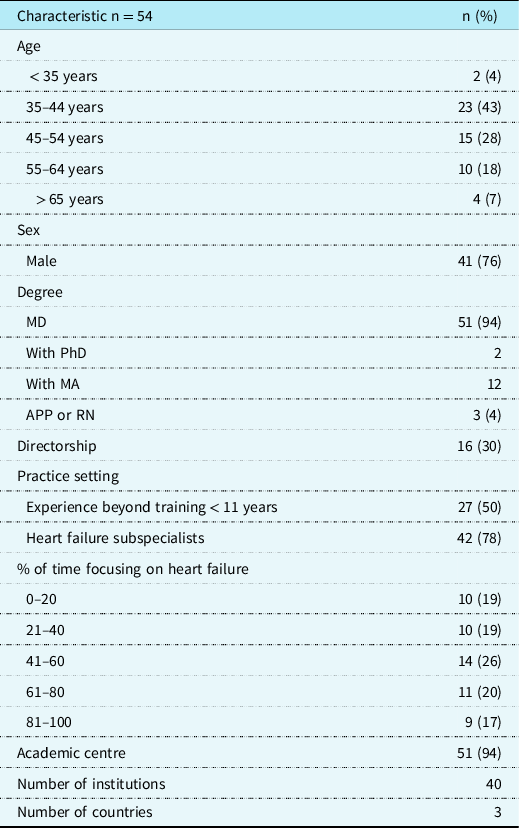
A total of 54 providers from 40 institutions and 3 countries responded to the survey. The majority are physicians from academic centres in the United States of America and with a subspecialty in heart failure (Table 1).
Characteristics of the respondents

Diagnosis and workup
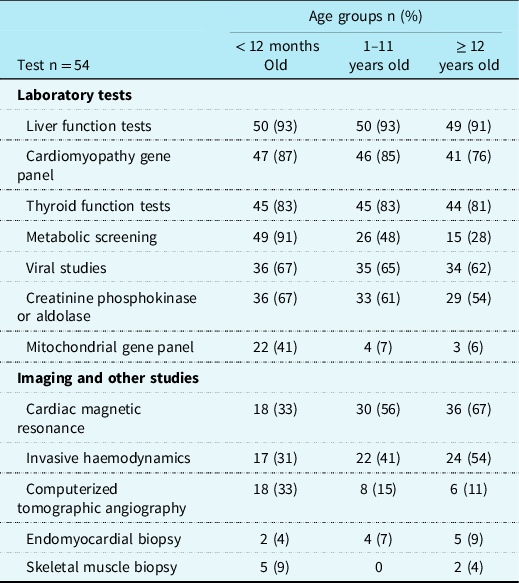
The diagnostic workup of patients with dilated cardiomyopathy by age group is presented in Table 2. Of laboratory tests, liver and thyroid function tests, cardiomyopathy gene panels are commonly used with little variation by age group, while metabolic screening and mitochondrial gene panel are used more often in the infants. Cardiac catheterisation and cardiac magnetic resonance are used more often in the older age group, while computerised tomographic angiography for coronary artery anatomy was used more frequently in the infant age group. Complete results for testing are shown in Table 2.
Tests used in the diagnostic workup of cardiomyopathy

Forty-six per cent of respondents refer to a geneticist or genetics counsellor regardless of the presentation. Of the other 54% who refer based on presentation, dysmorphic features, abnormal biochemical testing, non-cardiac organ involvement, or familial pattern of inheritance were the most common indications (89–100%). Presence of right ventricular dysfunction/remodelling and diagnosis made prior to age 5 years were indications in 32 and 46%, respectively.
Treatment of acute heart failure
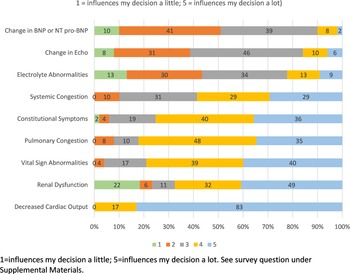
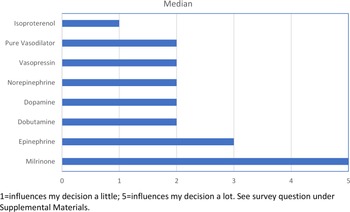
Abnormal clinical findings and the degree they influence the respondent to admit a patient for medical management of heart failure are depicted in Figure 1. Low cardiac output and renal function were the most influential, and change in natriuretic peptide has the least influence though all abnormalities appeared to have some influence in the decision-making. Following admission, Figure 2 illustrates the frequency of use of different inotropes and vasoactive drugs. Milrinone is the vasoactive drug of choice with 100% of the respondents choosing it either “often” or “always” with epinephrine as the next most likely agent chosen. Dobutamine and dopamine have nearly equal frequency of use from the categories of “never” to “often” but never “always.” In a separate question, only 8% of respondents use a pure parenteral vasodilator before starting an inotrope.
How much each abnormality influences the decision to admit for heart failure. n = 52.

Frequency of use of different inotropes and parenteral vasoactive drugs. n = 52.

For the management of volume overload, Fig. S1 (Supplemental Material) provides the frequency of use of various diuretics and their routes of administration, including antidiuretic hormone antagonists, and recombinant natriuretic peptide. Furosemide is the most prescribed diuretic, and enteral and parenteral bolus routes of administration are more commonly used than continuous parenteral infusion. A loop plus thiazide diuretic combination given enterally (53% selected “often” to “always”) or with one parenteral and the other enteral (62% chose “often” to “always”) are also used.
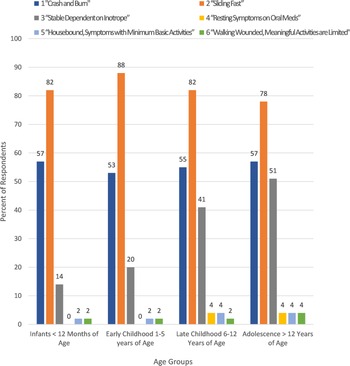
The threshold, using INTERMACS profile classification, Reference Stevenson, Pagani and Young4 at which a patient would be placed on a ventricular assist device by age group was surveyed (Fig 3). In the infant and early childhood age groups, the decision favouring implantation of ventricular assist device mainly resides in the INTERMACS profiles 1–2, whereas there is a noticeable extension into profile 3 and a total of 10–12% into profiles 4–6 combined in the late childhood to adolescent age groups.
Percent of respondents who would place ventricular assist device in patients based on age and INTERMACS profile classification 1–6. n = 51.

Chronic heart failure management
Diuretics were commonly used. The most common circumstance where respondents select to use diuretics was “when there are signs or symptoms of congestion” (75%, question # 20 in Supplemental Material). Furosemide as the first-line diuretic of choice was preferred by 96% followed only by one other diuretic, a thiazide, hydrochlorothiazide (4%). A loop–thiazide diuretic combination was also used: “never” in 25%; “rarely” 23%; “sometimes” in 39%; “often” in 12%; and “always” in 2%.
The frequency of use of common heart failure medications trialed in adults is variable, but angiotensin-converting enzyme inhibitors, mineralocorticoid receptor antagonists, and beta blockers are commonly used while there is more variability in the frequency of usage of angiotensin receptor blocker and digoxin (Table S1A, Supplemental Material). Their use based on functional classification or the American Heart Association/American College of Cardiology staging of heart failure is shown in Tables S1B and S1C (Supplemental Material). These medications are used without regard to functional class or stage from 37 to 68%. Angiotensin-converting enzyme inhibitor is chosen most frequently for the lowest functional class (37%) as well as for the lowest heart failure stage (16%). Among the multiple reasons respondents chose to use these five common heart failure medications (see survey questions in Supplemental Material), an angiotensin-converting enzyme inhibitor was not only chosen most frequently, but also it covered more of the reasons for its intended use than the other medications, from reducing afterload (96%), improving symptoms (84%), reversing remodelling (84%), improving clinical outcomes (90%), to being consistent with guidelines directed care (77%). Beta blockers were chosen for all the reasons provided by the survey question at a lower frequency ranging from 43 to 90% with improving clinical outcomes at 90%. The purpose in using mineralocorticoid receptor antagonists also covered all the available answers with reverse remodelling at 89% and its unique property of potassium sparing at 90%. The most common reason for the use of angiotensin receptor blocker was to reduce afterload (68%), to improve clinical outcomes (66%), to improve symptoms (64%), and for reverse remodelling (64%). However, for digoxin, the most common reason for its use was to improve symptoms (87%) followed by to help increase contractility (57%) with other reasons ranging only between 5 and 27%.
In infants, both captopril and enalapril are commonly used (53 and 41%, respectively). In younger children, 84% of respondents use enalapril and in adolescents, 77% choose lisinopril. Other angiotensin-converting enzyme inhibitors were not chosen at all.
In the choice of different beta blockers, only carvedilol and propranolol were used with a frequency of above 9% (see questionnaire in Supplemental Material). Carvedilol was used nearly evenly among infants (63%), children (74%), and adolescents (77%). Only 11 respondents would use propranolol and 91% of them use propranolol in the infant population and 9% (n = 1) in adolescents and not in other age groups. Other less commonly used drugs and supplements were explored, and their frequency of use are described in Figs. S2A–K (Supplemental Material).
Additional interventions used to manage chronic heart failure such as treating secondary pulmonary hypertension from left heart disease, implantation of pacemaker and defibrillator, and involving other services in a multi-disciplinary approach are described in Fig. S3 and Table S2 of Supplemental Material. There is wide variability in the frequency of these interventions. Weight control, nutrition, and social work involvement appear to be popular interventions, whereas a formal exercise and conditioning programme were not frequently recommended. In the invasive intervention modalities, “rarely” and “sometimes” were most frequently chosen, while 8% “never” use “cardiac resynchronization” and 4% “never” implant a “defibrillator.” Of those who use cardiac resynchronisation, 38% would implant only if a transvenous approach is feasible and the other 64% would also implant by a sternotomy. Of those who use cardioverter defibrillator, 33% would only do so if a transvenous approach is feasible and the other 67% would also implant by a sternotomy approach.
Since there are multiple classes of drugs used for the management of heart failure, the sequence in which they are used was examined (n = 51, question # 53, Supplemental Material). Few respondents would use a strategy where a beta blocker was started first (2%), whether it was followed by an angiotensin-converting enzyme inhibitor or mineralocorticoid receptor antagonist. A mineralocorticoid receptor antagonist as the initial drug of choice was also infrequent at 2–4%. An angiotensin-converting enzyme inhibitor followed by a mineralocorticoid receptor antagonist before a beta blocker was chosen by 24% respondents. The most frequent sequence chosen is starting with an angiotensin-converting enzyme inhibitor, followed by a beta blocker, and adding a mineralocorticoid receptor antagonist last (53%). It should be noted that 6% of respondents did not have a strategy in the sequence of introducing these classes of medications. No respondent stated that these classes of drugs are “not used.” For asymptomatic patients suspected but not meeting phenotypic criteria for dilated cardiomyopathy, such as genotype positive alone, or borderline abnormalities on imaging, 46% of respondents would not treat these patients pre-emptively and 42% use an angiotensin-converting enzyme inhibitor alone (n = 52, question #54, Supplemental Material).
Monitoring and prognostication
In examining the influence of different basic ambulatory cardiac assessments on the timing of follow-up by the respondents, symptoms appeared to be the most influential and echocardiographic results the least influential, with physical examination and laboratory results in between the two categories (Table 3), although there is a wide distribution of frequency. We also examined the frequency of clinic visits and echocardiograms based on the condition of the patient (Tables 4 and 5). Most respondents follow up with patients or perform echocardiograms at least every 5–6 months, and every 1–4 weeks for patients who are worsening. The frequency of use of other cardiac tests for surveillance were as follows: 77% would perform a Holter yearly; 33% would obtain an electrocardiogram every 3 months and 42% every 6 months; and a chest X-ray is “not used” by 71% of the respondents. For patients who resided locally, a referring cardiologist is “never” (46%), “rarely” (33%), “sometimes” (14%), “often” (6%), and “always” (2%) utilised in the management by the respondents. For patients from out of town, a referring cardiologist is “never” (8%), “rarely” 10%), “sometimes (39%), “often’ (35%), and “always” (10%) utilised in the management by the respondents.
Ranking of how much symptoms and tests influence the decision on the timing of follow-up by percent of respondents in each category. n = 51

Frequency (% of respondents) of follow-up clinic visits based on condition of the patient. n = 51

Frequency (% of respondents) of follow-up echocardiograms based on condition of the patient. n = 51

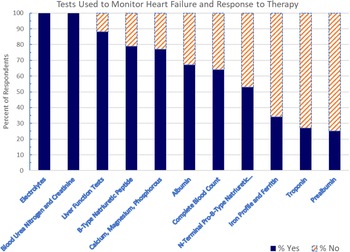
The use of laboratory tests to monitor heart failure and assess response to therapy in the outpatient setting was examined, and the responses are shown in Figure 4. Electrolytes, blood urea nitrogen, and creatinine are used by 100% of the respondents, followed by liver function tests. B-type natriuretic peptide is used more commonly than N-terminal pro-B-type natriuretic peptide.
Tests used to monitor heart failure and its response to therapy. n = 52.

Other cardiovascular-specific diagnostic tests to monitor and to prognosticate were queried. Table S3 (Supplemental Material) shows the frequency of use of these tests. There is a considerable variability in the frequency of use, and the Shape Step Test is rarely to never used. In a separate question (question #63, Supplemental Material) that involved less commonly prescribed methods to monitor patients, 10% of respondents chose to use quality of life questionnaires, 8% use home monitoring companies, 6% use the CardioMEMS HF system, 0% for cardiac impedance, and 84% used none of the above (n = 50).
As there are different scales to classify functional capacity and severity of heart failure, their usage was queried (n = 52, question # 62, Supplemental Material). Since the scales are not exclusive of each other, multiple selections can be made. NYHA Functional Classification was the most common (87%), followed by the American College of Cardiology/American Heart Association Stages of Heart Failure (60%) and the Modified Ross Heart Failure Classification (52%). Twelve per cent do not use any classification scale and 4% use the New York University Pediatric Heart Failure Index.
Discussion
This was a scientific survey to provide insights and scope in the medical management of heart failure with dilated cardiomyopathy in children. It is also a sequel to the first version which focused on the training and workforce of paediatric heart failure specialists. Reference Auerbach, Everitt, Butts, Rosenthal and Law5 The field of paediatric heart failure still lags that of heart transplant in terms of a registry, scientific publications, and strong evidence-based recommendations through guidelines. Consequently, variability in the medical management may exist. Even with randomised clinical trials in children, it is difficult to prove outcome benefits other than safety and surrogate clinical end points as opposed to trials in adults where survival and heart failure readmission are the accepted hard clinical end points. A survey can therefore offer the paediatric cardiovascular community an idea of the “median” or “mode” of common practices such that awareness can be raised to determine if one should examine one’s current practice. Until strong evidence-based guidelines are created, integration of one’s experience with others in conjunction with existing scientific data with ongoing quality improvement review may allow us to deliver the best care in this practice environment.
The respondents had a broad age and time from training distribution but skewed to the more experienced side. These respondents also represented 40 institutions, and 16 held a directorship. Combined, it is probable that their responses represented their programme’s and therefore somewhat representative of their constituents.
Pursuing a genetic or biochemical metabolic-based aetiology through testing was more likely in younger age groups, presumably because overt extracardiac manifestations would be more apparent in older children. Reference Ware, Bhatnagar and Dexheimer6,Reference Ware, Wilkinson and Tariq7 A skeletal muscle biopsy or endomyocardial biopsy was not common, while invasive haemodynamics was more routine, particularly in the older age groups probably because potential complication rate is lower in older children. The approach to the diagnostic workup may be evolving in the current era where it may be influenced by the advent of genetic testing and its ability to better define what constitutes a pathogenic genetic variant, and with the more common application of cardiac magnetic imaging, where most respondents would choose this diagnostic modality in children above the infant age group.
In the management of acute heart failure, it was perhaps no surprise that low cardiac output influenced the decision to admit a patient to the hospital as this signifies a higher severity of heart failure. Despite the challenge in attaining a history and physical from a child versus an adult, an emphasis on history and physical such as basic signs and symptoms related to heart failure are also major factors influencing the decision to admit and less so with diagnostic testing such as changes in echocardiography, electrolytes, and natriuretic peptide levels, except for labs related to renal function (Fig 1). Milrinone was the inotrope of choice and rarely did practitioners use a pure vasodilator, divergent from the practice in the management of adults. Reference Heidenreich and Biykem Bozkurt8 Adult heart failure guidelines do not recommend milrinone over other inotropes. Reference Heidenreich and Biykem Bozkurt8 Studies have not shown clear superiority of milrinone over dobutamine. Reference Mathew, Di Santo and Jung9,Reference Mathew, Visintini and Ramirez10 The overwhelming preference of milrinone in children is not evidence-based but may have derived from the paediatric experience of managing post-operative congenital heart repairs. Reference Hoffman, Wernovsky and Atz11 Respondents chose the diuretics furosemide and chlorothiazide most frequently (Fig. S1, Supplemental Material). Enteral or bolus administration was more popular than continuous parenteral infusion of diuretics. The preference for furosemide and the route of administration is consistent with the literature in adults where there was no superiority of continuous over bolus administration of loop diuretics in the landmark DOSE trial. Reference Felker, Lee and Bull12 The frequent use of chlorothiazide was less expected. This may be related to resistance to loop diuretics or the need for more aggressive diuresis in the inpatient setting. Nevertheless, the choice of diuretics and their mode of administration is likely a style that is passed down as direct comparison of their efficacy is not reported in children with heart failure.
The decision to place a child on ventricular assist device is not always straightforward. Using the INTERMACS profile Reference Stevenson, Pagani and Young4 cross-referenced to age to categorise the threshold of embarking on device therapy showed the older the age group, the lower the clinical threshold to implant a ventricular device. However, even in the infants, 82% would implant when a patient is “sliding fast.” The main reason for the difference by age is likely that devices developed for adults have a much lower complication rate than those developed for small children. Device therapy is not always chosen for the “crash and burn” profile probably because these patients require immediate rescue therapy, but we did not include a question on the use of extracorporeal membranous oxygenation or other percutaneous implantable devices that can be deployed rapidly for cardiogenic shock.
Common medications used to prevent the progression of heart failure were assessed, and angiotensin-converting enzyme inhibitors, followed by mineralocorticoid receptor antagonists, followed by beta blockers are commonly used (Table S1A, Supplemental Material). Interestingly, some respondents would categorically “never” use digoxin (12%), angiotensin receptor clocker (4%), or a beta blocker (2%), even though all are recommended in adult heart failure guidelines albeit the first two are not first-line drugs. Traditionally, spironolactone is used in conjunction with diuretics and digoxin to minimise hypokalemia in infants with heart failure from CHD, and this may be the reason it is popular among paediatric heart failure cardiologists. Digoxin is a second-line drug in adult guidelines and may explain its unpopularity among the respondents, even though traditionally it was used to treat heart failure in CHD from a left-to-right shunt. Beta blockers is a first-line drug in adult guidelines, and it is unclear why it is not as frequently chosen other than the fact that it is more difficult to up titrate, and a trial of carvedilol in children did not show benefits, although it was underpowered. Reference Shaddy, Boucek and Hsu13 Many respondents also do not base their decision on use of these medications on functional capacity classification (Table 2B) which is contrary to adult heart failure guidelines. Reference Heidenreich and Biykem Bozkurt8 One explanation is that it is difficult to accurately ascertain functional capacity in children. However, most would base their use on the stages of heart failure which is based on past heart failure history rather than current symptoms alone such as functional capacity. Reference Hunt, Baker and Chin14 Interestingly, despite lack of trial data, it does not appear that paediatric cardiologists are deterred from invasive therapy such as cardiac resynchronisation or implantable cardioverter defibrillator including implantation via a sternotomy if the indication exists.
Since multiple drug options exist, and they can be used together, it is of practical necessity to decide the sequence in which they are introduced. The most common sequence involved initiation with an angiotensin-converting enzyme inhibitor, followed by a beta blocker, followed by a mineralocorticoid receptor antagonist. There was near equipoise in whether to treat asymptomatic patients who are suspected but do not meet the imaging or phenotypic criteria for dilated cardiomyopathy (46% “no”/54% “yes” for treatment). This remains a controversial topic as more patients receive genetic testing. Like the decision to admit a patient for acute decompensated heart failure, the timing of follow-up is influenced more so by symptoms or manifestations than diagnostic tests. With the advent of cardiac magnetic imaging, it is used as commonly as conventional tests such as cardiopulmonary exercise and invasive haemodynamics for monitoring and prognosticating in the current era. One possible reason is that cardiac magnetic resonance can provide insight to the cause such as myocarditis. The fact that not 100% of respondents utilise a grading or staging system may have to do with the lack of data on their utility in children. For assessment of quality of life, it does not appear that this aspect of evaluation has gained popularity as only 10% would utilise these tools. This may have to do with the time required for the practitioner and family and the perception of the lack of validation of these tools in heart failure in children. Importantly, quality of life questionnaires are commonly used as secondary end points in adult heart failure therapy trials. The paediatric community may need to examine its utility if we want to ensure our patients do well beyond surviving heart failure. The above information can be useful for designing clinical research or quality improvement studies where it is crucial to ascribe the severity of heart failure in the study population and knowing which management options have equipoise if a study to compare them was to be undertaken.
While guidelines with strong scientific data substantiate therapeutic recommendations in adults with heart failure, the challenge is “getting” the broad and large number of practitioners to “get with the guidelines” as there remains a substantial number of adult patients not on optimal guideline directed care. The paediatric professional community is much smaller, and management of heart failure resides within cardiology specialists. The challenge for us may not be one of adherence by providers, but consensus on how to treat when evidence-based therapy is lacking, and when there is wide variation in practice despite incorporating most tools established by the adult heart failure community.
Limitation
The number of responses seems low which makes statistical analysis such as by the demographics of the respondents not possible. There is skewing to the more experienced and directorship position among the respondents which may represent that respondent’s institutional practice. The survey was sent to academic centres and children’s hospitals which invites a more expert opinion but misses capturing of community practitioners who also care for children with heart failure and cardiomyopathy. Additionally, it is difficult for a survey to address the reason behind a response and the nuances that exist in clinical decision-making, that is, decisions and answers are not always categorical. Therefore, the results must be interpreted as a descriptive distribution of the preferences of management within the confine of the specifics of that clinical situation as depicted in the question.
Conclusion
This scientific survey provided a general description of how children with acute and chronic heart failure are managed. The main findings are that there is in general much variability in how patients are managed. Direct patient assessment, such as signs and symptoms, remains important in the decision-making. Consistent with trends in modern medicine, MRI and genetic testing are commonly incorporated into diagnostics. And, for the most part, paediatric practitioners utilise management options, including therapy, established by our adult colleagues. But there are also differences from the adult practice and differences among the pediatric practitioners. These differences can provide the background information to help practitioners and centres examine their own practice patterns and protocols, including whether to pursue quality improvement initiatives and standardisation in various areas of management. For the paediatric heart failure community, the results can aid with the design of research studies, particularly clinical trials such as identifying where there is equipoise in management options. The survey can serve as a call to action to create consensus, such as through a workgroup by panel(s) of concentrated experts to deliver recommendations which can be vetted by additional subspecialists followed by taking public opinion by the paediatric cardiology community at large.
Supplementary material
For supplementary material accompanying this paper visit https://doi.org/10.1017/S1047951122002517
Acknowledgements
None.
Financial support
The study was funded by the Heart Center Research Initiative grant, Seattle Children’s Hospital.
Conflicts of interest
None.