Introduction
Attention deficit–hyperactivity disorder (ADHD) is a mental health (MH) disorder characterised by significant difficulties with inattention or hyperactivity and impulsiveness, or a combination of the two. Although it has been considered a disorder of childhood, evidence is emerging of on-going and impairing adult symptom expression in about one- to two-thirds of patients (Toone, Reference Toone2004; Turgay et al. Reference Turgay, Goodman, Asherson, Lasser, Babcock, Pucci, Barkley and Group2012). Earlier longitudinal studies report a wide variation in rates of persistent of ADHD into adolescence (from 50% to 70%, e.g. Thorley, Reference Thorley1984; Klein & Mannuzza, Reference Klein and Mannuzza1991) and adulthood (from 4% to 60%; Hechtman, Reference Hechtman1992; Mannuzza et al. Reference Mannuzza, Klein, Bessler, Malloy and LaPadula1993; Rasmussen & Gillberg, Reference Rasmussen and Gillberg2000). More recent studies, using standard criteria have shown a consistently high rate ranging from 60% to 75% (Fischer, Reference Fischer1997; Barkley et al. Reference Barkley, Fischer, Smallish and Fletcher2002), with a predominant persistence of impairment in inattention, as opposed to hyperactivity and impulsivity, which seem to resolve more with time (Valdizan & Izaguerri-Gracia, Reference Valdizan and Izaguerri-Gracia2009).
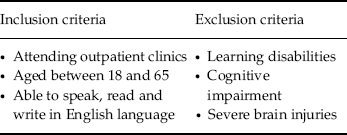
Inclusion- exclusion criteria for the study

Community prevalence of ADHD in the general adult population, is estimated between 2.5% and 5% (e.g. Kessler et al. Reference Kessler, Adler, Barkley, Biederman, Conners, Demler, Faraone, Greenhill, Howes, Secnik, Spencer, Ustun, Walters and Zaslavsky2006; Fayyad et al. Reference Fayyad, De Graaf, Kessler, Alonso, Angermeyer, Demyttenaere, De Girolamo, Haro, Karam, Lara, Lepine, Ormel, Posada-Villa, Zaslavsky and Jin2007; Ginsberg et al. Reference Ginsberg, Quintero, Anand, Casillas and Upadhyaya2014). In a meta-analysis of seven epidemiological studies, Simon et al. (Reference Simon, Czobor, Balint, Meszaros and Bitter2009) reported a pooled prevalence of ADHD in adult population of 2.5% (95% confidence interval 2.1–3.1). However, those numbers are increased when the prevalence is estimated in selective populations. For instance, in a meta-analysis of 29 studies of adolescents and adults with various substance use disorders, the prevalence of ADHD rose to 23% (van Emmerik-van Oortmerssen et al. Reference van Emmerik-van Oortmerssen, van de Glind, van den Brink, Smit, Crunelle, Swets and Schoevers2012). Screening in MH outpatient department clinic populations, rates from 22% (Rao & Place, Reference Rao and Place2011) to 50% (Lomas & Gartside, Reference Lomas and Gartside1999) have been found. However, the most interesting finding of those studies is that only a few of those patients had previously been diagnosed with the disorder during their childhood (Almeida Montes et al. Reference Almeida Montes, Hernandez Garcia and Ricardo-Garcell2007; Nylander et al. Reference Nylander, Holmqvist, Gustafson and Gillberg2009; Rao & Place, Reference Rao and Place2011). In addition, a number of studies have found that many children with ADHD go unrecognised and may present in adulthood for the first time (Asherson et al. Reference Asherson, Chen, Craddock and Taylor2007; Kooij et al. Reference Kooij, Bejerot, Blackwell, Caci, Casas-Brugue, Carpentier, Edvinsson, Fayyad, Foeken, Fitzgerald, Gaillac, Ginsberg, Henry, Krause, Lensing, Manor, Niederhofer, Nunes-Filipe, Ohlmeier, Oswald, Pallanti, Pehlivanidis, Ramos-Quiroga, Rastam, Ryffel-Rawak, Stes and Asherson2010). Several reasons have been proposed to explain this. These include the explanation that professionals working in adult mental health services (AMHS) remain unaware that ADHD frequently persists into adult life and remain uninformed about the clinical presentation and the consequences of ADHD across the lifespan (Kooij et al. Reference Kooij, Bejerot, Blackwell, Caci, Casas-Brugue, Carpentier, Edvinsson, Fayyad, Foeken, Fitzgerald, Gaillac, Ginsberg, Henry, Krause, Lensing, Manor, Niederhofer, Nunes-Filipe, Ohlmeier, Oswald, Pallanti, Pehlivanidis, Ramos-Quiroga, Rastam, Ryffel-Rawak, Stes and Asherson2010). The diagnosis is harder to establish for adults than it is with children since it shares numerous symptoms with other psychiatric pathologies (Ginsberg et al. Reference Ginsberg, Quintero, Anand, Casillas and Upadhyaya2014) and obtaining a collateral may be difficult. Additional reasons for under-diagnosis of ADHD include the frequent presence of comorbid psychiatric syndromes (Alpert et al Reference Alpert, Maddocks, Nierenberg, O’Sullivan, Pava, Worthington, Biederman, Rosenbaum and Fava1996), which in clinical practice may be identified as the primary or only diagnosis (McCarthy et al. Reference McCarthy, Wilton, Murray, Hodgkins, Asherson and Wong2013). As may occur with children, stigma may represent a barrier to diagnosis (Kooij et al. Reference Kooij, Bejerot, Blackwell, Caci, Casas-Brugue, Carpentier, Edvinsson, Fayyad, Foeken, Fitzgerald, Gaillac, Ginsberg, Henry, Krause, Lensing, Manor, Niederhofer, Nunes-Filipe, Ohlmeier, Oswald, Pallanti, Pehlivanidis, Ramos-Quiroga, Rastam, Ryffel-Rawak, Stes and Asherson2010).
Given the above, this present study aimed (a) to estimate the rates of symptomatology of ADHD in AMHS outpatient clinics attendees, in a regional MH Health Service Executive area of Sligo and Leitrim Counties, and (b) to find out how many cases had already been clinically diagnosed as ADHD.
Methods
Settings
Consecutive patients attending Adult Outpatient Mental Health Services in Sligo/Leitrim County were eligible for enrolment in the study. The population (catchment area) covered by Sligo Leitrim Mental Health Services is estimate at 109 000 people. Inclusion–exclusion criteria are shown in Box 1.
Following ethical approval, consecutive patients attending the outpatient clinics of AMHS of Sligo/Leitrim County who were eligible for inclusion were approached either before or after their consultation and informed of the study. Those who consented to participate in the study completed the self-report questionnaires. Data collection took place between August 2013 to September 2015.
Measurements
Adult ADHD Self-Report Scale (ASRS)
The ASRS is a self-report, Diagnostic and Statistical Manual of Mental Disorders-IV-based measure, which includes 6 (Part A) plus 12 (Part B) questions regarding current symptoms of adult ADHD. It is considered a reliable measurement for use in clinical settings, research and epidemiological studies, and takes less than 5 minutes to complete. Respondents are asked to rate, using a five-point response scale ranging from never (0), rarely (1), sometimes (2), often (3), to very often (4), how often a particular symptom of ADHD occurs. The total scores range from 0 to 72. A number of studies which investigated the psychometric properties have showed a sensitivity 56%, specificity 98%, positive predictive value 82%, negative predictive value 98.3% and κ 0.60 (Kessler et al. Reference Kessler, Adler, Ames, Demler, Faraone, Hiripi, Howes, Jin, Secnik, Spencer, Ustun and Walters2005; Taylor et al. Reference Taylor, Deb and Unwin2011). In addition, in substance abuse services with comorbid MH disorders the sensitivity of the scale was 0.88 and specificity was 0.67 (van de Glind et al. Reference van de Glind, van den Brink, Koeter, Carpentier, van Emmerik-van Oortmerssen, Kaye, Skutle, Bu, Franck, Konstenius, Moggi, Dom, Verspreet, Demetrovics, Kapitany-Foveny, Fatseas, Auriacombe, Schillinger, Seitz, Johnson, Faraone, Ramos-Quiroga, Casas, Allsop, Carruthers, Barta, Schoevers, Group and Levin2013).
Wender Utah Rating Scale (WURS)
The WURS provides a retrospective rating of childhood ADHD symptoms. The shorter form consisting of 25 questions was used in this study, having adequate psychometric properties of reliability (test–retest r=0.96; and inter-rater reliability r=0.75) and internal consistency (Cronbach’s α=0.78) (Rossini & O’Connor, Reference Rossini and O’Connor1995; Wierzbicki, Reference Wierzbicki2005; Marchant et al. Reference Marchant, Reimherr, Robison, Robison and Wender2013). Each question has five possible responses, scored from 0 to 4 points, giving a range of 0–100. Using a cut-off of 46 correctly identifies 86% of patients with ADHD. If depression is present a lower cut-off point of 36 is recommended (Taylor et al. Reference Taylor, Deb and Unwin2011). It is a self-report scale and it takes about 15 minutes to be completed by the participant. The intra-class correlation (κ) of the two scales (ASRS and WURS) combined, with the clinical diagnosis of ADHD in a general adult psychiatric population was equal to 0.78 (Rao & Place, Reference Rao and Place2011).
Demographics
Demographic data provided by the respondent included age, gender, marital status, years of education, living conditions, occupation and current employment status. In addition, case files were reviewed for a potential diagnosis of ADHD.
Statistical analysis
Statistical analysis was conducted using the IBM (SPSS) 21 package. Continuous variables are reported as means plus standard deviation, while categorical variables are reported as counts and percentages. Comparison between groups was conducted with parametric or non-parametric test as appropriate. When χ 2 test were used with more than two categories the adjusted residuals were calculated to examine significant differences between categories, using an adjusted residual of >1.96 (2.0 is used by convention) to indicate significance (Agresti, Reference Agresti2013).
Results
Description of sample
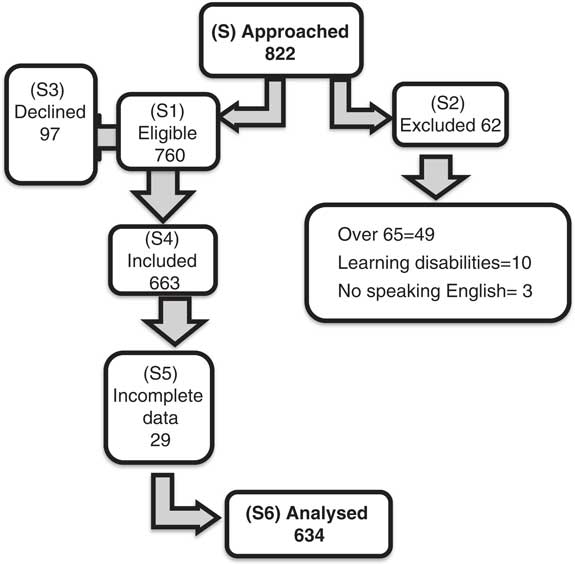
Out of 822 outpatients attending AMHS, 760 (92.5%) were eligible to enrol in the study. Of these, 97 refused, 29 were excluded due to an incomplete data set, leaving 634 for full data analysis, representing 83% of all eligible attendees (see flow chart in Fig. 1).
Flow chart of included/excluded participants. Comparison of demographic (age, gender, living circumstances, marital status, occupation, education and housing) variables. S v. S6: gender, no significant (NS) difference; age: (S) significantly older, living circumstances (S) more likely to live alone; marital status (S) more likely to be widowed; occupation: (S) more likely to be pensioners; education (S) more likely with none qualifications; housing (S) NS. S3 v. S4: significant difference (S3) more likely older, pensioners and lower education (junior certificate) no other differences in the rest of the variables. S4 v.S5: NS differences in any variable.

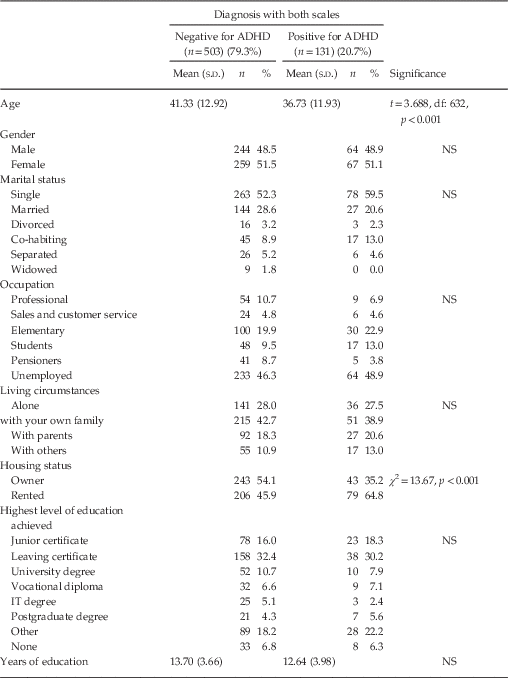
The mean age of the sample was 40.38 (s.d.: 12.85) with 326 (51.4%) female. Table 1 shows the rest of the demographic variables divided in categories according to ADHD status.
Demographic characteristics of the sample according to attention deficit–hyperactivity disorder (ADHD) categories

NS, Not significant.
Rates of ADHD screen positive on the self-report ADHD instruments in the sample
Using a cut-off point of >45 on the WURS-25 (cut-off point >36 if depression was present) as positive, identified 215 (33.9%) of the participants to be for ADHD. Similarly, using the ASRS-6, 219 (34.5%) were identified to screen positive for ADHD. However, given that the one scale (WURS-25) is retrospective for childhood ADHD and the other (ASRS-6) measures current symptomatology, a more stringent requirement of meeting criteria on both scales was used to quantify the potential group of ADHD cases. In total, 131 participants (20.7%) met criteria by this method. Inspection of the case files revealed that only three cases (2.3%) had already been diagnosed with ADHD.
Differences in socio-demographic variables between those who screened positive for ADHD and those who did not
There were no differences found between groups in terms of gender (χ 2 =0.005, df: 1, p=0.944), marital status (χ 2=7.912, df: 5, p=0.161), occupation (χ 2=6.64, df: 5, p=0.249), living circumstances (χ 2=1.051, df: 3, p=0.789), level of education achieved (χ 2=4.108, df: 7, p=0.767) and years of education (t-test, mean difference=1.06, t=1.722, df: 236, p=0.086) between those screened positive on the self-report ADHD instruments and those who did not (Table 1). However, statistically significant differences were found in terms of age (t-test, mean difference=4.603, t=3.688, df: 632, p<0.001) and house ownership (χ 2=13.67, df: 1, p<0.001), with those who screened positive on the self-report ADHD instruments criteria being younger and more likely to rent (rather than own) a house.
Relation of age with the severity of symptoms
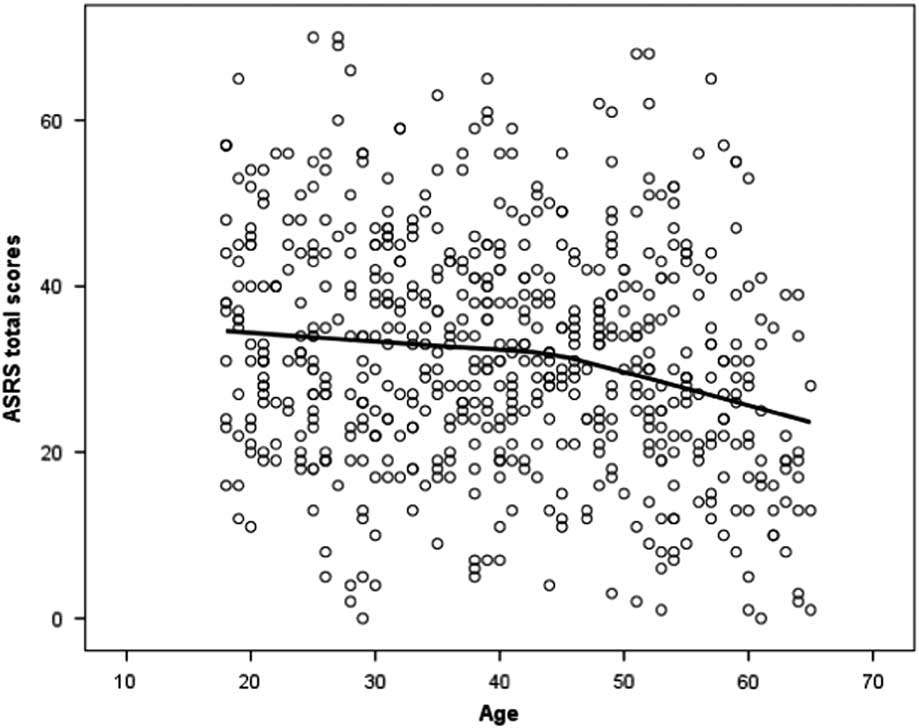
By using the ASRS total score (18 symptoms) as a continuous variable, a significant negative correlation was found between ASRS scores and age (Pearson’s Correlation=−0.194, p<0.001), and depicted in the scatter plot with a Loess curve fitted (Fig. 2). There is a steady decline in scores (reduction in severity) until age 44, where it appears to decline more rapidly.
Scatterplot and Loess curve (Kernel: Epanechnikov, 80% of points to fit) provide a visual description of the relationship between age and total score of Adult ADHD Self-Report Scale (ASRS). ADHD, attention deficit–hyperactivity disorder.

Discussion
This study screened 83% of all approached AMHS attendees for ADHD in a geographically defined catchment area of Sligo and Leitrim with a catchment population of 109 000. Around 34% of attendees were found to meet criteria for possible ADHD using either ASRS or WURS. When more stringent criteria were applied and the presence of both current and past ADHD symptoms were applied, this rate dropped to 20.7%. This suggests that many adults attending AMHS may have unrecognised ADHD, given that in only 2.3% of cases was a prior clinical diagnosis of ADHD given. There were no major differences between those identified with possible ADHD and non-ADHD cases in terms of most of the demographics studies, with similar gender rates, levels of employment and education. Those with possible ADHD were younger and more likely to be in rented, rather than owned accommodation. As with other studies, symptom severity seemed to decline with age.
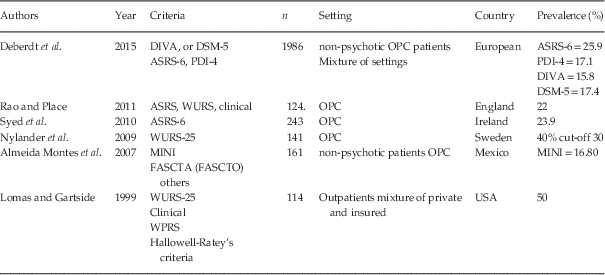
The high rate of those screened positive on the self-report ADHD instruments was not a surprise. Previous studies which have investigated prevalence of ADHD have shown similar results, and are tabulated in Table 2. The study by Rao & Place (Reference Rao and Place2011) in North East England using similar screening instruments to this study showed very similar rates (22%) of ADHD to the present study. A previous study in Ireland (Syed et al. Reference Syed, Masaud, Nkire, Iro and Garland2010) showed slightly higher estimates (23.9%) to the present study but the investigators have used only the ASRS-6. Given the possible risk of symptom overlap with other psychiatric disorders, the use of ASRS-6 alone could increase the rate. Such patients, even without ADHD tend to score high on ADHD scales (McCann & Roy-Byrne, Reference McCann and Roy-Byrne2004). For instance, inattentiveness of ADHD may resemble the lack of concentration of a major depressive episode, or cognitive deficits in a psychotic disorder, dysthymia, post-traumatic stress disorder or generalised anxiety disorder and the distractibility of ADHD may resemble that of a manic or hypomanic episode. ADHD hyperactivity (motor restlessness and excessive talking), also may resemble psychomotor agitation associated with mania, hypomania, or major depressive disorder, or the restlessness of anxiety disorder. Similarly, impulsivity in ADHD is also common in manic and hypomanic episodes and personality disorders like borderline personality disorder Given that ADHD is a condition with symptoms commencing in childhood, it seems important to ensure endorsement of some childhood symptoms, hence the value of adding the WURS, despite its reliance of retrospective recall (Taylor et al. Reference Taylor, Deb and Unwin2011).
Previous studies of prevalence of attention deficit–hyperactivity disorder (ADHD) in psychiatric patients

ASRS, Adult ADHD Self-Report Scale; FASCTA, Friederichsen, Almeida, Serrano, Cortés, Test, self-report; DIVA, Diagnostic Interview for Adult ADHD; DSM, Diagnostic and Statistical Manual of Mental Disorder; MINI, Mini-international neuropsychiatric interview; PDI-4, Provisional Diagnostic Instrument-4; OPC, outpatient clinics; WURS, Wender Utah Rating Scale; WPRS, Wender’s ten-item Parental Rating Scale.
Compared to the general population, this study, along with others, reported a higher rate of possible ADHD in patients attending AMHS and more importantly, reveal significant under recognition of the condition. In the present study, only three participants had already been identified clinically as having ADHD. Factors contributing to such under recognition include a lack of confidence amongst adult clinicians about ADHD (Beirne et al. Reference Beirne, McNamara, O’Keeffe and McNicholas2013; Coghill, Reference Coghill2015), a disbelief in the validity of ADHD as a concept (Moncrieff & Timimi, Reference Moncrieff and Timimi2010), a lack of onward referral by Child and Adolescent Mental Health Services (CAMHS) to AMHS services (Singh et al. Reference Singh, Paul, Ford, Kramer, Weaver, McLaren, Hovish, Islam, Belling and White2010; McNicholas et al. Reference McNicholas, Adamson, McNamara, Gavin, Paul, Ford, Barry, Dooley, Coyne and Cullen2015), difficulties with transitioning from one service to another (Singh et al. Reference Singh, Paul, Ford, Kramer, Weaver, McLaren, Hovish, Islam, Belling and White2010; Hall et al. Reference Hall, Newell, Taylor, Sayal and Hollis2015; McNicholas et al. Reference McNicholas, Adamson, McNamara, Gavin, Paul, Ford, Barry, Dooley, Coyne and Cullen2015), or a reluctance of youth with ADHD to attend AMHS (McNicholas et al. Reference McNicholas, Adamson, McNamara, Gavin, Paul, Ford, Barry, Dooley, Coyne and Cullen2015). In fact, recent studies of CAMHS–AMHS transitions in both Ireland and the United Kingdom found that individuals with ADHD were among the group least likely to transition (Singh et al. Reference Singh, Paul, Ford, Kramer, Weaver, McLaren, Hovish, Islam, Belling and White2010; McNamara et al. Reference McNamara, McNicholas, Ford, Paul, Gavin, Coyne, Cullen, O’Connor, Ramperti, Dooley, Barry and Singh2013; McNicholas et al. Reference McNicholas, Adamson, McNamara, Gavin, Paul, Ford, Barry, Dooley, Coyne and Cullen2015). Of the 20 individuals identified in the Irish study on transition (iTRACK Study), none were referred to public AMHS (McNicholas et al. Reference McNicholas, Adamson, McNamara, Gavin, Paul, Ford, Barry, Dooley, Coyne and Cullen2015). Qualitative interviews with professionals, held as part of iTRACK, identified a reluctance on the part of child psychiatrists to refer to adult MH services, believing the young person would not be accepted or effectively managed coupled with a lack of confidence as expressed by adult clinicians about ADHD management. Case note records suggested than many families declined referral, opting for either transfer back to the care of their GP, or disengaging in services. In the iTRACK study a significant number of youth with ADHD remained in CAMHS well beyond the transition boundary, with significant resource implications (McNicholas et al. Reference McNicholas, Adamson, McNamara, Gavin, Paul, Ford, Barry, Dooley, Coyne and Cullen2015).
It is also possible that there is a low rate of recognition and diagnosis of ADHD during childhood, and that comorbid MH problems in adulthood lead to AMHS attendance, and more obvious display of ADHD symptoms (Rao & Place, Reference Rao and Place2011).
ADHD is seen as predominantly a disorder more common in males than females, with a reported male to female ratio of 3:1 to 9:1 (Gaub & Carson, Reference Gaub and Carlson1997). More recent studies narrow this gap (Rucklidge, Reference Rucklidge2010). Previous studies in adult psychiatric populations (Almeida Montes et al. Reference Almeida Montes, Hernandez Garcia and Ricardo-Garcell2007; Nylander et al. Reference Nylander, Holmqvist, Gustafson and Gillberg2009; Rao & Place, Reference Rao and Place2011) showed similar results to ours regarding gender, but not the study by Syed et al. (Reference Syed, Masaud, Nkire, Iro and Garland2010). A possible explanation of the over-representation of females with ADHD in AMHS may be due to referral bias. In adulthood more females with comorbidity are referred to psychiatric services (in our service the ratio of male:female is about 1:1.2), in childhood associated conduct problems may explain the higher rate of boys with ADHD in CAMHS, while females who are more likely to have attention deficit without the hyperactivity, are less likely to be identified or referred. Thus, the over-representation of males, in childhood may reflect under diagnosis in females, which somewhat corrects itself, with the likelihood of more females seeking out treatment than adult males (Rucklidge, Reference Rucklidge2010). Therefore, undiagnosed childhood ADHD in females can lead to higher numbers of women with ADHD presenting in adulthood (Ginsberg et al. Reference Ginsberg, Quintero, Anand, Casillas and Upadhyaya2014).
Previous studies have shown that hyperactivity and impulsivity trend to decline with age (e.g. Biederman, Reference Biederman2005) but more recent evidence suggests that there is also a decline in the inattentive symptoms, at least in men (Biederman et al. Reference Biederman, Petty, Evans, Small and Faraone2010; Oerbeck et al. Reference Oerbeck, Overgaard, Pripp, Aase, Reichborn-Kjennerud and Zeiner2015) and evidence that ADHD generally minimises with age (Faraone et al. Reference Faraone, Biederman and Mick2006). Adult population studies have found a higher prevalence of ADHD in younger adults, compared to older individuals (Kessler et al. Reference Kessler, Adler, Barkley, Biederman, Conners, Demler, Faraone, Greenhill, Howes, Secnik, Spencer, Ustun, Walters and Zaslavsky2006; Fayyad et al. Reference Fayyad, De Graaf, Kessler, Alonso, Angermeyer, Demyttenaere, De Girolamo, Haro, Karam, Lara, Lepine, Ormel, Posada-Villa, Zaslavsky and Jin2007; Knight et al. Reference Knight, Kawatkar, Hodgkins, Moss, Chu, Sikirica, Erder and Nichol2014). Therefore, the difference in mean age between those who scored positive for ADHD and those who did not is not an unexpected finding in this study. Similarly, in our study we found a decline of intensity of symptoms across the age. The latter finding needs to be interpreted with caution, and given the cross-sectional nature of the study, does not suggest a decline in symptoms with increasing age, but rather a decline of the examined symptoms in the overall sample in relation to age.
We did not find any other differences in terms of socio-demographic variables except housing. This is most likely a confounder with age, younger people being more likely to rent than buy, rather than indicative of poor functioning, as we did not find any differences in occupation, education or marital status. Although previous community epidemiological studies have shown a difference in those variables (e.g. Fayyad et al. Reference Fayyad, De Graaf, Kessler, Alonso, Angermeyer, Demyttenaere, De Girolamo, Haro, Karam, Lara, Lepine, Ormel, Posada-Villa, Zaslavsky and Jin2007) this was not the case in our sample. Nearly half of all the participants in our sample were unemployed or had elementary jobs. Most of them were single with low levels of education. This may have precluded the finding of a difference between groups.
The present study reflects the rates of ADHD symptomatology within an AMHS population and is limited to that group. Undiagnosed or misdiagnosed ADHD can result in ineffective pharmacological and non-pharmacological treatments of other MH conditions, and in its own right is associated with a substantial psychosocial and functional decline (Able et al. Reference Able, Johnston, Adler and Swindle2007).
ADHD patients are also more likely to have a low attendance rate at the outpatient services, they are more likely to drop out and to have a decreased treatment retention (Nylander et al. Reference Nylander, Holmqvist, Gustafson and Gillberg2009; Schroder et al. Reference Schroder, Sellman, Frampton and Deering2009). Adolescents already identified and treated for ADHD are also very likely to discontinue their medication, with prescription rates among GPs showing a precipitous drop after age 16 (McCarthy et al. Reference McCarthy, Wilton, Murray, Hodgkins, Asherson and Wong2013).
Personal and social costs of untreated and impairing ADHD symptoms are high. It becomes a clinical priority, both to increase awareness about ADHD and to off-set the negative trajectories associated with untreated ADHD, but also to effect optimal treatments in co-morbid conditions.
Given the negative trajectory of un-treated ADHD in terms of impact on co-morbid MH, the associated personal and family distress, the tendency to poor engagement with services, it is essential that adult clinicians are alert to possible on-going or un-identified ADHD in patients presenting to their adult MH clinics. Personal financial and societal benefits accrued from effective treatment may help offset any additional service investment needed to adequately manage this population, and create more effective community and specialist adult MH services. On-going professional training and an improved understanding of the attitudinal barriers that exists which hinder ADHD adult diagnosis and treatment should be part of a multifaceted approach to improve the services available currently for adult individuals with ADHD. Clinical guidelines have developed (National Institute for Health and Clinical Excellence, 2008), specifically for this population as have pilot services (Nutt et al. Reference Nutt, Fone, Asherson, Bramble, Hill, Matthews, Morris, Santosh, Sonuga-Barke, Taylor, Weiss and Young2007; Kooij et al. Reference Kooij, Bejerot, Blackwell, Caci, Casas-Brugue, Carpentier, Edvinsson, Fayyad, Foeken, Fitzgerald, Gaillac, Ginsberg, Henry, Krause, Lensing, Manor, Niederhofer, Nunes-Filipe, Ohlmeier, Oswald, Pallanti, Pehlivanidis, Ramos-Quiroga, Rastam, Ryffel-Rawak, Stes and Asherson2010; Tatlow-Golden et al. Reference Tatlow-Golden, Neary, Farrelly, Reulbach and McNicholas2015).
Limitations of the study
Despite the large sample this study has three important limitations. First of all as reported above, the study reflects the rates of ADHD symptomatology within an AMHS population and is limited to that group. The lack of random sampling (across the country or with other settings) limits its generalisability, and despite accordance with other published studies (Table 2), rates may be different in other AMHS in Ireland. Second, this study did not collect data on co-morbidity or overlap of other MH symptoms. This should be included in future studies. Finally, the use of self-report scales, appropriate for screening of large groups are prone to false positive or negatives. The requirement of screening positive of two scales increases the reliability but still do not remove potential recall bias. Therefore, the rates of ADHD symptomatology from this study are reported as prevalence of ‘screen positive on the self-report ADHD instruments’ and not as true ADHD ‘cases’ because no further clinical evaluation has been done. Further research examining potential confounders, and addressing recall bias is needed before drawing firm conclusions.
Acknowledgement
The authors would like to thank the CPNs Robert Moore, Conor Evans and Margaret Harrington for helping in the collection of data.
Financial Support
This research received no specific grant from any funding agency, commercial or not-for-profit sectors.
Conflicts of Interest
None.
Ethical Standards
The authors assert that all procedures contributing to this work comply with the ethical standards of the relevant national and institutional committee on human experimentation with the Helsinki Declaration of 1975, as revised in 2008. The study protocol was approved by the Ethical Committee of Sligo University Hospital. Verbal informed consent was obtained from all participating patients.