1. Introduction
One of the main questions addressed by research on bilingual first language acquisition (BFLA) is whether children exposed to two languages from birth are able to distinguish their languages. Although earlier studies (e.g. Leopold, Reference Leopold1970; Volterra & Taeschner, Reference Volterra and Taeschner1978) claimed that children acquiring two first languages start with a unified system (the Fusion Hypothesis), recent research suggests that this unitary-language-system hypothesis cannot be maintained and that children start building two systems from the beginning (the Separate Development Hypothesis, e.g. De Houwer, Reference De Houwer1990). This two-system hypothesis needs to be refined in order to explain the precise nature of the development of the two systems, and current research goes beyond the one vs. two systems view to consider more subtle questions, such as the degrees of separation and interaction between languages. From pioneering speech perception studies such as Bosch and Sebastián-Gallés (Reference Bosch and Sebastián-Gallés1997) we know that BFLA infants are able to discriminate between two closely related languages.Footnote 1 Production studies related to the separation issue have dealt largely with lexical and morpho-syntactic development. However, there have also been some studies on phonological development (e.g. Deuchar & Clark, Reference Deuchar and Clark1996; Ingram, Reference Ingram1981/82; Johnson & Lancaster, Reference Johnson and Lancaster1998; Keshavarz & Ingram, Reference Keshavarz and Ingram2002; Paradis, Reference Paradis, Stringfellow, Cahana-Amitay, Hughes and Zukowski1996, among others). In general the available research points to early discrimination of the languages by very young infants and contrasts with fused system views.
Additional evidence for the Separate Development Hypothesis could be found if children exposed to two languages from birth were found to produce distinct babbling depending on linguistic context. Although interest in the babbling of children raised in a bilingual environment from birth goes back to at least Leopold's (Reference Leopold1970) and Ronjat's (Reference Ronjat1913) pioneering case studies of bilingual development, this area of bilingual development is still under-researched. Putting aside some comments on early vocalizations and babbling in case studies of bilingual acquisition (e.g. Cruz-Ferreira, Reference Cruz-Ferreira2006), there are so far very few studies on babbling in bilingual environments.Footnote 2 This study will examine the pre-speech babbling of a child exposed to Spanish and English from birth. Our goal is to determine whether the babbling of a child raised in a bilingual environment differs according to the linguistic context.
Oller, Eilers, Urbano and Cobo-Lewis (Reference Oller, Eilers, Urbano and Cobo-Lewis1997) investigated babbling in 20 Spanish–English bilingual infants to find out whether infants reared in bilingual environments had similar ages of onset for canonical babbling and produced similar quantities of well-formed syllables and vowel-like sounds. They did not find any delays or differences in the quantity of well-formed syllables, but they did not look for language-specific features of the bilingual infants’ babbling.
In regard to specific investigations of the differentiation issue in babbling, a recent survey of the field of BFLA (De Houwer, Reference De Houwer2009) mentions three studies: Maneva and Genesee (Reference Maneva, Genesee, Skarabela, Fish and Do2002), Poulin-Dubois and Goodz (Reference Poulin-Dubois, Goodz, Cenoz and Genesee2001), and Zlatić, MacNeilage, Matyear and Davis (Reference Zlatić, MacNeilage, Matyear and Davis1997).
Zlatić et al. (Reference Zlatić, MacNeilage, Matyear and Davis1997) analyzed the babbling over a five-month period of twin siblings (age 7–12 months) acquiring English and Serbian. The twins’ babbling showed one ambient language effect in that there was a higher frequency of palatal glides than is usually the case for English babbling. They also examined utterance and syllable structure. They excluded utterances consisting only of vowels and they found that the most frequent syllable type was consonant–vowel (CV) for both twins (78% and 75% of all syllables) and that disyllabic structures were also the most common for both twins (46% and 41%). One limitation of this study is that, as De Houwer (Reference De Houwer2009) points out, they did not record the twins in the two linguistic settings (English and Serbian).
Poulin-Dubois and Goodz (Reference Poulin-Dubois, Goodz, Cenoz and Genesee2001) examined place and manner of articulation of consonants in one babbling sample of 13 English–French bilingual infants (between 10 and 14 months of age) and found no differences between the French and English contexts. However, they found that in both contexts “most infants produced consonants more frequently found in the babbling of monolingual French-learning infants than the babbling of monolingual English-learning infants” (Poulin-Dubois & Goodz, Reference Poulin-Dubois, Goodz, Cenoz and Genesee2001, p. 104–105). Since their study involved 10 French-speaking mothers vs. 2 English-speaking mothers, they suggest that overall the infants’ babbling might reflect features of the French-speaking mothers’ input.
Maneva and Genesee (Reference Maneva, Genesee, Skarabela, Fish and Do2002) analyzed syllable and utterance structure in the babbling of a French–English bilingual child named Bryan, from 10 to 15 months and found evidence for some language-independent features of babbling such as the frequency of CV syllables and some language-specific features such as length of utterance, syllable type and syllable load. With respect to utterance length, they found that Bryan produced longer utterances in the French context (i.e. while interacting with his French-speaking father) than while interacting with his English-speaking mother, as measured by number of syllables per utterance (2.7 vs. 1.8). The authors note that studies of French monolingual babbling have shown longer utterances than English monolingual babbling at 11 months (e.g. Levitt & Utman, Reference Levitt and Utman1992). Bryan also produced significantly more polysyllabic utterances in the French context than in the English context (37.4% vs. 15.2%). As far as syllable structure is concerned, Bryan produced significantly more open syllables in French than in English, which has also been reported for adults, according to Delattre (Reference Delattre1965). CV syllables were the most common in both language contexts, but the child produced significantly more CVs in the English context (67.7%) than in the French context (57.2%). Maneva and Genesee (Reference Maneva, Genesee, Skarabela, Fish and Do2002) also found that V-syllables occurred more frequently in Bryan's babbling in the French context than in the English context (30.3% vs. 15.3%). Although this difference was not significant, they found a higher syllable load (i.e. more phonemes per syllable) in the English context (2.3) than in the French context (1.84) and a higher ratio of consonants to vowels in English, in accordance with what had been reported for adult English and French (Delattre, Reference Delattre1965). Maneva and Genesee's (Reference Maneva, Genesee, Skarabela, Fish and Do2002) study provides evidence for some language-independent features of babbling such as the frequency of CV syllables, as well as some language-specific features such as length of utterance, syllable type and syllable load. In the English context they found fewer open syllables, more monosyllabic and bisyllabic utterances, more CV- than V-syllables, and a higher syllable load in terms of sounds per syllable and C:V ratio.
Thus, the very limited investigation of the differentiation issue in bilingual babbling points to some language-independent features, some language-specific features, and a possible influence of the mother's native language in Poulin-Dubois and Goodz (Reference Poulin-Dubois, Goodz, Cenoz and Genesee2001). This study adds to this under-researched topic in BFLA by examining the pre-speech babbling of a child exposed to Spanish and English from birth, as mentioned above, in order to determine whether the babbling of a child raised in a bilingual environment differs according to the linguistic context.
The study will also raise questions regarding differences in the input mothers and fathers might provide, and how these may be reflected in babbling. In cases where one language is used by each parent, the so-called One Person, One Language (OPOL) method, a particular language is tied to a particular individual. This means that differentiated babbling could reflect not only specific features of the language but also specific features of the individual speaker. Brachfeld-Child, Simpson and Izenson (Reference Brachfeld-Child, Simpson and Izenson1988) found significant differences between English-speaking mothers’ and fathers’ mean number of utterances and length of utterances in a controlled experiment in which parents taught their eight-month-old infants to put a cube into a cup, with fathers producing significantly more, longer infant-directed utterances than mothers. Further, Masur and Gleason (Reference Masur and Gleason1980) and Rondal (Reference Rondal1980) found that children used longer and more complex utterances when interacting with their fathers than their mothers, suggesting that these differences between mothers’ and fathers’ speech to children do affect the child's speech behavior. While this study was not designed to directly investigate whether parental speaking style influences babbling, our findings will lead us to consider this possibility.Footnote 3
Similarly to Maneva and Genesee (Reference Maneva, Genesee, Skarabela, Fish and Do2002) we analyze syllable structure and utterance length. In addition, we include other suprasegmental features such as F0 and intonation contours, which are known to be among the earliest linguistic features infants can perceive. If children produce distinct babbling depending on linguistic context, as defined in Section 2 below, we expect differences in features which have to do with syllable type, syllable load, most frequent consonant types, and other aspects of language structure, but not with respect to other features such as F0, which does not distinguish Spanish from English, but rather varies from speaker to speaker, regardless of the language. This paper is organized as follows. In Section 2 we explain our methods and offer information about our subject, and our data collection, preparation and analysis. Section 3 offers our results regarding (i) syllable type and structure; (ii) F0 characteristics; (iii) type of intonation contours; (iv) utterance structure; and (v) utterance length. Finally, Section 4 offers some conclusions and suggestions for further research.
2. Method
2.1 The child and his linguistic environment
Our subject (Al) is the only son of one of the authors of this article, a native speaker of Castilian Spanish (and non-native speaker of English), and a non-linguist native speaker of Northeast American English with some knowledge of Spanish. The parents employed the One Person, One Language (OPOL) method (the mother interacted with the infant solely in Spanish and the father solely in English). The recordings were made separately with only one parent present. Interactions with the Spanish-speaking mother are considered Spanish-context babbling and interactions with the English-speaking father are considered English-context babbling, similarly to the classification in Maneva and Genesee (Reference Maneva, Genesee, Skarabela, Fish and Do2002). The parents use mostly English between them, particularly in the United States, where they reside, and more Spanish during their stays in Spain (approximately six weeks a year).
The data in this study come from a larger longitudinal corpus spanning from 11 months to four years, which includes audio and video recordings, and almost daily diary entries.Footnote 4 In this paper we focus on audio data from two age points. Although some studies like Zlatić et al. (Reference Zlatić, MacNeilage, Matyear and Davis1997) have analyzed a whole five-month period of babbling, we want to see if there are any noticeable changes in a 30-day period. Although Al has been exposed to both languages from birth, the amount of exposure in each language has varied through the period of data collection. At the time points for this analysis (12 and 13 months) he had more exposure to Spanish than to English (approximately 70% and 30%, respectively).
2.2 Data collection and preparation
Our subject was recorded regularly using a Sony DAT recorder and Sony ECM microphone. The sampling rate was 22050 Hz with a quantization rate of 24 bits. The recorded interactions were centered around monolingual play sessions involving the child and one parent. The data to be analyzed here were collected at two age points, 12 months and 13 months, in Spanish and English contexts.Footnote 5 All DAT recordings were transferred to a desktop computer using Audacity and saved as .wav files. For convenience during analysis, each recording session was divided into approximately one-minute intervals, which were saved as individual, consecutively numbered files. The parents’ utterances were then transcribed orthographically by a native speaker of the language, and the position of child vocalizations was noted. We analyzed all utterances with the exception of cries, coughs, grunts and other vegetative or non-speech-like vocalizations. Unlike Maneva and Genesee (Reference Maneva, Genesee, Skarabela, Fish and Do2002) and Zlatić et al. (Reference Zlatić, MacNeilage, Matyear and Davis1997), we included utterances that consisted only of a single vowel. We considered these part of Al's speech-like vocal behavior, following Stark (Reference Stark1981), who suggests that vowel-like sounds and even reflexive sounds are important indicators of speech development.
Continuous vocalizations that were produced as a single breath group were classified as a single utterance. In addition, vocalizations that shared a single intonation contour were considered a single utterance even if they were interrupted by a breath.
2.3 Acoustic analyses and transcription
Two native English speakers and experienced transcribers and a native Spanish speaker with phonetic training analyzed the speech-like child utterances to determine their syllable structure, duration, F0 characteristics and intonation contour. The analysis was initiated independently by each member of the team and to ensure reliability was completed by the team as a group. Utterances were examined using Praat (Boersma & Weenink, Reference Boersma and Weenink2008). Spectrograms and intonation contours were used to support transcription decisions regarding utterance boundaries and consonant–vowel/vowel–consonant margins. We began the analysis by determining the number of syllables in each utterance and its CV structure. Once the CV structure was determined, the segments in each syllable were classified by manner of articulation. This information was entered into an Excel spreadsheet. Manner of articulation was determined from acoustic cues that indicate degree of airflow obstruction, including the presence or absence of silence, frication noise and formant energy. Consonants were classified as stops, fricatives, affricates, nasals or liquids.
In addition to determining manner of articulation, the duration and F0 of each utterance were measured. Duration was measured by selecting each utterance and recording the time interval of the selected section. To analyze F0, individual cycles of vocal fold vibration were marked with pulses and checked for accuracy. Pitch analysis settings were adjusted as necessary to ensure that pulses were aligned with waveform cycles, and a Voice Report was then produced. The median F0, mean F0, standard deviation of F0 (F0 SD), minimum F0 and maximum F0 were extracted from the Voice Report and saved to the same Excel file as the syllable structure and duration data. Melodic contour shape was described on the basis of a pitch analysis of each utterance. Pitch contours were checked by examining harmonics and adjusting pitch settings as necessary. Pitch analyses were also supplemented by audition. Each intonation contour was classified in line with the terminology used by Karousou and López-Ornat (Reference Karousou and López-Ornat2007). Contours were classified as ascending (A), descending (D), suspensive (S), sinusoidal (SIN) or a combination of these patterns, for example ascending–descending (AD).
3. Results
3.1 Syllable types and syllable structure
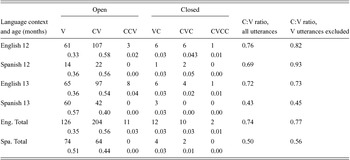
The syllable types produced by Al are listed by language context and age in Table 1. If we first look at each language, with ages combined, we can see that Al produced 16% more V-only syllables in the Spanish context than in the English context. He produced no syllables that contained consonant clusters in Spanish, whereas in English 13 syllables, or 4% of the total, included an initial or final consonant cluster. In combination, these differences result in dramatically different C:V ratios in English and Spanish contexts, both when utterances that consist of a single V are included (74% vs. 50%) and when they are excluded (77% vs. 56%). For both language contexts, the majority of syllables produced were open syllables. In the English context, 93% of syllables were open and in the Spanish context, 96% were open.
Syllable types by language context at 12 and 13 months.

Note: The final two columns give the consonant-to-vowel (C:V) ratio for all syllables and for syllables from utterances other than those consisting solely of a vowel. In cells with two numbers, the upper number is the actual number of productions and the lower number is the proportion.
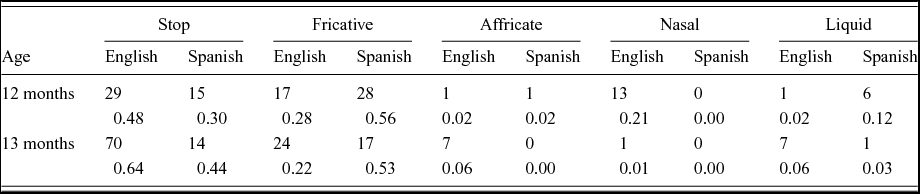
If we now look at each age separately, we can see that in both English and Spanish contexts, the number of syllables that consist of a single vowel increases from 12 months to 13 months of age. While the change in the English context is small (3%), in the Spanish context V syllables increased by 21%, making V-only syllables more common than CV syllables at 13 months in Spanish. The result is that syllable complexity, as measured by C:V ratio, decreases in both languages from 12 to 13 months. This is true both when utterances that consist solely of a vowel are included (English from 76% to 72%; Spanish from 69% to 43%) and when they are excluded (English from 82% to 73%; Spanish from 93% to 45%). As these numbers show, the decrease in syllable complexity from 12 to 13 months is greater in the Spanish than in the English context. Table 2 provides a summary of the types of consonants (excluding glides) used by Al at 12 and 13 months in English and Spanish contexts. Stops predominate in the English context, which is a general finding for children acquiring English as a first language (see e.g. Menn & Stoel-Gammon, Reference Menn, Stoel-Gammon, Fletcher and MacWhinney1995). However, in the Spanish context fricatives predominate. Table 2 also shows that the proportion of stops increases in both language contexts at 13 months.
Types of consonants in English and Spanish at 12and 13 months.

Note: The upper number is the actual number of utterances and the lower number is the proportion.
3.2 F0 differences
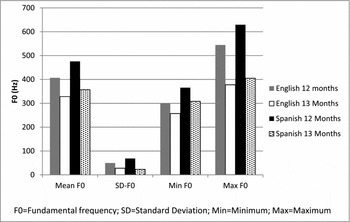
Summary statistics on the F0 characteristics of Al's voice in English and Spanish contexts are provided in Figure 1. In both language contexts, mean, minimum and maximum F0 decrease from 12 to 13 months. In addition to a general lowering of F0, F0 SD also decreases in both languages from 12 to 13 months, indicating that Al uses a smaller F0 range in any given utterance. As Figure 1 shows, Al uses a substantially larger F0 range and, at least at 12 months, shows a greater F0 SD in the Spanish context, while interacting with his mother, than in the English context, while interacting with his father.
Fundamental frequency (F0) characteristics across language context and age.

3.3 Intonation contours
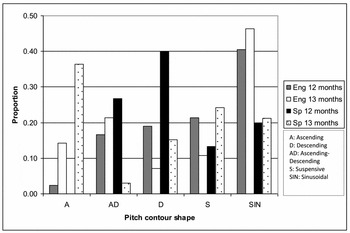
Four basic intonation contour shapes were classified in Al's English and Spanish context babbling at 12 and 13 months. These were Ascending (A), Descending (D), Suspensive (S) and Sinusoidal (SIN – repetitive rise-fall). In addition, some utterances were a combination of these (AD). The proportion of utterances with each contour shape is summarized in Figure 2. In the English context, sinusoidal (SIN) contours predominate at both 12 and 13 months and are about twice as frequent at both ages as in the Spanish context. In the Spanish context, descending contours predominate at 12 months, while ascending contours, which are completely absent in the Spanish context at 12 months, predominate at 13 months.
Intonation contour shapes across language context and age.

3.4 Utterance structure
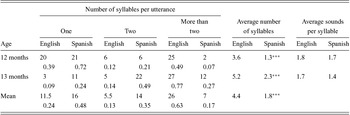
Table 3 provides information for each language subdivided by age and with the actual number of utterances in each category included. The last two columns of Table 3 give the average number of sounds per syllable. Looking first at the number of English and Spanish context utterances across the age range that contained one, two or more than two syllables, we can see that English context utterances were predominantly more than two syllables in length (63%), while in the Spanish context only 17% were more than two syllables. That is, Al produced more than three times as many polysyllabic (> 2) utterances in the English context as in the Spanish context. In regard to monosyllabic and bisyllabic utterances, there were approximately twice as many monosyllabic as bisyllabic utterances in the English context (24% vs. 13%) while there were approximately equal proportions in the Spanish context (48% vs. 35%). In terms of average number of syllables per utterance, utterances from the English context contained more than twice as many syllables as utterances from the Spanish context (4.4 vs. 1.8), a significant difference.
Number of syllables per utterance and number of sounds per syllable in English and Spanish at 12 and 13 months

***p < .001
Note: The upper number is the actual number of utterances and the lower number is the proportion.
We can see that, in both languages, the proportion of monosyllabic utterances decreased from 12 months to 13 months of age, while the proportion of utterances with more than two syllables increased. In Spanish, the proportion of bisyllabic utterances also showed a substantial increase from 12 to 13 months, while in English the proportion of bisyllabic utterances remained relatively stable. Although the average complexity of individual syllables, as measured by the average number of sounds per syllable, remains quite stable across language and age, there is a clear increase in the complexity of utterances in both languages, with the English context showing a substantially greater proportion of utterances with more than two syllables and a higher average number of syllables per utterance at both ages than the Spanish context.
3.5 Utterance length and duration characteristics
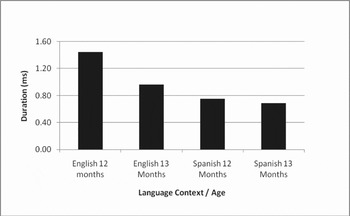
Figure 3 shows the average duration of Al's utterances by language context and age. As discussed above, on average Al's utterances at 13 months contain more syllables than at 12 months in both English and Spanish contexts. Figure 3 indicates that, in spite of this increase in syllables per utterance, there is a decrease in average utterance duration from 12 to 13 months. At both ages his utterances in the Spanish context are shorter in duration than in the English context. This is largely because he produced substantially more monosyllabic utterances in the Spanish than the English context at both ages (72% vs. 39% at 12 months and 24% vs. 9% at 13 months.)
Average utterance duration by language context and age.

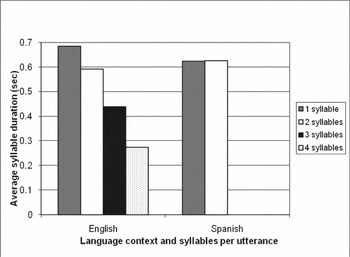
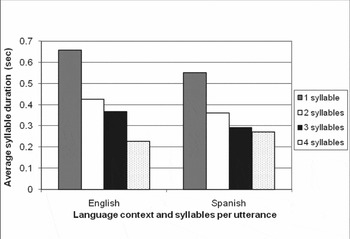
Figures 4 and 5 show average syllable durations for utterances up to 4 syllables in length at 12 and 13 months, respectively. At 12 months, Al's speech shows a pattern in which syllable duration decreases as the number of syllables per utterance increases in the English context, but not in the Spanish context. Since Al did not produce utterances more than 2 syllables in length in the Spanish context at 12 months, the degree of consistency in syllable durations in Spanish cannot be further evaluated at 12 months. However, at 13 months, Al produces utterances up to 4 syllables in length in both language contexts. A comparison of Figures 4 and 5 shows that utterances of each length are produced faster at 13 months than at 12 in both language contexts. The English context pattern, in which syllable duration decreases as the number of syllables increases, is apparent both at 12 and at 13 months. While no such pattern was apparent in the Spanish context at 12 months, at 13 months the pattern is similar in the Spanish and English contexts. However, syllable durations in the Spanish context are consistently shorter than those in the English context for utterances of one, two and three syllables in length, but not for utterances that are four syllables in length. Thus, the tendency for syllable duration to shorten as the number of syllables per utterance increases remains somewhat stronger in the English context than in the Spanish context at 13 months. In particular, there is a noticeable difference between three- and four-syllable utterances in the English context as opposed to the Spanish one.
Average syllable duration by language context and number of syllables per utterance at 12 months of age.

Average syllable duration by language context and number of syllables per utterance at 13 months of age.

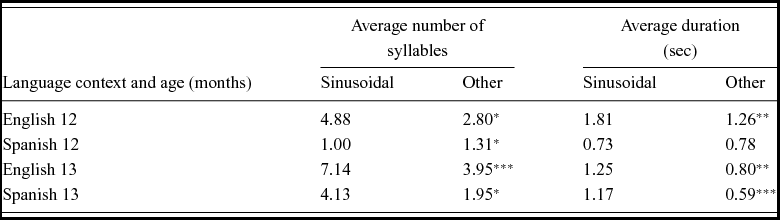
During our analyses of utterance structure, we noticed a strong association between utterance length and Al's use of sinusoidal contours. Specifically, sinusoidal contours were strongly associated with utterances that contained more syllables and were longer in duration, except in Spanish at 12 months. These data are summarized in Table 4. As this table also shows, the average number of syllables is dramatically different in the two contexts (4.88 in English vs. 1.0 in Spanish at 12 months and 7.14 in English vs. 4.13 in Spanish at 13 months).
Average number of syllables and duration of utterances with sinusoidal contours vs. other intonation contour shapes

*p < .05; **p < .01; ***p < .001
3.6 Language vs. speaker context effects
The differences in mean F0 and utterance length, reported above, are not known to distinguish Spanish from English. Nevertheless, in our results they appear to be associated with language context. Since each language was spoken to Al by only one parent, these differences may instead reflect differences in the mother's and father's speech to Al. Although a complete analysis of the parents’ input is beyond the scope of this research note, a brief follow-up examination of the parents’ utterances showed that in addition to different mean F0s, the input provided in Spanish (by the mother) and in English (by the father) was dramatically different in terms of utterance length. These differences coincide with those found in Al's babbling (lower mean F0 and longer utterances in the English context than in the Spanish context).
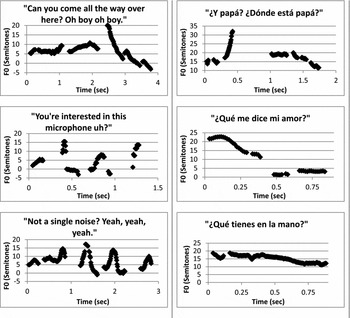
A further finding which is not known to distinguish Spanish and English is the predominance of sinusoidal contours in the English context, but not in the Spanish context. To explore whether this might also be associated with parental speaking style, we selected three utterances that were typical in length for each parent and created intonation contours for each of them (see Figure 6). Fundamental frequency was plotted in semitones rather than Hertz so that the father's and mother's voices could be directly compared. Although the F0 range of the parents’ voices is different, the plotted contours can be directly compared for amount of F0 movement, since each vertical axis shows a range of 25 semitones. The father's utterances are longer and more complex than the mother's and contain very few pauses between sentences. In addition, Al's father uses more sinusoidal intonation contours than his mother.
Example F0 contours for parental utterances. English utterances are from the father and Spanish utterances are from the mother. Semitones were calculated relative to 100 Hz.

We also observed that in interactions with Al, the father regularly produced adult-like stretches of discourse, such as:
-
(1) Do you want to try walking this way or the other way? We could try walking the other way. You know, you're kind of a clock-wise walker, aren't you? You like to walk clockwise. You like to walk clockwise, don't you. You want to try to walk counterclockwise this way? You're gonna try and walk counterclockwise this way?
It is notable that the father's speech was typically continuous across “sentences” such as those in the example above, as if no response was expected. Al's father also used vocabulary (such as clockwise and counterclockwise) that Al could not be expected to understand. In contrast, his mother tended to use shorter questions and statements with simpler vocabulary, such as:
-
(2) ¿Dónde está papá?
“Where is daddy?”
Short utterances in the mother's speech were virtually always followed by a pause, indicating that a response was expected.
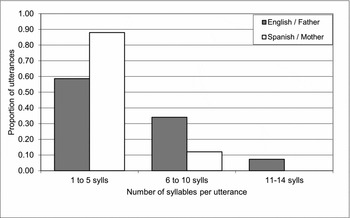
The above examples suggest that utterance length, choice of vocabulary and syntactic structures all differed across language contexts in the input which Al received. While the father makes little, if any, attempt to simplify his language, the mother's speech shows the characteristics typically seen in infant-directed speech. We counted the number of syllables in each parental utterance in all of the 12 month interactions and compared them. Figure 7 summarizes the results. As can be seen in the figure, nearly 90% of the mother's (Spanish context) utterances were five syllables or less, and none were longer than 10 syllables. In contrast, more than 40% of the father's (English context) utterances were longer than five syllables. Further, the father's utterances averaged 5.2 syllables per utterance, while the mother's averaged 3.6 per utterance, a difference significant at p < .05.
Proportion of parental utterances with different syllable lengths for all interactions at 12 months of age.

4. Discussion and conclusions
In this study we have found evidence of some universal features of babbling (e.g. predominance of open syllables) but we have also found important differences between the language contexts, which point to early differentiation of the two systems rather than a fused-system hypothesis. Al's babbling was found to be different in the two language contexts in terms of predominant consonant type, C:V ratio, proportion of V-only syllables, F0, intonation contours, syllable duration, number of syllables per utterance, and utterance duration. Although some of the differences seem to coincide with general features of the languages themselves (e.g. higher ratio of consonants in the English than in the Spanish context), others do not. We discuss these differences in more detail below.
4.1 Language-specific differences
Although open syllables predominate in Al's babbling in both language contexts, the type of open syllable is different in the two contexts: V syllables predominate in the Spanish context while CV syllables predominate in the English context. While CV syllables have been reported to predominate in Spanish babbling (Lleó et al., Reference Lleó, Prinz, El Mogharbel, Maldonado, Johnson and Gilbert1996; Oller & Eilers, Reference Oller and Eilers1982), a predominance of V syllables has also been noted in the literature for Spanish (Johnstone, Reference Johnstone2004). In Maneva and Genesee's study V-syllables also occurred significantly more frequently in the Romance language context (French in their study) than in the English context (30.3% vs. 15.3%).
As for the increase in V-only syllables and reduction in C:V ratios at 13 months, in both languages, the majority of V-only syllables are from multisyllabic utterances (63/65 in English and 55/60 in Spanish). Thus, the reduction in syllable complexity (C:V ratio) may be in compensation for production of longer utterances, i.e. utterances that contain more syllables. The fact that Al produces syllables with a higher ratio of consonants in the English than the Spanish context (74% vs. 50%) can be related to differences in English and Spanish syllable structure. In terms of consonant clusters, while no clusters appeared in the Spanish context, 4% of syllables in the English context contained a cluster, which coincides with a higher incidence of clusters in the English language as compared to Spanish (see e.g. Hammond, Reference Hammond1999; Hualde, Reference Hualde2005).
Another difference related to the nature of the two languages is the most common consonant type found in Al's babbling. While in the English context stops predominate, fricatives predominate in the Spanish context. This concurs with the Spanish monolingual data reported in Lleó, Prinz, El Mogharbel & Maldonado (Reference Lleó, Prinz, El Mogharbel, Maldonado, Johnson and Gilbert1996). In both language contexts, the small numbers of affricates, nasals and liquids suggest that these are either accidental or experimental productions at 12 and 13 months.
Overall, differences in syllable types and syllable structures in Al's babbling appear to reflect ambient language characteristics, with babbling in the English context showing more complex syllable structures, a higher C:V ratio and a preponderance of stops.
Finally, in terms of syllable duration (Figures 4 and 5), Al's speech shows a pattern in which syllable duration decreases as the number of syllables per utterance increases in the English context, but not the Spanish context. Although a complete analysis of this pattern is left for further research, it might be suggestive of stress-timed rhythm in English versus syllable-timed rhythm in Spanish.
4.2 Differences unrelated to features of each language
As Figure 1 shows, in both language contexts, mean, minimum and maximum F0 and F0 SD decrease from 12 to 13 months. Although some of this change is undoubtedly due to physical growth, listening to Al's babbling suggests that the larger reason is that his babbling is becoming more speech-like.
We found a substantially larger F0 range and a larger F0 SD in Al's utterances in the Spanish context, while interacting with his mother, than in the English context. Consistently higher F0s in the Spanish context might suggest that, in his early babbling, Al is attempting to reproduce differences in F0 that he hears in his parents’ voices. Since each parent spoke only one language to Al, these F0 differences could have been associated with language in one-on-one interactions, with the mother's higher F0 being associated with Spanish. By 13 months the F0 range and SD differences between the Spanish and English contexts are diminishing, suggesting that he might now be correctly associating these differences with the gender of the speakers rather than with the language. It could be that with the OPOL approach, where two different languages are tied to two different individuals, the child requires more time to disregard speaker characteristics such as F0.
As for utterance structure and as summarized in Table 3, Al's utterances were predominantly more than two syllables in the English context (63%) and predominantly monosyllabic in the Spanish context (48%). The utterances produced by Al in the English context contained more than twice as many syllables as utterances from the Spanish context (4.4 vs. 1.8), a significant difference. In Maneva and Genesee's (Reference Maneva, Genesee, Skarabela, Fish and Do2002) study, Bryan produced significantly more polysyllabic utterances when interacting with his French-speaking father than when interacting with his English-speaking mother (37.4% vs. 15.2%). They relate this difference to the fact that French-learning infants have been found to produce longer utterances when babbling than English infants of the same age (Boysson-Bardies & Vihman, Reference Boysson-Bardies and Vihman1991; Levitt & Utman, Reference Levitt and Utman1992). Given that, cross-linguistically, fathers use longer, more complex utterances in their speech to infants and children, the possibility should be considered that Bryan's longer, more complex utterances in French might also reflect his father's speaking style. In the absence of any studies showing that Spanish-learning infants produce shorter utterances when babbling than English-learning infants, a possible explanation for Al's higher percentage of polysyllabic productions in the English context while interacting with his father compared to the Spanish context while interacting with his mother may be the specific input he received in English.
As shown in Figure 6, the father's utterances are longer and more complex than the mother's and contain very few pauses between sentences. In addition, Al's father uses more sinusoidal intonation contours than his mother. As with our data on actual F0 values, this might suggest that Al's babbling at 12 months of age incorporates, as part of the language context, prosodic differences that are attributable to particular speakers. This appears to be a reasonable strategy for language learning, given that many prosodic characteristics are language-specific.
Although these results should be regarded as preliminary, given that we are dealing with a relatively small number of utterances produced by one child, they are suggestive of the importance of the input, particularly in the case of a dual linguistic environment in which the OPOL method is used.
4.3 Summary
In summary, our data appear to show the influence of three important factors: universal features of language development, structural differences between the languages, and a possible influence of the parents’ input.
Like other studies of monolingual and bilingual babbling, universal features of language development are evident in Al's preference for open syllables. In addition, we found important differences depending on language context. Similarly to Maneva and Genesee (Reference Maneva, Genesee, Skarabela, Fish and Do2002), these results point to an early differentiation of the two languages rather than a fused system. More generally, they also confirm the babbling drift hypothesis (Brown, Reference Brown1958, pp. 198–201), where children move from an early stage in which their babbling repertoire is less like the target language to a later stage in which their babbling increasingly resembles the language they are learning.
Contrary to Poulin-Dubois and Goodz (Reference Poulin-Dubois, Goodz, Cenoz and Genesee2001), our subject was not found to babble in the language of the mother, which in this case was also the language of higher exposure. Instead, and similarly to Maneva and Genesee (Reference Maneva, Genesee, Skarabela, Fish and Do2002), his babbling differed in the two language contexts with regard to six features. In interactions with his English-speaking father we found a greater ratio of C:V, a smaller F0 range, longer utterances and a predominance of stops, CV syllables and sinusoidal intonation contours, while in interactions with his Spanish-speaking mother we found a lower C:V ratio, a higher F0 range, shorter utterances and a predominance of fricatives, V syllables and descending and ascending intonation contours. Some of these differences can be related to general features of the input language. Thus, structural differences between the languages may explain contrasts in the C:V ratios, and in the predominance of V-syllables and absence of consonant clusters in Spanish. Influence of language structure is also apparent in Al's choice of segments. While stop–vowel combinations predominate in the English context, fricative–vowel combinations predominate in the Spanish context.
Our study found an unexpected association between Al's babbling and the parents’ input with respect to three features: F0 range, length of utterances and intonation contours. Thus, we found a higher F0 range, shorter utterances and a predominance of descending (at 12 months) and ascending (at 13 months) intonation contours in interactions with the mother and a lower F0 range, longer utterances and a predominance of sinusoidal intonation contours in interactions with his father.Footnote 6
The available literature does not offer a clear basis for these features in language structure. Since most previous studies examine separate groups of monolingual language-learning children, it is difficult to know whether the divergence in findings is related to individual learning styles or some other factor. Further research is needed to investigate how bilingual infants begin to differentiate pitch characteristics that are associated with the speaker versus the language, when their parents use the OPOL method. In this study, Al seems to be incorporating some pitch characteristics of his mother's and father's speech as if they were linked to language. A major contribution of this data is to demonstrate that a single child can show cross-language differences during acquisition that do not seem to originate from language structure and cannot originate from different learning styles. Instead, some of these differences appear to be related to contrasts in parental speaking style. In interactions with Al, his father essentially provided a running commentary on his behavior in a conversational style, in effect treating Al as if he were simply an adult conversational partner. In contrast, his mother attempted to elicit speech using classically short, simple motherese-style questions. These differences correspond to contrasts found in utterance and syllable durations, number of syllables per utterance, and average F0 in the two contexts and intonation contour shape in the English context. Both the importance of motherese vs. fatherese (e.g. Pancsofar & Vernon-Feagans, Reference Pancsofar and Vernon-Feagans2006) and the role of the input (e.g. Paradis & Navarro, Reference Paradis and Navarro2003) have been pointed out in the literature, so these are definitely issues further research needs to pursue.
Thus, although we have to be cautious, given that we are dealing with limited data from one child, these results offer some evidence of distinct babbling according to linguistic context and suggest that some of the differences found in this case study might be due to the type of exposure, OPOL in this case, rather than to the particular languages involved. Since with this method the input might contain both language-specific features as well as motherese/fatherese specific features, studies of BFLA need to be very specific about methods of exposure and gender of the care-givers for each language so that meaningful comparisons can be made.