Introduction
One of the most important advances in mental health care over the past 20 years has been the development of reliable methods for identifying those who are at greatly increased risk of developing psychosis (Yung et al. Reference Yung, McGorry, McFarlane, Jackson, Patton and Rakkar1996b ; Chuma & Mahadun, Reference Chuma and Mahadun2011; Fusar-Poli et al. Reference Fusar-Poli, Bonoldi, Yung, Borgwardt, Kempton, Valmaggia, Barale, Caverzasi and McGuire2012a ). The success of this approach has prompted calls for the inclusion of concepts such as ‘prodromal psychosis’, ‘psychosis-risk syndrome’ and ‘attenuated psychosis syndrome’ in the upcoming revision of the American Psychiatric Association's Diagnostic and Statistical Manual (Carpenter, Reference Carpenter2009; Woods et al. Reference Woods, Walsh, Saksa and McGlashan2010; Carpenter & van Os, Reference Carpenter and van Os2011). This has sparked much controversy and debate (Corcoran et al. Reference Corcoran, First and Cornblatt2010; Yung et al. Reference Yung, Nelson, Thompson and Wood2010), and it seems such proposals have now been set aside. One objection was that inclusion would lead to many young people being unnecessarily treated with antipsychotic drugs (Bentall & Morrison, Reference Bentall and Morrison2002; Morrison et al. Reference Morrison, Byrne and Bentall2010; Fusar-Poli & Yung, Reference Fusar-Poli and Yung2012), drugs that may be associated with a range of adverse effects, including weight gain (McGlashan et al. Reference McGlashan, Zipursky, Perkins, Addington, Miller, Woods, Hawkins, Hoffman, Preda, Epstein, Addington, Lindborg, Trzaskoma, Tohen and Breier2006), diabetes (Mitchell et al. Reference Mitchell, Vancampfort, de Herdt, Yu and de Hert2012), reduced cognitive functioning (Faber et al. Reference Faber, Smid, van Gool, Wiersma and van den Bosch2012; Bowie et al. Reference Bowie, McLaughlin, Carrion, Auther and Cornblatt2012) and reductions in brain tissue (Moncrieff & Leo, Reference Moncrieff and Leo2010; Tost et al. Reference Tost, Braus, Hakimi, Ruf, Vollmert, Hohn and Meyer-Lindenberg2010; Ho et al. Reference Ho, Andreasen, Ziebell, Pierson and Magnotta2011; Radua et al. Reference Radua, Borgwardt, Crescini, Mataix-Cols, Meyer-Lindenberg, McGuire and Fusar-Poli2012). Although off-label prescription of antipsychotics is now not uncommon (Broome et al. Reference Broome, Woolley, Johns, Valmaggia, Tabraham, Gafoor, Bramon and McGuire2005; Nieman et al. Reference Nieman, Rike, Becker, Dingemans, van Amelsvoort, de Haan, van der Gaag, Denys and Linszen2009; Fusar-Poli et al. Reference Fusar-Poli, Byrne, Badger, Valmaggia and McGuire2012b ), and although they lead to moderate improvements in symptoms for people with established psychosis (Leucht et al. Reference Leucht, Arbter, Engel, Kissling and Davis2009), whether they are beneficial, acceptable or harmful to young people at risk of developing psychosis remains unclear (McGorry et al. Reference McGorry, Yung, Phillips, Yuen, Francey, Cosgrave, Germano, Bravin, McDonald, Blair, Adlard and Jackson2002; McGlashan et al. Reference McGlashan, Zipursky, Perkins, Addington, Miller, Woods, Hawkins, Hoffman, Preda, Epstein, Addington, Lindborg, Trzaskoma, Tohen and Breier2006; Bechdolf et al. Reference Bechdolf, Müller, Stützer, Wagner, Maier, Lautenschlager, Heinz, de Millas, Janssen, Gaebel, Michel, Schneider, Lambert, Naber, Brüne, Krüger-Özgürdal, Wobrock, Riedel and Klosterkötter2011; Marshall & Rathbone, Reference Marshall and Rathbone2011). It was in this context that the highly favourable results of a recent trial of omega-3 fatty acids (fish oils), an inexpensive treatment with no known major adverse effects, were welcomed (Amminger et al. Reference Amminger, Schafer, Papageorgiou, Klier, Cotton, Harrigan, Mackinnon, McGorry and Berger2010).
Clinical equipoise regarding preventative treatments for psychosis has encouraged the development and evaluation of non-pharmacological psychosocial treatments, such as cognitive behavioural therapy (CBT) (French et al. Reference French, Morrison, Walford, Knight and Bentall2003; French & Morrison, Reference French and Morrison2004) and family-focused interventions (O'Brien et al. Reference O'Brien, Zinberg, Bearden, Daley, Niendam, Kopelowicz and Cannon2007; Schlosser et al. Reference Schlosser, Miklowitz, O'Brien, De Silva, Zinberg and Cannon2011). Although a recent Cochrane review found no clear evidence of efficacy for CBT (Marshall & Rathbone, Reference Marshall and Rathbone2011), several important and relevant studies have since been published. If such interventions are effective in preventing or delaying psychosis, then this would have important implications for clinicians and policy makers (McGorry et al. Reference McGorry, Hickie, Yung, Pantelis and Jackson2006).
The aim of this study was to systematically review and meta-analyse the evidence for the effectiveness of CBT-informed care for preventing psychosis in people who are at risk but are not taking prophylactic antipsychotic medication, when compared to usual or non-specific control treatment. Meta-analyses can provide greater statistical power over individual studies, particularly when study heterogeneity is low. They also provide additional information concerning effect size precision and heterogeneity that are valuable in clarifying the nature of effects and lend themselves to a more comprehensive and unbiased summary of the literature than that usually attained through informal review.
Our primary hypothesis was that CBT-informed interventions would be associated with a significantly reduced rate of transition to psychosis. Secondary hypotheses were that CBT-informed interventions would be associated with improved overall symptoms, functioning and quality of life. We also examined adverse effects and acceptability, the latter indexed by the numbers leaving early for any reason.
Method
Search
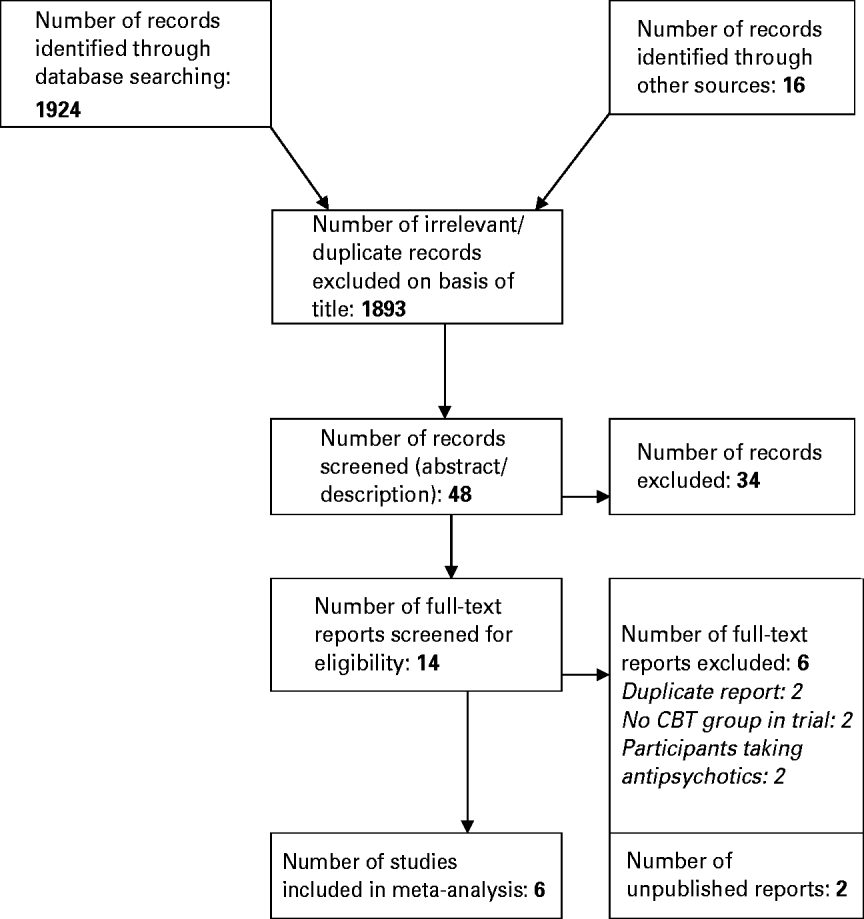
The Cochrane Group Trials Register (CENTRAL), PubMed, EMBASE, Medline, references of two recent reviews, including a systematic Cochrane review (Preti & Cella, Reference Preti and Cella2010; Marshall & Rathbone, Reference Marshall and Rathbone2011), the online clinical trials registers of the US government (clinicaltrials.gov), European Union (clinicaltrialsregister.eu), World Health Organization (apps.who.int/trialsearch) and Current Controlled Trials Ltd (controlled-trials.com) were searched in April 2012. The CENTRAL and PubMed searches were limited to the years 2008–2012, given that the recent Cochrane review completed their last search in 2009. All years up to April 2012 were searched in EMBASE, Medline and the clinical trial registries. Most of the search terms used in a recent systematic review of transition outcomes in the at-risk group were also used here, as they seemed suitably broad (Fusar-Poli et al. Reference Fusar-Poli, Bonoldi, Yung, Borgwardt, Kempton, Valmaggia, Barale, Caverzasi and McGuire2012a ). These were ‘psychosis risk, ultra high risk, prodromal psychosis, psychosis transition … and psychosis onset’. Other terms searched for were ‘psychosis prevention’ and ‘at-risk mental state’. The initial search was limited to the abstract, title and keywords (see PRISMA diagram, Fig. 1). To ensure that the work was as up-to-date as possible, we searched for published reports of any initially unpublished trials on a weekly basis from April 2012 until the manuscript was accepted for publication.
PRISMA flowchart detailing study selection.

Studies were included only if participants at high risk of developing psychosis were allocated randomly to receive various interventions, one of which had to include CBT but not pharmacological treatment, and one of which had to be treatment as usual or a non-specific control treatment (i.e. supportive therapy, monitoring, case management). Included studies had to meet basic quality criteria, such as concealed and random allocation to treatment groups.
Pre-registration of review protocol
The review protocol was registered in advance with the International Prospective Register of Systematic Reviews (PROSPERO), Protocol No: CRD42012002260 (Hutton, Reference Hutton2012).
Data extraction and outcomes
The primary outcome was transition to psychosis, as defined in each study. Secondary outcomes were reduction in overall symptoms (or when not reported, positive symptoms) and improvements in functioning [preferably Global Assessment of Functioning (GAF) scores] and quality of life.
A strict intention-to-treat (ITT) analysis for dichotomous data was performed, using the total numbers randomized to each group as the denominator in each case. Those leaving early or unaccounted for were assumed to have had the unchanged outcome. Examination of the impact of changing this assumption was intended, but only if data reporting would allow it. For secondary continuous outcomes, summary data based on a mixed-model repeated-measures imputation method were used when available; if not available, it was expected the analysis would be restricted to analysing data incorporating last observation carried forward (LOCF) assumptions. Following Leucht et al. (Reference Leucht, Arbter, Engel, Kissling and Davis2009), we extracted and analysed mean change scores when reported, and end-point scores otherwise.
To reduce the impact of attrition bias, study data were only included if they incorporated end-point scores from at least 50% of those who were randomized, excluding the analysis of leaving the study early. We contacted study authors to request missing or unpublished data. All extractions were carried out by the first author, and independently confirmed by the second. Any discrepancies were resolved by discussion.
Meta-analytic calculations
For binary data, the relative risk (RR) of the unfavourable outcome was calculated together with 95% confidence intervals (CIs). The absolute risk difference (RD) and the numbers needed to treat (NNT) were calculated only if the RR was significant. The NNT was calculated in two ways: (1) as the inverse of the RD, as in Leucht et al. (Reference Leucht, Arbter, Engel, Kissling and Davis2009), and (2) as the inverse of the product of the relative risk reduction (RRR) and an ‘assumed control risk’ (ACR), as in Higgins et al. (Reference Higgins and Green2011b ). Inclusion of the latter was a post-hoc decision but one that acknowledges that ‘Risk differences are least likely to be consistent across baseline event rates; thus, they are rarely appropriate for computing numbers needed to treat in systematic reviews’ (Higgins et al. Reference Higgins and Green2011b ). ACRs were derived from Fusar-Poli et al. (Reference Fusar-Poli, Bonoldi, Yung, Borgwardt, Kempton, Valmaggia, Barale, Caverzasi and McGuire2012a ).
Continuous data from different outcome measures were combined to allow calculation of the standardized mean difference (SMD; Higgins et al. Reference Higgins and Green2011b ). This and 95% CIs were calculated using Revman software, which uses the Hedges’ g adjustment for small sample bias. Statistical significance was assumed if the probability of the observed differences arising under the null hypothesis was 5% or less, using two-tailed hypotheses throughout. The magnitude of effect that would be considered clinically significant was not pre-specified, as there are few relevant data to inform such considerations in this group. A random-effects analysis was used for both continuous and binary outcomes but a secondary analysis using fixed effects was carried out if heterogeneity was moderate or less, in accordance with the methodology of the National Institute for Health and Clinical Excellence (NICE) schizophrenia guidelines (NICE, 2009). The results from both are reported only where the estimates differ. Moderate heterogeneity was assumed if the I 2 statistic was 40% (NICE, 2009; Higgins et al. Reference Higgins and Green2011b ). We also examined whether the primary outcome results were robust to excluding individual studies from the analysis. Calculations were performed by the first author, and independently replicated by the second. There were no discrepancies.
Risk of bias
Risk of bias was assessed with the Cochrane Collaboration Risk of Bias tool, version 5.1.0 (Higgins et al. Reference Higgins and Green2011b ). This involves categorizing studies as having a low, high or unclear risk of bias in the areas of selection and allocation of participants, intervention concealment, attrition and reporting (Higgins et al. Reference Higgins, Altman, Gotzsche, Juni, Moher, Oxman, Savovic, Schulz, Weeks and Sterne2011a ). The results of this assessment were used to inform interpretation of reported effect sizes and overall conclusions.
Results
Study selection
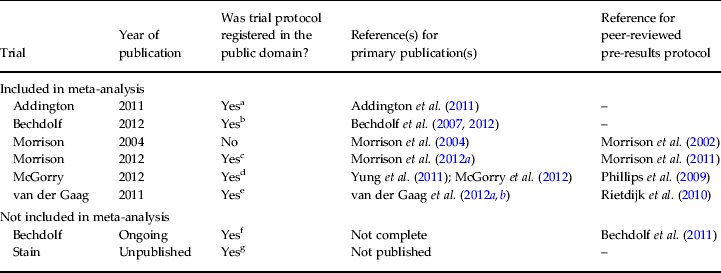
The process of selecting studies is detailed in Fig. 1. The initial search produced 1940 papers and conference abstracts. The vast majority of these were clearly irrelevant (e.g. involved different clinical populations such as dementia or established psychosis, or were brain imaging studies, antipsychotic trials or correlational studies). Overall, 48 were possibly relevant. Screening of abstracts reduced this to 14. The full-text publications or reports for each of these were traced. A further six were then excluded as they did not meet inclusion criteria (see Fig. 1). A total of eight studies were relevant, two of which could not be included because one is ongoing (Bechdolf et al. Reference Bechdolf, Müller, Stützer, Wagner, Maier, Lautenschlager, Heinz, de Millas, Janssen, Gaebel, Michel, Schneider, Lambert, Naber, Brüne, Krüger-Özgürdal, Wobrock, Riedel and Klosterkötter2011) and the other has yet to be published (Stain, unpublished observations). Trial publication details are given in Table 1.
Trial details

Study characteristics and treatment
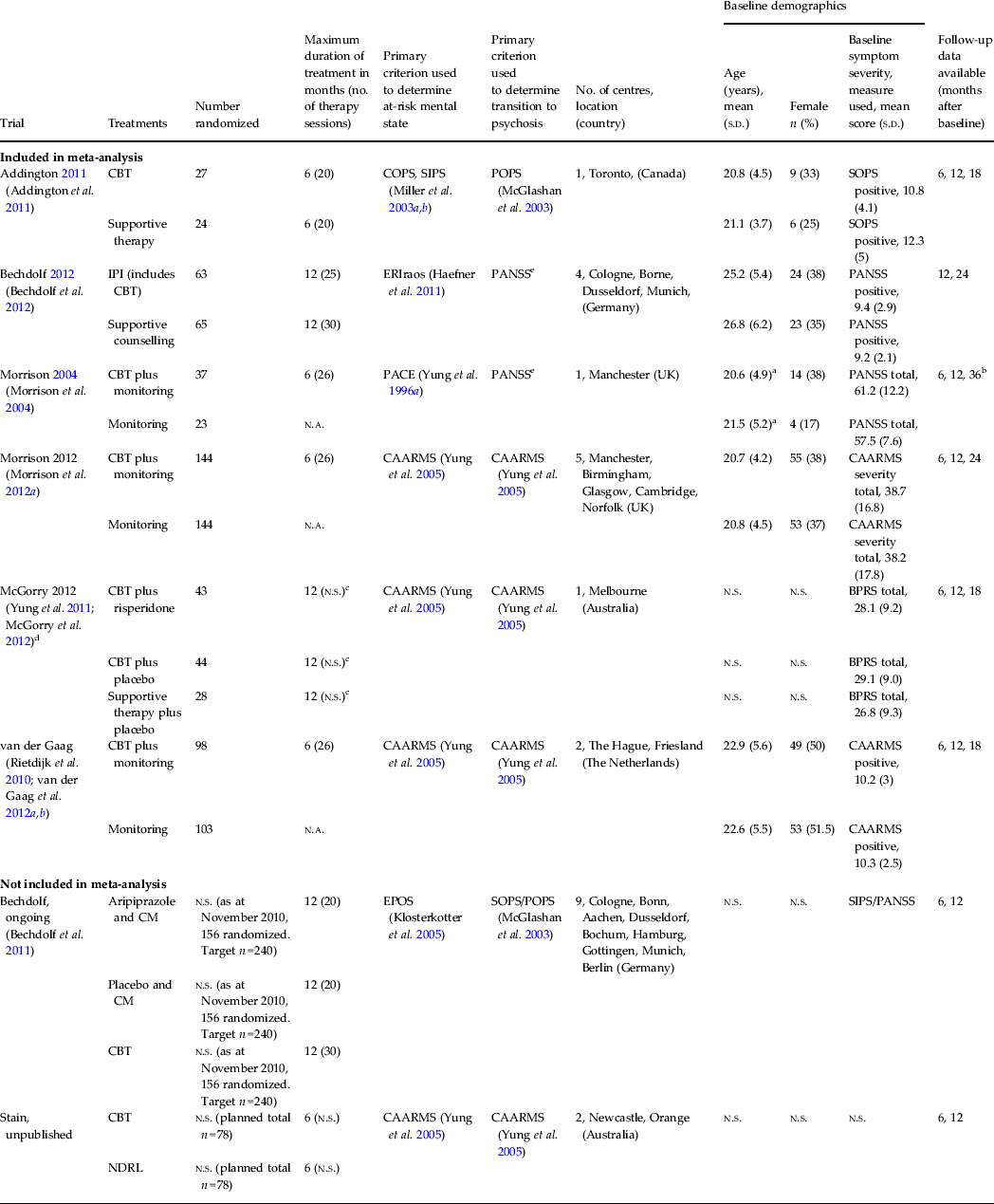
Trial characteristics and baseline demographics for all studies are given in Table 2. The CBT provided was based on published treatment manuals. Four trials (Morrison et al. Reference Morrison, French, Walford, Lewis, Kilcommons, Green, Parker and Bentall2004; Rietdijk et al. Reference Rietdijk, Dragt, Klaassen, Ising, Nieman, Wunderink, Delespaul, Cuijpers, Linszen and van der Gaag2010; Addington et al. Reference Addington, Epstein, Liu, French, Boydell and Zipursky2011; Morrison et al. Reference Morrison, French, Stewart, Birchwood, Fowler, Gumley, Jones, Bentall, Lewis, Murray, Patterson, Brunet, Conroy, Parker, Reilly, Byrne, Davies and Dunn2012a ) were based on one approach (French & Morrison, Reference French and Morrison2004). The remaining two trials (Bechdolf et al. Reference Bechdolf, Wagner, Ruhrmann, Harrigan, Putzfeld, Pukrop, Brockhaus-Dumke, Berning, Janssen, Decker, Bottlender, Maurer, Moller, Gaebel, Hafner, Maier and Klosterkotter2012; McGorry et al. Reference McGorry, Nelson, Phillips, Yuen, Francey, Thampi, Berger, Amminger, Simmons, Kelly, Thompson and Yung2012) were each based on one of two other published manuals (Yung et al. Reference Yung, Phillips and McGorry2004; Bechdolf et al. Reference Bechdolf, Puetzfeld, Gross and Guettgemanns2010). All approaches involved time-limited and structured sessions, formulation, self-monitoring, collaboration, homework between sessions, use of cognitive and behavioural experiments and other strategies to address unhelpful appraisals and improve coping, a focus on patient goals and work on addressing a range of difficulties as prioritized by the patient.
Trial characteristics and baseline demographics

CBT, Cognitive behavioural therapy; IPI, integrated psychological intervention; COPS, criteria of prodromal states; SIPS, Structured Interview for Prodromal Symptoms; SOPS, Scale of Prodromal Symptoms; POPS, presence of psychotic symptoms; ERIraos, Early Recognition Inventory; PANSS, Positive and Negative Syndrome Scale; PACE, Personal Assessment and Crisis Evaluation; CAARMS, Comprehensive Assessment of At-Risk Mental State; BPRS, Brief Psychiatric Rating Scale; EPOS, European Prediction of Psychosis Study; CM, clinical management; NDRL, non-directive reflective listening; n.s., not supplied; n.a., not applicable; s.d., standard deviation.
a Median (range).
b 36-month data not reported here as attrition > 50%.
c CBT was ‘offered weekly to fortnightly, depending on clinical need’ and supportive therapy was ‘offered weekly to monthly, depending on clinical need’ (Yung et al. Reference Yung, Phillips, Nelson, Francey, PanYuen, Simmons, Ross, Kelly, Baker, Amminger, Berger, Thompson, Thampi and McGorry2011).
d Data from an additional non-randomly allocated ‘monitoring’ group, consisting of those who declined to enter the formal trial, was also presented but is not included here.
e PANSS transition defined as a score of 4 or more on items measuring hallucinations and delusions and/or 5 or more on items measuring conceptual disorganization, with a frequency of at least several times a week and duration of more than 1 week.
Risk of bias
Selection bias refers to the risk of researchers being able to influence, or have knowledge of, allocation of participants to treatment (Higgins et al. Reference Higgins, Altman, Gotzsche, Juni, Moher, Oxman, Savovic, Schulz, Weeks and Sterne2011a ). Such bias has been found to inflate effect size estimates by around 30–40% (Schulz et al. Reference Schulz, Chalmers, Hayes and Altman1995). A particular strength of the included trials was that randomization and allocation procedures were clearly described and adequate in most cases, meaning such bias was generally low. However, although well-described and involving adequate concealment, the randomization procedure in Morrison et al. (Reference Morrison, French, Walford, Lewis, Kilcommons, Green, Parker and Bentall2004) produced significantly unequal sample sizes, meaning the risk of selection bias was unclear.
Detection bias refers to the risk that those completing outcome assessments know who received which treatment (Higgins et al. Reference Higgins, Altman, Gotzsche, Juni, Moher, Oxman, Savovic, Schulz, Weeks and Sterne2011a ). This is more of a problem when the assessments depend on the subjective judgement of the assessor (e.g. diagnosis), and less of a problem when they are more objective (e.g. death, unemployment). The risk of bias in this domain was unclear in two out of six trials because they did not report whether or not there were blind-breaks (Addington et al. Reference Addington, Epstein, Liu, French, Boydell and Zipursky2011; Yung et al. Reference Yung, Phillips, Nelson, Francey, PanYuen, Simmons, Ross, Kelly, Baker, Amminger, Berger, Thompson, Thampi and McGorry2011), and high in one study because they did not report attempts to use blinding (Bechdolf et al. Reference Bechdolf, Wagner, Ruhrmann, Harrigan, Putzfeld, Pukrop, Brockhaus-Dumke, Berning, Janssen, Decker, Bottlender, Maurer, Moller, Gaebel, Hafner, Maier and Klosterkotter2012) and described their study as open label in their published protocol. The other three studies did report some blind-breaks (Morrison et al. Reference Morrison, French, Walford, Lewis, Kilcommons, Green, Parker and Bentall2004, Reference Morrison, French, Stewart, Birchwood, Fowler, Gumley, Jones, Bentall, Lewis, Murray, Patterson, Brunet, Conroy, Parker, Reilly, Byrne, Davies and Dunn2012a ; van der Gaag et al. Reference van der Gaag, Nieman, Rietdijk, Dragt, Ising, Klaassen, Koeter, Cuijpers, Wunderink and Linszen2012a ). However, we assessed risk of bias as low for at least the assessment of transition because each trial introduced new blinded raters to either take over or validate the assessments, whereas one trial also validated their assessments by comparing them to an external measure with some ecological validity, the prescription of antipsychotic medication by an independent psychiatrist (Morrison et al. Reference Morrison, French, Walford, Lewis, Kilcommons, Green, Parker and Bentall2004). The incidence of unblinding was also relatively low (5–22%) in two studies (Morrison et al. Reference Morrison, French, Stewart, Birchwood, Fowler, Gumley, Jones, Bentall, Lewis, Murray, Patterson, Brunet, Conroy, Parker, Reilly, Byrne, Davies and Dunn2012a ; van der Gaag et al. Reference van der Gaag, Nieman, Rietdijk, Dragt, Ising, Klaassen, Koeter, Cuijpers, Wunderink and Linszen2012a ), although precise figures were not reported for the third (Morrison et al. Reference Morrison, French, Walford, Lewis, Kilcommons, Green, Parker and Bentall2004).
Performance bias refers to the risk of participants or clinical personnel being aware of treatment allocation (Higgins et al. Reference Higgins, Altman, Gotzsche, Juni, Moher, Oxman, Savovic, Schulz, Weeks and Sterne2011a ), as this may result in a change in behaviour designed to please the experimenter. A high risk of such bias is unavoidable in therapy trials, particularly when assessments rely on participant self-report, and indeed there is evidence from two included trials that at least some participants are able to conceal psychotic symptoms if motivated to do so (Morrison et al. Reference Morrison, French, Walford, Lewis, Kilcommons, Green, Parker and Bentall2004; van der Gaag et al. Reference van der Gaag, Nieman, Rietdijk, Dragt, Ising, Klaassen, Koeter, Cuijpers, Wunderink and Linszen2012a ).
There was a high risk of bias from selective reporting by Bechdolf et al. (Reference Bechdolf, Wagner, Ruhrmann, Harrigan, Putzfeld, Pukrop, Brockhaus-Dumke, Berning, Janssen, Decker, Bottlender, Maurer, Moller, Gaebel, Hafner, Maier and Klosterkotter2012), in that no continuous symptom end-point or change data were reported in either the main (Bechdolf et al. Reference Bechdolf, Wagner, Ruhrmann, Harrigan, Putzfeld, Pukrop, Brockhaus-Dumke, Berning, Janssen, Decker, Bottlender, Maurer, Moller, Gaebel, Hafner, Maier and Klosterkotter2012) or a secondary publication (Bechdolf et al. Reference Bechdolf, Wagner, Veith, Ruhrmann, Pukrop, Brockhaus-Dumke, Berning, Stamm, Janssen, Decker, Bottlender, Moller, Gaebel, Maier and Klosterkotter2007), despite this being identified a priori as a secondary outcome (see Table 1 for details of online trial protocol). The first author has advised there were no group differences with respect to symptoms, but these analyses were not reported in the main publication because peer reviewers argued the figures would be distorted by the premature exit of those who developed psychosis.
Several outcomes from Morrison et al. (Reference Morrison, French, Stewart, Birchwood, Fowler, Gumley, Jones, Bentall, Lewis, Murray, Patterson, Brunet, Conroy, Parker, Reilly, Byrne, Davies and Dunn2012a ) (quality of life at all assessment points and all outcomes at 24 months) were at high risk of attrition bias because of large amounts of missing data (> 50%) over and above planned drop-out (Xia et al. Reference Xia, Adams, Bhagat, Bhagat, Bhoopathi, El-Sayeh, Pinfold and Takriti2009). This was also true for all 36-month outcomes from Morrison et al. (Reference Morrison, French, Walford, Lewis, Kilcommons, Green, Parker and Bentall2004, Reference Morrison, French, Parker, Roberts, Stevens, Bentall and Lewis2007). In the other studies, attrition bias was either low for the primary analysis of transition rates, or unclear (McGorry et al. Reference McGorry, Nelson, Phillips, Yuen, Francey, Thampi, Berger, Amminger, Simmons, Kelly, Thompson and Yung2012). Risk of attrition bias inevitably increases as drop-out increases, which in turn is normally a function of trial duration. Thus the longer-term outcomes are more suspect in this domain than shorter-term outcomes.
Outcomes
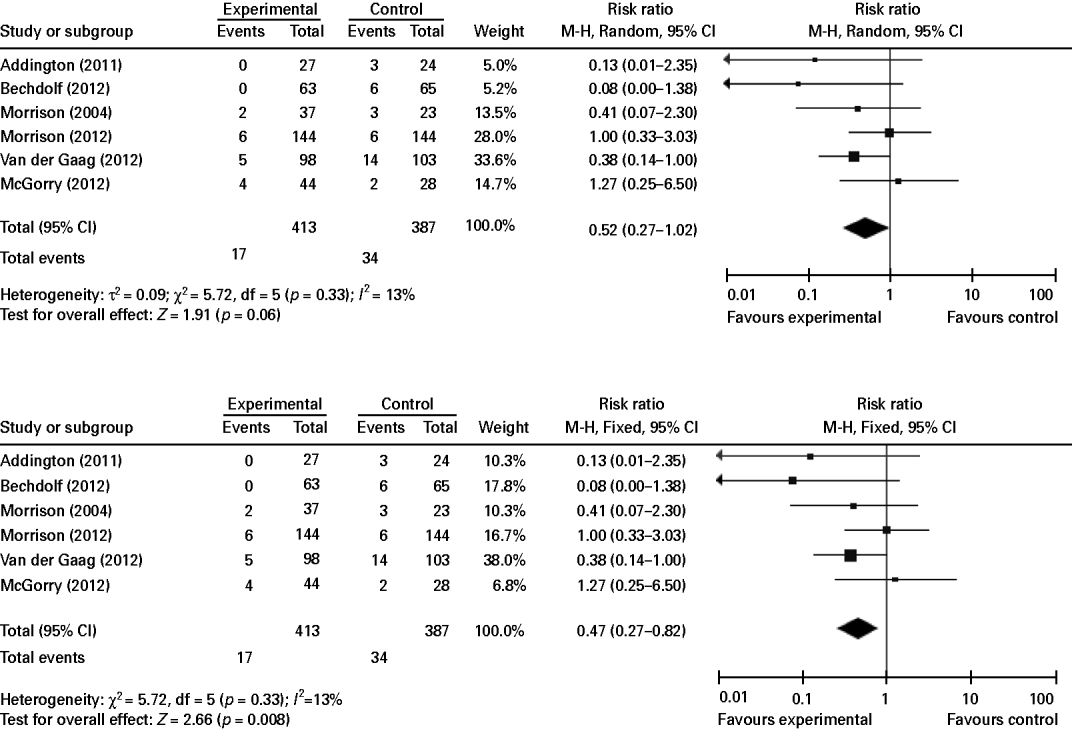
Primary outcome (Figs 2–4)
Transition at 6 months
All six trials contributed to this outcome, providing data from 800 participants. The difference in transition rates observed in the random-effects analysis (RR 0.52, 95% CI 0.27–1.02, p = 0.06 just failed to meet the criterion for statistical significance, meaning the odds of such a difference arising under a true null hypothesis were 1:17 instead of the requisite 1:20. The results achieved statistical significance (p = 0.03) if we excluded equivocal data from Yung et al. (Reference Yung, Phillips, Nelson, Francey, PanYuen, Simmons, Ross, Kelly, Baker, Amminger, Berger, Thompson, Thampi and McGorry2011).
Transition at 6 months.

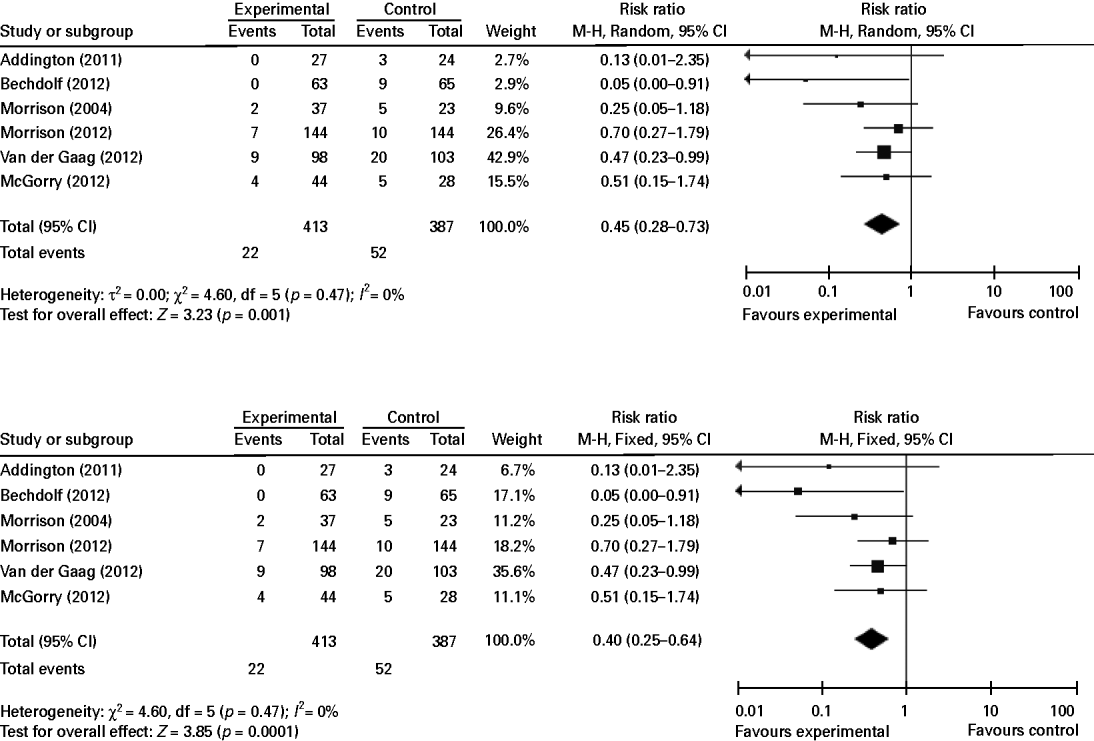
Transition at 12 months.

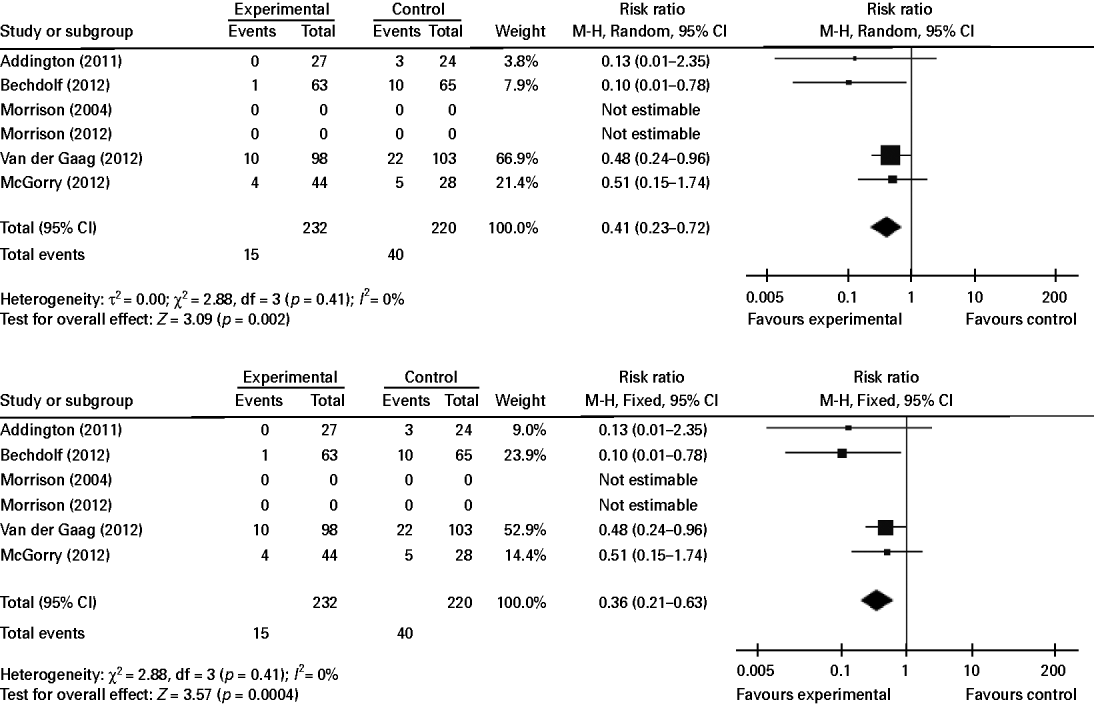
Transition at 18–24 months.

As heterogeneity was low (13%), a fixed-effects analysis was also conducted, according to our protocol. In this analysis the effect size was comparable, if not slightly larger (RR 0.47, 95% CI 0.27–0.82), but highly statistically significant (p = 0.008), meaning the odds of the observed differences arising under a true null hypothesis were 1:125. These odds fell to 1:17 (p = 0.06) if we removed CBT favourable results from the large trial by van der Gaag et al. (Reference van der Gaag, Nieman, Rietdijk, Dragt, Ising, Klaassen, Koeter, Cuijpers, Wunderink and Linszen2012a ).
Based on an observed absolute risk reduction of –0.05 (95% CI –0.08 to –0.01), the number needed to treat (NNT) for all six studies combined was 20 (95% CI 13–100). However, the control group transition rate of 9% (4% in CBT, 6% overall) was lower than other meta-analytical estimates, where 18% were found to make transition over 6 months (Fusar-Poli et al. Reference Fusar-Poli, Bonoldi, Yung, Borgwardt, Kempton, Valmaggia, Barale, Caverzasi and McGuire2012a ). The NNT estimate derived from the product of the Fusar-Poli et al. (Reference Fusar-Poli, Bonoldi, Yung, Borgwardt, Kempton, Valmaggia, Barale, Caverzasi and McGuire2012a ) transition rate and our observed fixed-effect RRR was considerably smaller at 10 (95% CI 8–31).
The control group transition rate increased to 12% (5% in CBT, 9% overall) if we excluded a study of early prodromal psychosis (i.e. where fewer would be expected to develop psychosis) (Bechdolf et al. Reference Bechdolf, Wagner, Ruhrmann, Harrigan, Putzfeld, Pukrop, Brockhaus-Dumke, Berning, Janssen, Decker, Bottlender, Maurer, Moller, Gaebel, Hafner, Maier and Klosterkotter2012) and a study where 29 potential participants were excluded because they developed or disclosed established psychosis between baseline assessments, before they were randomized (Morrison et al. Reference Morrison, French, Stewart, Birchwood, Fowler, Gumley, Jones, Bentall, Lewis, Murray, Patterson, Brunet, Conroy, Parker, Reilly, Byrne, Davies and Dunn2012a ).
Sensitivity analyses
The magnitude and precision of the effect favouring CBT was reduced if we excluded the Bechdolf Reference Bechdolf, Wagner, Ruhrmann, Harrigan, Putzfeld, Pukrop, Brockhaus-Dumke, Berning, Janssen, Decker, Bottlender, Maurer, Moller, Gaebel, Hafner, Maier and Klosterkotter2012 study (random effects: RR 0.58, 95% CI 0.31–1.07, p = 0.08; fixed effects: RR 0.55, 95% CI 0.31–0.99, p = 0.05, RD-NNT 25, 95% CI 13–∞, ACR-NNT 12, 95% CI 8–556), which differed from the other trials in respect of non-masked assessments, additional psychosocial interventions received by the CBT group (cognitive remediation, family psycho-education) and population studied (early prodromal). As this study was described as CBT in both the trial protocol and a previous publication (Bechdolf et al. Reference Bechdolf, Wagner, Veith, Ruhrmann, Pukrop, Brockhaus-Dumke, Berning, Stamm, Janssen, Decker, Bottlender, Moller, Gaebel, Maier and Klosterkotter2007), and because they reported the numbers developing a first episode of psychosis, we deemed inclusion to be valid. The effect size was also slightly smaller and less precise if we assumed the seven participants in two randomized controlled trials (RCTs; Morrison et al. Reference Morrison, French, Walford, Lewis, Kilcommons, Green, Parker and Bentall2004; van der Gaag et al. Reference van der Gaag, Nieman, Rietdijk, Dragt, Ising, Klaassen, Koeter, Cuijpers, Wunderink and Linszen2012a ) assessed as having concealed their pre-randomization transition to psychosis (e.g. as evidenced by past antipsychotic use or self-report) were in fact new transitions (random effects: RR 0.64, 95% CI 0.37–1.11, p = 0.11; fixed effects: RR 0.56, 95% CI 0.34–0.94, p = 0.03, RD-NNT 25, 95% CI 13–100, ACR-NNT 13, 95% CI 8–93).
Transition at 12 months
All six trials also contributed data to this outcome. A random-effects analysis found CBT was associated with a significantly reduced risk of transition (RR 0.45, 95% CI 0.28–0.73, p = 0.001, RD –0.09, 95% CI –0.14 to –0.04), with an NNT of between 11 (95% CI 7–25), using the inverse of the observed RD, and 8 (95% CI 6–17) using the observed RRR and an assumed control risk of 22% (Fusar-Poli et al. Reference Fusar-Poli, Bonoldi, Yung, Borgwardt, Kempton, Valmaggia, Barale, Caverzasi and McGuire2012a ). No heterogeneity was observed; however, the fixed-effects analysis produced a slightly better relative risk estimate (RR 0.40, 95% CI 0.25–0.64, p = 0.0001) and a slightly reduced estimate of the absolute risk reduction (RD –0.08, 95% CI –0.12 to –0.04). The results were robust to a leave-one-out analysis, suggesting they were not driven by one trial alone.
Overall, just over 13% of the control-group participants included in this analysis developed psychosis (5% in the CBT group, 9% overall), which is clearly lower than the 22% reported elsewhere (Fusar-Poli et al. Reference Fusar-Poli, Bonoldi, Yung, Borgwardt, Kempton, Valmaggia, Barale, Caverzasi and McGuire2012a ). Removing data from the two trials where baseline transition risk may have been reduced by trial design issues (Bechdolf et al. Reference Bechdolf, Wagner, Ruhrmann, Harrigan, Putzfeld, Pukrop, Brockhaus-Dumke, Berning, Janssen, Decker, Bottlender, Maurer, Moller, Gaebel, Hafner, Maier and Klosterkotter2012; Morrison et al. Reference Morrison, French, Stewart, Birchwood, Fowler, Gumley, Jones, Bentall, Lewis, Murray, Patterson, Brunet, Conroy, Parker, Reilly, Byrne, Davies and Dunn2012a ) resulted in a comparable control group transition rate of 18% (7% in CBT, 12% overall). The pooled data from the remaining four trials remained favourable to CBT, if not slightly more so.
Sensitivity analyses
The magnitude and precision of effect favouring CBT was slightly reduced if we excluded the Bechdolf (Reference Bechdolf, Müller, Stützer, Wagner, Maier, Lautenschlager, Heinz, de Millas, Janssen, Gaebel, Michel, Schneider, Lambert, Naber, Brüne, Krüger-Özgürdal, Wobrock, Riedel and Klosterkötter2012) study, according to both random- and fixed-effects analyses (RR 0.48, 95% CI 0.30–0.79, p = 0.001, RD –0.07, 95% CI –0.13 to –0.02, RD-NNT 14, 95% CI 8–50, ACR-NNT 9, 95% CI 6–22). Reclassifying seven pre-randomization transitions in two RCTs as post-randomization transitions was also associated with a slight reduction in effect size magnitude in both the random- (RR 0.53, 95% CI 0.34–0.82, p = 0.005, RD –0.08, 95% CI –0.13 to –0.03, RD-NNT 13, 95% CI 8–33, ACR-NNT 10, 95% CI 7–25) and fixed-effects analyses (RR 0.47, 95% CI 0.30–0.72, p = 0.0005, RD –0.08, 95% CI –0.12 to –0.03, RD-NNT 13, 95% CI 8–33, ACR-NNT 9, 95% CI 6–16).
Transition at 18–24 months
Four trials provided usable data from 452 participants. A random-effects analysis found CBT was associated with a reduced likelihood of transition (RR 0.41, 95% CI 0.23–0.72, p = 0.002, RD –0.12, 95% CI –0.18 to –0.06). The NNT was 8 (95% CI 6–14) when derived from the observed RD, and 6 (95% CI 5–11) when derived from the observed RRR and an assumed control risk of 27–29% (Fusar-Poli et al. Reference Fusar-Poli, Bonoldi, Yung, Borgwardt, Kempton, Valmaggia, Barale, Caverzasi and McGuire2012a ). Heterogeneity remained absent (0%), but the fixed-effect analysis produced slightly more favourable results (RR 0.36, 95% CI 0.21–0.63, p = 0.0004, RD –0.12, 95% CI –0.18 to –0.06), although the NNT estimates were unaffected. Although Morrison 2012 reported equivocal 24-month data, more than 50% of this was missing even after accounting for planned drop-out, therefore this was not included in the analysis. The results were also robust to a leave-one-out analysis.
Approximately 18% of control-group participants in these four trials converted to psychosis by 18–24 months (6% in CBT, 12% overall), whereas Fusar-Poli et al. (Reference Fusar-Poli, Bonoldi, Yung, Borgwardt, Kempton, Valmaggia, Barale, Caverzasi and McGuire2012a ) reported rates of 27% (18 months) and 29% (24 months). Excluding the Bechdolf et al. (Reference Bechdolf, Wagner, Ruhrmann, Harrigan, Putzfeld, Pukrop, Brockhaus-Dumke, Berning, Janssen, Decker, Bottlender, Maurer, Moller, Gaebel, Hafner, Maier and Klosterkotter2012) study was associated with marginally increased transition rates in the control group (19%), the CBT group (8%) and overall (14%).
Sensitivity analyses
Excluding the Bechdolf et al. (2012) study was also associated with a marginal reduction in magnitude of effect favouring CBT (random effects: RR 0.46, 95% CI 0.28–0.75, p = 0.01, RD –0.11, 95% CI –0.17 to –0.05; fixed effects: RR 0.44, 95% CI 0.27–0.72, p = 0.007, RD –0.11, 95% CI –0.17 to –0.05) with NNTs ranging from 6 (95% CI 5–12; based on an RRR of 0.56 and ACR of 29%) to 9 (95% CI 6–20; based on an RD of –0.11). Reclassifying five pre-randomization transitions in van der Gaag et al. (Reference van der Gaag, Nieman, Rietdijk, Dragt, Ising, Klaassen, Koeter, Cuijpers, Wunderink and Linszen2012a ) as post-randomization transitions had a slight effect on the fixed-effects analysis only (RR 0.42, 95% CI 0.27–0.64, p = 0.0008, RD –0.11, 95% CI –0.16 to –0.06), with NNT estimates ranging from 6 (95% CI 5–10; based on an RRR of 0.58 and ACR of 29%) to 9 (95% CI 6–17; based on an RD of –0.11).
Eighteen-month data from McGorry et al. (Reference McGorry, Nelson, Phillips, Yuen, Francey, Thampi, Berger, Amminger, Simmons, Kelly, Thompson and Yung2012) suffered from 47% missing data and transition at this time point was defined pragmatically as receipt of (a) help from a State psychiatric hospital and (b) a diagnosis of psychotic illness (McGorry, Yuen and Yung, personal communication), as inferred from medical records (McGorry et al. Reference McGorry, Nelson, Phillips, Yuen, Francey, Thampi, Berger, Amminger, Simmons, Kelly, Thompson and Yung2012). Excluding these potentially less reliable data was associated with an increase in the magnitude of the CBT-favourable effect size in the random-effects analysis (RR 0.30, 95% CI 0.12–0.72, p = 0.02, RD –0.13, 95% CI –0.18 to –0.07), with the most favourable NNT estimate now being 5 (95% CI 4–12; based on an RRR of 0.70 and an ACR of 29%) and the least favourable now being 8 (95% CI 6–14; based on a fixed-effects RD of –0.12).
Although these results are promising, the reporting of transition rates and numbers leaving early did not allow the impact of changing assumptions about the outcome of those who left early to be easily assessed. For example, it was often not clear from the study reports whether the numbers lost to follow-up or numbers failing to complete assessments included those who made transition before that particular assessment point. Thus the figures reported above may not be robust to changing assumptions about the outcome of those leaving early.
Test of robustness of findings to the unpublished study
One obvious concern is that the completed 12-month study remains unpublished because of disappointing findings. To test how the overall results would be affected by this risk, we entered either equivocal or even highly unfavourable data for this trial into the meta-analysis, using information in the published protocol. In each case we made several reasonable but conservative assumptions: (1) the researchers recruited their target of 78 participants; (2) each group had 39 participants; and (3) the transition rate in the control group was the same as the combined control-arm transition rate for all the other studies (i.e. 9% at 6 months, 13% at 12 months).
These tests suggested that, at 6 months, the overall RR for the favourable fixed-effects analysis would be slightly smaller if we assume this study produced an equivocal result (RR 0.52, 95% CI 0.31–0.87, p = 0.01), meaning the relative risk of transition would be reduced by 48% rather than 53%. Although the absolute risk reduction would be only slightly smaller (RD –0.04, 95% CI –0.08 to –0.01), the RD-NNT would increase from 20 to 25 (95% CI 13–100), and the ACR-NNT, based on an 18% transition rate (Fusar-Poli et al. Reference Fusar-Poli, Bonoldi, Yung, Borgwardt, Kempton, Valmaggia, Barale, Caverzasi and McGuire2012a ) and an RRR of 0.48, would increase to 12 (95% CI 8–51). If, compared to the control group, twice as many people in the CBT group developed psychosis by 6 months, then the pooled effect size would be smaller and of borderline statistical significance (RR 0.62, 95% CI 0.38–1.00, p = 0.05, RD –0.03, 95% CI –0.07 to –0.00).
At 12 months, the overall RR would be slightly smaller for the favourable random-effects analysis if we assume an equivocal result (RR 0.51, 95% CI 0.32–0.80, p = 0.004, RD –0.08, 95% CI –0.13 to –0.03), leading to an RD-NNT of 13 (95% CI 8–33) and an ACR-NNT of 10 (95% CI 7–23; based on a 22% transition rate and an RRR of 0.49). If we assume twice as many people receiving CBT made transition compared with those receiving the control treatment, then the magnitude of the effect size estimate would remain largely unaffected (RR 0.54, 95% CI 0.27–1.06, RD –0.07, 95% CI –0.14 to –0.01), but statistical significance would decline to trend level (p = 0.07). Of course this would not render CBT ineffective; rather, it would suggest a need to investigate what was causing the now considerable 49% heterogeneity (NICE, 2009).
Importantly, the Stain study researchers have advised that (a) there were few transitions in their study, (b) they recruited around 57 participants instead of the target 78 and (c) the reasons for non-publication do not relate to null findings (Stain, personal communication, 2012). Unfortunately, group comparison data were not provided.
Secondary outcomes (Figs 5 and 6)
Symptoms
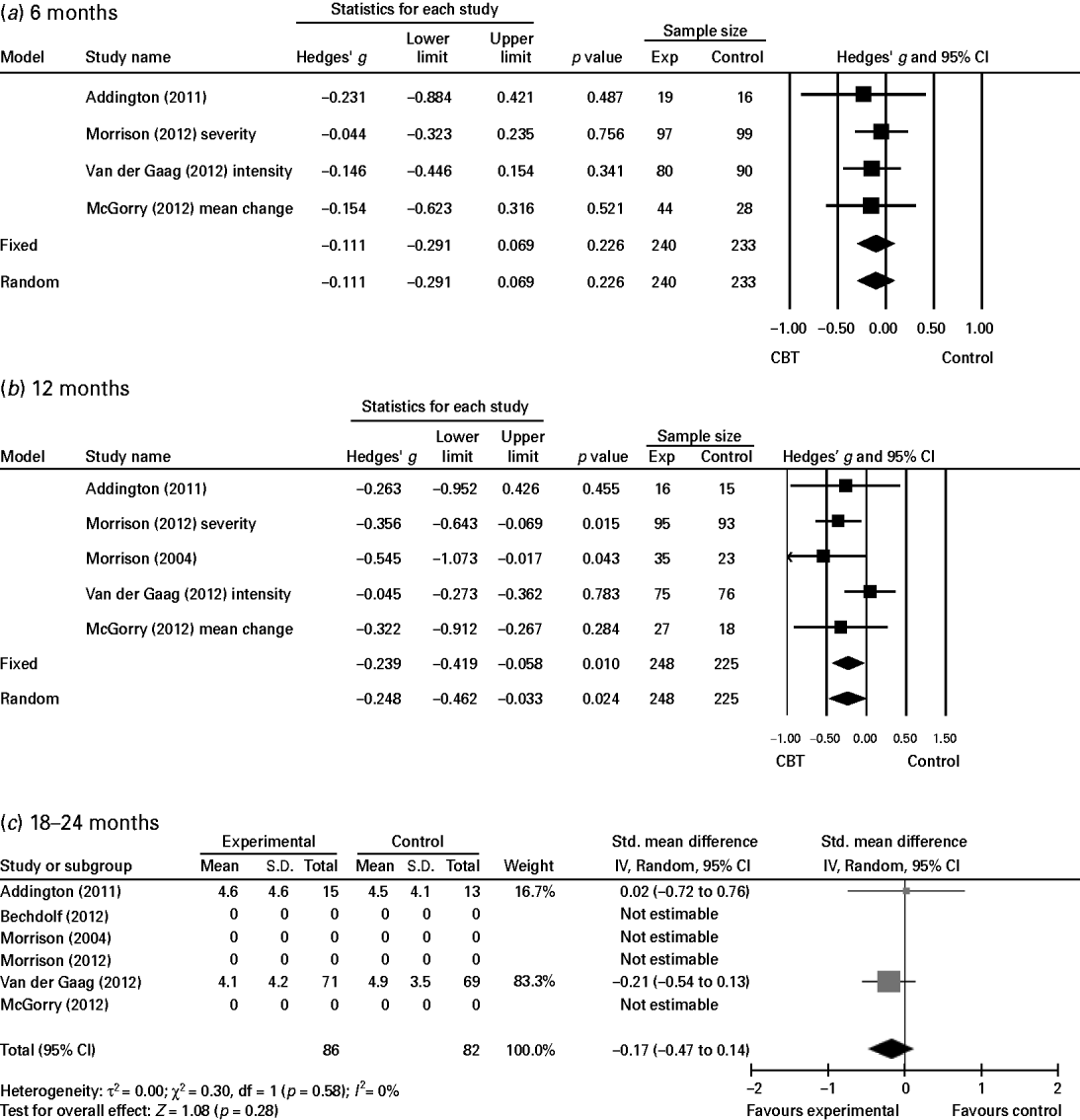
Data from four trials (Fig. 5) did not suggest a difference in overall symptom severity between groups at 6 months (Hedges’ g –0.11, 95% CI 0.07 to –0.29, p = 0.23) and data from two trials did not suggest a difference in symptom-related distress (g –0.16, 95% CI –0.53 to 0.22, p = 0.15), although there was notable heterogeneity (68%) in this analysis.
Symptoms at (a) 6, (b) 12 and (c) 18–24 months.

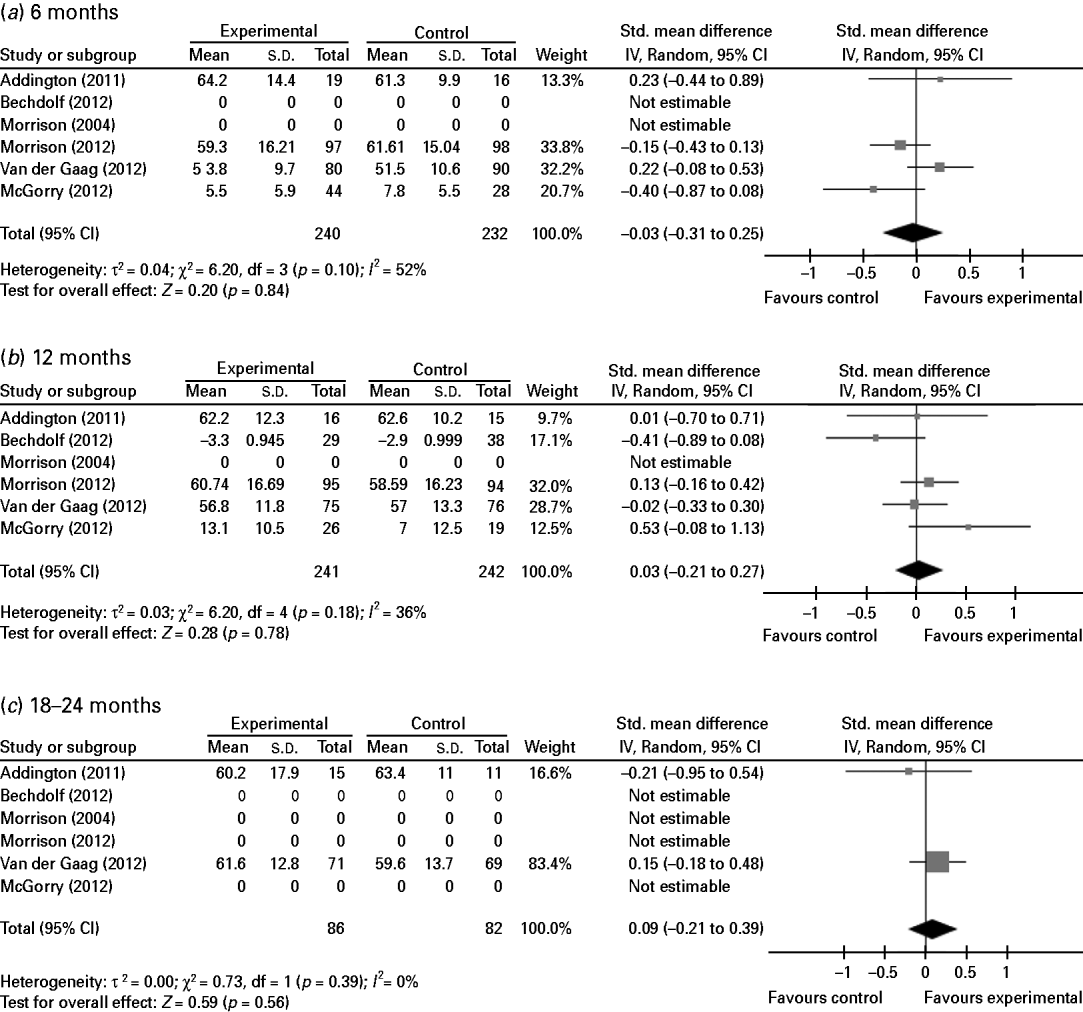
Functioning at (a) 6, (b) 12 and (c) 18–24 months.

At 12 months, available data from five trials suggested CBT was associated with a small effect on symptoms (Hedges’ g –0.25, 95% CI –0.46 to –0.03, p = 0.02). If we used end-point instead of mean change data for the McGorry (2012) study, then the effect was smaller and achieved statistical significance only when a fixed-effects analysis was used (g –0.20, 95% CI –0.39 to –0.02, p = 0.03). Data from two trials did not reveal a significant difference in symptom-related distress (g –0.17, 95% CI –0.39 to 0.05, p = 0.14).
Small benefits in symptom severity at 18–24 months in the two trials reporting usable data (Addington et al. Reference Addington, Epstein, Liu, French, Boydell and Zipursky2011; van der Gaag et al. Reference van der Gaag, Nieman, Rietdijk, Dragt, Ising, Klaassen, Koeter, Cuijpers, Wunderink and Linszen2012a ) did not achieve statistical significance, regardless of whether we used frequency (g –0.26, 95% CI –0.57 to 0.04, p = 0.09) or intensity data (g –0.17, 95% CI –0.47 to 0.14, p = 0.28) from van der Gaag et al. (2012b). No difference in symptom-related distress was found in the one trial reporting usable 18-month data (van der Gaag et al. Reference van der Gaag, Nieman, Rietdijk, Dragt, Ising, Klaassen, Koeter, Cuijpers, Wunderink and Linszen2012a ). CBT-favourable 18–24-month severity and distress data from Morrison et al. (Reference Morrison, French, Stewart, Birchwood, Fowler, Gumley, Jones, Bentall, Lewis, Murray, Patterson, Brunet, Conroy, Parker, Reilly, Byrne, Davies and Dunn2012a ) suffered from > 50% attrition and were therefore excluded.
Functioning
Three trials reported usable 6-month data on the GAF scale (Fig. 6), and one reported usable data on the Social Functioning Assessment Scale (SOFAS). No difference was observed (g –0.03, 95% CI –0.31 to 0.25, p = 0.84; negative sign means CBT worse). At 12 months, no difference was again observed in a combined analysis of GAF, SOFAS and Social Adjustment Scale II data from five trials (g 0.03, 95% CI –0.21 to 0.27, p = 0.78). GAF results from Morrison Reference Morrison, French, Walford, Lewis, Kilcommons, Green, Parker and Bentall2004 suffered from more than 50% missing data. Two trials reported usable GAF data at 18 months but no difference was detected (g 0.09, 95% CI –0.21 to 0.39, p = 0.56). Twenty-four month GAF data from Morrison 2012 were not usable because of missing data.
Quality of life
Data from two trials did not reveal group differences in relation to quality of life at 6 months (g –0.09, 95% CI –0.35 to 0.18, p = 0.52) or at 12 months (g 0.00, 95% CI –0.28 to 0.28, p = 0.99). No group differences were observed at 18 months in the one trial reporting usable data at this time point (g 0.11, 95% CI –0.22 to 0.44, p = 0.51) (van der Gaag et al. Reference van der Gaag, Nieman, Rietdijk, Dragt, Ising, Klaassen, Koeter, Cuijpers, Wunderink and Linszen2012a ). Morrison 2012 reported equivocal results at 6, 12 and 24 months, but more than 50% of the data were missing at each time point, and therefore were not included in the analysis.
Adverse effects
Limited data on adverse effects were available from five studies, most of which could not be combined for meta-analysis. Bechdolf et al. (Reference Bechdolf, Wagner, Ruhrmann, Harrigan, Putzfeld, Pukrop, Brockhaus-Dumke, Berning, Janssen, Decker, Bottlender, Maurer, Moller, Gaebel, Hafner, Maier and Klosterkotter2012) reported that no participants were withdrawn for deteriorating mood or suicidal ideation whereas analysis of reasons for drop-out by Addington et al. (Reference Addington, Epstein, Liu, French, Boydell and Zipursky2011) suggested one person receiving supportive therapy discontinued after 3 months because of subjective fears of worsening paranoia and referential thinking.
McGorry et al. (Reference McGorry, Nelson, Phillips, Yuen, Francey, Thampi, Berger, Amminger, Simmons, Kelly, Thompson and Yung2012) reported adverse effects at 6 months but data were missing from almost 50% of participants and 12-month data were available for only 33% of those randomized. At 6 months, no significant differences were observed between CBT plus placebo (n = 44) and supportive therapy plus placebo (n = 28) with respect to significant weight gain (2 v. 1, for the CBT and control groups respectively), fatigue (14 v. 8), depression (11 v. 5), concentration problems (7 v. 2), orthostatic dizziness (3 v. 3), or the psychic (18 v. 11), neurologic (4 v. 2), autonomic (13 v. 8) or ‘other’ (11 v. 6) Udvalg for Kliniske Undersogelser (UKU) Side Effect Rating Subscales (Lingjaerde et al. Reference Lingjaerde, Ahlfors, Bech, Dencker and Elgen1987) (all p > 0.05).
No differences in numbers with clinical levels of social anxiety (6 months: RR 0.93, 95% CI 0.67–1.30, p = 0.67; 12 months: 1.05, 95% CI 0.73–1.51, p = 0.80) or depression (6 months: RR, 0.94, 95% CI 0.74–1.19, p = 0.58; 12 months: RR 0.88, 95% CI 0.67–1.15, p = 0.35) were observed in the two trials reporting these data. One trial reported 18-month data, and no significant differences were found (van der Gaag et al. Reference van der Gaag, Nieman, Rietdijk, Dragt, Ising, Klaassen, Koeter, Cuijpers, Wunderink and Linszen2012a ). Morrison 2012's 24-month figures were uninterpretable because of missing data.
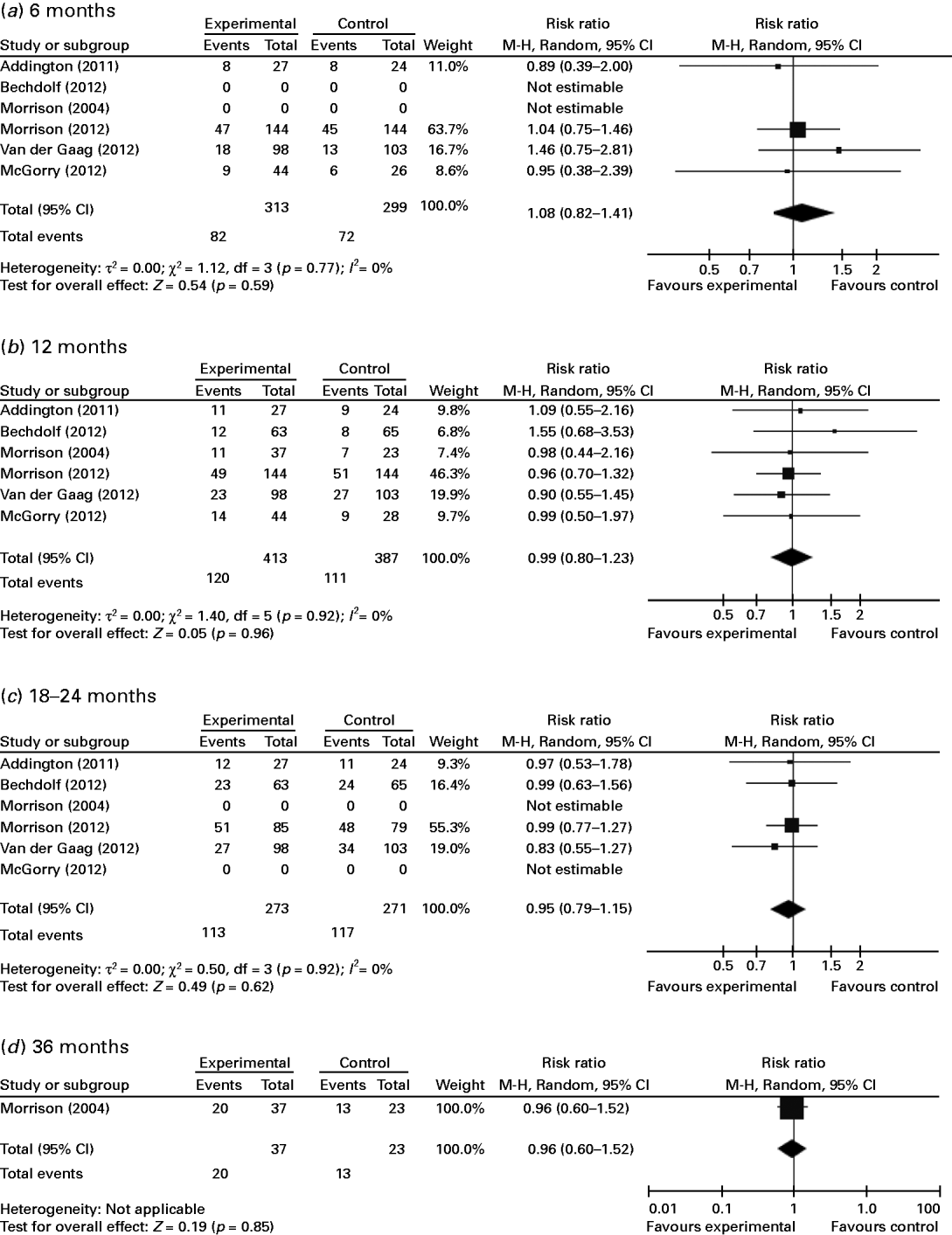
Leaving the study early for any reason (Fig. 7)
No differences in numbers leaving early for any reason were observed at 6 months (four RCTs, RR 1.08, 95% CI 0.82–1.41, p = 0.59), 12 months (six RCTs, RR 0.99, 95% CI 0.80–1.23, p = 0.96), 18–24 months (four RCTs, RR 0.95, 95% CI 0.79–1.15, p = 0.62) or 36 months (one RCT, RR 0.96, 95% CI 0.60–1.52, p = 0.85).
Leaving the study early (any reason): at (a) 6, (b) 12, (c) 18–24 and (d) 36 months.

Discussion
The results of this meta-analysis are encouraging, and suggest that prevention or delay of the onset of psychosis is achievable with a psychosocial treatment alone. CBT was associated with a significantly reduced rate of conversion to first-episode psychosis at 6, 12 and 18–24 months after treatment, compared with those receiving either monitoring or non-specific supportive therapy. The 6-month estimate was somewhat less robust, perhaps because of limited statistical power to detect differences in a relatively low-frequency event.
At every time point, the relative risk of transition was reduced by more than 50% for those receiving CBT. Overall, between eight and 11 need to receive CBT instead of, or in addition to, non-specific support for one person to avoid transition over the longer term (12 to 18–24 months). Such figures compare favourably to other preventative treatments in medicine. According to a recent comparison of psychiatric and general medical treatments, around 27 (95% CI 25–33) patients with heart disease need to take statins to prevent one major cardiac event whereas around 16 (95% CI 13–25) need to take angiotensin-converting enzyme (ACE) inhibitors for one to avoid death from chronic heart failure (Leucht et al. Reference Leucht, Hierl, Kissling, Dold and Davis2012).
However, the NNT estimates do not just reflect treatment efficacy. They are also very much influenced by the positive predictive value (PPV) of the high-risk criteria. If the PPV of the criteria is low (i.e. few people classified as at risk do in fact make transition), then the NNT will be higher regardless of the efficacy of a treatment. Likewise, once methods of predicting risk of transition improve, fewer people who are unlikely to make transition anyway will need to receive prophylactic treatment, and the NNT will be lower. In this context, relative risk estimates are a much better index of treatment-attributable benefits than are NNTs.
Of note, the rate of transition in the control conditions of 9–18% is considerably lower than the 18–29% reported in a recent meta-analysis (Fusar-Poli et al. Reference Fusar-Poli, Bonoldi, Yung, Borgwardt, Kempton, Valmaggia, Barale, Caverzasi and McGuire2012a ). Although transition rates were somewhat higher (12–19%) after excluding two studies where baseline transition risk was potentially diluted by trial design features, there is still a clear difference between these datasets. This might suggest that risk of transition can be substantially reduced by trial participation, where people have greater access to relatively inexpensive approaches such as regular monitoring, signposting and support. Although Fusar-Poli et al. (Reference Fusar-Poli, Bonoldi, Yung, Borgwardt, Kempton, Valmaggia, Barale, Caverzasi and McGuire2012a ) reported a transition rate of 33% in those receiving standard psychiatric care and case management, perhaps the relatively persistent and accessible attention offered by trial researchers and therapists reduces the risk of crises and unmet psychosocial need. Alternatively, the low transition rate may suggest that fewer participants in the CBT trials included here were genuinely ‘at risk’, and that the PPV of the high-risk criteria needs improving (Morrison et al. Reference Morrison, French, Stewart, Birchwood, Fowler, Gumley, Jones, Bentall, Lewis, Murray, Patterson, Brunet, Conroy, Parker, Reilly, Byrne, Davies and Dunn2012a ). The potential implications of this uncertainty for inclusion of an attenuated psychosis syndrome in DSM-5 have been outlined elsewhere (Morrison et al. Reference Morrison, French, Stewart, Birchwood, Fowler, Gumley, Jones, Bentall, Lewis, Murray, Patterson, Brunet, Conroy, Parker, Reilly, Byrne, Davies and Dunn2012a ).
The results from the secondary analyses are more difficult to interpret. Although there was some evidence that CBT had a small effect on symptoms at 12 months (–0.25), the differences observed at other time points were not statistically significant. The 12-month effects are comparable to the non-significant effect sizes of between –0.12 (95% CI –0.62 to 0.38; PANSS total) and –0.26 (95% CI –0.76 to 0.25; SOPS total) reported in a double-blind 1-year trial of olanzapine versus placebo for prodromal patients (McGlashan et al. Reference McGlashan, Zipursky, Perkins, Addington, Miller, Woods, Hawkins, Hoffman, Preda, Epstein, Addington, Lindborg, Trzaskoma, Tohen and Breier2006). However, the significant effect size for weight gain in that study was 1.18 (95% CI 0.63–1.72), many participants left early, and the results have yet to be replicated. Although the 12-month CBT effect size is much smaller than the large effect size of –0.88 (95% CI –1.34 to –0.44; PANSS total) reported in a double-blind study of omega-3 fatty acids versus placebo (Amminger et al. Reference Amminger, Schafer, Papageorgiou, Klier, Cotton, Harrigan, Mackinnon, McGorry and Berger2010), this study also awaits replication.
Furthermore, on the negative side, the secondary analysis suggests that CBT has yet to demonstrate effectiveness in improving functioning in this group, at any time point. This is an important finding, and suggests that existing CBT packages should be modified to target functioning specifically. An approach based on a specific cognitive model of low functioning (Grant & Beck, Reference Grant and Beck2009; Beck et al. Reference Beck, Grant, Huh, Perivoliotis and Chang2013) has recently shown promise in chronic established psychosis (Grant et al. Reference Grant, Huh, Perivoliotis, Stolar and Beck2012) and could perhaps be adapted for the at-risk group. Other psychosocial treatments, such as family-focused interventions, may also have an important role to play here (O'Brien et al. Reference O'Brien, Zinberg, Bearden, Daley, Niendam, Kopelowicz and Cannon2007; Schlosser et al. Reference Schlosser, Miklowitz, O'Brien, De Silva, Zinberg and Cannon2011). Similar results were found for quality of life, although there were only limited data on this outcome.
However, one problem with the CBT trials is that there seems to be no consensus on the best way to analyse and report continuous outcome data. Some authors excluded data from those who made transition (van der Gaag et al. Reference van der Gaag, Nieman, Rietdijk, Dragt, Ising, Klaassen, Koeter, Cuijpers, Wunderink and Linszen2012a ), some made transition an exit criterion for the trial but carried forward the last observation of those who converted (Bechdolf et al. Reference Bechdolf, Wagner, Veith, Ruhrmann, Pukrop, Brockhaus-Dumke, Berning, Stamm, Janssen, Decker, Bottlender, Moller, Gaebel, Maier and Klosterkotter2007), and some kept everyone in the trial and did not exclude any data from any time points (Morrison et al. Reference Morrison, French, Walford, Lewis, Kilcommons, Green, Parker and Bentall2004, Reference Morrison, French, Stewart, Birchwood, Fowler, Gumley, Jones, Bentall, Lewis, Murray, Patterson, Brunet, Conroy, Parker, Reilly, Byrne, Davies and Dunn2012a ). This latter approach seems most sensible to us, as it allows direct assessment of the real-world impact of CBT, minimizes the use of crude imputation strategies, and helps to preserve the benefits of randomization that exclusions inevitably remove (Schulz & Grimes, Reference Schulz and Grimes2002; Hamer & Simpson, Reference Hamer and Simpson2009). Of course, if more in the control treatment develop psychosis and then receive antipsychotics, then this may mask any beneficial effects of CBT at end-point. However, exposure to these drugs may also be associated with more adverse effects (McGlashan et al. Reference McGlashan, Zipursky, Perkins, Addington, Miller, Woods, Hawkins, Hoffman, Preda, Epstein, Addington, Lindborg, Trzaskoma, Tohen and Breier2006); effects that, if measured, should greatly inform the cost–benefit analysis. It should also be remembered that transition itself is an adverse event. If all trials retained all participants and their data in the analysis, then we would be able to provide young people with much more accurate information about what is likely to happen to them if they decide CBT is not for them.
Limitations
One possible concern is that the limited number of trials with usable outcome data (n = 6) precludes the use of meta-analysis. However, meta-analyses have been applied successfully to numerous other commonly used treatments for psychosis, many of which have a comparable number of studies and participants. For example, there are now more data on the long-term benefits of CBT for psychosis prevention than there are for the long-term benefits in established psychosis, compared to placebo, of drugs such as chlorpromazine (Adams et al. Reference Adams, Awad, Rathbone and Thornley2007), haloperidol (Joy et al. Reference Joy, Adams and Lawrie2006), and olanzapine, quetiapine and aripiprazole (Leucht et al. Reference Leucht, Arbter, Engel, Kissling and Davis2009). Historically, only 3–5 short-term trials have been required by the US Food and Drug Administration to license a new antipsychotic (e.g. Dubitsky et al. Reference Dubitsky, Harris, Laughren and Hardeman2002), and the median number of studies in a typical Cochrane review is, across medicine, six (Mallett & Clarke, Reference Mallett and Clarke2002). According to some experts, only two studies are required for meta-analysis ‘because all other synthesis techniques are less transparent and/or are less likely to be valid’ (Valentine et al. Reference Valentine, Pigott and Rothstein2010).
Sources of heterogeneity were not investigated, but this was generally low or absent. The trials were similar enough to combine in a meaningful way and subgroup analyses would not be informative at this stage. Such considerations should not be an obstacle to answering the simple question of whether CBT is beneficial or not. The control conditions varied somewhat, in that some trials compared CBT-informed interventions to basic monitoring whereas others used a supportive therapy control. Arguably, the latter provide a more definitive assessment of the importance of specific CBT strategies, such as normalizing and behavioural experiments (French & Morrison, Reference French and Morrison2004; Morrison & Barratt, Reference Morrison and Barratt2010). Future meta-analyses will have greater power to conduct separate comparisons, looking at CBT versus usual treatment and CBT versus a control condition.
The limited number of trials also means it would be uninformative at this stage to conduct tests for publication bias. Fail-safe N analyses are not recommended (Higgins et al. Reference Higgins and Green2011b ), and at least 10 trials are thought to be sufficient to ensure adequate power for funnel-plot tests (Ioannidis & Trikalinos, Reference Ioannidis and Trikalinos2007). Meta-analytical assessment of treatment efficacy should not depend on having adequate power for such tests. Such a rule would be remarkably conservative and preclude meta-analyses of almost all individual treatments for psychosis, in addition to treatments for many other conditions. Publication bias has now been thoroughly investigated in meta-analyses of psychosocial treatments for psychosis, including meta-analyses of CBT, and this has not been found to be a major threat to the integrity of the main findings (Niemeyer et al. Reference Niemeyer, Musch and Pietrowsky2012). We have shown that our primary outcome results are reasonably robust to the (low) risk of the one unpublished completed study having highly unfavourable results.
Recommendations for future trial design
Although these are promising results, firmer conclusions about the benefits and costs of CBT-informed treatment for this group are limited by methodological problems such as small sample sizes, difficulties maintaining the single-blind, selective reporting of outcomes and inconsistent assessment or reporting of potential adverse effects. However, these issues are certainly not unique to these trials (Schulz et al. Reference Schulz, Chalmers, Hayes and Altman1995; Thornley & Adams, Reference Thornley and Adams1998; Leucht et al. Reference Leucht, Heres, Hamann and Kane2008; Perlis et al. Reference Perlis, Ostacher, Fava, Nierenberg, Sachs and Rosenbaum2010; Miyar & Adams, Reference Miyar and Adams2012), nor do they vitiate the main findings.
One particular strength of the trials included here is that they suffer from relatively low rates of missing data, and clearly reported their randomization and treatment allocation procedures. Most trials also published their trial protocol in advance of their main publication, thus reducing scope for bias, which is also a strength of our systematic review (Bushe, Reference Bushe2011). All except one (McGorry et al. Reference McGorry, Nelson, Phillips, Yuen, Francey, Thampi, Berger, Amminger, Simmons, Kelly, Thompson and Yung2012) were health-service or government funded, and the researchers generally had few financial conflicts of interest. Inclusion criteria were also not overly restrictive, thus increasing generalizability.
One particular limitation was the non-thorough and inconsistent assessment and reporting of adverse effects. Researchers should consider developing a standard protocol for assessing adverse effects in trials for the at-risk group. This may include reporting the number of people in each condition experiencing a predefined degree of deterioration in mood, functioning or quality of life, along with serious adverse events (e.g. strong suicidal intent, suicide attempts, violence). This is important given preliminary evidence suggesting there may be a high prevalence of suicide risk factors in the at-risk population (Hutton et al. Reference Hutton, Bowe, Parker and Ford2011; Zimbron et al. Reference Zimbrón, Ruiz de Azúa, Khandaker, Gandamaneni, Crane, González-Pinto, Stochl, Jones and Pérez2012). Two recent trials of CBT for established psychosis provide examples of good practice for reporting harms (Klingberg et al. Reference Klingberg, Wittorf, Meisner, Wolwer, Wiedemann, Herrlich, Bechdolf, Muller, Sartory, Wagner, Kircher, Konig, Engel and Buchkremer2010, Reference Klingberg, Herrlich, Wiedemann, Wolwer, Meisner, Engel, Jakobi-Malterre, Buchkremer and Wittorf2012) and CONSORT (Consolidated Standards of Reporting Trials) provide a sensible set of recommendations (Ioannidis et al. Reference Ioannidis, Evans, Gotzsche, O'Neill, Altman, Schulz and Moher2004).
Conclusions
Provision of CBT was associated with a reduced risk of transition to psychosis at 6, 12 and 18–24 months, although the 6-month benefit was less robust. The results challenge the clinical equipoise that has so far characterized the field. Based on these findings, we recommend that young people seeking help for an at-risk mental state should now be offered a package of care that includes at least 6 months of structured CBT based on one of the manuals used in these trials, and delivered by an appropriately qualified and experienced professional. These young people should be advised that engaging with CBT could halve their risk of developing psychosis over an 18–24-month period, although they are unlikely to gain additional benefits in relation to functioning or quality of life. They should also be advised that the available evidence suggests that CBT is unlikely to lead to increased depression or social anxiety, but that data on adverse effects are generally very limited. This recommendation should not be taken to imply that other treatments should not also be offered to this group, if proven effective. We are advocates of treatment choice (Morrison et al. Reference Morrison, Hutton, Shiers and Turkington2012b ), which, to be meaningful, requires several effective treatments to choose from.
Declaration of Interest
There was no financial funding for this work. Both authors are employed by the National Health Service (NHS) in England and the first author is a member of Professor T. Morrison's (Chief Investigator in two of the key trials reviewed above) research unit. Both authors report no financial conflicts of interest.