Introduction
Increased interest in phytochemicals has been prompted by the undesirable side effects resulting from the indiscriminate use of pesticides against insect pests (Iqbedioh, Reference Igbedioh1991).The potential benefits of pesticides in terms of enhanced economic output resulting in increased food and fiber production cannot be ignored, but at the same time their non-judicious use has also resulted in pesticide resistant insects, a reduction in beneficial insect populations and serious health implications to man and his environment (Jeyaratnam, Reference Jeyaratnam1985; Gunning et al., Reference Gunning, Easton, Balfe and Ferris1991; Igbedioh, Reference Igbedioh1991; Forget, Reference Forget, Forget, Goodman and de Villiers1993; Fitt, Reference Fitt1994; Gatehouse et al., Reference Gatehouse, Hilder, Powell, Wang, Davison, Gatehouse, Down, Edmonds, Boulter, Newell, Merryweather, Hamilton and Gatehouse1994; Haq et al., Reference Haq, Atif and Khan2004).
The need to identify novel effective insecticidal compounds to combat these side effects has led to the exploration of plant-derivatized alternatives. During their long coexistence with insects, the metabolic system of plants has evolved a vast array of compounds which help them to cope with various challenges such as herbivory. These compounds are an integral part of the defense system of insects and include plant secondary metabolites and plant proteins. Proteinase inhibitors (PIs) are one of the most abundant defensive classes of proteins in plants. PIs are present in high concentration in storage organs such as seeds and tubers (Lawrence & Koundal, Reference Lawrence and Koundal2002; Dunse et al., Reference Dunse, Stevens, La, Gaspar, Heath and Anderson2010). The PIs act on insects by binding to the digestive enzymes in the insect gut, inhibiting their activity, thereby reducing protein digestion resulting in the shortage of amino acids, and slowing development and/or starving the insects (Azzouz et al., Reference Azzouz, Cherqui, Campman, Duport, Jouanin, Kaiser and Giordanango2005). The enzymes involved in digestion in the gut of insects are either serine, threonine, cysteine, aspartic, or metallo catalytic type of proteases. Protein PIs are abundantly distributed in plant seeds, particularly in legumes (Birk, Reference Birk1996). Potentially important insect pests belonging to order Lepidoptera, Diptera, Orthoptera, and Hymenoptera have been reported to possess serine proteases (Zhu-Salzman & Zeng, Reference Zhu-Salzman and Zeng2015). Serine proteases include trypsin, chymotrypsin, elastases, aminopeptidases, cathepsin-β-like proteases, and carboxipeptidases and perform approximately 95% digestive activity in the insect gut (Srinivasan et al., Reference Srinivasan, Chougule, Giri, Gatehouse and Gupta2005; Ponnuvel et al., Reference Ponnuvel, Nithya, Sirigineedi, Awasthi and Yamakawa2012). Some plant PIs are known to inhibit the functioning of these enzymes by binding specifically to the proteases (Barrett et al., Reference Barrett, Rawlings and Woessner1998). Among the various kinds of PIs isolated from plants (i.e. serine, cysteine, aspartic, and metalloproteases), the serine PIs have been studied extensively and generally reported to be isolated from leguminous plants (Mello et al., Reference Mello, Oliva, Sumikawa, Machado, Marangoni, Novello and Macedo2001; Giri et al., Reference Giri, Harsulkar, Ku, Gupta, Deshpande, Ranjekar and Franceschi2003; Garcia et al., Reference Garcia, Freire, Novello, Marangoni and Macedo2004; Bhattacharyya et al., Reference Bhattacharyya, Mazumdar, Leighton and Babu2006; Macedo et al., Reference Macedo, Durigan, da Silva, Marangoni, Freire and Parra2010).
Serine PIs have been reported to effectively inhibit the growth of many lepidopteran (Hoffman et al., Reference Hoffman, Zalom, Smilanick, Malyj, Kiser, Wilson, Hilder and Barnes1991; Heath et al., Reference Heath, McDonald, Christeller, Lee, Bateman, West, Heeswijck and Anderson1997; Tamhane et al., Reference Tamhane, Giri, Sainani and Gupta2007; Dunse et al., Reference Dunse, Stevens, La, Gaspar, Heath and Anderson2010; Saadati & Bandani, Reference Saadati and Bandani2011), and hemipteran insects (Azzouz et al., Reference Azzouz, Cherqui, Campman, Duport, Jouanin, Kaiser and Giordanango2005), but there is a scarcity of reports available on dipteran pests. So, the current study was designed to evaluate the influence of plant protease inhibitor isolated from winged beans on the survival and growth of melon fruit fly, Bactrocera cucurbitae (Coquillett) (Diptera: Tephritidae). Melon fruit fly is considered as an economically important pest of fruits and vegetables, especially cucurbits such as cucumber (Cucumis sativus L.), watermelon (Citrullus lanatus (Thunb.) Matsum. & Nakai), cantaloupe (Cucurbita pepo L.), bittermelon (Momordica charantia Descourt.), and zucchini (C. pepo) (Clausen et al., Reference Clausen, Clancey and Chock1965; White & Elson-Harris, Reference White and Elson-Harris1992; Koyama et al., Reference Koyama, Kakinohana and Miyatake2004). The losses caused by it are sometimes severe, i.e. up to 100% of crop loss. This loss can occur directly by damage caused to fruits and vegetables and indirectly through quarantine restrictions, hampering the international marketing of these agricultural products (Haq et al., Reference Haq, Cáceres, Hendrichs, Teal, Wornoayporn, Stauffer and Robinson2010). Conventional chemical control measures undertaken to manage tephritid pests (Roessler, Reference Roessler, Robinson and Hooper1989) has led to the sensitive issues regarding environment protection and therefore alternative measures are required. So the present work is a preliminary laboratory study to explore the possibility of using winged bean PIs for enhancing resistance in plants against the melon fruit fly.
Materials and methods
Collection of materials
Seed samples of winged beans (Psophocarpus tetragonolobus L.DC) were obtained from the local market for extraction and partial purification of protease inhibitors. Seeds were identified from the Department of Botanical and Environmental Sciences, Guru Nanak Dev University, Amritsar, Punjab, India.
Bovine serum albumin (BSA) was obtained from Loba (India). Bovine trypsin, N-a-benzoyl-DL-arginine-p-nitroanilide (BApNA), benzoyl-tyrosine-p-nitroanilide (BTPNA), succinyl-alanine-alanyl-prolyl-leucine-p-nitroanilide (SAAPLpNA), leucine-p-nitroanilide (LpNA) were obtained from Sigma-Aldrich, Delhi, India.
Extraction of protease inhibitor
The seeds of winged beans, P. tetragonolobus, were ground to make fine flour and were then defatted with acetone (1:10 w/v) and air dried four times. The flour after defatting was soaked in potassium phosphate buffer (10 mM, pH 7.2) (Roy & Dutta, Reference Roy and Dutta2009). The soaked material filtered through multiple layers of surgical gauze, next day was centrifuged at 10,000 rpm for a time interval of 15 min (4°C). The supernatant was stored at −20°C as crude extract and protease inhibitory activity was determined. It was then subjected to 0–80% direct ammonium sulfate saturation (kept overnight). The extract was then centrifuged at 10,000 rpm for 15 min at 4°C. Precipitates obtained were collected by dissolving them in minimal known volume of 50 mM Tris HCl. The dissolved fractions were dialyzed in cold for about 96 h against distilled water. The dialyzed partially purified protease inhibitor from winged beans was analyzed for protease inhibitor activity and was stored at −20°C for further experimental work.
Purification of winged bean protease inhibitors
Ion-exchange chromatography
The partially purified fractions having trypsin inhibitory activity, obtained after ammonium sulfate precipitation, were subjected to ion-exchange chromatography on DEAE-cellulose column (1.5 × 30 cm) pre-equilibrated with Tris HCl (50 mM, pH 8.0) (Gupta et al., Reference Gupta, Dhawan, Malhotra and Singh2000). The column was first washed with one bed volume of the same buffer to remove the unbound proteins. The elution of the bound proteins was done using a linear salt gradient of 0.1–1.0 M NaCl in Tris HCl (50 mM, pH 8.0), at a flow rate of 30 ml h−1 for almost 4 h. The fractions (2 ml) were collected and analyzed for protein content and trypsin inhibitory activity.
Affinity chromatography
Active fractions obtained from the ion-exchange chromatography with highest inhibitory activity were pooled and subjected to affinity chromatography. Cyanogen bromide (CNBr)-activated Sepharose 4B (Sigma Aldrich) was used for the preparation of resin/matrix for affinity chromatography to purify protease inhibitors from winged beans. Trypsin (bovine, SIGMA), an enzyme with unique affinity for trypsin/chymotrypsin inhibitors, was used as an affinity ligand to extract these inhibitors. Trypsin (5–10 mg ml−1 of gel) was dissolved in 5 ml of NaHCO3 buffer (0.1 M) containing NaCl (0.5 M, pH 8.3–8.5) to be used in next step.
The CNBr-activated Sepharose 4B (3 g) was washed and swollen in cold HCl (1 mM) for 30 min. A total of 200 ml g−1 of dry gel was added in several aliquots. Supernatant (containing lactose added during preservation) was removed by gentle filtration between successive additions. These swollen beads were then washed with distilled water (approximately 5–10 column volumes). After that, the resin was washed with NaHCO3/NaCl coupling buffer (5 ml g−1 dry gel) and immediately transferred to a solution of the ligand in coupling buffer prepared as mentioned above.
The protein ligand was mixed with gel by using an end-over-end mixer at room temperature for 2 h. The unreacted ligand was removed using NaHCO3/NaCl coupling buffer. The unreacted groups on the resin were blocked by incubating it with 0.2 M glycine (pH 8.0) for 16 h at 2–8°C. Followed by this, an extensive washing was given to remove the blocking solution (0.2 M glycine, pH 8.0), beginning with basic coupling buffer, pH 8.5 and then with 0.1 M acetate buffer, pH 4.0, having 0.5 M NaCl. The washing was repeated four to five times.
Preparation of affinity matrix
An affinity column was prepared by pouring 50 ml of the trypsin-sepharose 4B into a glass column (1.5 × 15 cm). The washing of the column was done with 150 ml of buffer (0.2 M KCl adjusted to pH 2.0 with HCl) and with two column volumes of Tris buffer (0.05 M Tris, 0.10 M KCl, 0.02 M CaCl2, pH 8.0) before the active fractions were loaded. Pooled active fractions were percolated through the packed column at a flow rate of 2 ml min−1, followed by a wash with Tris buffer, which was continued until absorbance of the eluate measured at 280 nm was reduced to a low level. The elution of the required protein was done with 0.2 M KCl, pH 2.0. Fractions of 2 ml each were collected and monitored for protein (A280) and trypsin inhibitory activity (A410). After elution of the inhibitor, the column was washed with CaCl2 solution (0.1 M, pH 3.8), containing 2% sodium azide and stored in 2% sodium azide at 4–5°C for reuse.
Sodium dodecyl sulfate polyacrylamide gel electrophoresis
The sodium dodecyl sulfate polyacrylamide gel electrophoresis (SDS-PAGE) of the heat-denatured protease inhibitor samples was performed according to the method of Laemmli (Reference Laemmli1970) using separating (11% w/v) and stacking gel (5%). The samples after mixing with an equal volume of sample buffer in the presence of 2-mercaptoethanol were heated for 7–8 min in boiling water to denature the protein. After cooling, the samples were loaded in the wells. Electrophoresis was run at 25°C at a constant voltage of 80 V in Tris-glycine buffer, pH 8.3, when the tracking dye was in stacking gel and switched to 100 V when it entered the resolving gel. When the tracking dye was 1.5 cm above the bottom of the gel, the electrophoresis voltage supply was switched off and the gels were stained in Coomassie Blue (0.25%) for 2 h. They were subsequently de-stained with gentle agitation on a shaker until the background of bands was washed off.
Protein estimation
Protein concentration in the protein extracts was determined using Folin Ciocalteu reagent as per the procedure of Lowry et al. (Reference Lowry, Rosebrough, Lewis and Randall1951). Crystalline BSA was used as a standard protein. The absorption of the blue color developed was measured at 540 nm using spectrophotometer.
Trypsin inhibition assay
Trypsin residual activity was estimated by hydrolysis of BApNA in the presence of inhibitor (Paulino da Silva et al., Reference Paulino da Silva, Leite, Bloch and Maria de Freitas2001). The enzyme was pre-incubated with partially purified inhibitor as well as with crude extract for 15 min at room temperature in 50 mM Tris-HCl buffer (pH 8.2). The assayed residual activities were followed by hydrolysis of 1 mM BApNA and the liberation of p-nitroaniline, which was measured at 410 nm. One unit of inhibitor activity corresponded to its amount that produced a decrease in absorption at 410 nm by 0.1 unit in the inhibitor activity assay at 50% inhibition.
Insect rearing
The larvae of melon fruit fly were procured from the culture maintained in the insect culture room of the department. The rearing of the melon fruit fly was done according to the methodology described by Gupta et al. (Reference Gupta, Verma and Kashyap1978) on natural food under controlled temperature (25 ± 2°C), relative humidity (70–80%) and photo phase (10L:14D). Adult flies were provided 20% sugar solution and protinex (Pfizer India) as food and pieces of pumpkin fruit, C. moschata (Dusch.) for oviposition.
Bioassays
About 100 gravid females, obtained after confining males with females for mating for approximately 2 weeks, were released for oviposition in wire mesh cages provided with fresh pumpkin pieces for 8 h. The pumpkin pieces were removed at an appropriate time interval from the cages and dissected in saline water for harvesting the second instar (64–72 h old) larvae. Generally the life cycle of melon fruit fly lasts from 21 to 179 days (Narayanan & Batra, Reference Narayanan and Batra1960) and comprises of egg, larval, pupal and adult stage. There are total three instars of larvae, and for the present study, the second instar larvae were selected for conducting experiments as not only are they voracious feeders but are also easy to handle. The harvested larvae were transferred to culture tubes (25 mm diameter × 100 mm length) containing artificial diet incorporated with various concentrations (12.5, 25, 50, 100, 200, and 400 µg ml−1) of winged bean protease inhibitor (WBPI). The artificial diet (control as well as treated) was prepared according to the standardized methodology given by Srivastava (Reference Srivastava1975). Observations were made daily for recording various parameters such as time taken for pupae formation (larval period), number of puparia formed, pupal weight, time taken for emergence of flies from pupa to adults (pupal period), total time taken for emergence from larval stage till emergence (total development period), and the total number of flies emerged. For each concentration tested, six replications were set up and each replication consisted of 15 larvae of melon fruit fly.
Enzyme assays
The inhibitory potential of WBPIs toward the digestibility of the gut proteinases of B. cucurbitae was evaluated by determining the activity of larval gut trypsin-like enzyme with BApNA, chymotrypsin-like enzyme with BTPNA, elastase-like enzyme with SAAPLpNA, and leucine-aminopeptidase-like enzymes using LpNA as substrate (Christeller et al., Reference Christeller, Laing, Shaw and Burgess1990, Reference Christeller, Laing, Markwic and Burgess1992). All enzymes were monitored for their activity at three consecutive time intervals (24, 48, and 72 h) after feeding second instar larvae of melon fruit fly on artificial diet incorporated with four concentrations (50, 100, 200, and 400 µg ml−1) of partially purified protease inhibitor from winged beans.
Statistical analysis
Statistical analyses were performed using SPSS 10.0 computer program. One-way analysis of variance was used to analyze the effect of WBPI on growth and development parameters of melon fruit fly, B. cucurbitae. The results were expressed as mean ± SE. If the variable was significant, Tukey's multiple range test was used for pairwise comparison of the difference between treatments for mean separation (P < 0.05). Significance of the effect of the WBPI on the activity of various digestive, detoxification, and other metabolic enzymes of B. cucurbitae at three exposure intervals was determined by t-test.
Results
Purification of the WBPIs
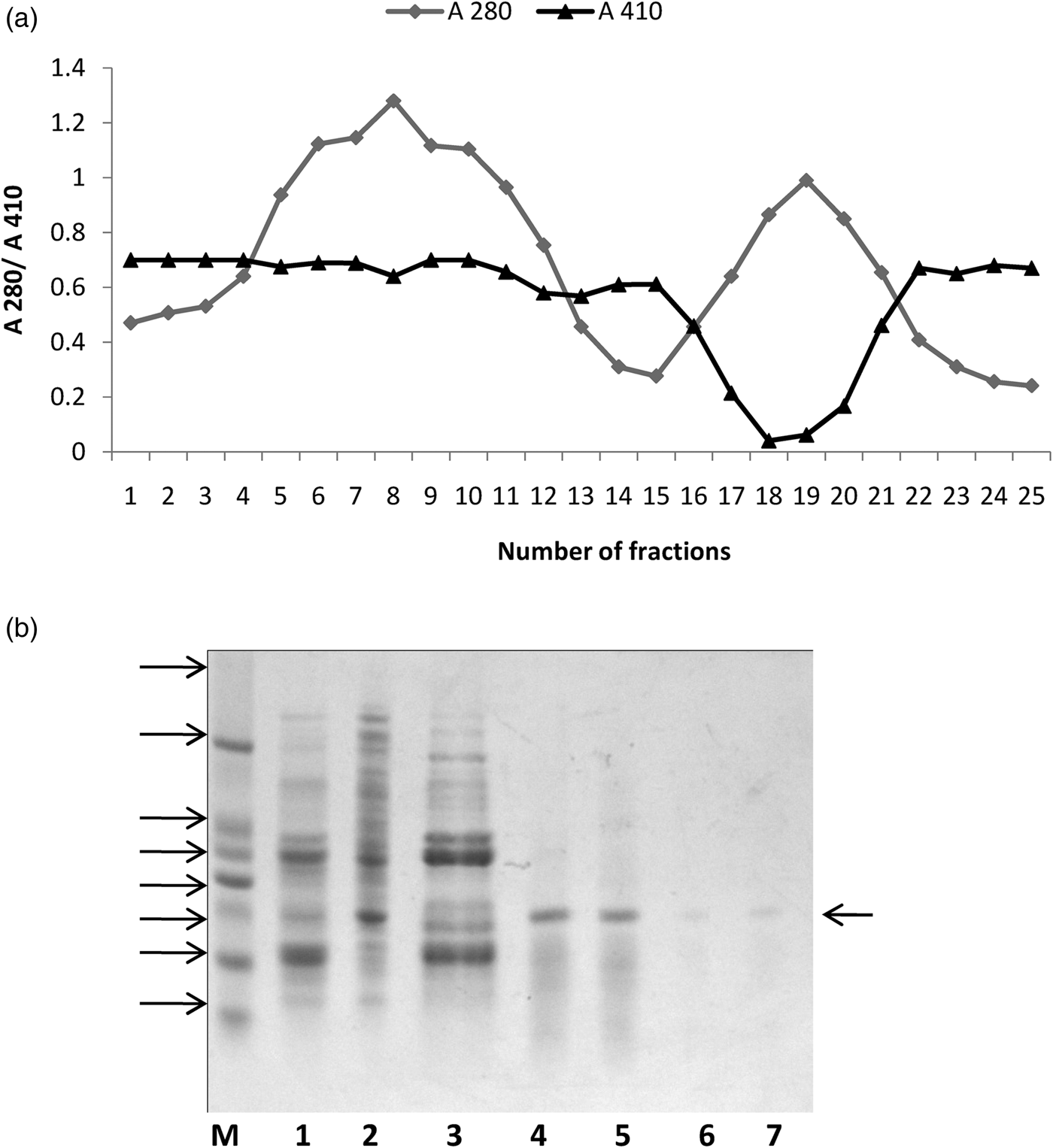
Protease inhibitor from winged beans was isolated by the traditional method of ammonium sulfate precipitation, ion-exchange chromatography, and affinity chromatography (Table 1). The ammonium sulfate fractions with 65.88% inhibitory activity were applied to a DEAE-cellulose column, which resulted in two peaks, and only one peak exhibited trypsin inhibitory activity with 3.26-fold increase as compared with that of crude winged bean extract (fig. 1). The inhibitory fractions obtained by DEAE-cellulose were applied to trypsin-sepharose 4B column and purified winged bean PI was eluted in a single peak with fractions resulting in 23.35% recovery of the total proteolytic activity and 6.68-fold purification with respect to crude fractions (fig. 2a). Qualitative analysis through SDS-PAGE showed molecular mass of purified winged beans PI in the range of 20 kDa (fig. 2b).
Purification of WBPI through DEAE-cellulose column by loading the partially purified active fractions. The gray line shows absorbance at 280 nm. The black line indicates the absorbance at 410 nm of protease inhibitory assay performed on every fraction. Control trypsin reactions (without winged bean protein fractions) gave an A410 nm of 0.7.

(a) Purification of WBPI through trypsin-sepharose 4B affinity column by loading the fractions obtained from DEAE-cellulose on trypsin-sepharose column. The gray line shows absorbance at 280 nm. The black line indicates the absorbance at 410 nm of protease inhibitory assay performed on every fraction. Control trypsin reactions (without winged bean protein fractions) gave an A410 nm of 0.7. (b) SDS-PAGE of WBPI and crude fractions of proteins during the purification process. Proteins were separated by electrophoresis using 11% SDS polyacrylamide gel and stained by Coomassie Brilliant Blue R-250. Lane M denotes low range Sigma Marker, lanes 1, 2, and 3 denote the crude, supernatant, and partially purified proteins. Lanes 4 and 5 denote the proteins obtained after ion-exchange chromatography on DEAE-cellulose. Lanes 6 and 7 showed affinity purified protein obtained from trypsin-sepharose run.

Purification of protease inhibitors from winged beans.

Effect of winged bean PIs incorporated in diet on larval growth
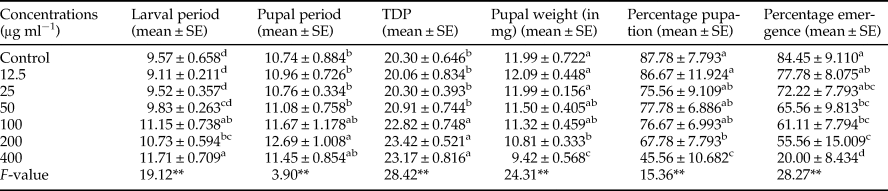
Bioassays conducted to evaluate the influence of winged bean PI on second instar larvae of melon fruit fly, B. cucurbitae showed a significant prolongation (F 6,35 = 19.12; P < 0.01) in the larval, pupal, and total development period (Table 2). The larval period and total development period were delayed maximally by 2.14 and 2.87 days, at 400 and 200 µg ml−1, respectively, as compared with that of control. A significant prolongation was also noticed in the pupal period with a maximum increase of 1.95 days at 200 µg ml−1 concentration of the PI when compared with that of control.
Different developmental parameters of B. cucurbitae after feeding second larval instar on artificial diet treated with different concentrations of purified winged bean PI.

**Significant at 0.01%. Means within a column followed by the same letter are not significantly different, P < 0.05; based on Tukey's test. Larval period, pupal period and TDP (total development period) are expressed in days.
Furthermore, winged bean PI after causing an insignificant induction in pupal weight at 12.5 µg ml−1 concentration significantly (P < 0.01) reduced the weight of the pupae formed as the concentration of the WBPI was increased (Table 2). At the highest concentration of 400 µg ml−1, the pupal weight decreased to 78.57% of the control. The percentage pupation was found to be significantly lower (F 6,35 = 15.36; P < 0.01) for the larvae fed on purified WBPI incorporated diet as compared with the larvae fed on control diet (Table 2). The percentage of pupae formed declined by 48.09% at the highest tested concentration (400 µg ml−1) when compared with that in control. Percentage emergence was significantly inhibited (F 6,35 = 28.27; P < 0.01) in a concentration-dependent manner when the second instar larvae were fed purified WBPI incorporated diet (Table 2). Maximum reduction (76.32%) in percentage adult emergence was observed at 400 µg ml−1 concentration as compared with that in control.
Effect on proteases
The activity of all the proteases decreased in the larvae fed artificial diet containing WBPI except for an induction observed in trypsin at 50 µg ml−1 concentration, chymotrypsin at 50 and 100 µg ml−1 concentrations, and elastase at 100 and 400 µg ml−1 concentrations at some of the treatment intervals (fig. 3). The inhibition in enzyme activity was significantly greater at the higher concentrations with maximum decrease noticed in trypsin after 48 h of feeding on diet containing 400 µg ml−1 concentration of the inhibitor.
Effect of purified PI from winged beans on proteases of second instar larvae of B. cucurbitae: (a) trypsin, (b) chymotrypsin, (c) elastase, (d) leucine aminopeptidase.

Discussion
Effect of winged bean PI on larval growth
The reduction of growth and development of second instar larvae of B. cucurbitae under the influence of winged bean PI was manifested in the form of delayed larval, pupal, and total development period. Results analogous to present findings were also observed by Steffens et al. (Reference Steffens, Fox and Kassell1978) when they found that inhibitor from soybean, SBTI (soybean trypsin inhibitor, Kunitz type), caused a delay in the pupation of European corn borer, Ostrinia nubilalis (Hübner), by 6 days. SBTI also increased larval period of tobacco cutworm, Spodoptera litura (Fab.) and sugarcane borer, Diatrea sachharalis (Fab) as was observed by McManus & Burgess (Reference McManus and Burgess1995) and Pompermayer et al. (Reference Pompermayer, Lopes, Terra, Parra, Falco and Silva-Filho2001), respectively. SBTI (Kunitz type) also prolonged larval period (36.6%) and remaining development period (21.4%) of second instar larvae of melon fruit fly when fed in artificial diet (Kaur et al., Reference Kaur, Kaur, Sohal, Rup and Kaur2009). The larval stage is of great importance during the development period as it is very crucial for the accumulation of essential nutrients and energy that is to be used for pupal and adult development (Pandey et al., Reference Pandey, Singh, Singh, Khan and Jamal2014). Adverse conditions like nutritional stress interfere with the normal pattern of larval development (Mochizuki et al., Reference Mochizuki, Nishizawa, Onodera, Tabei, Toki, Habu, Ugaki and Ohashi1999). The prolonged development of the larvae of B. cucurbitae might be a reflex response mechanism to acquire a minimal weight required by the larvae to pupate (Slansky & Scriber, Reference Slansky, Scriber, Kerkut and Gilbert1985). Pandey et al. (Reference Pandey, Singh, Singh, Khan and Jamal2014), who had also reported an increase in pupal duration of African bollworm, Helicoverpa armigera (Hübner) from 10.46 days in control to 15.97 days at the highest concentration of Butea monosperma (Lam.) Taub. seeds PI (BmPI), suggested that prolongation in the larval and pupal period durations were due to the interference of PIs in molting process which hindered the development of the insect.
The winged bean PI had an inhibitory effect on the percentage pupation and percentage emergence of B. cucurbitae larvae. A reduction in pupation and adult emergence of melon fruit fly was also observed when larval instars were fed on diet containing SBTI, SBBI, and pea PI (Kaur et al., Reference Kaur, Kaur, Sohal, Rup and Kaur2009, Reference Kaur, Sohal, Rup and Kaur2010; Kaur & Sohal, Reference Kaur and Sohal2016). A significant effect on the growth inhibition and mortality of the pea aphid, Acyrthosiphon pisum (Harris) (Rahbe et al., Reference Rahbe, Ferrasson, Rabesona and Quillies2003), was noticed when the nymphs were fed on pea trypsin-chymotrypsin inhibitors (PSTI-2) of the Bowman-Birk family. Adverse effects were also observed with chick pea trypsin inhibitor against Mexican cotton boll weevil, Anthonomus grandis Boh., where 45% mortality of larvae fed with 1.5% concentration was recorded (Gomes et al., Reference Gomes, Dias, Broch, Melo, Furtado, Monnert, Grossi-de-Sa and Franco2005). Chick pea trypsin inhibitor was also found to reduce adult emergence in the larvae of H. armigera (Kansal et al., Reference Kansal, Kumar, Kuhar, Gupta, Subhrahmanyam, Koundal and Gupta2008). Winged bean PI also reduced the survival of the larvae of H. armigera by 44.1% and S. litura by 50% at 4.5 trypsin inhibitor units g−1 of diet (Gupta et al., Reference Gupta, Birah and Rani2008).
Significant effect of WBPI was also observed on pupal weight which decreased with increase in concentration of the inhibitor. Congruent with the present findings, Harsulkar et al. (Reference Harsulkar, Giri, Patankar, Gupta, Sainani, Ranjekar and Deshpande1999) had reported that the growth of all second instar larvae of H. armigera was inhibited under the influence of PIs from winged beans. More than 65% of the larvae fed on WBPI showed stunted growth. Chick pea PIs have also been reported to reduce the pupal weight in the larvae of H. armigera fed on an artificial diet supplemented with the inhibitor (Kansal et al., Reference Kansal, Kumar, Kuhar, Gupta, Subhrahmanyam, Koundal and Gupta2008). In another study, black gram protease inhibitor evaluated for its antibiosis effect toward croton caterpillar, Achaea janata (Linnaeus) and S. litura resulted in smaller sized pupae which eclosed into short lived sterile adults (Prasad et al., Reference Prasad, Dutta-Gupta and Padmasree2010).
Biochemical results
The activity of proteolytic enzymes decreased at almost all concentrations of the WBPI. Previous studies carried out by Harsulkar et al. (Reference Harsulkar, Giri and Kothekar1997, Reference Harsulkar, Giri, Patankar, Gupta, Sainani, Ranjekar and Deshpande1999) with WBPI had also revealed a decrease of total as well as trypsin-like proteinase activity in H. armigera larvae as a result of which the growth of the early second instar was inhibited. WBTI was also found to significantly lower trypsin activity in the larvae of codling moth, Cydia pomonella (Linnaeus), but the elastase activity was higher than that in water controls (Markwick et al., Reference Markwick, Reid, Laing and Christeller1995). LAP activity was also lower at 0.33% of the WBTI. Inhibitory activities of protease inhibitors from black gram and chick pea against trypsin-like enzymes have also been reported in the larvae of S. litura and H. armigera, respectively (Srinivasan et al., Reference Srinivasan, Chougule, Giri, Gatehouse and Gupta2005; Prasad et al., Reference Prasad, Dutta-Gupta and Padmasree2010). The inhibitory action of PIs observed on proteases in B. cucurbitae larvae indicated that they downregulate protein digestion as has been suggested by Pandey et al. (Reference Pandey, Singh, Singh, Khan and Jamal2014).
Conclusion
This study establishes the potential of WBPI to impair the growth and development of B. cucurbitae larvae by targeting its biochemical and physiological processes and can be explored by plant breeders for the development of resistant plants. Serine proteases are involved in major developmental and physiological processes such as molting, digestion, homeostasis, apoptosis, reproduction, signal transduction, synthesis of neuropeptides, and the immune response (Ge et al., Reference Ge, Wan and Han2012). Serine protease inhibitors can disrupt these processes by inhibiting the target proteases (Lipke et al., Reference Lipke, Fraenkel and Liener1954; Shukle et al., Reference Shukle, Murdock and Gallun1985; Broadway & Duffey, Reference Broadway and Duffey1986) leading to delayed growth and development of insects (Haq et al., Reference Haq, Atif and Khan2004; Schluter et al., Reference Schluter, Benchabane, Munger, Kiggundu, Vorster, Goulet, Cloutier and Michaud2010), and therefore can have a possible role in plant protection against insect pests.
Acknowledgement
The grant received from the University Grant Commission (F. No. 34-472/2008 SR), New Delhi is gratefully acknowledged.