



Pregnancy is a major life event in a woman’s life, carrying a significant increased risk of developing a mental health disorder. Reference Yin, Sun, Jiang, Xu, Gan and Zhang1 About 10–20% of pregnant women are affected by peripartum depression (PPD), defined as a major depressive episode with onset during pregnancy or within the first year after childbirth. Reference Wang, Liu, Shuai, Cai, Fu and Liu2,Reference Roddy Mitchell, Gordon, Lindquist, Walker, Homer and Middleton3 Multiple, interacting factors can contribute to the development of PPD. Reference Yin, Sun, Jiang, Xu, Gan and Zhang1,Reference McLeroy, Bibeau, Steckler and Glanz4,Reference Solar and Irwin5 At the individual level, along with the bodily changes (e.g. abdominal expansion, increased adipose deposition, breast hypertrophy, changes in body shape and proportions) associated with pregnancy, factors such as primiparity, unwanted/unplanned pregnancy, history of abuse, trauma, low self-esteem and obstetric complications may all increase the risk of developing depressive symptoms. Reference Yin, Sun, Jiang, Xu, Gan and Zhang1
The interpersonal context also plays a role, with lack of support from partner, family conflicts, intimate partner violence and limited familial or social support having a strong influence. Reference Noonan, Jomeen and Doody6,Reference Biaggi, Conroy, Pawlby and Pariante7 Community and societal factors, which include workplace adversity and discrimination Reference Cooklin, Rowe and Fisher8,Reference Clayborne, Colman, Kingsbury, Torvik, Gustavson and Nilsen9 and neighbourhood disadvantage, Reference Onyewuenyi, Peterman, Zaritsky, Ritterman Weintraub, Pettway and Quesenberry10 can also play a key role in the development of depressive disorders in the peripartum period.
Heterogeneous data have been reported with respect to the onset of this disorder (i.e. during pregnancy versus postpartum period). This partly reflects the heterogeneity of clinical phenotypes of PPD, Reference Waqas, Nadeem and Rahman11–Reference Putnam, Wilcox, Robertson-Blackmore, Sharkey, Bergink and Munk-Olsen13 but also the assessment tools adopted across studies (i.e. self-reported versus clinician-led instruments), Reference Levis, Negeri, Sun, Benedetti and Thombs14 diagnostic criteria and severity thresholds, Reference Bai, Li, Cheng, Caine, Tong and Wu15–Reference Woody, Ferrari, Siskind, Whiteford and Harris17 study design and timing of assessments. Reference Yang, Wang, Wang, Liu, Lun and Ma18
Despite this heterogeneity, evidence indicates that a substantial proportion of PPD begins during pregnancy. Indeed, meta-analytic evidence indicates that antenatal PPD is at least as prevalent as postpartum PPD Reference Yin, Sun, Jiang, Xu, Gan and Zhang1 and cohort studies show that a substantial proportion of PPD episodes have their onset before delivery. Reference Robbins, Ko, D’Angelo, Salvesen von Essen, Bish and Kroelinger19–23
Importantly, PPD with antenatal onset is associated with significant repercussions for both mother and baby. Reference Yin, Sun, Jiang, Xu, Gan and Zhang1,Reference Dadi, Miller, Bisetegn and Mwanri24,Reference Dunkel Schetter and Tanner25 Antenatal depression has been associated with a variety of maternal, fetal and obstetric complications. In fact, antenatal depression is one of the strongest risk factors for postpartum depression, Reference Dlamini, Amelia, Shongwe, Chang and Chung26,Reference Luciano, Di Vincenzo, Brandi, Tretola, Toricco and Perris27 and is also associated with greater symptom severity than postpartum presentations. Reference Putnam, Robertson-Blackmore, Sharkey, Payne, Bergink and Munk-Olsen28 Furthermore, antenatal depression is linked to poorer self-care in pregnancy, inadequate nutrition, increased substance use and lower adherence to prenatal medical advice, all of which can hinder fetal and obstetric outcomes. Reference Dadi, Miller, Bisetegn and Mwanri24 Obstetric complications linked to antenatal depression include preeclampsia and operative deliveries, while studies on fetal outcomes show higher odds of intrauterine growth restriction, preterm birth and low birth weight. Reference Dadi, Miller, Bisetegn and Mwanri24,Reference Smith, Twynstra and Seabrook29 In addition, strong evidence suggests that in utero exposure to maternal depression and distress can negatively affect neurodevelopment, which may contribute to the offspring’s higher risk for behavioural and cognitive difficulties as well as mental health disorders, including disruptive and antisocial behaviour Reference Tusa, Alati, Ayano, Betts, Weldesenbet and Dachew30,Reference Morgan, Channon, Penny and Waters31 and psychotic disorders. Reference Srinivasan, Pearson, Johnson, Lewis and Lewis32
Thus, antenatal depression represents a significant public health issue requiring timely and effective interventions during pregnancy. Pharmacological treatments, however, pose concerns due to fetal exposure Reference Dubovicky, Belovicova, Csatlosova and Bogi33,Reference Creeley and Denton34 and, even more critically, because their acceptability among pregnant women is limited. Reference James, Smith, Rai, Culpin and Turner35,Reference Adhikari, Patten, Lee and Metcalfe36 Surveys and qualitative interviews consistently show that fears of fetal harm, stigma surrounding use of psychiatric medications in pregnancy and the lack of updated and clear clinical guidance on this topic frequently lead women to decline pharmacotherapy. Reference Kothari, de Laat, Dulhunty and Bruxner37–Reference Frayne, Ellies and Nguyen40 These barriers underlie the real-world prescribing patterns in antenatal depression: data from nation-wide cohort studies show that the vast majority of women – almost the totality in some cohorts Reference Noh, Choe, Kim and Shin41 – who are taking antidepressants prior to conception, discontinue them before pregnancy or during the first trimester. Reference Noh, Choe, Kim and Shin41–Reference Broughton, Hughes-Medlicott, Zeng and Smith43 For these reasons, while current guidelines recommend against withholding medications for mental health conditions due to pregnancy (albeit based on low-quality and often conflicting evidence), they recommend psychological interventions, especially cognitive–behavioural therapy (CBT), as first-line treatment in mild-to-moderate cases of antenatal depression, reserving antidepressant medications for severe recurrent or treatment-resistant presentations. Reference Molenaar, Kamperman, Boyce and Bergink44–Reference Curry, Krist, Owens, Barry, Caughey and Davidson47
Meta-analytic evidence supports the efficacy of psychological and psychosocial interventions for the treatment Reference Cuijpers, Franco, Ciharova, Miguel, Segre and Quero48–Reference Cluxton-Keller and Bruce50 and prevention Reference Yasuma, Narita, Sasaki, Obikane, Sekiya and Inagawa51,Reference Wu, Wang, Hui, Qian, Wang and E52 of peripartum depression. However, because most of these syntheses combine antenatal and postpartum data and often fail to distinguish clearly between preventive and therapeutic approaches, evidence on the efficacy of treatments for clinically diagnosed antenatal depression remains jeopardised. Reference Cuijpers, Franco, Ciharova, Miguel, Segre and Quero48–Reference Cluxton-Keller and Bruce50,Reference Wu, Wang, Hui, Qian, Wang and E52,Reference Sockol, Epperson and Barber53
Crucially, many studies and reviews have relied on self-report screening tools, such as the Edinburgh Postnatal Depression Scale (EPDS) Reference Cox, Holden and Sagovsky54 for both participant enrolment and outcome assessment. Although the EPDS is widely used in perinatal mental health research, it was developed as a screening tool rather than a diagnostic instrument, yet it is often applied in ways that assume diagnostic precision. For this reason, above-threshold scores may capture a broad spectrum of symptom severity, including transient or subclinical distress, rather than confirmed depressive episodes. Reference Levis, Negeri, Sun, Benedetti and Thombs14,Reference El-Den, Pham, Anderson, Yang, Moles and O’Reilly55–Reference Matthey, Henshaw, Elliott and Barnett58 However, the EPDS remains a validated and useful measure of depressive symptom levels and change over time and is therefore appropriate for assessing symptom improvement in research contexts. As with any self-report questionnaire, its subjective nature should be considered when interpreting results, particularly when scores are used to classify clinical status or determine trial eligibility.
Most recent evidence has often focused on single types of interventions, such as CBT, Reference Dooley and McAloon59,Reference Wan Mohd Yunus, Matinolli, Waris, Upadhyaya, Vuori and Korpilahti-Leino60 mindfulness, Reference Reangsing, Punsuwun and Oerther61 exercise-based interventions Reference Liu, Liu, Liu and Yang62 or complementary medicine approaches, Reference Smith, Shewamene, Galbally, Schmied and Dahlen63 limiting the ability to draw conclusions about their comparative efficacy and acceptability.
The goal of the present network meta-analysis (NMA) is to integrate both direct and indirect evidence from randomised controlled trials to comprehensively compare and rank the efficacy of different non-pharmacological interventions for clinical antenatal depression. By synthesising the available evidence within a unified analytical framework, we aim to generate precise and clinically meaningful estimates of relative efficacy and acceptability of non-pharmacological interventions for the treatment of clinically diagnosed antenatal depression, thereby informing evidence-based decision-making and guiding the development of tailored treatment guidelines for pregnant women experiencing depression.
Method
Search strategy
This study was conducted in compliance with the Preferred Reporting Items for Systematic Reviews and Meta-Analyses extension for Network Meta-Analyses (PRISMA-NMA) guidelines (Supplementary Table S1), and it was prospectively registered in PROSPERO (CRD420251013258) on 9 September 2025, prior to data extraction, which was performed between 15 and 20 September 2025. A comprehensive search of PubMed, Scopus, Psychinfo and Web of Science was conducted for publications from inception to the most recent available data. We searched the databases using medical subject headings and free-text terms relating to psychological interventions and antenatal depression. Detailed search strings for each database are described in Supplementary Table S2. We combined the PubMed search with the Cochrane Highly Sensitive Search Strategy for identifying randomised controlled trials in MEDLINE: sensitivity-maximising version (2008 revision; Lefebvre 2011). We also used the reference list of retrieved articles and conference proceedings. Eligible studies were randomised controlled trials enrolling pregnant women aged ≥16 years with antenatal depression according to DSM or ICD criteria and evaluating a structured non-pharmacological intervention against treatment-as-usual (TAU)/enhanced usual care (EUC) or another eligible active intervention. Eligible interventions included structured psychological or psychosocial treatments, whereas non-structured supportive interventions were excluded. Interventions aimed exclusively at prevention were also excluded. For outcome assessment, depressive symptom severity could be measured using either validated self-report or clinician-rated instruments. No restrictions were applied according to geographical setting or psychiatric comorbidity. Full eligibility criteria are reported in Supplementary Table S3.
Data extraction
Five authors (S.C., E.C., B.D.R., A.M., C.T.) independently screened the abstracts of all records identified by the search strategy. Three authors (C.T., S.C., A.M.) independently assessed the full text of potentially relevant studies for inclusion. Any disagreements during both the abstract screening phase and the full-text eligibility assessment were resolved through discussion or, when necessary, by consulting a sixth reviewer (M.L.). An extraction form was designed to ensure consistency of both data collection and appraisal of each study. Two authors (C.T., S.C.) independently extracted data regarding: number and characteristics of participants, setting, type of experimental and control intervention, length of follow-up, efficacy and acceptability outcomes as previously reported. Any discrepancies arising during data extraction were resolved through discussion or, when necessary, by consulting a third co-author (B.D.R.).
Risk of bias and quality of the evidence
Two authors (E.C., A.M.) independently assessed risk of bias for each study using the criteria outlined in the Cochrane Handbook for Systematic Reviews of Interventions. Reference Higgins, Altman, Gotzsche, Juni, Moher and Oxman64 The following domains were assessed: random sequence generation, allocation concealment, blinding of participants and outcome assessment, incomplete outcome data and selective outcome reporting. Each domain was judged to be at low risk of bias, to raise some concerns or at high risk of bias. Studies were rated at high overall risk of bias if at least one domain was judged high risk, at low overall risk if all domains were judged low risk and at some concerns in all remaining cases.
Missing data
All analyses were based on information reported in the original articles and their supplementary materials. For dichotomous outcomes, we used the numbers of participants with events and the total number of participants as reported (available case analysis), without imputing missing data. For continuous outcomes, we analysed endpoint scores, including only participants with a final assessment (completer analysis).
Statistical analysis
Analyses were performed in R version 4.5.2 for Windows (R Foundation for Statistical Computing, Vienna, Austria; https://www.R-project.org/) within a frequentist network meta-analysis framework using the netmeta, meta and ggplot2 packages. A random-effects model with a single between-study variance (τ Reference Wang, Liu, Shuai, Cai, Fu and Liu2 ) across all treatment comparisons was used as the primary model for efficacy and acceptability, with TAU as the reference comparator. The two key outcomes were efficacy, defined as depressive symptom severity at the latest acute post-intervention assessment and acceptability, defined as all-cause dropout. Analyses used available-case post-intervention data based on arm-level completer counts and summary statistics. Continuous outcomes were synthesised as standardised mean differences (SMD, Cohen’s d); acceptability, defined as all-cause dropout, was analysed using risk ratios (RRs). Two trials were cluster-randomised; Reference Gureje, Oladeji, Montgomery, Araya, Bello and Chisholm65,Reference Rahman, Malik, Sikander, Roberts and Creed66 for these, we applied design-effect adjustments based on the reported intracluster correlation coefficients (ICC 0.056 and 0.026). Interventions were grouped into prespecified treatment nodes; network geometry and key effect modifiers (baseline severity, delivery format, study setting) were inspected to support the transitivity assumption. Heterogeneity and inconsistency were summarised using τ 2 and I 2. Global and local inconsistency were explored using the design-by-treatment interaction model and node-splitting, respectively; however, formal inconsistency testing was not estimable because the networks contained no closed loops. Treatment rankings were based on surface under the cumulative ranking curve (SUCRA) values from the random-effects models. Sensitivity analyses included common-effect models, restriction to trials not at high risk of bias and restriction to trials with mean baseline depressive scores between 30% and 60% of the maximum scale score. In addition, efficacy was re-analysed within a Bayesian random-effects framework using the same study-level contrasts and an empirically informed heterogeneity prior from Rhodes et al (2015), log(τ 2) ∼ t 5(−3.85, 1.93); treatment effects were assigned diffuse N (0,10) priors. Robustness to prior specification was additionally examined using a half-normal (0, 0.5) prior on τ. Details are reported in the Supplementary Materials. All procedures followed Cochrane guidance and the Grading of Recommendations Assessment, Development and Evaluation (GRADE) approach for assessing certainty of evidence. Reference Guyatt, Oxman, Vist, Kunz, Falck-Ytter and Alonso-Coello67,Reference Higgins, Altman, Gøtzsche, Jüni, Moher and Oxman68
Confidence in the evidence
Two authors (A.M., E.C.) independently assessed the confidence in the evidence from each network comparison using the Confidence in Network Meta-analysis (CINeMA) framework, based on the GRADE framework. Reference Guyatt, Oxman, Vist, Kunz, Falck-Ytter and Alonso-Coello67,Reference Nikolakopoulou, Higgins, Papakonstantinou, Chaimani, Del Giovane and Egger69 CINeMA evaluates six domains: within-study bias, reporting bias, indirectness, imprecision, heterogeneity and incoherence. For each comparison, we employed CINeMA’s web application to judge concerns at individual domains (rated as no concerns, some concerns or major concerns) and to derive an overall confidence rating (high, moderate, low or very low).
Results
Literature search
A total of 1178 records were identified through the database search. After the exclusion of 576 duplicates, 602 titles and abstracts were screened. A full-text review was carried out on 42 studies, with 10 articles meeting the inclusion criteria (Fig. 1).
Preferred reporting items for systematic reviews and meta-analyses (PRISMA) 2020 flow diagram. PRISMA, Preferred Reporting Items for Systematic Reviews and Meta-Analyses.

Fig. 1 Long description
The flowchart begins with the identification phase where records are identified from databases: PubMed (256), Scopus (574), Web of Science (246), and PsycINFO (102), totaling 1178 records. Duplicate records (576) are removed before screening. Records are then screened, resulting in 602 records. During screening, 558 records are excluded for various reasons: other population (251), other outcome (138), other study design (80), other publication type (65), other drug (23), and foreign language (1). Reports sought for retrieval total 44, with 2 reports not retrieved. Reports assessed for eligibility are 42, with 32 reports excluded for other outcome (7), other study design (11), other population (13), and foreign language (1). Finally, 10 studies are included in the review and network meta-analysis.
Study characteristics
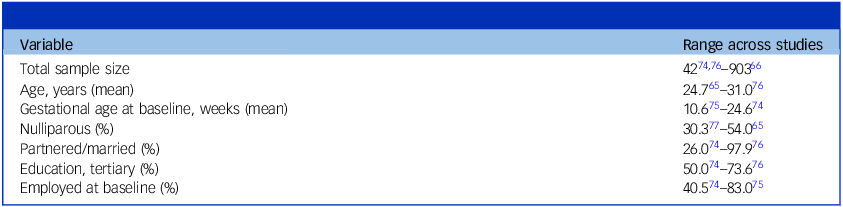
In total, the included samples comprised 1853 participants across six countries. Half of the trials were conducted in the United States, Reference Dimidjian, Goodman, Sherwood, Simon, Ludman and Gallop70–Reference Lenze and Potts74 while the others were conducted in the United Kingdom, Reference Trevillion, Ryan, Pickles, Heslin, Byford and Nath75 Sweden, Reference Forsell, Bendix, Holländare, Szymanska von Schultz, Nasiell and Blomdahl-Wetterholm76 Nigeria, Reference Gureje, Oladeji, Montgomery, Araya, Bello and Chisholm65 Pakistan Reference Rahman, Malik, Sikander, Roberts and Creed66 and Australia. Reference Spinelli, Endicott, Leon, Goetz, Kalish and Brustman77 Sociodemographic characteristics of the included samples are summarised in Table 1.
Summary of sociodemographic features of included samples

Table 1 Long description
The table presents sociodemographic characteristics of participants from six countries. It has two columns: Variable and Range across studies. The variables listed are Total sample size, Age (mean), Gestational age at baseline (mean), Nulliparous (percent), Partnered/married (percent), Education, tertiary (percent), and Employed at baseline (percent). The ranges across studies for these variables are 42 to 903, 24.7 to 31.0 years, 10.6 to 24.6 weeks, 30.3 to 54.0 percent, 26.0 to 97.9 percent, 50.0 to 73.6 percent, and 40.5 to 83.0 percent, respectively.
Gestational timing at enrolment varied across trials, with participants recruited from early pregnancy through the third trimester. Most studies reported gestational-age ranges or mean gestational age rather than participant-level distributions across trimesters; therefore, trimester-specific proportions could not be reliably derived. Diagnostic populations were also heterogeneous: although major depressive disorder or a major depressive episode was the predominant diagnosis, some studies also included dysthymia, depression not otherwise specified, or mixed anxiety and depressive disorder. Detailed study-level information on gestational timing and diagnostic ascertainment is provided in Supplementary Table S4.
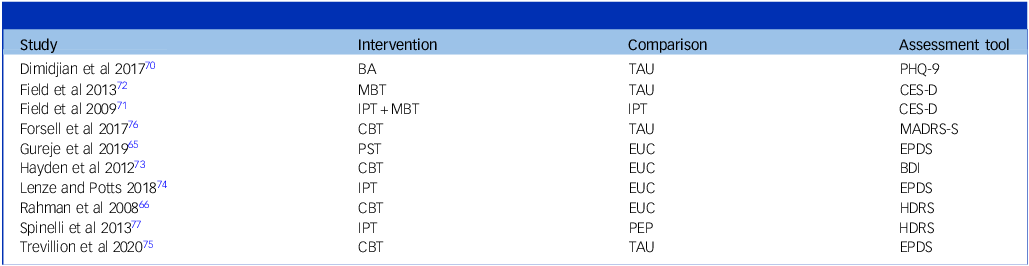
A summary of the included interventions and employed assessment tools is reported in Table 2. Seven studies compared their intervention with TAU or enhanced usual care (EUC), Reference Gureje, Oladeji, Montgomery, Araya, Bello and Chisholm65,Reference Rahman, Malik, Sikander, Roberts and Creed66,Reference Dimidjian, Goodman, Sherwood, Simon, Ludman and Gallop70,Reference Field, Diego, Delgado and Medina72,Reference Lenze and Potts74–Reference Forsell, Bendix, Holländare, Szymanska von Schultz, Nasiell and Blomdahl-Wetterholm76 while three studies involved head-to-head comparisons between different active interventions. Reference Field, Deeds, Diego, Hernandez-Reif, Gauler and Sullivan71,Reference Hayden, Perantie, Nix, Barnes, Mostello and Holcomb73,Reference Spinelli, Endicott, Leon, Goetz, Kalish and Brustman77 CBT Reference Rahman, Malik, Sikander, Roberts and Creed66,Reference Hayden, Perantie, Nix, Barnes, Mostello and Holcomb73,Reference Trevillion, Ryan, Pickles, Heslin, Byford and Nath75,Reference Forsell, Bendix, Holländare, Szymanska von Schultz, Nasiell and Blomdahl-Wetterholm76 was evaluated in four studies and interpersonal psychotherapy (IPT) Reference Field, Deeds, Diego, Hernandez-Reif, Gauler and Sullivan71,Reference Lenze and Potts74,Reference Spinelli, Endicott, Leon, Goetz, Kalish and Brustman77 in three. Behavioural activation, Reference Dimidjian, Goodman, Sherwood, Simon, Ludman and Gallop70 problem-solving therapy (PST) Reference Gureje, Oladeji, Montgomery, Araya, Bello and Chisholm65 and mind–body therapy (MBT) Reference Field, Diego, Delgado and Medina72 were each tested in one single trial. Interventions varied in delivery format, including individual, group-based, face-to-face, remote and community-based approaches. Treatment intensity and duration also varied, with planned treatment exposure ranging from six weekly sessions to 16 contacts; most structured interventions comprised approximately 8–12 sessions or modules. Treatment timelines ranged from 6 to 12-week antenatal protocols to programmes extending into the postpartum period, with the Thinking Healthy Programme continuing through 12 months postpartum. Within the CBT node, interventions shared a cognitive–behavioural framework while varying in format, intensity, provider and duration, ranging from individual and internet-delivered CBT to guided self-help and community-based CBT-informed programmes. A direct comparison of the characteristics of the four CBT-based interventions is provided in Supplementary Table S5.
Summary of included interventions and employed assessment tools

Table 2 Long description
A table with four columns and ten rows. The columns are labeled Study, Intervention, Comparison, and Assessment tool. The rows list different studies and their respective interventions, comparisons, and assessment tools. Row 1: Dimidjian et al 2017, BA, TAU, PHQ-9. Row 2: Field et al 2013, MBT, TAU, CES-D. Row 3: Field et al 2009, IPT + MBT, IPT, CES-D. Row 4: Forsell et al 2017, CBT, TAU, MADRS-S. Row 5: Gureje et al 2019, PST, EUC, EPDS. Row 6: Hayden et al 2012, CBT, EUC, BDI. Row 7: Lenze and Potts 2018, IPT, EUC, EPDS. Row 8: Rahman et al 2008, CBT, EUC, HDRS. Row 9: Spinelli et al 2013, IPT, PEP, HDRS. Row 10: Trevillion et al 2020, CBT, TAU, EPDS.
BA, behavioural activation; BDI, Beck Depression Inventory; CBT, cognitive–behavioural therapy; CES-D, Center for Epidemiologic Studies Depression Scale; EPDS, Edinburgh Postnatal Depression Scale; EUC, enhanced usual care; HDRS, Hamilton Depression Rating Scale; IPT, interpersonal psychotherapy; MADRS-S, Montgomery–Åsberg Depression Rating Scale – Self-report; MBT, mind–body therapy (e.g. yoga, massage); PEP, antenatal psychoeducation programme; PHQ-9, Patient Health Questionnaire-9; PST, problem-solving therapy; SCID, Structured Clinical Interview for DSM Disorders; TAU, treatment-as-usual.
Two studies assessed depression symptoms using clinician-rated scales, Reference Rahman, Malik, Sikander, Roberts and Creed66,Reference Spinelli, Endicott, Leon, Goetz, Kalish and Brustman77 while eight employed self-reported measures. Reference Gureje, Oladeji, Montgomery, Araya, Bello and Chisholm65,Reference Dimidjian, Goodman, Sherwood, Simon, Ludman and Gallop70–Reference Forsell, Bendix, Holländare, Szymanska von Schultz, Nasiell and Blomdahl-Wetterholm76 Taken together, the included trials showed substantial heterogeneity in study design, intervention format, comparator conditions, outcome assessment and follow-up duration. Detailed trial-level characteristics, including intervention content, delivery format, session structure, diagnostic ascertainment and follow-up schedules, are reported in Supplementary Table S4.
Network meta-analysis results
Efficacy
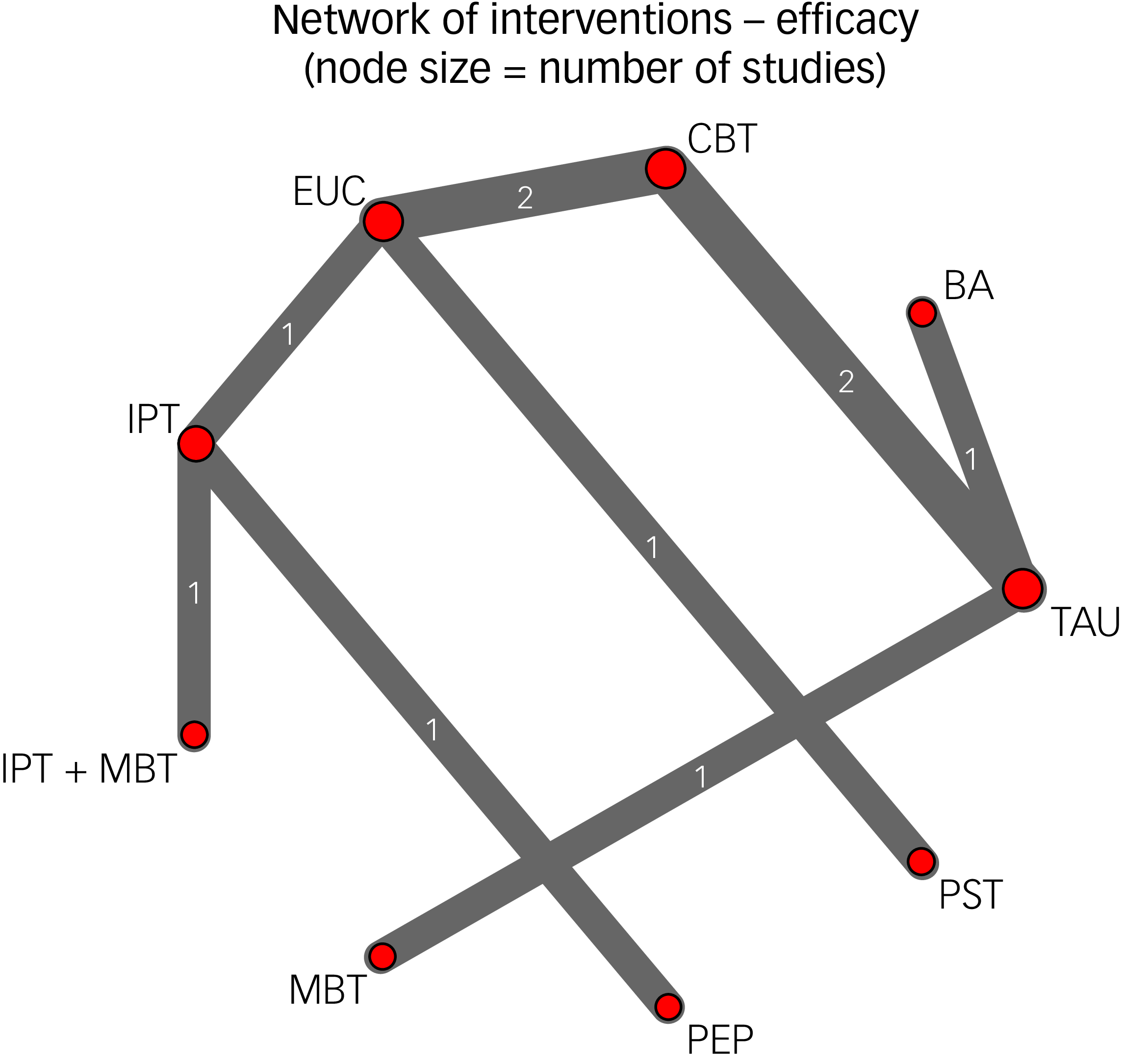
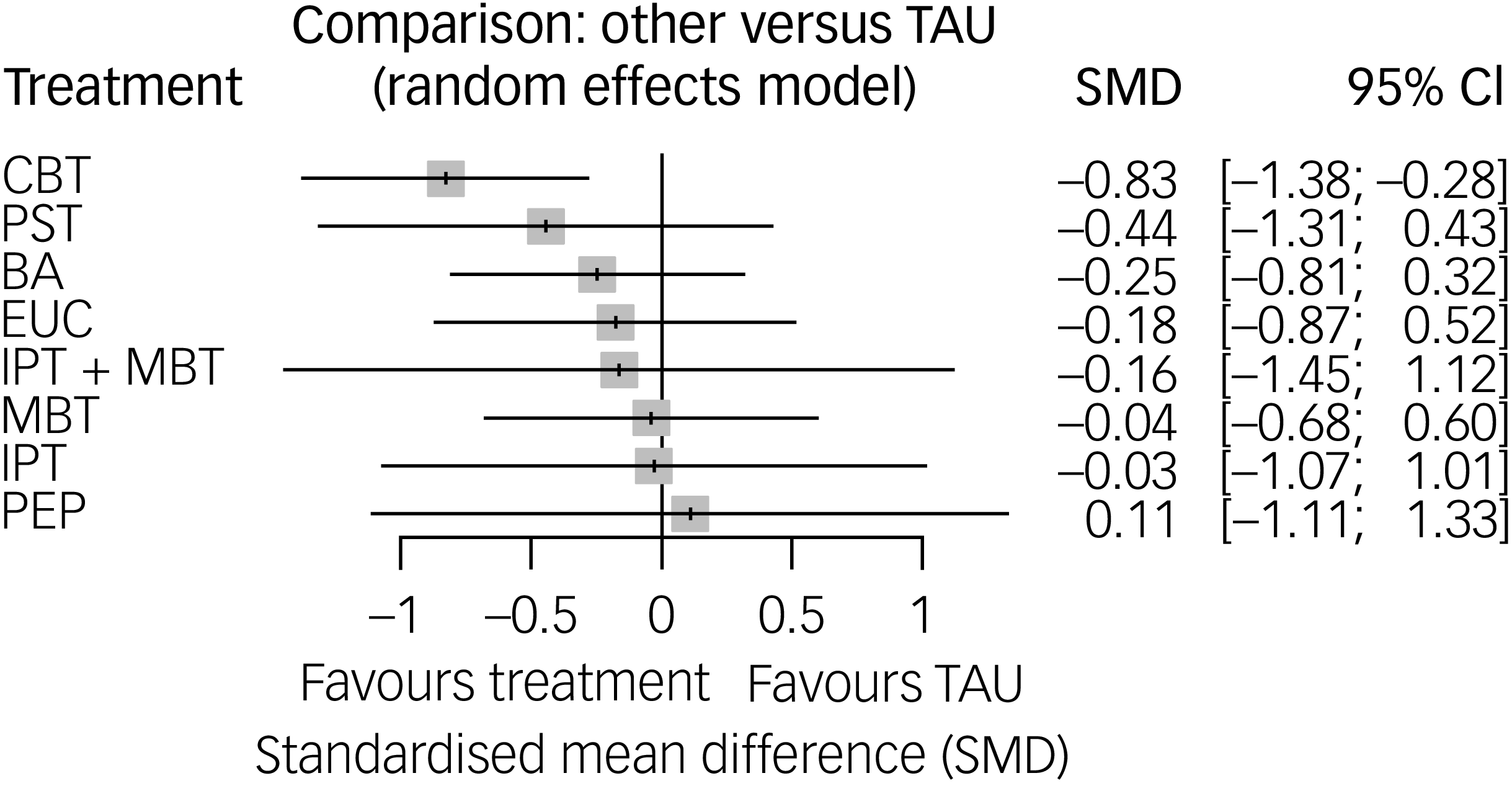
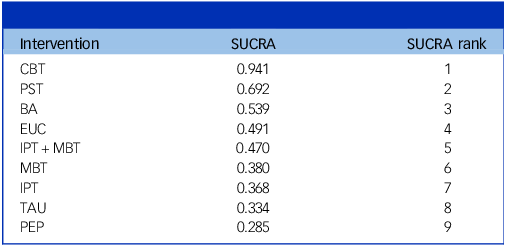
Ten trials, comprising 1818 participants with available endpoint efficacy data, contributed to the efficacy network meta-analysis. Figure 2 reports the network of efficacy comparisons while random-effects estimates versus TAU are reported in Fig. 3 and treatment rankings in Table 3. The number of studies and participants contributing to each treatment comparison are reported in Supplementary Table S6. Across the network meta-analysis, CBT was consistently the most effective intervention. Reference Rahman, Malik, Sikander, Roberts and Creed66,Reference Hayden, Perantie, Nix, Barnes, Mostello and Holcomb73,Reference Trevillion, Ryan, Pickles, Heslin, Byford and Nath75,Reference Forsell, Bendix, Holländare, Szymanska von Schultz, Nasiell and Blomdahl-Wetterholm76 CBT showed the largest reduction in depressive symptoms compared with TAU (SMD −0.83, 95% CI −1.38 to −0.28) and was the only intervention whose confidence interval excluded the null. PST showed a moderate but imprecise point estimate (SMD −0.44, 95% CI −1.31 to 0.43), whereas behavioural activation, EUC, IPT, MBT, combined IPT plus MBT and the parenting education programme showed smaller and highly uncertain effects. CBT ranked first in the random-effects analysis (SUCRA 0.94), followed by PST (0.69) and behavioural activation (0.54). Between-study heterogeneity was low to moderate (τ 2 = 0.052; I 2 = 37.2%). Formal assessment of global or local inconsistency was not possible because the network contained no closed loops.
Network structure of efficacy comparisons among non-pharmacological interventions for antenatal depression. Node size is proportional to the number of studies evaluating each intervention, while edge thickness reflects the number of trials informing each head-to-head comparison. Numbers on the connecting lines indicate the exact study count for each comparison, illustrating the density and distribution of evidence across the network. CBT, cognitive–behavioural therapy; PST, problem-solving therapy; BA, behavioural activation; EUC, enhanced usual care; IPT, interpersonal psychotherapy; IPT + MBT, combined interpersonal psychotherapy and mind–body therapy; MBT, mind–body therapy; PEP, antenatal psychoeducation programme; TAU, treatment-as-usual.

Forest plot of standardised mean differences for active interventions compared with treatment as usual (TAU). Forest plot showing standardised mean differences (SMDs) and 95% confidence intervals for each non-pharmacological intervention compared with TAU in the random-effects model; negative values indicate greater improvement in depressive symptoms relative to TAU. CBT, cognitive–behavioural therapy; PST, problem-solving therapy; BA, behavioural activation; EUC, enhanced usual care; IPT, interpersonal psychotherapy; IPT + MBT, combined interpersonal psychotherapy and mind–body therapy; MBT, mind–body therapy; PEP, antenatal psychoeducation programme; SMD, standardised mean difference.

SUCRA rankings of the included interventions

Table 3 Long description
The table presents the SUCRA rankings of various interventions. It has three columns: Intervention, SUCRA, and SUCRA rank. The interventions listed are CBT, PST, BA, EUC, IPT plus MBT, MBT, IPT, TAU, and PEP. The SUCRA values and their corresponding ranks are as follows: CBT has a SUCRA value of 0.941 and rank 1, PST has a SUCRA value of 0.692 and rank 2, BA has a SUCRA value of 0.539 and rank 3, EUC has a SUCRA value of 0.491 and rank 4, IPT plus MBT has a SUCRA value of 0.470 and rank 5, MBT has a SUCRA value of 0.380 and rank 6, IPT has a SUCRA value of 0.368 and rank 7, TAU has a SUCRA value of 0.334 and rank 8, and PEP has a SUCRA value of 0.285 and rank 9.
BA, behavioural activation; CBT, cognitive–behavioural therapy; EUC, enhanced usual care; IPT, interpersonal psychotherapy; IPT + MBT, combined interpersonal psychotherapy and mind–body therapy; MBT, mind–body therapy; PEP, antenatal psychoeducation programme; PST, problem-solving therapy; TAU, treatment-as-usual; SUCRA, surface under the cumulative ranking curve.
Acceptability
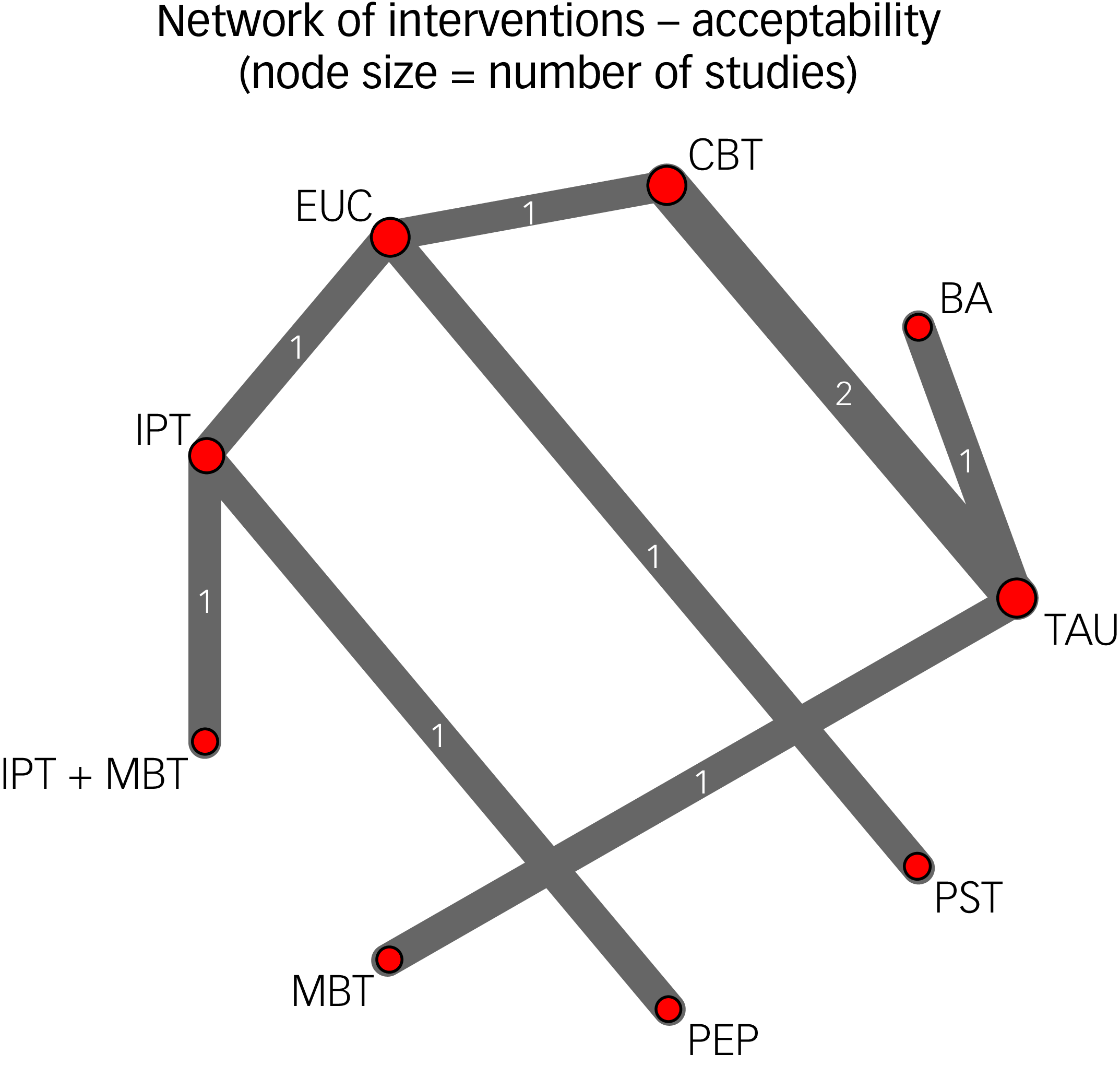
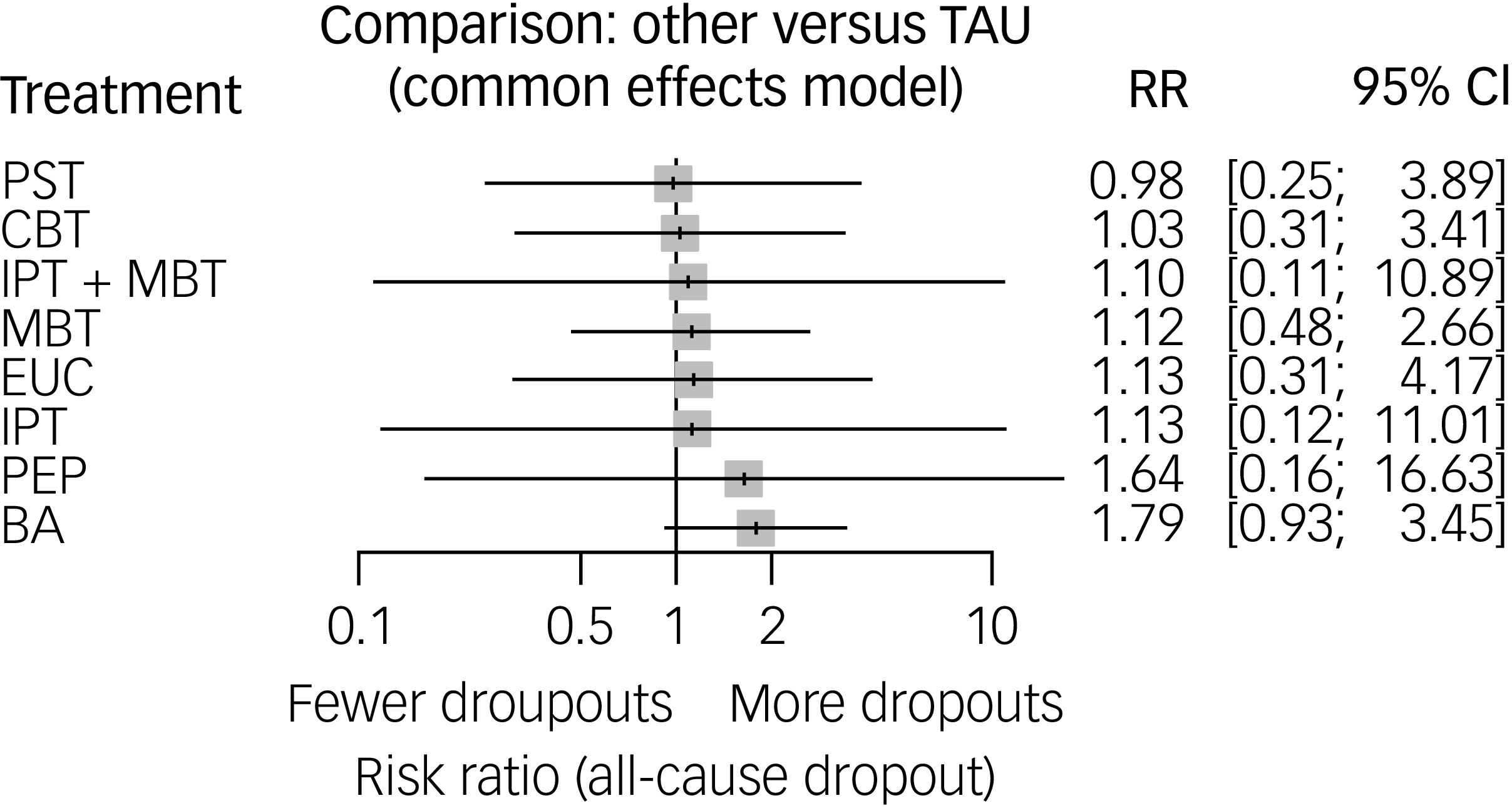
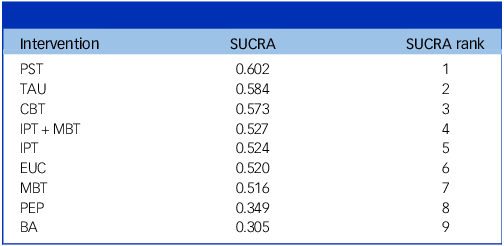
Nine trials, comprising 2235 randomised participants, contributed to the acceptability network meta-analysis (Fig. 4). Random-effects estimates versus TAU are reported in Fig. 5 and treatment rankings in Table 4. The number of studies and participants contributing to each treatment comparison are reported in Supplementary Table S6. No intervention showed evidence of a difference in all-cause dropout compared with TAU. CBT showed an RR of 1.03 (95% CI 0.31 to 3.41), while estimates for the remaining interventions were similarly imprecise, ranging from 0.98 (95% CI 0.25 to 3.89) for PST to 1.79 (95% CI 0.93 to 3.45) for behavioural activation. PST, TAU and CBT had the highest random-effects SUCRA values (0.60, 0.58 and 0.57, respectively), although rankings were highly uncertain given the wide confidence intervals. No between-study heterogeneity was detected (τ 2 = 0; I 2 = 0%); formal assessment of global or local inconsistency was not possible because the network contained no closed loops.
Network structure of acceptability comparisons among non-pharmacological interventions for antenatal depression. Node size is proportional to the number of studies evaluating each intervention, and edge thickness reflects the number of trials informing each head-to-head comparison; numbers on the connecting lines indicate the exact study count. CBT, cognitive–behavioural therapy; PST, problem-solving therapy; BA, behavioural activation; EUC, enhanced usual care; IPT, interpersonal psychotherapy; IPT + MBT, combined interpersonal psychotherapy and mind–body therapy; MBT, mind–body therapy; PEP, antenatal psychoeducation programme; TAU, treatment-as-usual.

Forest plot for dropout rates for active interventions compared with TAU. Forest plot showing risk ratios (RRs) and 95% confidence intervals for dropout rates comparing each non-pharmacological intervention with treatment-as-usual (TAU) under a random-effects model; values greater than 1 indicate higher dropout relative to TAU. CBT, cognitive–behavioural therapy; PST, problem-solving therapy; BA, behavioural activation; EUC, enhanced usual care; IPT, interpersonal psychotherapy; IPT + MBT, combined interpersonal psychotherapy and mind–body therapy; MBT, mind–body therapy; PEP, antenatal psychoeducation programme; RR, risk ratio.

SUCRA rankings of acceptability analysis

Table 4 Long description
A table titled ‘SUCRA rankings of acceptability analysis’ with three columns and nine rows. The columns are labeled ‘Intervention’, ‘SUCRA’, and ‘SUCRA rank’. The rows list the interventions and their corresponding SUCRA values and ranks. Row 1: PST, 0.602, 1. Row 2: TAU, 0.584, 2. Row 3: CBT, 0.573, 3. Row 4: IPT + MBT, 0.527, 4. Row 5: IPT, 0.524, 5. Row 6: EUC, 0.520, 6. Row 7: MBT, 0.516, 7. Row 8: PEP, 0.349, 8. Row 9: BA, 0.305, 9.
CBT, cognitive–behavioural therapy; PST, problem-solving therapy; BA, behavioural activation; EUC, enhanced usual care; IPT, interpersonal psychotherapy; IPT + MBT, combined interpersonal psychotherapy and mind–body therapy; MBT, mind–body therapy; PEP, antenatal psychoeducation programme; TAU, treatment-as-usual.
Sensitivity analyses
Sensitivity analyses supported the robustness of the primary findings. Common-effect models, exclusion of studies at high risk of bias and restriction to trials with intermediate baseline depressive severity produced no material changes in effect estimates or their interpretation (Supplementary Material). In the Bayesian random-effects analysis of efficacy using the empirically informed Rhodes heterogeneity prior, Reference Rhodes, Turner and Higgins78 estimates closely matched the frequentist results (CBT versus TAU: SMD −0.81, 95% credible interval −1.38 to −0.28); conclusions were unchanged using an alternative weakly informative prior.
Risk of bias and confidence of the evidence
Of the ten included trials, three were rated at high overall risk of bias, five as raising some concerns and two at low risk of bias. Confidence in the evidence was rated as very low across all 36 network comparisons. Major concerns were most frequent for imprecision, affecting 27 of 36 comparisons (75%), followed by within-study bias in 5 (14%), indirectness in 3 (8%) and heterogeneity in 2 (6%). Formal assessment of global or local inconsistency was not possible because the network contained no closed loops. Detailed CINeMA assessments are reported in the Supplementary Material.
Discussion
This network meta-analysis found that CBT showed the clearest evidence of benefit for depressive symptom reduction compared with TAU, whereas estimates for the other interventions were generally less precise and more uncertain. No significant differences in acceptability, assessed as all-cause dropout, were observed across treatments. To the best of our knowledge, this is the first network meta-analysis to compare the efficacy and acceptability of non-pharmacological interventions specifically for antenatal depression in women with a depressive disorder established according to DSM or ICD criteria. An important early observation from the systematic database search is the limited range of available interventions. In line with our protocol, we aimed to include a wider spectrum of non-pharmacological approaches, ranging from psychological, psychosocial and community-based interventions. However, the studies meeting eligibility criteria included exclusively psychological or narrowly defined psychosocial interventions, with no community-based interventions. In its 2013–2030 Comprehensive Mental Health action plan, 79 the World Health Organization underscores the centrality of community-based, intersectoral models of care as a means to support individuals within their own social environments. These approaches may be particularly crucial for the management of PPD, where societal factors, such as limited support, gendered expectations around motherhood, stigma surrounding maternal mental health, social isolation, economic and housing instability substantially shape both risk and recovery. Reference De Risio, Pettorruso, Collevecchio, Collacchi, Boffa and Santorelli80–Reference Sambrook Smith, Lawrence, Sadler and Easter82 Recent systematic and scoping reviews indicate that community-based and multisectoral interventions promoting social, peer and family support, community participation, access to local resources and services and reducing barriers such as stigma and isolation show promising benefits for well-being and depressive symptoms across diverse populations. Reference De Risio, Pettorruso, Collevecchio, Collacchi, Boffa and Santorelli80,Reference Siddiqui, Morris, Ikeda, Balsari, Blanke and Pearsall83–Reference Baskin, Zijlstra, McGrath, Lee, Duncan and Oliver85 In contrast to the growing recognition and evidence regarding these models of care, our findings indicate that available evidence on non-pharmacological treatments for antenatal depression remains predominantly focused on individually delivered psychotherapeutic and psychosocial interventions, while broader social or community-level approaches remain largely under-evaluated. Another relevant point is that, although pregnancy is frequently characterised by a high degree of family involvement, no studies were found assessing family-focused interventions. The absence of such interventions may reflect historical tendencies to consider perinatal depression as an individual maternal condition, as well as practical challenges associated with recruiting and assessing multiple family members. This gap is striking given that such interventions are strongly recommended in the clinical guidelines for several other mental disorders and that interpersonal and relational factors play a central role in perinatal mental health. Reference Sambrook Smith, Lawrence, Sadler and Easter82–Reference Luciano, Del Vecchio, Giacco, De Rosa, Malangone and Fiorillo89
Across the included trials, there was considerable heterogeneity in methodology, geographical distribution, sample characteristics and modalities of intervention delivery. Eight of the ten originated from high-income countries, while two studies Reference Gureje, Oladeji, Montgomery, Araya, Bello and Chisholm65,Reference Rahman, Malik, Sikander, Roberts and Creed66 have been conducted in low- and middle-income settings. This imbalance restricts global generalisability and may bias effect estimates towards models more feasible in well-resourced contexts.
Another important finding concerns the variability in outcome measurement. While study inclusion was based on a depressive disorder diagnosis established according to DSM or ICD criteria, eight of the ten trials used self-report measures to assess depressive symptom outcomes, whereas clinician-rated measures were used as primary depression outcomes in only two studies. Reference Rahman, Malik, Sikander, Roberts and Creed66,Reference Spinelli, Endicott, Leon, Goetz, Kalish and Brustman77 Self-report measures may have limited comparability Reference Stefana, Cena, Trainini, Palumbo, Gigantesco and Mirabella90 and greater susceptibility to measurement noise and construct overlap with other psychopathological dimensions (e.g. anxiety) as well as with normal pregnancy experiences (e.g. somatic symptoms). Reference Levis, Negeri, Sun, Benedetti and Thombs14,Reference El-Den, Pham, Anderson, Yang, Moles and O’Reilly55–Reference Matthey, Henshaw, Elliott and Barnett58,Reference Stefana, Cena, Trainini, Palumbo, Gigantesco and Mirabella90
Overall, interventions delivered with adequate duration, high therapist expertise, strong fidelity and clear TAU/EUC comparators yielded the most stable estimates, while small samples, high attrition, active comparators or brief protocols resulted in attenuated or imprecise effects. These recurring methodological patterns closely mirror the treatment hierarchy revealed by the network model.
Across interventions, cognitive–behavioural approaches emerged as consistently effective. This pattern aligns with meta-analytic evidence indicating that CBT reliably improves antenatal and postnatal depressive symptoms. Reference Cuijpers, Franco, Ciharova, Miguel, Segre and Quero48,Reference Hua, Yue, Zhu, Yang and Zhou49,Reference Dooley and McAloon59 Overall, these converging findings strengthen the position of CBT as a first-line psychological treatment during pregnancy. PST also produced benefits, deriving primarily from the high-quality trial by Gureje et al, Reference Gureje, Oladeji, Montgomery, Araya, Bello and Chisholm65 where the WHO Problem Management Plus model Reference Dawson, Bryant, Harper, Tay, Rahman and Schafer91 was effectively delivered by supervised lay health workers in south-western Nigeria. PST significantly outperformed EUC, demonstrating scalability and cultural adaptability in low-resource settings. This result contrasts with the findings from the NMA by Hua and colleagues, Reference Hua, Yue, Zhu, Yang and Zhou49 which included only a single study targeting women without a clinical diagnosis of PPD. Reference Khamseh, Parandeh, Hajiamini, Tadrissi and Najjar92 The more structured intervention design and higher methodological rigour of the Gureje et al trial Reference Gureje, Oladeji, Montgomery, Araya, Bello and Chisholm65 suggests that higher-quality studies may yield more favourable effects of PST than previously reported. Behavioural activation also showed clinically significant effects, largely driven by the methodologically rigorous trial by Dimidjian et al (2017), which delivered intensive, manualised behavioural activation through highly trained clinicians. This finding is again consistent with previous findings on PPD, where behavioural activation produced meaningful reductions in depressive symptoms. Reference Cuijpers, Franco, Ciharova, Miguel, Segre and Quero48,Reference Hua, Yue, Zhu, Yang and Zhou49 IPT showed more modest and inconsistent effects. Lenze et al Reference Lenze and Potts74 tested a brief IPT intervention with high attrition and reliance on self-report measures, producing imprecise estimates. Spinelli et al (2013) by contrast, used clinician-rated outcomes and a rigorous design but compared IPT against an active educational/support intervention, potentially reducing between-group detectability. This discrepancy is notable because IPT is often identified as highly effective in broader perinatal meta-analyses. Reference Hua, Yue, Zhu, Yang and Zhou49 Our findings suggest that IPT may require longer protocols, more structured delivery or TAU comparators to be fully effective in antenatal populations.
MBT showed negligible effects. Reference Field, Deeds, Diego, Hernandez-Reif, Gauler and Sullivan71,Reference Field, Diego, Delgado and Medina72 However, these trials were small, brief and methodologically fragile, relying exclusively on self-report measures. Similarly, educational interventions (antenatal psychoeducation programme (PEP)) also showed minimal benefit. Reference Spinelli, Endicott, Leon, Goetz, Kalish and Brustman77 Acceptability was high across interventions, with no meaningful differences from TAU/EUC. Dropout rates were low, and importantly, most attrition was attributable to pregnancy-related reasons, such as medical complications, scheduling difficulties or changes in pregnancy health status, rather than intervention burden itself. This pattern suggests that structured psychological interventions are tolerable, feasible and well received during pregnancy. The overall pattern of efficacy results remained stable across sensitivity analyses, including common-effect and risk-of-bias-restricted models and a Bayesian random-effects analysis using an empirically informed heterogeneity prior; findings were also unchanged under an alternative weakly informative prior (Supplementary Material).
Limitations of this network meta-analysis include an evidence base of only ten trials, which reduces precision for some comparisons and limits the robustness of treatment rankings. Individual trial sample sizes ranged from 42 to 903 participants, and six of the eight directly observed treatment comparisons were informed by a single trial, further reducing the precision of treatment-specific estimates and increasing their susceptibility to random variation. The predominance of high-income settings restricts global generalisability, and the absence of community-based or structural interventions narrowed the scope of our study. Heterogeneity in outcome measures, intervention duration, comparator strength and intervention delivery modalities further complicates interpretation of findings, particularly given the reliance on self-report measures in most trials. The evidence base was also constrained by variation in follow-up schedules and treatment exposure, as well as by the use of active or enhanced comparators in some studies, which may have reduced between-group contrasts and contributed to imprecision in the network estimates. The CBT node represented a broad therapeutic-family category encompassing conventional CBT as well as lower-intensity and contextually adapted CBT-based interventions, which differed in delivery format, intensity, provider, duration and degree of perinatal adaptation. Accordingly, the pooled estimate should be interpreted as an average effect across heterogeneous CBT-based approaches and not as evidence that individual CBT modalities are interchangeable or equally effective. Several nodes in the network were informed by only one or two studies, increasing uncertainty and limiting the stability of comparative estimates. Moreover, the sparse, tree-shaped network contained no closed loops, precluding formal assessment of global or local inconsistency and providing limited information for estimating between-study heterogeneity. Accordingly, the Bayesian estimate of heterogeneity remained sensitive to prior specification, although relative treatment effects were remarkably stable across frequentist and Bayesian models.
Implications for clinical practice and future research
This network meta-analysis provides the strongest comparative evidence to date for CBT as an effective non-pharmacological treatment for antenatal depression, while PST and behavioural activation showed potentially favourable but substantially more uncertain estimates. Acceptability did not significantly differ across treatments. Rather than providing a definitive hierarchy of treatments, this study offers a comparative synthesis of the available randomised evidence, highlighting both the interventions with the clearest signals of benefit and the substantial uncertainty and evidence gaps that remain across the network.
Eligibility was restricted a priori to trials enrolling women with a depressive disorder established according to DSM or ICD criteria, addressing an important limitation of the broader literature, in which participant eligibility is frequently based on screening and/or self-report instruments rather than formal diagnostic assessment. This methodological choice necessarily narrowed the eligible evidence base and contributed to the sparsity of the network, but allowed the analysis to focus specifically on clinically diagnosed antenatal depression and to evaluate treatment effects within a clinically defined population. The focus on non-pharmacological interventions is also particularly relevant in pregnancy, where concerns regarding fetal exposure and the limited acceptability of pharmacotherapy often shape treatment choices. These findings may therefore inform clinical decision-making while also helping to define priorities for strengthening the evidence base in this area.
Future research should prioritise harmonised, adequately powered and methodologically rigorous studies using clinically diagnosed samples and robust assessment methods, with improved representation from low-resource settings. Importantly, research should also move beyond individually delivered psychotherapies to evaluate family interventions and community-based and intersectoral care targeting the social and systemic determinants of perinatal mental health, which remain largely absent from the antenatal depression evidence base despite their potential scalability and public health relevance.
Supplementary material
The supplementary material is available online at https://doi.org/10.1192/bjp.2026.10864
Data availability
Data availability is not applicable to this article as no new data were created or analysed in this study.
Acknowledgements
The authors made use of an artificial intelligence tool (ChatGPT, OpenAI) to assist with language editing and manuscript drafting. The authors reviewed and edited the content as needed and take full responsibility for the final version of the manuscript.
Author contributions
All authors contributed to the conception and design of the study. Data screening and extraction were performed by E.C., A.M., B.D.R., S.C. and C.T. Statistical analyses were conducted by A.M., E.C. and M.F. E.C., B.D.R. and A.M. contributed to data interpretation. The manuscript was drafted by E.C., B.D.R. and A.M. and critically revised by all authors. All authors approved the final version of the manuscript and agree to be accountable for all aspects of the work.
Funding
This research received no specific grant from any funding agency, commercial or not-for-profit sectors.
Declaration of interest
None.
Transparency declaration
The authors affirm that this manuscript is an honest, accurate and transparent account of the study being reported; that no important aspects of the study have been omitted; and that any discrepancies from the study as planned and registered have been explained.
Analytic code availability
Analytic code supporting the findings of this study is available from the corresponding author upon reasonable request.
Research material availability
Materials supporting the findings of this study are available from the corresponding author upon reasonable request.





eLetters
No eLetters have been published for this article.