Introduction
Our world has been and still is plagued by oppressive social and political systems. Why do these systems persist or why did they persist for as long as they did? After all, in many cases the oppressed significantly outnumber their oppressors. Facing an intolerable existence and with superior numbers on their side, why don’t the oppressed—through either peaceful or violent means—revolt against their chains?
One answer to this puzzle appeals to ideology or false consciousness (I shall use these terms interchangeably). Roughly, ideology explanations claim that the oppressed have distorted beliefs about the social and political system that oppresses them; these distorted beliefs lead the oppressed voluntarily to accept their servitude. For example, the proletariat (who are exploited under capitalism, according to Marxists) might incorrectly believe that capitalism is the only feasible economic system, that success in the market reflects merit and only merit, that upward mobility is open to all, and so on. These beliefs make the proletariat complacent rather than revolutionary. The term ‘ideology’ is thus used in a pejorative rather than general way, as it refers to beliefs that are in some sense epistemically defective and sustain oppressive social and political systems.
Ideology explanations were initially developed by Karl Marx and his followers to explain why the capitalist system marches on. More recently, ideology has been invoked to explain the persistence of racism,Footnote 1 sexism,Footnote 2 the Soviet Union,Footnote 3 the Hindu caste system,Footnote 4 nationalism,Footnote 5 gun culture,Footnote 6 why poor working-class people vote for Republicans,Footnote 7 why Tea Party voters support low taxes,Footnote 8 and much more.
If oppressive social and political systems persist because the oppressed are in the grip of ideology, then the first step toward abolishing these systems is to correct oppressed individuals’ beliefs. This is the job of ideology critique. To continue the classic Marxist example, the critical theorist demonstrates to the proletariat that socialism is feasible, that much success in the market reflects luck, that very few workers ever become capitalists, and so on. I shall call “critical theorists” those who appeal to false consciousness when explaining persistent oppression and those who embrace ideology critique as a tool for liberation.
Ideology explanations face numerous criticisms. I focus on one in the “Ideology and the origin puzzle” section of this essay. Jon Elster raises an important challenge for ideology explanations: How do the ideas of the ruling class come to dominate? After all, other ideas about how society should organize its social, political, and economic institutions will be floating around, some of which will be more congenial to the interests of the oppressed when compared to the ruling class’s ideology. Why, then, do the oppressed embrace the ruling class’s ideology?
Critical theorists echo a common response to this question, which I explain in the section on “The common response.” This common response says that the ruling class controls the “means of mental production”—organizations such as churches, schools, news agencies, and so on—thus ensuring the oppressed are only exposed to the ruling class’s ideology. Because the oppressed are not exposed to alternative worldviews, they embrace the ruling class’s ideology. This account of how the ruling class’s ideology comes to dominate is frequently cited but never criticized. It faces serious challenges, I argue.
A different solution to Elster’s challenge says that the oppressed embrace the ruling class’s ideology not because they are inundated with the ruling class’s propaganda, but because believing it is good for them, as I explain in the section on “The demand for false consciousness.” An obvious argument here says that embracing the ruling class’s ideology is good for the oppressed because doing so allows them to avoid persecution and curry favor with the powerful. This, however, is not an argument saying why it is good for the oppressed to believe the ruling class’s ideology, but an argument articulating why it is good for them to pretend to believe it. In comparison, I argue that genuinely believing the ruling class’s ideology allows the oppressed to maintain a positive self-image despite their oppression and motivates them to take actions that allow them to succeed (to the extent this is possible) within their oppressive constraints.
If this demand-driven explanation of how false consciousness originates is correct, then significant challenges arise for ideology critique as a tool for liberation. I argue in the “Rethinking ideology critique” section that critical theorists need to focus less on the message of ideology critique and more on the medium of delivery. Beyond this, ideology critique becomes morally risky, in that it may (but does not necessarily) harm the oppressed.
Ideology and the origin puzzle
What is ideology? Among social scientists, ideologies are typically defined as beliefs—interpreted widely to include values, understandings, interpretations, myths, and preferences—that support or contest political arrangements and provide guides for political action.Footnote 9 Critical theorists tend to focus only on a proper subset of ideologies: those that are, in some sense, bad. More specifically, “to claim that a particular belief system is ideological … is to impute to the system of belief some negative characteristic(s) that provides a reason to reject it (or at least some significant part of it) in its present form.”Footnote 10 What are these negative characteristics?
There are two. First, many of the beliefs that constitute ideologies are false or epistemically defective in some way. Second, ideologies serve a pernicious social function; they support and sustain oppressive social and political systems. Here are several passages highlighting these two features:
[I]deology: a widely held set of associated beliefs and implicit judgments that misrepresent significant social realities and that function … to bring about or perpetuate unjust social relations.Footnote 11
False consciousness … refers to beliefs that are false and that are formed under conditions of oppression that support the maintenance of the oppression.Footnote 12
[I]deology functions to stabilize or perpetuate unjust power and domination, and does so through some form of masking or illusion.Footnote 13
[I]deology claims that the dominant social ideas in such societies are typically false or misleading in a fashion that redounds to the advantage of the economically dominant class.Footnote 14
[W]orkers have a poor perception of their interests. They have absorbed commercial values and chase after consumer goods. Their desires have been organized by a system which depends on their docility.Footnote 15
To avoid confusion going forward, I shall use the term ‘worldview’ to denote a set of beliefs that evaluates political arrangements and guides political action. I shall reserve the term ‘ideology’ for a set of beliefs that evaluates political arrangements and guides political action that also possesses both negative characteristics. All ideologies are worldviews, but not all worldviews are ideologies. No doubt, this definition makes ideologies difficult to identify in the real world, for identification requires we know for sure whether a set of beliefs is false and, even more problematically, whether the beliefs contribute to complex social and political processes. Nonetheless, this is how many critical theorists understand ideology.
Ideological beliefs can take many forms: denial of injustice or exploitation, fatalism about prospects for social change, rationalization of social roles, false attribution of blame, identification with the oppressor, and resistance to social change.Footnote 16 More concretely, Ann Cudd offers the following examples of ideological beliefs: women’s place is in the home, black men are more prone to commit violence than white men, women are more nurturing than men, and rich persons deserve their wealth.Footnote 17 According to Cudd, these beliefs are often “held by members of both the groups whose dominance and whose subordination they justify.”Footnote 18 I was initially skeptical of ideology explanations of persistent oppression. Empirical work in social psychology, however, demonstrates that the disadvantaged, at least in some cases, hold beliefs and attitudes that do seem counter to their interests.Footnote 19
Ideology explanations face many criticisms. The most prominent criticism is that there are better explanations for why the oppressed do not revolt. For instance, another explanation for why the oppressed do not revolt appeals to the collective action problems inherent in revolution.Footnote 20 Some believe that collective action explanations for persistent oppression are superior to ideology explanations, making ideology explanations superfluous.Footnote 21 Allen Buchanan convincingly addresses this criticism by arguing that ideology and collective action explanations are not incompatible; in fact, they complement one another.Footnote 22
Elster raises the criticism of ideology explanations that I focus on in this essay. He writes:
[W]e are left with the question of the mechanism whereby a ruling class is able to selectively favor certain theoretical views at the expense of others …. How does a ruling class make sure that the theoretically dominant ideas correspond, at least minimally, to its own “material interest and social position”? The question is not how a class selects its ideologists, but how the chosen ideologists come to acquire intellectual hegemony by virtue of the economic power of the class. Why should the ruling ideas be the ideas of the ruling class?Footnote 23
In any society, there are numerous worldviews floating around that articulate a vision for how social, political, and economic institutions should be organized. Some of these worldviews favor the interests of the ruling class, but many do not. Given the multiple options on the table, how does the ruling class’s ideology come to dominate? Why doesn’t a worldview more congenial to the interests of the oppressed win popular support? Call this the “origin puzzle” for ideology explanations.
Here is another way to state the origin puzzle that, I think, reveals how significant a challenge it is for ideology explanations. Let R be the ideology preferred by the ruling class; through illusion and distortion, it solidifies (so long as enough people adopt it) their rule. Let O be a competing worldview to R. Unlike R, O does not contain any epistemic defects. Moreover, O is more congenial to the interests of the oppressed than is R. For someone who is not a member of the ruling class, O seems far more attractive a worldview than R. Why on earth, then, would an oppressed individual embrace R instead of O?Footnote 24
Although counterintuitive, ideology explanations say that the oppressed consistently choose R over O. If they did not, then something other than false consciousness stabilizes oppressive social and political systems. It is difficult to fathom, though, why a rational person would make this choice. The origin puzzle essentially challenges the critical theorist to explain why the oppressed consistently make this perplexing decision—why, that is, they choose the ruling class’s ideology that is both epistemically defective and contributes to their oppression when more attractive options are available.
Left unanswered, the origin puzzle causes significant problems for ideology explanations of persistent oppression. False consciousness may explain why the oppressed do not revolt against their chains, but the explanation is seriously lacking if we do not have a plausible account as to how the oppressed come to acquire false consciousness in the first place. Do critical theorists have an origin story to tell? They do and it is the subject of the next section.
The common response
When faced with the choice of the ruling class’s ideology R or worldview O, why would a member of the oppressed choose R over O? The critical theorist might respond that this is a misleading question. If the oppressed saw O as a real option, then most would undoubtedly choose it. The oppressed, however, are not presented with both options; they are only exposed to R. They adopt R because it is the only game in town.
Why are the oppressed only exposed to R? Marx’s answer is that “the class which has the means of material production at its disposal, has control at the same time over the means of mental production.”Footnote 25 Marx’s statement here is a bit cryptic, but the basic idea seems to be this. There are organizations that supply worldviews for people to adopt. The state (through public school curriculum, for instance) is one such organization, but it is not the only one. There are plenty of nonstate organizations that supply worldviews: private news media, religious and civic organizations, social media accounts and channels, private schools and universities, and so on. Marx’s thesis is that these organizations are controlled by the ruling class. Because the ruling class controls them, they advocate R (the ruling class, on this view, tends to all be of one mind). Never presented with O as an option, the oppressed embrace the ruling class’s ideology. Call this the “common response” to the origin puzzle.
Many contemporary critical theorists embrace the common response.Footnote 26 Some of them offer a clearer articulation of the common response than Marx’s initial statement. For instance, Denise Meyerson writes:
[T]he unprofitable desires of members of the subordinate class are mostly the effect of a lifetime of social conditioning. On this theory, it is no coincidence that the desires of those who are exploited by the economic system should be so suited to it, for since it is the people with economic power who control the major institutions (church, school, press, and so on), it is naturally bourgeois attitudes, the attitudes which suit them, which those institutions will communicate …. Since they have the power, they control access to opinion-forming institutions and their values inevitably get disseminated.Footnote 27
Also embracing the common response, Cudd writes:
[O]ne must note that the dominant group of society—at least some of their members—are those who have the most ability to mold common social beliefs. In modern capitalist society they own the media and the companies that employ people, and run the schools that educate people; in socialist societies they are the political elite who have the power over the media, employment, and education; in traditional societies they run the religions and the tribal councils. They have the power to shape opinion … while some members of the dominant group are passive receptors of the beliefs, some have sought to construct and perpetuate these ideological beliefs through their greater ability to shape public opinion.Footnote 28
In what follows, I shall not argue that the common response is incorrect. Rather, I shall argue that it is incomplete. Pointing to the ruling class’s ownership of the means of mental production cannot, on its own, explain why members of the oppressed embrace R. For the common response to succeed, the critical theorist must also posit among the oppressed some kind of demand or desire to embrace R. I will now defend this claim with two arguments, one of which is theoretical, the other empirical.
Theoretical concerns
According to the common response, organizations that supply worldviews are controlled by the ruling class. As a result, these organizations advocate R. My contention is not that this claim is incorrect, but that it must assume there is some kind of demand for R among the oppressed. To see this, assume that a sizable number of oppressed individuals would embrace O over R were they exposed to both. If this is true, then it will be advantageous for some members of the ruling class to operate their organizations in a manner contrary to their class interests by pushing O. Hence, organizations that supply worldviews will not all advocate R, contra the claims of the common response.
Assume that leaders of organizations want to maximize the number of people who consume services provided by their organization. Churches want as many congregants as possible, news agencies as many readers and viewers as possible, social media pages as many followers and interactions as possible, and so on. This puts organizations into competition with one another. Every person who reads your newspaper does not read mine, so I need to do everything in my power to convince potential readers to read my newspaper instead of yours. This competition can lead organizations controlled by the ruling class to push a worldview counter to their class interests.
Suppose that there are two newspapers, A and B, both owned by members of the ruling class. Newspaper A advocates R in its coverage. Newspaper B wants to acquire as many subscribers as possible. The newspaper has two options; it can also advocate R in its coverage or it can advocate O. The latter option will be more profitable for B (assuming, as we are, that there is a sizable number of people who want to hear O over R). After all, newspaper A has already cornered the market for subscribers who want news from the ruling class’s perspective. Competing on this margin will be difficult. Instead, newspaper B can acquire subscribers unsatisfied with A’s coverage by supplying a worldview critical of the ruling class. To maximize profits, the owner of B should push O, not R.
The point here is we cannot assume—as the common response does—that just because the ruling class controls worldview-supplying organizations that these organizations will all advocate the ruling class’s ideology. If a diversity of worldviews is demanded by consumers, competition will incentivize organizations to supply diversity. There is empirical and theoretical evidence supporting this claim. For example, competition among news agencies results in slanted media, but these slants run in all ideological directions.Footnote 29 Religious competition tends to produce a diversity of denominations.Footnote 30 So, even if the ruling class controls the major worldview-supplying organizations, we should nonetheless expect a diverse array of worldviews advocated. Indeed, consider the ideological gap between elite-run organizations such as Fox News and MSNBC, the National Review and Jacobin, the Cato Institute and the Progressive Policy Institute, Liberty University and Bard College.
According to the ordinary definition, oligopoly occurs when a small number of firms collude to fix prices. Similarly, the common response to the origin puzzle assumes that all organizations collude to push R. Yet we know that while oligopolies are possible, they are fragile. This is because they face a collective action problem. While it might be in the collective interest of firms to collude on a higher price, it is in my firm’s individual interest to undercut your firm’s prices to secure a greater market share. A small number of firms can perhaps solve this collective action problem, but not a large number.Footnote 31 The same problem applies to the common response. It may be in the class interest of news agencies to supply only R, but an individual news agency can make a killing by defecting on this pact. So long as there is demand for O among the oppressed, there will be opportunities to cater profitably to that demand, and some members of the ruling class will choose profit over class interest.
I have argued that if a sizable number of oppressed individuals are disposed to embrace O over R, then organizations will not all push the ruling class’s ideology, contra the claims of the common response. My argument collapses, however, if most members of the oppressed are inclined to embrace R over O. If this is true, then it is in the interest of all organizations to supply R and compete across other dimensions (such as price and quality), for supplying O no longer presents a profit opportunity. Hence, if the ruling class’s ideology dominates—as the common response says it does—because the organizations that supply worldviews all advocate R, then it must be true that most members of the oppressed harbor some kind of demand or desire to embrace R.
Empirical concerns
According to the common response, worldview-supplying organizations all advocate the ruling class’s ideology. Because they are steeped in it, the oppressed come to genuinely embrace R. My contention is not that this claim is incorrect, but that it must assume an inclination to embrace R among the oppressed. Grounding my contention is empirical work from the social sciences on the efficacy of mass persuasion.Footnote 32 An important takeaway from the literature is that mass persuasion tends to harden preexisting views: both those sympathetic to the worldview being pushed and those who are not. Propaganda produces few new converts; it excites those who are already believers.
If these empirical findings are to be trusted, then the common response cannot simply jump from the claim that worldview-supplying organizations push R to the conclusion that the oppressed will embrace R as a result. Instead, the literature forces us to conclude that if submersion in the ruling class’s ideology leads the oppressed to genuinely embrace R, then it must be because they are in some sense predisposed to embrace it. Mass persuasion, after all, tends to work on those who are already sympathetic. It can radicalize in the opposite direction those who are unsympathetic.
Let’s briefly look at a few examples from the literature. Regions in Nazi Germany with greater radio access—the Nazis’ primary propaganda tool—displayed, all things being equal, increased anti-Semitism when compared to regions with less radio access, suggesting that mass persuasion is effective. However, this result only holds in areas with a history of anti-Semitism. In regions without a history of anti-Semitism, “a 1 standard deviation increase in radio availability led to a 28% decrease in deportations [of Jews] and 45% decrease in the number of letters to Der Stürmer [a Nazi propaganda paper].”Footnote 33 In other words, mass persuasion efforts made those unsympathetic to Nazi ideology less anti-Semitic, in that greater exposure to propaganda resulted in fewer Jews deported and fewer anti-Semitic letters to the editor. The key takeaway from the article is that “mass media does help dictators gain popular support … but only if the majority does not disagree with the propaganda message a priori … [P]ropaganda may even be counterproductive if listeners have a negative predisposition to its message.”Footnote 34
Let’s consider another example. All things being equal, in 2014 regions in northeast Ukraine with access to Russian news media—the Russian government’s primary propaganda tool—voted at higher rates for pro-Russian candidates when compared to regions without access to Russian news media. This suggests that Russian news media had a persuasive effect on Ukrainians. This result only holds, though, in areas that had preexisting pro-Russian sympathies. In regions of Ukraine that lacked such sympathies, the “effect of Russian television on Ukrainian voters does not just decrease as we move from historically pro-Russian to historically pro-Western precincts but becomes altogether negative below a certain threshold.”Footnote 35 More specifically, if a precinct had less than 30 percent vote share for pro-Russian candidates in the election prior to 2014, then “Russian television reception reduced the support for pro-Russian candidates.”Footnote 36 The implication is similar to that of the previous article. Mass persuasion efforts can enflame those already sympathetic to the message being pushed, but they can make those unsympathetic more obstinate.
Let’s consider a final example. In the 2000 U.S. Presidential election, towns with access to Fox News saw increased electoral support for George W. Bush when compared to similar towns without access to Fox News. This suggests that Fox News had a persuasive effect on voters. This effect only holds, however, for certain populations. Access to Fox News increased support for Bush among Republicans by 2.6 percent. Among independents, access to Fox News increased support for Bush by 3.7 percent, but the authors note they have low confidence in this specific result due to potential measurement errors. Access to Fox News decreased support for Bush among Democrats by .5 percent.Footnote 37 The authors conclude that “Fox News access does not have effects so broad as to alter Democrats’ electoral preferences. Instead, the effects are confined to reinforcing the predispositions of Republicans and possibly persuading independents.”Footnote 38
If we take these empirical results seriously, then we have another reason to think that the common response is incomplete. The common response says that worldview-supplying organizations advocate R; because of this submersion, the oppressed come genuinely to embrace R. Mass persuasion only has this kind of effect, though, on those already sympathetic to the message being pushed. Hence, the common response must posit demand for the ruling class’s ideology among the oppressed.
The demand for false consciousness
In the previous section, I argued that the common response to the origin puzzle is incomplete. For it to succeed, it must assume that there is demand for the ruling class’s ideology among the oppressed. Why, though, would the oppressed be inclined to embrace R when O is a real option? Some argue that believing the ruling class’s ideology is, in some sense, good for the oppressed. For example, in later work, Elster says that he is “strongly in sympathy … that the oppressed believe in the superiority and even the divinity of the ruler because it is good for them, although the fact they so believe also is beneficial for the ruler.”Footnote 39
Call a solution to the origin puzzle that claims false consciousness is acquired because it is in some sense good for the oppressed a “demand-side solution.” The common response, I argued in the previous section, must ultimately presuppose a demand-side solution. Demand-side solutions need not supplement the common response, however. One could develop a demand-side solution to the origin puzzle completely divorced from the common response.
Demand-side solutions to the origin puzzle are underexplored. There are some proponents, such as Elster along with a few others who I mention below. These advocates discuss demand-side solutions only briefly, however, and leave many questions unanswered. In my view, there are three big questions demand-side solutions confront, only the first of which has received even scant attention.
First, why is it good for the oppressed to embrace R when O is a real option? After all, R is epistemically defective and contributes to their oppression; O has neither of these features. Second, how do demand-side solutions jump from the premise that it is good for the oppressed to believe R to the conclusion that the oppressed will thus actually come to believe R? Third, what are the broader implications of demand-side solutions for ideology explanations of persistent oppression and ideology critique as a tool for liberation? The rest of this essay answers these questions.
In what way is ideology good for the oppressed?
Why is false consciousness good for the oppressed? One answer says that embracing R allows them to maintain a positive self-image despite their circumstances. William H. Shaw writes that “it is not easy to live with the knowledge that the social order is fundamentally and arbitrarily exploitative and that one and one’s family are condemned to a life of toil on behalf of a class that can claim no justification for its privileges.”Footnote 40 Because it is difficult to live with these thoughts, the oppressed construct “interpretations of social reality that make it easier to bear.”Footnote 41 John Rawls advances a similar thesis in his lectures on Marx. On Rawls’s reading of Marx, capitalism needs ideology to persist because “workers don’t want to be, or to be seen as, robbed.”Footnote 42 More generally, Vivek Chibber argues that the oppressed embrace the ruling class’s ideology to rationalize their unfortunate situation.Footnote 43
The basic idea is that believing the ruling class’s ideology can be good for an oppressed individual’s self-esteem. Generally speaking, psychologists have established that people often hold dubious beliefs that contribute to a positive self-image. For instance, “on almost any desirable human trait, from kindness to trustworthiness to the ability to get along with others, the average person consistently rates him- or herself above average.”Footnote 44 At least some of these people must be mistaken, so it would not be out of the ordinary for the oppressed to adopt false beliefs that contribute to their self-esteem. The key question is: Why would embracing the ruling class’s ideology contribute to a positive self-image? The thinkers just discussed do not give a clear answer, but we can fill in the details for them.
Poor self-esteem can result from having your interests sacrificed to advance the interests of others.Footnote 45 Imagine a child whose parents make him miss many of his favorite activities so they can take his sister to her favorite activities. If this happens frequently and is never reciprocated in the opposite direction—that is, if the sister never misses her favorite activities for the sake of her brother—then it is easy to see how the boy could end up with low self-esteem. Many cases of oppression involve sacrifices like this. For example, it is typically women who sacrifice professional ambitions to take on childrearing duties. This can result in reduced self-esteem: Why was I the one who had to give up my career? However, if women embrace an ideology that says their proper place is in the home, then these thoughts vanish. Their interests have been served, not sacrificed, by leaving the workforce to raise children.
Another source of negative self-esteem comes from thinking that you are exploited. A young woman invites friends over every Friday night to hang out at her parents’ house. She learns that her friends do not really like her; they merely tolerate her to use her parents’ pool. This likely reduces her self-esteem. Many cases of oppression involve the ruling class taking advantage of the oppressed. Marx believes that capitalists exploit the proletariat, for example. Like the case of the young woman, this can lead to negative self-esteem. If the oppressed adopt an ideology that says they are not exploited, then these thoughts disappear. The proletariat thus adopt an ideology that says the bourgeoisie treat them fairly.
Finally, poor self-esteem can result from reflecting on what could have been. Consider the star football player who gets in a horrific accident that ends his career early. He experiences negative emotions when he thinks about how life might have turned out if the accident had not happened. An oppressed individual likely also experiences negative emotions when she thinks about what life might have been like if the social system had treated her fairly. According to James C. Scott, one form of false consciousness “achieves compliance by convincing subordinate groups that the social order in which they live is natural and inevitable.”Footnote 46 If an oppressed individual adopts this kind of ideological belief, then she is less likely to spend time thinking about what could have been, for anything other than the status quo seems utterly infeasible. False consciousness stops her from pondering upsetting counterfactuals.
In sum, it is plausible to think that false consciousness is good for the oppressed because it can, at least in some cases, contribute to a positive self-image. Another reason false consciousness may be good for the oppressed points to the positive motivational effects of believing R. To clarify what I mean by this, I want to look briefly at a series of models that seek to explain why Americans and Europeans have widely diverging beliefs about social mobility, even though social mobility is not that different between the two continents. I then generalize these models to a wider set of cases.
Beliefs about social mobility vary widely between the United States and Europe. For example, 29 percent of Americans believe that the poor are trapped in poverty in comparison to 60 percent of Europeans. Only 30 percent of Americans believe that luck determines income, while 54 percent of Europeans believe this. Roughly 60 percent of Americans believe that the poor are lazy; only 26 percent of Europeans believe this.Footnote 47 Two additional facts make this divergence even more interesting.
First, rates of social mobility between the continents are not all that different: “[W]hile America has historically been richer than Europe, there is little evidence to suggest that America is more mobile than Europe.”Footnote 48 For instance, even though “31 percent of Germans and 34 percent of Americans in the middle [income] quintile moved to either of the top quintiles between 1984 and 1999,” Americans tend to be far more optimistic than Germans about social mobility.Footnote 49 Second, attitudes about social mobility are highly correlated with government spending on social services. The more a population believes that effort and not luck determines income, the less it spends on social services; the less a population believes that effort matters and the more it believes that luck matters, the more it spends.Footnote 50
What explains these stylized facts? Roland Bénabou and Jean Tirole develop a series of models to account for them.Footnote 51 Suppose that you live in a country with minimal social safety nets. If you end up poor, little help is on the way. Faced with these circumstances, it makes sense to work hard to avoid this fate. Since motivation is difficult to come by, though, you adopt a set of beliefs that motivate hard work, including that anyone can make it if they work hard enough, that luck will not determine your fate, and that it is the poor’s fault they are in the position they are in. Holding these optimistic beliefs is more conducive to hard work than if, say, you were to believe that there is little you could do to improve your lot. Pessimistic beliefs of this latter sort are discouraging. As Bénabou and Tirole describe it:
When the safety net and redistribution are minimal, agents have strong incentives to maintain for themselves, and pass on to their children, beliefs that effort is more important than luck, as these will lead to working hard and persevering in the face of adversity. With high taxes and generous transfers, such beliefs are much less adaptive, so fewer people will maintain them.Footnote 52
The basic idea is that with a minimal welfare state, hard work is necessary and optimistic beliefs about social mobility motivate hard work. Importantly, if enough people adopt these beliefs in response to a meager social safety net, a feedback loop is created. Minimal welfare states produce optimistic beliefs, which in turn maintain minimal welfare states.
Now suppose that you live in a country with extensive social safety nets. This, of course, comes at the cost of higher taxes. How do you motivate yourself to work hard knowing that a significant portion of your income will be taken from you? You tell yourself a story about how the services provided through the taxation are essential, so you believe that success requires the helping hand of the state, that without extensive social services you would be at the whims of an arbitrary market, and that without a safety net you might end up poor through no fault of your own. As Bénabou and Tirole describe it: “When people expect to be ‘living with’ and paying for a large public sector, the psychological incentive is to view it as an important source of future benefits (anticipatory utility), which in turn makes one more willing to vote for it.”Footnote 53 As in the first scenario, a feedback loop is created. Extensive welfare states produce pessimistic beliefs, which in turn maintain extensive welfare states.
The key idea is that an illusory worldview is adopted to motivate behavior that is optimal given the regime you find yourself in, resulting in a kind of self-fulfilling prophecy. Holding fixed an individual’s environment, she will be better motivated (in some cases, at least) to successfully navigate this environment if she embraces a distorted worldview than she would be if she were to hold accurate beliefs. The models developed by Bénabou and Tirole explain diverging views about social mobility between Americans and Europeans, but they can extend to other cases.
Suppose a sexist ideology says that women should look and act in a stereotypically feminine manner. Consider a woman who embraces this ideology. She spends a great deal of time preparing her makeup, dressing in the appropriate outfits, adopting certain mannerisms, and so on. Holding fixed the unequal society she lives in, it is plausible to think that the woman does better when embracing this ideology than she would if she were to reject it. If she embraces the ideology, she is motivated to undergo the significant effort required to act and appear feminine. In doing so she has better access to social circles, career opportunities, romantic partners, and so on. If she rejects this ideology, she will not be as motivated to undergo effort to act and appear feminine. This might result in lost opportunities. The woman thus embraces the ideology because doing so motivates her to take actions that help her succeed (as best she can) in the position she finds herself.
To sum up, there are two reasons it might be good for the oppressed to embrace the ruling class’s ideology. First, the oppressed might embrace R because it helps them maintain a positive self-image in the face of oppression. Second, the oppressed might embrace R because R motivates them to take actions that allow them to succeed (to the extent this is possible) within their constraints.
Let me close by considering an objection. I argued that there are good reasons for the oppressed to embrace the ruling class’s ideology. This, however, does not show that there is, all things considered, good reason to embrace the ruling class’s ideology. In fact, embracing the ruling class’s ideology seems bad, all things considered, especially when an alternative like O is on the table, for embracing R helps stabilize an oppressive social and political system.
If enough people embrace the ruling class’s ideology, then total social costs will be high, as an oppressive system will be stabilized. Even so, the marginal costs of one more person embracing the ideology may be low or even zero. If there are already enough people in the grip of ideology to stabilize the oppressive system, what harm does one more person embracing R add? To offer an analogy, if enough people emit carbon dioxide, then total social costs will be high, as the planet warms. Even so, the marginal cost of one more person driving a fuel-inefficient car is negligible. Embracing the ruling class’s ideology is like driving a fuel-inefficient car. It offers some benefit for an oppressed individual and, when viewed as a strictly individual decision, does little to no harm. Because an oppressed individual can control only her beliefs and actions, it is, all things considered, good for her to embrace R.
How do we get from “It would be good if I were to believe x” to “I believe x”?
I just proposed several reasons why it might be good for an oppressed individual to embrace the ruling class’s ideology. Even if I am right, this does not explain how the oppressed come to believe R. Beliefs are supposed to respond to evidence, not interests. It might be good for my self-esteem to believe that I am the greatest philosopher since Plato, but the available evidence does not support this belief. Pointing to what would be good for a person to believe seems orthogonal to explaining her actual beliefs.
The notion that beliefs respond to evidence rather than interests might be a compelling normative account of belief formation, but it is descriptively dubious. There is convincing evidence that people often engage in motivated reasoning.Footnote 54 By this, I mean that whatever view we adopt as a default, we are more interested in evidence that confirms it and more inclined to give that evidence weight. As Hugo Mercier and Dan Sperber describe it: “[R]easoning systematically works to find reasons for our ideas and against ideas we oppose. It always takes our side.”Footnote 55 Evolution explains this tendency. The secret to homo sapiens’s success is our ability to cooperate in large groups.Footnote 56 Our reasoning capabilities, argue Mercier and Sperber, evolved to facilitate large-scale cooperation.Footnote 57 More specifically, our reasoning capabilities evolved to be “used in the pursuit of social interaction goals, in particular to justify oneself and convince others.”Footnote 58 We have an evolved capacity to convince others; unfortunately, this means we are also good at convincing ourselves.
Motivated reasoning does not mean we believe anything we want.Footnote 59 It is not doxastic voluntarism. Rather, motivated reasoning means we analyze evidence in ways that allow us to arrive at conclusions we desire. This process can either be conscious or unconscious.Footnote 60 For example, motivated reasoners seek out evidence that supports and avoid evidence that undermines what they want to believe. As Nicholas Epley and Thomas Gilovich describe it, most people “recruit evidence like attorneys, looking for evidence that supports a desired belief while trying to steer clear of evidence that refutes it.”Footnote 61 At the end of the day, we come down on the side of the evidence. Before the day ends, though, we do our best to acquire evidence that supports and avoid evidence that undermines our favored positions.
For instance, those who know they are at risk of carrying Huntington’s Disease rarely get tested to confirm this. Those who remain untested estimate their risks of carrying Huntington’s far below their objective risk profile. Moreover, they live their lives in a manner like those who have no risk of carrying the disease (for example, they do not plan on retiring early in the way those with a confirmed diagnosis do).Footnote 62 This is a case of motivated reasoning. People do not want to know they have an incurable genetic disorder, so they avoid confirming evidence. If people do have the evidence, however, they must update their beliefs and behavior. Those with confirmed Huntington’s adjust their lives accordingly (for example, they plan to retire early).
Returning to the original question: How do we get from the claim that it is good for the oppressed to embrace R to the claim they will embrace R? If it really is good for the oppressed to embrace R, then the human tendency to reason in a motivated manner will steer them in that direction. They will believe R so long as they can find evidence that supports and avoid evidence that undermines it. Will they be able to do this?
If an oppressed individual wants to believe R, she will be able to find evidence that supports it. In the subsection above on “Theoretical concerns,” I argued that worldview-supplying organizations will respond to consumer demand. If a significant number of oppressed individuals want to believe R, then we should see organizations supply it. Those who want to believe the ruling class’s ideology will consume these organizations’ services.
Of course, there may be significant evidence that runs in the opposite direction, undermining R. Can the oppressed individual who wants to believe R avoid this? That depends on the form the evidence takes. Some organizations that supply worldviews may try to undermine R and provide evidence for O. It is often easy to avoid organizations that push a worldview counter to what you want to believe. If you are conservative, MSNBC bores you; if you are liberal, you are at best bored by, and at worst hardened against, Fox News. If you are a populist, then you are tirelessly excited by even the flimsiest of evidence that the 2020 U.S. presidential election was stolen and studiously avoid those who demonstrate this flimsiness.
Some of the evidence that undermines R might be unavoidable, however. Suppose R says that the status quo treats everyone equally. Suppose you are a slave in Antebellum America or a woman before the end of de jure sex discrimination. Evidence undermining R is all around you. As a slave you are constantly reminded of how unequal your society is. As a woman who is not allowed to own property, vote, or work in certain professions you are constantly reminded of how unequal the status quo is. In these cases, it is difficult to see how motivated reasoning can allow the oppressed to embrace R, even if doing so is good for them.
Whether an oppressed individual can avoid evidence undermining R will depend on what exactly R says and the nature of the oppressive system in question. A woman who suffers de jure discrimination cannot believe that the social order treats her equally, for evidence to the contrary is unavoidable. Yet, she may be able to convince herself that the gender roles practiced in her society are “natural.” Because this claim is so ambiguous, it is not fully clear what counts as evidence for or against it. Someone who wants to believe this claim can plausibly reason themselves to that conclusion.
The point here is that an oppressed individual will be able to reason his way to embracing R in some, but not all, cases. Whether motivated reasoning can support false consciousness depends on what exactly the ruling class’s ideology says and the nature of the oppressive system in question. On some ways of specifying R, evidence that undermines R is unavoidable, so belief in R cannot be sustained. In other cases, the oppressed should be able to find evidence that supports and to avoid evidence that undermines R. When this is the case, the oppressed will reason their way to embracing R. They will do this not because they are inundated with ruling-class propaganda, but because embracing R is good for them.
Rethinking ideology critique
Demand-side solutions present an interesting answer to the origin puzzle. Beyond this, they have implications for ideology critique as a tool for liberation. The point of ideology critique is to “free agents from a kind of coercion which is at least partly self-imposed, from self-frustration of conscious human action.”Footnote 63 The critical theorist does this by convincing the oppressed to reject R and embrace O.
An implication of demand-side solutions is that critical theorists do not pay enough attention to ideology critique’s mode of delivery. Let’s suppose the critical theorist’s arguments are good enough such that, if someone who believes R hears them, they will feel liberated (if not downright compelled) to renounce it and embrace O. The problem is getting the person in the grip of ideology to hear the argument. Motivated reasoners jump through hoops to avoid evidence that undermines what they want to believe. Those who want to believe R will avoid classes that teach O, change the channel when a pundit on the news begins criticizing R, switch churches when the pastor begins slipping O into his sermons, and so on.
How does the critical theorist reach those who have incentive to avoid her? I do not know. Demand-side solutions to the origin story, though, imply that this is a pressing question for critical theory. Yet, no critical theorist (to my knowledge) has addressed it. If people believe R because it is good for them, they will do everything they can to avoid critique of R. For ideology critique to succeed, it must counteract this tendency. How does the critical theorist stop the oppressed from changing the channel?
Let me now move to the second interesting implication that follows from demand-side solutions. The worry here is that ideology critique is fraught with moral risk, in that it may make the oppressed worse off. There is always risk in revolutionary action, for revolting against an oppressive status quo can result in serious harm. The moral risk I highlight, however, is of a different kind from what is traditionally emphasized. By merely correcting an oppressed individual’s false beliefs—an act that many would view as innocuous, if not laudable—the critical theorist may have made her significantly worse off, even if she does not go on to engage in risky revolutionary activity.
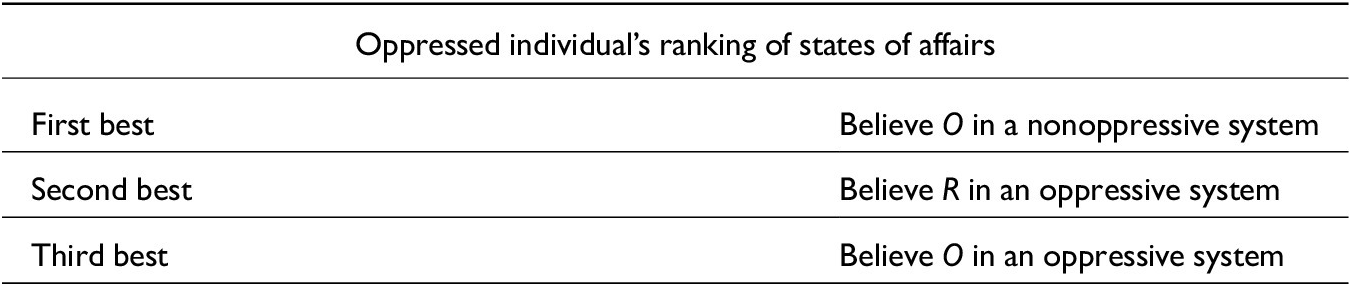
According to demand-side solutions, an oppressed individual is better off believing R than O, holding fixed her oppressive environment. This is because believing R contributes to a positive self-image and/or motivates her to take actions that allow her to succeed given her constraints. The best-case scenario, though, is if the entire system topples. This ranking of states of affairs is displayed in Table 1.
Oppressed Individual’s Ranking of States of Affairs

Suppose that a critical theorist encounters a small group of oppressed individuals; call them G. Everyone in G embraces R. The critical theorist’s goal is to get G to switch to O. What happens if she succeeds? There are two possibilities. Before getting to these two possibilities, though, I will provide some terminology. There is a critical threshold who must believe R for the oppressive system to persist. If the number of persons who believe R drops below this threshold, then the oppressive system collapses. If the number of persons who believe R remains above this threshold, then the system continues.
When the critical theorist convinces G to switch from R to O, this group might be the tipping point who brings the number of R believers below the critical threshold. If this is the case, then the system topples and everyone in G moves from their second-best to their first-best option. It is unlikely for a small group to be a tipping point, however. It is more likely that, when G switches from R to O, the total number of R believers remains above the critical threshold. If this is the case, then the critical theorist has moved G from their second-best to their third-best outcome. Through ideology critique, she has made them worse off, at least from a basic welfarist perspective.Footnote 64
The critical theorist will not stop with G, however. She and other critical theorists will move to the next group. The aim is that enough people eventually switch from R to O to bring society below the critical threshold. If there is reasonable hope that further efforts will succeed, then perhaps the temporary harm to G is justified, for G will greatly benefit when the new system is in place.
In at least some cases, though, reasonable hope will not be found. Changing beliefs is difficult, especially when those who hold the targeted beliefs have incentive to maintain them. As such, the critical theorist’s decision calculus runs as follows. She can change G’s beliefs from R to O. In doing so, she might bring G from their second-best to their first-best option, but she probably brings them from their second-best to their third-best option. If the latter possibility holds, further ideology critique with other groups might compensate G by taking them from their third-best to their first-best option. Further ideology critique might fail, though, leaving G in their worst-case outcome.
Ideology critique, then, entails moral risk. Does this mean there are cases when ideology critique should be avoided? I do not know. Approaching this dilemma with a straightforward expected utility calculus likely implies that ideology critique is morally required in some cases and impermissible in others. This would depend on how bad the oppressive system is, how much worse the oppressed are if they go from believing R to O, the chances of ever falling below the critical threshold, and so on. Expected utility calculus may not be the appropriate way to navigate this moral dilemma, however. I do not know how this dilemma should be resolved. If we embrace a demand-side solution to the origin puzzle, though, then it is a real dilemma that critical theorists must confront.
Acknowledgments
The author would like to thank other contributors to this volume, an anonymous reviewer, and David Schmidtz for their helpful feedback on an earlier version of this essay.
Competing interests
The author declares none.