Introduction
Posttraumatic stress disorder (PTSD) is a psychiatric disorder that is conditionally defined; its symptoms must develop temporally (beginning or worsening after the event) or contextually (recollections/reminders specific to the event) in relation to a qualifying exposure to a traumatic event (criterion A) (Breslau et al., Reference Breslau, Chase and Anthony2002; North et al., Reference North, Surís, Davis and Smith2009; Downs, North, Reference Downs, North and Black2017). Most existing research on PTSD symptom groups has examined the three symptom group categories that were originally established for PTSD in DSM-III and retained, with modifications, in DSM-III-R, DSM-IV, and DSM-IV-TR (North et al., Reference North, Surís, Smith and King2016). In DSM-IV-TR (American Psychiatric Association, 2000), these three symptom groups comprise intrusive re-experience (criterion B), avoidance and numbing (criterion C), and hyperarousal (criterion D). To meet diagnostic criteria, the symptoms must also persist for >1 month (criterion E) and cause clinically significant distress or impairment in social, occupational, or other important areas of functioning (criterion F). The clinically significant distress or functional impairment requirement was added not only to PTSD but also across the psychiatric disorders in DSM-IV to improve differentiation between normality and psychopathology (American Psychiatric Association, 1994).
DSM-5 criteria (American Psychiatric Association, 2013) for PTSD have rearranged the symptom groups, dropping one symptom (foreshortened future, a numbing symptom) and adding three negative cognitions/emotion symptoms and a hyperarousal symptom (reckless/self-destructive behavior) (North et al., Reference North, Surís, Smith and King2016). The old symptom group C was split into a new smaller group C (two symptoms) and a new group D, thus bumping the hyperarousal group up one letter to become criterion E, the duration requirement to criterion F, and the distress/impairment criterion to criterion G. Because most of the DSM-IV PTSD symptom content was preserved (although redistributed across symptom groups) in DSM-5, symptoms provided by the newer criteria can be compared with prior research on the symptom groups and vice versa.
Extensive clinical and epidemiological research conducted on the DSM-IV-TR PTSD symptom groups has consistently found that a lower prevalence of avoidance and numbing (group C) than of intrusive re-experience (group B) and hyperarousal (group D) (Solomon and Canino, Reference Solomon and Canino1990; Norris, Reference Norris1992, Reference Norris, Friedman, Watson, Byrne, Diaz and Kaniasty2002; Ehlers et al., Reference Ehlers, Mayou and Bryant1998; Maes et al., Reference Maes, Delmeire, Schotte, Aleksander, Creten, Mylle, Struyf, Pison and Rousseeuw1998; North et al., Reference North, Nixon, Shariat, Mallonee, McMillen, Spitznagel and Smith1999, Reference North, Oliver and Pandya2012; Schell et al., Reference Schell, Marshall and Jaycox2004). This literature has further established that group C is particularly predictive of PTSD, distinguishing this symptom group as a marker for PTSD and an indicator of the core psychopathology of PTSD, in contrast to groups B and D which represent largely normative trauma responses (Ehlers et al., Reference Ehlers, Mayou and Bryant1998; Maes et al., Reference Maes, Delmeire, Schotte, Aleksander, Creten, Mylle, Struyf, Pison and Rousseeuw1998; North et al., Reference North, Nixon, Shariat, Mallonee, McMillen, Spitznagel and Smith1999, Reference North, Oliver and Pandya2012; McMillen et al., Reference McMillen, North and Smith2000; Breslau, Reference Breslau2001; Breslau et al., Reference Breslau, Lucia and Davis2004, Reference Breslau, Reboussin, Anthony and Storr2005; Schell et al., Reference Schell, Marshall and Jaycox2004; North and Oliver, Reference North and Oliver2013; Whitman et al., Reference Whitman, North, Downs and Spitznagel2013; Downs and North, Reference Downs, North and Black2017). Other research has also found that numbing symptoms appear to be substantially less prevalent than avoidance symptoms and that the numbing symptoms appear to be the component of DSM-IV group C that is most specifically associated with PTSD (Foa et al., Reference Foa, Riggs and Gershuny1995; Feeny et al., Reference Feeny, Zoellner, Fitzgibbons and Foa2000; Carper et al., Reference Carper, Mills, Steenkamp, Nickerson, Salters-Pedneault and Litz2015). Thus, prior research has convincingly established the importance of the role of symptom group C in the diagnosis of PTSD.
No consensus has been established, however about the role of the distress/impairment criterion in PTSD in the nearly a quarter of a century since its addition to the definition of PTSD. In particular, research is needed to examine the distress/impairment criteria specifically in relation to PTSD symptom groups and particularly numbing. This study was conducted to examine these relationships in a large database of disaster survivors consistently studied across 12 different incidents of the full range of disaster typology.
Methods
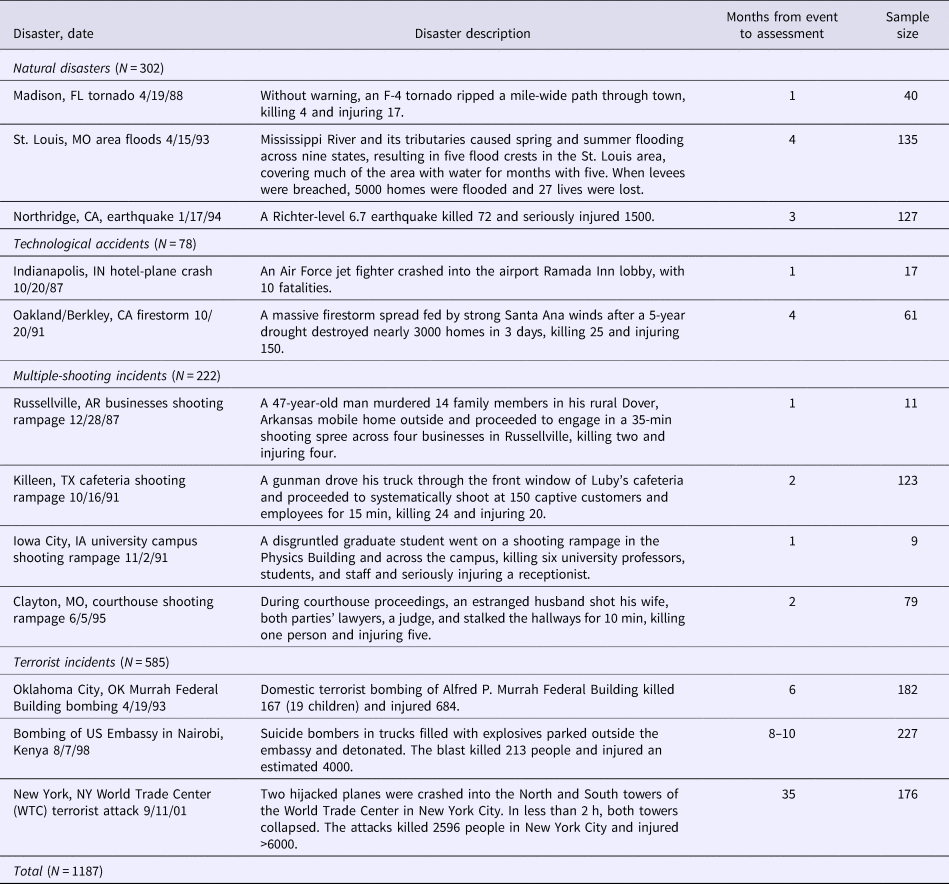
Data collected from 1187 trauma-exposed survivors of 12 different disasters were merged for analysis. See Table 1 for a description of these disasters and the numbers from each. The 12 disasters include three natural disasters (tornado, earthquake, flood), two technological accidents (plane crash, firestorm), four multiple-shooting incidents, two terrorist bombings (Murrah Federal Building in Oklahoma City, OK; US Embassy in Nairobi, Kenya), and the 9/11 terrorist attacks on New York City's World Trade Center (WTC).
Description of disasters by disaster type and survivor samples

Directly-exposed samples from six disasters (plane-hotel crash; tornado; Oklahoma City bombing; and multiple-shooting incidents at a cafeteria, university campus, and local businesses) were systematically collected (77% participation) and interviewed 1–6 months post-disaster. Directly-exposed samples for four disasters (earthquake, courthouse shooting, floods, firestorm) comprised volunteer samples (unknown participation rate) interviewed 2–4 months post-disaster. The directly-exposed sample from the terrorist bombing of the US embassy in Nairobi, Kenya consisted of employees selected systematically from businesses in buildings in the path of the bomb blast (69% participation) interviewed 9 months post-bombing. The trauma-exposed sample from the 9/11 attacks on New York City's World Trade Center comprised a volunteer sample of employees from affected area companies interviewed approximately 35 months post-disaster. Published articles from these studies provide full methodological details (North et al., Reference North, Smith, McCool and Lightcap1989a, Reference North, Smith, McCool and Shea1989b, Reference North, Smith and Spitznagel1994, Reference North, Nixon, Shariat, Mallonee, McMillen, Spitznagel and Smith1999, Reference North, Kawasaki, Spitznagel and Hong2004, Reference North, Pfefferbaum, Narayanan, Thielman, McCoy, Dumont, Kawasaki, Ryosho, Kim and Spitznagel2005, Reference North, Hong, Surís and Spitznagel2008, Reference North, Pollio, Smith, King, Pandya, Surís, Hong, Dean, Wallace, Herman, Conover, Susser and Pfefferbaum2011a, Reference North, Ringwalt, Downs, Derzon and Galvin2011b, Reference North, Oliver and Pandya2012; Smith et al., Reference Smith, North, McCool and Shea1990; McMillen et al., Reference McMillen, North and Smith2000, Reference McMillen, North, Mosley and Smith2002; Johnson et al., Reference Johnson, North and Smith2002; North and King, Reference North, King, Neria, Galea and Norris2009). The rationale for combining data from these 12 disasters is that the disasters were severe, resulting in multiple fatalities, and trauma-exposed survivors all 12 disasters were studied using consistent methodology by one research team.
Institutional Review Board (IRB) approval for these studies was obtained prior to conducting the research. All participants provided written informed consent at the time of enrollment into the research study.
The PTSD module of the Diagnostic Interview Schedule (DIS) (Robins et al., Reference Robins, Helzer, Cottler and Goldring1989, Reference Robins, Cottler, Compton, Bucholz, North and Rourke2000) was administered by professionals who were formally trained on this structured interview. PTSD criterion F (clinically significant distress or functional impairment in DSM-IV) was operationalized by the DIS as any positive on any of the following: told a doctor or other health professional about the symptoms, took medication for the symptoms, or the symptoms resulted in difficulties with family, friends, or work.
Data analysis
The diagnostic algorithm was programed to yield DSM-IV-TR diagnoses for all disaster samples, accommodating the one change in symptom group criteria between DSM-III-R and DSM-IV-TR that involved moving one symptom (physiological reactions to trauma reminders) from group D in DSM-III-R to group B in DSM-IV-TR. The main variables for the analyses in this study are dichotomous variables representing selected components of DSM-IV-TR PTSD symptom criteria: group B (meeting ⩾1 of 5 possible intrusion symptoms), group C (meeting ⩾3 of 7 possible avoidance/numbing symptoms), group D (meeting ⩾2 of 5 possible hyperarousal symptoms), and criterion F (clinically significant distress or functional impairment). Additionally, components of symptom group C were divided into symptom subgroups for avoidance (meeting ⩾1 of 2 possible avoidance symptoms) and numbing (meeting ⩾2 of 5 possible numbing symptoms).
Data analysis was conducted using SAS 9.4 (SAS Institute, Inc., Cary, NC). Descriptive statistics include raw numbers, proportions, means, and standard deviations (SD). Dichotomous variables were compared using two-tailed chi-square tests, substituting Fisher's exact tests for instances of cell sizes <5.
Analysis of a two-tailed binary logistic regression model (PROC LOGISTIC in SAS) was conducted to predict criterion F (dependent variable representing an outcome of interest) from symptom groups (independent variables) entered simultaneously together in the same multivariable model. Demographic variables (sex, age, race, college education, and marital status) were entered simultaneously into all of the models as covariates. The number of fatalities in the disaster was also included as an independent covariate because prior research has shown that it is the scope and magnitude of the disaster rather than the type of disaster that is associated with PTSD (North et al., Reference North, Oliver and Pandya2012). A second model was also tested, substituting avoidance and numbing symptom subgroups for group C. Similar models were examined for the four different types of disasters in subsets of the data. To correct for type-I errors arising from multiple comparisons, statistical significance was set as α < 0.005.
Results
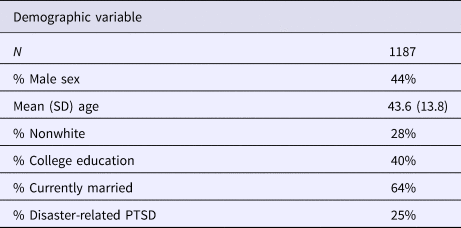
Table 2 provides demographic characteristics for the entire sample and subsets by disaster type. The collective membership of the merged disaster sample (N = 1187) had a slight female preponderance, more than one-fourth were nonwhite, and the median age was 41 years; more than one-third were college-educated and nearly two-thirds were married. One-fourth of the entire sample met criteria for disaster-related PTSD. The number of months elapsed between the disaster and collection of data was not associated with meeting criterion F.
Demographic characteristics of the sample
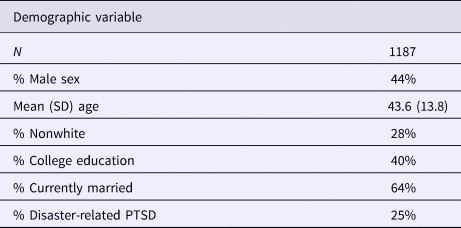
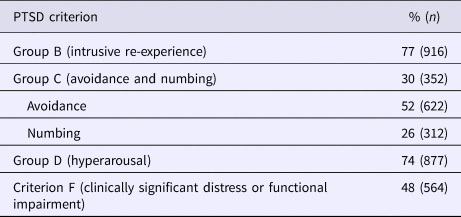
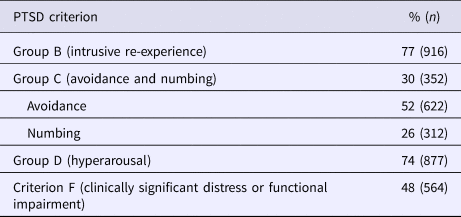
Table 3 lists the prevalence of DSM-IV-TR PTSD criteria. About three-fourths of the entire sample met criteria for groups B and D, but less than one-third met criteria for group C. Criterion C was less prevalent than criterion B (χ2 = 538.99, df = 1, p < 0.001) and criterion D (χ2 = 465.41, df = 1, p < 0.001), but criteria B and D did not differ in prevalence. Nearly one-half had the avoidance and one-fourth had the numbing subgroups. The numbing subgroup was significantly less prevalent than the avoidance group (χ2 = 169.63, df = 1, p < 0.001). Nearly one-half of the sample met criterion F.
DSM-IV-TR PTSD criteria for the entire sample and by disaster type
Bivariate comparisons were made between symptom groups and criterion F, beginning by examining the proportions of those meeting symptom group criteria who also met criterion F. In the entire sample, 58% (532/911) of those meeting symptom group B, 84% (295/351) of those meeting group C, and 61% (537/874) of those meeting group D also met criterion F (not shown in tables). The proportion meeting criterion F was significantly higher for those meeting criterion C than for those meeting group B (χ2 = 73.79, df = 1, p < 0.001) or group D (χ2 = 58.72, df = 1, p < 0.001), but was not significantly different for those meeting group B than group D (χ2 = 1.72, df = 1, p = 0.190). More than one-half (57% and 53% respectively) of those meeting groups B and D in the absence of group C (i.e. largely normative trauma responses) did not meet criterion F. Overall, 84% (283/337) of those meeting criteria for all three symptom groups also met criterion F, and only 5% of the sample (54/1181) met criteria for all three symptom groups without meeting criterion F. Specifically, 84%, (295/351) of those meeting group C also met criterion F, and only 5% of the sample (56/1181) met group C criteria without meeting criterion F. (Of note, 96% (338/352) of those meeting group C criteria met criteria for all three symptom groups.) Thus, the contribution of criterion F to the diagnosis of PTSD was to disqualify 5% of the sample meeting symptom criteria for the diagnosis of PTSD.
Additionally, 64% (394/619) of those meeting the avoidance subgroup and 83% (258/312) of those meeting the numbing subgroup also met criterion F. The proportion meeting criterion F was significantly higher for meeting the numbing subgroup than for meeting the avoidance subgroup (χ2 = 35.84, df = 1, p < 0.001). More than one-half (52%) of those with avoidance in the absence of numbing did not meet criterion F; in contrast, few (17%) of those with numbing did not meet criterion F.
Conversely, those meeting criterion F were also examined for the proportions also meeting symptom group criteria: 50% (281/564) of those meeting criterion F failed to meet all three symptom groups. This relationship was almost identical to the association of group C with criterion F: 48% (269/564) of those who met criterion F failed to meet group C criteria. Among those meeting criterion F, only 6% (32/564) failed to meet group B and 5% (27/564) failed to meet group D.
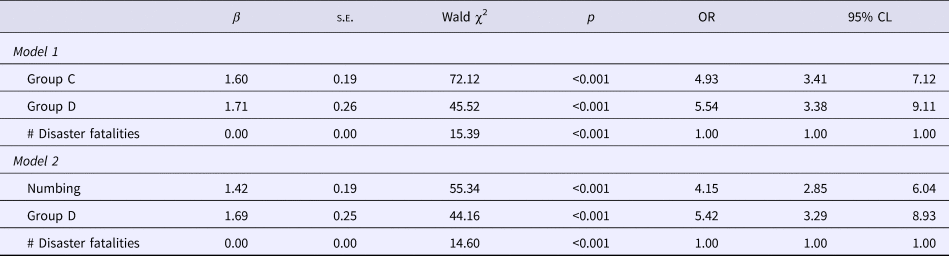
A multivariable model was tested to predict PTSD criterion F (dependent variable) from a list of independent covariates entered simultaneously into the model including PTSD symptom groups B, C, and D, demographic variables (sex, age, race, college education, and married status), and number of fatalities in the disaster. A similar model was tested substituting the avoidance and numbing components of symptom group C for that symptom group, and holding all the other covariates constant. Table 4 lists the findings of the variables with significant associations with criterion F. Demographic variables were not associated with criterion F in these models and are thus not listed in Table 4. In the first model, groups C and D were independently associated with criterion F, but group B was not. Additionally, the number of disaster fatalities was independently associated with criterion F. Specifically, groups C and D had approximately 5–6 times greater likelihood of meeting criterion F. In the second model examining the avoiding and numbing components of group C separately, in addition to group D, numbing was independently associated with criterion F, but avoidance was not. Similarly, the number of disaster fatalities was independently associated with criterion F.
Significant odds ratios in multiple logistic regression models predicting PTSD criterion F from symptom groups and demographic variables
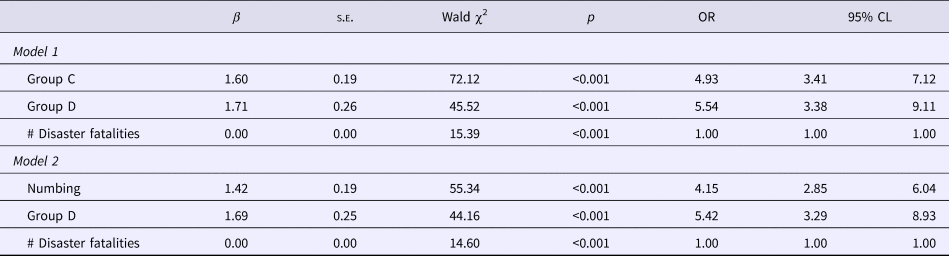
Independent covariates included in these models include individual demographic variables (sex, age, race, college education, and married status) and number of fatalities in the disaster. Only independent variables significantly associated with the dependent variable in the models are listed. Statistical significance was set as α < 0.005 for results in this table.
These models were further examined specifically for the subsets of data pertaining to natural disasters, technological accidents, multiple-shooting incidents, and terrorist incidents (detailed findings are available in an online Supplementary Table). The findings for natural disasters, as for the entire sample, found both groups C and D as well as numbing to be significantly associated with criterion F, but the models for the technological accidents yielded no significant associations with criterion F. The models for the multiple-shooting and terrorist incidents yielded findings similar to the models for the full sample with the exception that group D was not associated with criterion F.
Discussion
This study examined the association of DSM-IV PTSD symptom groups with clinically significant distress or functional impairment (DSM-IV criterion F) in a large survivor sample across 12 different disasters, with a focus on the respective association of symptom group C (and especially its numbing component) with distress and impairment. Group C prevalence was low compared to groups B and D prevalence, and the association with distress and impairment was more robust for group C than for group D and not present for group B. Numbing prevalence was lower than avoidance prevalence, and the association of numbing with distress and impairment was more robust for numbing than for avoidance. Thus, group C – and particularly numbing – was less common and more associated with distress and impairment compared to the other symptom groups.
In this study, the overwhelming majority of disaster survivors who met group C also met distress and impairment criteria, but only half of those who met distress/impairment criteria also met group C. Therefore, group C identified most of those determined to have psychopathology by distress/impairment criteria, but this criterion did not identify half of those with group C (which is an established marker for psychopathology and is required for the diagnosis of PTSD). Additionally, more than half of survivors meeting criteria for groups B and D in the absence of group C and more than half of those with avoidance in the absence of numbing did not meet distress/impairment criteria, but few of their counterparts (those with group C or numbing) did not meet distress/impairment criteria. This suggests that the symptoms of more than half of those who met groups B and D alone or who met avoidance without numbing may represent normative, highly prevalent, emotional responses to trauma exposure. Conversely, it also suggests that group C (and particularly numbing) is almost always pathological as determined by the distress/impairment criterion.
In the multivariable models, group C and the numbing component specifically were strongly associated with distress/impairment. Group D was also associated with distress/impairment but the relationship was not as strong as for group C, and group D's relationship with distress/impairment was not present in the multiple-shooting and terrorist incidents. Several other studies have examined the association of the two components of the distress/impairment criterion with PTSD symptom groups. Two studies examined the association of subjective distress and PTSD symptom groups. A study of disaster workers using the Clinician-Administered PTSD Scale (CAPS) for DSM-5 (CAPS-5) found that subjective distress was associated with PTSD groups B and C but not with group D (Hunnicutt-Ferguson et al., Reference Hunnicutt-Ferguson, Wyka, Peskin, Cukor, Olden and Difede2018). A study of combat veterans using the CAPS for DSM-IV (CAPS-IV) found that subjective distress was associated with both groups C and D but not with group B (Shea et al., Reference Shea, Vujanovic, Mansfield, Sevin and Liu2010). Thus, even though these studies differed on the associations of groups B and D with subjective distress, they both agreed that group C was significantly associated with subjective distress.
Six studies have examined the association between functional impairment and PTSD symptom groups. The above-mentioned disaster worker study found that functional impairment was associated with groups B, C, and D (Hunnicutt-Ferguson et al., Reference Hunnicutt-Ferguson, Wyka, Peskin, Cukor, Olden and Difede2018), but the above-mentioned combat veterans study found that functional impairment was associated only with groups C and D (Shea et al., Reference Shea, Vujanovic, Mansfield, Sevin and Liu2010). A study of tobacco-dependent veterans with chronic PTSD (Harder et al., Reference Harder, Chen, Baker, Chow, McFall, Saxon and Smith2011) and a study of women with PTSD associated with childhood/adult physical/sexual assault (Shnaider et al., Reference Shnaider, Vorstenbosch, Macdonald, Wells, Monson and Resick2014), both using the CAPS-IV, found functional impairment to be associated with both numbing and group D. A study of motor vehicle accident survivors using the CAPS-III-R found functional impairment to be associated with numbing, avoidance, and groups B and D, but the only consistent association was with the numbing subgroup (Kuhn et al., Reference Kuhn, Blanchard and Hickling2003). Finally, a study of Kosovo peacekeepers using the PTSD Checklist for DSM-IV found that functional impairment was somewhat associated with avoidance and strongly associated with arousal (Maguen et al., Reference Maguen, Stalnaker, McCaslin and Litz2009). Therefore, although many of these studies found functional impairment to be associated with all three symptom groups and with both numbing and avoidance components of group C, the most consistent and strongest associations were with group C and especially with the numbing component, with group D less consistently associated.
Although the current study did not separate the distress and impairment components of DSM-IV criterion F in its analyses, the findings that group C and particularly the numbing component were most strongly associated with criterion F agrees with the findings of other studies that group C and particularly the numbing component were most consistently associated with both distress and impaired functioning. The current study's finding that group D was also somewhat associated with criterion F is consistent with findings in other studies that group D had additional associations with distress and functional impairment.
Thus, the findings from the current study and from other literature summarized above that group C and the numbing component specifically are central to the distress/impairment criterion in PTSD are also consistent with the understanding of group C and the numbing component specifically as central to the psychopathology of PTSD described in the literature (Foa et al., Reference Foa, Riggs and Gershuny1995; Feeny et al., Reference Feeny, Zoellner, Fitzgibbons and Foa2000; Carper et al., Reference Carper, Mills, Steenkamp, Nickerson, Salters-Pedneault and Litz2015). Analysis of this large disaster survivor database further found that the addition of the distress/impairment requirement broadly across the psychiatric diagnoses in DSM-IV added little value to PTSD criteria. The analysis demonstrated that the role of the distress/impairment criterion in the final diagnosis of PTSD was relatively small because it limited the diagnosis beyond the symptom criteria by only 16% of those meeting the symptoms criteria or 5% of the entire sample. Because the ability of group C to differentiate the psychopathology of PTSD from normative response has already been well established and meeting group C criteria was virtually synonymous with meeting all symptom group criteria, it can be inferred that the distress/impairment criterion added little to enhance the ability of group C to differentiate PTSD psychopathology from normative responses.
Additionally, the finding in this study and in the extant literature that group D appears to have variable associations with distress and functional impairment independent of effects of the other symptom groups suggests that hyperarousal symptoms may sometimes have clinical implications even in the absence of PTSD. This is important because hyperarousal symptoms are very common, occurring in more people without than with PTSD. The distress and impairment associated with hyperarousal may warrant interventions outside of formal PTSD treatment, such as psychological first aid and social and emotional support.
A strength of this study was the large sample of 1187 disaster survivors from 12 different disasters studied with consistent methods that allowed merging of data from different disasters of all types and across many geographic locations. Additional strengths were the structured diagnostic interviews and careful determination of disaster trauma exposure, with all survivors having disaster trauma exposures and most having direct exposures. Importantly, because the entire sample had PTSD criterion A disaster trauma exposures, collection of PTSD symptom data was appropriately limited to those with qualifying exposures in this study.
Despite its important strengths, this study also had several noteworthy limitations. The data were collected before the publication of DSM-5 criteria, and thus the analysis was limited to DSM-IV-TR criteria, and the new DSM-5 PTSD criterion D could not be fully examined beyond the symptoms common to DSM-IV criteria. Additionally, the distress and impairment components of criterion F were not separated in the database for this study and therefore could not be examined separately. More fundamentally, the operationalization of ‘clinically significant distress or functional impairment,’ despite the specific language provided by the DIS, has long represented an incompletely resolved issue in the assessment of psychiatric disorders (Frances, Reference Frances1998; Beals et al., Reference Beals, Novins, Spicer, Orton, Mitchell, Baron, Manson, Big Crow, Buchwald, Chambers, Christensen, Dillard, DuBray, Espinoza, Flemming, Frederick, Gurley, Jervis, Jim, Kaufman, Keane, Klein, Lee, McNutly, Middlebrook, Moore, Nez, Norton, Randall, Sam, Shore, Simpson and Yazzie2004). Disaster-specific differences in time elapsed from the date of the disaster to assessment varied up to 35 months, but for most of the disasters the data were collected within 6 months. Because disaster-related PTSD prevalence was the focus of the study, the variability of time to assessment is of less concern than if current PTSD or PTSD remission had been the focus, as previous work with these datasets has determined that delayed-onset PTSD is uncommon after disasters (North et al., Reference North, Pollio, Smith, King, Pandya, Surís, Hong, Dean, Wallace, Herman, Conover, Susser and Pfefferbaum2011a; North and Oliver, Reference North and Oliver2013).
These findings have practical implications for revisions of the major diagnostic criteria. PTSD criteria in the proposed 11th edition of the International Classification of Diseases (ICD-11) (World Health Organization, 2018) have been streamlined to remove nonspecific symptoms comorbid to other disorders, in efforts to improve discriminant validity and reduce diagnostic overlap (Friedman, Reference Friedman2013; Brewin et al., Reference Brewin, Cloitre, Hyland, Shevlin, Maercker, Bryant, Humayun, Jones, Kagee, Rousseau, Somasundaram, Suzuki, Wessely, van and Reed2017). As a result, all the numbing symptoms have been removed from the proposed ICD-11 PTSD criteria. Because the findings from this and other studies have demonstrated numbing symptoms to be core indicators of PTSD psychopathology as well as the strongest predictors of distress and impairment, their removal may exclude the symptoms most critical to the psychopathology of PTSD (Mitchell et al., Reference Mitchell, Wolf, Bovin, Lee, Green, Rosen, Keane and Marx2017). The division of the former DSM-IV-TR group C (avoidance/numbing) into two new symptom groups for the DSM-5 revision of PTSD criteria generated an avoidance group (consisting of the two DSM-IV-TR avoidance symptoms) and an altered cognitions and mood group (consisting of seven symptoms, including four of the five DSM-IV-TR numbing symptoms) (North et al., Reference North, Surís, Smith and King2016). Because this and other studies have not consistently found avoidance specifically to be associated with either the psychopathology of PTSD or the distress/impairment criterion, the two-symptom DSM-5 avoidance criterion has questionable utility. Because data from this and other studies have demonstrated that numbing symptoms are pivotal both to the diagnosis and to associated distress and impairment that are central to processes such as disability determination, future revisions of both sets of criteria may benefit by revisiting these findings to possibly re-include a prominent numbing symptom section.
Supplementary material
The supplementary material for this article can be found at https://doi.org/10.1017/S0033291719001569
Author ORCIDs
Carol S. North, 0000-0001-6032-5323
Financial support
This work was funded by NIH R01 grant # MH40025 and by Metrocare Services.
Ethical standards
The authors assert that all procedures contributing to this work comply with the ethical standards of the relevant national and institutional committees on human experimentation and with the Helsinki Declaration of 1975, as revised in 2008. The authors assert that all procedures contributing to this work comply with the ethical standards of the relevant national and institutional guides on the care and use of laboratory animals.