1 INTRODUCTION
For many years I was a part of the performance group Verdensteatret, whose trademark is large-scale performances and installations, dense with information. Speech, movement, video, lights, sound and music, all with simultaneous full ranges of expression – fast to slow, loud to soft, bright to dark and so forth. More than once, the amount of information was overwhelming, and anyone attending would have to make choices of where to focus and what to follow. I recall sitting in rehearsal for the work Louder (Verdensteatret Reference Verdensteatret2007) thinking:
Isn’t that sound finishing off Marius’ movement? They are both coming to a halt after finishing a similar arch through the room. And the sound continues ten seconds after Marius has stopped. They start together but finish separately. A connection appears as they separate. The connection is clear for the ten seconds from when Marius finished, and the sound finishes in a similar manner. Nothing more happens to either of the two elements, and their initial connection remains strong since they started out as if in unison.
I imagine that what I saw in the rehearsal for Louder was a glimpse, a very short glimpse of a connection between movement and sound. Not appearing in parallel as in dance and music, rather as adhering to a common structure of time and intensity, a structure that lies beyond any single medium. I didn’t realise this at the time, it is only now that I can put words to it. After all, ‘things are indications before they become phenomena’ (Bachelard Reference Bachelard1958: 176). The light of memory is a blend of the initial experience and our imagination.
The work discussed in this article has come about through an artistic research project, Organised Time. The project was organised as part of the Norwegian artistic research programme and hosted by the Norwegian Academy of Music. Artistic research underlines the importance of the artist and places her practice at the centre. It emphasises the subjective perspective in artistic work and the reflections on it, and the presence of a subjective perspective is also clear in this text. My practice is such that I write music, or build and program mechanical instruments in a workshop where trial and error is a method, and my intuition, taste and experience is the yardstick. However, by way of intersubjectivity, understood as ‘the sharing of experiential content (e.g., feelings, perceptions, thoughts, and linguistic meanings) among a plurality of subjects’ (Zlatev, Racine, Sinha and Ikonen Reference Zlatev, Racine, Sinha and Itkonen2008), I aim for validity beyond my workshop.
My perspectives are that while development within a field indicates research, artistic research aims to structure, articulate and reflect on this research whilst making art: ‘Artistic research is research where the artist makes the difference’ (Borgdorff Reference Borgdorff2012: 50).Footnote 1
To the best of my knowledge, no one has previously described bit by bit the common ways in which sound, light and movement jointly can express time and intensity, and on this basis proposed a strategy for composing trans media. In Organised Time I developed a strategy for transmedial composition. In this article, a description of these compositional coincidences is my contribution to the art of composition – and perhaps also to music.
2 THEORY AND TERMINOLOGY
Top hits in a quick web search for the word ‘transmedia’ describe and discuss transmedia storytelling. This type of storytelling is a recent practice where concepts such as Disney’s fantasy world Sofia the first is presented through movies, colouring books, Lego kits, dolls, games and so forth. Transmedia storytelling is ‘the technique of telling a single story or story experience across multiple platforms and formats’Footnote 2 (Wikipedia Reference Wikipedia2018). ‘Practitioners conceive and design a fictional world to be expressed across distinct media and environments’ (Dena Reference Dena2009: i). A concept is constructed for suitability as transmedial expression, where each medium is deliberately used in whichever way it is thought best. In contrast to this practice we find Kittler and his view of different media and translation between these. Kittler believes that there can never be a perfect translation between media. Indeed, ‘every transposition is to a degree arbitrary, a manipulation’ (Kittler Reference Kittler1986: 265).
A medium is a medium is a medium. Therefore it cannot be translated. To transfer messages from one medium to another always involves reshaping them to conform to new standards and materials. (Kittler Reference Kittler1986: 265)
I was introduced to the term ‘transmedial’ composition by Professor Ivar Frounberg, who at the time directed the research area on transmedial and intermedial artistic research projects at the Arne Nordheim Centre at the Norwegian Academy of Music. Frounberg looked at the practices of mixed media and made a distinction between intermedial and transmedial. He thought of intermedial as the situation in a ballet, where two or more complete specific structures work in parallel. One could remove the music and the choreography would still stand on its own. One could also remove the choreography and the music would still stand on its own. Transmedial was a situation where the media were connected in a common structure beyond any single medium.
This perspective is similar to that of theoretical physicist Basarab Nicolescu in his texts on transdisciplinarity: ‘transdisciplinarity concerns that which is at once between the disciplines, across the different disciplines, and beyond all disciplines’ (Nicolescu Reference Nicolescu2002: 44).
I find that in the arts, disciplines and media often follow the same lines; certainly musical composition and sound seem to do so. In The Order of Things (Foucault Reference Foucault1966), Michel Foucault describes how our underlying ontology, and consequently what is acceptable in a discourse, changes throughout history. This informed my ideas on how artform, medium and technique can be disassembled and combined on different levels. The deconstruction of music, sound and composition is fundamental for research into transmedial composition, and how components combine.
So, in adapting of Nicolescu’s point one might understand a transmedial structure as that which is between the media, across different media, and beyond all media.
Thus, in the Latin prefix trans, understood as across, beyond and through, an idea of a new kind of structure that exists beyond any specific medium is embedded.
The media I speak of are sound, light and movement, and my idea of transmedial composition is a structure from which you cannot extract a set of sounds, movements or lights without weakening the structure itself so that it can no longer stand on its own.
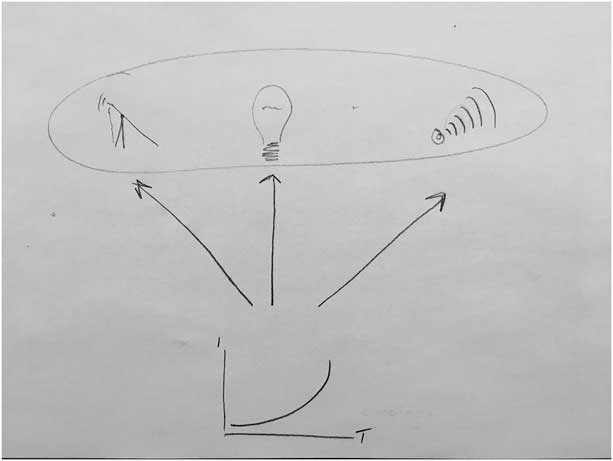
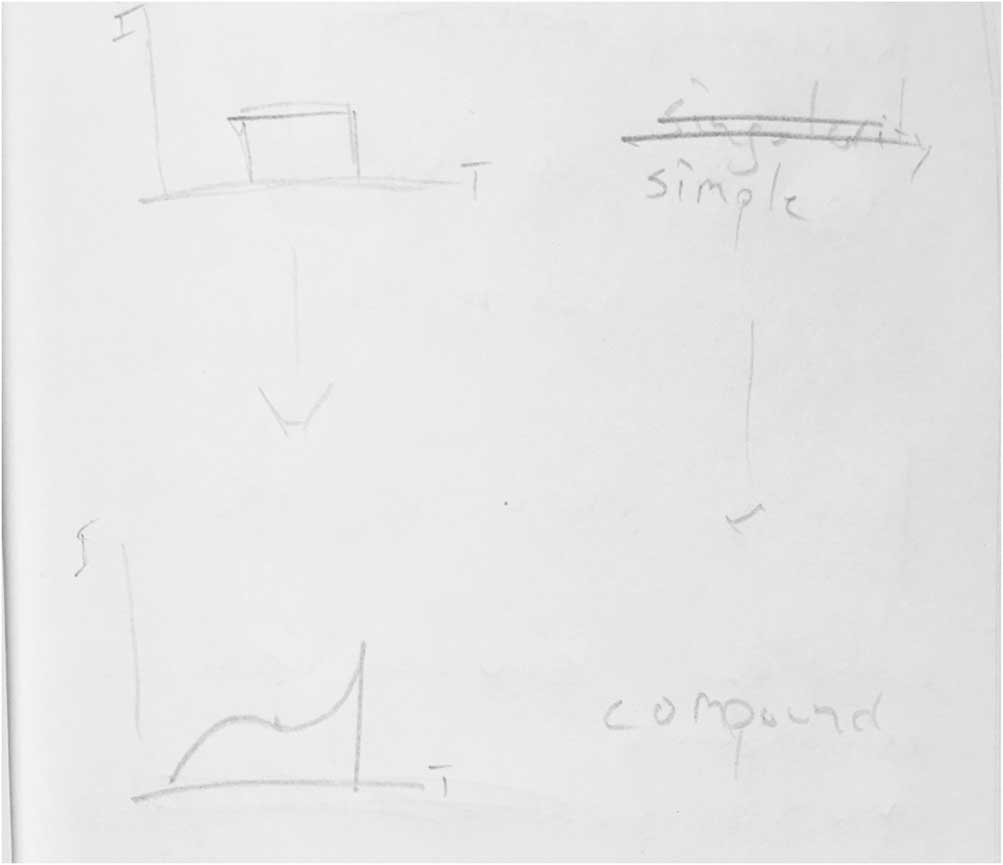
Figure 1 illustrates two ways in which transmediality is understood in this text. At the bottom is an envelope of time and intensity, something is moving from slow and low to fast and high. When this drawing is translated into sound, movement or light this is an instance of transmediality understood as a translation from one medium to another. Paper and lead is translated into light. The other way to read transmediality out of this drawing is as transmedial composition, to compose across media. At the top of Figure 1 is a drawing of a stick, a light bulb and a sound source. A focus for this project has been to compose with these as elements in a common structure, as in a musical piece, but with sound, light and movement instead of only sound; a transmedial composition. The two ways of transmedia are entangled. During the progressing of the project, it was discovered that a seeming prerequisite for transmedial composition is adequate similarity between the media, and that this can be obtained through attempted translation. The understanding of transmediality that is operative at this level in my project does not require a perfect translation; it requires a translation that maintains an adequate amount of similarity and a concept that can utilise the necessary manipulation that is involved when it is realised across a fan of media.
Two ways of transmediality.

2.1 Time
Merriam-Webster offers this description of subjective time:
Time that is subjectively experienced; specifically: the subjective feeling of duration with its absolute give present — called also experiential time, private time — contrasted with objective time.Footnote 3
This type of time is recognised by gradual change, available to our senses and our memory. It is flexible and slows down if one watches a bird in flight from a distance, and it speeds up if one sits between the feathers on its back. It is relative to our senses, our perspective, our position in space and the speed with which we move through space. Yet it is the common element that structures movement and is structured by movement, sound and light. This time is the common denominator for organising movement, sound and light.
Daniel Kahneman describes the apparent relation that can be experienced between degrees of intensities in sound, movement and light as ‘mental association’ (Kahneman Reference Kahneman2011). He points to David Hume who described three principles for sorting the world around us: similarity, proximity in time and space, and causality. From this, I draw that the connection between sound and movement is an association that is made because they can be similar. Movement, light and sound can express time and intensity in a similar manner and can therefore share a structure of time and intensity.
3 STRATEGY FOR TRANSMEDIAL COMPOSITION
3.1 Basic structures of time and intensity
The strategy for transmedial composition was developed through a series of works. The process started with a hunch, described as the experience from in the rehearsal with Verdensteatret. The first work, an installation called The Singer (Movie example 1), turned out to be much too elaborate. Full of nooks and creeks it drew attention to what it was rather than what it was doing. The two latest works, Stick, String and Light (Movie example 2) and Composition for Light, Movement and Sound (Movie example 3) are more precise examples. The referred video-material is an important aid in further reading, as the strategy for transmedial composition was developed alongside and inside the processes through which the works came into being.
In the process of observing and researching what sound the movement of an arm and the flash of a light have in common, I noticed the ability of a medium to unfold content in time and how time was shaped through varying degrees of intensity. This was not specific to a single medium; it was a shared characteristic, and basic structures of time and intensity became apparent. A basic structure of time and intensity can be realised with similar precision by using light, sound and movement, and I have divided the basic structures of time and intensity in to two groups: simple and compound.
3.2 Simple
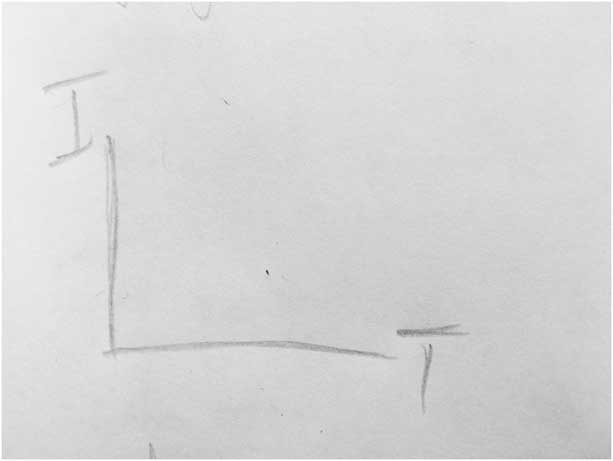
At first there is nothing (Figure 2).
Time (T) along the x-axis and intensity (I) on the y-axis. No data is shown.

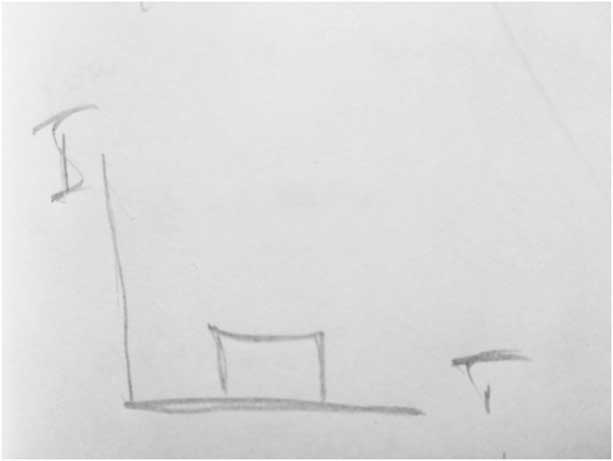
Then there is something (Figure 3).
Something.

The difference between nothing and something is a presence of something. The little square in Figure 3 is something. This something has a duration in time and a degree of intensity. In this case more is understood as having a higher intensity and less as having a lower intensity.
Through the intensity of something, something has a form. I refer to this form as its envelope.
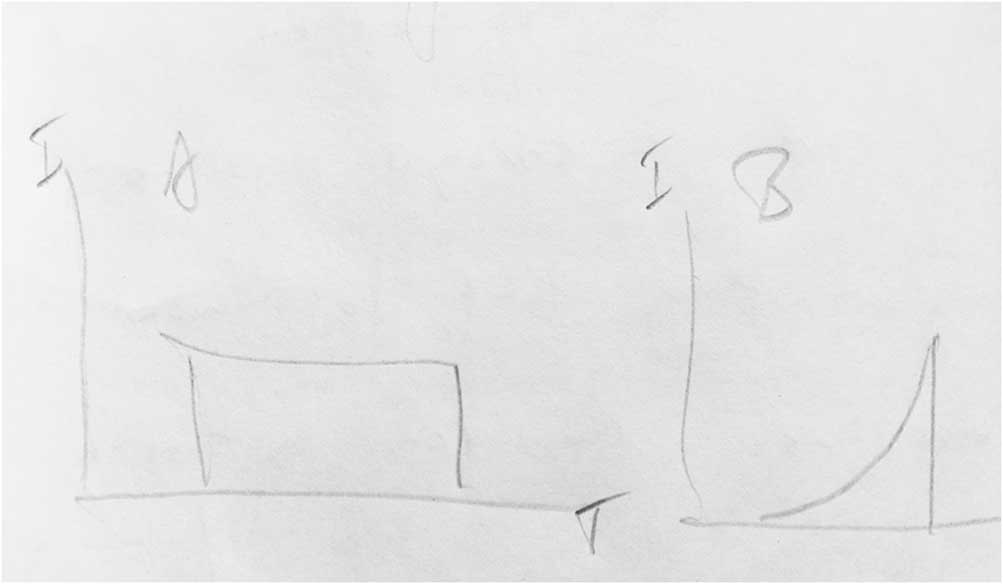
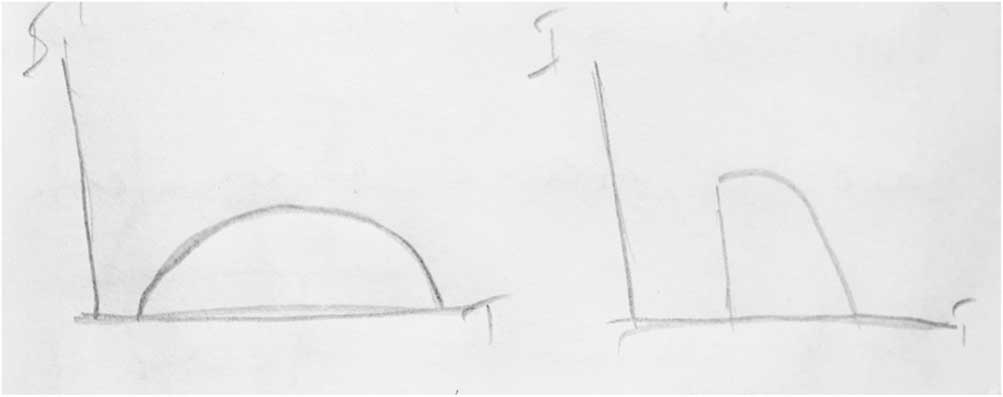
On the left side of Figure 4 the intensity is evenly distributed throughout the duration of something. On the left side the intensity increases from a very low level until it suddenly drops to nothing again.
Simple basic structures of time and intensity.

To the left in Figure 5 is shown a gradual rise and fall of intensity, equally applicable to light and movement. These somethings with their envelopes are what I call simple basic structures of time and intensity, and they can equally well be performed using light, sound or movement. These are building blocks for a transmedial composition.
Light, sound or movement shaped in time by varying degrees of intensity.

3.3 Compound
The next level of basic structures is the compound. As seen at the bottom of Figure 6, this shape has a more composite character than the simple structure. The compound indicates the simple structure and then something is added. The shape is somewhat more than simple, yet not complex.
Simple and compound structures of time and intensity.

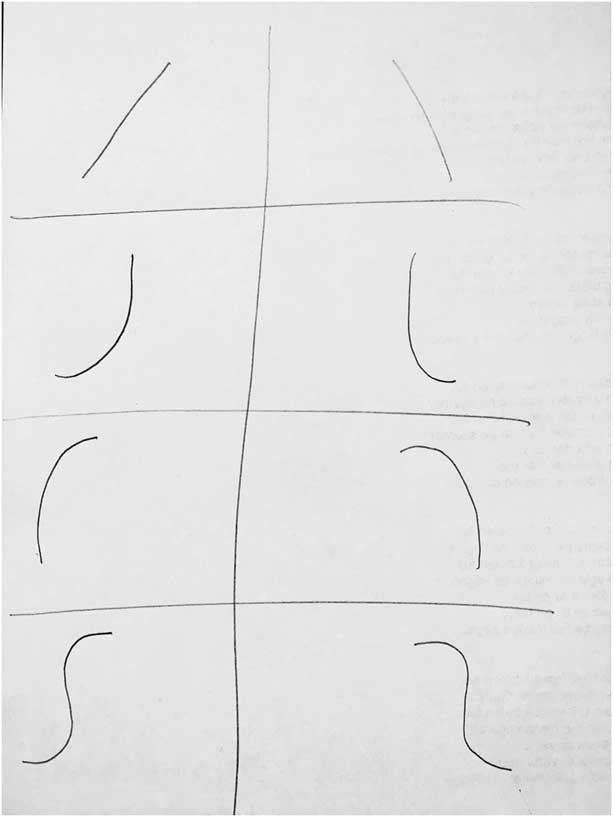
Figure 7 displays examples of basic structures that have been used in this research; three simple shapes on the left and their counterparts on the right. The pair at the bottom can be considered as compounds. The project was developed as variations of time and intensity according to these basic structures. A combination of these basic structures of time and intensity forms a composition, and to perform the composition, one needs to choose media and translate the forms to them. A translation to sound yields a sonic composition, a ‘musical work’. A translation to movement will yield a composition of movements, or ‘dance’. A translation to light yields a type of light show that doesn’t necessarily have a name yet, since lights aren’t commonly used as instruments in this fashion, although they could be. A translation of the composition to a combination of light, movement and sound yields a composition that I want to name transmedial composition.
Adhering to simple or compound basic structures helps media resemble each other. This strengthens the fabric of the transmedial composition.

3.4 Single or blended basic structures
Translation of basic structures to other media can be executed in single or blended fashion.
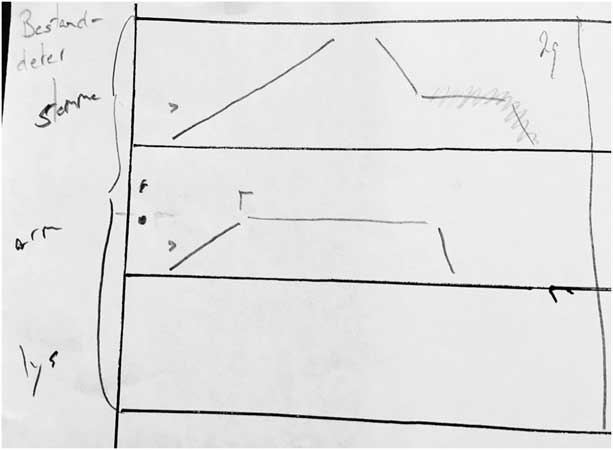
This basic structure has been translated to several media in a blended fashion. Figure 8 displays the line for my voice at the top and the line for my arm in the middle, exemplifying a blended way of performing two simple basic structures. A straight increase in intensity is started in unison, and half way up the arm stops and the voice continues. The voice continues on to diminish in intensity alone, until half way down there is a slight overlap with the arm, from where the arm finishes off the movement alone. The voice and the arm blend as they perform a simple basic structure. A combination of basic structures translated to a combination of single or blended media in a single work is a transmedial composition.
Detail from the score of Composition for light, movement and sound (2016).

3.5 Good building blocks
In order for basic structures to connect more easily in a transmedial composition, it is beneficial if the bits and pieces appear incomplete. At 4:17 of Composition for Light, Movement and Sound (Movie example 3), a single, seemingly unfinished sound connects well with the gesture. In the same piece from 5:47 to 6:40 one can see how the more complete compound and simple, single medium instances connect with less ease than simple structures with a blended output. Compound structures may more easily appear as complete and meaningful in themselves. It is also good if the objects or movements have weak emblematic qualities. If they are strongly associated to conditions external to the work, these associations might be strong enough to cause the work to fall apart.
3.6 Light, sound and movement
Light, sound and movement are different, and to connect them in a composition entails understanding their differences in order to correlate them along lines of similarity. Music can be understood ‘as a heavily semanticized cultural art’ (Ernst Reference Ernst2016: 24), and it is difficult to approach harmony and melody for fear that they might tear sound away from the movement and the light.
If I had used a guitar or a violin, their sound and appearance would have recalled their history, repertoire and cultural status. In order to avoid this, strangeness was used as a vehicle. The string instrument in Stick, String and Light is new to the world, only vaguely associated with hundreds of years of music. Glissandi were used, with the tone gliding from one point to another in a continuum rather than stepping through a scale of some sort. Scales have repertoire and historic eras, and belong in specific geographical areas, and glissandi have less of this. The amplitude was set fairly low in order to avoid reflections off surfaces in the room, thus mediating the space itself. In this research, I wanted focus on the source itself and not the qualities of the venues.
Electric light in the form of a light bulb is simpler to work with than sound, as it does not have a repertoire and is quite efficient for mediating envelopes of time and intensity. I have differentiated between direct and indirect light, where indirect light draws the room or shows an object through reflections or shadows. Direct light works with the other instruments, and facilitates a focus on the bulb itself rather than how light is reflected.
Light and sound share a quality in that they can vanish or appear at any intensity. They are flexible tools for composition, while an arm is always present and has to move from any current position. Sound and light as more similar and flexible, movement is somehow the weaker component, and as a result it is easier to make the light and sound imitate the arm than the other way around. The stick in Stick, String and Light, with a nitinol wire needing to cool down, takes a long time to come down, thus dictating a slow tempo. The nitinol wire is a technology that dictates my composition.
Size and magnitude are also important factors for all three elements; the size of the string instrument and its amplitude, and the size of the lamp and its brightness. The balance in the studio, however, does not necessarily function well in performance, as the balance between the media further entails a balance between media, room and spectator.
3.7 Connecting the elements
Close proximity creates a type of coherence in itself, and when the light, movement and sound instruments are placed close to one another, they influence the perception of each other, seemingly building a connection between them. Connections vary in strength. Two tones played seemingly simultaneously have a very strong connection; they appear as one. The stick moving and the string played in the work Stick, String and Light is a weaker connection. If performed simultaneously their connection is obvious, however, while they mimic each other, they are not one. If performed with a distance in time and space their perceived connection is rapidly weakened. If only a tone and a movement occur, they are easily connected, but if there is a series of movements and a series of sounds, the sounds seem to connect more easy with other sounds and movements connect more easy with other movements, and the transmedial aspect becomes less significant. So in order for a transmedial composition to be realised, the sounds, movements and lights must be forced to connect with each other. Sound must be isolated from sound but open towards movement and light. Light must be isolated from light, but open towards movement and sound. The insulation is slow tempo and placement in the sequence.
3.8 Summary of the strategy for transmedial composition
For transmedial composition to work, the media should resemble each other by adhering to a common set of basic structures. When simple or compound basic structures of time and intensity are realised in light, sound or movement, their combination of single or blended media in a single work constitutes the transmedial composition.
4 IS IT MUSIC?
An earlier work of mine, al Khowarizmis Mekaniske Orkester (Movie example 4) served as musician and composer on the record Bring Me That Horizon (Sound examples 1–5), it was presented as kinetic art in London during the 2012 Kinetica Art Fair,Footnote 4 and in other instances it has appeared as installation, sound-art or music machine. The descriptions are determined by the context, and not the work. As an artist who started out as a classical guitarist, moved into composition and now find myself at this point, I experience only a continuum; if a line has been crossed, I did not see it. On more than one occasion I have been asked: is it music? This always leads to the question: what is music? There might not be only one answer to these questions, and it might be counterproductive to make the distinctions too tight and too rigid. Still, it is interesting to oversee the connections between an ever-shifting terrain and its map.
The idea of what constitutes music has changed radically over the last hundred years. Music has moved from being a sonic object described in terms of rhythm, melody and harmony, to being what we listen to with the intention of hearing music. This observation is credited to Luciano Berio (Berio, Dalmonte and Varga Reference Berio, Dalmonte and Varga1985: 19). This attitude towards the act of listening, underlining subjectivity, might as well have been attributed to Max Neuhaus; it is an immanent reflection in his series of works from the 1960s and 1970s, Listen (Cooke Reference Cooke2009: 29). Studies on the history of modern music often bring forth Edgard Varèse’s definition of music as organised sound, and the project title recognises the value of Varèse’s definition. It was a radical definition in itself in the early twentieth century. He in turn was inspired by the nineteenth-century philosopher Jósef Maria Hoene-Wronski, who spoke of music as being the ‘corporealization of the intelligence that is in sounds’ (Oulette Reference Oulette1968: 17). Wronski seemingly presupposes intelligence to be information, and music then becomes ‘the corporealization of the information that sound contains’.
Wronski’s understanding of music emphasises the subject and its interpretation as constitutional. Wronski further includes any kind of emblematic or conceptual reading of a sonic matter since this is also available information in sound. Varèse used the word ‘organised’ and focused his attention on the sounds and their internal organisation. Varèse’s definition has had a significant influence, and today Organised Sound is a journal, a festival and an often-repeated definition of music.
A key change that has happened during the twentieth century is the supplementing of objectivity with subjectivity and inter-subjectivity. In music, John Cage’s ideas from the 1940s and 1950s of ‘music being in all sounds and all sounds can be in music’ (Licht Reference Licht2007: 12) is a line of great iconoclasm and a levelling of hierarchies. Any sonic matter can be music, and it is the act of listening that constitutes the music.
4.1 Music, technology, the sonic and a universal alphabet
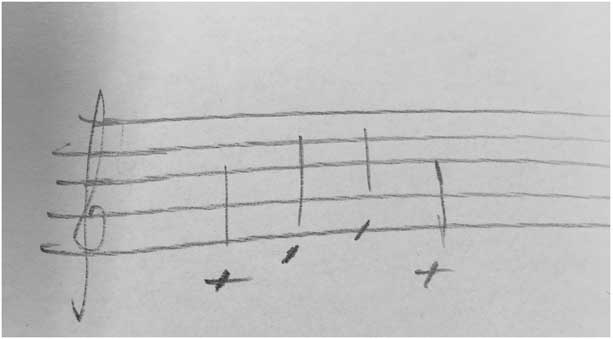
Both organised sound and what we listen to with intention of hearing assume that music is sonic. However, technology also points in a different direction. It is speculated that the technology of musical notation is as old as 4,000 years. An example of a cuneiform writing on a clay tablet was discovered in Syria in 1950. It contained a hymn to Nikal, the moon god, and instructions for performing it (Stolba Reference Stolba1990: 5). With the introduction of musical notation music evolved and developed its silent side (Figure 9).
Musical notation.

Notation allows what Ernst calls structural listening by reading scores (Ernst Reference Ernst2016: 24). With this technology music has been able to evolve into advanced harmony, melody and form, and the four-movement symphony is unthinkable without the aid of notation. Notation has allowed composers to get the necessary overview for composing, by combining a reproducible memory with the performance instructions needed for synchronisation, much the same as the electronic technological development over the last 70 years or so has resulted in digital tools that have facilitated new ways of writing, imagining and programming music.
The importance of the Greek alphabet for Kittler is that a single signifying system was used to denote letters, number and musical notes. (Sale Reference Sale2015: 60)
The European Middle Ages demolished this trinity of writing, tone and number for good – or so it seemed. It was not until the days of Alan Turing and John von Neumann that we once again had universal alphabets. (Kittler Reference Kittler2006: 57)
There is a link between what music is and how it is notated and the technology we use to compose it with. Through computers music is attached to a universal alphabet, music shares a language in the computers with video. The editing tools have almost identical traits. If I attach a micro controller, I find that music shares a language with transistors that control the flow of electricity. In the extension of this, music shares a language with electrical motors and lights. This indicates that through digital media, music is stretching to connect in a manner similar to that of music in antiquity, threatening the exclusive link between music and sound. In this perspective, an inclusive approach to music is indicative of the link between antiquity and present time. The link being the presence of a universal alphabet. As a consequence, a composer’s transmedial practice is close to the understanding of music in antiquity when music was associated with melody, words, and rhythm including dancing (Stolba Reference Stolba1990: 10).
4.2 Sound art
Historically, the term ‘music’ is a flexible one. In recent history, what can be considered as musical material has been the object of intense questioning. In 1913, Luigi Russolo wrote The Art of Noises, and Russolo and his brother Antonio developed acoustic noise generators that they called intonarumori. Russolo and the futurist movement are often recognised as being the first to introduce noise into music, however, a closer scrutiny has shown how ‘the machine’s noises always have been an inherent part of any piece of musical technology’ (Riis Reference Riis2012: 24). Thus, a more precise description is that noise has moved from merely being a resulting aspect of music technology towards the centre of attention. Also composer Edgard Varèse conceived of ‘liberating music from the tempered system, from the limitations of musical instruments and from years of bad habits, erroneously called tradition’ (Oulette Reference Oulette1968: 18). His inclusion of sirens in the work Amériques (1921) and 13 percussionists in Ionisation (1931) demonstrated that prior to scales and harmonies there is a unifying basic element: rhythm. Over a few decades, material previously considered extramusical became musical material, and when Cage omitted sounds from any instrument in his work 4:33, he pointed out that there is no such thing as silence. Music had expanded to include both noise and (no such thing as) silence by 1952.
Taking the lines above into account, sound art can be seen as another expansion of what music can be. Alan Licht dates the term to 1982, to William Hellerman’s Sound art Foundation, which primarily seemed to work with experimental music (Licht Reference Licht2007: 11). However, the practices date further back. Walter Ruttman’s experimental collages, Max Neuhaus’s listening works and Gordon Monahan’s site-specific sound sculptures are all examples of artists whose practices examine the borders of music – might they not also help us understand music better?
Walter Ruttmann (1887–1941) made Wochenende in 1928–30 (Ruttmann 1930). Ruttman was an experimental film director whom had made Berlin: Symphony of a Great City (1927) a sort of depiction of, or homage to, city life in Berlin. Many things are striking about this film, but of particular interest is the way it is cut. There is a distinct rhythmic layer in the cutting, which activates the idea of the symphony and associations to music. The cutting underlines form and medium: ‘Ruttmann was in a milieu of painters, poets and musicians who saw in the new media a possibility to expand the limits of the fine arts. They described their abstract films as visual music, seeking to achieve a similar experience in the visual as in music’ (Reference Sfsound.orgsfsound.org 2016).
Ruttmann took the musical component even further in Wochenende, his 10-minute film with only sound, no pictures. The work comprises recorded sounds from the city, music and voices. The underlay of form and medium appears through the rhythm of the cutting, and Ruttmann uses a strong uniting force known from verse and music: repetition. Ruttmann’s film without pictures is an early example of use of recording technology for making music. This work is 10–15 years older than Pierre Schaeffer’s efforts. Schaeffer, however, had a more methodical approach, and the consequences of his work are huge, still Ruttmann’s piece was first and it displays an inherent understanding of the role of the media in composition. His work relays both the history of music and the history of the music of that medium. It is a very early example of sampling and musical collage, and indicates a relation between film and music as sound, and how they might merge into a common rhythmical artform of cutting, forming suspension and anticipation, montage technique and canned theatre all at once.
Max Neuhaus (1939–2009) and his series of works Listen is arguably another interesting example of music. Neuhaus was a percussionist, and was familiar with the practice of taking everyday sound sources into the concert hall and treating them as instruments. To Neuhaus, the next logical step was to take the music out of the concert hall, and he staged himself as a sonic tour guide. He stamped the word Listen on the hands of the audience and guided them through the city from one interesting listening place to another. Below the Brooklyn Bridge was one such spot. Neuhaus demonstrated how one creates music by the act of listening as an inquiry into how the subject and its urban sonic surroundings constitute music together.
Gordon Monahan’s (1956) work Aeolian Winds over Claybank Saskatchewan (Monahan 2006–07) is a large-scale sound sculpture built in, on and of an abandoned brick factory. Hundreds of metres of piano strings are stretched between chimneys and ‘abandoned barns, storage buildings, and factory workshops’ (Monahan Reference Monahan2017). Wind blows through the strings, and the houses work like resonant bodies when the strings are excited. In this work the composer is a facilitator for the audience who walk inside the music. The work has no beginning or end, and the music is distributed in space, with form given by the visitors’ choices of where to walk. This site-specific work is from 2006–07, made after the term ‘sound art’ was established. The work contributes a notion of music as a place one can walk within, and because the strings run between chimneys and wooden houses, the connection between instrument and surroundings is consolidated, in this they are all part of the work.
These three examples underpin the importance of understanding sound art as a new type of music. Sound art is continuously exploring what music can be. As Neuhaus puts it, ‘it is essentially new music’ (Licht Reference Licht2007: 10), Monahan has a more open attitude and writes that ‘perhaps some pieces can be both at the same time’ (Monahan Reference Monahan2017).
The field of music is arguably divided in two. Large institutions such as broadcasters, operas and orchestras maintain the Urtext, while the smaller institutions and the free field supplies the comments to the Urtext, slowly forcing it to adapt to new practices. In Listen, Neuhaus left the economy, institutions and the idea of music as a sonic construction with a beginning and an end. He bypassed the institutions and left musicians and conductors as the middlemen of musical life, and as a reward he was later expelled from music history. Considering that the term ‘sound art’ came into use in 1982, the history of sound-art is the history of music. To divide these two in retrospect is the equivalent of redefining old terrain according to a new map and giving away terrain with the knowledge and resource produced in it.
5 CONCLUSION
The definition of music appears every day from the practice of music, common and less common. My practice, and the practice of the artists discussed in this text, explores what music can be. The works ask ‘Could this be music?’, and in the works that have been used as examples in this text, the importance of listening, understanding site and the connection between medium and composition technique are keys to a possible expansion of music. The challenge to all parties in musical life is captured in a formulation by Morton Feldman: ‘You make a small circle to exclude me, I’ll make a larger circle to include you’ (Feldman Reference Feldman1984: 175).
My contribution is the strategy for transmedial composition and in particular its high level of blending artistic media. This contribution is to the composing artists, professional and students, from a variety of backgrounds who come to work in the fields of music, performance, technology-based and cross-disciplinary arts. It is my hope that those who compose in these crossroads will find my strategy for transmedial composition of some use.
Acknowledgements
I wish to thank my advisors at the Norwegian Academy of Music for their guidance in formulating the original approach for my research, and the issue editor of Organised Sound for comments on early versions of this text.