The environment is a reservoir for several healthcare-associated pathogens such as methicillin-resistant Staphylococcus aureus (MRSA) and vancomycin-resistant Enterococcus (VRE).Reference Weber, Anderson and Rutala 1 , Reference Dancer 2 The environment is estimated to be linked to 30%–50% of healthcare-associated infections (HAIs).Reference Peters, Otter, Moldovan, Parneix, Voss and Pittet 3 However, many environmental cleaning interventions fail to demonstrate a reduction in patient colonization or infection.Reference Donskey 4
Highlight® (Kinnos, Brooklyn, NY) is a novel colorant additive designed to improve visualization of surface coverage by colorizing the disinfectant. The additive provides a bright blue color to the disinfectant and is engineered to fade after the manufacturer specified disinfectant contact time.Reference Mustapha, Cadnum, Alhmidi and Donskey 5 Previously only available as a powder to add to liquid bleach, Highlight® is now available as a liquid dye prepared for addition to bleach wipes via a dispensing mechanism that fits atop the wipe dispenser. This pilot study evaluated the effectiveness of this product in the live hospital inpatient setting.
Methods
This study was performed at Yale New Haven Hospital, New Haven, Connecticut, utilizing a sample of 30 patient rooms with a nonblinded, prospective crossover design: 15 rooms were cleaned with a bleach wipe and 15 rooms were cleaned with a bleach wipe plus additive. Patient rooms located in the medical oncology, hematology-oncology, and medical intensive care units that required daily bleach cleaning were utilized for testing.
The liquid additive was dispensed by a battery-driven device on top of the wipe container (Sani-Cloth bleach, PDI, Orangeburg, NY). One prototype device, provided by Kinnos, was used for this study. Five environmental associates (EAs) were trained to use the bleach wipes with the additive in the same general manner as they do with standard, uncolored bleach wipes. Prior to cleaning the patient room, fluorescent marks were made on 5 high-touch surfaces: bed rails, tray tables, room light switches, bathroom inner door knobs, and toilet seats. Additionally, environmental swabs (BD Liquid Amies Elution Swab Collection/Transport System; BD Diagnostics, Sparks, MD) were collected from quarter-sized areas immediately adjacent to the fluorescent marks on those 5 high-touch surfaces. All pre- and postcleaning environmental swabs were plated on blood agar media and incubated aerobically at 37°C for 24 hours. Following cleaning, the fluorescent marks were inspected using a black light, and the collection of the environmental swabs was repeated. A “pass” was recorded as the absence of the mark, whereas a “fail” was recorded as the partial or full presence of the mark.Reference Boyce 6 , Reference Ng 7 The colony-forming units (CFU) were compared before and after cleaning. The CFU data were computed using a χ2 test; P < .05 was considered statistically significant.
American Society for Testing and Materials (ASTM) methods were utilized to evaluate the efficacy of bleach versus bleach plus additive on select test pathogens. 8 Small steel disks were initially inoculated with the selected test pathogens. The pathogens assessed were Staphylococcus aureus (MRSA, ATCC 43300), Enterococcus faecium (VRE, ATCC 51559), Escherichia coli (ESBL, ATCC BAA-201), Klebsiella pneumoniae (KPC, ATCC BAA-1705), and Serratia marcescens (clinical strain). Following inoculation, the disks were divided into 3 groups: untreated, treated with bleach, and treated with bleach plus additive. Each test pathogen was evenly divided among the 3 groups (n = 6 each) for 18 individual tests. The disks were then subcultured and incubated aerobically on blood agar media at 37°C for 24 hours. The CFUs were analyzed in accordance with the environmental assessment methods. The EAs were interviewed using open-ended questions to explore their experiences on the ease/difficulty of learning how to use the additive along with their likes and dislikes.
The study was assessed by the Yale University Human Investigations Committee and determined to be quality improvement work not requiring the approval of our institutional review board.
Results
Quantitative assessment
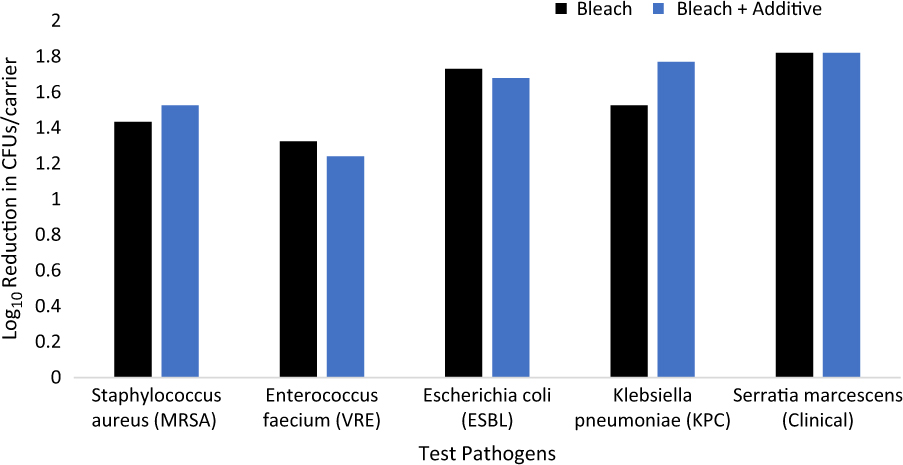
Overall cleaning effectiveness assessed by fluorescent marking was not greater in the bleach plus additive group compared with bleach wipes alone (52% vs 41% removal, respectively) (P = .190) (Fig. 1). The addition of Highlight® significantly improved the cleaning of bathroom inner door knobs compared with bleach alone (60% vs 20% removal, respectively) (P = .025). In contrast, bleach alone resulted in greater reduction of bacteria (98%) than bleach plus additive (58%) for all 5 high-touch surfaces (P < .001). To address this discrepancy, an experimental assessment was performed to determine whether the additive impaired the microbiocidal efficacy of the bleach. No difference in bacterial killing between the bleach and bleach plus additive groups for any bacteria tested was shown (P = .671) (Fig. 2).
Percent of surfaces which passed the fluorescent marking assessment comparing the bleach (N = 15) versus the bleach plus additive group (N = 15). The aggregate bar graph depicts the cumulative percentage of patient rooms which passed the fluorescent marking assessment. There were five surfaces assessed with fluorescent marks in each room, and an environmental sample was obtained for each of the five surfaces (N = 75 before cleaning, N = 75 after cleaning for each group).

The change in colony-forming units (CFUs) comparing the bleach wipe group (N = 6) and the bleach wipe plus additive group (N = 6) versus an untreated group (N = 6).

Qualitative assessment
The EAs noted that learning to use the additive and dispenser was straightforward, that the blue color looked appealing, and that they were more enthusiastic cleaning with blue wipes. One EA remarked, “I really like cleaning with this. Seeing the blue where I wipe down is really useful.” Negative remarks from EA staff included that the blue residue remained on surfaces after the contact time elapsed, and this increased the amount of work required to remove it. As a result, they noted some hesitance in wiping down large surfaces due to the concern for staining such as “The problem with the blue is that it doesn’t always disappear. I have to use some elbow-grease to remove it, and it adds more work for me.” Additionally, some EA staff noted that the prototype dispenser occasionally jammed, spilling the additive.
Overall, patient feedback showed either indifference or positivity. Of 15 patients surveyed, 11 (73%) remarked that the additive significantly reduced the strong smell of the bleach. One patient noted, “This blue product really removed the smell of the bleach by a lot. It’s nice because the bleach usually has a very strong smell.” Furthermore, patients and their visitors alike commented that the blue did not create any discomfort. However, they did not feel as if the additive would provide a clear advantage over the standard bleach in daily cleaning.
Discussion
Optimal environmental stewardship is a priority to reduce the transmission of healthcare-associated pathogens. A product geared toward visualizing surface coverage such as Highlight® provides an innovative solution to improve environmental cleaning. Although the additive did not reduce bleach efficacy in our experimental assessment, we hypothesize that concerns for staining and persistence of additive residue led to decreased effectiveness in the patient rooms. We speculate that the additional time required to remove the additive may have led to less vigorous wiping when using the bleach plus the additive. One novel finding was that the discrepancy between the efficacy and effectiveness of Highlight® may have been attributed to a behavioral component. The primary limitations of this pilot study were the small sample size and the use of a single prototype dispensing device. After the completion of this study, the dispensing device was updated by Kinnos to include an improved pump to ensure more precise volume of additive delivery and improved overall reliability of the dispenser (personal communication, Kinnos).
In conclusion, Kinnos Highlight® is a novel colorant additive that could improve the effectiveness of environmental cleaning. We showed that although use of the colorant does not impact the microbiological effectiveness of the disinfectant, it may affect the behavior of the user and lead to less effective cleaning. Additional study will be needed to determine whether (1) the addition of Highlight® changes user behavior to impact the effectiveness of environmental cleaning, and (2) whether more precise volumetric dispensing of the additive decreases the excess color on surfaces.
Supplementary material
To view supplementary material for this article, please visit https://doi.org/10.1017/ice.2019.67.
Author ORCIDs
Richard A. Martinello, 0000-0002-0355-9200
Acknowledgments
We thank Kinnos for lending the prototype device for the performance of the study. Kinnos staff had no involvement in the design of the study, data collection, or manuscript preparation. We thank the environmental services department at Yale New Haven Hospital for their collaboration and support in training the select EAs with the prototype as well as for providing continuous feedback. We also thank the Clinical Microbiology Laboratory at Yale New Haven Hospital for their guidance and generosity in providing the necessary laboratory equipment, supplies, and test microorganisms.
Financial support
No financial support was provided relevant to this article.
Conflicts of interest
All authors report no conflicts of interest relevant to this article.