One of the shortcomings of the implicit racial attitudes literature is that it relies almost exclusively on white subjects. Arguably, there are two possible reasons for this. First, these measures were created to address issues of social desirability among whites who harbor negative racial attitudes toward blacks. Second, social desirability pressures and antiblack affect were not viewed as significant among black respondents (see Craemer Reference Craemer2008). This assumption is problematic because it treats black racial attitudes as a monolith. Rather than examining black racial opinion as a complicated and multivalenced set of evaluations about their own group and others, there has been an over emphasis on measures of group solidarity (e.g., linked fate). Understandably, bloc voting and cohesive policy opinions have partially justified this focus; however, the black community is more diverse than presidential election turnout suggests. Price (Reference Price2009) argues that linked fate, the most common measure for black racial identity, is not adequately problematized as a potentially positive or negative measure of psychological attachment. Here, we hope to build on this literature by using an implicit black identity measure.
Also, much of the research on black racial attitudes has focused almost entirely on explicit measures of racial solidarity. Here we examine both explicit and implicit measures of some form of anti-black sentiments. We argue that despite differing vantage points, blacks and whites are exposed to the same prevailing stereotypes, thus there should be some expectation that blacks have internalized some anti-black affect. Knowing how this is incorporated into their collective outlook and into individual political decisions is important. Indeed, Orey et al. (Reference Orey, King, Titani-Smith and Ricks2012; see also Orey Reference Orey2004; and Orey Reference Orey2003), when applying the racial resentment/symbolic racism (see e.g., Kinder and Sanders Reference Kinder and Sanders1996) variable to blacks, find that blacks who resent other blacks are more likely to oppose affirmative action policies, reparations, and welfare. Moreover, it is well established that blacks are also influenced by social desirability pressures. Indeed, scholars examining race of the interviewer effects demonstrated that blacks are more reluctant to offer anti-black responses when they perceive their interviewer to be white (Davis Reference Davis1997).
Lastly, in most surveys, the dearth of black respondents makes it nearly impossible to conduct meaningful statistical analyses. Here, we use data collected primarily from historically black colleges and universities (HBCUs). The use of college students in social science research is fairly standardized; however, HBCUs have been underutilized as a concentrated site for accessing black subjects. We argue for the increased use of black subject pools and suggest that scholars turn to HBCUs as the source of those subject pools. These institutions represent a nascent resource for scholars and allow for a more robust analysis of black opinions on race and racism.
DATA AND METHODS
Our nonprobability sample of students at HBCUs was obtained over the Internet at the invitation of the first author. The majority of respondents in this study were students at Jackson State University (61.6%), and 1.6% from other HBCUs. The remaining students were from other minority-serving institutions like California State University at Northridge (29.2%) and Texas A&M International University (7.6%).Footnote 1 In terms of racial self-classification, students were able to select multiple racial or ethnic categories. Two-hundred and ninety three students (64.4%) of the sample used “Black or African American” at least as one option, while 35.6% did not. Of the respondents 50.8% described themselves as black non-Hispanic, 2.6% as black Hispanic, and 11% as multiracial including “Black or African American.” In this article we focus only on the 293 respondents that used “Black or African American” as at least one option to describe themselves.
HBCU participants logged on to an online questionnaire programmed in Inquisit by Millisecond.com, a specialized software package for precision reaction-time measurement. To prevent variations of data transmission speed on the Internet from interfering with the accuracy of reaction time measurements, the Inquisit software is downloaded on the user's computer. There, the software temporarily takes over the computer's task prioritizing functions to prevent any background processes from compromising the precision of the reaction time measures. De Clercq et al. (Reference De Clercq, Crombez, Buysse and Roeyers2003, 109) have independently assessed the accuracy of Inquisit's reaction time measures and found these to be within fractions of a single millisecond (standard deviation 0.3–0.4 ms, De Clercq et al. Reference De Clercq, Crombez, Buysse and Roeyers2003, 113). Participants completed three reaction-time procedures to measure implicit racial associations and answered explicit survey questions regarding their racial and political attitudes.
The reaction time procedures were the implicit association test (IAT, Greenwald et al. Reference Greenwald, McGhee and Schwarz1998), subliminal racial priming, and an implicit black identification measure (Craemer Reference Craemer2010). The IAT and subliminal racial priming exploit the same phenomenon, that positive or negative associations with racial groups influence reaction times by which respondents recognize positive or negative race-unrelated words (like “joy” or “sad”). A racial stimulus is presented on a computer screen followed by a race unrelated word and the respondent is asked to classify this word as either positive or negative. One of the main differences between the two measures is that the IAT requires that respondents pay conscious attention to the racial stimulus while subliminal racial priming displays it only for a split second to minimize conscious perception (≤50 ms). Another difference is that the IAT only allows measuring relative pro-black vs. pro-white associations, while subliminal racial priming measures separate pro- vs. anti-black and pro- vs. anti-white associations.
The implicit black identification measure fundamentally differs from the other two reaction time procedures and is much less intuitive (for a detailed description see Craemer Reference Craemer2008). It exploits the phenomenon of mental “self-other overlap” when an individual identifies with a group (Coats et al. Reference Coats, Smith, Claypool and Banner2000). No groups are mentioned; instead the respondent describes himself or herself as an individual as quickly as possible based on 90 trait-adjectives that appear on the computer screen in random order. The respondent is asked to press one key if the trait is self-descriptive and another if it is not. Mental “self-other overlap” ensures that a respondent who identifies with a group will recognize shared traits much faster than unshared ones. No such reaction-time effect occurs if the respondent does not identify with the group. The degree to which the respondent views each of the traits as shared or unshared is ascertained independently at the end of the study.
We created two dependent variables: opposition to government efforts on behalf of minorities and pride in President Obama. Opposition to government efforts on behalf of minorities was measured using the following Likert item: “The government should not make any special effort to help Blacks and other minorities because they should help themselves—do you strongly agree, somewhat agree, somewhat disagree, or strongly disagree?” (Reverse coded). Pride in President Obama is operationalized based on the following Likert item: “How often has Barack Obama, because of the kind of person he is or because of something he has done, ever made you feel proud?” The response options were “most often,” “some of the time,” “only now and then,” and “hardly at all” and were reverse coded so that greater numbers indicate more pride.
Our explicit measures include intra-racial resentment based on the National Election Studies four-item Racial Resentment Scale (Kinder and Sanders Reference Kinder and Sanders1996; Sears and Kinder Reference Sears, Kinder and Hirsch1971) traditionally used to measure symbolic racism/racial resentment among whites. We also control for old-fashioned anti-black stereotypes based on respondent views of blacks as being unintelligent. Further, we constructed a linked-fate variable from an item that asked whether black respondents believe what happened to blacks as a whole had an impact on their individual life. In addition, we used standard measures to control for ideology (liberal to conservative), party identification (Democrat), age, income, education, and gender.
RESULTS
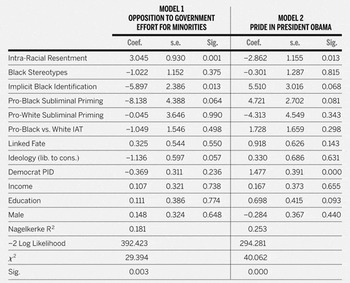
Model 1, in table 1, predicts opposition to special government efforts for minorities. Based on these findings, the intra-racial resentment coefficient is statistically significant (p < 0.01). However, in this model, two implicit racial attitude measures outperform the Intra-Racial Resentment Scale in absolute magnitude. Implicit black identification and pro-black subliminal priming scores significantly reduce opposition to government efforts on behalf of blacks (the former at p < 0.05, the latter, albeit with a larger absolute logit coefficient, only at marginal levels of significance: p ≈ 0.064).
Predicting Racialized Opinions among Black HBCU Students (n = 293)

Note: Estimation Method: Ordered Logit, all variables range from 0 to 1 for comparability; cut-point estimates omitted.
Turning to model 2 in table 1, implicit black identification and pro-black subliminal priming are found to have marginally statistically significant impact on students' pride in Obama (p ≈ 0.068 and p ≈ 0.08, respectively). The Intra-Racial Resentment Scale exerts a significantly negative influence on pride in Obama (p < 0.05) while identifying as a Democrat significantly boosts it (p < 0.01). In summary, implicit racial attitude measures prove to significantly influence opposition for government efforts for minorities and marginally explain pride toward Obama. The Linked-Fate variable failed to achieve statistical significance in either model. Although the IAT is much more common in the extant literature, the variable's coefficient failed to reach statistical significance in either model.
CONCLUSION
We found that implicit black identification and subliminal priming influenced opinions on government efforts for blacks and other minorities as well as, at marginal levels of significance, pride in Obama. We feel confident reporting marginally significant results for pride in Obama because finding any implicit effects in our study is remarkable for two reasons. First, implicit measures are associated with extraordinary amounts of random error making it extremely difficult to detect any significant impact of an implicit variable on an explicit survey question. This is why early research on implicit attitudes had reached a consensus that explicit and implicit attitudes were intrinsically “dissociated” (e.g., Wilson et al. Reference Wilson, Lindsey and Schooler2000) until larger samples and more sophisticated statistical methods provided evidence of statistical association.
Second, in black samples the variance in dependent variables associated with racial issues is often limited. For example, 63.2% of black respondents in our study supported government efforts on behalf of blacks and other minorities, and 85.3% reported feeling pride in Obama. This leaves relatively little variance in the dependent variable to be explained and reduces the likelihood that any independent variable will emerge statistically significant. Given these problems, the failure of the IAT to reach statistical significance should not discourage its use and the predictive success of the other implicit measures provides evidence that the use of implicit attitude measures should be broadened to explore black political opinion. Additionally, it suggests a utility beyond cases where social desirability pressures lead respondents to hide their white supremacist biases.
Rather than providing clear answers our results point to how much we do not yet understand about the nature of implicit racial attitudes. The failure of the discipline to sufficiently include people of color in its samples has left a gaping hole in the literature that we hope future studies will soon fill. Finally, given the dearth of data available to examine implicit attitudes among blacks, we hope that scholars will increasingly turn to HBCUs as a potential source for subject pools.
ACKNOWLEDGMENTS
This research was supported by an National Science Foundation grant, SES-0905629.