Introduction
Chickpea (Cicer arietinum L.) is a self-pollinated, diploid (2n = 2x = 16), cool season legume crop ranking second in global production among food grain legumes (after common beans) with a total production of 15.08 Mt from an area of 14.8 m ha (FAOSTAT, 2020). It is grown in a wide range of environments in over 55 countries in sub-tropical and temperate regions of the world, predominantly in Asia (87.5%), followed by Europe (4.1%), the Americas (3.5%), Africa (3.1%) and Oceania (1.9%) (FAOSTAT, 2020). It is cultivated primarily for its protein-rich seeds. Besides, seeds are rich in fiber, minerals (calcium, potassium, phosphorus, magnesium, iron and zinc), β-carotene and unsaturated fatty acids (Jukanti et al., Reference Jukanti, Gaur, Gowda and Chibbar2012). It can fix atmospheric nitrogen via a symbiotic relationship with Rhizobium bacteria and can meet up to 80% of its own nitrogen requirements thereby improving soil fertility.
Extensive efforts have been made in chickpea improvement programs worldwide by using variability within cultivated species but varieties with high levels of durable resistance to the major biotic stresses such as botrytis grey mould (BGM), dry root rot (DRR), ascochyta blight (AB), pod borer, cutworms and abiotic stresses (drought, heat, cold and salinity) could not be developed. It is estimated that yield losses by individual pests or diseases vary from 5 to 10% in temperate, and 50 to 100% in tropical regions (van Emden et al., Reference van Emden, Ball, Rao and Summerfield1988). Amongst these constraints, AB (caused by Ascochyta rabiei (Pass.) Labrousse), BGM (caused by Botrytis cinerea Pers. ex. Fr.) and DRR (caused by Rhizoctonia bataticola) are the most important and devastating biotic stresses affecting chickpea production and productivity in different agro-climatic regions and causes huge grain yield and quality losses (Sharma et al., Reference Sharma, Ghosh and Pande2016). AB, a devastating foliar disease in areas with cool, cloudy and humid weather (15–25°C and >150 mm rainfall) may cause complete yield loss (Pande et al., Reference Pande, Siddique, Kishore, Baya, Gaur, Gowda, Bretag and Crouch2005). The disease has been reported in 34 countries across six continents and is the major biotic factor affecting chickpea production in areas of WANA, southern Europe, Australia (Pande et al., Reference Pande, Siddique, Kishore, Baya, Gaur, Gowda, Bretag and Crouch2005) and Canada (http://www.pulse.ab.ca/ascoch.pdf). BGM, a foliar disease, can devastate chickpea resulting in complete yield loss in years of extensive winter rains and high humidity and is of serious concern in India, Nepal, Bangladesh, Pakistan, Australia and Argentina (Pande et al., Reference Pande, Singh, Rao, Bakr, Chaurasia, Joshi, Johansen, Singh, Kumar, Rahman and Gowda2002; Davidson et al., Reference Davidson, Pande, Bretag, Lindbeck, Kishore, Elad, Williamson, Tudzynski and Delen2004; Pande et al., Reference Pande, Ramgopal, Kishore, Mallikarjuna, Sharma, Pathak and Narayana Rao2006; Sharma et al., Reference Sharma, Kiranbabu, Ghosh, Rameshwar, Rathore, Kaur, Kushwaha, Das and Pande2013) where yield losses of up to 100% were reported under conducive conditions. DRR is the most important and widespread soilborne disease in areas with relatively dry and warm weather generally appearing at the late flowering and podding stage and can completely devastate the crop. Due to changing climatic conditions with erratic rainfalls and high temperatures, this disease is emerging as a major threat to chickpea cultivation in major chickpea growing regions in central and southern India and elsewhere (Sharma et al., Reference Sharma, Ghosh and Pande2016).
Cultivation of resistant varieties is the most economical, practically feasible and effective way to minimize the yield losses due to these diseases. However, chickpea has a narrow genetic base and high levels of resistance against these biotic stresses are not available in cultivated genepool. In contrast, wild species have continued to evolve under natural selection and carry many useful genes/alleles for resistance against such biotic stresses as well as for agronomic and nutrition-related traits. Genus Cicer, comprising eight annual and 35 perennial species, is a rich reservoir of genetic variability. The genebank at ICRISAT conserves 308 accessions of 18 wild Cicer species. AB, BGM and DRR are the important challenges for improving chickpea productivity. However, confirmed sources with high levels of resistance are not reported in the cultivated genepool for these diseases. Hence, the present study was carried out to screen the wild Cicer accessions to identify new and diverse sources of resistance against AB, BGM and DRR. Intra-accession variability is common in the germplasm conserved in genebanks, and hence, stable sources of resistance were developed by re-screening the progenies of single selected resistant/moderately resistant plant. These stable sources of resistance, referred to as trait-specific genetic stocks (TGS) (Sharma et al., Reference Sharma, Schulthess, Bassi, Badaeva, Neumann, Graner, Özkan, Werner, Knüpffer and Kilian2021a, Reference Sharma, Sharma, Govindaraj, Mahala, Satyavathi, Srivastava, Gumma and Kilian2021b), were developed for each disease. These new and diverse TGS can be used as donors in pre-breeding programme for chickpea improvement. A few earlier studies have reported sources of resistance for AB (Singh et al., Reference Singh, Robertson and Ocampo1998; Stamigna et al., Reference Stamigna, Crino and Saccardo2000; Collard et al., Reference Collard, Ades, Pang, Brouwer and Taylor2001; Pande et al., Reference Pande, Ramgopal, Kishore, Mallikarjuna, Sharma, Pathak and Narayana Rao2006; Kaur et al., Reference Kaur, Sirari, Kumar, Singh, Singh, Kapoor, Singh, Gowda, Pande, Gaur, Sharma, Imtiaaz and Siddique2012; Sharma and Ghosh, Reference Sharma and Ghosh2016) and BGM (Pande et al., Reference Pande, Ramgopal, Kishore, Mallikarjuna, Sharma, Pathak and Narayana Rao2006, Sharma et al., Reference Sharma, Kiranbabu, Ghosh, Rameshwar, Rathore, Kaur, Kushwaha, Das and Pande2013) in wild Cicer species. The present study is the first attempt to identify the confirmed sources of resistance for DRR as well as those with combined resistance for AB, BGM and DRR and on developing TGS following single plant selection. As chickpea is an annual crop, the emphasis was given to screen the accessions belonging to eight annual Cicer species.
Materials and methods
A total of 68 accessions belonging to eight annual wild Cicer species were included in the present study (Table S1). These germplasm accessions were collected from or originated in eight countries. Desi chickpea cultivars, Pb 7, JG 62 and BG 212 were used as susceptible checks for AB, BGM and DRR respectively. The screening for AB, BGM and DRR was carried out under controlled environmental conditions for two years consecutively following a completely randomized design (CRD) with three replications, using 5–7 seedlings per replication.
Screening for AB
In the first screen, 47 accessions belonging to seven wild Cicer species were screened for AB. A desi chickpea cultivar, Pb 7, highly susceptible to AB, was used as infector row. Seeds of wild Cicer accessions were scarified by incising the hard seed coat to initiate germination. Seedlings of each test genotype were grown in plastic trays (35 × 25 × 8 cm) filled with a mixture of sterilized river sand and vermiculite (10:1) in a greenhouse maintained at 25 ± 1 °C for 10 days. The raising of seedlings, their maintenance, mass culturing of A. rabiei, inoculation and incubation procedures, etc. were followed in a growth chamber at ICRISAT as per the details described in Pande et al. (Reference Pande, Sharma, Nagavardhini and Telangre2012). The 10-day-old seedlings of test genotypes were transferred to a growth room maintained at 20 ± 1 °C and 12 h photoperiod. The seedlings were acclimatized for 24 h under these conditions. Then the conidial suspension of A. rabiei (5 × 10⁴ conidia/ml) was sprayed on the test genotypes as well as on susceptible check until runoff using a hand-operated atomizer. Inoculated plants were allowed to dry partially for 30 min to avoid dislodging of spores and thereafter, maintained at 20 ± 1 °C and continuous relative humidity of 100% for 96 h. After 96 h, the 100% RH was maintained for 6–8 h a day till the completion of the experiment. Disease severity of individual genotypes was recorded 10 days after inoculation on a 1–9 rating scale, i.e. 1 = no visible symptoms and 9 = 100% of the plants killed (Pande et al., Reference Pande, Sharma, Nagavardhini and Telangre2012). From this preliminary screening, 29 resistant accessions belonging to six wild Cicer species exhibiting AB resistance (score ≤5.0) were selected and the single resistant plant from each of these selected accessions were transplanted in pots for seed multiplication. These seeds were used for re-screening to confirm resistance in the second screen following the same methodology under similar plant growth conditions. The resistant accessions identified after two screens were selected and selfed for 2–3 generations following the single seed descent method to develop TGS as sources of resistance to AB.
Screening for BGM
In the preliminary screening, 64 accessions belonging to seven wild Cicer species were screened for BGM. A desi chickpea cultivar, JG 62, highly susceptible to BGM, was used as a susceptible check and infector row. Seeds of wild Cicer accessions were scarified by incising the hard seed coat to initiate germination. Seedlings of the test genotypes along with a susceptible check JG 62 were screened as per the protocol described in Pande et al., Reference Pande, Sharma, Nagavardhini and Telangre2012. Twenty-four hours before inoculation, 10-day-old test seedlings grown in plastic trays were transferred to the plant growth room maintained at 15 ± 1 °C with a 12 h photoperiod for acclimatization. The seedlings were inoculated artificially by spraying the inoculum on the foliage until run off using a hand-operated atomizer. Inoculated plants were dried for 30 min to avoid dislodging of the spores and, thereafter, the growth room was maintained at 15 ± 1 °C and 95–100% relative humidity (RH) with a 12 h photoperiod of 2500–3000 lux intensity. The severity of the disease in all the test genotypes was recorded after 20 days of inoculation using a 1–9 rating scale where, 1 = no infection on any part of the plant and 9 = extensive soft rotting, fungal growth on more than 70% of the leaves, branches and stems (Pande et al., Reference Pande, Sharma, Nagavardhini and Telangre2012). Based on these preliminary studies, 33 accessions belonging to four wild Cicer species exhibiting BGM resistance (score ≤5.0) were selected and the single resistant plant from each of these selected accessions was transplanted in pots for seed multiplication. These seeds were used for re-screening to confirm resistance following the methodology described earlier under similar plant growth conditions. The resistant accessions identified after two screens were selected and selfed for 2–3 generations following the single seed descent method to develop TGS as sources of resistance to BGM.
Screening for DRR
In the preliminary screening, 55 accessions belonging to seven wild Cicer species were screened for DRR using paper towel technique (Pande et al., Reference Pande, Sharma, Nagavardhini and Telangre2012). A desi chickpea cultivar, BG 212 was used as susceptible check. Seeds of wild Cicer accessions were scarified by incising the hard seed coat to initiate germination. Seeds of the susceptible check as well as test genotypes were surface sterilized using 2% sodium hypochlorite, rinsed twice in water and sown in pre-sterile sand covers. The seedlings were maintained at 25 ± 2 °C in the glasshouse for seven days. Simultaneously, a bit of Rhizoctonia bataticola was transferred to 250 ml capacity conical flask containing 100 ml autoclaved potato dextrose broth for mass multiplication. The inoculated flask was incubated at 25 °C. After 7 days, the mycelial mat was macerated in a blender for 1 min and the inoculum was prepared by adding 50 ml distil water per mat. Seven-days-old seedlings were uprooted from the polythene covers and the roots were washed under running tap water. Roots of the seedlings were dipped in the inoculum suspension for 2 min, placed on towel paper and the heap of 10 paper was kept in trays. The trays were incubated at 35 °C temperature, 12 h photoperiod and were moistened adequately as per the need every day. The disease severity was scored at 8 days after inoculation on a 1–9 rating scale, where 1 = no symptoms on roots and 9 = complete discoloration of roots. Based on this screening, 32 accessions belonging to five wild Cicer species exhibiting DRR resistance (DRR ≤ 5.0) were selected and the single resistant plant from each of these selected 32 accessions was transplanted in pots for seed multiplication. These seeds were used for re-screening to confirm resistance following the same methodology under similar plant growth conditions. The resistant accessions identified after two screens were selected and selfed for 2–3 generations following single seed descent method to develop TGS as sources of resistance to DRR.
Replication-wise data for disease scores were subjected to analysis of variance using the GenStat 9.1 statistical package. In each screen for AB, BGM and DRR, based on 1–9 disease score, the accessions were grouped as resistant (disease score 1.0–3.0), moderately resistant (disease score 3.1–5.0), susceptible (disease score 5.1–7.0) and highly susceptible (disease score 7.1–9.0). Data were also recorded for days to first flowering and 100-seed weight.
Results
The analysis of variance showed significant differences (P ≤ 0.001) among accessions for AB, BGM and DRR in both the screens (Table 1). In the first screen, Pb 7, JG 62 and BG 212 were completely susceptible with disease score of 9.0 for AB, BGM and DRR (Fig. 1). None of the wild Cicer accessions were found immune to these diseases in both screens. However, considerable variability was observed between and within species.
Analysis of variance for ascochyta blight (AB), botrytis grey mould (BGM) and dry root rot (DRR) at ICRISAT, Patancheru, India

*Significant at P ≤ 0.001.
Disease score of wild Cicer accessions and respective susceptible checks for ascochyta blight (AB; top), botrytis grey mould (BGM; middle) and dry root rot (DRR; bottom) in the first screen.

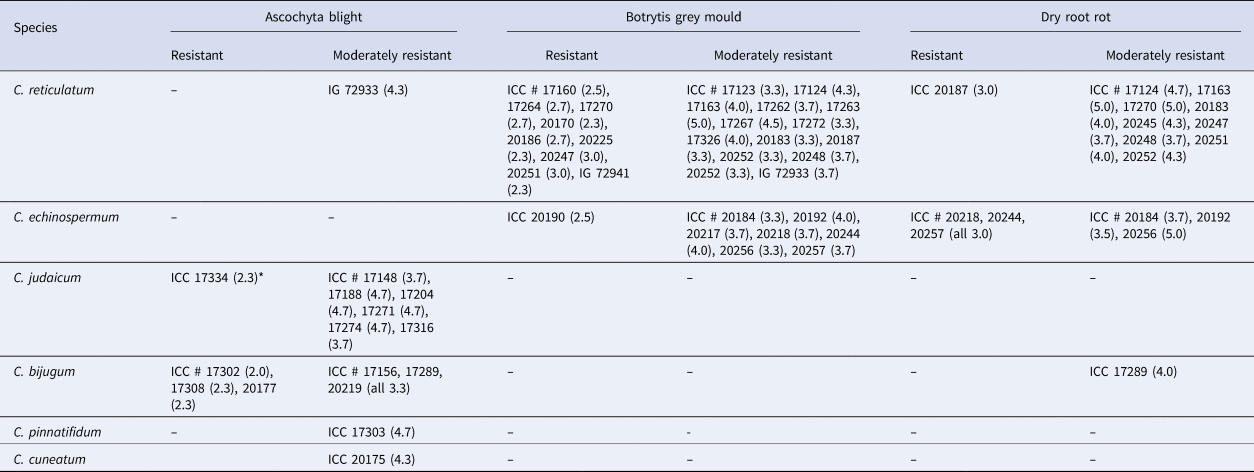
For AB, the mean score varied from 2.0 to 8.8 in wild Cicer accessions in first screen (Fig. 1). Intra-accession variability for resistance and susceptibility was observed in most of the lines. The resistant plants were selected, and the seeds harvested from a single resistant plant were used for re-evaluation in the second screen. The intra-accession variability was significantly reduced in the second screen. None of the accessions were free from any of the diseases and the average score varied from 2.0 to 8.0 in wild Cicer accessions. One C. judaicum accession, ICC 17334 and three C. bijugum accessions, ICC 17302, ICC 17308 and ICC 20177 were resistant to AB (Table 2). Of these, ICC 17302 and ICC 17308 were consistently resistant whereas, one C. reticulatum accession, IG 72933 was moderately resistant to AB in both screens (Table 2).
Identification of trait-specific genetic stocks as novel sources of resistance for Ascochyta blight, botrytis grey mould and dry root rot at ICRISAT, Patancheru, India

*Average disease score is given in the parentheses.
The varying extent of intra-accession variability for resistance and susceptibility was also observed for BGM in the first screen and the mean disease score varied from 3.2 to 9.0 in wild Cicer accessions (Fig. 1). The resistant plants were selected, and the seeds harvested from a single resistant plant were used for re-screening. In the second screen, intra- accession variability was significantly reduced, and the mean score varied from 2.3 to 7.0 in wild Cicer accessions. Nine C. reticulatum accessions and one C. echinospermum accession exhibited high levels of resistance to BGM (≤3.0) whereas, 13 and seven accessions of C. reticulatum and C. echinospermum, respectively were moderately resistant to BGM in both the screens (Table 2).
Intra-accession variability was also observed for DRR in the first screen. The mean disease score varied from 3.0 to 9.0 (Fig. 1). The resistant plants were selected, and the seeds were harvested from the single resistant plant and were used for re-screening for confirmation of results. Intra-accession variability was significantly reduced in the second screen and the mean score varied from 3.0 to 9.0 in wild Cicer accessions. One and three accessions of C. reticulatum and C. echinospermum, respectively exhibited high levels of resistance (≤3.0). Of these, two accessions ICC 20218 and ICC 20244 were consistently resistant, whereas eight, three and one accessions of C. reticulatum, C. echinospermum and C. bijugum, respectively were moderately resistant to DRR in both the screens (Table 2).
The resistant and moderately resistant accessions were selfed for 2–3 generations following single seed descent method and were developed as TGS for AB, BGM and DRR resistance.
Discussion
AB, BGM and DRR have been recognized as economically important diseases in chickpea worldwide. Of these diseases, DRR is emerging as a major threat under the changing climatic conditions (Sharma et al., Reference Sharma, Ghosh and Pande2016). Sources of high levels of resistance to these diseases are scarce in the cultivated germplasm and chickpea cultivars become prone to newly emerging matching virulence of the respective pathogens. This necessitates the exploitation of wild species to introgress alleles conferring resistance for these diseases into chickpea cultivars. In the present study, wild Cicer accessions belonging to eight annual species were screened for AB, BGM and DRR resistance following a rigorous screening of the progenies of resistant/moderately resistant plants to identify stable, durable and confirmed sources of resistance and were proposed as TGS (Sharma et al., Reference Sharma, Schulthess, Bassi, Badaeva, Neumann, Graner, Özkan, Werner, Knüpffer and Kilian2021a, Reference Sharma, Sharma, Govindaraj, Mahala, Satyavathi, Srivastava, Gumma and Kilian2021b) for these diseases. A high level of resistance for AB was identified and confirmed in four accessions viz. ICC 17334 (C. judaicum), and ICC 17302, ICC 17308 and ICC 20177 (C. bijugum). A high level of resistance for AB has been reported in C. judaicum (Singh et al., Reference Singh, Hawtin, Nene and Reddy1981; Singh and Reddy, Reference Singh and Reddy1993; Pande et al., Reference Pande, Ramgopal, Kishore, Mallikarjuna, Sharma, Pathak and Narayana Rao2006; Kaur et al., Reference Kaur, Sirari, Kumar, Singh, Singh, Kapoor, Singh, Gowda, Pande, Gaur, Sharma, Imtiaaz and Siddique2012), C. bijugum (Stamigna et al., Reference Stamigna, Crino and Saccardo2000; Collard et al., Reference Collard, Ades, Pang, Brouwer and Taylor2001) and C. pinnatifidum (Stamigna et al., Reference Stamigna, Crino and Saccardo2000). Only one accession (IG 72933) of primary genepool species, C. reticulatum had moderate level of resistance against AB. High level of resistance to BGM was identified and confirmed in nine accessions, ICC 17160, ICC 17264, ICC 17270, ICC 20170, ICC 20186, ICC 20225, ICC 20247, ICC 20251 and IG 72941 of primary genepool species, C. reticulatum and one accession, ICC 20190 belonging to the secondary genepool species, C. echinospermum. All the accessions of tertiary genepool species, viz. C. judaicum, C. bijugum, C. pinnatifidum, C. chorassanicum and C. cuneatum were susceptible and/or highly susceptible. As observed in the present study, C. reticulatum accession, IG 72941 was found resistant to BGM earlier also (Pande et al., Reference Pande, Ramgopal, Kishore, Mallikarjuna, Sharma, Pathak and Narayana Rao2006). Similarly, C. reticulatum accessions ILWC 114, ILWC 140, ILWC 216 and ILWC 229 showed resistance to Australian isolates of BGM at the seedling stage and both on intact plant and cut twigs at adult plant stage (Basandrai, Reference Basandrai2006).
High level of resistance for DRR was identified and confirmed in one accession, ICC 20187 of C. reticulatum, and three accessions, ICC 20218, ICC 20244 and ICC 20257 of C. echinospermum. Only one accession, ICC 17289 of tertiary genepool species, C. bijugum was moderately resistant to DRR and remaining accessions were found susceptible/highly susceptible to DRR.
The TGS of wild species were developed as sources of resistance for AB, BGM and DRR following 2–3 generations selfing of the resistant plants following the extended daylength and single seed descent method.
The sources with multiple resistance were identified. Accession IG 72933 (C. reticulatum) recorded moderate levels of resistance against AB and BGM, whereas ICC 20187 (C. reticulatum) showed high and moderate levels of resistance against DRR and BGM, respectively. Accessions ICC 17270, ICC 20247 and ICC 20251 (C. reticulatum) exhibited high and moderate levels of resistance against BGM and DRR, respectively. Accessions ICC 20218, ICC 20244 and ICC 20257 (C. echinospermum) showed high and moderate levels of resistance against DRR and BGM, respectively. C. echinospermum accessions ICC 20184, ICC 20192 and ICC 20256 were moderately resistant to BGM and DRR, and C. bijugum accession ICC 17289 was moderately resistant to AB and DRR.
It is evident from the present study that C. reticulatum accessions IG 72933, IG 72941, ICC 17270, ICC 20187, ICC 20183, ICC 20247, ICC 20251, ICC 17124, ICC 17163, ICC 20248 and ICC 20252 showed multiple resistance to AB, BGM and/or DRR. These would be of special interest to the chickpea breeders as these accessions are freely and easily crossable with cultivated chickpea. The utilization of wild Cicer species for chickpea improvement in ICRISAT, Hyderabad, India or elsewhere having warm temperatures is hindered due to their vernalization and extended photoperiod requirement for flowering, which can be overcome by using cold treatment or artificially extending natural photoperiod by using incandescent bulbs (Sharma and Upadhyaya, Reference Sharma and Upadhyaya2015, Reference Sharma and Upadhyaya2019). The C. reticulatum accessions of interest viz. IG 72933, IG 72941, ICC 17270, ICC 20187, ICC 20183, ICC 20247, ICC 20251, ICC 17124, ICC 17163, ICC 20248 and ICC 20252 flowered in about 55–58 days when grown under 18-h extended day length and had ~12.9 to 16.0 g 100-seed weight (data not given). The secondary genepool C. echinospermum accessions, ICC 20218, ICC 20244 and ICC 20257, with origin from Turkey, hold great potential for chickpea improvement. These accessions also exhibited multiple resistance, flowered in 57 to 61 days under 18 h extended daylength treatment and had 10.5–13.1 g 100-seed weight. However, the major limitation associated with utilization of C. echinospermum for chickpea improvement is sterility of the resulting hybrids and progenies. A high level of AB resistance was observed in tertiary genepool species, C. judaicum (ICC 17334) and C. bijugum (ICC 17302, ICC 17308 and ICC 20177). These accessions flowered in about 56–58 days under 18-h extended day length treatment. The accessions of C. bijugum had high 100-seed weight (11–13 g) compared to C. judaicum accession ICC 17334 with ~3.0 g 100-seed weight and should be given high priority for its utilization in chickpea breeding programmes. Tertiary genepool species are cross-incompatible with cultivated chickpea and specialized techniques such as embryo and/or ovule culture are required to introgress AB resistance from these accessions into chickpea cultivars. Another approach to transfer useful alleles from tertiary geneoool species into cultivated chickpea could be by using cross-compatible wild species such as C. reticulatum and C. echinospermum as bridge species in crossing programme. In ICRISAT, systematic pre-breeding efforts are underway by harnessing wild Cicer species to enrich variability and widen the genetic base of disease resistance in the primary genepool for chickpea improvement. These TGS are being utilized to synthesize new genepools following introgression of AB, BGM and DRR resistance from wild Cicer species into cultivated chickpea.
The present study has concluded that high levels of resistance against AB, BGM and DRR are available in wild Cicer species. Specifically, C. reticulatum accessions, IG 72941, ICC 20170 and ICC 20225 should be given the highest priority for introgressing high levels of resistance for BGM. C. reticulatum accession ICC 20187 and C. echinospermum accessions, ICC 20218, ICC 20244 and ICC 20257 will be useful donors for DRR resistance. C. judaicum accession, ICC 17334 and C. bijugum accessions, ICC 17302, ICC17308 and ICC 20177 will be promising donors for incorporating AB resistance into chickpea cultivars. Identification and utilization of these accessions in chickpea pre-breeding programmes will not only help to enhance the levels of resistance but will also help to broaden the genetic base of chickpea cultivars.
Supplementary material
The supplementary material for this article can be found at https://doi.org/10.1017/S1479262123001004.
Acknowledgements
The authors acknowledge the guidance provided by Dr HD Upadhyaya in executing this study.