INTRODUCTION
It has long been observed that the acquisition of grammatical function morphemes proceeds gradually over time, taking several years to reach adult-like performance (e.g. Brown, Reference Brown1973). Rather than appearing all at once, morphemes such as the articles a and the and verbal inflections such as third person singular -s and past tense -ed initially appear in only a few obligatory contexts, then slowly increase over time. This type of gradual learning curve poses a problem for parameter-setting models of language acquisition (e.g. Hyams, Reference Hyams1986), where the acquisition of a grammatical construction is presumed to be categorical once the appropriate ‘triggering’ data have been observed. Other theories of syntactic acquisition have no explanation for the gradual learning process that is typically noted. Radford (Reference Radford1990) proposes that early productions of a particular grammatical function item are only ‘imposters’, and cannot be treated as having syntactic status. Similarly, Wexler and colleagues (e.g. Wexler, Reference Wexler, Lightfoot and Hornstein1994) treat the variable appearance of tense morphemes as ‘optional’, or random events that indicate a lack of grammatical knowledge. Both approaches assume that once the child matures, and the necessary syntactic and semantic knowledge or representations are available, a given grammatical morpheme should be reliably produced in obligatory contexts. During the period of variability, however, there is little attempt to make predictions regarding where and when a grammatical morpheme is most likely to appear. This paper takes a different, phonological approach to this problem. Rather than suggesting that the variable production of grammatical morphemes is due to a lack of syntactic representations, this study proposes that it is due to constraints on phonological (or prosodic) representations.
Researchers have long noted that children are more likely to produce grammatical morphemes in certain phonological environments (e.g. Gleitman & Wanner, Reference Gleitman, Wanner, Wanner and Gleitman1982). Gerken (Reference Gerken1996) and colleagues, in a series of studies, showed that some of this variability could be understood in terms of rhythmic, or metrical constraints, where grammatical morphemes such as articles and pronouns were more likely to be produced if they were part of a disyllabic trochaic (strong–weak) foot. They also suggested that this pattern of development could be understood in terms of children's lack of access to higher-level prosodic structures (discussed below). We have found that similar constraints hold on Sesotho-speaking and French-speaking children's use of early grammatical morphemes (Demuth & Ellis, Reference Demuth, Ellis, Guo, Lieven, Ervin-Tripp, Budwig, Özçaliskan and Nakamurain press; Demuth & Tremblay, Reference Demuth and Tremblay2008), suggesting that these phrase-level prosodic constraints hold across languages with very different metrical structures.
Recent studies on the acquisition of inflectional morphology have also found that some of the variability in morpheme production at the level of the word can be attributed to issues of phonological complexity. That is, children tend to produce past tense and third person singular morphemes more consistently when these constitute a simple word-final (coda) consonant (e.g. sees) rather than a more complex consonant cluster (e.g. hits) (e.g. Marshall & van der Lely, Reference Marshall and van der Lely2007; Song, Sundara & Demuth, Reference Song, Sundara and Demuthin submission). Thus, although these children can produce coda clusters in isolation, these grammatical morphemes are more likely to be produced in phonologically simple, or unmarked contexts (e.g. at the end of a phrase, when the verb ends in a simple coda).
The above sets of findings suggest that, across languages, some of the variability in children's production of grammatical morphemes may be understood in terms of phonological (or prosodic) constraints at the relevant levels of structure (word-level, phrase-level, etc.). That is, both the metrical/rhythmic constraints and the syllable/word-structure constraints can be captured in terms of more general constraints on phonological (or prosodic) competence. We can then make the prediction that language learners will be more likely to produce grammatical morphemes in prosodically licensed (phonologically simple, ‘unmarked’) contexts (see Lleó (Reference Lleó2003) for similar proposals). We call this the Prosodic Licensing Hypothesis. As children's phonological (and prosodic) competence increases over time, they are better able to produce grammatical morphemes in a wider range of prosodic contexts. Under this view, a child's developing phonological grammar is opportunistic, incorporating grammatical morphemes in phonologically simple contexts whenever possible, all else being equal. The Prosodic Licensing Hypothesis therefore differs from more templatic approaches to word production in being a more general, probabilistic, interactive, soft constraint (in the spirit of Optimality Theory) rather than a ‘hard’ constraint at a particular point in development (e.g. Fikkert, Reference Fikkert1994). Critically, however, both appeal to notions of markedness, where less-marked structures are expected to appear before those that are more marked.
If the Prosodic Licensing Hypothesis is correct, we should be able to make predictions about the phonological contexts in which grammatical morphemes will be most likely to first appear, both within and across languages. Furthermore, if children are more likely to produce grammatical morphemes first in phonologically unmarked contexts, this could hold significant implications for our understanding of when and how children's syntactic competence develops. In some cases, this may be earlier than is typically assumed. Such results would also hold implications for the design of morphosyntactic experiments, which typically do not control for phonological factors.
It is also well known that children can exhibit individual variation in their early productions, especially at the level of segments and words (e.g. Vihman, Reference Vihman1996). Little is known about individual variation in the production of grammatical morphemes, except that some children acquire these faster than others (Brown, Reference Brown1973). In the present longitudinal study, we show that most English-speaking children's articles tend to appear first in prosodically unmarked (disyllabic foot) contexts, confirming and extending Gerken's (Reference Gerken1996) cross-sectional results. However, we also show that some of the individual variation found in children's production of articles is due to phonological factors, where different strategies are used to prosodically license these grammatical morphemes.
After introducing some of the basics of prosodic structure, we briefly review previous studies that provide support for the Prosodic Licensing Hypothesis. We then conduct a corpus study of five English-speaking one- to two-year-olds' longitudinal development of articles, showing that most of these children are more likely to first produce articles that can be prosodified as a disyllabic foot. However, one child exhibits a slightly different pattern of development. We therefore carry out an acoustic study, showing that she goes through a stage of development where all articles are produced as separate prosodic words, providing further evidence that the production of articles is governed by prosodic rather than syntactic constraints. We conclude with a discussion of how the Prosodic Licensing Hypothesis can make predictions regarding article development across languages, and the implications this holds for understanding the nature of syntactic development.
BACKGROUND
Prosodic structure
Researchers have long known that many word-formation processes can best be characterized in terms of interactions at the phonology–syntax interface. Thus, certain constraints on word structure in languages as diverse as Arabic and Italian can be represented in terms of the prosodic hierarchy in (1) (e.g. McCarthy & Prince, Reference McCarthy and Prince1986; Nespor & Vogel, Reference Nespor and Vogel1986; Selkirk, Reference Selkirk1984).
(1) Prosodic hierarchy


The level of the foot has received much attention in the acquisition literature. Feet have a privileged status in many grammars because they are typically considered to be the unmarked form for prosodic words (e.g. McCarthy & Prince, Reference McCarthy, Prince and McCarthy2003). In addition, Allen & Hawkins (Reference Allen, Hawkins, Bell and Hooper1978) proposed that a stressed–unstressed (Strong–weak (Sw)) trochaic foot is a privileged prosodic unit in children's early speech. This was based on the observation that children often truncated trisyllabic wSw words with an initial unstressed (unfooted) syllable (banana) to a disyllabic Sw foot in early speech (2) (cf. Pater, Reference Pater1997).
(2)
Selkirk (Reference Selkirk1984, Reference Selkirk, Morgan and Demuth1996) proposed that grammatical function items are prosodified at the level of either the prosodic word (PW) or the phonological phrase (PP), and that this varies depending on the prosodic characteristics of the grammatical morpheme and the language. The possible prosodic realizations of grammatical morphemes are illustrated in (3a–d), where fnc indicates a closed-class grammatical functional item, and lex indicates an open-class lexical item. Selkirk proposed that unstressed English function words are typically prosodified as free clitics, where the function word is prosodified at the level of the PP (3b) (e.g. to Boston, a message, can cook, his picture) (though see an alternative analysis in (8) below). In contrast, Selkirk proposed that stressed auxiliaries and pronouns (e.g. we CAN, HE knows) are themselves PWs, and combine with lexical items at the level of the PP (3a).
(3) The Prosodic structure of grammatical function items
One of the challenges for the learner is to determine the level of structure at which different grammatical function items are prosodified in the language they are learning. Gerken (Reference Gerken1996) suggests that the adult-like representations for English (3b) may be later acquired due to the fact that the function word is not immediately dominated by Foot and PW structure, as it is in (3c), thereby violating constraints on prosodic well-formedness (Exhaustivity) (Selkirk, Reference Selkirk, Morgan and Demuth1996). Following this lead, Demuth & Tremblay (Reference Demuth and Tremblay2008) suggest that children's first articles will be prosodified at the level of the foot (3c), and only later at more marked, higher levels of structure such as the PW and the PP (3b) (though see Goad & Buckley (Reference Goad and Buckley2006) for an alternative view). Relatively little is known about children's acquisition at the phonology/syntax interface, and it is possible that children explore different strategies for producing early articles as compared to lexical items (cf. McGregor & Johnson, Reference McGregor and Johnson1997). However, the acquisition patterns from English, French and Sesotho suggest that children's first grammatical morphemes are prosodified at the level of the foot as an internal clitic (3c), the simplest prosodic structure. Over time, as the child's prosodic representations become more complex, other means for prosodifying grammatical function morphemes become possible (e.g. (3a, b, d)). That is, the internal clitic (3c) represents the prosodically least complex, unmarked form of prosodic structure. Grammatical morphemes that cannot be prosodified in this fashion will be omitted in children's early speech (see Demuth & Tremblay (Reference Demuth and Tremblay2008) for discussion). We now turn to the acquisition of noun-class prefixes in the southern Bantu language Sesotho, reviewing the findings that provided the original motivation for the present study.
Prosodic licensing of noun-class prefixes in Sesotho
Connelly (Reference Connelly1984) investigated how Sesotho-speaking children acquire the complex noun-class system of their language, with thirteen different singular/plural noun-class prefixes. Like many Bantu languages, Sesotho has no lexical stress, but lengthens the penultimate syllable of a phonological phrase. Consider (4), where both the subject marker (SM) on the verb and the postnominal adjective agree in class number with the preceding noun.
(4a) Mo-sadi o-ngotse le-ngolo le-le-tle1-woman SM1-wrote 5-letter 5-5-nice‘The woman wrote a nice letter’
(4b) Ba-sadi ba-ngotse ma-ngolo a-ma-tle2-women SM2-wrote 6-letters 6-6-nice ‘The women wrote some nice letters’
Like many other Bantu languages, Sesotho also shows strong word-minimality effects, where open-class lexical items that are smaller than a disyllabic foot must be produced with an epenthetic vowel. This occurs, for example, when a monosyllabic verb appears in the imperative (e.g. *ja! ‘eat’ > eja! ‘eat!’). These word-minimality effects provide additional evidence for the foot as a prosodic unit in these languages, independent of phrasal penultimate lengthening (Doke & Mofokeng, Reference Doke and Mofokeng1985).
Connelly (Reference Connelly1984) found few prefix errors of commission, but many errors of omission, especially around the age of two. He also noted that prefixes were typically produced before monosyllabic nominal stems, but were often omitted before disyllabic nominal stems. Demuth (Reference Demuth, Lust, Suñer and Whitman1994) suggested that this phenomenon could best be understood in terms of prosodic constraints on children's productions. That is, these grammatical morphemes were included in children's speech productions if they formed part of a disyllabic foot, but tended to be omitted if they fell outside the foot, remaining unfooted. This is shown below, where the noun-class 1 prefix mo- is consistently produced with the monosyllabic stem in (5a), but tends to be omitted (indicated by parentheses) when the nominal stem already contains a disyllabic foot (5b).
(5a) [mo-tʰo]Ft1-person‘person’
(5b) (mo)-[sadi]Ft1-woman ‘woman’
Recent corpus analysis of three Sesotho-speaking children has shown that the prosodic licensing of noun-class prefixes occurs until around the age of 2 ; 3 (Demuth & Ellis, Reference Demuth, Ellis, Guo, Lieven, Ervin-Tripp, Budwig, Özçaliskan and Nakamurain press). After 2 ; 3, noun-class prefixes that precede disyllabic nominal stems (which already contain a foot of structure) begin to be more reliably produced. Although there has been little research on the prosodic phonology of grammatical morphemes in Sesotho, we assume that the noun-class prefixes that occur with monosyllabic stems are prosodified as internal clitics as part of a foot (3c), whereas those that occur with disyllabic stems are prosodified at a higher level of structure, either as free clitics (3b) or as affixal clitics (3d). Children would therefore initially produce those noun-class prefixes that are part of a foot, and only later begin to produce those that occur at higher levels of structure.
Critically important is the fact that even when a noun-class prefix was not produced, children indicated knowledge of the grammatical/gender class of the noun by using the appropriate agreement features on the following modifier. This is shown in (6), where the class 7 prefix se- is omitted (in parentheses), but the correct class 7 demonstrative agreement sa- is used in (6a), and the same for class 5 le- in (6b) (Demuth, Reference Demuth, Lust, Suñer and Whitman1994: 129).
(6a) (se)-[kolo]Ft [sa-ne]Ft ‘that school' Hlobohang 2 ; 17-school 7-that‘that school’
(6b) (le)-[ponko]Ft [la-ne]Ft5-green corn stalk 5-that‘that green corn stalk’
Such examples show that the omission of the noun-class prefix is not due to a lack of knowledge about the grammatical class to which the noun belongs. Rather, early prefix omission is due to prosodic constraints on the output form, providing support for the Prosodic Licensing Hypothesis (see Demuth & Ellis (Reference Demuth, Ellis, Guo, Lieven, Ervin-Tripp, Budwig, Özçaliskan and Nakamurain press) for further discussion).
The Sesotho findings are essential to our understanding of children's emerging knowledge of grammar. The fact that some of the early variable production of grammatical morphemes may be prosodically conditioned has serious implications for our understanding of how and when syntax is acquired. However, despite early findings to this effect for English articles (Gerken, Reference Gerken1996), this has yet to be taken seriously by the syntax acquisition community. Below we show that the prosodic licensing of grammatical morphemes appears to be a general phenomenon found across languages, as illustrated for French.
Prosodic licensing of French determiners
It has been proposed that, like English articles, French articles (and determiners in general) prosodify as free clitics at the level of the PP (3b) (Goad & Buckley, Reference Goad and Buckley2006). However, several studies of French acquisition have reported that children's determiners first appear with monosyllabic words, and only later with disyllabic and trisyllabic words. For example, Demuth & Tremblay (Reference Demuth and Tremblay2008) conducted a longitudinal study of two French-speaking children's development of determiners. In keeping with the Prosodic Licensing Hypothesis, there was a significant prosodic effect: as in Sesotho, French-speaking children's production of determiners preceding monosyllabic words was several months in advance of their production of determiners with disyllabic and trisyllabic words. Thus, even though the foot structure of French is iambic (wS) rather than trochaic (Sw) (e.g. Charette, Reference Charette1991), children are much more likely to first produce determiners that are prosodically licensed as part of a disyllabic foot. That is, French determiners that can be prosodified as part of a wS iambic foot (7a) are produced at higher rates at early stages of acquisition than those that must be prosodified outside the foot (7b).
(7a) [dyˈlε]Ft du lait ‘some milk’
(7b) (la) [kuˈʁɔn]Ft la couronne ‘the crown’
Thus, in French as well, the first determiners produced are those that are prosodically licensed as part of a foot. Since about half of the words French-speaking children hear and produce are monosyllables (Demuth & Johnson, Reference Demuth and Johnson2003), these children produce many determiners by around 1 ; 10. Note that this differs from Sesotho, where the majority of nominal stems are disyllabic, resulting in consistent use of noun-class prefixes only by the age of 2 ; 4–2 ; 6. Thus, although both sets of children begin to exhibit the use of footed nominal morphemes around the same age, French-speaking children look more advanced than their Sesotho-speaking counterparts since the majority of Sesotho noun-class prefixes occur in a prosodically more complex environment, and are therefore later acquired. Despite these language-specific lexical and prosodic differences, children learning both languages begin to exhibit early use of those grammatical morphemes that can be prosodified as part of a disyllabic foot. We might therefore expect to find a similar longitudinal pattern of development in the case of English articles.
Prosodic licensing of English articles
In the foregoing discussion we have seen that disyllabic feet have a privileged status in children's early grammars, and that grammatical function items are more likely to be produced early in development if they can be prosodified as part of a disyllabic foot. Selkirk (Reference Selkirk1984) proposed that unstressed grammatical function items in English, as in the other languages discussed above, are prosodified as free clitics at the level of the PP (3b). However, English is also a stress-timed language that tends to incorporate weak, unfooted syllables into Strong–weak (Sw) trochaic feet (e.g. Liberman & Prince, Reference Liberman and Prince1977). In the metrical grid for the sentence in (8), Sw feet are constructed for each stressed–unstressed sequence, and the remaining unstressed (unfooted) syllables are gathered together to form another (Sw) foot (cf. Hayes, Reference Hayes1994). Thus, under appropriate rhythmic conditions, English articles can prosodify to the left as part of a foot, as an internal clitic (3c).
(8) * * * Ft
* (* *) (* *) (* *) σ
I (put it) (in the) (trailer)
w [S w]Ft [S w]Ft [S w]Ft
Results from Gerken's (Reference Gerken1996) cross-sectional elicited production study demonstrated that two-year-olds are more likely to produce object articles such as the when these are prosodified as part of a Sw trochaic foot (9a) than when they are left unfooted (9b).
(9a) He [kicks the]Ft piggy
(9b) He [catches]Ft (the) piggy
These experimental findings indicate that English articles, like French determiners and Sesotho noun-class prefixes, are more likely to be produced in children's early speech when they form part of a disyllabic foot. However, these results also suggest the need for further study. First, the English experimental studies involved elicited imitation tasks, in which children were asked to repeat what they heard. Although many studies report similar results for both elicited imitation tasks and spontaneous speech (Kehoe & Stoel-Gammon, Reference Kehoe and Stoel-Gammon2001), a study of children's spontaneous productions would confirm the robustness of these findings. Second, performance on different conditions in experimental tasks provides only indirect evidence of developmental trajectories. A longitudinal study of article acquisition is needed to confirm that English-speaking children show the same developmental patterns as those found in French and Sesotho. Third, a longitudinal study could provide information about individual developmental patterns, which tend to be masked in cross-sectional studies. That is, do all children exhibit the same patterns of development, or are there individual differences that might shed further light on why the early production of articles is variable? Finally, a longitudinal study of article development would provide a unique window into the development of prosodic structure. Unlike Sesotho and French, English footed articles can prosodically cliticize to the previous (monosyllabic) word, in some cases creating a mismatch between prosodic (verb+article) and syntactic (V+NP) structure, as in (9a). Little is known about when this ability emerges, and if this mismatch presents a problem, perhaps contributing to the reported lack of articles in early speech.
The purpose of the present study was therefore to test the Prosodic Licensing Hypothesis using longitudinal data on the development of articles in the spontaneous speech of five English-speaking children. We began the study for each child when there were at least five unambiguous article targets for each prosodic context (e.g. footed and unfooted), and some articles were actually being produced. Although we expected that there might still be a gradual developmental trajectory (due to issues of utterance planning and execution), we presumed at this point that children had sufficient knowledge of the syntax and semantics to know when and where an article was required. Thus, the focus of the study was to compare the production of articles across prosodic contexts. We predicted that we would find the same patterns in development that Gerken (Reference Gerken1996) found in the cross-sectional elicited production tasks, i.e. that children would be more likely to produce articles in footed as opposed to unfooted contexts. However, we also anticipated that there might be some individual variation in the developmental patterns observed.
THE CORPUS STUDY
The data were drawn from the Providence Corpus, a longitudinal corpus of spontaneous child–adult speech interactions of six children from southern New England between approximately one and three years (Demuth, Culbertson & Alter, Reference Demuth, Culbertson and Alter2006). All were monolingual speakers of American English. Digital audio/video recordings were conducted in the child's home for approximately one hour every two weeks, commencing with the onset of the child's first words. In most cases a research assistant came to set up the recording equipment and then left, encouraging naturalistic spontaneous speech interactions between parent and child. The children and their parents (usually the mothers) each wore a wireless Azden WLT/PRO VHF lavalier microphone pinned to the collar. The child's radio transmitter was stored in a child-sized backpack. The radio receiver was attached to the top of a small Panasonic PV-DV601D-K Mini digital video-recorder placed on a tripod nearby. Although parent and child could move freely about, the video information was useful for determining the context of what was being discussed, including possible target words.
At the completion of each session the digital audio/video recordings were downloaded onto a computer, and both adult and child speech were orthographically transcribed using CHAT conventions (cf. MacWhinney, Reference MacWhinney2000). The child data were also transcribed using broad phonetic transcription. The child's target words and utterances were determined using a combination of linguistic context, phonetic match and visual information from the video (see Vihman & McCune (Reference Vihman and McCune1994) for discussion of similar procedures). Ten percent of the child phonetic transcriptions were retranscribed by a second transcriber. Segmental reliability between the two transcribers averaged 86%.
Participants
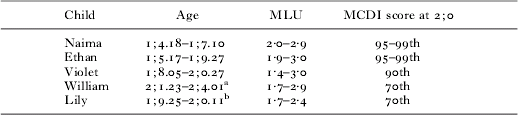
The participants were five normally developing children with no clinically diagnosed neurological, motor control or hearing deficits. All had enrolled with their parents in a two-year longitudinal study of phonological and morphological development. Recording began around one year or once the parent reported that the child was producing approximately four words. Three of the participants were girls (Naima, Violet and Lily) and two were boys (Ethan and William). Two of the children (Naima and Ethan) were precocious, beginning to speak at around 0 ; 11, whereas the others exhibited more ‘normal’ development. The data examined for this study began during the first session when a sufficient number of both footed and unfooted target article contexts were present, and ended once both footed and unfooted articles were produced in approximately 60% of obligatory contexts. Table 1 shows the age range during which articles were being acquired, the MLU range during that time and the percentile score on the long form of the MacArthur Communicative Development Inventory (MCDI) (Fenson et al., Reference Fenson, Dale, Reznick, Thal, Bates, Hartung, Pethick and Reilly1993) at age 2 ; 0. The sixth child in the Providence Corpus was not included in this study due to slower overall development (15th percentile on the MacArthur CDI at 2 ; 0), resulting in a lack of sufficient article tokens for analysis.
Participants' information

a William started producing articles before 2 ; 1, but had insufficient target footed article contexts until 2 ; 1·23.
b Lily's final session came from two recordings, at 2 ; 0·04 and 2 ; 0·11. These have been collapsed and represented as 2 ; 0·11.
Coding
We examined the acquisition of articles in each child's speech. First, we identified all target contexts where a or the was obligatory. Any utterances where the article context was potentially ambiguous (such as utterances containing referents that could be interpreted as proper names (e.g. Lowly Worm), or as part of a list (e.g. dog, cat, mouse) where an article would not be appropriate), were excluded from the analysis.
The remaining utterances were then subjected to further culling. Identical repetitions were counted only once. Utterances where the lexical content preceding or following a target article was not clear, or where the target utterance was ambiguous, were excluded from the analysis. For example, consider the utterance in (10), where an article was produced as part of a foot, but the child's utterance was ungrammatical. It was therefore not clear if the child's target was ‘put on a leash’, ‘put a leash on’ or the ungrammatical ‘put a leash’.
(10) he gonna put a leash [ˈhigõpʊʔ eɪˈliʃ] (Ethan, 1 ; 9.27)
The final set of utterances was parsed into Sw feet using the metrical grid, as illustrated in (8). Target articles were then coded as occurring in either a footed or unfooted context, in accordance with adult-like target forms. In the majority of cases the target article was clearly either part of a Strong–weak trochaic foot (11a), or was unfooted (11b), similar to the experimental stimuli used in Gerken (Reference Gerken1996).
(11a) Footed Article [it's a]Ft [bag]Ft
(he) [wants the]Ft [dog]Ft
(11b) Unfooted Article (a) [star]Ft
(he's) [kicking]Ft (the) [dog]Ft
Coding for the remaining few cases where footing was not as straightforward (about 10% of the data) employed the following procedures: articles following unreduced monosyllabic prepositions were coded as footed, as in (12).
(12) Footed Article [climbed]Ft [on the]Ft [mattress]Ft
[put it]Ft [on the]Ft [table]Ft
In sentences containing an initial disyllabic word, target articles following the unreduced form of the auxiliary/copula ‘is’ were coded as footed (13a), whereas target articles following the contracted/cliticized form were coded as unfooted (13b).
(13a) Footed Article [Mommy]Ft [is the]Ft [dragon]Ft
(13b) Unfooted Article [Mommy's]Ft (the) [dragon]Ft
In sentences containing an initial monosyllabic word, target articles following the contracted/cliticized form of ‘is’ were coded as footed (14ai) and target articles following the unreduced form were coded as unfooted (14b). However, if there was a breath/pause between the initial monosyllabic word and ‘is’ (14aii), a target article was coded as footed with the auxiliary/copula. In such cases, the child's actual utterance (as well as the target utterance) was taken into account.
(14a) Footed Article (i) [Tom's the]Ft [dragon]Ft
(ii) [Tom]Ft # [is the]Ft [dragon]Ft
(14b) Unfooted Article [Tom is]Ft (the) [dragon]Ft
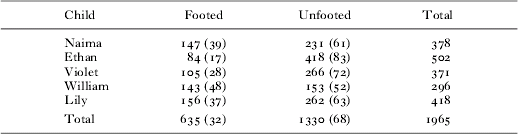
The total number of target footed and unfooted articles considered for final analysis is presented in Table 2. Note that, for most of the children, the contexts for unfooted articles are much more numerous than those for footed articles. Although this did not appear to influence the results (as attested by similar findings despite different proportions across children), it does mean that we may be seriously underestimating children's ability to produce and use articles if the majority of these occur in prosodically marked, more challenging phonological contexts.
Number (percent) of target articles in footed and unfooted contexts

Once target articles were coded for prosodic context, the utterances were coded for whether the article was actually produced (in full or reduced ‘filler syllable’ form (cf. Peters, Reference Peters1983)) or omitted. Examples of target footed and unfooted articles are provided in (15) and (16) respectively. The (a–d) examples include cases where the article was produced, and the (e–h) examples include cases where the article was omitted.
(15) Examples of footed articles
Target utterance Child production Child Age
(a) Dressed up [like a]FT witch. [ˈdwεst əp ˈlaɪkə ˈwɪt] Naima 1 ; 7.10
(b) [It's a]FT lamb. [ˈɪtsəˈwæm] Violet 1 ; 9.25
(c) [And an]FT egg. [ˈεnə ˈεg] Lily 1 ; 11.7
(d) [Where's the]FT cake? [ˈwʌzəˈkeɪk] William 2 ; 4.1
(e) [Hug the]FT person. [həgˈpɚsɪn] Naima 1 ; 5.11
(f) Barking [at the]FT moon. [ˈbupeɪæ ˈmoːn] Ethan 1 ; 8.22
(g) Oh I draw right [on the]FT floor! [ˈo ˈʌ ˈdwɑ ˈwaɪt ˈʌn ˈfwoə] Lily 1 ; 10.8
(h) Look [on the]FT chair. [ˈlʊk ɑn ˈtʃεə] Violet 1 ; 10.12
(16) Examples of unfooted articles
Target utterance Child production Child Age
(a) Watching (the) cat. [ˈwɑtʃɪŋ dəˈkæt] Naima 1 ; 7.10
(b) He's being (a) shark? [ˈhi biːɪŋ əˈʃɑk] Ethan 1 ; 8.22
(c) (The) water spilled. [ˈdʌˈwɑdəˈsbɪw] Lily 1 ; 11.7
(d) (A) bulldozer. [əˈbʊldoƷɪ] William 2 ; 4.01
(e) (A) spider, (a) spider. [ˈpaɪdə sdeɪdə] Naima 1 ; 5.11
(f) Rolly (the) roller. [ˈɔleɪ ˈrolə] Ethan 1 ; 7.14
(g) (A) puzzle piece? [ˈpʌˈtuˈpi] Violet 1 ; 9.25
(h) (A) farm. [ˈfʌm] William 1 ; 10.10
Results of the corpus study
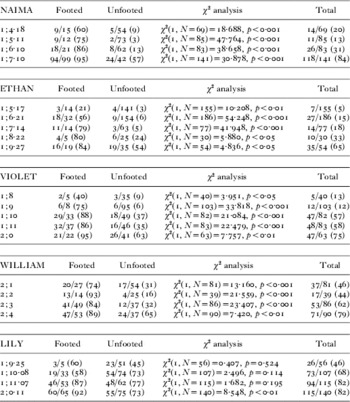
Recall that the Prosodic Licensing Hypothesis makes the prediction that articles will be acquired earlier in footed as opposed to unfooted contexts. Children's production of both footed and unfooted articles, as a function of appearance in obligatory contexts, was therefore calculated for each recording session examined. The number of tokens for each context, and totals for each child, are presented in Table 3.
Number (percent) of target footed and unfooted articles produced

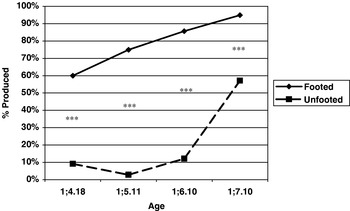
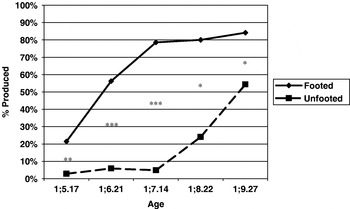
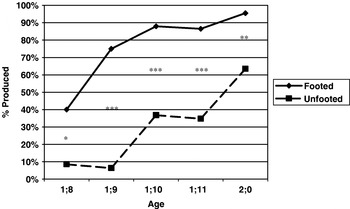
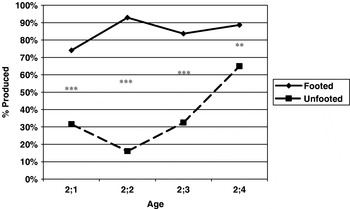
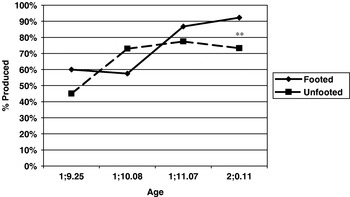
Although the number of article tokens in some early sessions was low, the results show striking support for the Prosodic Licensing Hypothesis, where footed articles were consistently produced at higher overall rates than unfooted articles for all children except Lily. This is visually illustrated in Figures 1–5 (where significance levels correspond to those in Table 3: * p<0·05, ** p<0·01, *** p<0·001).
Naima's footed and unfooted article production.

Ethan's footed and unfooted article production.

Violet's footed and unfooted article production.

William's footed and unfooted article production.

Lily's footed and unfooted article production.

The results of the corpus study demonstrate that four of the five children showed consistently earlier production of footed as opposed to unfooted articles. This confirms our hypothesis that, at the early stages of acquisition, children are more likely to produce articles that are prosodically licensed. Thus, our results are consistent with both the English cross-sectional findings (Gerken, Reference Gerken1996) and the longitudinal developmental patterns from Sesotho (Demuth & Ellis, Reference Demuth, Ellis, Guo, Lieven, Ervin-Tripp, Budwig, Özçaliskan and Nakamurain press) and French (Demuth & Tremblay, Reference Demuth and Tremblay2008).
However, the fifth child (Lily) showed no production advantage for footed articles until the age of two. Unlike the other children, she also produced unfooted articles at a much higher rate than expected, and footed articles at a somewhat lower rate. During the coding process for the corpus study it was noted that many of Lily's articles were transcribed as being ‘stressed’. Although stress is difficult to reliably transcribe, and difficult for learners to reliably produce, follow-up auditory inspection of the recordings found a long interval of silence between her words and articles. This suggested that Lily was producing her articles as independent prosodic words, and that this may have accounted for the lack of early difference in her rate of footed and unfooted article productions. To explore this issue more closely, we therefore conducted an acoustic analysis of Lily's article productions, examining how this changed over time.
THE ACOUSTIC STUDY
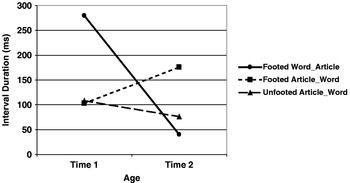
Lily's rate of unfooted article production was much higher than that of the other children, quickly rising to around 75% accuracy at 1 ; 10·8, where it remained until 2 ; 0·11. During this period Lily's use of articles in footed contexts such as (17a) dramatically increased from 58% to 92%, suggesting that these may have undergone a process of prosodic reorganization. This indicated that Lily may have been producing both types of articles as independent PWs from early in development. If so, we expected to find some acoustic evidence to support this possibility. We therefore conducted an acoustic analysis of Lily's productions, measuring the duration of the interval of silence before and after her articles to see if there was any change in prosodic organization over time. Given her low number of footed contexts at 1 ; 9·25, our acoustic analysis considered data from 1 ; 10·8 (Time 1) and 2 ; 0·11 (Time 2).
Consider the three intervals between the article and preceding/following words in (17).
(17)
If Lily was producing her articles as a separate PW at Time 1, we predicted that there would be a relatively long interval between the article and the preceding word in footed contexts (17a). Since she showed a rapid increase in production of determiners in footed contexts between Time 1 and Time 2, we expected this interval to decrease in duration by Time 2. This would indicate that her ‘footed’ articles were initially produced separately from the preceding word, only later becoming prosodically incorporated into a foot. We also measured the interval between her ‘footed’ article and the following word (17b). Although we did not necessarily expect any change in the length of this interval over time, we anticipated that it might increase once the article and preceding word formed a disyllabic foot. For completeness, we also measured the interval between the article and the following word in the ‘unfooted’ contexts (17c). Since there was no behavioral change in Lily's production of unfooted articles between Time 1 and Time 2, we hypothesized that the length of this interval would show no change. This also served as a control, ensuring that any change in interval length would not be due to an overall increase in speaking rate with age. Finally, we predicted that the length of the interval between the article and the following word in both footed (17b) and unfooted (17c) contexts might be similar at Time 1 if Lily was using a similar strategy for producing them.
METHOD
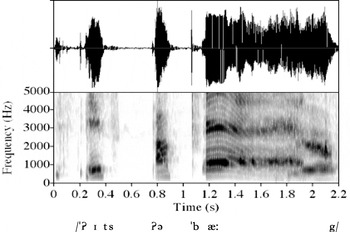
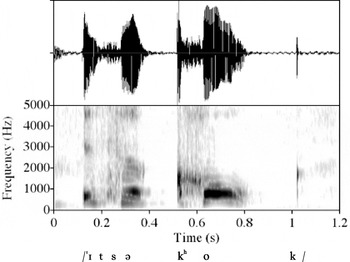
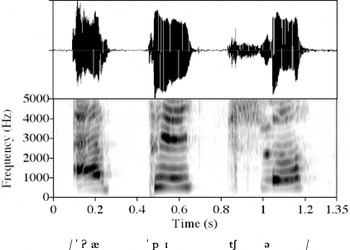
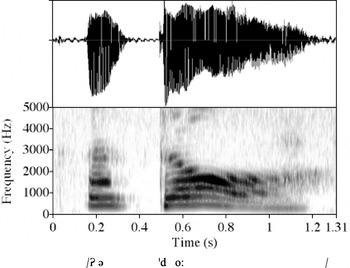
We first extracted all utterances containing articles produced in target footed and unfooted contexts at Time 1 and Time 2, discarding cases with background noise, discourse overlap, or where the acoustics were otherwise not clear. Articles followed by a word beginning with a vowel or a sonorant consonant (m, n, r, l) were also eliminated to enhance the accuracy of interval length measurement (cf. Turk, Nakai & Sugahara, Reference Turk, Nakai, Sugahara, Sudhoff, Lenertová, Meyer, Pappert, Augursky, Mieinek, Richter and Schlißer2006). We then conducted acoustic measurements on the remaining utterances. For articles in footed contexts, a total of 15 and 21 utterances were examined at Time 1 and Time 2, respectively. For the articles in unfooted contexts, a total of 38 and 26 utterances were examined at Time 1 and Time 2, respectively. Both visual (waveform and spectrogram) and auditory cues were used to carry out the analysis using Praat (Boersma & Weenink, Reference Boersma and Weenink2005). Examples of Lily's footed and unfooted articles, produced at both Time 1 and Time 2, are provided in Figures 6 and 7.
Example of Lily's footed article at Time 1 (1 ; 10·8): It's a bag.

Example of Lily's footed article at Time 2 (2 ; 0·11): It's a Coke.

Example of Lily's footed article at Time 2 (2 ; 0·11): It's a Coke.

Example of Lily's unfooted article at Time 2 (2 ; 0·11): A door.

The (17a) intervals between word and article were measured from the offset of the consonant preceding the article (as determined by consonant release or termination of frication) to the onset of the article (often a schwa (indicated by onset of voicing), but sometimes a glottal stop (another indication of ‘stress’ (cf. Figure 6a)), or another consonant). The interval between the article and the following word ((17b) and (17c)) was measured from the termination of vowel voicing (rapid fall in voicing and amplitude) to the onset burst or frication of the following obstruent. Approximately half of the measurements (53%) were remeasured by a second coder. The mean difference in agreement was 18 ms (SD 35 ms). As is typical of child speech, there was a large amount of variability in the data. Seven outliers, determined as being two standard deviations from the mean, were therefore excluded from the final analysis.
RESULTS OF THE ACOUSTIC STUDY
The results of the acoustic study are shown in Figure 8. As hypothesized, unpaired t-tests showed that Lily significantly shortened the mean interval length between the article and preceding word in footed contexts from Time 1 to Time 2 (17a) (t(32)=6·643, p<0·001) (Time 1: range 0 ms–561 ms, SD 137 ms; Time 2: range 0 ms–265 ms, SD 72 ms). She also exhibited an increase in the mean interval length between the article and following word in the footed context that approached significance (17b) (t(33)=−1·774, p=0·085) (Time 1: range 0 ms–280 ms, SD 89 ms; Time 2: range 0 ms–475 ms, SD 139 ms). Both findings are consistent with the notion that the article became prosodically reorganized to form part of a foot with the preceding word. However, Lily showed no change in mean interval length between the article and the following word in unfooted contexts (17c) (t(58)=1·352, p=0·181) (Time 1: range 0 ms–369 ms, SD 93 ms; Time 2: range 0 ms–269 ms, SD 82 ms), ensuring that the changes found in the other contexts were not due to artifacts of increased speaking rate. This also indicates that her unfooted determiners continued to be produced as a separate PW. Interestingly, the length of her interval between the article and the following word in both footed and unfooted contexts ((17b) and (17c)) was same at Time 1, confirming our expectation that she was treating all determiners prosodically the same at this point in development. By Time 2, however, there was a significant difference in the length of the interval between these two contexts (t(42)=2·949, p<0·01), providing further evidence that footed and unfooted articles were prosodified differently at this point in Lily's development.
Mean changes in interval length between article and preceding/following word.

Thus, the acoustic analysis shows that, at Time 1, Lily was treating both footed and unfooted articles as separate PWs. Compared with her peers, this resulted in her better performance on unfooted articles (which other children tended to omit), but somewhat worse performance on the footed articles (since these are produced as an independent word rather than prosodically incorporated into the previous word). By Time 2, however, she had begun to produce target footed articles as an internal clitic (3c), a more efficient production process (involving one foot instead of two) that raises her production accuracy to 92%, similar to that of the other children. At this time she still produced her unfooted articles as independent PWs, a process that appears to be more efficient than trying to prosodify them as part of a higher-level PP. These findings raise many questions about the prosodic organization of articles (and other grammatical morphemes) in child (and adult) speech more generally. This is obviously an area for further systematic acoustic investigation, but one that goes well beyond the scope of the present study.
Alternative explanations of the data
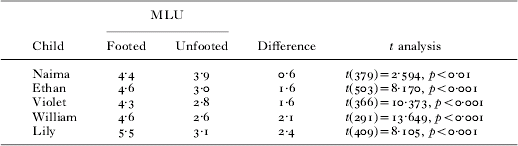
One might wonder if there could be other, non-linguistic explanations of the English data presented in this study. For example, researchers have suggested that utterance length can increase young children's processing load, with a detrimental effect on the production of grammatical morphemes (e.g. Valian, Reference Valian1991). Perhaps the utterances in which unfooted articles were targeted in the current study happened to be longer than the utterances containing footed articles, with the result that the former were more often omitted. To investigate this issue we calculated the mean length of utterance (MLU) (morphemes) for all target utterances containing footed and unfooted articles for each child. If the MLU of utterances with unfooted articles was found to be longer than the MLU of utterances with footed articles, this would support a performance explanation of the data. However, unpaired t-tests indicated that the utterances containing footed articles were significantly longer than those containing unfooted articles for all the children. This is shown in Table 4. Thus, for all five children, utterances with unfooted articles were actually shorter than those with footed articles. A performance limitation account therefore cannot explain the acquisition patterns found in the present study.
MLU of utterances with articles targeted

The finding that utterances containing unfooted articles were shorter than those containing footed articles can be explained by the fact that many of the unfooted articles occurred in simple two-word utterances (e.g. a ball). Perhaps, then, unfooted articles are more likely to be omitted because they often occurred at the beginning of an utterance. However, we suggest that this is unlikely. First, Gerken's (Reference Gerken1996) findings that unfooted articles were more likely to be omitted than footed articles held even when all articles occurred sentence-medially, in object position. Second, children also truncate lexical items that begin with a weak, unstressed syllables until the age of 2 ; 0 or 2 ; 6 (e.g. banana>nana), and many of these occur in sentence-final (object) position. Thus, lexical items are also truncated in order to conform to a metrical unit, or foot, with unfooted lexical material often omitted in children's early speech (e.g. Demuth, Reference Demuth and Beckman1995; Pater, Reference Pater1997; Carter & Gerken, Reference Carter and Gerken2004). Interestingly, McGregor & Johnson (Reference McGregor and Johnson1997) found greater omission of articles than word-initial unstressed syllables in the spontaneous speech of two-year-olds. This is possibly due to the fact that the weak initial syllable of a lexical item is prosodified as part of the PW, whereas an article is prosodified at the higher level of the PP (3b) (e.g. Selkirk, Reference Selkirk, Morgan and Demuth1996; see Gerken (Reference Gerken1996) for discussion)). Perhaps this higher level of structure is acquired later, once children's prosodic representations are more fully developed (cf. Demuth & Tremblay, Reference Demuth and Tremblay2008). Future research will be needed to more thoroughly explore this issue, in both English and other languages.
Throughout this study we have assumed that children treat target articles as distinct grammatical units. But perhaps the footed articles are merely prosodic place holders, or lexicalized forms with no grammatical status, as proposed by Peters (Reference Peters1983) and others. We think this is unlikely, since the children in our study showed within-speaker variability in the production of the article in the same target context (e.g. and (a) leaf and a starfish [ˈεn ˈwiv ˈεnə ˈstofwʌθ], Lily, 1 ; 11·7), suggesting that these are not frozen lexicalized forms. In contrast, disyllabic lexical items of this prosodic shape (a trochaic foot) typically do not show this type of variable production at this stage of development. Further examination of the data found that possible collocations (e.g. that's a, it's a, and a) accounted for approximately 30% of Lily and William's footed articles, but only 5% of Naima's and Ethan's footed articles, with Violet in between. These differences might be due to the fact that Naima and Ethan were extremely precocious, perhaps having less formulaic speech in general. Recall, however, that all of the children showed similar patterns of article development except for Lily, who produced articles as separate PWs. We therefore think it unlikely that differences in the production of footed versus unfooted articles are due to a lack of morphological analysis. A larger study with more children would be needed to further explore the possible effects of such individual differences on article development.
DISCUSSION
This study examined the emergence of articles in five English-speaking one- to two-year-olds. Consistent with the Prosodic Licensing Hypothesis, most of the children were more likely to produce their early articles in unmarked prosodic contexts as part of a disyllabic foot. These results confirm and extend Gerken's (Reference Gerken1996) findings from elicited imitation tasks, and are consistent with cross-linguistic longitudinal findings from prosodically different Sesotho and French. The study further showed that this pattern of development is due to constraints on phonological (i.e. linguistic) representations, and cannot be handled by accounts appealing to non-linguistic, performance factors.
This study also found that one child showed a different pattern of development, producing both footed and unfooted articles with the same accuracy for several months. Further acoustic analysis revealed that she produced all articles as separate prosodic words, resulting in high patterns of production for unfooted articles. However, by the age of 2 ; 0, her footed articles were produced as part of a disyllabic foot, showing higher levels of production consistent with the other children in the study. Thus, for this child, learning the prosodic organization of articles evolved over several months. This raises the possibility that other children might show a similar pattern of development, taking time to prosodify determiners in an adult-like fashion. Further longitudinal study with additional children will be needed to more fully explore the extent of this and other types of individual variation.
The results of this study demonstrate that children's developing phonologies, rather than syntactic or semantic limitations, account for much of the variability in children's early article use. Given what we know today about infants' rapidly emerging perceptual abilities, this should come as no surprise. These findings also raise the possibility that other grammatical morphemes may be subject to prosodic constraints. Gerken (Reference Gerken1996) showed that English-speaking children's pronouns exhibit a sensitivity to metrical structure that is similar to that found with articles. Recent findings from the acquisition of English inflectional morphology provide further evidence that phonological limitations may underlie children's variable production of tense morphemes. For example, Marshall & van der Lely (Reference Marshall and van der Lely2007) showed that older children with language delay perform worse on past tense morphemes when these occur in complex syllable structures. These children are more likely to produce the past tense morpheme in a word like sewed than in a word like yelled or danced, where the past tense -t/d morpheme forms part of a consonant cluster. Similarly, the children in the present study showed syllable structure complexity effects with third person singular -s/z, where this morpheme was more likely to be produced when it occurred in a word with a simple coda consonant like sees than in a word with a more complex coda cluster as in hits (Song et al., Reference Song, Sundara and Demuthin submission). These studies suggest that some of the variable production of inflectional morphemes in English may interact with syllable structure complexity. That is, as with articles, children's early inflectional morphemes tend to appear earlier in prosodically unmarked structures.
Taken together, these findings suggest that morphosyntactic development and phonological (prosodic) development are more closely linked than often assumed. This has important methodological implications for the study of children's early syntactic abilities. One way to address this issue is to use prosodically unmarked contexts (e.g. disyllabic feet, simple syllable structures) as the benchmark for determining children's knowledge of morphosyntax, in both the study of longitudinal corpora and in experimental design. This should lead to a better understanding of children's early syntactic abilities, with implications for theories of language development more generally. The Prosodic Licensing Hypothesis thus provides a framework for making testable predictions about the contexts in which early grammatical function items should be most likely to appear, both within and across languages.