Introduction
The potential for incidents involving large numbers of patients (mass-casualty events) remains high.Reference Goh1 Mass-casualty triage training is a complex learning modality involving the interaction of cognitive and psychomotor skills.Reference Williams, Sullivan and Suner2, Reference King, Patel, Feinstein, Earle, Topp and Proctor3 Although various triage training methods have been developed, none have been validated.Reference Lerner, Schwartz and Coule4 In addition, initial triage training is highly susceptible to skill decay and non-transference. Skill decay refers to the loss or attenuation of trained or acquired skills and knowledge after extended periods of nonuse. This phenomenon is particularly salient and problematic in situations where individuals receive initial training on skills and knowledge that they may not be required to use or may not have the opportunity to perform for extended periods of time. Although trainees may experience extended periods of nonuse and lack of retraining, they are still expected to perform at high proficiency levels should an emergency or disaster arise. Consequently, the extent to which initial triage skills decay over time is of potential vital importance and value. Previous research on triage skill decay is lacking, thus rendering tenuous generalizations of automatic transference of skills to real-world contexts.
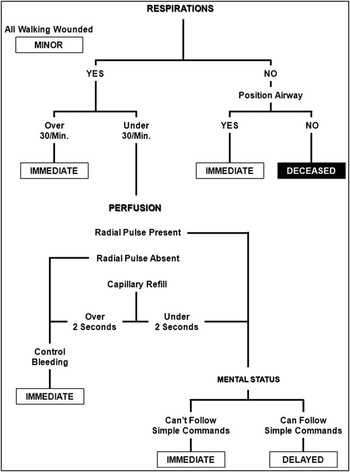
The purpose of this study was to compare the effectiveness of training prehospital providers to master mass-casualty triage skills through video instruction with subsequent application in both written and moulage scenarios. In this study, the Simple Triage and Rapid Treatment (START) method (Figure 1) was utilized.Reference Arnold, Cleary, Groth, Hook, Jones and Super5 Independent variables included type of instructional design (written scenarios or moulage), time-dependent knowledge retention (measured initially and at six months), and level of prior training (emergency medical technicians (EMTs) and emergency medical technician paramedics (EMT-Ps). Influences of these independent variables were analyzed on a dependent variable of test scores representing participants’ performance on an exam measuring triage skills. This study fills a void in the literature on mass-casualty triage skill decay after an extended nonuse period.
START Triage Algorithm

Methods
Institutional Review Board approval was obtained at a level II trauma center for a convenience sample of 45 prehospital providers (both EMTs and EMT-Ps) who consented to participate. Power analysis was based on the accuracy of 55% prior to the educational intervention, as determined in a previous study,Reference Risavi, Salen, Heller and Arcona6 and 85% sensitivity, yielding a minimum of 20 subjects required. Each participant was trained in the START method using a video presentation demonstrating the triage parameters. Each participant completed both a written and moulage scenario initially, consisting of 12 patients in each group. This was repeated six months later to assess learning retention. To minimize selection bias, 28 subjects completed the written scenario prior to the moulage, and 17 completed the moulage first. Six months later, 25 subjects completed the written scenario first, while 20 completed the moulage first. Inclusion criteria included certified EMTs or EMT-Ps; there were no exclusion criteria. Data were analyzed using parametric methods, although a non-normal distribution of data was noted. Normal probability plots and convergence of mean and median estimators suggested that parametric tests be used.
Results
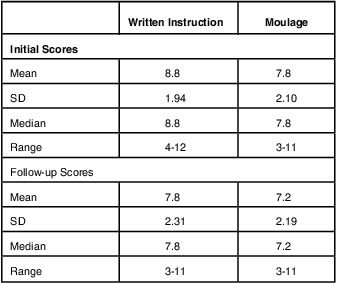
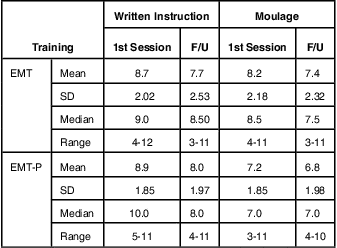
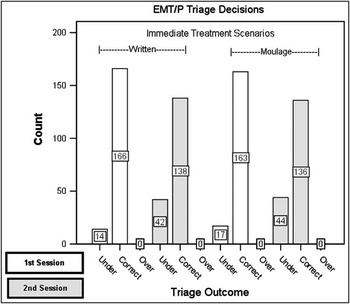
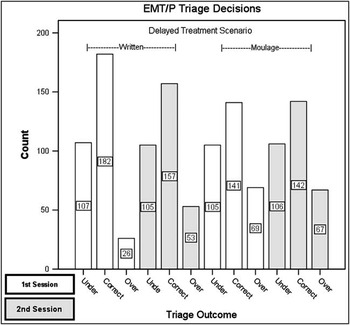
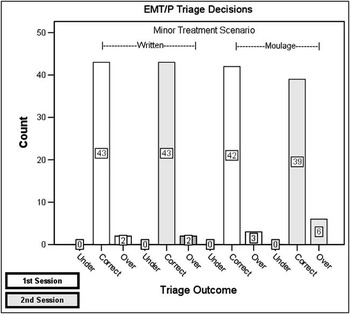
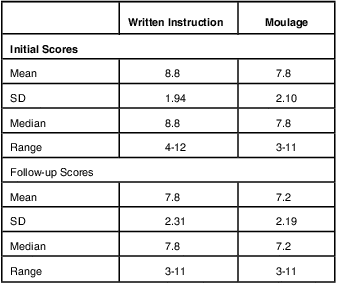
Forty-five prehospital providers completed the study protocol. There were 28 EMTs (62%) and 17 EMT-Ps (38%). Long-term retention of triage skills decreased significantly (P < .05) over time (Table 1) for both instructional designs. Mean scores for the written scenario decreased from 8.8 initially to 7.8 after six months (number correct based on 12 patients) and mean scores for the moulage decreased from 7.8 initially to 7.2 at six months. There were no significant differences on subsequent triage test scores between the written or moulage scenarios, either initially or at six months, and sequencing of that instruction (written or moulage first) had no significant effect on test scores. Level of prior training (EMT or EMT-P) yielded no significant differences on subsequent triage test scores regardless of instructional design or sequence. Written scenario mean triage test scores for EMT and EMT-P, taken initially, were 8.7 and 8.9, respectively, and at six months were 7.7 and 7.4, respectively. Moulage scenario mean triage test scores for EMT and EMT-P (taken initially) were 8.2 and 7.2, respectively, and six months later were 7.4 and 6.8, respectively (Table 2). The issue of under and overtriage was reviewed as well. Data were evaluated based on triage categories: red (immediate), yellow (delayed), and green (walking wounded) (Figures 2–4). The immediate category showed slight undertriage, though significant undertriage was noted in all groups tested. The greatest degree of variability was in the delayed group. This group also had significantly less overtriage. The delayed group, however, demonstrated minimal overtriage.
Summary Data, Mass-Casualty Scores for Written Instruction or Moulage Training
Effect of Background/Training
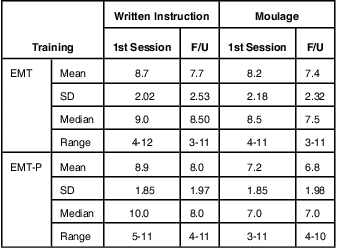
Abbreviations: EMT, Emergency Medical Technician; EMT-P, Emergency Medical Technician-Paramedic; F/U, follow up
Triage Outcome: Immediate Treatment Scenarios

Triage Outcome: Delayed Treatment Scenarios

Triage Outcome: Minor Treatment Scenario

Discussion
Mass-casualty events are relatively rare. Such events, however, can easily overwhelm medical resources, both prehospital and hospital-based. The primary focus must be identifying the minority of patients with critical injuries and focusing appropriate resources on those patients who are likely to survive if treatment is rendered in a timely manner.Reference Frykberg7 Recognizing the infrequency of use and less than optimal sensitivity of current triage methods, it is reasonable to expect that a concerted effort to reassess patients via layers of triage in an expeditious yet organized fashion might improve sensitivity by separating critical from non-critical patients.Reference Lerner, Schwartz and Coule4, Reference Jenkins, McCarthy and Sauer8, Reference Beekley9 By becoming more thorough in terms of physical assessment, each layer of triage would assist in matching limited resources with the most seriously injured patients; this could be accomplished via casualty collection stations. This may permit the most critical patients to be evacuated first.Reference Waeckerle10
Triage is, by its very nature, a dynamic process. So too is trauma. As patients’ conditions change, so must the assessment. An ideal triage method must meet the following criteria: simple, efficient, have predictive validity, reliable over all hazards, and accurate.Reference Armstrong, Frykberg and Burris11 There are numerous triage methods, including the newly proposed SALT (sort, assess, life-saving interventions, transport) method.Reference Lerner, Cone and Weinstein12 None of these methods has been validated or otherwise subjected to rigorous evaluation. While some methods are clearly too complicated and not likely beneficial in the real-time constraints associated with an actual mass-casualty event, others have yielded conflicting results.Reference Sacco, Navin, Fiedler, Waddell, Long and Buckman13, Reference Zoraster, Chidester and Koenig14 There are many confounding variables affecting the ability to perform triage in a mass-casualty setting. The level of training of personnel, length of time required for personnel to perform triage, and the extent to which personnel follow the triage method are important considerations.Reference Roccaforte15-Reference Cook17 The overall number of patients may in fact decrease the quality of care.Reference Hirshberg18 Geography may affect triage due to the availability of numbers/types of resources (such as rural versus suburban). The accuracy of the triage method and the ability of providers to correctly apply the method are important considerations as well. Currently, there exists no universally accepted triage method for mass-casualty incidents.
In performing mass-casualty triage, many scoring systems have been developed to predict mortality; none, however, have the ability to predict which patients are likely to survive. Emergency Medical Services providers’ judgment, based on injury severity perception, appears to play a role in the triage process.Reference Kahn, Schultz, Miller and Anderson19 Simmons et al reported that advanced EMTs were able to recognize the need for trauma center evaluation of patients, even in the presence of normal physiologic parameters. The authors also noted that provider judgment alone was insufficient with respect to triage decisions.Reference Simmons, Hedges, Irwin, Maassberg and Kirkwood20 Emerman et al reported that EMS providers (both basic and advanced) also could correctly identify patients at risk for mortality and in need of trauma center referral; their judgment was benchmarked against three trauma scores (Revised Trauma Score, Prehospital Index, and CRAMS (Circulation, Respiration, Abdomen, Motor, and Speech)). Emphasis was placed on identifying physiologic abnormalities, mechanism of injury, and anatomic site of injury.Reference Emerman, Shade and Kubincanek21 Frykberg has suggested the optimal measure of mass-casualty triage success is the critical mortality rate.Reference Frykberg7
It is also important to examine patient characteristics in mass-casualty events. Although the majority of mass-casualty events are trauma-related, large numbers of patients may have pre-existing illnesses.Reference Buerk, Batdorf, Cammack and Ravenholt22, Reference Okumura, Takasu and Ishimatsu23 A review of four Disaster Medical Assistance Team (DMAT) deployments revealed that high numbers of low acuity patients were treated (four natural disasters and a total of 2,255 patients, with a mean age of 30). The most common injuries/illnesses were upper respiratory infections, wounds, and musculoskeletal pain. Less than ten percent of these patients were transported to the hospital.Reference Nufer, Wilson-Ramirez, Shah, Hughes and Crandall24 In a study of 20 mass-casualty incidents, primarily due to terrorist bombings in Israel, Alfici et al noted that only 14% were seriously injured, while approximately 50% had acute psychological stress reactions.Reference Alfici, Ashkenazi and Kessel25
Analysis of the 1983 Beirut Airport terminal bombing demonstrated that 78% of patients had non-critical injuries. Head injury was the most common injury associated with death.Reference Frykberg, Tepas and Alexander26 Garner et al reported that the motor component of the Glascow Coma Score was correlated with severe injury, as was systolic blood pressure (less than 80 mmHg).Reference Garner, Lee, Harrison and Schultz27 Meredith et al studied nearly 30,000 patients and determined that the motor component of the Glascow Coma Score was a marker for mortality in trauma patients, as measured by the ability to follow simple commands.Reference Meredith, Rutledge and Hansen28 Burns also were associated with mortality. The New York City surgical response of two hospitals involved with the terrorist attacks of September 11, 2001 revealed 911 patients who presented for care. Seven hundred seventy-six (85%) patients were walking wounded. Only 135 were admitted, 18 (13%) of whom underwent surgery. The majority of injuries were orthopedic, multiple trauma, or burns.Reference Cushman, Pachter and Beaton29 A review of the Olympic Centennial bombing in Atlanta found that 111 patients with injuries secondary to shrapnel were evaluated and treated, the majority with excellent outcomes.Reference Feliciano, Anderson and Rozycki30
When faced with large numbers of patients, overtriage is a concern. A number of studies have documented a correlation between overtriage rates and mortality.Reference Frykberg7 This, however, has been disputed by other authors. Aylwin et al studied the London terrorist bombings of 2005 and revised their prehospital as well as hospital responses. Four bombs, each at a different location, were detonated within one hour. There were 775 injuries with 56 fatalities (53 on-scene). Overtriage was reported to be 64% (35/55 critical patients). The critical mortality rate was 15%, lower than that of similar events. The authors’ assessment was that the critical mortality rate appeared to be unrelated to overtriage. The authors further asserted that the rapid access to definitive care, medical personnel performing their duties in their normal environment, and rapid evacuation from the scene were the most important components contributing to the low critical mortality rate. Equally important, the authors suggest that overtriage, as well as undertriage, may be reduced by a global reassessment and reprioritization at each stage when resources are outstripped by demand.Reference Aylwin, König and Brennan31 Cushman et al reviewed the surgical response of two New York City hospitals on September 11, 2001 and found that explosions typically result in small numbers of critical patients. The majority (85%) are walking wounded.Reference Cushman, Pachter and Beaton29 In fact, only 56 of 911 patients were admitted to a surgical service. There have been two studies, utilizing models, which analyzed overtriage. The first evaluated, via a computer model, the system response involving between 50 and 1,000 patients. The results demonstrated the greatest effect on critical mortality from the ratio of critical patients to treatment capability. The authors noted, however, that overtriage may have significant, minimal, or no impact in the model.Reference Hupert, Hollingsworth and Xiong32 The authors discuss in some detail the statistical reality that decreased numbers of critical patients in relation to total number of patients may increase the potential for false positive results, ie, overtriage. They concluded that the actual mortality rate was related to overtriage in a non-linear fashion. The sigmoid-shaped curve depicts the system response to surge capacity, recognizing that treatment capability decreases gradually as the number of patients increases. As the two studies were models, they are certainly not meant to provide a definitive answer for mass-casualty triage, but rather were meant to assist in developing further research questions by examining a specific component of the process based on the assumptions of the author.Reference Hirshberg, Frykberg, Mattox and Stein33
Recent data from the military experience in Iraq has provided greater understanding of the important role of physiologic parameters as a triage tool. Husum et al determined that a respiratory rate >25 was useful in predicting death from trauma. Although their dataset was small, respiratory rate >25 after assessment, bleeding control, volume resuscitation, and analgesia was a sensitive indicator. The authors acknowledged limitations, including pain control.Reference Husum, Gilbert, Wisborg, Van Heng and Murad34
In a study of manual vital signs, Halcomb et al studied the use of manual versus automated vital signs and determined the probability of needing lifesaving intervention. In 381 patients, the motor and verbal components of the Glascow Coma Scale and the radial pulse character were useful in predicting the need for lifesaving interventions in non-head injured patients (>88% after abnormal findings of these two parameters).Reference Holcomb, Salinas, McManus, Miller, Cooke and Convertino35 McManus et al also studied pulse character and its correlation with systolic blood pressure in 342 patients. The majority had suffered blunt trauma; however, there were patients who sustained penetrating trauma. Patients with weak radial pulses had a 29% mortality rate and were five times more likely to be admitted to an intensive care unit that those with a normal radial pulse, who had a three percent mortality rate.Reference McManus, Yershov and Ludwig36
As patients undergo assessment during triage, it is worth noting the study by Eastridge et al regarding blood pressure and hypotension. An analysis of over 81, 000 patients in the National Trauma Data Bank revealed a significant relationship between systolic blood pressure and mortality/complication rates. A systolic blood pressure of ≤110 resulted in substantial increases in mortality and complication rates. A maximum of 26% mortality was identified at a systolic blood pressure of 60 mmHg. The authors acknowledge the fact that this definition of hypotension is a diagnostic aid only. Nonetheless, it represents an important marker for hypovolemia, given the significant mortality from hemorrhagic shock.Reference Eastridge, Salinas and McManus37 Hasler et al reported similar findings with respect to penetrating trauma.Reference Hasler, Nüesch, Jüni, Bouamra, Exadaktylos and Lecky38 Systolic blood pressure <110 mmHg was associated with increased mortality, doubling at a systolic blood pressure of 90-109 mmHg, and four-fold higher at 70-80 mmHg.
Additionally, Almogy et al reviewed 15 suicide bombings in Israel and determined that external evidence of trauma was helpful in identifying blast lung injury and in distinguishing between those patients who were salvageable versus non-salvageable. The 798 survivors and 153 fatalities reviewed caused the authors to conclude the following: patients with skull fractures, burns covering more than ten percent total body surface area, or penetrating injury to the head/torso were more likely to experience blast lung injury. Burns, open fractures, and amputations were associated with mortality.Reference Almogy, Luria and Richter39 Thus, the data support the role of both physiology and anatomic criteria as important components of mass-casualty triage.
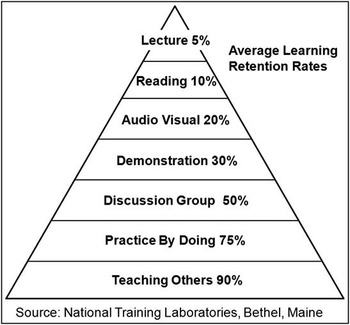
Given the limitations of current triage methods, including under and overtriage, the process of educating EMS providers clearly plays a critical role in the management of mass-casualty incidents. Curriculum design is an important component and must take into account the educational content of an infrequently-used process to bridge the gap between knowledge and competency/retention. The degree of retention is highly variable, based on the teaching methodology utilized. The learning pyramid (Figure 5) indicates that retention improves as one descends the pyramid.40 This corresponds to more active engagement of the learner in the learning process. Using multiple modalities, learners can immediately apply what is learned in a given educational session, thereby enhancing retention.
The Learning Pyramid

Skill decay represents loss of knowledge/skill after a period of nonuse. Major factors influencing decay are retention interval (the longer the period of nonuse the higher the decay), and degree of overlearning, or learning beyond that required for proficiency. Both factors result in more confidence and decreased stress/anxiety for the learner. Skill retention depends on how information was encoded into memory and the types of cues present at retrieval. The encoding specificity principle states that retention will be maximized if the conditions at retention assessment match as closely as possible to those present during the original learning.Reference Arthur, Bennett, Stanush and McNelly41 Similarity between the condition or context of the recall situation (the retention environment) and those of the original learning (the learning environment) allows the stimuli of the learning environment to provide cues that enhance retrieval of information from memory. Performance appears to be improved via an organized and comprehensive knowledge base rather than superior memory skills.Reference Patel, Glaser and Arocha42
It is clear that competency and skill retention are important components of training in an infrequently used process. Competency, or mastery learning, first requires well-defined goals and objectives to describe what the learner is expected to accomplish.Reference Harden43 The testing effect has been shown to enhance retention, including format of testing (ie, recognition versus production). Tests requiring effortful recall of information, such as short-answer, fill-in-the-blank, essay), promote improved retention compared to recognition-type tests (such as, multiple choice).Reference Larsen, Butler and Roediger44 It appears that repeated retrieval through the testing process enhances retention.Reference Karpicke and Roediger45 The spacing out of testing is also important for repeated recall. Kerfoot et al evaluated online spaced education (via E-mail) using urology residents. The focus was on studying the transfer of histopathology diagnostic skills. The learning occurred over the first 16 weeks, with retention assessed at weeks 18-45 in four modules (each three weeks long). The authors utilized a question-and-answer format, taking advantage of the testing effect. Results indicated improved retention during weeks 18-45.Reference Kerfoot, Fu, Baker, Connelly, Ritchey and Genega46 Formative evaluation instruments are also important as learners progress through the educational process, using directly observable and measurable data.Reference Bell, Kozakowski and Winter47 Through feedback, encouragement, and direction, formative evaluation seeks to shape, grow, and develop the learner. It reinforces that which has been done correctly, identifies areas for improvement, and corrects mistakes. Providing adequate time for achieving mastery, and availability of a variety of teaching strategies also facilitates competency. Thus, competency is a process whereby one achieves mastery of skills/knowledge, and practical application of knowledge. A well-organized knowledge base is the goal in order to recognize configurations of stimuli which are critical to triaging patients in mass-casualty incidents.
The focus of instructional design and techniques is to facilitate the acquisition of knowledge and skills in the training environment, to be transferred later to a second performance environment, typically the job. Competency, thus, is results-driven. Learners progress from the novice to the mastery level via a structured curriculum with multiple learning modalities which permit students to be exposed to new knowledge, acquire knowledge, and integrate that knowledge into a coherent whole.Reference Paukert and Richards48 It is important to note that the learning process is dynamic. Active participation, repetition, and reinforcement strengthen and enhance learning. Finally, variety in learning activities stimulates interest and the immediate use of the information/skills in a formal course of instruction, further enhancing retention.
When a mass-casualty event occurs, there becomes the sudden need to make use of a skill under novel circumstances, different from the training lab, and when the skill has gone unutilized for an extensive period of time. The acquisition, retention, and transfer of triage skills are inseparable and need to be considered together when conducting research on triage skill acquisition involving long periods of nonuse, as conducted in the present study. The results of the current study suggest that, given the loss of retention in triage skills over long periods of nonuse, the spacing of practice is an important consideration in the design of training programs because it has been shown to influence learning.Reference Schmidt and Björk49 Massed practice conditions are those in which individuals practice a task continuously with limited breaks. In contrast, distributed practice conditions incorporate appreciable time intervals between practice sessions. Due to the significant loss of retention of triage skills over time, the results of this study suggest using a distributed practice approach. The progressive deterioration of knowledge and skills when they are not used over extended periods of time is well studied and the longer the period of nonuse, the greater the decay.Reference Arthur, Bennett, Edens and Bell50 One obvious strategy to enhance skill retention is to provide opportunities to perform the task during the nonuse interval. Since no differences in task performance were found between moulage and written scenarios, educators may use either approach, basing decisions on ease of implementation and resources needed.
Conclusion
In summary, these data confirm the skill deterioration associated with an infrequently used triage method. Mass-casualty triage trainees frequently do not get the opportunity to practice and perform trained skills after formal training and after an extensive period of nonuse, they may find themselves in need of these skills.Reference Ford, Quiñones, Sego and Speer Sorra51 Further research to more precisely define triage criteria, as well as the ability to apply the criteria in a clinical setting and to rapidly identify patients as risk for morbidity/mortality, is needed.Reference Zoraster, Chidester and Koenig14