Introduction
Obesity is a significant global health problem, with overweight individuals now seen across populations of children and adults from developed and developing nations. 1 Worldwide, obesity is among the five leading risks for mortality 2 and in several developed populations it has recently become the greatest cause of disease or death.Reference Hoad, Somerford and Katzenellenbogen 3 , Reference Jia and Lubetkin 4 Over 25% of children are estimated to be overweight or obese in developed regionsReference Wang and Lobstein 5 and the prevalence of paediatric obesity is increasing. 1 , Reference Wang and Lobstein 5
Excess weight in childhood is associated with a multitude of short-, medium- and long-term consequences, which have physical, psychological and financial effects. 1 Clearly, reducing the burden of obesity is a public health priority; however, reviewing the treatment of childhood obesity has failed to illustrate the most effective interventions to combat this problem.Reference Oude Luttikhuis, Baur and Jansen 6 This highlights the need to better understand the factors that influence obesity development.
There is evidence that dietary patterns and behaviour related to weight gain are established early in life and may persist with age.Reference Mikkilä, Räsänen, Raitakari, Pietinen and Viikari 7 – Reference Northstone and Emmett 10 There is also growing knowledge that several diseases including obesity, which manifest later in life, have origins stemming back to early periods of development.Reference Barker, Winter, Osmond, Margetts and Simmonds 11 – Reference Hales and Barker 14 Both of these concepts represent important windows of opportunity for early obesity prevention.
Initial research into the developmental origins of health and disease focussed on how antenatal factors such as birth weight influence health and disease later in life. More recently, it has been acknowledged that the phase during which development may be altered is not limited to gestation; rather it extends from the peri-conception period through to the postnatal period.Reference Gluckman, Cutfield, Hofman and Hanson 15 Despite this recognition, the contribution of the early postnatal environment to the developmental origins of obesity, in particular the role of nutrition, is incompletely understood.Reference Gluckman, Cutfield, Hofman and Hanson 15 One aspect that appears to be important is rapid weight gain in early life.Reference Baird, Fisher and Lucas 16 , Reference Monteiro and Victora 17 As weight gain is influenced by current diet, nutrition and energy intake, a greater understanding of the relationship between early postnatal nutrition and weight is required.
A small reduction in the risk of obesity later in life has been observed in breastfed infants compared to formula-fed infants,Reference Horta, Bahl, Martines and Victora 18 although there is no consistent evidence that breastfeeding causally reduces obesity risk.Reference Cope and Allison 19 Specific macronutrients have also been examined in relation to subsequent overweight or obesity;Reference Scaglioni, Agostoni and Notaris 20 , Reference Rolland-Cachera, Deheeger, Akrout and Bellisle 21 however, human diets are comprised of a variety of foods and drinks, therefore there are restrictions associated with examining the diet from the point of view of a single element.Reference Hu 22 The relationship between overall dietary quality in early life and weight later in life is not adequately described in the literature. A handful of studies have explored these links in children,Reference Cheng, Gerlach and Libuda 23 – Reference Kranz, Findeis and Shrestha 26 although the cross-sectional study design in the majority of previous work has been a limitation and provided inconsistent results.
The Western Australian Pregnancy Cohort (Raine) Study is a longitudinal study that has collected dietary and nutrition information from birth to 3 years of age and in adolescence. Comprehensive anthropometric and sociodemographic data have also been gathered from birth up to the age of 17 years. Therefore, it provides opportunities to explore whether early diet influences nutrition and growth later in life. In this study, we investigated whether maternally reported early childhood dietary quality was associated with (a) infant and adolescent nutrition and (b) body mass index (BMI) throughout childhood and adolescence. The degree that early nutrition and growth factors account for BMI in childhood and adolescence was also explored within the Raine cohort.
Methods
Study population
Participants were enrolled in the Western Australian Pregnancy Cohort (Raine) Study, a population-based prospective cohort study in Perth, Western Australia, between May 1989 and November 1991. Initially, 2900 pregnant women were recruited between 16 and 20 weeks’ gestation into a randomized controlled trial to evaluate the effects of repeated ultrasound in pregnancy. Recruitment occurred predominantly at public antenatal clinics at King Edward Memorial Hospital (KEMH), the only tertiary obstetric hospital in Western Australia. Full details of the study are documented elsewhere.Reference Evans, Newnham, MacDonald and Hall 27 – Reference Williams, Evans and Newnham 29 The cohort has been demonstrated to be representative of the population presenting to the antenatal tertiary referral centre in Western Australia.Reference Li, Kendall and Henderson 30 The ethics committees of KEMH and Princess Margaret Hospital granted approval for the study protocols. The primary caregiver, who was the mother in most cases, provided written and informed consent. The parents of 2868 live-born children consented for follow-up at the ages of 1, 2, 3, 5, 8, 10, 14 and 17 years.
Nutrition and dietary data
Nutrition in the first year of life was ascertained from questionnaires administered by study nurses at the 1–3-year follow-up visits. At each visit the primary caregiver was asked whether the child was breastfed; when breastfeeding was stopped; when solid foods were first given; and when other types of milk were introduced. All measures were recorded in months. The duration of exclusive breastfeeding was determined from this information.
At the 1–3-year follow-up assessments the primary caregiver also completed a 24-h dietary recall of their child's diet. This requested a description of the type and quantity of all food and drink consumed for breakfast, lunch, dinner and snacks in 1 day. Accurate quantitative data were not consistently recorded by the caregiver, therefore each time a food or drink was written on the dietary recall, this was considered one ‘eating occasion’ for that particular item. In order to utilize the semi-quantitative dietary data from the Raine cohort, we developed a new index, the Raine Eating Assessment in Toddlers (EAT) score, to provide a measure of overall dietary quality at these ages. This was based on a previously published paediatric dietary index,Reference Feskanich, Rockett and Colditz 24 although it was modified for use with the Raine cohort data. The EAT score was constructed around seven component food groups where there exists evidence of their nutritional benefit or detriment in young children: (1) whole grains, (2) vegetables, (3) fruit, (4) a meat ratio, (5) dairy, (6) snack foods, (7) soda and drinks. Breast milk and breast milk substitutes were not included in the EAT score at any time.
Individuals were assigned a score out of 10 for each component. Components one to five were defined as ‘healthy’ for their nutritional benefitsReference Binns and Baghurst 31 and greater frequency of consumption of foods from these components resulted in scores closer to 10. Components six and seven were defined as ‘unhealthy’ as they are not recommended for young childrenReference Binns and Baghurst 31 and greater frequency of consumption of these resulted in scores closer to zero. The overall score for an individual was determined by the sum of the seven component scores, such that the possible total score ranged from 0 to 70. Individuals with the highest scores were those whose 24-h recalls recorded more healthy foods relative to less unhealthy foods. Therefore, this research defines better dietary quality over the ages of 1–3 years by higher scores and poorer dietary quality by lower scores.
Diet and nutrition were assessed at the 14-year follow-up by a semi-quantitative food frequency questionnaire (FFQ) developed by the Commonwealth Scientific and Industrial Research Organisation (CSIRO).Reference Baghurst and Record 32 The FFQ listed 212 individual foods, mixed dishes and beverages. The frequency of consumption in the preceding 12 months, in relation to standard serving sizes, was estimated. The FFQ was intended for the primary caregiver to complete with the study adolescent, as adolescents and children may be less likely to recall diet well.Reference Nelson and Bingham 33 A research nurse clarified missing responses with the study participant, the FFQ data were entered twice and CSIRO confirmed the data. Additional details of the FFQ and a description of those who completed it are published elsewhere.Reference Ambrosini, Oddy and Robinson 34 , Reference Ambrosini, O'Sullivan and De Klerk 35
From the FFQ information, two major dietary patterns, healthy and Western, were identified through factor analyses in previous research.Reference Ambrosini, Oddy and Robinson 34 All participants received a score for both dietary patterns. Foods loading on the healthy dietary pattern included wholegrain cereals, fresh fruit, legumes, steamed, grilled or canned fish and vegetables, excluding potatoes.Reference Ambrosini, Oddy and Robinson 34 Foods loading on the Western dietary pattern included take-away foods, red meat, processed meat, full-fat dairy foods, fried potatoes, refined cereals, cakes, confectionary and soft drinks.Reference Ambrosini, Oddy and Robinson 34 Estimates of 40 macro- and micronutrients were also calculated, based on usual intakes of the 212 foods listed in the FFQ. The present research utilizes the total grams of carbohydrates, protein, fat, fibre and sugar consumed per day.
Anthropometric assessment
Physical examinations at birth assessed birth weight and length. From these measurements ponderal index was calculated (weight at birth in kilograms divided by the length in metres cubed). Anthropometric data were obtained by physical assessments at the Telethon Institute for Child Health Research. Weight was measured to the nearest 100 g using a Wedderburn digital chair scale with children wearing underclothes. Height was measured to the nearest 0.1 cm with a Holtain stadiometer. BMI was calculated as weight in kilograms divided by the height in meters squared. This study uses BMI at 3, 5, 8, 10, 14 and 17 years of age.
Covariates
Information regarding pregnancy, infant, parental and socioeconomic characteristics was collected from questionnaires and physical examinations at 16–20 and 34 weeks’ gestation, birth, 1–3 years of age. Maternal smoking was assessed in both antenatal questionnaires. Marital status was categorized into those who were married or de facto, and those separated, divorced, widowed or never married. The level of maternal and paternal education after school-leaving was assessed. Family size was evaluated by asking how many other children were at home, in addition to the study participant.
To assess socioeconomic status, cohort members were assigned Socioeconomic Indexes for Areas (SEIFA) scores at each year of follow-up. The SEIFA consist of four indices, each measuring a slightly different aspect of socioeconomic conditions within an area.Reference Pink 36 This research uses the Index of Relative Socioeconomic Advantage and Disadvantage (IRSAD), which measures the spectrum of socioeconomic well-being, from the most disadvantaged to the most advantaged.Reference Pink 36 The IRSAD is based on 21 measures including income, occupation and education within a specific geographical area. Higher IRSAD scores reflect a relative lack of disadvantage and greater advantage.Reference Pink 36
The level of physical activity at age 14 years was determined by asking participants the duration in hours, that they exercised enough to become breathless or sweaty, out of school. To provide a measure of the timing of puberty in females, the year of the first menstrual period was used.
Statistical analyses
Analyses were based on cohort members who answered at least one 24-h recall at the 1–3-year follow-up assessments. Descriptive statistics were calculated for pregnancy, family, anthropometric and nutritional characteristics. Medians and interquartile ranges are presented for continuous variables and numbers and percentages of participants are presented for categorical variables. To evaluate gender differences, the Mann Whitney (U) test was performed on continuous variables and Pearson's χ 2-test was used for comparison of categorical variables.
To assess whether nutrition in the first year of life was correlated with dietary quality over years 1–3, linear regression was performed. Univariate regression involved the Raine EAT score as the dependent variable, with either duration of breastfeeding, duration of exclusive breastfeeding or age of introduction of solids as the independent variable in three separate models. The multivariable linear regression adjusted for the potential confounders of maternal tertiary education, maternal age, maternal smoking, the number of other children at home, IRSAD and age of the study participant.
To determine whether the EAT score was associated with nutrition at 14 years, linear regression was carried out. The EAT score at years 1–3 were the independent variables and dietary elements (carbohydrates, protein, fat, fibre and sugar) were separate dependent variables. Maternal tertiary education, maternal age, number of other children in the home, maternal smoking, age-specific IRSAD, hours of physical activity per week at 14 years, gender and age were included in multivariate analyses to adjust for potential confounding.
Linear regression was also used to determine associations between EAT scores and BMI later in life. The EAT score at years 1–3 were each independent variables in three separate models including BMI at 3, 5, 8, 10, 14 and 17 years of age as dependent variables. BMI was positively skewed from the age of 5 years and older; therefore, BMI variables were log-transformed. Multivariate regression was adjusted for age, birth weight, maternal smoking and age-specific IRSAD. Analyses involving 14- and 17-year-old females were also adjusted for the year of first menstruation.
Gender interactions were explored in all of the linear regression analyses described above. The interaction term in each model consisted of gender and the independent variable for that particular linear model. Significant interaction terms were retained in the regression models. To reduce the potential for a correlated error structure the following covariates were mean-centred: gestational age at birth, birth weight, ponderal index, breastfeeding duration, exclusive breastfeeding, age of introduction of solids, weight gain in the first year of life, child's BMI, IRSAD, maternal age, duration of physical activity at 14 years and fat, protein, carbohydrate, fibre and sugar intake at 14 years.
Analyses were performed using Predictive Analytics Software (PASW) Statistics 17 (SPSS 17). 37 Statistical significance was considered where P < 0.05.
Results
The primary caregiver of 2562 (89%) cohort members answered at least one 24-h recall at the ages of 1, 2 or 3 years. Compared with non-responders, responders were more likely to be older, married, have completed tertiary education and higher IRSAD scores and less likely to smoke (all P < 0.001). The parents who responded were also more likely to have fewer children (P = 0.002), completed tertiary education (P < 0.001) and higher IRSAD scores (P < 0.001). Mothers who answered the recall were more likely to have breastfed their child (P < 0.001) and for a longer duration (P = 0.020), than those mothers who did not respond to the recall.
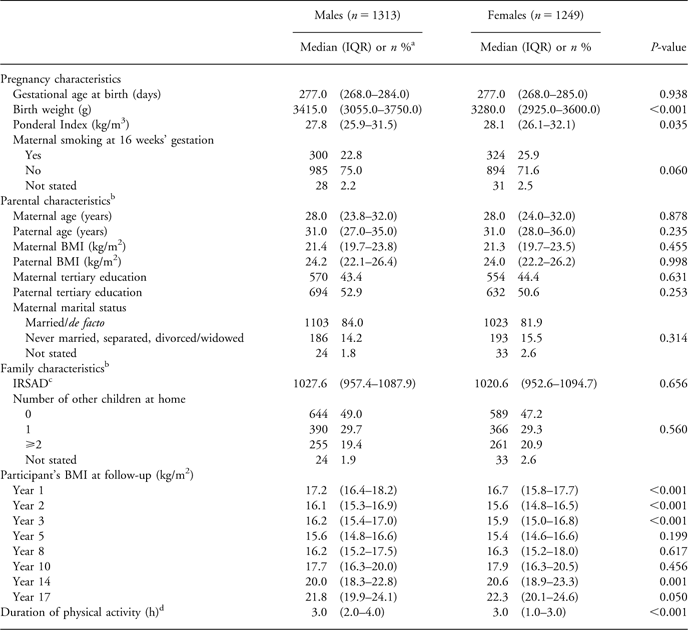
Demographic and anthropometric data are presented in Table 1. Males and females were significantly different for birth weight, ponderal index, BMI in early childhood and adolescence and the duration of physical activity at 14 years. Median BMI increased after 7 years of age with significant differences between males and females at ages 1–3 and 14 years (all P-values ⩽ 0.001, Table 1).
Cohort characteristics: participants who completed at least one 24-h food recall at the 1-, 2- or 3-year follow-ups of the Western Australian Pregnancy Cohort (Raine) Study (n = 2562)

IQR, interquartile range; IRSAD, Index of Relative Socioeconomic Advantage and Disadvantage; BMI, body mass index.
aValues are median and IQR for continuous variables and n % for categorical variables.
bParental and family characteristics ascertained from surveys at 16 and 34 weeks’ gestation.
cCalculated from year 1 follow-up information. Index scores ranges from 683 to 1231, higher scores reflect a relative socioeconomic advantage.
dAt 14 years, h/week undertaken outside of school that cause breathlessness or sweating.
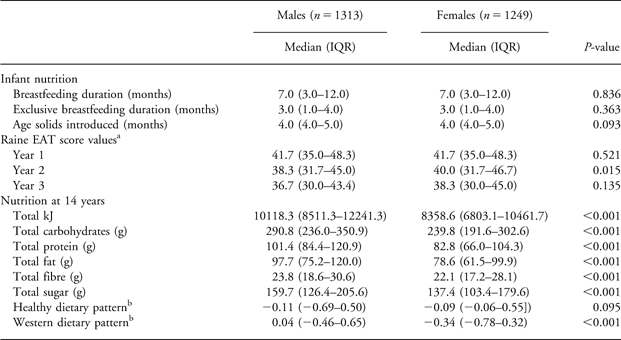
Descriptive statistics for measures of nutrition are outlined in Table 2. There were no gender differences in nutrition in the first year of life, measured by the duration of breastfeeding and age that solid foods were introduced. Females had higher year 2 and year 3 EAT scores, although the difference was only statistically significant at the age of 2 years. The Raine EAT scores declined over 1–3-year follow-ups, driven by an increase in the frequency of consumption of unhealthy snack foods and soft drinks, and a decrease in the frequency of consumption of food groups such as dairy, whole grains and vegetables. Considering nutrition at 14 years, males had a higher daily intake of kilojoules, carbohydrates, protein, fat, fibre and sugar (all P < 0.001). Males also had significantly higher Western dietary pattern scores (P < 0.001).
Nutrition descriptive statistics on Raine Study participants with at least one 24-h food recall in year 1–3-year follow-ups (n = 2562)

IQR, interquartile range; EAT, Eating Assessment in Toddlers.
aRange is from 0 to 70, higher scores reflect better dietary quality.
bHealthy and Western are dietary patterns identified through factor analysis. Range for healthy: −2.12 to 5.01. Range for Western: −2.07 to 4.74.
Infant nutrition and early dietary quality
All three measures of nutrition during the period from birth to 1 year of age were associated with the EAT scores at 1–3 years of age (Table 3). Concordant results were obtained for males and females and therefore the EAT score was assessed in a combined male and female model. The breastfeeding measures remained significant in adjusted analyses, although the magnitude of the association for breastfeeding and exclusive breastfeeding with the score were reduced by between 1.7–2.2 and 1.3–1.8, respectively. The age that solid foods were introduced became non-significant in adjusted analyses.
Associations between infant nutrition at 0–1 years and the Raine EAT scores from 1 to 3 years of age

EAT, Eating Assessment in Toddler.
aAdjusted for: maternal tertiary education, maternal age, maternal smoking, family size (number of other children at home), socioeconomic status (Index of Relative Socioeconomic Advantage and Disadvantage (IRSAD) at 1 year of age) and age.
bBreastfeeding duration, exclusive breastfeeding duration and age solids introduced are all measured in months.
Three different models were to obtain the results above, each of which tested one main exposure of interest (breastfeeding duration, or exclusive breastfeeding duration, or age that solids were introduced) The variables breastfeeding duration, exclusive breastfeeding duration, age solids introduced, maternal age and the IRSAD were mean-centred for analyses.
Early dietary quality and adolescent diet
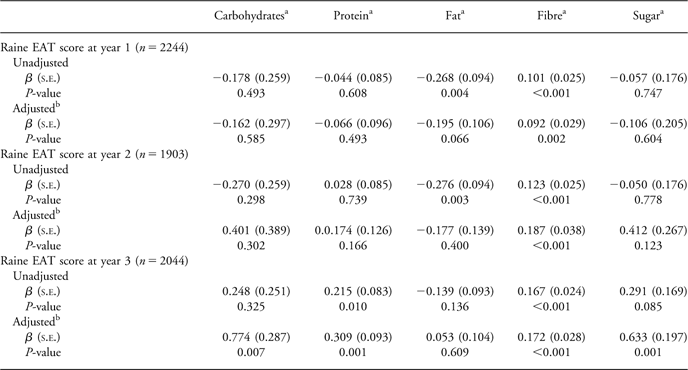
Higher Raine EAT scores were associated with greater fibre intake at 14 years at all 3 years of follow-up (P < 0.001). This association remained significant after adjusting for several potential confounding factors (Table 4). Higher EAT scores at years 1 and 2 were inversely associated with fat intake at 14 years, but after adjustment this relationship became non-significant. Higher Raine EAT scores at year 3 were associated with higher protein intake before and after adjusting for potential confounders. The models involving fibre and sugar as dependent variables demonstrated discordant results for males and females at year 2. The interaction term involving the EAT score at year 2 and gender was significant for sugar (P = 0.045) and fibre intakes (P = 0.031).
Associations between the Raine EAT score in early childhood and diet at 14 years of age

EAT, Eating Assessment in Toddler.
aCarbohydrates, protein, fat, fibre and sugar were measured in grams.
bAdjusted for: maternal tertiary education, maternal age, family size (number of other children in the home), maternal smoking, 14-year Index of Relative Socioeconomic Advantage and Disadvantage (IRSAD), hours of physical activity per week at 14 years, gender, age and the interaction between EAT score at year 2 and gender. The following variables were mean centred: maternal age, 14-year IRSAD and hours of physical activity per week.
Early nutrition and growth and later BMI
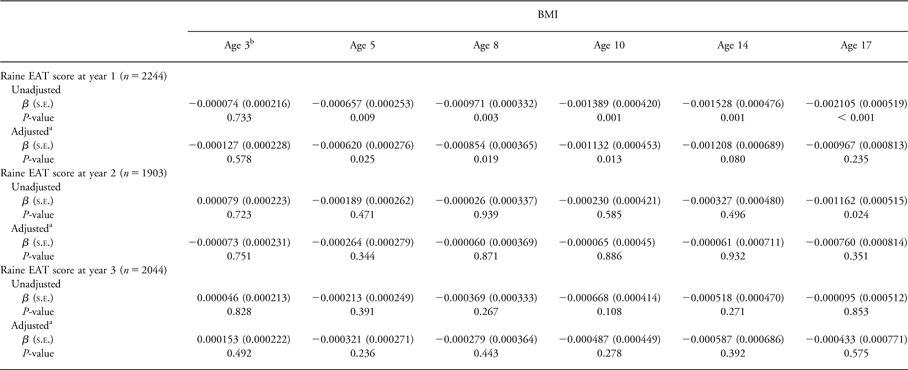
There were no consistent associations between the EAT scores at years 1–3 and BMI throughout childhood and adolescence in the unadjusted and adjusted analyses (Table 5). The EAT score at year 1 was associated with BMI at age 5, 8, 10, 14 and 17 years, although this association become non-significant at the age of 14 and 17 years after adjusting for several confounding factors. Analyses involving males and females separately yielded concordant results; therefore, a combined male and female model is presented.
Associations between the Raine EAT score in early childhood and BMI in later childhood and adolescence

EAT, Eating Assessment in Toddler; BMI, body mass index.
aYears 3, 5, 8 and 10 models were adjusted for birth weight, maternal smoking, socioeconomic status (age-specific Index of Relative Socioeconomic Advantage and Disadvantage (IRSAD)) and age. Years 14 and 17 models were also adjusted for puberty (year of the first menstruation in females).
bBMI is log-transformed at every year.
The following variables were mean centred in analyses: birth weight and IRSAD.
Discussion
This study suggests that maternally reported early nutrition and dietary quality is associated with elements of diet during adolescence. In contrast to the associations between early and late dietary patterns, late childhood and adolescent BMI were not associated with early dietary quality. Antenatal and postnatal factors such as birth weight and growth in the first year of life as well as maternal socioeconomic factors appear to play a more important role in determining BMI.
Associations between infant nutrition and early childhood diet
Optimal infant nutrition is achieved by exclusive breastfeeding for the first 6 months of life, followed by breastfeeding with complementary foods for up to 2 years.Reference Kramer and Kakuma 38 In this research, a longer duration of exclusive or non-exclusive breastfeeding, considered to provide more optimal nutrition, was independently associated with better dietary quality over 1–3 years of age. Exclusive breastfeeding had approximately double the magnitude of association on dietary quality, compared to non-exclusive breastfeeding.
These findings are consistent with those of a cross-sectional survey of 2–6-year-old children,Reference Cooke, Wardle and Gibson 39 although that study examined fruit and vegetable intake, rather than overall dietary quality. Children who had been breastfed ate more fruit than those who were not breastfed.Reference Cooke, Wardle and Gibson 39 Similarly, a comparison of breastfed with formula-fed infants revealed that the highest percentage of consumers of healthier foods, such as fruits and vegetables, were the breastfed infants.Reference Noble and Emmett 40 It is likely that associations between breastfeeding and dietary quality may be due to residual socioeconomic confounding and strongly influenced by maternal reporting. There is also evidence supporting plausible biological mechanisms, through which breastfeeding may programme healthier dietary habits later in life.Reference Koletzko, von Kries and Closa 41 Given that infant feeding and dietary quality in early childhood both reflect maternal choices, this highlights the paramount role a child's mother can play in influencing nutrition across the early years of life.
The relationship of childhood dietary quality to adolescent dietary patterns
Maternal reporting of dietary quality in early childhood was associated with elements of diet at the age of 14 years. Higher EAT scores were given to toddlers consuming greater frequency of wholegrain foods, which are a valuable source of fibre.Reference Binns and Baghurst 31 In this study, greater maternal reporting of wholegrain consumption in early life was linked to increased fibre consumption as reported by the mother and study participant in adolescence. Higher EAT score values were also assigned to children in this study who consumed fewer sweet and savoury snack foods, many of which are high in fat.Reference Binns and Baghurst 31 The association between higher EAT scores and lower fat consumption at 14 years suggests that maternally reported fat intake patterns are similar in childhood and in adolescence.
This study did not intend to analyse true dietary tracking, due to the different dietary data collection methods and different measures of dietary quality applied in early and late childhood. Nevertheless, the associations between maternally reported infant nutrition, early childhood dietary quality and adolescent's diet are broadly in line with consistent reporting of fibre and fat intake described previously in children.Reference Patterson, Wärnberg, Kearney and Sjöström 42 , Reference Singer, Moore, Garrahie and Ellison 43
Early dietary quality and BMI
Inconsistent associations were demonstrated between early childhood dietary quality and BMI from 3 to 17 years of age. After adjusting for confounding factors, associations remained between the EAT score at year 1 and BMI at the ages of 5, 8 and 10 only. Given the lack of consistent association between the EAT scores taken at other years and BMI, it is possible that the associations observed at year 1 may be due to residual sociodemographic confounding.
To date, four studies have applied a dietary quality score to paediatric populations and measured associations with anthropometric outcomes.Reference Cheng, Gerlach and Libuda 23 – Reference Kranz, Findeis and Shrestha 26 Three of these have asserted links between dietary quality and measures of body mass or obesity. The first observed a weak inverse relationship between dietary quality and BMI in 9–14-year-olds.Reference Feskanich, Rockett and Colditz 24 The second demonstrated decreasing obesity prevalence in 2–5-year-olds, when the lowest and highest dietary quality scores were compared.Reference Kranz, Findeis and Shrestha 26 The third study found that in 11–16-year-olds, there were no significant associations between BMI and dietary quality score, although higher body fat and abdominal fat were significantly associated with lower dietary quality scores.Reference Hurley, Oberlander and Merry 25 These studies were all cross-sectional and therefore had limited capacity to detect whether dietary quality predicts later BMI. One longitudinal study found that dietary quality in 6–9-year-olds was not related to BMI after 2–3 years.Reference Cheng, Gerlach and Libuda 23 These findings were consistent with our results, although our study involved a larger, younger population and diet–BMI relationships were assessed for a longer period.
The small number of paediatric studies and inconsistent associations indicate that the evidence in this area is still developing. Recent research in adult women revealed that participants with lower dietary quality were more likely to be overweight or obese after 16 years of age.Reference Wolongevicz, Zhu and Pencina 44 There are important implications for obesity prevention associated with this finding. Further longitudinal investigations in young children are essential before definite conclusions can be drawn, regarding the association between early dietary quality on weight later in life.
Early nutrition and growth: the relationship to BMI
Our assessment of dietary quality was not associated with BMI, although research illustrates that other measures of early nutrition and growth are important in obesity development.Reference Baird, Fisher and Lucas 16 , Reference Monteiro and Victora 17 , Reference Parsons, Power, Logan and Summerbell 45 Birth weight and infant weight gain are often considered surrogate measures of foetal nutrition and early postnatal nutrition, respectively. Evidence from the Raine cohortReference Burke, Beilin and Simmer 46 and other longitudinal studiesReference Parsons, Power, Logan and Summerbell 45 suggests that birth weight and BMI are positively related. Studies have also consistently demonstrated links between high infant weight gain and increased obesity risk later in life.Reference Ong and Loos 47 Within the Raine cohort, high postnatal weight gain influenced adolescent cardiovascular risk factors, including higher BMI.Reference Huang, Burke and Newnham 48
Consistent with previous findings, we found that birth weight and weight gain over the first year of life were positively and significantly related to later BMI within the Raine cohort. In comparison, no other postnatal measure of nutrition that we assessed in infancy (breastfeeding duration or age of introduction of solids), early childhood (dietary quality measured by the Raine EAT score) or later childhood (healthy or Western dietary patterns) demonstrated significant associations with BMI.
Evidence suggests that breastfeeding has a small protective effect on the prevalence of obesity.Reference Horta, Bahl, Martines and Victora 18 When breastfeeding in the Raine cohort has been explored in relation to BMI, weight gain or risk of overweight, the results have been inconsistent. Considering duration of breastfeeding as a continuous variable yielded no associations with childhood BMI in adjusted analyses.Reference Burke, Beilin and Simmer 46 , Reference Oddy, Sherriff and de Klerk 49 When breastfeeding duration was analysed as a categoricalReference Burke, Beilin and Simmer 50 or binaryReference Huang, Burke and Newnham 48 variable, significant associations with BMI or weight gain were observed in the cohort. Therefore, it is not unexpected that breastfeeding duration considered continuously in this research was not significantly associated with BMI in later childhood or adolescence.
Strengths and limitations
Previous studies in this area have been cross-sectional or limited by shorter durations of follow-up. A major strength of this research is that the Raine Study is longitudinal and involved a relatively large sample of children. The dietary and anthropometric data collected from birth to late adolescence meant that we could explore long-term diet–obesity relationships. The comprehensive family, environmental and sociodemographic data accumulated over the years also allowed for the consideration of potential confounders in this relationship.
There are limitations with the methodology utilized in this research. Dietary recalls based on a period of 24 h may not be fully representative of usual diet. Further, the original dietary data were semi-quantitative. This meant that the EAT score was limited in its capacity to depict dietary elements such as total kilojoules or total fat intake per day. This may have restricted the ability of the score to predict obesity development. It may be considered ideal to use a previously validated instrument. The semi-quantitative nature of the Raine data precluded the utiliation of indices published to date,Reference Feskanich, Rockett and Colditz 24 , Reference Huybrechts, Vereecken and De Bacquer 51 – Reference Kranz, Hartman, Siega-Riz and Herring 53 as these were developed for more precise quantitative data. For this study, it was therefore necessary to develop an index specifically for the nutritional data available. The exclusion of breastfeeding data from the EAT score may be considered a limitation of this instrument. However, this allowed the inclusion of these important data as an effect modifier of the association between early childhood diet and adolescent BMI. Although a concerted attempt was made to adjust for socioeconomic status, residual confounding was likely to play a role in accounting for the associations observed between early and later dietary habits. Specifically, dietary data were based on maternal reporting in infancy, childhood and adolescence. It would have been ideal for independent assessment of the duration of breastfeeding, early dietary quality and adolescent nutrition to occur; however, this was not possible. Future studies investigating nutritional patterns across the life course should consider this issue in the study design and methodology. Care must also be taken when extrapolating these findings to the general population. The members of the cohort not included in this study, due to their lack of dietary data, were less socioeconomically advantaged, compared to the individuals included in analyses. A final potential limitation is that the cohort was recruited 20 years ago. Adult BMI in Australia has increased over the past 20–30 years. 54 If this study was repeated today it is possible that the findings may differ, because higher maternal weight may create a different nutritional environment for the foetus.Reference Deierlein, Siega-Riz, Adair and Herring 55
Conclusion
Early diet and nutrition have been implicated in weight status later in life. In this study, we found that maternally reported dietary patterns in early life are associated with diet in adolescence as reported by the mother and adolescent. Despite consistency of dietary behaviours between early childhood and adolescence, data in this study suggest that early growth is a more important determinant of adolescent BMI. Maternal nutritional education to optimize their child's diet has the potential to influence nutrition throughout childhood and adolescence; however, interventions focussing on minimizing early weight gain may have a greater impact on the obesity epidemic seen in our population. These findings extend our understanding of the complex interplay between behavioural, nutritional and sociodemographic contributors to obesity's early-life origins. The Raine cohort continues to be followed and thus provides unique opportunities to explore these relationships into adulthood.
Acknowledgements
The authors would like to acknowledge the Raine Study Team for their cohort co-ordination and data collection and the National Health and Medical Research Council (NH&MRC) of Australia and Telethon Institute for Child Health Research for their long-term support and contribution to funding. Special thanks must go to the Raine Study participants and their families for their ongoing participation in the study.
Sources of funding
Funding for Core Management of the Raine Study has been provided by The University of Western Australia, The Telethon Institute for Child Health and Research, the Raine Medical Research Foundation, the University of Western Australia Faculty of Medicine, Dentistry and Health Sciences and the Women's and Infants’ Research Foundation. Funding for the 1-3-, 5-, 8- and 10- year cohort reviews was provided by the NH&MRC and the Raine Foundation. The 14-year-follow-up was funded by the NH&MRC (Sly et al., ID 211912), NH&MRC Program Grant (Stanley et al., ID 003209) and the Raine Foundation. Funding for the 17-year-follow-up was provided by the NH&MRC Program Grant (Stanley et al., ID 353514). Claire Meyerkort was funded by the King Edward Memorial Hospital Women's Health Research Scholarship.