IntroductionFootnote 1
“Spa(R) … Could you tell me where I can find a spa(r)?” “Are you sure you want to find a spar?” A Chinese traveller, inquiring about the nearest spa while on a tour in South Africa, left the local hotel receptionist confused. This anecdote involved the overuse of the R-colouring sound and aroused my interest in rhoticity in China English. Rhoticity in English refers to ‘the production of historical or orthographic /r/ in the syllable coda of words such as father and card” (Becker, Reference Becker2014: 141). However, since the R-colouring sound in English, a simple allophone feature, does not distinguish word meanings, its pronunciation features and phonological environments have seldom been taught in EFL classes in China.
English varieties with the occurrence of this coda /r/ (also called R-colouring) are described as rhotic; if they do not have coda /r/ they are non-rhotic (Wells, Reference Wells1982: 139). Of the Inner Circle varieties, American and British English are the most well-known rhotic and non-rhotic varieties, respectively. In China, British English has long been established as the norm or a teaching model in orthodox schools, especially primary and middle schools, while American English, a new and growing variety, is learned either in after-school English classes, or through English TV news, internet videos or American movies. Therefore, R-colouring is thought to be a symbol of Americanisation by most Chinese EFL teachers. This is something that some Chinese EFL learners usually acquire by themselves, because of the preference for American culture and media (Sundkvist & Gao, Reference Sundkvist and Gao2016).
However, little research has been carried out on the current use of rhoticity by English-language learners nationwide in China, because it has been considered as an individual accent preference or performance rather than a reflection of complex interactions between English varieties and social identities. The objectives of this research are thus twofold. First, I aim to examine the extent to which rhoticity exists in China English. Second, I aim to understand linguistic and sociolinguistic factors in rhoticity production and to find out whether the rhoticity in China English is a product of Americanisation.
Is there a China English pronunciation?
It is estimated that Mainland China has 390 million English-language learners (Wei & Su, Reference Wei and Su2012: 14), and their English proficiency keeps improving with the rapid growth of English education ‘fuelled by the recent political and social development of Chinese society’ (Bolton & Graddol, Reference Bolton and Graddol2012: 3). Many linguists foresee that Chinese English or China English will grow and emerge as an important and new variety of English, and an important component of world Englishes (Bolton, Reference Bolton2003; Jiang, Reference Jiang2003; Hu, Reference Hu2005; Deterding, Reference Deterding2006; He & Li, Reference He and Li2009).
However, among the many studies of linguistic features of China English, few have attempted to closely analyse its phonological features (Deterding, Reference Deterding2006), because this involves some difficulties that researchers cannot gloss over. First, it has never been an easy task to collect, transcribe and analyse phonological data on a large scale. Second, compared with lexical, syntactic and pragmatic features, salient phonological features are much more difficult to summarise because ‘over time, the sounds of languages tend to change’ (Campbell, Reference Campbell2004: 16).Third, it is not possible to describe any distinctive features of English pronunciation used by speakers from all over China, because of the complex multilingual and multi-ethnic situation in Mainland China (Bolton, Reference Bolton2003; Kirkpatrick, Reference Kirkpatrick2007; Ao & Low, Reference Ao and Low2012). Based on the assumption that there is more than one variety of English in China, some researchers believe that phonological features of an indigenous variety of Chinese English are more significant and require more research attention than those of one national variety of China English (Ao & Low, Reference Ao and Low2012; Sundkvist & Gao, Reference Sundkvist and Gao2016).
I argue that the issue of whether there exist any features of China English pronunciation has been alleviated in recent years by the dominance of Putonghua Footnote 2 education and large-scale migration across Mainland China. The multilingual and multidialectal ecology has been changing with the government's vigorous nationwide promotion of Putonghua and the greatest population migration in recent times in Mainland China. More teachers from different regions with different dialect backgrounds have been employed by kindergartens and primary schools in densely populated big cities. ‘Regional languages and local dialects are giving way to the spread of Putonghua’ (Bolton & Graddol, Reference Bolton and Graddol2012: 7), and thus Putonghua has become the first language of almost every English teacher and learner in China. The substantial variation in the way in which English is spoken by learners and users from different Chinese regions has gradually diminished in the past decade. A distinctive pronunciation style of China English is emerging and is technically becoming easier to identify because of the change in the L1 ecology of Mainland China.
Previous studies of rhoticity in Asian English varieties
There are many studies of rhoticity in Southeast Asian English varieties, such as Brunei English (Sharbawi & Deterding, Reference Sharbawi and Deterding2010), Singapore English (Tan & Gupta, Reference Tan and Gupta1992; Poedjosoedarmo, Reference Poedjosoedarmo, Brown, Deterding and Ling2000; Low & Brown, Reference Low and Brown2005; Deterding, Reference Deterding2007), Malaysian English (Baskaran, Reference Baskaran, Schneider, Burridge, Kortmann, Mesthrie and Upton2004; Hickey, Reference Hickey and Hickey2004; Rajadurai, Reference Rajadurai2006) and Hong Kong EnglishFootnote 3 (Poon, Reference Poon2006; Deterding, Wong & Kirkpatrick, Reference Deterding, Wong and Kirkpatrick2008). The results of these studies are summarised in Table 1.
An overview of rhoticity in Southeast Asian English varieties

Table 1 shows that the degree of rhoticity is generally not high in Southeast Asian English varieties except in Brunei English. This low degree of rhoticity is derived from the early British colonial influence. The degree of rhoticity in these varieties is reported to be growing because of the increasing influence of American media and culture.
However, to date, rhoticity in China English has rarely been characterised or discussed. Sundkvist and Gao (Reference Sundkvist and Gao2016: 55) carried out an empirical and regional study of rhoticity in Yunnan Province, a very south-western province in China known for extensive ethnic diversity. They found different degrees of rhoticity across three tasks: interview (38%), reading (45%) and questionnaire (65%). Unfortunately, only eight informants were interviewed and recorded in the study, far from sufficient to represent the large population across China or even the complex ethnic composition in Yunnan Province.
Participants and methodology
Seventy-two non-English-major Chinese undergraduates were recruited for this study, consisting of 41 females and 31 males from 29 provinces, autonomous regions and municipalities across Mainland China. They speak different dialects or Chinese varieties, but all of them acquired Putonghua before they were six years old and Putonghua has been their most frequently used language since primary school. The participants were invited to take part in a reading task and complete a written questionnaire.
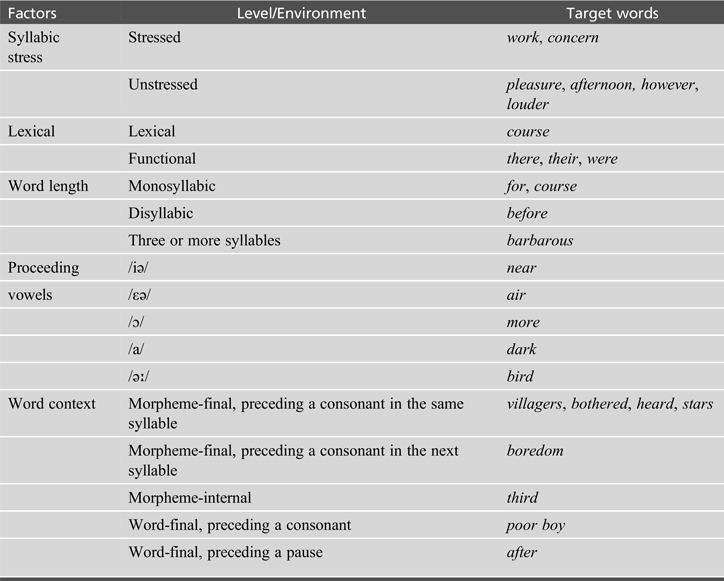
During the reading task, the participants were asked to read a short passage of 194 words, and a 33-word list. The passage contains 25 target words with R-colouring tokens, and the word list includes 17 target words and 16 fillers. The target words in this study cover all of the R-colouring phonological environments, summarised and classified by Becker (Reference Becker2014: 152) in his study of rhoticity in New York City English as presented in Table 2.
Target words classified by phonological environment

Both read-aloud tasks, i.e. passage reading and word list, were recorded and two investigators, one from the United States, the other speaking Irish English, were invited to investigate whether R-colouring occurred in each token produced by the participants. The presence of a clear R-colouring sound was marked as 1; and the absence as 0. The R-colouring tokens that sounded with non-native accents to the two investigators are marked as UCR (unclear R-colouring).
After the two read-aloud tasks, the participants took part in a written questionnaire that consisted of the following five questions about their English variety use and accent preferences.
1. Do you know the pronunciation differences between American and British accents?
2. Do you know where to apply the ‘R’ sound in the American accent?
3. Which English variety do you speak?
4. Which English variety or accent do you prefer?
5. Why do you prefer this accent? If you have no accent preferences, why?
Results
Reading tasks
The perceptual judgements of the two investigators show that China English is highly rhotic in the two reading tasks. Only 1.94% of the 1800 tokens produced by participants in the reading-passage task are non-rhotic. In the word-reading task, the percentage of rhotic tokens is even as high as 99.7%. In addition, there is no significant difference between males and females in terms of the rhoticity percentage. Although the degree of rhoticity of the tokens is generally high, only about 8% of the participants show consistent use of rhoticity in their linguistic production in the reading-passage task. In the word-reading task, about 39% of the participants consistently produced R-colouring sounds.Footnote 4
On the whole, the two investigators agreed on most of the tokens, especially the tokens produced by the female participants. However, their perceptual judgements varied greatly in rating the male data. This disagreement or uncertainty regarding the male data can be interpreted from an acoustic perspective: the R-colouring is reflected in a lowering of F3. This acoustic feature can be blurred by the relatively low F3 of male voices, resulting in a perceptual difficulty for the two investigators. Therefore, in the following features analysis, only the R-colouring tokens produced by female participants are considered.
Female participants produced 1003 R-colouring tokens in the reading-passage task, of which 94 and 88 tokens, respectively, were marked as UCR by the two investigators, about 9.07% on average. The percentage of UCR tokens in the word-reading task is lower, at 6.03%. Although very low on the whole, the occurrence of UCR is heavily focused on the eight target words, i.e. concern, barn, dark, boredom, careless, air, pleasure and heard. On the contrary, from the six words, i.e. later, after, louder, however, villagers and for, the investigators heard the most clear R-colouring sounds.
The features of rhoticity in China English
A closer examination of the occurrence of R-colouring tokens from the two reading tasks, especially the UCR R-colouring tokens in different phonological environments (see Table 2), allowed me to distinguish the following main features of rhoticity in China English:
1. Total rhoticity after a monophthong in an open syllable
This feature is reflected in the high occurrence of the R-colouring sound in the following words: later, after, louder, however, for. All productions by the participants were judged by the two investigators as showing a clear R-colouring sound. This may be interpreted as the result of positive transference from Mandarin rhotacisation, or er -hua in Mandarin Chinese, a phonological process in which the retroflex /ɻ/ is added to the vowel nucleus or coda. Although the degree of rhotacisation in Mandarin varieties may vary and many languages or dialects of Chinese families are non-rhotic, the promotion of standard Mandarin Chinese nationwide in the mass media and schools requires all speakers to be able to pronounce the retroflex /ɻ/ correctly in the standard Mandarin proficiency spoken test (or PSC in Chinese). Therefore, most Chinese speakers have no trouble in pronouncing the retroflex /ɻ/ as long as the rhoticity occurs in the same environment as in Mandarin.
2. Less rhoticity or unclear R -colouring in closed syllables
The uneven distribution of unclear R-colouring sounds in the participants’ data indicates the negative transference from their native language. When it comes to the different syllable structure from Mandarin, the participants had great difficulty in pronouncing a clear R-colouring sound. Take the following target words as examples: concern, barn, dark and heard. Although the preceding vowels are monophthongs that do exist in Mandarin, the R-colouring sound is followed by a consonant coda in these words, which is an environment that is unfamiliar to Mandarin speakers. In Mandarin, only two consonants, /n/ and /ŋ/, can appear in coda position. When a retroflex /ɻ/ is attached to a word with /n/ or /ŋ/, the nasal coda is usually dropped. The lost /ŋ/ helps the preceding vowel nasalised after the vowel to become rhotic. In fact, Chinese speakers are not only sensitive to the syllable coda environment, but also to the following consonant across syllable boundaries within a word. This misfit can be seen in the relatively higher occurrence of non-rhoticity or unclear R-colouring sounds in boredom. Evidently, this sensitivity does not apply to the word-final environment with a following consonant, e.g. for some, poor boy. Word boundary overrides the participants’ sensitivity to the following consonant. The boundary pause provides Chinese speakers with enough time to realise the R-colouring sound.
3. Unclear R -colouring after the diphthong /εǝ/ or the consonant /ʒ/
Chinese speakers have trouble producing English diphthongs and the consonant /ʒ/ correctly (Deterding, Reference Deterding2006; Ao & Low, Reference Ao and Low2012). As Ao and Low (Reference Ao and Low2012: 32) reported, the participants tend to mix the diphthong /εǝ/ with /ɪǝ/ or to replace /εǝ/ with /ɜː/. Furthermore, they usually pronounce /ʒ/ as /j/ or /ɹ/ (Deterding, Reference Deterding2006; Ao & Low, Reference Ao and Low2012). These salient features of the preceding phonemes may easily explain why the unclear R-colouring pronunciation often occurs in the words air, careless and pleasure.
4. Overuse of rhoticity in open syllables
The Mandarin er -hua facilitates production of English rhoticity by Chinese speakers in certain environments, but it also leads to overuse of rhoticity when the rhoticity rule does not apply. For example, in the word-reading task, China was often produced by the participants as /tʃaɪnɚ/; in the reading-passage task, the was pronounced as /ðɚ/. Normally, this overuse does not create ambiguities or unintelligibility in communication, so this popular overuse is usually ignored. However, this helps us to better understand the spa case in the anecdote mentioned at the beginning of this paper.
Questionnaire survey
Based on the responses to Questions 1 and 2, the survey found that 81.8% of the participants knew very little about the phonological features of American and British Englishes. Only 13.9% knew in which environments rhoticity should apply.
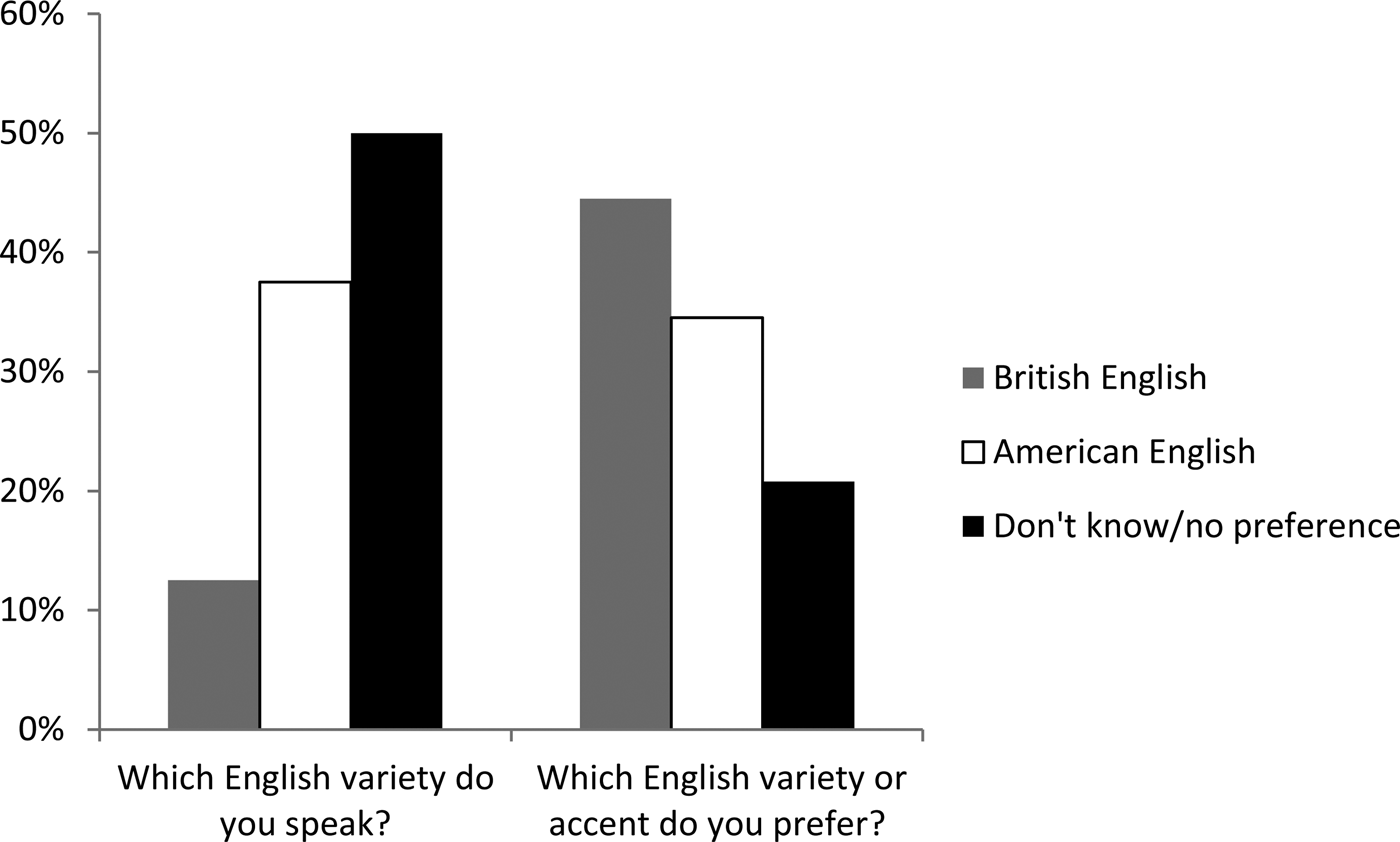
Figure 1 shows variation in responses to questions 3 and 4. 12.5% and 37.5% of the 72 participants think they speak “British English” and “American English”, respectively. Half of them do not know which variety they speak. However, when asked which English variety or accent they prefer, 44.5% and 34.5% chose British English and American English, respectively. 20.8% made it clear that they had no preference for any variety.
Responses to survey questions 3 and 4

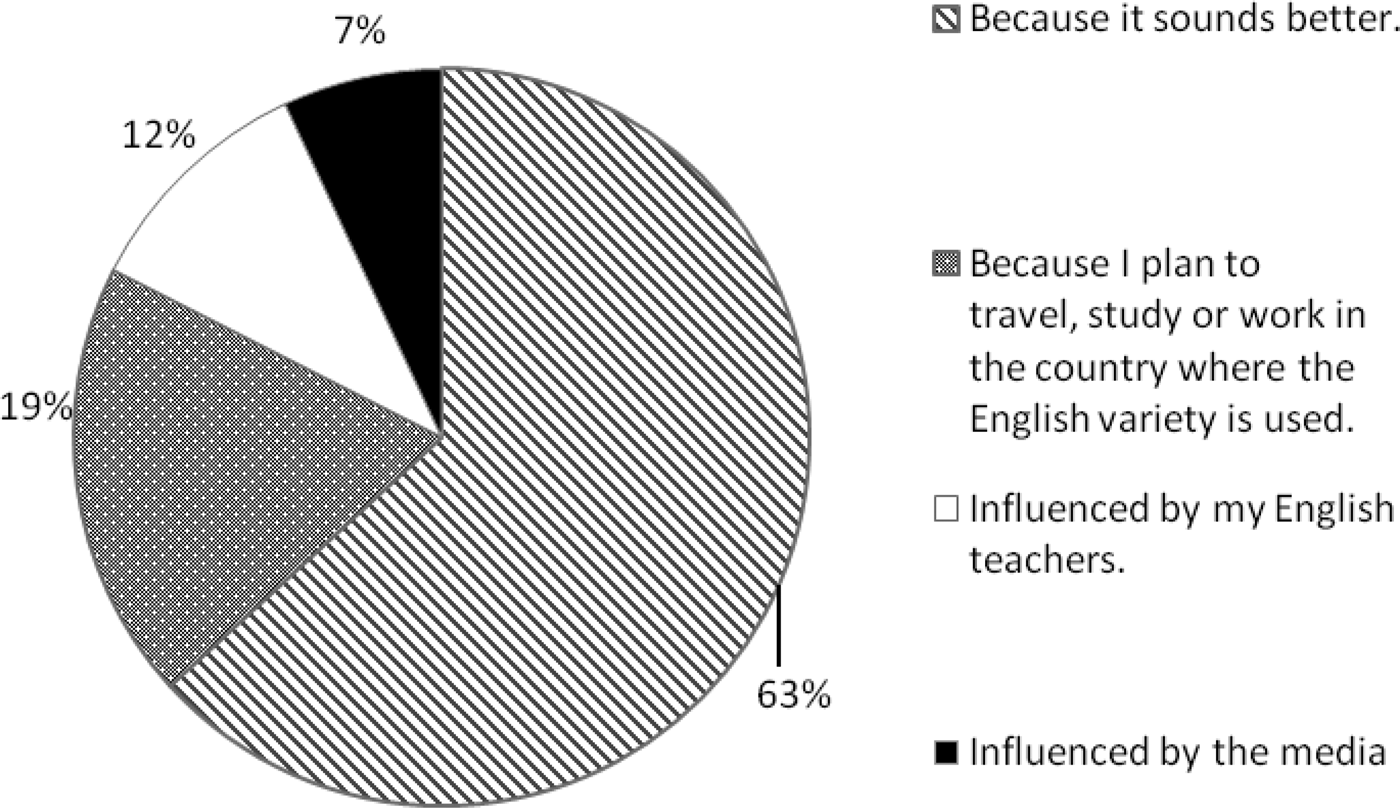
Figure 2 shows responses to question 5. Among those participants who have a preference for either British or American accent, 63% prefer that variety because they think the accent sounds better. Only four participants counted the influence from the media as the primary reason for preferring a particular variety or accent.
Primary reasons for variety/accent preferences

It is worth noting that no significant gender variation was found in the responses to questions 1 to 5.
Discussion: Americanisation or localisation?
Overuse or overgeneralisation in SLA is sometimes equated with hypercorrection in the sociolinguistic context (Siegel, Reference Siegel, Doughty and Long2003: 200). Whether in the sociolinguistics or language change milieux, hypercorrection is interpreted as an erroneous outcome resulting from an attempt to emulate a particular, more prestigious, language variety (Labov, Reference Labov1963, Reference Labov1966; Siegel, Reference Siegel, Doughty and Long2003; Campbell, Reference Campbell2004). Labov (Reference Labov1966) attributed the increasing use of R-colouring in New York City to mimicking the speech style of the social class with the highest prestige, speakers of which showed the greatest use of this variable. Campbell (Reference Campbell2004) also listed an example of rhoticity overuse phrase-finally when the speakers attempted to emulate a more prestigious dialect in which a rhotic sound is often added only between two vowels as a linking-r, but never in phrase-final positions.
Tan and Gupta (Reference Tan and Gupta1992) reported that for some Singapore English speakers, the R-colouring sound was a prestige feature. Could the high rhoticity and the overuse of rhoticity in China English be the result of an attempt to emulate the more prestigious American English or be an influence of American media? Based on a close examination of rhoticity features in the reading tasks, I contend that the phonological influence from the native language is the major drive for the high rhoticity in China English, and that the transference from the native language phonemic and phonotactic constraints heavily influences the production of rhoticity in China English. As Figure 1 shows, half of the participants do not think they speak either British English or American English. Figure 2 tells that most of the participants chose either American or British accents out of their own interests or rather practical motives, such as for travelling or studying abroad. The influence from teachers and American media only play a limited part in this phenomenon. Moreover, based on the responses to questions 1 and 2, even those who prefer the American accent do not know exactly when and how rhoticity should be used. Therefore, as indicated by the results of both the perceptual judgements and the questionnaire, the rhoticity in China English cannot be interpreted as a symbol of Americanisation, but reflect a trend towards the localisation of English in China.
Some may wonder why the English produced by Chinese speakers has not, until recently, been so rhotic or ‘localised’, since English has long been spoken as a primary foreign language in China. Two recent changes in language status have contributed to the rhoticity of China English: on the one hand, the dominance of the British English variety has been weakened in China, as Chinese people have started to communicate with more people with various English accents from a greater number of different countries at home or abroad in the context of educational globalisation and multilingualism; on the other hand, regional dialects or languages have given way to rhotic Putonghua, as widespread and mass migration has taken place in China. It can be predicted that, liberated from the input of a single English variety, English will be more localised with phonological features grafted from Putonghua.
Conclusion
This study investigated rhoticity in China English and its linguistic and sociolinguistic factors by analysing the tokens produced by 72 non-English-major undergraduates across China in both reading-passage and word-reading tasks. It was found that China English is highly rhotic. Furthermore, based on the close features analysis, I found that rhoticity in China English is interwoven with many phonological features from NL Putonghua, which is a graphic illustration of the localisation that China English is undergoing, instead of the ‘Americanisation’ as many people assume. Combined with the questionnaire results, the findings show that Chinese attitudes towards non-native English accents are changing. Intelligibility has become the priority. Even those who have a preference for a particular English variety accent emulate the accent for more pragmatic purposes such as travelling, studying or working.
The above findings should help Chinese teachers of English and language policy researchers and makers reconsider attitudes towards the rise of China English. As Clark (Reference Clark2013: 51) points out, Chinese authorities face a dilemma which is how to preserve its language and national identity while teaching Chinese children and the workforce English, which functions as the most commonly used working language worldwide. The Chinese government assumes that advocating a standard variety of Anglo American or British English, rather than endorsing the China English variety, is a better ‘way of keeping issues of language and identity apart as much as possible’ (Clark, Reference Clark2013: 54). However, as the Chinese have been playing an increasingly important role in international affairs and business, Chinese speakers of English are no longer satisfied with pursuing any ‘standard’ English variety. If currently there is no way to abandon English as an intercultural communicative tool in this globalised world, maybe adding more NL features to this English variety is an option that Chinese speakers of English can choose to preserve and highlight identity, especially in an English as a lingua franca context.
 JIAN Li is currently a lecturer in the School of Foreign Studies at Shanghai University of Finance and Economics, China. She holds a Ph.D. in Linguistics at the Graduate Center of City University of New York. Her research areas are language contact and change, loanword phonology and SLA phonology. At present she is concentrating on the project of Phonological Adaptation of English Loanwords in Shanghai Dialect, which is supported by Shanghai Pujiang Program. Email: li.jian@shufe.edu.cn