

I. Introduction
Let us, therefore, lay down a certain maxim, that whenever the public good happens to be the matter in question, it is not for the advantage of the public to deprive an individual of his property, or even to retrench the least part of it by a law, or a political regulation.Footnote 1
—Montesquieu (Reference Montesquieu1748b, p. 252)On April 15, 2014, a consortium of all major European wine associationsFootnote 2 cosigned an urgent letter to all the European Union (EU) governments and the EU commissioner for agriculture and rural development complaining about the detrimental effects of new proposed regulations and restrictions on planting vineyards:
We are extremely concerned that the [proposals] would result in an even more restrictive regime (…) it would fatally jeopardize the competitiveness of the EU wine sector in a context of international competition. (…) It would be just irresponsible to impose (…) arbitrary or discriminatory criteria and restrictions (…).
We are shocked by the lack of ambition for our sector shown by our national governments. (…) Their requests are not justified on the grounds of protecting the sector against possible oversupply (…) their requests are driven by fear, selfishness and corporatist protectionisms. (Comité Européen des Entreprises Vins [CEEV], 2014b, p. 2)
The letter reflects the frustrations and concerns of the European wine associations. In 2014, when the wine associations wrote their letter, things looked very different than a few years earlier. In 2008, the EU had decided to liberalize the EU's vineyard planting rights regime. The decision was in line with reforms in other agricultural markets—such as grains, oilseeds, sugar, and dairy—where various regulations that distorted production allocations had been removed and replaced by a more market-oriented policy combined with direct income support for farmers (Swinnen, Reference Swinnen and Naylor2014).
Also in the wine sector extensive regulations had led to problems of oversupply, low quality, and distorted market. After a series of more timid reforms in the 1980s and 1990s, the European Commission proposed to get rid of the planting rights regime, a system that regulated and restricted vineyard planting since 1970, in line with the removal of production quotas in, for example, the dairy and sugar sectors. After two years of discussions, in 2008, the EU ministers of agriculture adopted the EU Commission's proposal to liberalize the planting rights as part of broader reform of the EU wine sector.Footnote 3
However, almost as soon as the liberalization decision was reached in 2008, an intense lobbying campaign started to reverse the decision and successfully so: the liberalization of the planting rights system was overturned in 2013. Not only was the liberalization decision reversed, but a series of new proposed regulations could create an even more restrictive system of planting rights regulations, depending on how the new regulations will be implemented by the member states. Facing the proposal to make vineyard planting even more restrictive, the European wine associations wrote their desperate letter to EU governments.
Recent history shows that the strength of the lobby of those in favor of vine planting regulations is more powerful than those opposing them. Moreover, a look at the longer history also does not look promising for those opposing planting rights. In fact, there is a precedent to the wine associations’ letter.
II. An Advocate for the Liberty of Men and Wine
The accumulation of all powers legislative, executive and judiciary in the same hands, whether of one, a few or many, and whether hereditary, self appointed, or elective, may justly be pronounced the very definition of tyranny. (…) In order to form correct ideas on this important subject, it will be proper to investigate the sense, in which the preservation of liberty requires, that the three great departments of power should be separate and distinct.
The oracle who is always consulted and cited on this subject, is the celebrated Montesquieu.
—James Madison (Reference Madison1788)Every man invested with power is apt to abuse it (…). To prevent this abuse, it is necessary from the very nature of things power should be a check to power.
—Montesquieu (Reference Montesquieu1748a, p. 242)Footnote 4In 1748, Charles-Louis de Secondat, Baron de La Brède et de Montesquieu (1689–1755), published his famous and most influential work, De l'Esprit des Lois (The Spirit of the Laws), in which he argued the need to separate political power into three separate branches: the executive, the legislative, and the judicial (Montesquieu, Reference Montesquieu1748a). Montesquieu's work inspired James Madison (the “Father of the United States Constitution”) and the American founders on the separation of powers in the 1787 U.S. Constitution. In fact, Montesquieu is the second most cited source in the period of Constitution writing—only surpassed by the Bible (Lutz, Reference Lutz1984). Montesquieu's ideas on the separation of powers also inspired the 1791 French Constitution and many other constitutions in the world (Lane and Ersson, Reference Lane and Ersson2000).
However, Montesquieu was more than a political philosopher. He was also a wealthy owner of land and vineyards in France. In this position, he wrote a letter in 1726 to Mr. Le Pelletier, the just-appointed French controlleur général who was in charge of the finances of King Louis XV (1710–1774) of France. In this essay, like today's European wine associations, he bitterly complained about the newly introduced prohibition on planting new vines:
The prohibition on planting vines is useless because the owner knows, much better than the Minister, if the vines suffer economic losses; he calculates accurately; and, as winemaking requires financial anticipation, costs and care, as long as vines do not yield well, he is naturally led to uproot and convert his land into a different kind of revenue, less cumbersome.Footnote 5 (Montesquieu, Reference Montesquieu and Masson1726/1955, p. 267)
Montesquieu argued that the 1725 prohibition was “useless” because winegrowers were much more competent in assessing the needs of the market than public officers (“il n'y entend rien” [they understand nothing about it]). According to Montesquieu, given the high demand for Bordeaux wines (in France and abroad such as in England, Holland, and Flanders), it is in the public interest to rely on the winegrowers entrepreneurial skills to invest in the most efficient vineyards:
[The Bordeaux wine region] must provide different kinds of wines to the foreign market, depending on the diversity of its soils. However, the taste of foreigners varies continuously (…). We must therefore follow this inconsistent taste, planting or uprooting accordingly.Footnote 6 (Montesquieu, Reference Montesquieu and Masson1726/1955, p. 267)
Although Montesquieu may have inspired the U.S. Constitution, he was not able to convince the French king (or his advisors) to get rid of planting rights. Actually, he may have made things worse when he complained that partial planting rights would only induce other regions to plant more. In fact, this was his only argument taken up by King Louis XV. In 1731, the king extended the prohibition on planting vines to the entire kingdom of France. The outcome was the opposite of Montesquieu's intention.
Montesquieu would not see the end of the planting rights. He passed away in 1755. Four years later, there was some relaxation of the planting rights system, but it was only in 1789, 34 years after the death of Montesquieu and 64 years after planting rights were introduced, that they were removed and wine production was liberalized. The thing that made it happen was the French Revolution. Only a dramatic political change sufficiently shifted the political equilibrium to allow a liberalization of planting rights.
What does this imply for today? Like Montesquieu, the European wine associations want to remove the restrictions imposed by the planting rights regime. So the question is, what would make liberalization of the EU planting rights system possible? In the rest of this article, we document many similarities between Montesquieu's time and now in terms of the motivation for the introduction of the planting rights, their extension to other regions, and problems of implementation. This comparative analysis suggests that, as planting rights were ultimately abolished and plantings liberalized only after a major political change in the eighteenth century, it may again require another (type of) French Revolution this time.
III. Planting Rights Restrictions in Eighteenth-Century France
In France the anxiety of the proprietors of the old vineyards to prevent the planting of any new ones, seems to (…) indicate (…) that this superior profit can last no longer than the laws which at present restrain the free cultivation of the vine. In 1731, they obtained an order of council prohibiting both the planting of new vineyards and the renewal of those old ones (…).
—Adam Smith (Reference Smith and Cannan1776/1904, p. 217)As Meloni and Swinnen (Reference Meloni and Swinnen2013, Reference Meloni and Swinnen2014) show, many wine regulations are political responses to excessive supplies of wine, which are, in turn, often triggered by earlier periods of shortage. The regulations in France during Montesquieu's time are no exception. The domestic oversupply of wine in the early eighteenth century followed earlier shortages caused by the destruction of many vineyards through extreme weather conditions and an increase in wine consumption with economic growth.
An exceptionally cold winter in Europe in late 1708 and early 1709, the Great Frost (Le Grand Hiver), resulted in the destruction of many vineyards and in an increase in wine prices (Labrousse, Reference Labrousse1933; Le Roy Ladurie, Reference Le Roy Ladurie1960). At the same time, demand was growing due to an increase in wine consumption in the rural areas of France. Until the beginning of the eighteenth century, wine consumption was much lower in rural areas than in cities, where wine was consumed on a daily basis. This changed during the early eighteenth century as France recovered from the constant wars of King Louis XIV (between 1661 and 1715). The increased well-being in the rural areas led to an increase in wine consumption. As peasants drank more wine, wine prices increased (Dion, Reference Dion1959, p. 597).
The increased demand and higher prices, attracted investments in vineyard plantings. The extension of new vineyards was most important in the regions of Touraine, Anjou, and Bordeaux. Martin (Reference Martin1907, p. 19) notes King Louis XV was informed that “in the best areas of the Bordeaux province, the residents abandoned (…) the cultivation of arable land, to engage in (…) the planting of vineyards in the hope of finding a substantial profit in wines that the foreigners are in the habit of buying.”Footnote 7
It was also pointed out to King Louis XV that these vineyard plantings occurred “without reflecting on the disadvantages that result from too great abundance.”Footnote 8 French wine production increased strongly around 1720 as farmers and landowners started to plant vines instead of grain (because winegrowing was more profitable and because new (younger) vines were more productive than older ones).Footnote 9 Not surprisingly, wine prices declined significantly with production growth.
With their returns from the market declining, the owners of existing (older) vineyards in the renowned and established wine regions turned to the government to support them.Footnote 10 Many belonged to rich and influential families.Footnote 11 They pressured both the Council of State (Conseil d'Etat)Footnote 12 and the local administration (intendant)Footnote 13 to intervene (de Tocqueville, Reference de Tocqueville1856; Smith, Reference Smith and Cannan1776/1904; Unwin, Reference Unwin1991). In France, two institutions were in charge of the local administration: the parlements (regional courts), which were the highest juridical organizations, and the généralités (provinces), which governed the police and the economy of the area. Membership of both institutions was limited to clergy and nobles (Brink, Reference Brink1986).
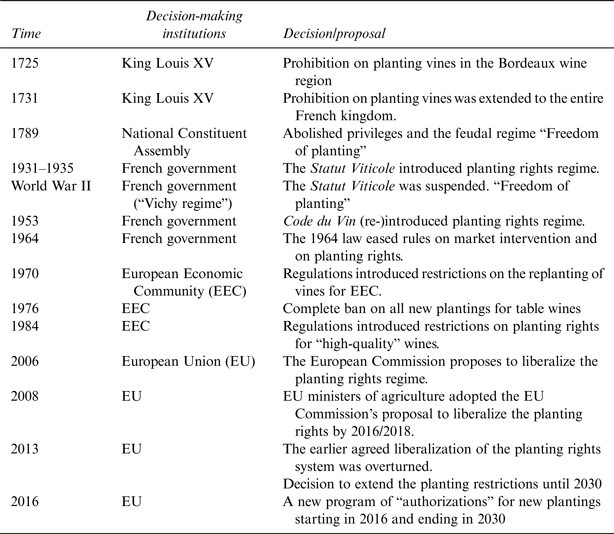
The lobby efforts were successful: between 1722 and 1731, various regulations were introduced to reduce the supply of wine (see Table 1). For example, in Guyenne—a historic region in southwestern France that corresponds to the present-day Gironde, Lot-et-Garonne, Dordogne, Lot, and Aveyron departments (Encyclopædia Britannica Inc., 2014a) and that includes the Bordeaux wine region—the existing owners of vineyards were nobles or magistrates.Footnote 14 They typically owned vineyards on the slopes in the traditional Médoc region, situated north of Bordeaux.Footnote 15 In contrast, the “fury of plantings” concerned mostly vineyards in the vast plains south of Bordeaux (Enjalbert, Reference Enjalbert1953; Johnson, Reference Johnson1989, pp. 256–258). The existing vineyard owners lobbied Mr. Boucher, the intendant of Guyenne, who wrote to Mr. Dodun, controlleur général in charge of the king's finances. In his letter, the intendant of Guyenne proposed to uproot at least one-third of the vines planted since 1709 (Montesquieu, Reference Montesquieu and Masson1726/1955).Footnote 16 Successively, Mr. Dodun wrote a report to the king of France, Louis XV, on the overplanting of vines in the Bordeaux area.
Chronology of Plantings Restrictions in France and the EU, 1725–2030

In 1725, the Council of State forbade planting new vines in the Guyenne province (the Bordeaux wine region) without an express permission of the king of France.Footnote 17 The mentioned reason for the edict was “to provide for the best interests of the inhabitants of Bordeaux,”Footnote 18 which in reality were the best interests of the existing vineyard owners. Yet, the Council of State did not follow the proposed “uprooting” plan and only prohibited new plantings.
Other provinces, including Champagne (the Châlons province), also issued royal edicts forbidding the planting of new vines.Footnote 19 Some regions did introduce uprootings: the regional court of Metz (located in the northeast of France) forbade the planting of new vines and ordered the uprooting of all vines planted before 1700 (Denis, Reference Denis1995; Dion, Reference Dion1959, p. 598).
IV. Regulations Breed More Regulations
Moreover, this prohibition is pernicious because either it is general for the whole kingdom, or not. (…) This prohibition is pernicious by being too narrow-minded: as the other provinces can indiscriminately and freely plant their vines.Footnote 20
—Montesquieu (Reference Montesquieu and Masson1726/1955, p. 267)In his petition against the authorities, Montesquieu declared not only that the 1725 prohibition on planting vines was “useless” but also that it was “pernicious” and “narrow-minded,” unless it would be applied to the entire kingdom. If limited to a certain region (i.e., the Bordeaux wine region), the neighboring areas could still freely plant their vines and produce cheaper wines at prices that could undermine the reputation (and prices) of Bordeaux wines. Hence, local planting rights have negative effects: “if the same precautions are not taken in neighboring provinces, the remedy would be a very poor one.”Footnote 21
Montesquieu made these arguments because he was against state intervention.Footnote 22 His assessment on the effects of the prohibition on planting vines turned out to be visionary—but not his anticipation of the policy response.
As Montesquieu had predicted, these restrictions were “pernicious” in that they just resulted in substitution of wine from other regions. The neighboring areas of Bordeaux (such as Quercy, Languedoc, Saintonge, Aunis, and Poitou) planted more vineyards and flooded the Guyenne region (Martin, Reference Martin1907).
However, instead of following Montesquieu's proposal to liberalize, King Louis XV decided to do the opposite. Once again, the existing vineyard owners lobbied the French administration, and again they were influential. In 1731, following three years of good grape harvests, his remède (remedy) was to extend the prohibition on planting new vines to the entire French kingdom. The 1731 edict stated that “there shall be no new planting of vines in the provinces of the kingdom, and that those who have been two years without being cultivated cannot be replanted without express permission of His Majesty.”Footnote 23
The edict clearly indicated that the measure was driven by the interests of the existing vineyard owners producing “high-quality” wines: “over-abundance of vines in the kingdom that occupies a large amount of land suitable to grow grain or pastures (…) multiplied the quantity of wine to the extent that the value and reputation in many places was destroyed.”Footnote 24
In summary, Montesquieu's only argument that was taken up by the French king was that local planting rights were inefficient. However, instead of liberalization, the outcome was more regulations as planting rights were introduced throughout the French kingdom and restrictions were extended to the old vines (and not only on the new vines). Vines abandoned for more than two years could not be replanted without an express authorization from the king.
V. Planting Rights Liberalization after 1789
(…) the Revolutionaries appeared ready to sweep through grandiose measures which would not only liberate men, but also the landed property of France.
—Plack (Reference Plack2009, p. 35)Although there were significant problems with their enforcement (see further), the planting rights introduced by King Louis XV lasted for almost 70 years. They were abolished only in 1789, as part of a major political, institutional, and economic transition: the French Revolution. The French Revolution started with the assault on the Bastille on July 14, 1789. It promoted liberty of men (Liberté) and destroyed all previous privileges. Three weeks after the assault on the Bastille, a series of decrees abolished feudalism, serfdom, and seigneurial and royal privileges in place during the previous “Ancien Régime.” However, it would take “over one hundred decrees and four more years until the seigneurial regime was completely dismantled” (Plack, Reference Plack2009, p. 35).
The liberty principle of the French Revolution also implied vines could be planted anywhere in France. It not only removed the planting rights, it also proved to be a turning point in the political equilibrium on planting rights for the next century and a half. There was considerable lobbying by vineyard owners in the rich wine regions in the nineteenth century but it was not successful in reintroducing the planting rights regime. They (unsuccessfully) pressured the French government during Consulate (1799–1804), the First Empire (1804–1814), and the Restoration (1814–1830) (Dion, Reference Dion1959, p. 600).Footnote 25
The French governments in the nineteenth century refused to introduce planting rights because they were inspired by the principles of the French Revolution, favoring the rights of new winegrowers and the masses to access cheap wines. However, they also feared popular discontent if they reduced the supply of wine, because the French wine market in the nineteenth century was mostly characterized by high demand. In the first decades of the nineteenth century, the demand for wine was very high in France due to the Napoleonic Wars that lasted from 1803 to 1815.Footnote 26 The wars required a continuous supply of food and drink for an army of many hundreds of thousands of soldiers.Footnote 27 Demand for wine was high because wine was still a safer drink compared with water and it was used to “fuel” the soldiers in the battles. Many witness accounts describe drunken soldiers’ actions in the battles. During the French invasion of Spain in 1808, a senior commissary officer observed: “In the end Villafranca was literally plundered, and the drunkenness that prevailed … led to the most shameful incidents” (Fremont-Barnes and Fisher, Reference Fremont-Barnes and Fisher2004, p. 206).
Later in the nineteenth century, two major vine diseases reduced the supply of wine (and thus any demand for planting restrictions). About 30 years after the end of the Napoleonic Wars, the outbreak of two vine diseases ravaged France's vineyards. The first wave of vine fungal disease in France (oidium or powdery mildew) showed up in 1846. In seven years, from 1847 to 1854, wine production collapsed from 54 million to 11 million hectoliters, an 80% decline. However, the discovery of sulfur to tackle the vine disease allowed a rapid recovery. French wine production was back at 54 million hectoliters in 1858 (Institut National de la Statistique et des Études Économiques [Insee], 1935; Paul, Reference Paul1996, p. 12).
Six years later, another vine disease, phylloxera, appeared. It also had dramatic consequences and destroyed many vineyards in France.Footnote 28 One-third of the French vine area was destroyed, and the remaining (infected) vineyards produced little wine. French wine production declined by approximately 70% in the 1870s and 1880s (Augé-Laribé, Reference Augé-Laribé1950; Lachiver, Reference Lachiver1988).
In summary, in the nineteenth century planting rights did not return to France due to a combination of the dominant liberal philosophy of the French Revolution and the limited pressure to restrict supplies during several periods of excess demand caused by the high demand for wine to satisfy the thirst of Napoleon's armies in the first half of the century and two major diseases that crippled French wine production in much of the second half.
However, as in the early eighteenth century, the shortage of wine due to the devastation of the vineyards in the late nineteenth century forebode a future surplus problem—and pressure to reduce supply.
VI. L'Histoire se répète.Footnote 29 Planting Rights Regimes in the Twentieth Century
This is a law of a very exceptional nature … We believe it is, since the French Revolution, the legislation with the largest government intervention in the economy.
This is … a planned economy.Footnote 30
—Mr. Jean-Ch. Leroy, General Counsel of the Wine Appellations of Origin, 1932The “liberal” wine regime (without planting rights) would last 150 years. Planting restrictions were (re-)introduced in 1931 in France (exactly 200 years after King Louis XV's 1731 planting prohibitions), and after France's integration in the European Economic Community (EEC), the precursor of the EU, planting rights would spread across Europe in the second half of the twentieth century (see Table 1).
The outbreak of phylloxera and the collapse of French wine production in the late nineteenth century induced major investments in vineyards in Algeria, a colony of France. The crisis induced an inflow of skills in wine making through the migration of many broke French winegrowers to Algeria, and it caused an increase in the demand for Algerian wine. Algerian wine exports to France increased rapidly (Meloni and Swinnen, Reference Meloni and Swinnen2014).
By the beginning of the twentieth century, French vineyards had gradually been reconstructed thanks to the planting of hybrid grape varieties and the use of grafting, and production recovered. The combination of many new highly productive vineyards and growing imports from Algeria caused a major surplus crisis in the French wine market. With the growing surplus, the pressure on the French government to intervene grew. This time, pressure came from winegrowers located in the Midi region in southern France, organized in the Confédération Générale des Vignerons du Midi (General Confederation of Midi Winemakers). The destruction of World War I temporarily reduced wine supplies. However, as production recovered and wine prices declined in the 1920s, the pressure on the government to intervene grew. When protests turned into violence, the French government gave in and introduced a series of laws aimed at restricting the wine supply (Meloni and Swinnen, Reference Meloni and Swinnen2013).
In 1931, vine planting restrictions were (re-)introduced in France, again to protect existing vineyard owners from increased production by new and cheaper wine producers. The planting rights were part of the Statut Viticole,Footnote 31 the new French wine policy regime introduced to protect established French producers from increased production in Algeria and other regions of France (JORF, 1931, art. 3). In 1935, another law restricted production of certain wines to specific regions (through areas’ delimitation) and to specific production criteria such as grape variety, minimum alcohol content, and maximum vineyard yields—as part of the creation of the appellation d'origine contrôlée (AOC) system (Meloni and Swinnen, Reference Meloni and Swinnen2013, Reference Meloni and Swinnen2014).
World War II caused a temporary break in the restrictions. French production declined from 60 million hectoliters in 1938 to 29 million hectoliters in 1945 due to massive vineyard destruction. As a result, the Statut Viticole was suspended in 1942. After the war, wine demand grew rapidly, and supply was still low. This resulted in high prices, which encouraged vineyard replantings. Wine prices in 1946 were approximately three times those in 1939 (Insee, 1966, p. 190; Institut National des Appellations d'Origine, 1943, p. 35).
As in the eighteenth century and earlier in the twentieth century, wine production increased strongly in the following years because young vines were more productive than older ones and due to increased wine imports from Algeria. The increase in wine production reduced prices again and soon resulted in new pressure for political intervention. In 1947, the French government decided that winegrowers could only plant new vines if they had grubbed up the equivalent surface area. However, the 1947 regulation was hardly enforced, and winegrowers continued to plant “illegal” vines (Warner, Reference Warner1960, p. 174).
In 1953, a new planting rights regime was introduced in France. The new wine policy (the Statut Viticole) was reintroduced under the name Code du Vin. The law reestablished planting restrictions and “replanting rights,” subsidies to uproot vines, as well as surplus storage,Footnote 32 compulsory distillation,Footnote 33 and penalties for high yields (JORF, 1953; Milhau, Reference Milhau1953).
The restrictions in the Code du Vin were linked to production regions—based on the French terroir principal, which through regulations links “quality” with location and which today is present in many geographical indications (GIs)—and grape varieties. First, the 1953 code identified which regions were qualified for viticulture. All “other regions” were not qualified for viticulture according to the government. If there were vineyards there, then they were “regions of reconversion” and the vineyards needed to be uprooted (JORF, 1953).
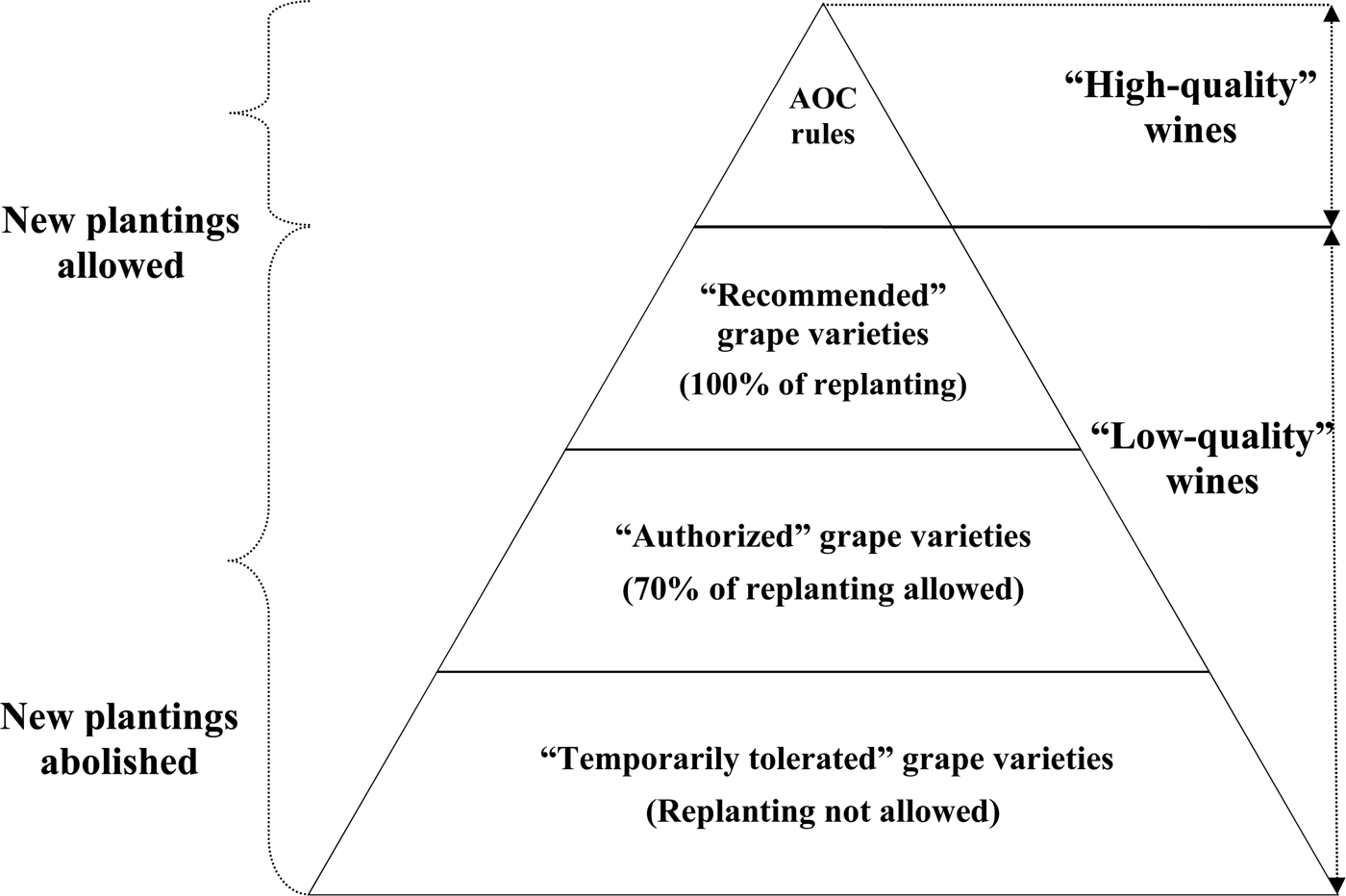
Second, inside the regions officially qualified for viticulture, the restrictions were different for table wines (“low-quality” wines) and AOC wines (“high-quality” wines) (see Figure 1).Footnote 34 AOC wines were (by AOC definition) only produced in specific (sub-)regions (such as Bordeaux or Champagne), and new plantings were allowed under the specific AOC regulations.Footnote 35 For table wines, the general principle was that no new plantings were allowed.
The French 1953 Classification of Vine Varieties and the “Quality” Pyramid

Third, there were further distinctions within the table wines with more restrictions. New (additional) plantings were prohibited for all table wines, but replanting, after vineyards had been uprooted, was allowed under strict conditions. The lowest category of grape varieties was the “prohibited” (mainly hybrids, such as Noah, Othello, Isabelle, Jacquez, Clinton, and Herbemont), which required the area to be grubbed up and the wine distilled. The second category was the “temporarily tolerated,” which could not be replanted. The third category was the “authorized” varieties. If these varieties were used, the producer had to reduce the area by 30% when replanting. The fourth category was the “recommended” grape varieties. If producers planted these grapes, they could go for the same (100%) area as they had grubbed up. Finally, it should be noted that these “replanting rights” could not be transferred to other producers or landowners (JORF, 1953, art. 30).
The impact of the introduction of planting restrictions and subsidies to uproot vines was sizable. From 1953 to 1957, approximately 120,000 hectares of vines were uprooted, representing 7% of the total vineyard area. As a consequence, French wine production declined by approximately 10% in the same period (Insee, 1966, p. 190). Moreover, due to the policy of replanting of vines to “better vine varieties,” in the next ten years (1958–1968), the share of the “recommended” grape varieties increased from 58% to 90% of the planted grape varieties in France (Durbiano, Reference Durbiano1975).
A. Regulations Breed More Regulations—Again
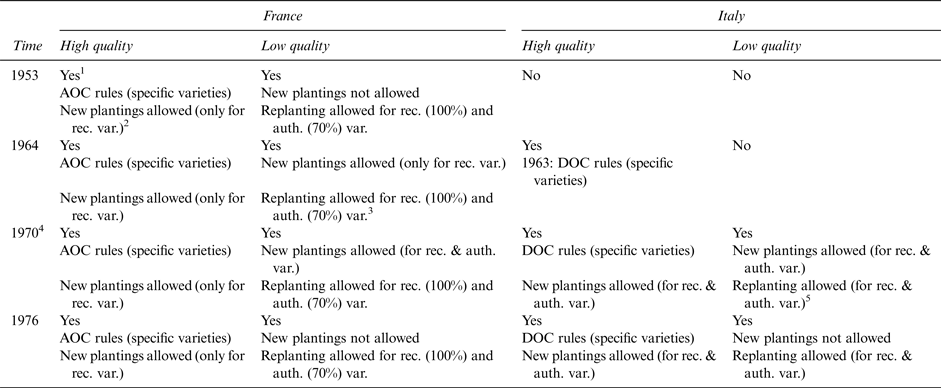
Economic integration in the EEC during the 1960s and 1970s required the integration of different policy regimes in one EEC wine policy (the common market organization [CMO] for wine). The most important producers, Italy and France, held different positions (see Table 2). Although France's wine market was highly regulated through government intervention, including prohibitions on new vineyards and price supports, Italy had more liberal wine policies: there were no price interventions or planting restrictions.
Plantings Restrictions in France and Italy, 1950s to 1970s

Notes: 1 Yes/No refers to whether there are planting restrictions. 2 “rec. var.” stands for “recommended varieties” and “rec. & auth. var.” for “recommended and authorized varieties.” 3 Restrictions on replanting rights were included in the French Rural Code (see art. R665-16; Government of France, 2008). 4 From 1970, the Common Wine Policy applied to both countries, but more restrictive national regulations could be introduced. 5 “Allowed” means replanting rights for 100%, unless explicitly indicated. AOC, appellation d'origine contrôlée; DOC, denominazione di origine controllata.
The Treaty of Rome (1957) fixed a “transitional period” for a common policy to be negotiated and introduced. The initial EEC regulatory steps toward a Common Wine Policy (CWP) were taken in 1962. It was far from a common policy and only required that each member state established a viticultural land register; the notification of annual production levels to a central authority (harvest and stock declarations); the annual compilation of future estimates of resources and requirements; and stricter rules on “quality wines.”Footnote 36 There was no agreement on stronger regulations such as planting rights (Council Regulation No. 24/1962 [Council of the European Union, 1962]). The transition period was supposed to end in 1969, and by 1969, wine was the last major agricultural product that was still subject to national regulations. Italy and France had to reach an agreement on a common policy by the end of the year (Niederbacher, Reference Niederbacher1983; Spahni, Reference Spahni1988).Footnote 37
In the absence of common EEC regulations, national wine policies continued. In 1964, there was some relaxation of planting rights restrictions in France. The main reason was the fall in Algerian wine imports. After Algeria achieved independence in 1962, France imposed import restrictions and tariffs on Algerian wine causing a dramatic decline in imports of Algerian wine and therefore in the total wine supply in France. A second factor was a decrease in Italian wine production due to a decrease of mixed crop vineyards and to the Italian miracolo economico (economic miracle) that led to a massive exodus from the rural areas into the cities (Bartoli et al., Reference Bartoli, Boulet, Lacombe, Laporte, Lifran and Montaigne1987, p. 23; Meloni and Swinnen, Reference Meloni and Swinnen2014; Niederbacher, Reference Niederbacher1983).
In 1964, two laws, on “the wine production and organization of the wine market” and on “the organization of the vineyard and improving the quality of wine production,” eased rules on market intervention and especially on planting rights (JORF, 1964a, 1964b).Footnote 38 First, the 1964 law allowed the transfer of wine “replanting rights” from one winegrower to another. Second, the planting of new vines was extended to table wines (and not only to AOC wines) and was allowed if justified by “favorable economic prospects and trade opportunities” or by “improving the geographical distribution of the vineyard or the structure of farms” (JORF, 1964a).Footnote 39
However, restrictions were not fully removed. For example, replanting with authorized varieties was still restricted at 70%,Footnote 40 the transfer of wine “replanting rights” was subject to authorization by the Institut des Vins de Consommation Courante,Footnote 41 and new planting of table wines was allowed only if the “recommended” grape varieties were used within the regions qualified for viticulture (JORF, 1964a, arts. 1 and 3).Footnote 42
During the 1964–1970 period, this “more liberal” French planting regime helped to facilitate the negotiations between France and Italy. In 1970, a compromise between the positions of Italy and France formed the basis of the European CWP.Footnote 43 The 1970 CWP introduced restrictions on vine plantings for the entire EEC. The structure of the EEC planting rights regime strongly resembled the French system, but in a weaker version of implementation. First, as in the French system a distinction was made between “table wines” and “quality wines produced in a specific region” (often abbreviated to “quality wines psr” or simply “quality wines,” as AOC in France or denominazione di origine controllata [DOC] in Italy). Second, within the table wine regime different grape categories were introduced. Vines were classified as “recommended,” “authorized,” and “provisionally authorized” varieties—with “recommended” as the highest quality level, resembling the French 1953 classification (Council Regulation No. 1388/70, art. 6 [Council of the European Union, 1970c]).Footnote 44
Restrictions were introduced on the new planting and replanting of vines to “better vine varieties”—the so-called rules designed to improve vine-stock selection. Also in this aspect, the CWP structure resembled the French system, but under Italian pressure, the implementation was weakened. In the EEC, new plantings in “quality wines” (e.g., AOC and DOC) regions were allowed for both “recommended” and “authorized” grape varieties. Similarly, “authorized” varieties were also allowed for new plantings of table wines under EEC rules. However, France applied more restrictive national regulations (as allowed under EEC rules) and still imposed only “recommended” grape varieties for AOC regions and the “70% replanting rule” for table wines (Council Regulation Nos. 816/70 and 817/70 [Council of the European Union, 1970a, 1970b]; JORF, 1972).Footnote 45
However, the compromise on the planting rights regime did not last very long. There was continued pressure from France for a more interventionist approach, and this pressure grew stronger with increasing imports of Italian wine. A full-blown “wine war” exploded in 1974, when increasing grape harvests in 1973 and 1974 and a devaluation of the Italian lira lowered prices of exported Italian wines. In 1975, French growers physically blocked Italian wine imports at the French ports. In 1976, under growing pressure from French producers, who feared that cheaper Italian wine would swamp the French market and cause a collapse in prices, the European Council of Ministers introduced stricter measures to control the supply of wine through more stringent planting rights restrictions and other policies such as subsidized grubbing up (i.e., uprooting).Footnote 46
The 1976 regulation on vineyard plantings, contrary to the 1970 regulation, not only restricted the replanting of vines to “better vine varieties,” but also imposed a total ban on all new plantings for table wines.Footnote 47 Furthermore, member states had to uproot hybrid grape varieties by 1979 and to uproot “provisionally authorized” grape varieties by 1983 (Council Regulation No. 1160/76 [Council of the European Union, 1976a]).
The tighter regulations of planting rights were initially perceived as a temporary measure and only affecting “low-quality” wines. In fact, the 1976 regulation stated: “All new planting of vine varieties (…) shall be prohibited during the period from 1 December 1976 to 30 November 1978” (Council Regulation No. 1162/76, art. 2 [Council of the European Union, 1976b]). However, since then the system has been continuously reconfirmed, and it has been continued over the years (becoming a permanent one) and even expanded to include also “high-quality” wines in 1984 (Council Regulation No. 1208/84 [Council of the European Union, 1984]).
Hence, by the mid-1970s, instead of being liberalized, the French wine policy with its extensive regulations and heavy government intervention in markets had become the official European wine policy. As during the reign of King Louis XV, instead of loosening regulation to solve problems of market distortions, the opposite happened: politicians introduced more restrictions and extended them to other regions to control supply there as well.
VII. Enforcement Problems
As France was divided into an infinity of small lordships, which recognized feudal dependency rather than political dependency, it would have been very difficult for a single law to have authority: indeed, one could not have seen to its enforcement.Footnote 48
—Montesquieu (Reference Montesquieu1748b, p. 297)An important problem with the implementation of planting rights restrictions (and with quantitative restrictions on output and input use in generalFootnote 49 ) is the enforcement of the regulations. Major problems of enforcement of the EU planting rights system received a lot of publicity in 2012 when the European Commission fined Greece, Italy, and Spain for a total of 250 million euros because of 120,000 hectares of illegally planted vineyards, approximately 8% of total vineyard area. For instance, in Italy more than 24,000 hectares (equal to approximately 34,000 soccer fields) of illegal vine planting were found (73% of them were found in the Puglia region, in southern Italy; Corsentino, Reference Corsentino2012).
Given that technologies have improved so much over the past two centuries, it is not surprising that enforcement was even more problematic in the eighteenth century. Martin (Reference Martin1907) argues that the 1731 edict did not restrict plantings effectively, and that there were more planted vines in the 1750s than in 1731.Footnote 50
The edict was weakly enforced for two main reasons. The first reason was the “freedom of interpretation” of the intendants in charge of controlling and enforcing the restrictions on the vine planting. Initially, the municipalities inspected whether new vines were planted. This changed during the 1740s. Independent persons were appointed. They were in charge of preparing reports on the existence of new planting of vines. Based on these reports, the intendant issued the sentences. If new vines were found, the vineyard owners were sued in court and legally punished with fines of 3,000 livres (the currency of France until 1795).Footnote 51 However, in 1737, the 1731 edict was adjusted so that vines could be planted if the winegrower was able to prove that the land was not suitable to grow grain.Footnote 52 In practice, this implied that the edict could (and did) have different effects depending on whether the intendant in charge of enforcing the edict was willing (or not) to accept the arguments of the winegrower. Dion (Reference Dion1959, p. 599) argues that this led to a gradual erosion of the 1731 edict.
Another reason was the different interests of wine producers in regions such as Bordeaux and those located in the Midi region in southern France. After the end of the wars with France that lasted from 1689 to 1713, Britain decided to impose high tariffs on French wines in 1714.Footnote 53 Volume tariffs on wine (and not ad valorem) hurt especially the export of cheap wines to Britain. It allowed the upper British class to continue to consume “high-quality” wines, whereas the lower class moved to beer (Nye, Reference Nye2007). Therefore, the British tariffs encouraged landowners in Bordeaux to produce “higher-quality” (price) wines to continue to export them to England. The landowners were supervising the entire wine-making process and planting lower-yielding grapes on the slopes. On the contrary, in the Midi, the landowners were not exporting their wines nor aiming at increasing their quality. They just wanted more wine to increase their profits and therefore wanted to plant higher-yielding and more grapes (Dion, Reference Dion1959, p. 598; Enjalbert, Reference Enjalbert1953; Lacouture, Reference Lacouture2003, p. 134).
Problems of implementation continue today. In their study of the current EU planting rights, Montaigne et al. (Reference Montaigne, Coelho, Delord and Khefifi2012, p. 60) point out that “the lack of efficient controls and the non-compliance by winemakers” as a major problem. Without appropriate enforcement, the aim of a planting rights regime (i.e., restricting supply) is undermined.
The enforcement of the regulation is, in the first place, the responsibility of the member states. They have to manage “appropriate control systems” (i.e., a vineyard register, a planting rights register, and the associated controls). If the member states discover “unlawful” or “illegal” plantings (i.e., areas planted with vines without a corresponding planting right), they must order the uprooting of these plantings and punish the winegrowers with fines of 12,000 euros per hectare per year until the grubbing up is done (European Commission, 2012).
An additional control is made by the European Commission, which can fine growers for illegal vine planting. The last control was made after the 2008 CMO reform, where winegrowers could “regularize” the illegal plantings planted before 1998 against the payment of a fee. However, as the 2012 fines illustrate, many illegal plantings remain.
VIII. Attempts to Reform the EU Planting Rights
It took three years of hard work with ups and downs, but in the end the sector scored the winning goal (…): the Europeans gods heard our prayers or so to say.
—Blog of the European Federation of Origin WinesFootnote 54There have been several proposals to reform the EU wine policy and the planting rights system. The most serious attempt, which initially appeared successful, occurred in the second half of the 2000s.
Liberalization of the EU's current system of planting rights was widely discussed since 2006, when the European Commission proposed a set of bold reforms, which included the elimination of planting rights. The European Commission proposed that planting rights restrictions should be removed by 2013, allowing producers to freely decide where to plant. The reform proposals were in line with the abolition of production quotas in the dairy and sugar sectors and reforms in other agricultural sectors that had been decided earlier.
In 2008, the EU leaders approved this major reform of the CWP.Footnote 55 A key component was the abolition of the planting rights system. However, the Council of Ministers decided to allow a long transition period: the member states wishing to continue the restrictions could do so until 2018.
Although the reform was approved by a qualified majorityFootnote 56 —significantly more than a simple majority of votes—in the Council of Ministers, interest groups opposed to the liberalization immediately started to reorganize and launched a new lobby campaign. They succeeded in changing the position of many member states. The first countries to express their wish to overturn the decision were Germany and France in 2010. Since then, all EU member states that produce wine joined in asking for a continuation of planting rights (Deconinck and Swinnen, Reference Deconinck and Swinnen2015; Zandona, Reference Zandona2012). This led to the creation of a High Level Group (HLG) on wine planting rightsFootnote 57 and a joint decision by the European Parliament and the Council of Ministers in 2013 to extend the planting rights system until 2030 with a new program of authorizations for new plantings starting in 2016—effectively overturning the 2008 decision to liberalize (Gaeta and Corsinovi, Reference Gaeta and Corsinovi2014).Footnote 58
There is discussion on whether the new planting rights system is even more restrictive than the existing one. In principle, the new “authorization” system could be either more or less restrictive, depending on how the new regulations will be implemented by the member states. Interestingly, these implementation decisions may change yearly, making an ex ante assessment difficult.
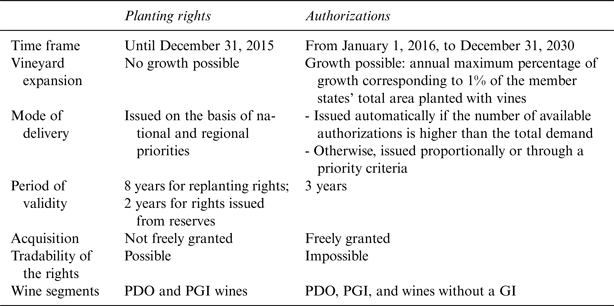
The new EU-wide “authorization” system will be (once more) based on the French authorization system.Footnote 59 One major difference between the “planting rights” system (as it was implemented in many other EU countries) and the “authorization” system (as applied in France) is the tradability of the rights. In many EU countries, the “planting rights” can now be traded, whereas the “authorizations” will be individual and nontransferable. Another major difference is that the ability to plant new vines is now extended to wines without a GI (thus not only to protected designation of origin [PDO]/protected geographical indication [PGI] wines).Footnote 60 In addition, these authorizations for new plantings have an annual maximum percentage of growth (corresponding to 1% of the member states’ total area planted with vines). For instance, in France, it corresponds to 8,057hectares per year (see Table 3; Regulation No. 1308/2013 [European Parliament, Council of the European Union, 2013]).Footnote 61
Planting Rights and Authorizations, a Comparison

Notes: GI, geographical indication; PDO, protected designation of origin; PGI, protected geographical indication.
In 2014, fourteen EU wine-producing countries requested new implementation criteria, such as the possibility to increase the restrictions for replanting on grape varieties or on the “immediate geographical neighbourhood areas to existing vineyards” (CEEV, 2014a, p. 1).Footnote 62
These developments triggered the open letter of the European wine associations fearing that the recently agreed on vine planting authorizations system could result in “an even more restrictive regime” than the former planting rights scheme (CEEV, 2014b, p. 1). In their open letter, the CEEV claimed that these “technical details” and “implementations rules” for applying the new system from 2016 were a “shopping-list of disparate requests” that would lead to a regime “more restrictive than the previous one, in clear contradiction with the spirit and the letter of the reform” (CEEV, 2014b, p. 2). The European wine associations were “shocked” by this backdoor mobilization and believed that these requests were only justified on the grounds of protecting “a bunch of privileges driven by domestic narrow interests” (CEEV, 2014b, p. 3).
The final rules (delegated and implementing regulations) are now published (Regulation No. 2015/560 [European Commission, 2014]; Regulation No. 2015/561 [European Commission, 2015]). However, the political debate will continue at the national level, as the implementation rules can be changed. It is therefore still not fully clear how the new vine planting system will be implemented by the member states in the coming years.
Every year, three types of decisions can be made. First, member states will be able to establish a lower threshold (lower than 1%) at the national or the regional level for new plantings—the so-called safeguard mechanism.Footnote 63 Even if at the national level the threshold is maintained at 1%, regions (or even smaller areas eligible for specific PDO/PGI) could still decide to lower the threshold. Second, member states can decide to impose restrictions on the allocation of the authorizations. If requests by winegrowers for new plantings are below the 1% threshold, all requests will be accepted. However, if the requests exceed the 1% threshold, authorizations shall be granted either according to a “pro-rata distribution of hectares to all applicants” or according to “objective and non-discriminatory priority criteria,” which can vary substantially.Footnote 64 Third, restrictions can be imposed on the replanting of PDO/PGI wines through a recommendation from a professional organization (i.e., wine producers association) (Regulation No. 2015/560 [European Commission, 2014]; Regulation No. 2015/561 [European Commission, 2015]).Footnote 65
In summary, in the current authorization system, restrictions to control the supply of wine can be imposed on the total amount of land available for new plantings (1% or less), on the way these new plantings are allocated to winegrowers, and on the replantings of PDO/PGI wines. Moreover, these are yearly decisionsFootnote 66 determined by member states and professional organizations according to national and PDO/PGI priorities, thereby strengthening regional power.Footnote 67
To illustrate the different outcomes that are possible, consider two (extreme) scenarios. One scenario that could give greater flexibility to the wine sector is that of a 1% yearly expansion in vineyard areas, a pro rata distribution of new plantings and no replanting restrictions on PDO/PGI wines. This would allow innovative wine producers to plant wines without a GI (outside the production rules established within the GI areas) and to plant, for instance, different varieties than those imposed by the PDO/PGI areas—also to adapt to climate change or different consumer tastes and preferences.Footnote 68 However, another scenario that could also be possible is that of a threshold lower than 1%, a “priority” allocation of new plantings (e.g., restricting authorizations to vineyards located in slopes with terraces or to winegrowers that grow certain grape varieties) and replanting restrictions on PDO/PGI wines. This would imply that the new authorization system could be more restrictive than the previous one.
IX. Why Liberalization May Require Another French Revolution
The previous section explained how—similar to the EEC decision making on wine during France's integration into the EEC in the 1970s—even a qualified majority vote in favor of planting rights liberalization in the 2000s ultimately was only a temporary (and noneffective) step toward liberalization. Opposition to the liberalization overcame even this “obstacle,” successfully using the political strategy of emphasizing member states’ “fear of oversupply” and of “significant devaluation of a PDO/PGI” (Deconinck and Swinnen, Reference Deconinck and Swinnen2015).
In historical perspective, these arguments are very similar to the 1731 edict of King Louis XV, which stated that the planting rights measure was driven by an “over-abundance of vines in the kingdom (…) to the extent that the value and reputation in many places was destroyed” (Martin, Reference Martin1907, pp. 27–29). Another remarkable point of similarity is the discussion regarding production on hill slopes versus production in the plains.Footnote 69 The final document of the HLG (2012, p. 16) on wine planting rights states that “there is a risk that production would move from that kind of fragile areas [areas in slopes] to lower cost production areas in the plains where higher yields could be obtained.” The similarity to the 1725 edict is remarkable as it protected the vineyards on the slopes by forbidding vine plantings in the “uncultivated part, commonly called the swamps or the ‘moors of Bordeaux,’” the vast flat plains south of Bordeaux.Footnote 70
In summary, one can only conclude that the political forces against liberalization of planting rights are very strong. Old and recent history suggests that planting rights liberalization is possible but only under exceptional political and economic conditions. Major economic events (the destruction caused by World War II, which caused a 10-year break in the planting rights restrictions in 1942–1952, and the dramatic fall in Algerian wine imports, which contributed to a relaxation in 1964–1970), major institutional changes (France's integration into the EEC, which resulted in a temporary compromise in 1970–1975), or political decisions (an EU qualified majority vote in favor of liberalization, which was overturned before it could be implemented) only caused short periods of liberalization and proved not strong enough to effectively overcome the formidable opposition in the long run.
Only the French Revolution led to a fundamental liberalization of planting rights at the end of the eighteenth century (after being in place for almost 70 years). The “liberal period” of the nineteenth century was sustained by the combination of the French Revolution's liberal ideology, the thirst for wine of Napoleon's armies, and diseases that wiped out most of the French vineyards. Even for those in favor of the liberalization, these condition must be a frightening prospect.
X. Epilogue
But I believe that my old castle and my vats will soon call me to the country; for since the peaceFootnote 71 my wine becomes more and more in vogue amongst the English, much more so than even my book.
—Letter of Montesquieu to the Grand Prior Solar, 1749The Code is more like “guidelines” rather than actual rules.
—Captain Hector BarbossaFootnote 72Montesquieu, unlike other writers and philosophers that depended on the generosity of wealthy patrons, maintained his financial independence thanks to the profits he made from the wine trade (Brut-Moncassin, Reference Brut-Moncassin2006, p. 191; Lacouture, Reference Lacouture2003, p. 10).Footnote 73 At the time of the 1725 edict, Montesquieu already owned 216 hectares of vines in the Bordeaux wine region: 11 hectares of vines in La Brède,Footnote 74 75 hectares of vines in Rochemorin (Martillac), 60 hectares of vines in Raymond, 70 hectares of vines in Montesquieu (where he produced Armagnac), and a few vines in Clairac (Brut-Moncassin, Reference Brut-Moncassin2006, p. 208).Footnote 75
Because his wine constituted the wealth of his estate, Montesquieu wanted to plant more vineyards. Despite the 1725 regulation, in 1726 he acquired lands (approximately 10 hectares) in Pessac in the district of Pujeaux-de-Péougran (6 km south from Bordeaux) because of the higher expected value of the wines (Martin, Reference Martin1907, p. 6; Perceval, Reference Perceval1935, p. 30). It was close to one of the most well-known and wealthy wine producers—Château Haut-Brion. Montesquieu acquired the lands in Pessac for an amount of 60 livres. As he wrote, his intention was to transform it into a land that would be worth 500,000 livres, thereby increasing its value by approximately 8,000 times (Montesquieu, Reference Montesquieu and Masson1726/1955, p. 271)—a huge expected gain, provided the land was planted with vines. However, with the 1725 prohibition, he could not plant vines on the newly acquired lands.
Faced with these (costly) restrictions, he first sent a letter to his friend, M. Lamoignon de Courson, the previous intendant of Guyenne (1709–1720), counselor of state, and brother-in-law of Mr. Le Pelletier, the just-appointed French controlleur général. Montesquieu explained the issue to him and asked for “a permission to plant vines” (Brut-Moncassin, Reference Brut-Moncassin2006, p. 226). Montesquieu then wrote his essay to Mr. Le Pelletier, the just-appointed French controlleur général, arguing for the need to remove the restrictions on economic grounds. When his arguments did not lead to a change in policy, Montesquieu changed tactics. Besides being a political philosopher, writer of economic ideas, and wine producer, he was also a wealthy and influential noble, involved in the highest juridical organizations in France. At the time, he was président à mortier (magistrate) in the parlement (regional court) of Bordeaux (inherited from his uncle Jean-Baptiste de Secondat). These appeal courts were politically influential, and only nobles could purchase or inherit these posts (Dast Le Vacher de Boisville, Reference Dast Le Vacher de Boisville1896; Richter, Reference Richter1977).
Although it remains unclear how (on se sait comment), Montesquieu ultimately obtained the permission to plant his vines. In fact, Mr. Boucher, the intendant of Guyenne, reported himself that “the prohibitions were overridden on all sides, and Montesquieu himself planted his vineyard.”Footnote 76
Based on these plantings, Montesquieu became a successful wine producer and merchant,Footnote 77 with his wines exported to England (Lacouture, Reference Lacouture2003). In many of Montesquieu's letters, reference is made to the “purity” of his wine,Footnote 78 the exports to England (his main market),Footnote 79 and its increased reputation.Footnote 80 His wine was found extrêmement bon (extremely good; Vian, Reference Vian1879, p. 161).
The wine trade, and his success in overcoming the planting rights restrictions, allowed him to travel and to spend time thinking, discussing, and ultimately writing up his ideas, which influenced much of the Western world. In 1726, he sold his magistrate office and leased his wine properties in order to have a comfortable rent. He then spent more than a year in Paris before traveling to Europe, mainly to England (Richter, Reference Richter1977, p. 14; Walckenaër, Reference Walckenaër1835, p. xi). After Montesquieu visited many European countries, he returned to France in 1732 and retired to his Castle at La Brède, which he considered to be “the most beautiful country retreat that I know of anywhere” (Montesquieu, Reference Montesquieu1777, p. 34). After two years, he published the book Considérations sur les causes de la grandeur des Romains et de leur décadence (Considerations on the Causes of the Grandeur and Decadence of the Romans), and, after 16 years, in 1748 he published his famous De l'Esprit des Lois (Walckenaër, Reference Walckenaër1835, p. xiii–xiv).
Hence, ultimately for Montesquieu, political philosophy, excellent wine, and (imperfect enforcement of) planting rights reinforced each other. Montesquieu was so successful in the wine trade that he claimed his wine was more popular in England than his book (De l'Esprit des Lois): “my wine becomes more and more in vogue amongst the English, much more so than even my book.”Footnote 81