Road traffic deaths have plateaued in recent years despite the growing population and increasing motorization worldwide (World Health Organization [WHO], 2018). Nevertheless, traffic accidents remain one of the leading causes of death across all age groups and the main cause of death among young drivers (Masuri, Isa, & Tahir, Reference Masuri, Isa and Tahir2017). The situation is not homogeneous across countries: whereas the number of crashes in high-income countries has gone down, the opposite is the case on the whole in low- and middle-income countries (WHO, 2018). In Latin America, though the overall rate of fatality due to road traffic injuries has increased, with more than 150,000 people dying every year, the figures differ from country to country (Panamerican Health Organization, PHO; 2016). The economic burden associated with road traffic injuries is also high, being estimated at 4.5 billion dollars per year (Bhalla, Diez-Roux, Taddia, De La Peña Mendoza, & Pereyra, Reference Bhalla, Diez-Roux, Taddia, De La Peña Mendoza and Pereyra2013). Thus, road crashes not only represent a major public health concern but also pose a serious threat to economic development in the region.
Risky driving has commonly been acknowledged as the most critical component for road safety (Hoffmann, Reference Hoffmann2005; Petridou & Moustaki, Reference Petridou and Moustaki2000). Risk while driving encompasses a wide variety of behaviors with different degrees of intentionality ranging from unintentional errors (e.g., misjudging the distance in a car park and hitting an adjacent vehicle) to deliberate violations of traffic rules (driving over the legal blood-alcohol limit, disregarding red traffic lights etc.; de Winter & Dodou, Reference de Winter and Dodou2010; Reason, Manstead, Stradling, Baxter, & Campbell, Reference Reason, Manstead, Stradling, Baxter and Campbell1990). While both types of behavior may endanger the driver and other road users, deliberate risk-taking behavior, particularly ignoring traffic rules, exceeding the speed limit and driving under the influence of alcohol have been associated with an increased risk of collision (Antonopoulos et al., Reference Antonopoulos, Germeni, Bacopoulou, Kalampoki, Maltezos, Skalkidis and Petridou2011; Jiménez-Mejías et al., Reference Jiménez-Mejías, Medina-García, Martínez-Ruiz, Pulido-Manzanero and Fernández-Villa2015; Mallia, Lazuras, Violani, & Lucidi, Reference Mallia, Lazuras, Violani and Lucidi2015; Mohamed & Bromfield, Reference Mohamed and Bromfield2017; Vázquez, Reference Vázquez2004; Woratanarat et al., Reference Woratanarat, Ingsathit, Suriyawongpaisal, Rattanasiri, Chatchaipun, Wattayakorn and Anukarahanonta2009). For example, Gjerde, Normann, Christophersen, Samuelsen, and Mørland (Reference Gjerde, Normann, Christophersen, Samuelsen and Mørland2011) reported that alcohol was found in the blood of 35.2% of fatally injured drivers. Shyhalla (Reference Shyhalla2014) demonstrated that drivers who tended to drive above the speed limit were more likely to initiate severe two-vehicle collisions, with the likelihood increasing by 10 percent for every 10 km/h of increased speed. Strategies focused on reducing drivers’ risky behaviors and attitudes are therefore deemed essential for improving road safety.
Attitudes toward traffic safety reflect beliefs endorsed by individuals regarding traffic regulations, speeding, drink-driving, and other risky behaviors, determining how these behaviors are evaluated (i.e. whether drivers consider this sort of behavior acceptable or not; Assum, Reference Assum1997). Research on attitudes has commonly distinguished between explicit and implicit attitudes (Roefs & Jansen, Reference Roefs and Jansen2002; Sabin, Riskind, & Nosek, Reference Sabin, Riskind and Nosek2015; Sherman, Rose, Koch, Presson, & Chassin, Reference Sherman, Rose, Koch, Presson and Chassin2003). Explicit attitudes are deliberate, consciously-driven evaluative judgments about a given object resulting from a propositional process. In contrast, implicit attitudes rely on more automatic, associative processes that activate evaluations without people’s awareness or conscious control (Gawronski & Bodenhausen, Reference Gawronski and Bodenhausen2006; Rydell, McConnell, Mackie, & Strain, Reference Rydell, McConnell, Mackie and Strain2006). Empirical research has shown that both implicit and explicit components of attitude contribute towards explaining risky driving behavior (Hatfield, Fernandes, Faunce, & Job, Reference Hatfield, Fernandes, Faunce and Job2008; Ledesma, Tosi, Poó, Montes, & López, Reference Ledesma, Tosi, Poó, Montes and López2015; Stephens, Bishop, Liu, & Fitzharris, Reference Stephens, Bishop, Liu and Fitzharris2017).
In order to assess drivers’ explicit attitudes in the traffic context, Iversen (Reference Iversen2004) developed the Attitudes toward Traffic Safety Scale (henceforth referred as ATTS). The ATTS is a 16-item, self-report instrument that measures attitudes toward risky behaviors of particular relevance to road safety, such as traffic violations and speeding, other people’s driving, and drinking and driving. The first factor comprises driver attitudes toward non-compliance with traffic regulations in order to keep the traffic flowing, exceeding speed limits to get ahead, ignoring traffic lights and driving faster when there are no other vehicles around. The second factor examines whether it is acceptable to take certain risks as passengers, such as accepting a ride with a driver who speeds if this is the only chance of getting home at night. Finally, attitude towards drinking and driving refers to drivers’ evaluations regarding driving after consuming alcohol and riding with a drink driver. A negative attitude towards traffic safety issues corresponds to a high risk-taking attitude. Iversen (Reference Iversen2004) found that three subscales were supported by confirmatory factor analysis and that the subscales were positively but moderately correlated, suggesting that they represent relatively distinct domains of driver attitudes. Additionally, all subscales revealed adequate internal consistency (α ranging from .68 to .86) and acceptable test-retest reliability. A one-year prospective analysis showed that the three attitude dimensions predicted self-reported risky driving behavior, supporting predictive validity. Overall, these results show that the ATTS has good psychometric properties.
After its publication, the ATTS became popular and has since been used in many countries including South Africa (Bachoo, Bhagwanjee, & Govender, Reference Bachoo, Bhagwanjee and Govender2013), Italy (Lucidi et al., Reference Lucidi, Giannini, Sgalla, Mallia, Devoto and Reichmann2010), Ireland (Sarma, Carey, Kervick, & Bimpeh, Reference Sarma, Carey, Kervick and Bimpeh2013), China (Ma, Yan, Huang, & Abdel-Aty, Reference Ma, Yan, Huang and Abdel-Aty2010), Norway (Iversen, & Rundmo, Reference Iversen and Rundmo2004) and Turkey (Şimşekoğlu, Nordfjærn, & Rundmo, Reference Şimşekoğlu, Nordfjærn and Rundmo2012). The cited studies have consistently shown the utility of the ATTS in predicting self-reported risky driving behavior. Nevertheless, despite its usefulness, there are certain relevant properties of the ATTS (e.g., factor structure) that were not examined in these studies and which require further investigation to provide evidence of construct validity. Furthermore, as self-report measures involve controlled (i.e. conscious) responses, individuals may feel motivated to distort their responses in order to provide a favorable self-image as a driver (af Wåhlberg, Reference af Wåhlberg2010). This may be especially relevant when assessing attitudes and behaviors that are socially unacceptable (e.g., speeding), where honest responses may be viewed by respondents as self-incriminatory (Corbett, Reference Corbett2001). Since we were not able to identify previously published studies addressing this specific issue in the ATTS, additional studies are called for. Assessing the degree to which responses are susceptible to social desirability bias is of paramount concern in ensuring the psychometric quality of the scale.
Furthermore, most traffic research has been carried out in developed, high-income countries, such as the North America, United Kingdom, Norway, and Australia (Ledesma, Peltzer, & Poó, Reference Ledesma, Peltzer and Poó2008; Nordfjærn, Jørgensen, & Rundmo, Reference Nordfjærn, Jørgensen and Rundmo2011). Comparatively few studies to date have addressed the issue of road safety attitudes and their correlates on driving behavior in low- and middle-income societies. For instance, Yunesian, Mesdaghinian, Moradi, and Vash (Reference Yunesian, Mesdaghinia, Moradi and Vash2008) investigated whether attitudes toward road safety predict driver behavior in Iran and found no association between the variables. Lund and Rundmo (Reference Lund and Rundmo2009) showed that attitudes toward road safety predicted driving behavior in Norwegian drivers but not in Ghanaian drivers. Another study comparing Turkish and Norwegian drivers revealed that while the former had safer attitudes toward drinking and driving, the latter had safer attitudes toward speeding. Turkish drivers also reported a lower frequency of speeding behaviors than their Norwegian counterparts, while Norwegian drivers reported less alcohol-related driving (Şimşekoğlu et al., Reference Şimşekoğlu, Nordfjærn and Rundmo2012). Overall, these results suggest that there are important cross-cultural differences in attitudes, risky behaviors and in attitude-behavior relationships, for which reason findings from high-income societies cannot be extrapolated to the case of developing countries. From a practical viewpoint, these results also imply that safety campaigns aimed at improving people’s attitudes toward road safety which have proven effective in high-income countries may not be suitable for low- and middle-income countries. Consequently, more research is needed in developing countries to design effective, evidence-based countermeasures for improving road safety attitudes.
Despite the implications of attitudes toward traffic safety in risky driving behavior and well-documented cross-cultural differences, there is a dearth of research on the matter in Latin America. Furthermore, to our knowledge there is no Spanish version of the ATTS. A valid and reliable version of ATTS for Latin American countries with Spanish-speaking populations would be particularly useful for stimulating empirical research on driver attitudes. Accordingly, the first and foremost objective of the present study was to translate and examine the psychometric properties of the ATTS for its use among Spanish-speaking populations. Since as previously mentioned there is little information available regarding the influence of social desirability bias on ATTS responses, a second objective was therefore to examine the ATTS’s robustness against this bias. Lastly, differences in ATTS scores according to sociodemographic and driving-related variables were also analyzed.
Method
Participants
A heterogeneous sample of 558 licensed drivers from the general population of Córdoba, Argentina, was recruited for the study. Participants were eligible if they were 18 years of age or older, had a valid driver’s license, drove a motor vehicle and had driven at least once per week during the last month. The mean age of the respondents was 29.2 (SD = 12.03), ranging from 18 to 77 years old. Men accounted for the 53.1% of the total sample. The majority of participants drove every day (58.3%) or regularly (more than twice a week: 23.6%); 91.4% drove an automobile/ pick up, 2.8% a motorcycle, 4.0% more than one type of vehicle and 1.8% “other” vehicle (e.g., truck). Eighty-one percent of the drivers had an educational level of at least high school.
Measures
Risk-taking attitudes. The Attitudes toward Traffic Safety Scale (ATTS; Iversen, Reference Iversen2004) is a 16-item attitudes scale that assesses individuals’ road safety attitudes with respect to driving. Specifically, the ATTS contains three subscales: Attitude towards Rule Violation and Speeding (11 items), Attitude towards the Careless Driving of Others (3 items), and Attitude towards Drinking and Driving (2 items). Respondents are asked to indicate their agreement with each statement on a five-point Likert-type scale, ranging from strongly disagree (1) to strongly agree (5). In the original scale, the internal consistency (α) measured at two time points was as follows: .82 – .81 for attitude towards rule violations and speeding; .70 – .68 for attitude towards the careless driving of others; and .85 – .86 for attitude towards drinking and driving.
Risky driving. Risky driving behavior was measured by nine items drawn from the Spanish-language version of the Multidimensional Driving Style Inventory (MDSI-S; Poó, Taubman-Ben-Ari, Ledesma, & Díaz-Lázaro, Reference Poó, Taubman-Ben-Ari, Ledesma and Díaz-Lázaro2013) referring to drivers’ tendency to seek stimulation and take risks while driving (e.g., “like to take risk while driving”). Participants were asked to read each item and rate the extent to which it reflected their feelings, thoughts, and behaviors during driving on a six-point Likert scale, ranging from not at all (1) to very much (6). Poó et al. (Reference Poó, Taubman-Ben-Ari, Ledesma and Díaz-Lázaro2013) demonstrated good psychometric properties for the MDSI-S and its robustness against social desirability bias in a large sample of Argentinean drivers. In the present study, the internal consistency was high (α = .90).
Social desirability. Social desirability responses were examined using the Argentinean adaptation of the Driver Social Desirability Scale (DSDS; Poó, Ledesma, & Montes, Reference Poó, Ledesma and Montes2010). The DSDS is a self-report questionnaire that taps two components of social desirability responses in traffic contexts: Driver Impression Management (DIM) and Driver Self-Deception (DSD). Exploratory factor analysis, internal consistency, and correlations with multidimensional measures of driving style supported the validity and reliability of the DSDS in Argentina. In the current sample, the Cronbach’s alpha coefficients for DIM and DSD subscales were .85 and .79, respectively.
Sociodemographic and driving-related questions. A self-report questionnaire was used to assess sociodemographic characteristics of drivers (sex, age, and educational level) and different driving-related variables (type of vehicle, driving frequency and self-reported traffic crashes and fines in the last two years).
Procedure
After requesting permission from the ATTS author, a one-way translation from English to Spanish was carried out by two independent, well-qualified, bilingual translators. They were encouraged (a) to place importance on meaning rather than literal translation; (b) to ensure the correct contextual translation of words with several different meanings; (c) to avoid awkwardness in the Spanish language translation; and (d) to use the standard Spanish language in order to avoid regionalisms and vocabulary of limited acceptance. A team of expert judges subsequently compared the original version and the two draft translations, item-by-item, together with the scale instructions. The team was composed of three expert researchers in the field of traffic psychology, fluent in both English and Spanish, and a psychometrician who was familiar with the construct of attitude. Each judge was asked to separately evaluate the linguistic, semantic and cultural appropriateness of the translated versions using a five 5-point Likert-type scale, from very poor (1) to very good (5). A quantitative analysis of the judges’ evaluations was then carried out to select items from the two translations that were rated by the experts as most appropriate and true to the original scale. The final step involved a pretest of the definitive version. A qualitative study using two focus group interviews (n = 12, n = 14) was performed to explore respondents’ understanding of each item and of the instructions. Participants were invited to “think aloud” and paraphrase their understanding of each item with a view to assessing how well the connotative meanings had been captured in the Spanish version of the ATTS. In all cases, anonymity and confidentiality were assured. Participants were debriefed on the study’s objective and gave their verbal consent before completing the scales.
Data analysis
The Aiken V coefficient was calculated to quantify the agreement between expert judgments on the appropriateness of the translated versions. The range of V coefficient is 0 to 1, with a high value showing a high inter-rater agreement. Confirmatory factor analysis (CFA) was used to test the latent structure of the ATTS, and several model fit indices were calculated: the absolute fit index (χ2), the χ2/df ratio, the goodness of fit index (GFI), the Tucker-Lewis index (TLI), the comparative fit index (CFI) and the root mean square error of approximation (RMSEA) and its 90% confidence interval. It is assumed that GFI, TLI and CFI values greater than .90 and RMSEA values smaller than .08 indicate an acceptable model fit, while values greater than .95 (for GFI, TLI and CFI) and smaller than .05 (for RMSEA) are indicative of excellent fit (Hu & Bentler, Reference Hu and Bentler1999). For the χ2/df ratio a value lower than 3 is expected (Kline, Reference Kline2011). In addition, a chi-square difference test was computed to compare nested models (Furr, Reference Furr2011).
Reliability analysis (internal consistency) was performed by computing Cronbach’s alpha coefficient for the factor scales. Although other alternatives have been proposed for carrying out reliability estimates for two-item scales (Attitude towards drinking and driving subscale in the present study), such as the Spearman-Brown (SB) and the Angoff-Feldt (rAF) coefficients (Feldt, Reference Feldt1975; Warrens, Reference Warrens2015), recent studies have shown that if the ratio of standard deviations between items is not large –i.e. < 1.15, as in the present study- then reliability estimates using α, SB and rAF provide near identical results (Domínguez-Lara, Merino-Soto, & Navarro-Loli, Reference Domínguez-Lara, Merino-Soto and Navarro-Loli2016). The use of Cronbach’s alpha is therefore deemed appropriate. Bivariate correlations (Pearson’s r) were used to examine relations between dimensions of ATTS and risky driving behavior, and partial correlations were calculated to estimate the influence of socially desirable responses on the ATTS. Finally, multivariate analysis of variance (MANOVA) was applied to analyze differences in the ATTS scores according to sociodemographic variables (sex, age, and educational level) and traffic crashes and fines. Confirmatory factor analysis was performed using Mplus 6.12 and the remaining analyses were conducted using SPSS 20.
Results
Factor structure and reliability
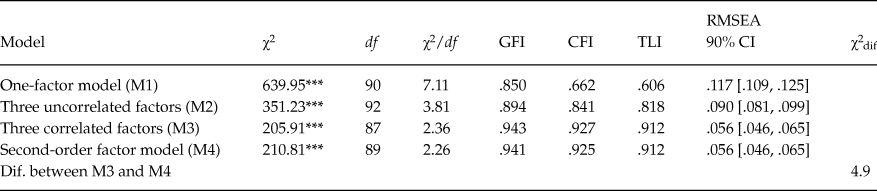
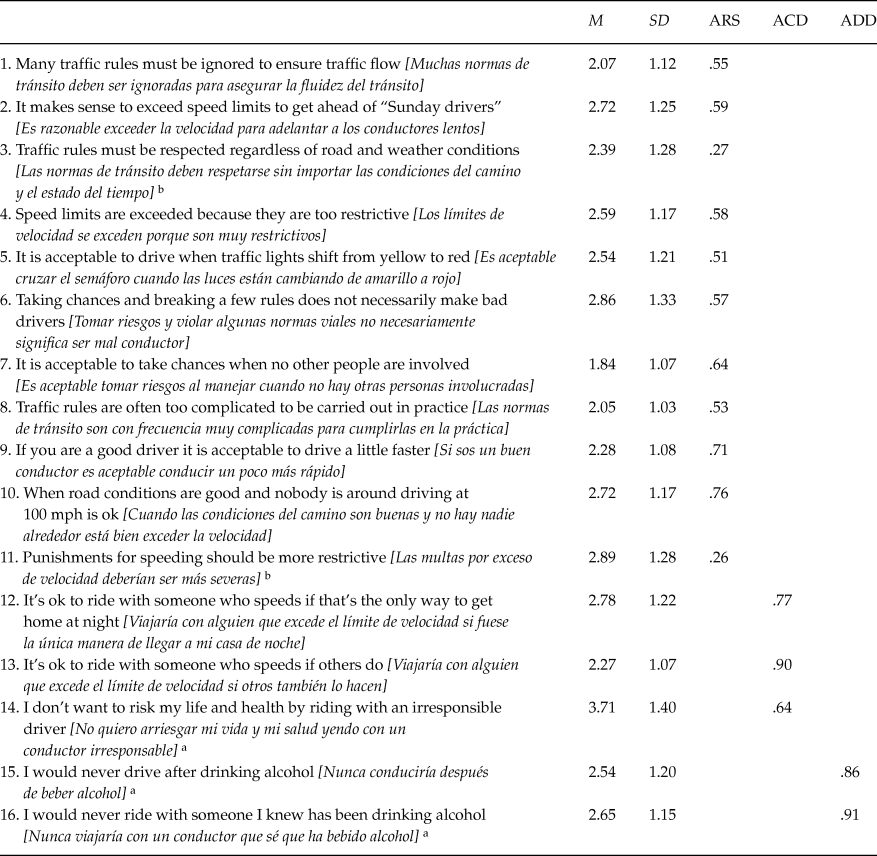
Maximum likelihood (ML) was used for model estimation. Some researchers (e.g., Li, Reference Li2016) indicate that ML may not be appropriate for CFA with ordered categorical data since it assumes that observed indicators are continuous. Rather, they recommend using alternative estimation methods, particularly diagonally weighted least squares (WLSMV), which has been specifically designed for observed ordinally scaled data. However, as we found comparable results in parameter estimates (model fit indices, factor loadings and interfactor correlations) using ML and WLSMV, and there is less consensus regarding optimal cut-off values for evaluating a model fit based on the WLSMV estimation method (Sass, Schmitt, & Marsh, Reference Sass, Schmitt and Marsh2014), we only report ML-based results here. Four different models were tested: Model 1 (M1) a one-factor model assuming attitudes toward traffic safety as a unidimensional construct. Model 2 (M2) tested a three-uncorrelated factor model including attitude towards rule violation and speeding, attitude towards the careless driving of others, and attitude towards drinking and driving. This model assumes that the three dimensions evaluated by ATTS represent empirically distinct and independent domains of driver attitudes. The third model tested (M3) is a three-correlated factor model assuming that the three dimensions of ATTS are empirically distinct yet related domains of driver attitudes. Finally, Model 4 (M4) tested whether a second-order factor model (with attitude towards rule violation and speeding, attitude towards the careless driving of others, and attitude towards drinking and driving as first-order factors) accounted for the observed data. This model assesses whether specific attitudes relating to violations and speeding, drink-driving and careless driving of others can be considered indicators of an overall risky attitude towards driving, in which case the use of the total ATTS score in addition to subscale scores is justified. Results are summarized in Table 1. As seen in the Table, neither M1 nor M2 yielded acceptable fit indices; M3 and M4, on the other hand, fitted well to data. The chi-square difference test showed non-significant differences between M3 and M4. Thus, both models accounted equally well for data. Means, standard deviations and standardized factor loadings are presented in Table 2. All factor loadings were statistically significant (p < .001) and most of the indicators had factor loadings of .50 or above, thus being substantially explained by latent variables. The internal consistency (α) for the total scale was .81, and for each subscale as follows: .74 for attitude towards rule violations and speeding; .77 for attitude towards the careless driving of others; and .84 for attitude towards drinking and driving.
Goodness-of-fit Indices for CFA Models
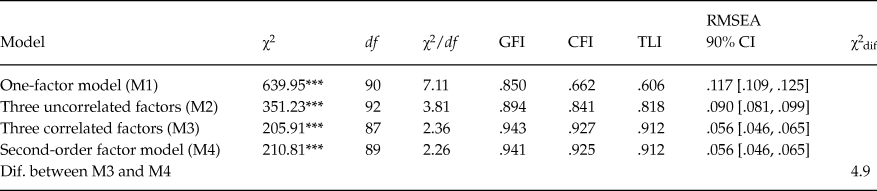
Note: df = degree of freedom; GFI = goodness of fit index; CFI = comparative fit index; TLI = Tucker–Lewis index; RMSEA = root mean square error of approximation.
*p < .05. ***p <. 001.
Means, Standard Deviations and Standardized Factor Loadings of the Attitudes toward Traffic Safety Scale-Spanish Language’ Items
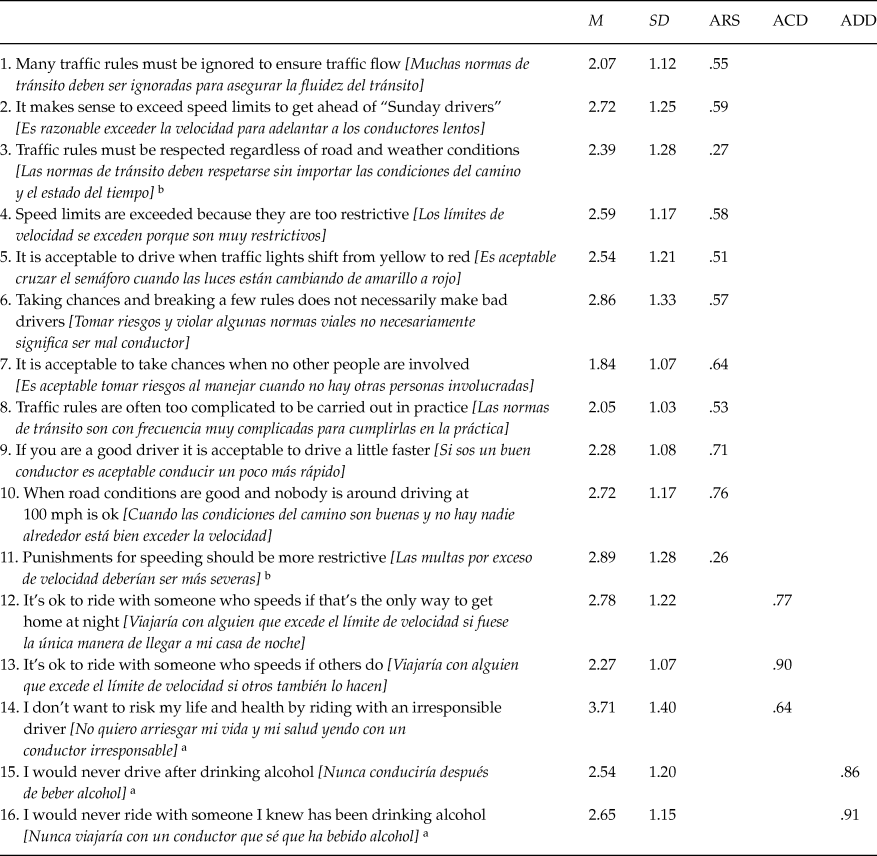
Note: ARS = Attitude towards rule violation and speeding; ACD = attitude towards the careless driving of others; ADD = Attitude towards drinking and driving.
aReversed item. bReverse-coded item
Reproduced and translated with permission from “Risk-taking attitudes and risky driving behavior", by H. Iversen, Transportation Research Part F: Traffic Psychology and Behaviour, 7, 135–150. Copyright 2004 by Elsevier Ltd.
Risky driving attitudes, risky driving behavior and social desirability
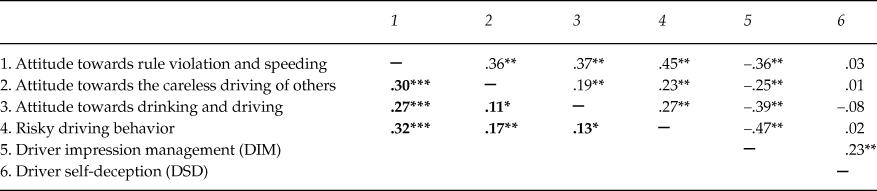
Correlations between ATTS subscales and risky driving behavior are shown in Table 3. As expected, drivers with negative attitudes toward traffic safety (i.e. higher risk-taking attitudes) also showed higher self-reported risky driving behavior. In addition, both measures correlated negatively with Driver Impression Management (DIM). Thus, a potential source of common variance accounting for the observed relationships between dimensions of ATTS and risky driving behavior may be deliberate attempts by respondents to describe themselves in a socially desirable manner. To test this possibility, partial correlations (controlling for DIM) were calculated between the predictor and criterion variables and then compared with their zero-order correlations. If social desirability responses biased the results, then one would expect that after partialling out DIM, correlations between ATTS factors and risky driving behavior would be considerably lower or become non-significant (Nederhof, Reference Nederhof1985). First-order partial correlations showed that once DIM is controlled, the magnitude of the correlations was somewhat lower, but remained statistically significant (see Table 3).
Intercorrelations among Dimensions of ATTS, Risky Driving Behavior, and Social Desirability Measures
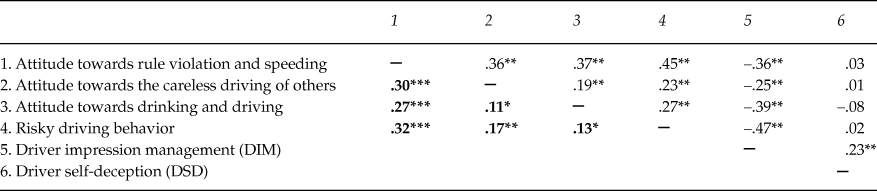
Note: Partial correlations (controlling for DIM) are in bold.
* p < .05. ** p < .01. *** p < .001, two-tailed.
Risky driving attitudes and sociodemographic variables
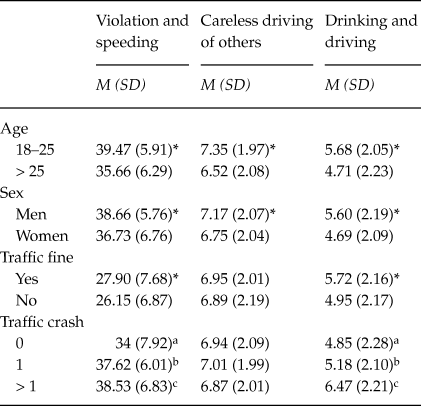
A one-way MANOVA was carried out to examine differences according to drivers’ age. Participants were divided in two groups, 18–25 and older (> 25). The rationale for such grouping is based on non-fatal and fatal traffic injury statistics suggesting that those under 25 are at higher risk of being involved in a collision. Results showed that younger drivers (18–25) scored significantly higher than adult drivers in attitude towards rule violation and speeding, F(1, 441) = 42.72, p < .001, ηp2 = .089; attitude towards the careless driving of others, F(1, 441) = 18.11, p < .001, ηp2 = .040; and attitude towards drinking and driving, F(1, 441) = 22.47, p < .001, ηp2 = .049.
Next, a second one-way MANOVA was performed using risky driving attitudes as dependent variables, and sex as independent variable. Results indicated that men had more positive attitudes than women regarding rule violation and speeding, F(1, 441) = 11.08, p = .001, ηp2 = .025; careless driving of others, F(1, 441) = 4.68, p = .03, ηp2 = .011; and drinking and driving, F(1, 441) = 20.42, p < .001, ηp2 = .045. There were non-significant differences for education level, and interaction effects between Sex x Age, Sex x Educational Level, and Age x Educational Level were also statistically non-significant. Means and standard deviations for each group are presented in Table 4.
Mean Differences (One-way MANOVA) in Risky Driving Attitudes according to Sociodemographic Variables, Self-reported Traffic Fines and Traffic Crashes
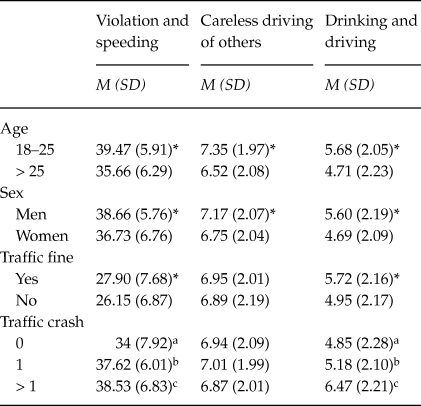
Note: In each row, means with different superscript differ at least to the level of p < .05 after applying Bonferroni post-hoc test.
Violation and Speeding X Traffic Crash: a-b : p < .001; a-c : p = .030; b-c : p = .045
Drinking and driving x Traffic Crash: a-b = p < .001; b-c = p = .017; a-c = p < .001
* Significant mean difference at least p < .05
Risky driving attitudes, self-reported traffic crashes and fines
Involvement in road crashes was categorized as follow: “None” (65.9%), “one” (26.2%), and “more than one” (7.9%). Traffic fines were measured in terms of two categories: “Yes” (30.8%) and “no” (69.2%). Results indicated significant differences between accident-involved and accident-free drivers in their attitude towards rule violation and speeding, F(2, 440) = 6.49, p = .002, ηp2 = .029; and attitude towards drinking and driving, F(2,440) = 7.40, p = .004, ηp2 = .025. Similarly, results also indicated significant differences between drivers who received traffic fines and those who did not in their attitude towards rule violation and speeding, F(1, 441) = 5.38, p = .04, ηp2 = .021; and attitude towards drinking and driving, F(1, 441) = 11.87, p = .01, ηp2 = .019. As shown in Table 4, individuals involved in traffic crashes as drivers scored significantly higher than those who had not been involved in traffic crash; a similar pattern was observed for drivers who reported traffic fines compared to those who did not.
Discussion
The aim of the present study was to examine the psychometric properties of a Spanish-language version of the ATTS and explore whether ATTS responses are prone to social desirability bias. The results suggest good psychometric properties for the scale in terms of internal structure, internal consistency and concurrent validity. In particular, confirmatory factor analysis supported the original three-factor structure of the ATTS: Attitude towards rule violations and speeding, attitude towards the careless driving of others, and attitude towards drinking and driving. A subsequent second-order factor model also fitted well to the data, thus indicating that the three domains of risky attitudes assessed by ATTS dimensions may reflect a more general risk-taking attitude. From a practical viewpoint, this suggests that ATTS subscale scores can be to produce a single total score reflecting an overall risky attitude towards driving.
It is worth mentioning that two subscale items, those referring to attitude towards rule violations and speeding, had low factor loadings. Since the items are reversed, there are at least two possible explanations. Firstly, it is possible that such items lead to response inconsistencies or misresponses (i.e. inconsistency in responses to regular and reversed items; Weijters & Baumgartner, Reference Weijters and Baumgartner2012), which is more likely when multiple items worded in the same direction precede a reversed item (Drolet & Morrison, Reference Drolet and Morrison2001). Secondly, we cannot rule out the possibility that such finding is an artifact. Indeed, reversing scores assume that attitude towards rule violations and attitude towards complying with traffic rules are perfect counterparts to each other (i.e. opposite ends of a continuum): A high score on attitude towards rule violations is deemed equivalent to a negative attitude towards complying with traffic rules, and vice versa. This is, indeed, the prevalent view of attitude as a bipolar evaluative dimension (cf. Eagly & Chaiken, Reference Eagly and Chaiken1993; Fishbein & Ajzen, Reference Fishbein and Ajzen2010). However, it is also possible that attitude towards rule violations and attitude towards complying with traffic rules are strongly (but not perfectly) and negatively related to each other. Further research is required to address this issue.
Reliability analysis showed a good level of reliability for both the total scale and the subscales, with alpha coefficients above .70. Furthermore, correlational analysis revealed positive correlations between ATTS dimensions and self-reported risky driving behavior. These findings are consistent with past research (Bachoo et al., Reference Bachoo, Bhagwanjee and Govender2013; Chen, Reference Chen2009; Iversen, Reference Iversen2004; Stephens et al., Reference Stephens, Bishop, Liu and Fitzharris2017; Yilmaz & Celik, Reference Yilmaz and Celik2004) and provide support for concurrent validity. It should be noted that correlations between ATTS factors and risky driving behavior were generally low in magnitude. According to the Fishbein and Ajzen (Reference Fishbein and Ajzen2010) principle of compatibility, attitudes and behaviors should be measured at the same level of generality or specificity to ensure strong correlations. Since the ATTS examines attitude towards specific behaviors (e.g., drinking and driving) whereas risky driving behavior was evaluated using a broad measure (e.g., enjoying the excitement of dangerous driving) rather than assessing particular risky driving behaviors, this evaluative inconsistency could explain the weak correlations obtained in this study. Regarding response bias, our results show that the ATTS scale does not appear to be particularly sensitive to socially desirable responses, which is in accordance with various studies indicating minor or no effect of social desirability on drivers’ self-report (Boufous et al., Reference Boufous, Ivers, Senserrick, Stevenson, Norton and Williamson2010; Sullman & Taylor, Reference Sullman and Taylor2010; Sundström, Reference Sundström2011; Taubman-Ben-Ari, Eherenfreund-Hager, & Prato, Reference Taubman-Ben-Ari, Eherenfreund-Hager and Prato2016), thus additionally supporting the psychometric quality of the scale. Finally, in line with previous literature (Lund & Rundmo, Reference Lund and Rundmo2009; Mallia et al., Reference Mallia, Lazuras, Violani and Lucidi2015; Nabi et al., Reference Nabi, Salmi, Lafont, Chiron, Zins and Lagarde2007) we found that drivers with higher risky driving attitudes were also more prone to vehicle crash involvement. Sociodemographic comparisons revealed that as previously reported (Iversen & Rundmo, Reference Iversen and Rundmo2004; Laapotti, Keskinen, & Rajalin, Reference Laapotti, Keskinen and Rajalin2003; Sarma et al., Reference Sarma, Carey, Kervick and Bimpeh2013), men and young drivers tend to display more negative attitudes toward traffic safety, thus delineating a high-risk subgroup of drivers that should be primarily targeted in road safety interventions and campaigns aimed at changing attitudes.
In sum, this study provides evidence of the validity and reliability of the ATTS for assessing attitudes toward traffic safety. There are, however, certain limitations that should be mentioned: Firstly, although we recruited a heterogeneous sample of drivers according to age, sex, educational level and driving experience, they were selected by convenience sampling; in order to corroborate the present findings, further studies should be carried out based on a representative sample. Secondly, since in our study relations between attitudes and risky driving behavior were assessed using self-report measures, it would be of value to replicate the findings based on objective assessments from naturalistic driving data or in-vehicle devices. Thirdly, our results show that the ATTS is reliable and free from social desirability bias. Nonetheless, since there has been some criticism surrounding the validity of the DSDS as a measure of drivers’ susceptibility to the social desirability bias (af Wåhlberg, Dorn, & Kline, Reference af Wåhlberg, Dorn and Kline2010), it would be useful to further examine the robustness of the ATTS against social desirability using alternative methods, for example by comparing driver responses under conditions potentially eliciting self-presentation biases (i.e. anonymity vs non-anonymity). We are planning to carry out this study in a subsequent paper. Fourthly, although our findings provide evidence of the validity and reliability of the ATTS, further studies are required for a more in-depth examination of psychometric properties such as test-retest reliability and discriminant and convergent validity. It would also be worthwhile to examine the accuracy of ATTS scores in predicting which drivers are most likely to crash. In this sense, are there optimal cut-off scores with a high degree of sensitivity and specificity to distinguish between accident-involved and accident-free drivers? Addressing this point would enhance the psychometric quality of the ATTS and demonstrate its utility as a diagnostic assessment tool for identifying high-risk drivers who can then be referred for special courses on safe driving attitudes prior to obtaining a driving license. Finally, the content of the ATTS refers to attitudes associated with risky driving behaviors that contribute significantly to road crashes. However, there are others high-risk behaviors not tapped by ATTS items (e.g., not using a seatbelt, texting while driving) that could be included to increase the content validity.
The present study supports the use of the ATTS among Spanish-speaking populations for conducting research on risky driving attitudes in Latin America, where such studies remain scarce despite the high rates of road traffic injuries (Ledesma et al., Reference Ledesma, Peltzer and Poó2008). The paucity of research may impede the development of evidence-based interventions to reduce traffic injuries. Hopefully, the current study will provide a useful and easy-to-administer tool to promote research on driver attitudes toward traffic safety. The ATTS could also be used to identify high-risk subgroups of drivers for targeted interventions and to design and evaluate strategies aimed at reducing risky driving and increasing road safety attitudes.