

Introduction
In the post-glacial period, Europe became largely re-colonised by forests. Birch was the predominant taxon, displaced by pine towards the end of the Preboreal oscillation (Firbas Reference Firbas1949; Reference Firbas1952). Hazel (Corylus avellana) became a dominant tree and shrub in central Europe in the beginning of the Boreal, locally replacing birch and pine. Mixed oak forests grew in central Europe from the Boreal onwards, consisting mainly of oak (Quercus robur, Quercus petraea), elm (Ulmus minor), lime (Tilia x europaea) and ash (Fraxinus excelsior).
The Mesolithic hunter-fisher-gatherers responded to the vegetation changes by intensively utilising wood and developing an extensive woodworking and processing technology. The wood was taken from trees and shrubs. It was not only needed as firewood, but also to manufacture manifold objects: dwellings, burial constructions, pyres, canoes, paddles, platforms, sledges, skis, household and religious items, and hunting and fishing gear (Burov Reference Burov, Vermeersch and Van Peer1990; Mertens Reference Mertens2000; Skaarup & Grøn Reference Skaarup and Grøn2004; Andersen Reference Andersen2013; Lozovskaya & Lozovski Reference Lozovskaya, Lozovski, Uino and Nordqvist2016; Oshibkina Reference Ошибкина2017b; Reference Oshibkina2023; Savchenko & Zhilin Reference Savchenko and Zhilin2023). All parts seem to have been exploited, eg bark, stem, branches and roots.
This paper focuses on the use of roots and burrs which were harvested by the Mesolithic and the following Neolithic toolmakers to manufacture sleeves to haft unperforated stone adzeheads or other insets. Burrs are often seen on trees near water or areas of frequent precipitation. They differ from roots. Burrs have deformed grain structures seen in many different types of wood, commonly formed due to stress caused by an injury, fungus, insect infestations or virus. Such bumps or knots can be found on tree trunks, mostly on the lower parts, and on branches (Schmid Reference Schmid2024). Often, they are attached to the roots beneath the ground and had to be deliberately searched and dug for (H. Stewart Reference Stewart1984; Taylor et al. Reference Taylor, Allen, Milner, Conneller and Taylor2018). Burrs occur in all sizes and shapes, even underground where they can grow to large sizes. Many of the smaller outgrowths have naturally spherical shapes. Almost all of them are covered with bark, which had been completely or mostly removed from the sleeves. This contribution presents and compares the finds, expanding the database of archaeological wooden objects. It gives novel insights into how Mesolithic foragers exploited wood resources for making tools by using burrs and roots and provides new information about their little-known technical craftsmanship.
Mesolithic hafting methods of adzes and axes
The early post-glacial hunter-fisher-gatherers employed miscellaneous adze and axe types (Andersen Reference Andersen1981; Reference Andersen2013; Lozovskaya Reference Лозовская2009a; Pratsch Reference Pratsch, Baron and Kufel-Diakowska2011). The form, size and raw material varied chronologically, regionally, and probably according to task. These tools were used for woodworking and in burial rituals, but probably also in hunting, for various household duties and as weapons. Most of the tools were adzes. The wooden handles had different cross-sections. Mesolithic hafts and hafted tools were excavated in bog, underwater and other wetland sites. They generally reveal three different hafting techniques:
A) The adze- or axehead was lashed on a handle.
B) The axe- or adzehead was inserted into a handle.
C) A handle was inserted into the adze- or axehead.
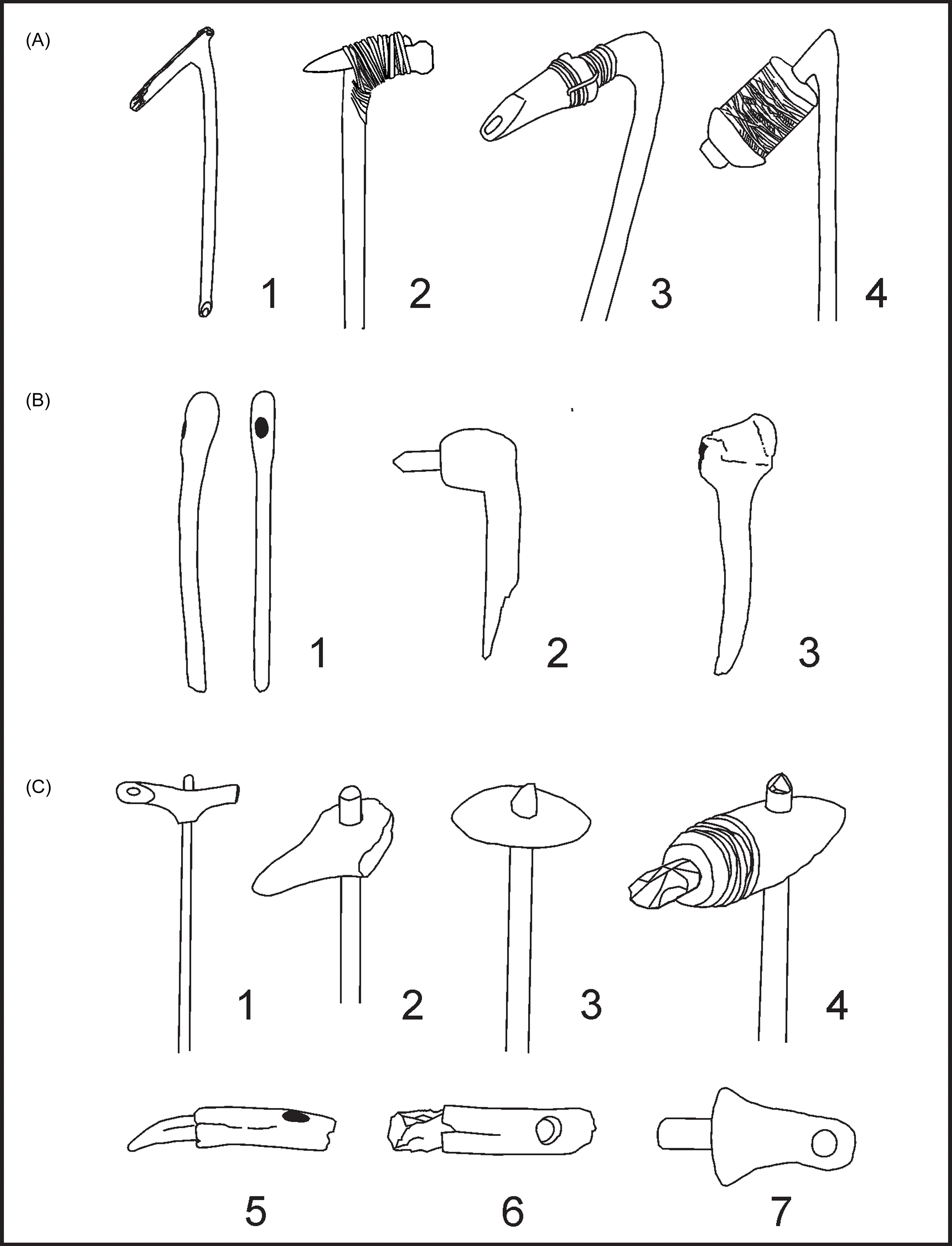
Each of the three groups was manufactured in several variants. The majority of the first group — the end-hafted adzes — are ‘handle surface bindings’. Stone adzeheads or antler blades were directly lashed onto the flat (upper) surface of an angled handle. These were made of tree parts with a natural crook, eg bent or forked limbs or special L- or V-shaped trunk-root-configurations (Figure 1: A1, A2). Several of these ‘knee-hafts’ were excavated at Tybrind Vig, Zamostje 2 and other sites. Sometimes a longitudinal facet was carved into the mounting surface for embedding the adzehead, as at the Ertebølle settlement of Neustadt LA 156 in Schleswig-Holstein, Germany (Hartz & Kraus Reference Hartz, Kraus, Müller, Kleingärtner and Huber2009). Plant fibres (eg bast of lime, Tilia spp., or willow, Salix spp.; Gramsch & Kernchen Reference Gramsch, Kernchen, Banck-Burgess, Marinova-Wolff and Mischka2023), but also rawhide or leather (eg buckskin) straps were employed as wrappings to reinforce the haft. Additionally, adhesives — hide or fish glue, beeswax, resin or pitch/tar — could have been used (Wescott Reference Wescott1999). The ‘elbow adzes’ became the most frequent type in the Neolithic, well preserved in the pile dwellings in and around the Alps. A few large angled wooden hafts have a short, broad terminal end, sometimes with a small hole to use in binding the adzehead onto the handle (Hartz Reference Hartz2004; Skaarup & Grøn Reference Skaarup and Grøn2004). Bevelled metapodia of large ruminants and socketed stone axeheads were also strapped to the distal end of knee-hafts like early forms of ‘spout axes’ (Figure 1: A3, A4).
Schematic drawings of the three major hafting types: A) V- or L-shaped angled handles for hafting stone adzeheads (A1–2), but also to attach bevelled metapodia of large ruminants (A3) or socketed stone axeheads (A4); B) straight perforated (mortise) handle for hafting stone axeheads either directly or indirectly embedded in a sleeve (B1), sleeve shaft for hafting small insets or a stone adzehead (B2), small curved antler handle for mounting flint core or flake axeheads (B3); C) straight handles for hafting perforated antler, bone or stone adze- and axeheads (C1–3) directly or indirectly embedded in a perforated sleeve (C4–7) (H.A. Graetsch, modified after Friis Johansen Reference Friis Johansen1919; Oshibkina Reference Ошибкина1997; Louwe Kooijmans et al. Reference Louwe Kooijmans, Vermeeren, van Waveren and Louwe Kooijmans2001b; Gramsch Reference Gramsch2002; Rimantienė Reference Rimantienė2005; Lozovskaya Reference Лозовская2011; Andersen Reference Andersen2013).

The second group comprises ‘perforated or slotted hafts’ for axes (mortise hafts). The stone axehead or other inset made of wood, antler or bone — mostly from elk (Alces alces) or red deer (Cervus elaphus) — was either directly inserted or pushed through a round hole or perpendicular groove in a straight wooden handle or indirectly embedded in a socket (Figure 1: B1). A modification of this hafting method is the ‘sleeve shaft’ with a fixed sleeve (Figure 1: B2), ie the handle and socket had been carved in one piece. The sleeve shafts hold a stone adzehead or a smaller inset, eg made of antler (Oshibkina Reference Ошибкина1997; Reference (Ošibkina)2007). The proximal end of a red deer antler was also employed as a mount (Figure 1: B3). The short, curved brow tine was used as the handle. The main beam was removed to a few centimetres above the coronet, bevelled and hollowed, leaving only parts of the dense cortical bone layer for clamping a flint core or flake axehead (Friis Johansen Reference Friis Johansen1919; Schwantes Reference Schwantes1939).
The third group are ‘shaft hole adze- and axehead hafts’ (cross-shafts). Straight wooden handles were directly mounted in perforated antler, bone or stone heads, such as the T-shaped antler axes, mattock- or maceheads (Figure 1: C1–C3). In addition, there are indirect instances of hafting using a sleeve equipped with a slot for the blade and a shaft hole (Figure 1: C4–C7).
Many wooden handles were fitted with unperforated antler blades or lithic adze- and axeheads knapped from flint or stone material. The latter two are known from hundreds of Mesolithic sites in Europe (Gramsch Reference Gramsch1973; Koltsov Reference Кольцов1989; Mom & Andresen Reference Mom, Andresen, Nicolucci and Hermon2010). Ground and polished stone adzes, flint core — or more rarely flint flake — axes and a flat perforated boulder adze were found in at least 40 Mesolithic burials in seven countries of northern, central and eastern Europe. Apparently, they were mainly associated with men, as a minimum of 17 graves were of males and one (Uleberg) a double burial of a man and a woman (Grünberg Reference Grünberg2000; Reference Grünberg, Meller, Wunderlich and Knoll2013; Little et al. Reference Little, van Gijn, Collins, Cooney, Elliott, Gilhooly, Charlton and Warren2017). Five burials were of infants, including neonates. Possibly they were all boys, as in most of these cemeteries these stone tools were also documented in burials of adult males or found with other male-associated items, eg large flint knives, missing in graves of adult women (Popovo, Vedbæk-Gøngehusvej 7). However, stone adzeheads were excavated in burials of females at Bad Dürrenberg in Germany and at Zvejnieki grave 57 in Latvia (Grünberg et al. Reference Grünberg, Graetsch, Heussner and Schneider2016a; Zagorska Reference Zagorska2016; Petrović et al. Reference Petrović and Little2024), the former in a double burial with a newborn. In 15 burials the sex could not be determined, mostly due to the lack of preserved skeletal remains, eg at Chornaya Guba I and Syamozerskiy II in Russia, Jönsas in Finland and Nadelwitz (Schafberg) in Germany (Pankrushev Reference Панкрушев1978; Geupel Reference Geupel1983; Reference Geupel and Vogt1988; Grünberg Reference Grünberg2000; Ahola Reference Ahola2019).
The sleeves were made of antler, bone or wood. The intermediate pieces did not only stabilise the blade but allowed the hafting of short insets and functioned as shock absorber. Moreover, socketed hafts allowed to rotate the inset. The composite manufacture made it possible to replace individual defective parts without having to discard the tool entirely. Most antler sockets had an elongated form like those from Hohen Viecheln, Ivanovskoye 7, Kunda Lammasmägi and Sværdborg (Friis Johansen Reference Friis Johansen1919; Schuldt Reference Schuldt1961; Zhilin Reference Жилин2018). But wooden sleeves varied regionally in shape, raw material and hafting mode. Socketing unperforated stone adzeheads or other insets with wooden sleeves was still practised by the following Neolithic foraging cultures, for instance in the eastern Baltic region and Russia (Loze Reference Loze1988a; Reference Лозе1988b; Rimantienė Reference Rimantienė1996; Reference Rimantienė2005; Sorokin & Hamakava Reference Сорокин and Хамакава2014).
Wooden sleeve variants
Wooden hafts were excavated in northern, central and eastern Europe. They include two-part and one-part sockets. Hafted tools are rarely preserved even at sites with larger Mesolithic wood assemblages, like Star Carr in England (Taylor et al. Reference Taylor, Allen, Milner, Conneller and Taylor2018).
Two-part wooden sleeves
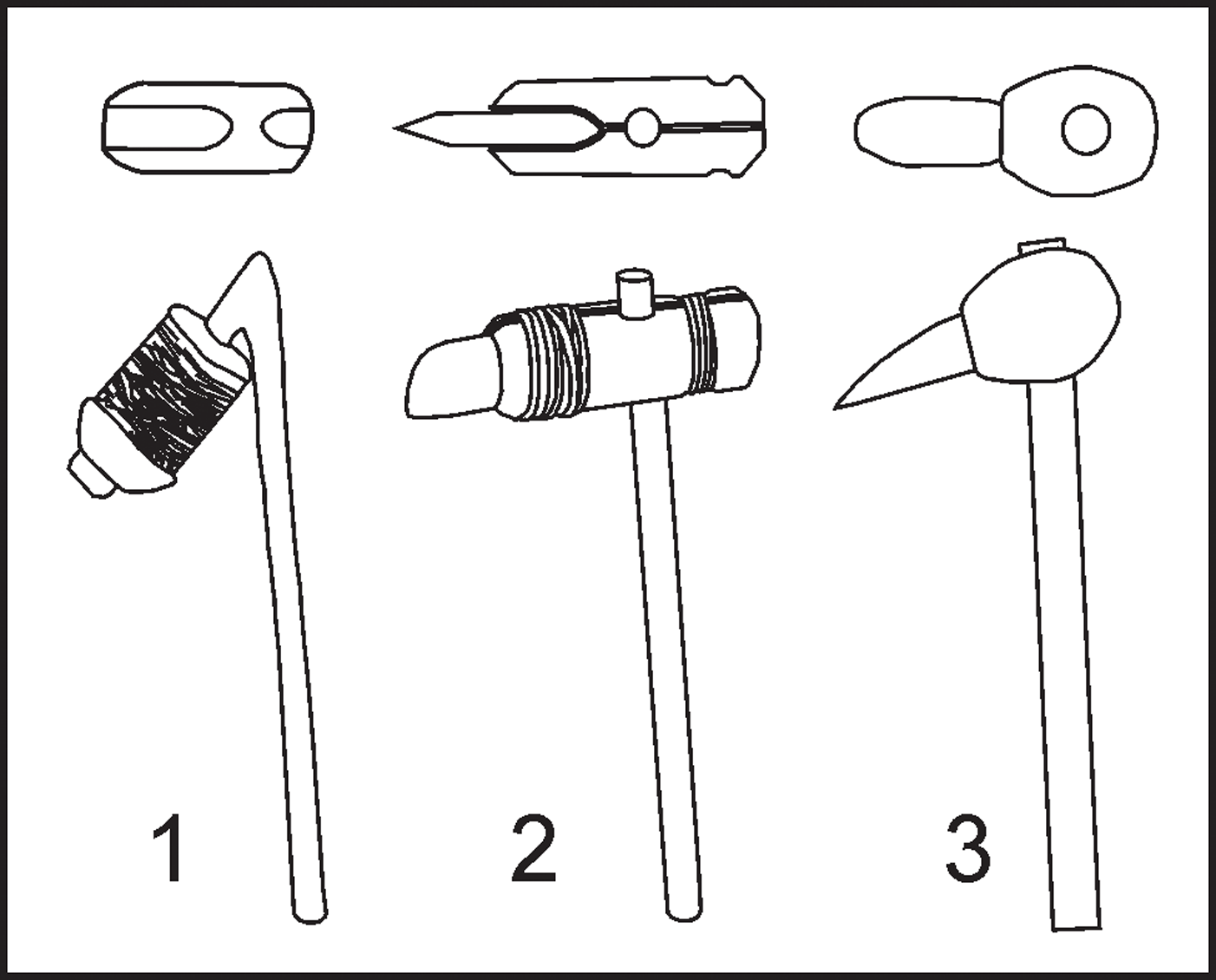
With the two-part sleeves, axeheads were clamped between two halves of a cylindrical collar and fastened on a knee-haft. On the inside they were hollowed at both ends, broader for the blade and smaller for the distal part of an angled handle, as illustrated by the finds from Latvia and Lithuania (Figure 2: 1). Others in Denmark and northern Germany were hollowed only at one end on the inside for the blade and perforated to be fitted on a straight handle (Figure 2: 2). On the surface at one or both ends, the sockets had thickened rims or ended in a round knob. The two-part wooden sockets usually had a length of 15.5–18.5 cm and allowed the hafting of broader blades. They were made of hardwood: blood-twig dogwood (Cornus sanguinea), hawthorn (Crataegus spp.) or hazel (Corylus avellana) and other taxa. In northern Europe, the two-part sleeves are known from Maglemose, Kongemose and Ertebølle sites. In Denmark they were for instance recorded at Maglelyng, Flynderhage and Tybrind Vig (Andersen Reference Andersen2013), in Sweden at Segebro (Larsson Reference Larsson1982). An exceptionally large sleeve is known from the Final Mesolithic site of Jäkelberg-Nord (Poel 16) in north Germany. It has a length of 21.5 cm, a width of 5.5 cm and was manufactured of wood from a fruit tree (Pyrinae/Maloideae). The settlement of the older Ertebølle culture has a date between c. 5600 and 5100 cal BC (Klooß Reference Klooß2015). Dozens of two-part sleeves were excavated in the Neolithic settlements of the Narva culture (c. 5300–1750 BC), eg Šventoji in Lithuania or Sārnate and Zvidze in Latvia (Vankina Reference Ванкина1970; Loze Reference Loze1988a; Reference Лозе1988b). Alongside nine knee-hafts, at least six fragments of two-part sleeves were also recorded from the Neolithic foraging groups of the Upper Western Dvina (= Daugava) — Naumovo, Serteya II and Usvyaty IV — in Russia (Miklyaev & Semenov Reference Микляев and Семенов1979; Lozovskaya Reference Лозовская2009a; Zhilin Reference Жилин2018). According to M.I. Kolosova, State Hermitage Museum St. Petersburg, all handles were made of oak (Quercus spp.) and the sleeves of ash (Fraxinus spp.) like at Šventoji (Kolosova & Mazurkevich Reference Колосова, Мазуркевич, Савинов, Седых and Петрова1998). A further damaged two-part wooden sleeve is published from Asaviec in the Kryvina peat bog in north Belarus (Charniauski Reference Чарняўскі1997). The two-part sleeves had similar lengths of 16–18 cm, some up to 19–19.5 cm (Rimantienė Reference Rimantienė1996; Reference Rimantienė2005).
Schematic drawings of a one-part (3) and two variants of two-part wooden sleeves (1, 2) viewed along and perpendicular to the shaft; 1) with one half of the sleeve in the upper row (H.A. Graetsch, modified after Friedel Reference Friedel1879; Rimantienė Reference Rimantienė2005; Andersen Reference Andersen2013).

One-part wooden sleeves
In contrast, the number of excavated one-part wooden sleeves (Figure 2: 3) is small. They are merely known from Mesolithic and Neolithic hunter-fisher-gatherer sites in central and eastern Europe: Germany, Latvia, Poland and Russia. The sleeves were fitted with stone adzeheads, antler blades or small insets. All the sockets have circular or nearly circular shaft holes but differ in other features. Recently, new finds have been added to the corpus and provide the reason to study, summarise and analyse this rare artefact group in more detail for the first time.
Mesolithic and Neolithic one-part wooden sleeves: the database
GERMANY
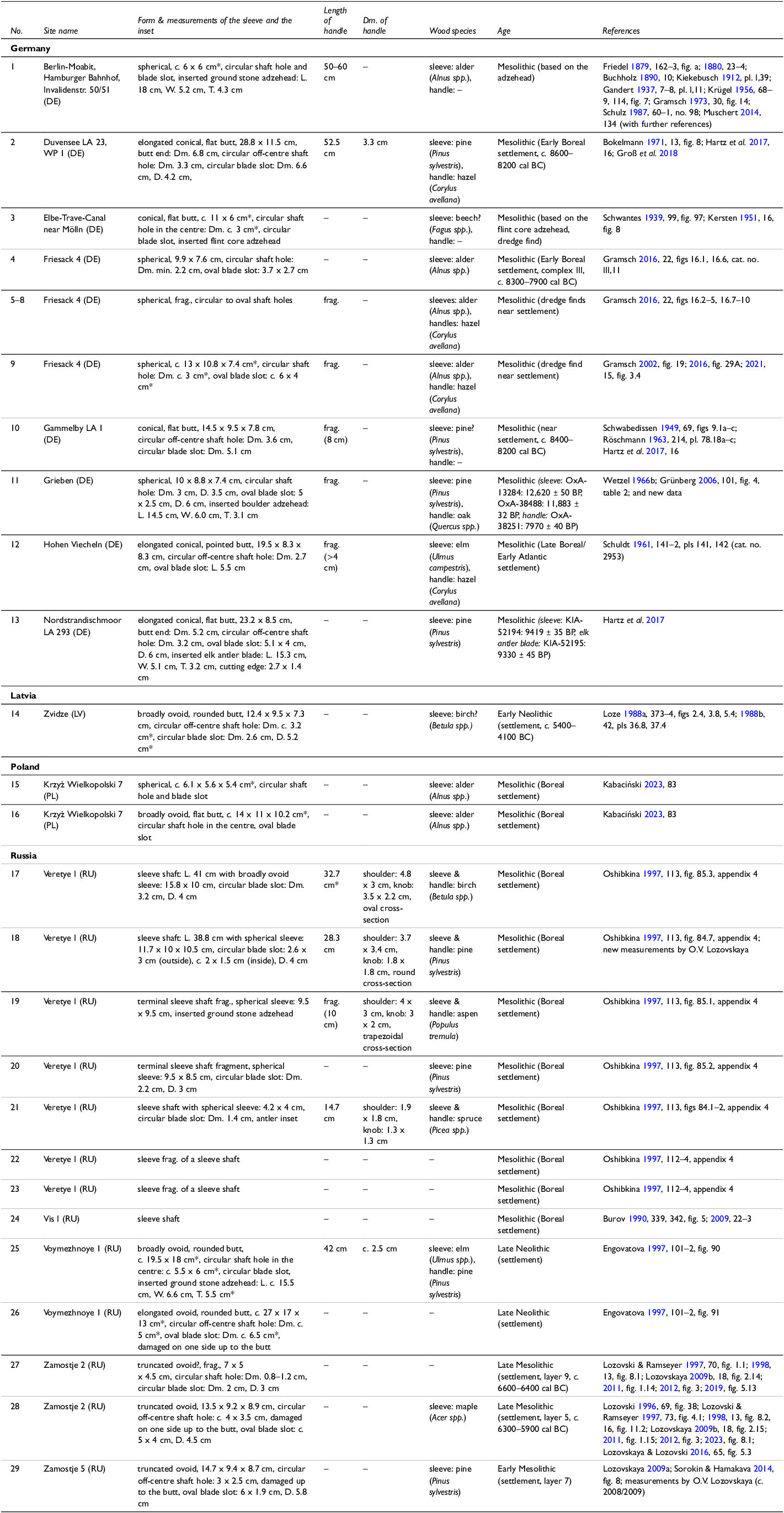
A total of 13 Mesolithic one-part wooden sleeves are published from eight sites in north, north-east and central Germany. They comprise both stray and settlement finds. The shaft holes have a diameter of 2.2–3.6 cm. The blade slots measure 3.7–6.6 cm in width and 4.2–6 cm in depth. They are mostly circular or wide oval but rarely long oval (ie with a 2:1 ratio). Details are listed in Table 1.
One-part wooden adze sleeves from Mesolithic and Neolithic sites in Europe

* Measurements based on published drawings/photographs, L. = length, W. = width, T. = thickness, D. = depth, Dm. = diameter.
1) Märkisches Provinzial-Museum, Berlin, inv. no. MM II 6278 (wooden socket); MM II 6279 (stone adzehead), now in the Museum für Vor- und Frühgeschichte (MVF), Staatliche Museen zu Berlin.
2) Museum für Archäologie Schloß Gottorf, Schleswig.
3) Museum für Kunst- und Kulturgeschichte, Lübeck, inv. no. 1912/139 (Schwantes Reference Schwantes1939, 100, fig. 97), stray find currently missing (pers. comm. Dr I. Sudhoff, Hansestadt Lübeck, Abteilung Archäologie, 15th November 2023).
4–9) Brandenburgisches Landesamt für Denkmalpflege und Archäologisches Landesmuseum, Zossen, OT Wünsdorf, No. 4) inv. no. 1977:7/H54.
10) Kieler Sammlung (K.S. 19800), Schleswig-Holsteinisches Landesmuseum für Vor- und Frühgeschichte, Schleswig, stray find currently missing.
11) Landesamt für Denkmalpflege und Archäologie Sachsen-Anhalt - Landesmuseum für Vorgeschichte, Halle (Saale); HK 64:608a–d.
12) Museum für Ur- und Frühgeschichte, Schwerin, cat. no. 2953, settlement find currently missing (pers. comm. Dr D. Jantzen, Landesamt für Kultur und Denkmalpflege Mecklenburg-Vorpommern, Abteilung Landesarchäologie, Schwerin, 13th May 2024).
13) Museum für Archäologie Schloß Gottorf, Schleswig.
14) National History Museum of Latvia, Riga, inv. no. VI 188.
15–16) Institute of Archaeology and Ethnology, Polish Academy of Sciences, Poznań.
17–23) The State Hermitage Museum, St. Petersburg, inv. no. 2930–36 (No. 21), 2930–37 (No. 17) and 2930–905 (No. 20); The State Historical Museum, Moscow, inv. no. GIM 108821 A 2202/6 (No. 18).
24) No further information in the records (pers. comm. Dr A. Volokitin, Komi Science Centre of the Ural Branch, RAS, Syktyvkar, 12th April 2024).
25–26) Museum of Moscow, inv. no. 28312/2143–2146.
27) Sergiev-Posad State History and Art Museum-Preserve, inv. no. 1200 arch. The wooden sleeve was treated with phenolic alcohols and sugar at the Belarusian Technological Institute (BTI) in 1992–93.
28) Sergiev-Posad State History and Art Museum-Preserve, inv. no. 1698 arch. The sleeve was treated with polyethylene glycol and freeze-dried at the Archaeological Service of the Canton of Fribourg (Switzerland).
29) Institute of Archaeology of RAS, Moscow.
CENTRAL GERMANY
Grieben, City of Tangerhütte, district of Stendal, Saxony-Anhalt
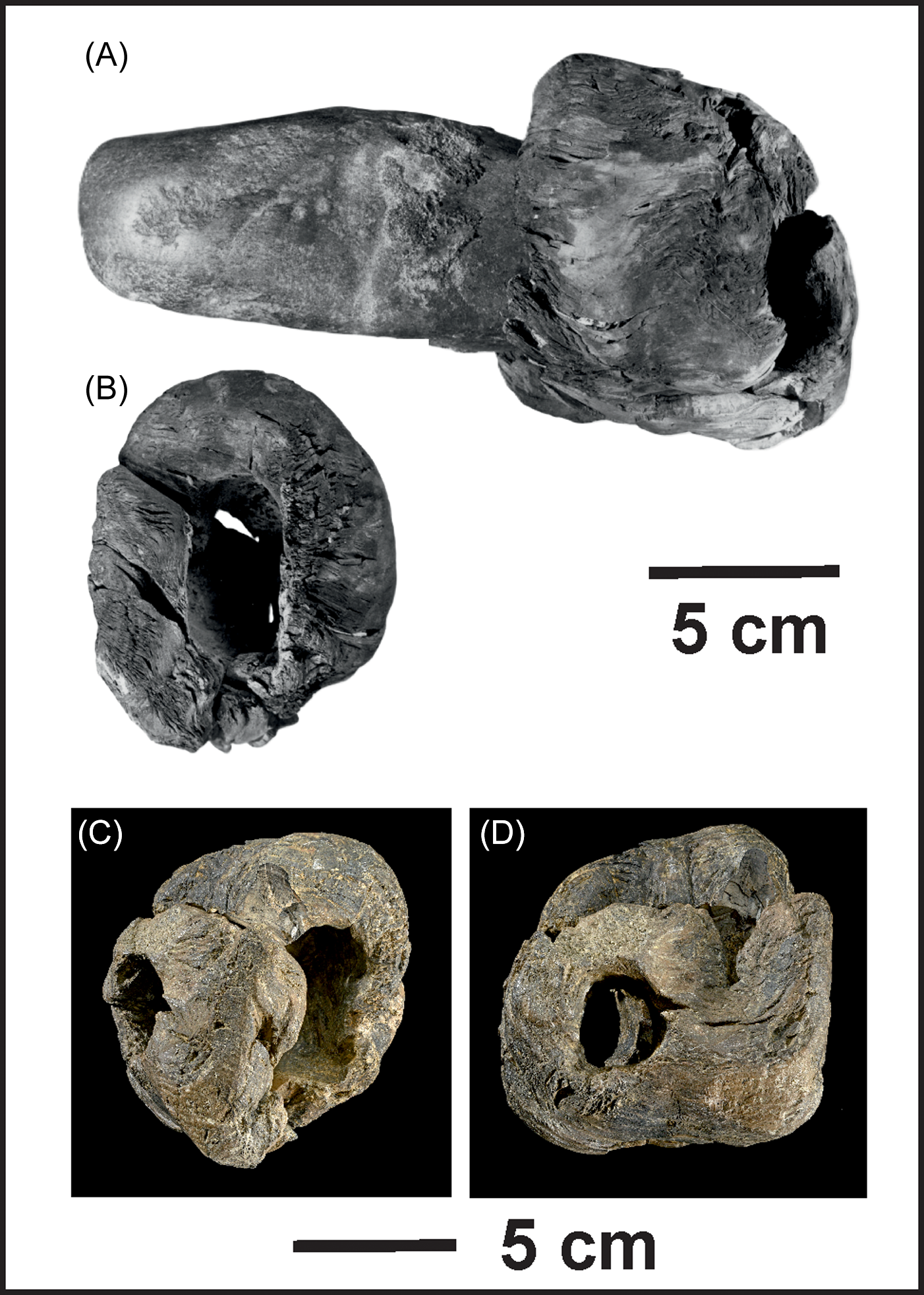
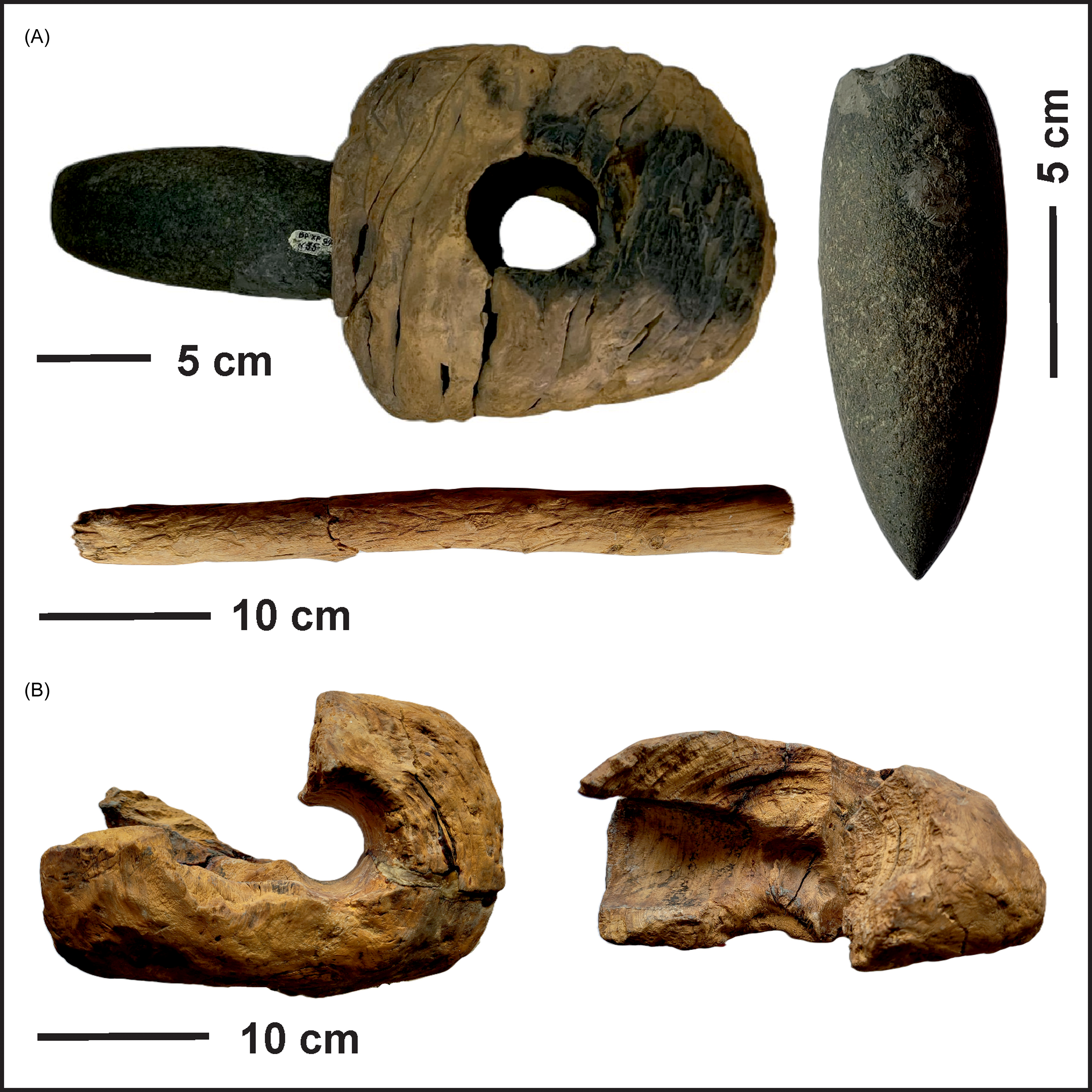
New research was conducted on a Mesolithic socketed stone adze dredged in 1962 from a gravel pit north-east of Grieben near the left bank of the Elbe River (Figure 3: A). There are numerous Palaeolithic and Mesolithic sites in the Altmark, mostly consisting of concentrations of flint artefacts on inland sand dunes lacking all organic material (Toepfer Reference Toepfer1958; Reference Toepfer1967). In addition, Stone Age finds are retrieved from gravel pits along the Elbe River, but wooden objects like the Neolithic bow made of yew (Taxus baccata) found at BarlebenFootnote 1 are rare (Lies Reference Lies1966; Wetzel Reference Wetzel1966a).
Grieben (Saxony-Anhalt, Germany). Mesolithic socketed stone adze, shortly after retrieval: A) stone adzehead in the wooden sleeve; B) blade slot in the wooden sleeve. Current state of the wooden sleeve: C) shaft hole and blade slot; D) shaft hole (A, B: Wetzel Reference Wetzel1966b, pl. 5; C, D: © Landesamt für Denkmalpflege und Archäologie Sachsen-Anhalt, Halle/Saale, photos A. Hörentrup).

The waterlogged preserved spherical wooden sleeve of the Grieben adze has a maximum width of c. 10 cm. It weighed 233.9 g. The blade slot is long oval (Figure 3: B, C). The shaft hole (Figure 3: D) contained a few fragments of the handle. The wood was first examined in the 1960s by E. Schwarze, scientific-technical assistant of the State Museum of Prehistory in Halle/Saale (Kaufmann Reference Kaufmann1984). He concluded that the sleeve was made of a burr from pine (Pinus sylvestris), and the handle from oak (Quercus spp.). But no photographs of the thin sections were published (Wetzel Reference Wetzel1966b; Grieben, OA 859, archive file LDA Halle/Saale).
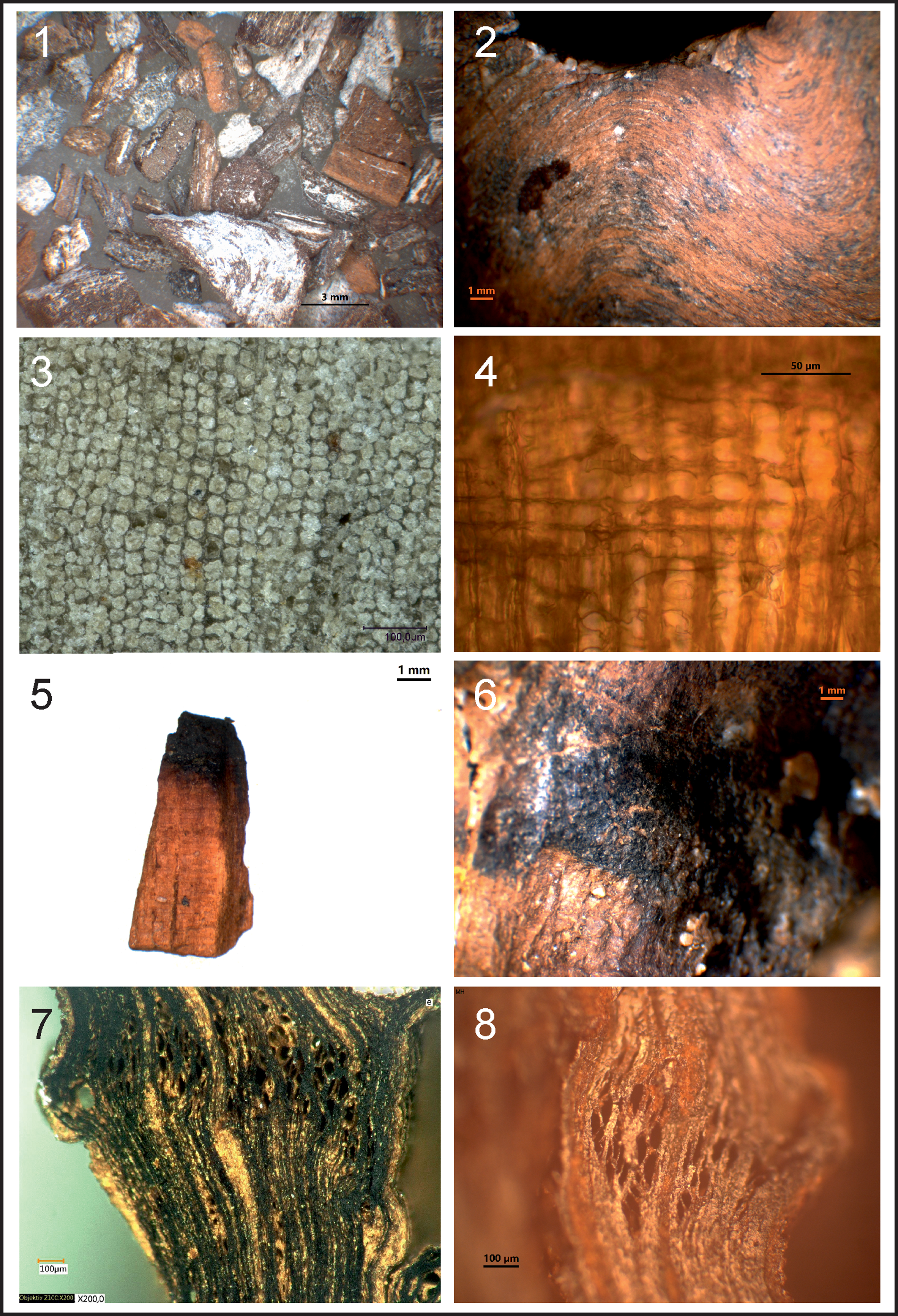
Our new studiesFootnote 2 confirm the results. The wood fragments from inside were surrounded in places by a fine white quartz sediment (Figure 4: 1). The wood of the sleeve has an irregular wavy grain pattern (Figure 4: 2), indicating that the sleeve was made from a burr. There are no remains of bark. The microscopic images show the typical structure of coniferous wood with only tracheids, mostly parenchyma cells in the rays and resin canals (Figure 4: 3). In the radial view heterocellular rays with large window-like pits in the cross-fields are seen, alongside marginal transversal tracheids with dentate walls and typical pits of Pinus sylvestris-type (Figure 4: 4; Schweingruber Reference Schweingruber1982, 62). Several pieces of pine as well as traces on and inside the sleeve indicate contact with fire (Figure 4: 5, 6). The sediment remains contain small fragments and a single 5 cm long piece of the handle made of oak (Quercus spp.). Although the wood has shrunk considerably upon drying — mainly in tangential direction with a horn-like condensation — broad rays and ring-shaped pores can partly be recognised (Figure 4: 7, 8). Due to the mostly dark brown to black colour of the oak wood, charring is not clearly visible on the shaft remains.
Grieben (Saxony-Anhalt, Germany). Microscopic images of the wooden sleeve and handle remnants: 1) wood fragments from inside the sleeve covered with a fine white quartz sediment. 2–6. Sleeve: 2) bent structure of the pine (Pinus sylvestris) wood at the shaft hole; 3) transverse view; 4) radial view, rays with transversal tracheids with dentate-shaped walls, large window-like pits in the cross-fields; 5) charred pine fragment; 6) view on the charring in the shaft hole. 7, 8. Handle: 7) transverse view of the oak (Quercus spp.) wood; 8) large rays of the ring porous wood. Scale: 1) 3 mm; 2, 5, 6) 1 mm; 4) 50 μm; 3, 7, 8) 100 μm (M. Hellmund: 1, 2, 4–6, 8 taken with digital microscope camera ProgRes C3 Company Jenoptik; 3, 7 Keyence VHX 700).

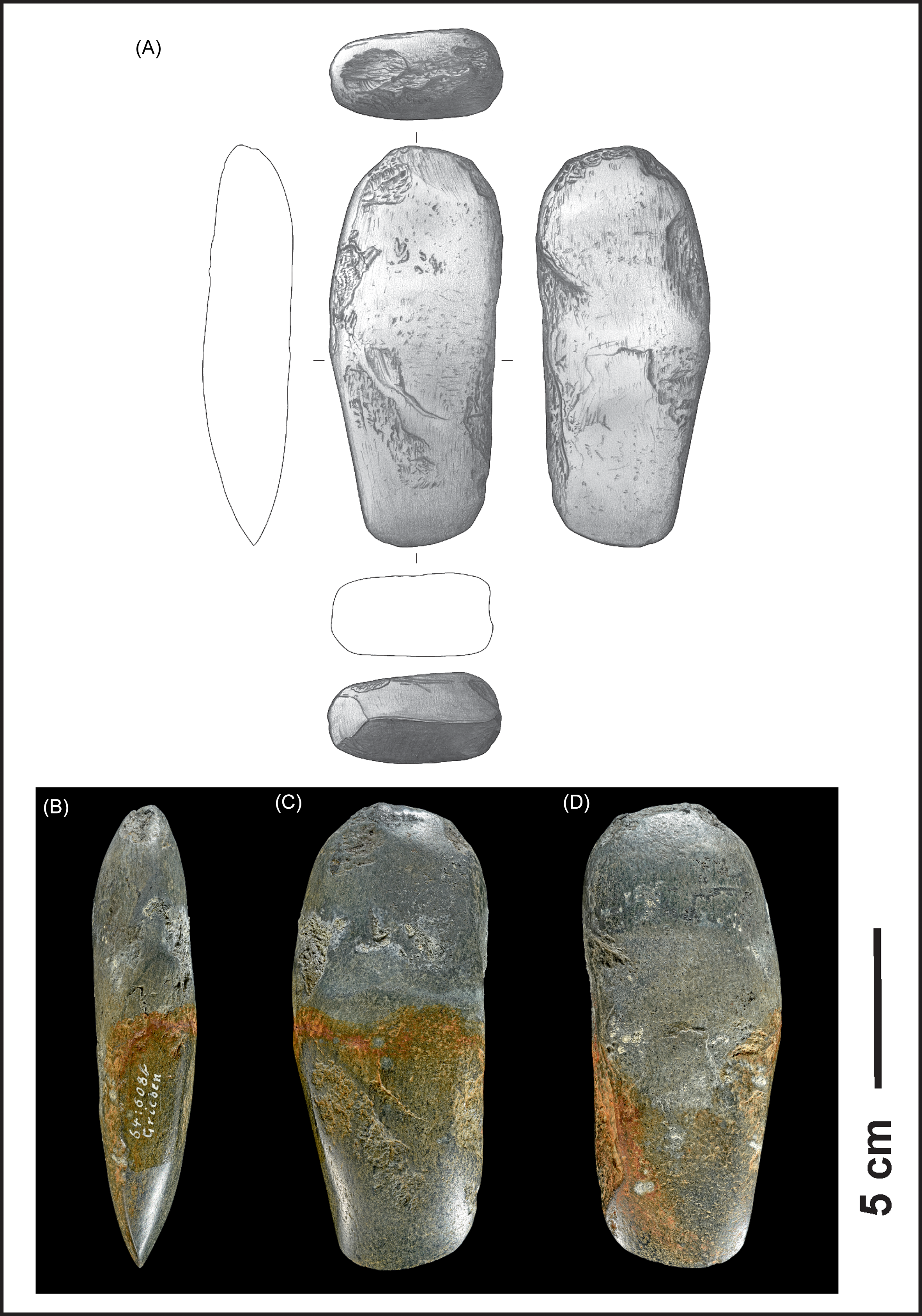
The inserted stone adzehead is 14.5 cm long and weighs 480.7 g (Figure 5). It was made of an irregularly formed boulder, assumed to be a Nordic erratic (Wetzel Reference Wetzel1966b). The shape was little modified. The lower two thirds of the lateral surfaces and of both sides had been ground; the left side more than the right side and the upper side more than the lower side. The cutting edge is asymmetrical and was well smoothed. The butt is unworked but pecked with a deeper flaked cavity on both lateral sides (Figure 5: A). This could be deliberate to better secure the blade in the socket. Mesolithic stone adzeheads with only partially ground surfaces were also recorded at Friesack 4 in Brandenburg, located c. 54 km north-east of Grieben (Gramsch Reference Gramsch2021). About half of the adzehead from Grieben was embedded in the sleeve. The lower 7.5–8 cm of the upper and lateral sides as well as the lower 5 cm of the lower side are coloured red by ochre (Figure 5: B–D). The upper 5 mm on the upper side form an intensively coloured band, marking the area immediately below the sleeve. In contrast, almost no ochre colouring is on the sleeve, except for two small faint reddish stains on the outside and a single small red spot inside the blade slot. The colouring does not seem to be tanning caused by the oak handle.
Grieben (Saxony-Anhalt, Germany). A) different views of the stone adzehead with cross sections; B–D) ochre colouring on the lateral surface and on both sides (© Landesamt für Denkmalpflege und Archäologie Sachsen-Anhalt, Halle/Saale; A: drawings M. Wiegmann; B–D: photos A. Hörentrup).

The adzehead was made of amphibolite granofels. An X-ray powder diffraction analysis showed that the main constituents of the stone with almost 70 vol.% are amphibole of the tremolite-aktinolite solid solution series (Ca2(Mg,Fe2+)5Si8O22(OH)2) and about 30 vol.% intermediate plagioclase feldspar (labradorite). A small amount of diopside (CaMgSi2O6) was also detected. Like true nephrite with more than 95% tremolite/actinolite, this kind of amphibolite could have been formed at an early stage of thermal metamorphosis of siliceous dolomite and has a widespread occurrence (Gaines et al. Reference Gaines, Skinner, Foord, Mason and Rosenzweig1997; Maresch et al. Reference Maresch, Schertl and Medenbach2014). The supply areas are regions with crystalline rock, eg the Ore Mountains, the Fichtel Mountains, the Franconian Forest or the Bohemian Massif. The compositions of the amphibole and plagioclase show similarities to metabasites from the Bohemian Massif, which were used for the manufacture of tools in the Neolithic (Šída & Kachlík Reference Šída and Kachlík2009). However, none of the reported minor and accessory minerals (ilmenite, chlorite, biotite, titanite, apatite and sulfides) were detected in the adzehead from Grieben, but diopside was. Other amphibolite was locally available, either glacially transported from Scandinavia to central Germany or by the Elbe River and tributaries from deposits in Bavaria, Thuringia, Saxony and Bohemia in the south and south-east.
New AMS 14C measurements proved a Boreal age of the wooden handle from Grieben: 7970 ± 40 BP (OxA-38251; 7045–6698 cal BC)Footnote 3 . It corresponds to the age of the Mesolithic double burial of a ‘shaman’ woman and a child from Bad Dürrenberg, which included a polished amphibolite adzehead (Grünberg et al. Reference Grünberg, Graetsch, Heussner and Schneider2016a). The funeral site is located on an elevated old terrace of the Saale River, a tributary of the Elbe, c. 126.5 km south of Grieben. The sleeve from Grieben was carved of a Late Glacial pine burr according to two AMS 14C dates: 12,620 ± 50 BP (OxA-13284; 13,285–12,884 cal BC) and 11,883 ± 32 BP (OxA-38488; 11,850–11,656 cal BC; Grünberg Reference Grünberg2006). Pine trees usually achieve an age of 200 to 300 years, exceptionally also 800 to 1000 years (Roloff Reference Roloff2017). However, in waterlogged and anaerobic conditions, oak and conifer wood can preserve over much longer periods. Therefore not only the boulder but also a (fossilised) burr could have been collected along the Elbe River.
NORTH-EAST GERMANY
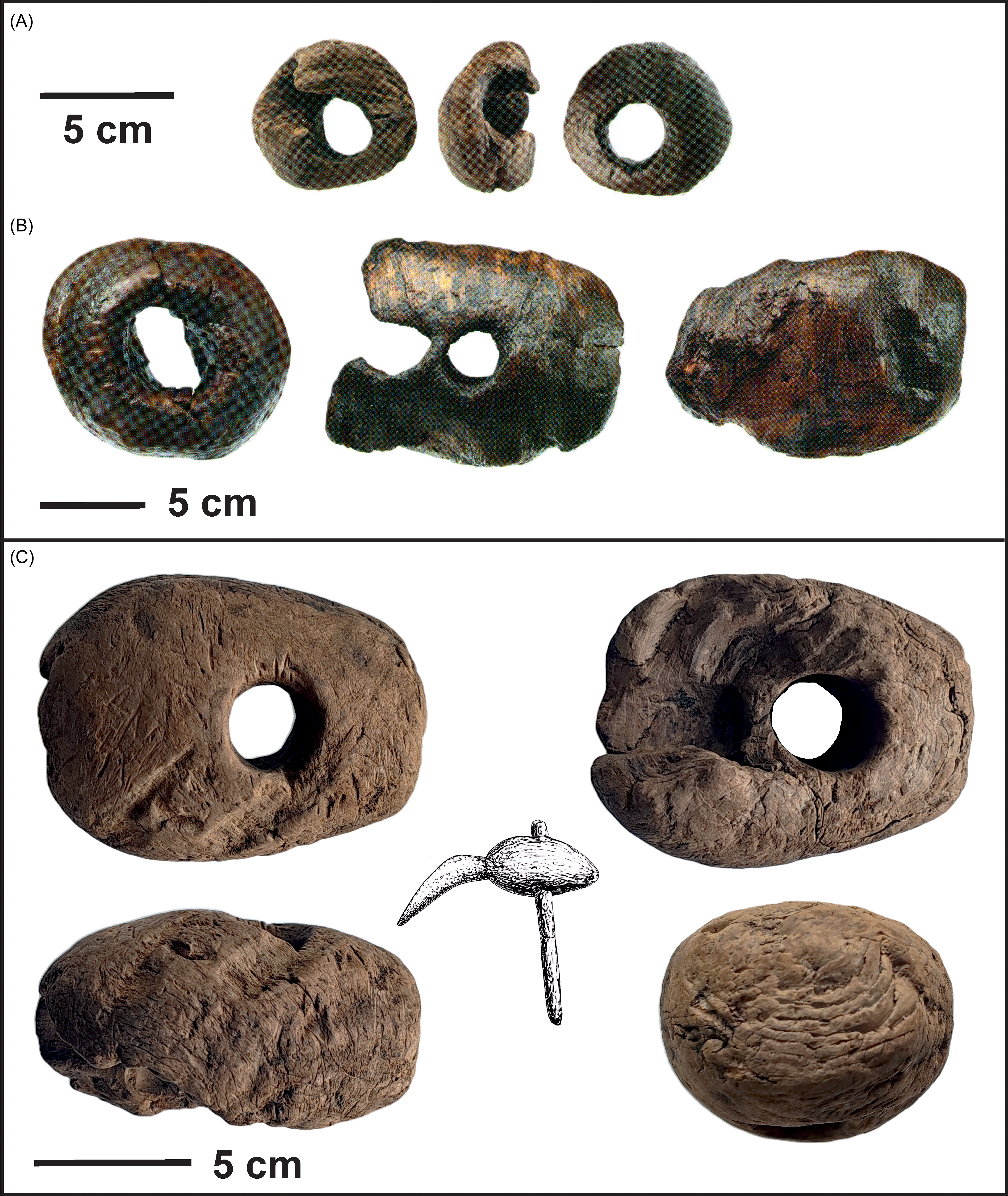
Seven similar wooden sleeves were found in Berlin and Brandenburg, but one of a different shape in Mecklenburg-West Pomerania, ie in the Baltic region of north-east Germany.
Berlin-Moabit, ‘Hamburger Bahnhof’, Invalidenstrasse 50/51, Berlin
In 1842 or 1844 the oldest known completely preserved Mesolithic socketed stone adze was found during the building of the ‘Hamburger Bahnhof’, then ‘Bezirk 2: Berlin-Tiergarten’ (Figure 6: A). The site was a bog — peaty meadow — north of the Spree River. The spherical sleeve, described as a burr or tuber piece of an alder (Alnus spp.) tree, has shrunk to a maximal width of c. 6 cm (Buchholz Reference Buchholz1890, 10; Krügel Reference Krügel1956, 114; Schulz Reference Schulz1987). The blade slot is nearly circular. The 18 cm long ground adzehead was made of a dark grey greenish diorite. It has a D-shaped cross-section and a pointed butt. The cutting edge is small and seems to have been heavily used. The socket was vertically perforated and mounted on a 50–60 cm long handle. The wood of the handle was not determined and not preserved. The find was first published by E. Friedel (Reference Friedel1879; Reference Friedel1880). Since then, it has been mentioned and illustrated by several other authors (Muschert Reference Muschert2014).
Mesolithic one-part wooden sleeves from north-east Germany. A) Berlin-Moabit, Berlin, with earliest published sketch of the complete adze (Friedel Reference Friedel1879, 162; Krügel Reference Krügel1956, fig. 7; Schulz Reference Schulz1987, 60 and by courtesy of the Landesdenkmalamt Berlin); B) Friesack 4, Brandenburg (Gramsch Reference Gramsch2016, figs 16, 29A, modified); C) Hohen Viecheln, Mecklenburg-West Pomerania (Schuldt Reference Schuldt1961, pls 141, 142, cat. no. 2953).

Friesack 4, district of Havelland, Brandenburg
The largest assemblage of Mesolithic one-part wooden sleeves was documented at this Stone Age bog site situated at the westernmost end of the Warsaw–Berlin ice-marginal valley, not far from the Elbe River (Gramsch Reference Gramsch2002, fig. 18; Reference Gramsch2016, cat. no. III,11; Reference Gramsch2021, 15, fig. 3.4). Between 1977–89 and in 1998 almost 300 m2 were excavated. In total 134 objects made of wood and bark were registered. Among them are six spherical sockets catalogued as root wood from alder (Alnus spp.). Two non-refitting fragments of a socket (Figure 6: B1; BLDAM, inv. no. 1977:7/H54) with a maximal width of 9.9 cm stem from the Early Boreal complex III, 14C dated on charcoal samples in Berlin to an age between c. 8300 and 7900 cal BC. The other five wooden sleeves were dredged from the drainage channel south of the settlement area (Figure 6: B2–B6). The blade slots are circular to wide oval (Figure 6: B6). Some shaft holes contained fragments of the handle made of hazel (Corylus avellana).
Hohen Viecheln, district of Nordwestmecklenburg, Mecklenburg-West Pomerania
A single one-part wooden sleeve was recorded in the later Mesolithic settlement on the north-western shore of Lake Schwerin, c. 12 km south of Wismar (Schuldt Reference Schuldt1961). It was embedded in the gyttja of cut 4. The excavator described it as an adzehead made of a gnarled root probably from elm (Ulmus campestris/minor). It is elongated conical, 19.5 cm long and maximally 8.3 cm wide. It has a pointed butt and a wide oval blade slot (Figure 6: C). The upper side is convex, the lower flat and slightly concave. The shaft hole was drilled off-centre nearer to the butt (Schuldt Reference Schuldt1961, pls 141 & 142, cat. no. 2953). Between 1953 and 1955 about 770 m2 of the site had been excavated. Five wooden tools and 26 bark floats were recorded. Despite the assemblage comprising 127 flint core and 19 flake axe- and adzeheads, as well as five more stone adzeheads, there were merely six sleeves. These include the wooden and five antler sockets, two perforated. One of the latter has an 8 cm long flint core adzehead inserted into it (Schuldt Reference Schuldt1961, pl. 14, cat. no. 5268). The shaft holes of both sleeves contained a piece of the handle made of hazel (Corylus avellana). Based on the pollen analyses and the AMS 14C dates, the terrace was settled from the Preboreal to the Late Boreal/Early Atlantic, between c. 9100 and 7200 cal BC (Groß et al. Reference Groß, Lübke, Meadows, Jantzen, Dreibrodt, Groß, Lübke, Meadows and Jantzen2019).
NORTH GERMANY
In Schleswig-Holstein four elongated conical one-part wooden sleeves were documented, tapering towards a flat butt. The blade slots are mostly circular. Two of them still have insets.
Elbe-Trave-Canal near Mölln, district of Herzogtum Lauenburg, Schleswig-Holstein
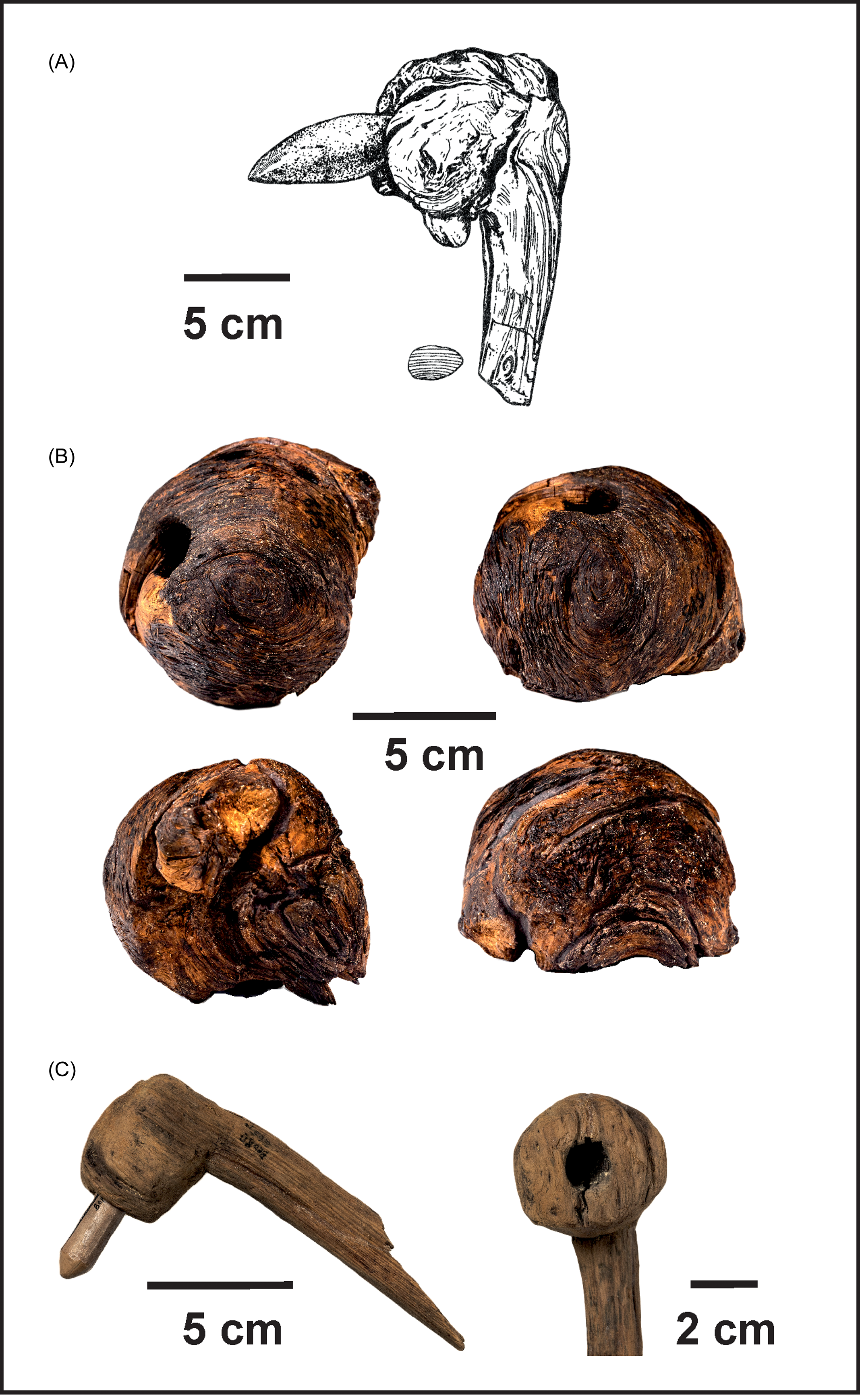
The socket (Figure 7: A), collected in 1912 in the dredged backfill material from the building of the Elbe-Trave-Canal, was seemingly made of a root from beech (Fagus spp.) and fitted with a Mesolithic flint core adzehead (Schwantes Reference Schwantes1939). A handle was not preserved. Based on a drawing from 1936, the sleeve had a length of c. 11 cm, a width of 6 cm and a centred shaft hole (Kersten Reference Kersten1951, fig. 8).
Mesolithic one-part wooden sleeves from Schleswig-Holstein (north Germany). A) Elbe-Trave-Canal near Mölln (Kersten Reference Kersten1951, fig. 8); B) Duvensee LA 23, Wpl. 1 (Bokelmann Reference Bokelmann1971, fig. 8; photo S. Hartz); C) Gammelby LA 1 (Röschmann Reference Röschmann1963, pl. 78.18a–c); D) Nordstrandischmoor LA 293 (Hartz et al. Reference Hartz, Klooß, Paulsen and Hörmann2017; photos S. Hartz).

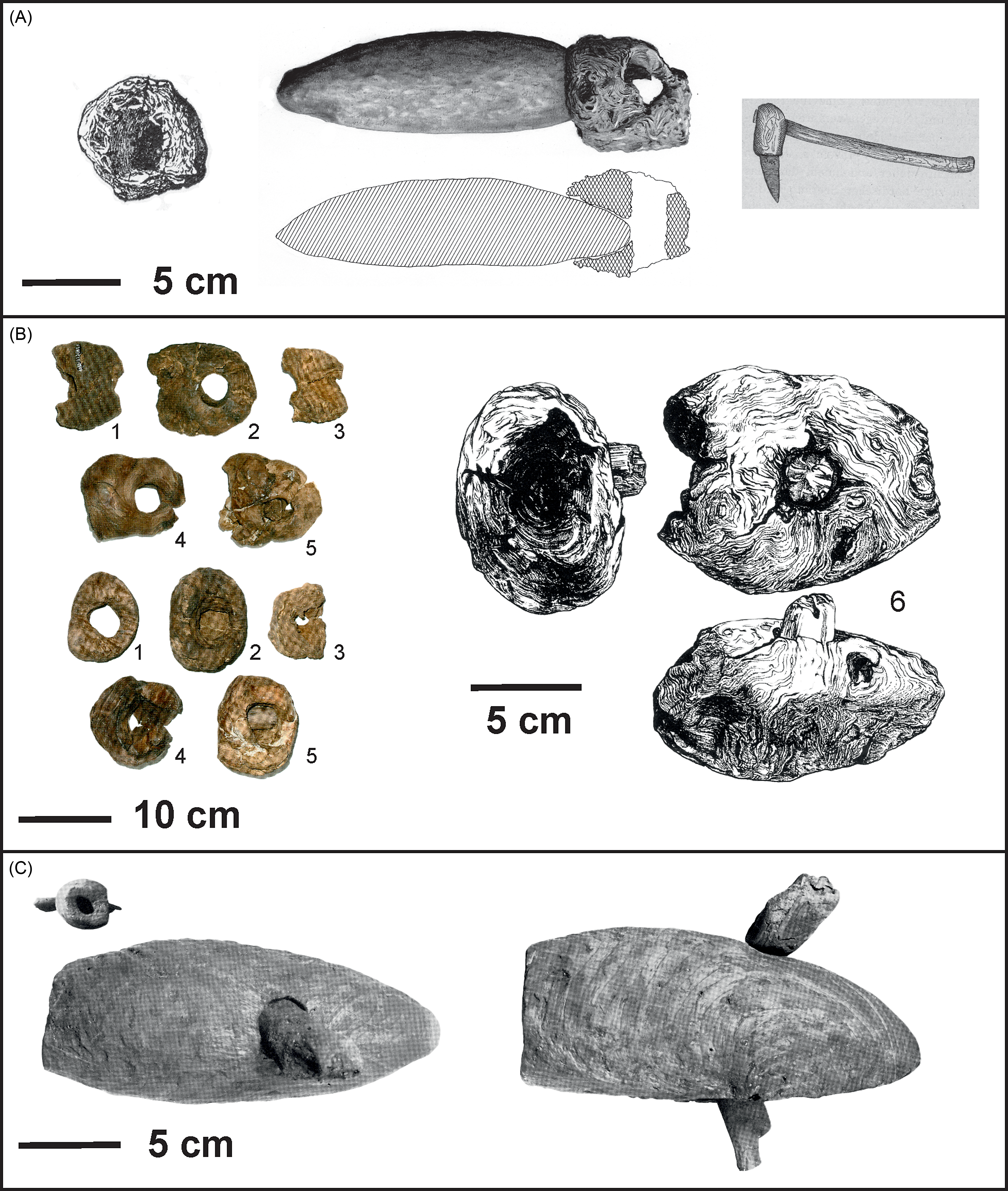
A, B) two Mesolithic one-part wooden sleeves from Krzyż Wielkopolski 7, Poland (Kabaciński Reference Kabaciński2023, 83); C) Neolithic one-part wooden sleeve from Zvidze, Latvia (N. Grasis, National History Museum of Latvia, Rīga) with reconstruction of the complete adze with inserted antler blade (Loze Reference Лозе1988b, pl. 37.4).

The other three one-part wooden sleeves are reported to have been made of pine (Pinus sylvestris) roots. All shaft holes are drilled off-centre nearer to the butt.
Duvensee LA 23, district of Herzogtum Lauenburg, Schleswig-Holstein
The sleeve from the Early Boreal settlement ‘Wohnplatz 1 (WP1)’ was excavated during research campaigns in 1966/67 at the ancient Lake Duvensee, about 20 km south-west of Lübeck (Bokelmann Reference Bokelmann1971). The 28.8 cm long and maximally 11.5 cm wide sleeve was mounted on a 52.5 cm long handle made of hazel (Corylus avellana; Figure 7: B). 14C measurements in Hannover and Kiel on charcoal and hazelnut shells have dated the dwelling site between c. 8600 and 8200 cal BC (Hartz et al. Reference Hartz, Klooß, Paulsen and Hörmann2017; Groß et al. Reference Groß, Lübke, Schmölcke and Zanon2018).
Gammelby LA 1, district of Schleswig-Flensburg, Schleswig-Holstein
The sleeve was exposed during peat dredging in 1946/47 north of the Satrupholm bog, a former lake along the Bondenau River (Schwabedissen Reference Schwabedissen1949). According to J. Röschmann (Reference Röschmann1963), the socket had a length of 14.5 cm and a maximum width of 9.5 cm (Figure 7: C). The shaft hole contained an 8 cm long handle fragment. The wood of the handle was not determined.
Nordstrandischmoor LA 293, district of Nordfriesland, Schleswig-Holstein
In July 2016, a 23.2 cm long and maximally 8.5 cm wide wooden sleeve was picked up at the south-western shore of a small hallig in the north Frisian Wadden Sea (Hartz et al. Reference Hartz, Klooß, Paulsen and Hörmann2017). The rear end has at least two circumferential grooves (Figure 7: D). The pine root presumably used for the sleeve shows clear changes in the wood texture. In the front third of the socket the fibres are straight, in the central part strongly twisted with several sideways runs, and towards the butt again evenly concentric. The wood is extremely hard and only slightly smoothed. Small pieces of bark have remained at the butt and the shaft hole. The blade slot is wide oval. The socket was fitted with a 15.3 cm long elk (Alces alces) antler blade, likely carved from a spike or forked beam of a young bull. About 6 cm are embedded in the sleeve. One lateral side of the blade shows traces of the chopping process. The 2.7 cm wide cutting edge was sharpened asymmetrically from both sides and smoothed. It has a concave fracture, exposing the spongiosa. Based on AMS 14C measurements of the wooden sleeve (KIA-52194; 9419 ± 35 BP) and the elk antler blade (KIA-52195; 9330 ± 45 BP), the Mesolithic adze was manufactured c. 8700 cal BC.
POLAND
Krzyż Wielkopolski 7, Greater Poland voivodeship
Two Mesolithic wooden sleeves of different shapes were excavated at this wetland site, located on an old, abandoned channel of the Noteć River in the western part of Poland (Table 1). The smaller piece is spherical and c. 6 cm in diameter. It has a circular blade slot (Figure 8: A). The other socket is broadly ovoid and c. 14 cm long. It has a flat butt, an oval blade slot and a centred shaft hole (Figure 8: B). Both artefacts are made from alder (Alnus spp.) roots. The settlement site was inhabited in the Late Glacial and during the Preboreal/Boreal transition (Kabaciński Reference Kabaciński2023). From the later period a bone splinter mounted on a pine wood shaft, secured with bast ligaments and coated in birch bark tar, has been AMS 14C dated to 8930 ± 50 BP (Poz-60253; 8271–7949 cal BC; Kabaciński et al. Reference Kabaciński, Henry, David, Rageot, Cheval, Winiarska-Kabacińska, Regert, Mazuy and Orange2023).
LATVIA
Zvidze, Madona Municipality, Vidzeme
Various sleeves were recorded between 1973–75 and 1981–84 in this multilayer Mesolithic–Neolithic habitation site at the north-western end of Lake Lubāns in eastern Latvia (Loze Reference Loze1988a; Reference Лозе1988b). In total, 289 wooden tools, their half-finished rough-outs or wood fragments with processing traces were excavated. Among them are five halves of two-part wooden sockets from the Middle Neolithic. Two one-part sockets are from the Early Neolithic — one of antler and one of wood. The latter is broadly ovoid, 12.4 cm long and 9.5 cm wide (Figure 8: C; Table 1). It is probably made of birch (Betula spp.). The blade slot is circular. The shaft hole is off-centre, nearer to the rounded butt. The Early Neolithic settlements are from the Narva culture and have an age between c. 5400 and 4100 BC. Antler blades, stone adze- and axeheads found at the site could have been used as insets (Loze Reference Loze and Gramsch1981). The reconstruction illustrates the one-part wooden sleeve from Zvidze fitted with an antler blade and mounted on a 30.5 cm long shaft from the assemblage.
RUSSIA
At least 13 one-part wooden sleeves are known from five post-glacial settlements in Russia (Table 1). Eight of them were attached or stem from shafts with fixed wooden sleeves, excavated at two Early Mesolithic sites — Veretye I and Vis I — in north-west Russia, located c. 700 km apart.
NORTH-WEST RUSSIA
Veretye I, Kargopol district, Arkhangelsk oblast
The Mesolithic settlement is situated on the left bank of the Kinema River, about 1 km east from where the river flows into Lake Lacha. Between 1978–85 and 1988–89 a total of 1475 m2 was excavated, and 5643 objects registered, dating from the Preboreal to the Late Boreal/Early Atlantic, c. 8950 to 6200 cal BC (Oshibkina Reference Ошибкина1982; Reference Ошибкина1983; Reference Ошибкина1989; Volokitin & Gribchenko Reference Volokitin, Gribchenko, Kotlyakov, Velichko and Vasil’ev2017). Among them are stone adzeheads, antler blades and other insets. In addition, 372 (6.6%) wooden artefacts were recorded. The latter include 12 hafts of four axe and adze types: one angled, one perpendicularly grooved and three perforated handles, as well as three complete ones and four fragments of shafts with fixed sleeves (Oshibkina Reference Ошибкина1997; Reference Ошибкина2006; Reference (Ošibkina)2007).
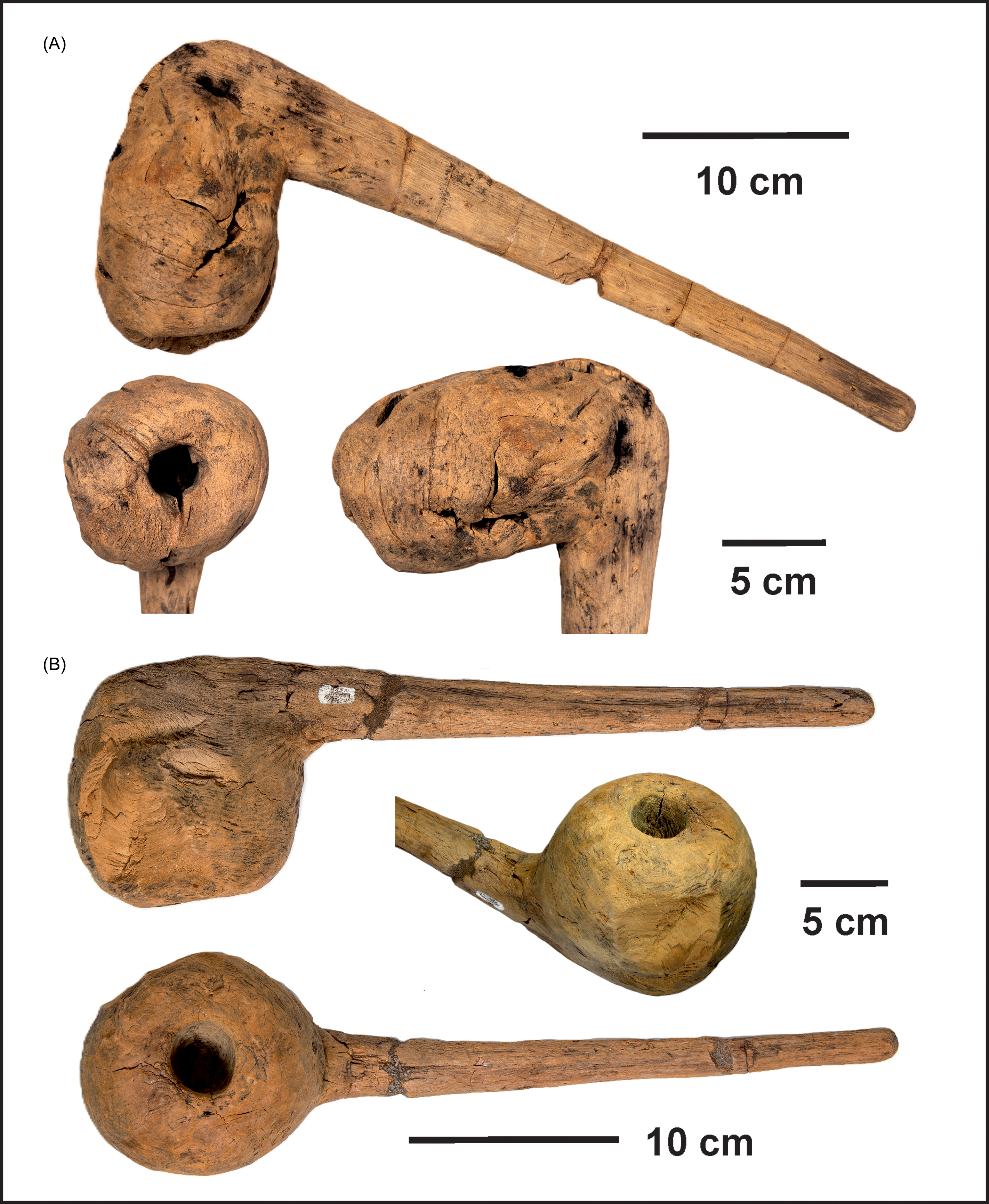
The ‘sleeve shafts’ were carved in a single piece from a root with a (mostly spherical) burr at the end. The cross-section of the shafts varies between circular, oval or trapezoidal and decreases in thickness from the sleeve towards the knob. The size ratio of socket and handle is approximately 1:3. The slots for the insets are circular.
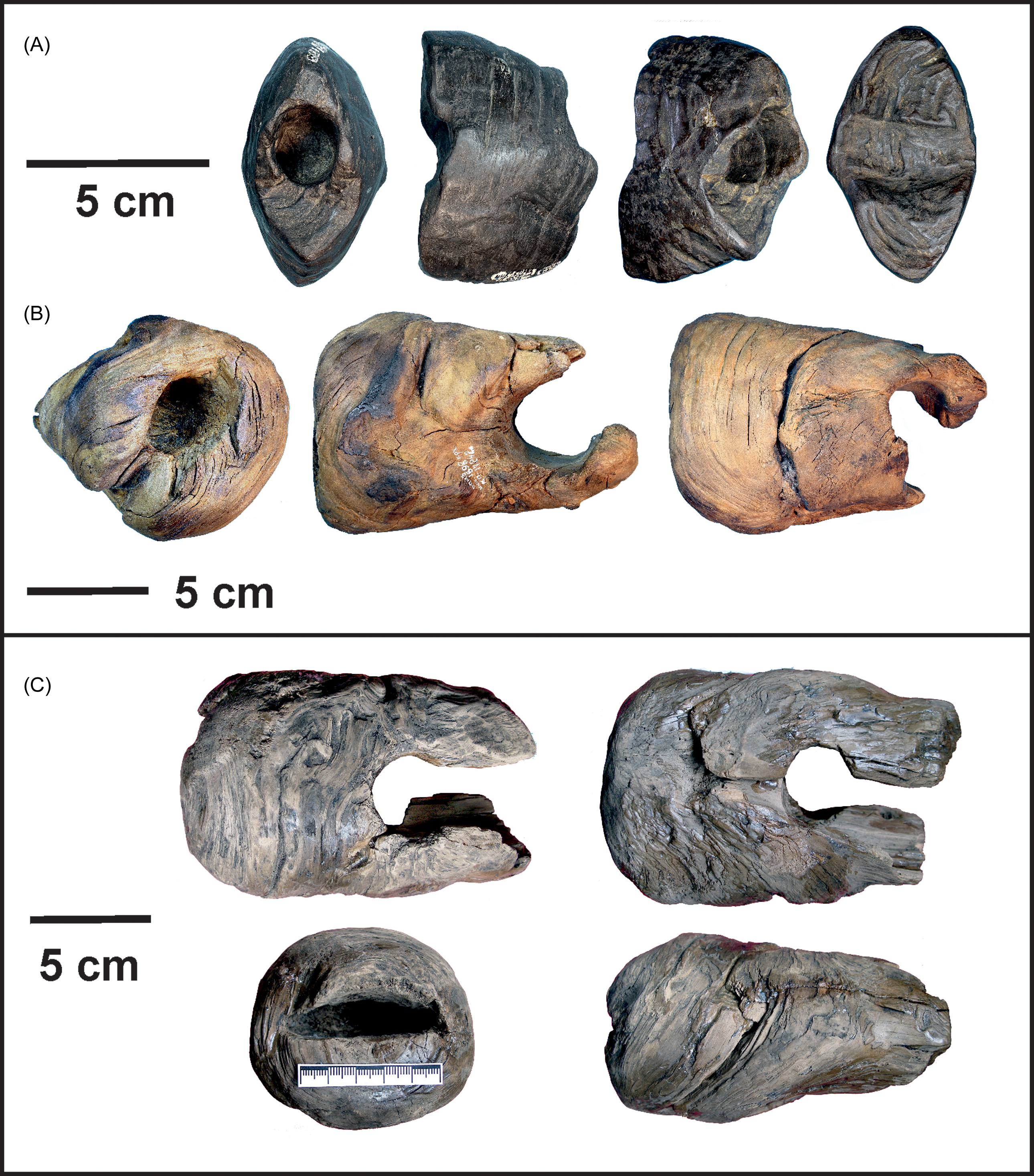
The largest ‘sleeve shaft’ is 41 cm long. The sleeve measures 15.8 x 10 cm (Figure 9: A). The shaft tapers from 4.8 x 3 cm at the shoulder to 3.5 x 2.2 cm at the knob. The second ‘sleeve shaft’ was remeasured (O.L.). It has a length of 38.8 cm with a sleeve of 11.7 x 10 cm (Figure 9: B). Both blade slots have a diameter of about 3 cm and a depth of 4 cm. A distal fragment consists of a 9.5 x 9.5 cm socket attached to a 10 cm long shaft fragment and fitted with a ground stone adzehead (Figure 10: A). Another broken-off socket measures 9.5 x 8.5 cm (Figure 10: B). The third complete ‘sleeve shaft’ looks like a miniature version of the two larger hafts. The shaft is only 14.7 cm long. The socket measures 4.2 x 4 cm and is fitted with an antler inset (Figure 10: C). It is one of three different miniature wooden hatchets possibly manufactured for children (Oshibkina Reference Ошибкина2017a). The other two have perforated shafts with an antler and a wooden inset, respectively. The larger wooden ‘sleeve shafts’ were made of pine (Pinus sylvestris), aspen (Populus tremula) and birch (Betula spp.). The small ‘sleeve shaft’ is carved from spruce (Picea spp.). Pine was primarily used at the site, dominating with 65%, while Picea (8.1%), Betula (5.8%) and Populus (2.3%) were much less represented (Oshibkina Reference Ошибкина1997). Recent studies of antler ‘pressure flakers’ used by Late Neolithic hunter-fisher-gatherers of the East European Plain (Kashina et al. Reference Kashina, Simonenko and Zhilin2023) now might question the function of the ‘sleeve shafts’ for axes.
Veretye 1 (Arkhangelsk oblast, Russia). Different views of the two large Mesolithic ‘sleeve shafts’. A) inv. no. 2930–37 (© The State Hermitage Museum, St. Petersburg, photos I. Regentova & O. Lapenkova); B) inv. no. GIM 108821 A 2202/6 (photos of the complete tool by courtesy of The State Historical Museum, Moscow; detail O.V. Lozovskaya).

Mesolithic ‘sleeve shafts’ from Veretye 1 (Arkhangelsk oblast, Russia). A) fragment mounted with a stone adzehead (Oshibkina Reference Ошибкина1997, fig. 85.1); B) four views of a sleeve fragment showing the curly structure of burr wood (inv. no. 2930–905; © The State Hermitage Museum, St. Petersburg, photos V. Terebenin); C) small wooden ‘sleeve shaft’ with antler inset (inv. no. 2930–36; © The State Hermitage Museum, St. Petersburg, photos I. Regentova & O. Lapenkova).

Vis I, Knyazhpogost district, Komi Republic
In 1961 a single wooden ‘sleeve shaft’ was exposed in the eastern part of the Mesolithic peat bog site near Lake Sindor. Between 1960 and 1967, c. 575 m2 of the settlement was excavated (Burov Reference Burov, Vermeersch and Van Peer1990; Reference Буров2009). A total of 213 artefacts made of wood, bark and sedge were recorded. Among them were 133 shaped items consisting of 50 pieces of hunting and fishing gear, household goods and a few unique pieces of artwork. The finds were dated to an age between c. 7300 and 5800 cal BC (Volokitin & Gribchenko Reference Volokitin, Gribchenko, Kotlyakov, Velichko and Vasil’ev2017). The ‘sleeve shaft’ seems to have been one of the oldest wooden objects, carved from a root or growth on wood. It had a wavy pattern. Unfortunately, the find was lost during the excavation.
CENTRAL RUSSIA
The other five one-part wooden sleeves were excavated at one Neolithic and two Mesolithic settlements in the Moscow oblast. The Mesolithic sockets have a truncated ovoid form with a circular to oval cross-section.
Zamostje 2, Sergiev-Posad district, Moscow oblast
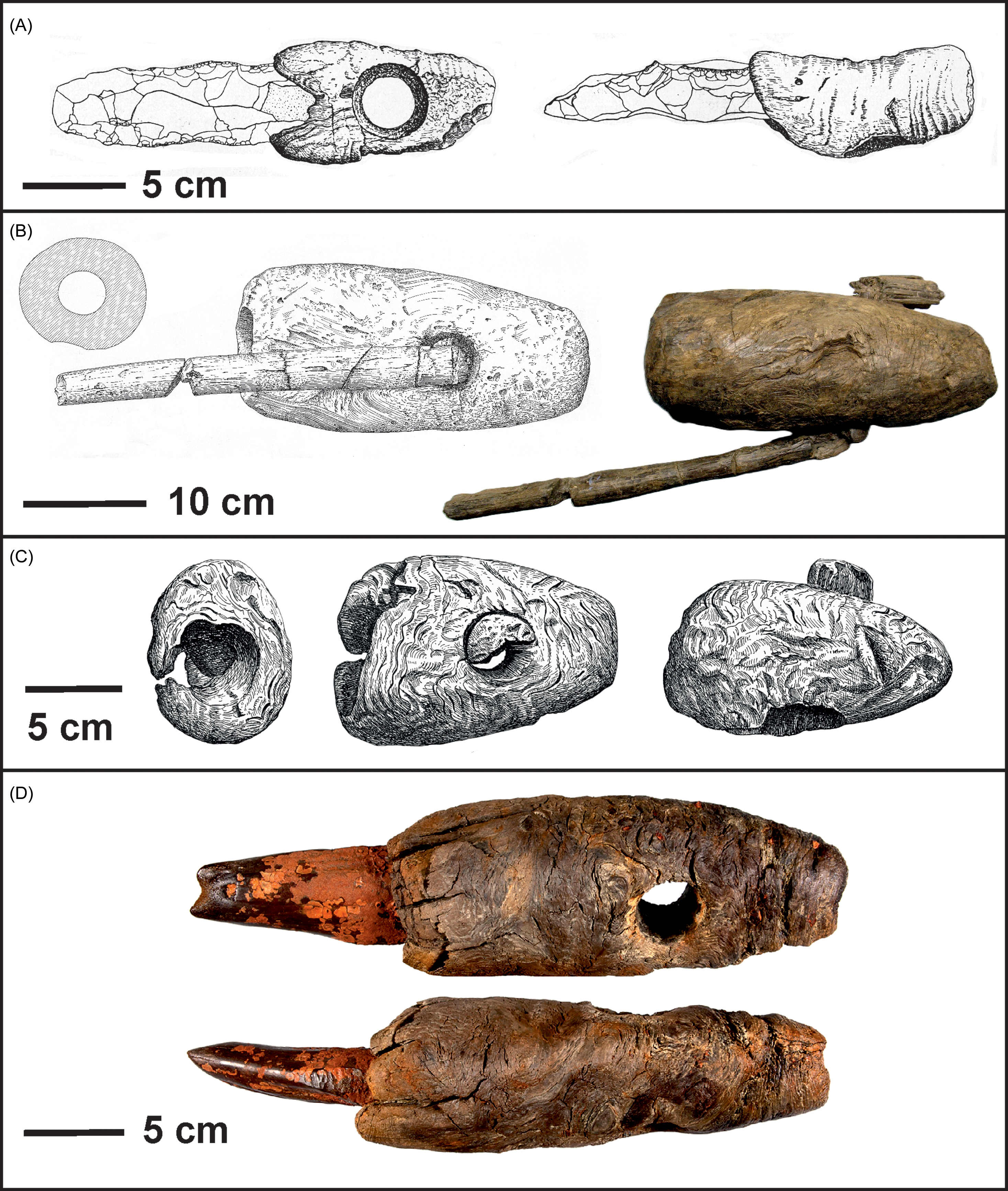
Two one-part wooden sleeves with circular to wide oval blade slots were documented at this Stone Age wetland site located on the western bank of the Dubna River. About 164 m2 of the settlement was excavated between 1989 and 2014 (Lozovskaya & Lozovski Reference Lozovskaya, Lozovski, Palomo, Piqué and Terradas2013; Reference Lozovskaya, Lozovski, Uino and Nordqvist2016; Lozovskaya Reference Lozovskaya, Hovmand, Felter and Stelzner2023). Most of the finds, including the wooden sockets, belong to the Late Mesolithic. In total more than 300 wooden artefacts and several hundred polished elk antler blades were recorded. However, only one wooden sleeve fragment was found during the 1990 campaign in layer 9 (square V6), which is slightly older than c. 6600 and 6400 cal BC. The sleeve measures 7 x 5 cm (Figure 11: A). The wood is not yet determined. Another socket from the 1991 campaign is more complete, measuring 13.5 x 9.2 cm. The damaged shaft hole was perforated close to the butt (Figure 11: B). It was recorded in layer 5, which has an age between c. 6300 and 5900 cal BC. D. Pillonel, Musée d’archéologie in Neuchâtel, identified the wood as maple (Acer spp.; Lozovski & Ramseyer Reference Lozovski and Ramseyer1998). Both artefacts were first published by V.M. Lozovski (Reference Lozovski1996) and V.M. Lozovski and D. Ramseyer (Reference Лозовский, Рамсейер, Манушина, Массон, Вишневский, Лозовский and Лозовская1997).
Mesolithic one-part wooden sleeves from the Moscow oblast (Russia). A) Zamostje 2, layer 9; B) Zamostje 2, layer 5; C) Zamostje 5, layer 7 (photos O.V. Lozovskaya).

Zamostje 5, Sergiev-Posad district, Moscow oblast
In 1996 a similar sleeve was excavated in layer 7 at a Mesolithic settlement located on the eastern bank of the Dubna River, c. 100 m downstream from Zamostje 2 (Sidorov & Sorokin Reference Sidorov, Sorokin, Darvill, Afanas’ev and Wilkes2000; Sorokin & Hamakava Reference Сорокин and Хамакава2014). The sleeve measures 14.7 x 9.4 cm (Figure 11: C). The blade slot is long oval. The shaft hole is off-centre nearer to the butt and damaged (Lozovskaya Reference Лозовская2009a and new studies). In 2010 M.I. Kolosova, State Hermitage St. Petersburg, determined the wood of the socket as pine (Pinus sylvestris).
Voymezhnoye 1, Shatura district, Moscow oblast
A complete socketed stone adze and an individual sleeve were documented in this multi-period Neolithic/Bronze Age settlement and attributed to the Volosovo culture, dated to c. 3500–3000 cal BC (Engovatova Reference Энговатова1997). Both one-part sleeves have rounded butts. The mounted sleeve is broadly ovoid measuring c. 19.5 x 18 cm (Figure 12: A). According to L. Solovyeva, Institute of Archaeology in Moscow, it was made from elm (Ulmus spp.). The sleeve (Museum of Moscow, inv. no. 28312/2146) has a circular blade slot and a centred shaft hole. The inserted ground diorite adzehead is c. 15.5 cm long. The cutting edge is symmetrical, the butt flat. The latter has a small cavity on both sides which was perhaps intentionally knapped to better secure the blade. About 3 cm of the stone adzehead were embedded in the sleeve. The preserved handle fragment is c. 42 cm long and made of pine (Pinus sylvestris). The other wooden socket is an elongated ovoid measuring c. 27 x 17 cm. The shaft hole was drilled off-centre nearer to the butt. The shaft hole and the oval blade slot are damaged on one side (Figure 12: B).
Late Neolithic one-part wooden sleeves from Voymezhnoye 1 (Moscow oblast, Russia). A) parts of the complete socketed stone adze with handle; B) individual sleeve (by courtesy of the Museum of Moscow, photos E.A. Kashina).

Discussion
Wood use
The Mesolithic hunter-fisher-gatherers must have had detailed knowledge on the mechanical properties of different growth forms of wood, its strength and toughness (Ennos & Oliveira Reference Ennos and Oliveira2021). Burr wood is hard to work by hand. The whirled structure of compressed, tightly interlocked fibres provides this wood with a maximum strength and makes it more resistant to splitting. Their unusual grain patterns still make them highly valued wood today. Conifers develop burrs much less frequently than deciduous trees: ash, birch, elm, maple, oak and walnut trees. But anomalous growth could have been stimulated by scoring the tree or ‘cultural burning’, as practised by Native Americans (O.C. Stewart Reference Stewart2002). Fire traces like those on the sleeve from Grieben might originate from controlled heating with successive cooling to further harden the shaft hole, or from the removal of the bark. However, this practice is more effective with deciduous wood, especially oak and ash, than conifer wood (Lippoldt Reference Lippoldt2024). Another method called ‘live tree’, or ‘growth-assisted hafting’ is reported from Africa, America and Europe (Wescott Reference Wescott1999). A stone axehead or a blank is wedged into a living tree, which causes secondary growth, ie abnormal fibre build-up, around the mortise (hole). It is assumed that the process requires two to three years at least. However, there appear to be no documented ethnographic cases which were manufactured in this way (Arp Reference Arp2021).
Indigenous populations in North America, Siberia and northern Scandinavia have regularly harvested burrs and curly knots for manufacturing knife handles, but also bowls and drinking vessels (Hodge Reference Hodge1907; Piezonka et al. Reference Piezonka, Adaev, Kirleis, Poshekhonova, Rud’, Berihuete-Azorín, Martín Seijo, López-Bultó and Piqué2021). These were hollowed out and shaped using smooth stones heated red-hot in a fire and lifted for example with shell tongs bound to wood handles. The ash and carbonised wood could be chipped away with stone tools and beaver incisors (Lefevre Reference Lefevre2010). Interestingly, burr wood vessels have not been found at Mesolithic sites, while wooden sleeves were apparently not used for hafting axes by Native Americans, Siberians or Sámi (Wescott Reference Wescott1999). However, a Mesolithic ladle blank made of an ash burr is recorded from Zamostje 2 (Lozovskaya Reference Лозовская2011; Lozovskaya & Lozovski Reference Lozovskaya, Lozovski, Uino and Nordqvist2016). Burr wood vessels are known from a few Early Neolithic sites, for instance from Strelka, part of the Gorbunovo peat bog site group in the middle Trans-Urals. The find is housed in the State Historical Museum Moscow (inv. no. GIM 75907 A128/73, 74).
Wood characteristics
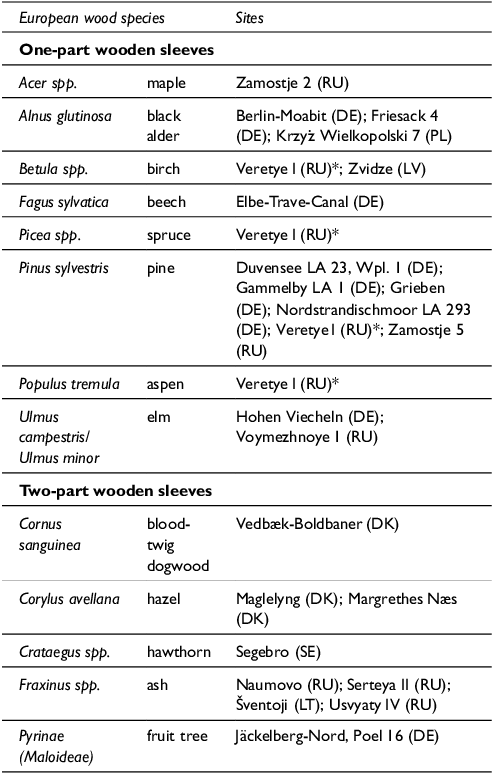
Different wood species were selected for the sockets (Table 2). The one-part wooden sleeves were usually made of softwood (aspen, pine, spruce) or soft hardwood (alder, birch, elm). Alder (probably mostly black alder, Alnus glutinosa) and pine (Pinus sylvestris) dominate. A few Mesolithic and Neolithic one-part sleeves were carved from other hardwood (beech, maple), like the pieces from the Elbe-Trave-Canal and Zamostje 2. In contrast, the two-part sockets seem to have generally been manufactured from hardwood (ash, blood-twig dogwood, fruitwood, hawthorn, hazel).
Wood taxa of Mesolithic and Neolithic one and two-part adze and axe sleeves

*Sleeve shafts; with additional data from Klooß Reference Klooß2015; O.V. Lozovskaya this paper.
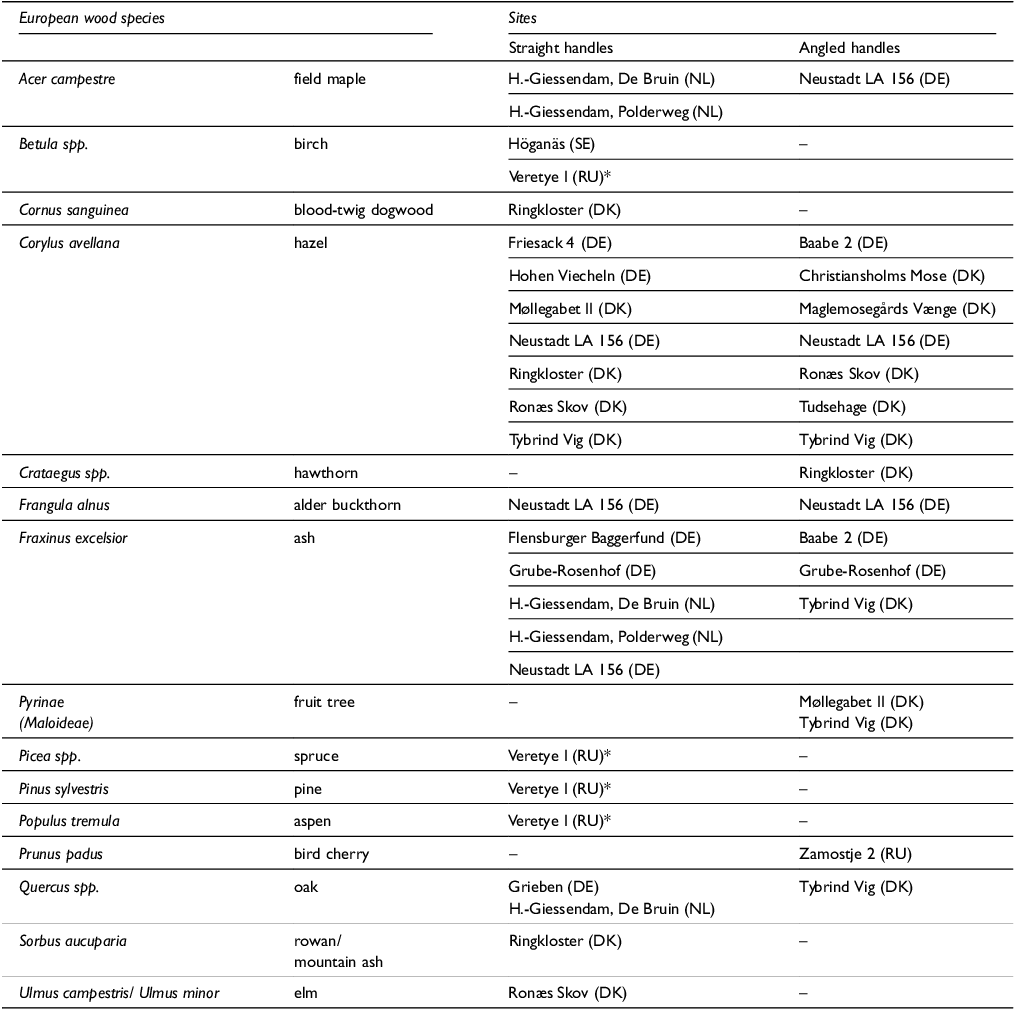
Perforated one- and two-part sleeves were mounted on straight shafts, unperforated two-part sleeves on angled shafts. The wood for the handle had to be carefully chosen to withstand splitting under the impact pressure. Many handles were therefore made of hardwood or more rarely of soft hardwood (Table 3). The variety of woods selected for the handles seems to be larger than for the sleeves. However, hazel (Corylus avellana) and ash (Fraxinus excelsior) dominated. Early Mesolithic straight shafts were also manufactured from birch (Betula spp.) and oak (Quercus spp.), in the Late Mesolithic from alder buckthorn (Frangula alnus), blood-twig dogwood (Cornus sanguinea), elm (Ulmus minor) and rowan/mountain ash (Sorbus aucuparia). Similarly, angled shafts were carved of alder buckthorn, but also of bird cherry (Prunus padus), hawthorn (Crataegus spp.), field maple (Acer campestre) and fruitwood (Pyrinae/Maloideae). In contrast, the Mesolithic sleeve shafts from Veretye I were completely and exclusively made of soft hardwood, ie birch (Betula spp.), or softwood, ie pine (Pinus sylvestris), aspen (Populus tremula) and spruce (Picea spp.). The Late Neolithic adze from Voymezhnoye 1 also had a handle made of pine.
Wood taxa of the Mesolithic adze and axe handles

* Sleeve shafts; H.-Giessendam = Hardinxveld-Giessendam; with data from Rydbeck Reference Rydbeck1929; S.V. Oshibkina Reference Ошибкина1983; Reference Ошибкина1997; Louwe Kooijmans et al. Reference Louwe Kooijmans, Hänninen, Vermeeren and Louwe Kooijmans2001a; Reference Louwe Kooijmans, Vermeeren, van Waveren and Louwe Kooijmans2001b; Andersen Reference Andersen2013; Klooß Reference Klooß2015; and new data.
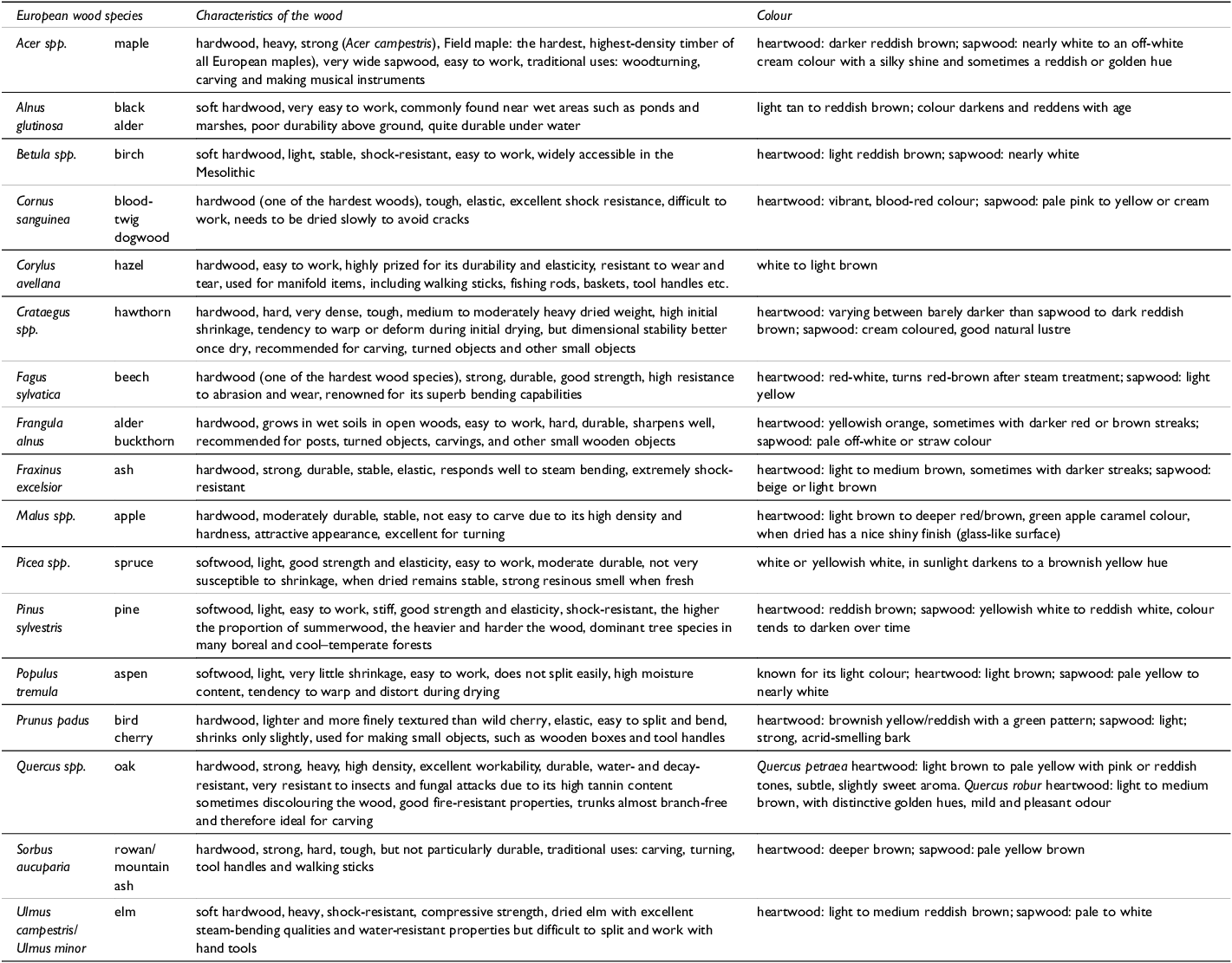
The mechanical properties of wood greatly differ and depend on the growing conditions. Black alder (Alnus glutinosa), for instance, spreads very well in bogs and swamps, and its wood is particularly resistant under water (Klooß Reference Klooß2015). The wood species vary not only in their availability, durability and workability, but also in their weight and appearance, eg colour and grain pattern (Table 4). Many have reddish heartwoods, but some are vibrant blood-red or yellowish orange: Cornus sanguinea and Frangula alnus. Others are known for their light colour (Populus tremula) or their good natural lustre (Crataegus spp.). Different tree and shrub woods were commonly available in the environment, but they were also seemingly intentionally selected for their specific inner structure and individual properties (Porter Reference Porter2007; Meier Reference Meier2015; see also https://www.timberblogger.com). Hazel has pliable, moderately hard and tough wood. It has a fine, even texture and a straight grain which can be crafted to a variety of objects. Several adze sleeves and handles were manufactured from wood species known for their elasticity and shock resistance: Betula spp., Cornus sanguinea, Fraxinus excelsior, Pinus sylvestris and Ulmus minor. Various hardwoods used for the handles are still recommended for woodturning today: Acer campestre, Corylus avellana, Crataegus spp., Frangula alnus, Pyrinae (Maloideae) and Sorbus aucuparia.
Characteristics of the wood taxa used for Mesolithic adze and axe sleeves and handles. Based on Porter Reference Porter2007; Meier Reference Meier2015; https://www.timberblogger.com

The stone adze from Grieben in Saxony-Anhalt appears to be a rather exceptional composite tool, fitted with an only partially ground amphibolite boulder in a socket probably made of a Late Glacial pine (Pinus sylvestris) burr and hafted with a handle of Boreal oak (Quercus spp.). Pine wood is light, strong and known for splitting better than all other species. Moreover, it was easily available. Pine wood was widely used by Mesolithic foragers in northern Europe, eg at Veretye I and Friesack 4 (Oshibkina Reference Ошибкина1997; Gramsch Reference Gramsch2016). Oak wood is heavy, but good to work and durable, water- and decay-resistant, as well as resistant to insects and fungal attacks. The pollen diagrams from Friesack 4 (Brandenburg) show that Ulmus and Quercus already appeared in small quantities in the Early Boreal (Va) in central Europe (Jahns et al. Reference Jahns, Gramsch, Kloss, Benecke, Gramsch and Jahns2016).
Summary and conclusion
Although there are hundreds of unperforated stone adze- and axeheads as well as elk antler blades, sleeves are scarce. One-part wooden sleeves were far more rarely recorded than two-part sleeves. But at least in the eastern Baltic region and eastern Europe, the hafting technique with wooden sockets was still practised by Neolithic foraging groups.
This paper presents 29 one-part wooden sleeves from 13 Mesolithic and two Neolithic hunter-fisher-gatherer sites in Germany, Latvia, Poland and Russia. Due to the very bad preservation conditions for wood, the actual cultural, geographical and temporal distribution remains unknown. Their scarcity could imply that their manufacture was rare, eg for special individuals or as offerings.
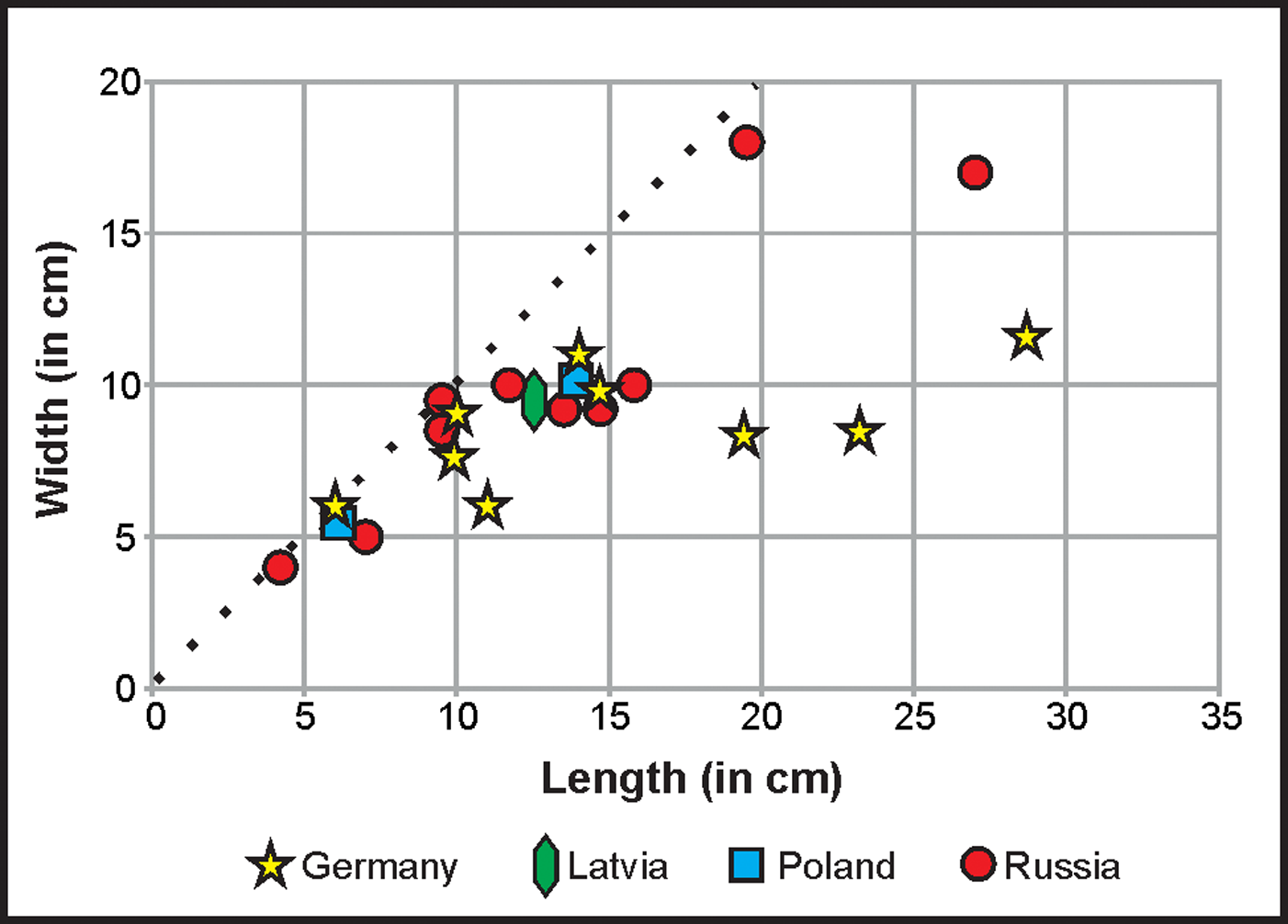
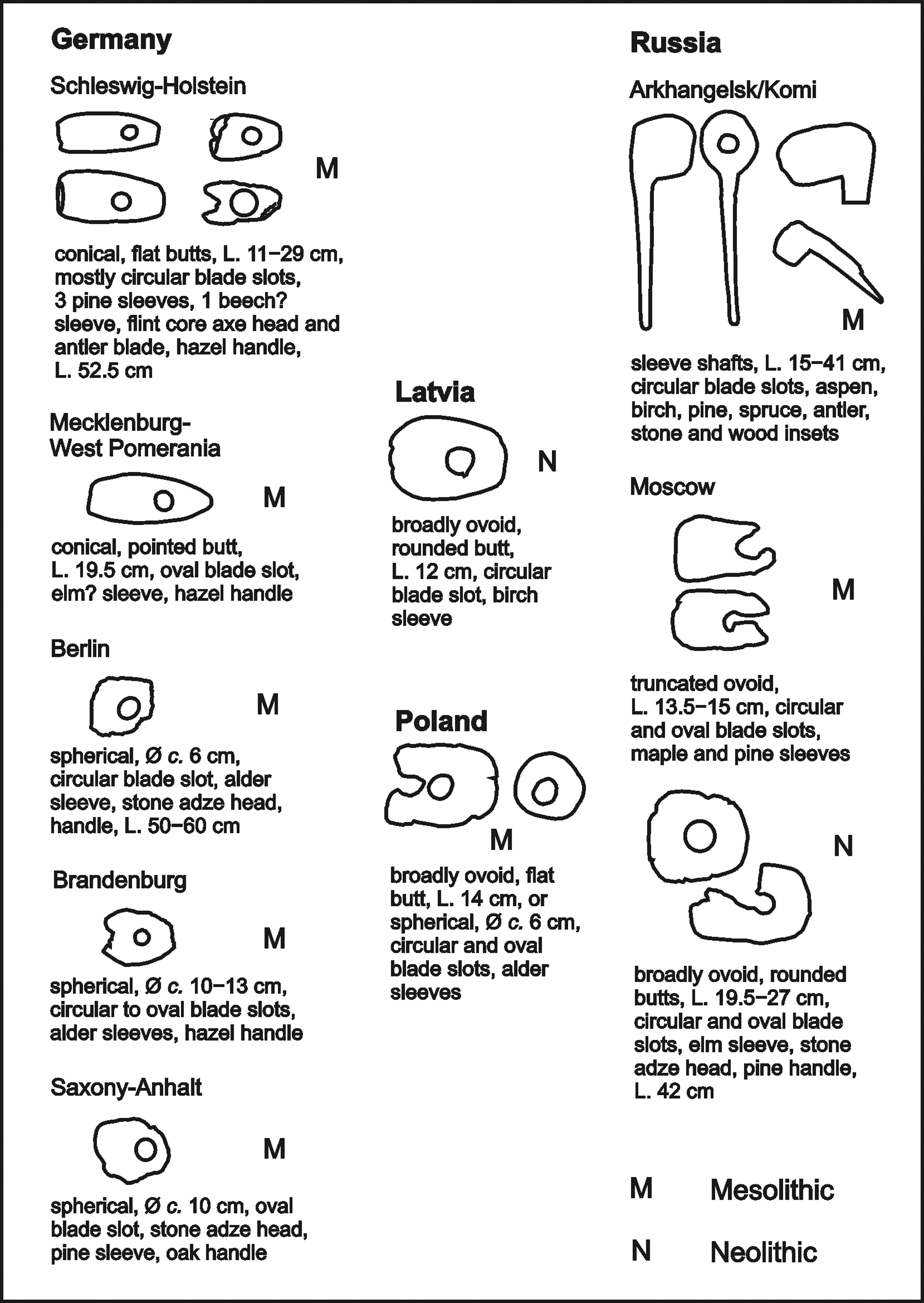
Completely preserved socketed stone adzes with one-part wooden sleeves, inset and handle remnants are currently known only from one Neolithic (Voymezhnoye 1) and three Mesolithic forager sites (Berlin-Moabit, Grieben, Veretye I). Several sleeves have significantly shrunk due to drying of the wood after their retrieval, in the case of Grieben by about a third of the former circumference. There are regional differences not only in the wood species, but also in their shapes and sizes (Figure 13). Most sleeves with a width up to c. 10–15 cm are isometric (spherical). They were found in central and north-east Germany as well as in Poland. Broadly ovoid forms are known from Latvia, Poland and Russia. Elongated sleeves up to a length of c. 30 cm with pointed, flat or rounded butts were documented in north and north-east Germany, as well as in central Russia.
Variation in size of the Mesolithic and Neolithic one-part wooden sleeves. The dotted line indicates an isometric shape (H.A. Graetsch & J.M. Grünberg).

Most blade slots are circular or wide oval. Oval slots with a ratio of about 2:1 are rare but occur across central and eastern Europe: Grieben, Krzyż Wielkopolski 7, Zamostje 5. All shaft holes were circular. Many sleeves — especially the elongated forms — had off-centre shaft holes, located closer to the butt. The handles were straight and usually made of hardwood species. Wooden shafts with fixed sleeves were mostly made of softwood or soft hardwood. They had a length of up to more than 40 cm with shafts tapering towards the knob. The sleeve shafts are only known to have been manufactured in north-western Russia (Arkhangelsk, Komi) in the Boreal period (Figure 14).
Main characteristics of the Mesolithic and Neolithic one-part wooden sleeves in Europe. Germany: (SH) Nordstrandischmoor LA 293; Gammelby LA 1; Duvensee LA 23; Elbe-Trave-Canal; (MV) Hohen Viecheln; (BE) Berlin-Moabit; (BB) Friesack 4; (ST) Grieben. Poland: Krzyż Wielkopolski 7. Latvia: Zvidze. Russia: (Arkhangelsk/Komi) Veretye I; Vis I (no image); (Moscow) Zamostje 2; Zamostje 5; Voymezhnoye 1. The artefacts are not to scale (H.A. Graetsch & J.M. Grünberg).

One Neolithic (Voymezhnoye 1) and four Mesolithic (Berlin-Moabit, Elbe-Trave-Canal, Grieben, Veretye I) wooden sockets were fitted with ground stone or flint core adzeheads. Only one Mesolithic wooden sleeve holds an antler blade (Nordstrandischmoor LA 293), although such blades were excavated in many Mesolithic and Neolithic settlements in northern, central and eastern Europe (Veretye I, Zamostje 2, Zvidze). With a length of 14.5–18 cm, a width of 5–7 cm and a thickness of 3–5.5 cm these mounted insets vary little in size.
Only two wooden sleeves — Grieben and Nordstrandischmoor LA 293 — are directly AMS 14C dated. The age of the others is based on associated artefacts or stratigraphy. The oldest one-part wooden sleeve is the Late Glacial find from Grieben with an AMS 14C age between 11,850 and 11,656 cal BC, the youngest is from Voymezhnoye 1 with an age of c. 3500–3000 cal BC. About 65% (19/29) of the recorded one-part wooden sleeves are Early to Middle Mesolithic. A few are Late Mesolithic or Neolithic.
Mesolithic hunter-fisher-gatherers had developed several direct and indirect hafting systems still used in the Neolithic and in later times. But the large variety of materials and shapes of the stone adze- and axeheads, other insets and sleeves remains unique. The Early Neolithic farmers had modified and significantly standardised the axe designs. Especially knee- and mortise hafts were widely used. The unperforated polished stone axe and adze blades were larger, made for intensive woodwork. Some of them seem to have been used as status symbols. Often, they were manufactured from raw material traded from distant sources. Socketing axe blades in antler sleeves was still practised. At the transition to the Middle Neolithic the dominating hafting system changed with the spread of shaft hole stone axeheads which were mounted on straight or curved wooden hafts without sleeves. The unparalleled variability of hunter-fisher-gatherer technological solutions deserves a more concerted research effort in the future.
Acknowledgements
We are very grateful for the photographs of the wooden sleeve shafts from Veretye I, kindly taken by Olga Lapenkova, Inna Regentova and Vladimir Terebenin. The State Hermitage Museum, St. Petersburg, holds the copyright of these photographs. We thank the Museum of Moscow and the curator, Julia Kuzminova, for the permission to use the photos of both Voymezhnoye 1 sleeves. Lydia Solovyeva (Institute of Archaeology, Moscow) kindly determined the wood species of one Voymezhnoye 1 sleeve. Dr. Jens Henker (Landesdenkmalamt Berlin, Abteilung Bodendenkmalpflege) provided the drawing of the socketed stone adze from Berlin-Moabit. Many thanks to Andrea Hörentrup and Mario Wiegmann (Landesamt für Denkmalpflege und Archäologie Sachsen-Anhalt, Halle/Saale) for the new colour photographs and the detailed drawings of the wooden sleeve and the stone adzehead from Grieben. Dr. Ingrid Sudhoff (Hansestadt Lübeck, Bereich Archäologie und Denkmalpflege, Abteilung Archäologie) helped find the socketed flint core adze from the Elbe-Trave-Canal. Hartmut Benkwitz (Institut für Physik, Forschungswerkstatt, Martin-Luther-Universität Halle-Wittenberg) and Torsten Schurig (Naturwissenschaftliche Fakultät II, Institut für Chemie, Glasbläserei, Martin-Luther-Universität Halle-Wittenberg) kindly took the samples of the Grieben sleeve for the AMS 14C dates. Special thanks go to Prof. Dr. Christiane Stephan-Scherb, PD Dr. Stefan Stöber and Jan-Hendrik Schulz (Institut für Geowissenschaften und Geographie, FG Mineralogie/Geochemie, Martin-Luther-Universität Halle-Wittenberg) for quickly providing the x-ray powder diffraction data for the white sediment from the find. Finally, we are indebted to Lisa J. Ortmann (Sedalia, MO) for critically reading and correcting the English of our manuscript. Thank you to the three anonymous reviewers for their comments and suggestions to improve this contribution.