I. INTRODUCTION
Hard coatings are often used to increase the wear and corrosion protection of materials. Transition metal carbide and nitride coatings are suggested for this purpose on cutting and shaping tools.Reference Jiménez, Restrepo and Devia1 ZrN film is currently widely used as a protective layer because of its attractive physical, mechanical, and chemical properties.Reference Larijani, Elmi, Yari, Ghoranneviss, Balashabadi and Shokouhy2 This coating exhibits higher thermal stability and corrosion resistance in comparison with other hard coatings, such as TiN.Reference Jiménez, Restrepo and Devia1,Reference Qi, Huang, Zhu, Sun and Wang3 It is well known that properties of deposited films strongly depend on aspects of their microstructure, such as degree of crystallinity, preferred orientation, grain size, surface roughness, and stoichiometry. On the other hand, the film deposition method and parameters can also affect film microstructure.Reference Jiménez, Restrepo and Devia1
Magnesium alloys are used as biomaterials, since the magnesium ion (Mg+) is essential to all cells in living organisms and its alloys present a good strength-to-weight ratio.Reference Altun and Sinici4,Reference Guo-Song, Ai-Ying, Ke-Jia, Cai-Yun, Wei and Ai-Jiao5 According to published reports,Reference Wen, Guan, Peng, Ren, Wang and Hu6,Reference Altun and Sen7 the low corrosion resistance of magnesium alloys in human body fluids limits their applications. Some studiesReference Altun and Sinici4,Reference Takadoum and Bennani8 examined the effect of transition metal nitride coatings on the corrosion behavior of magnesium alloys. The purpose of the present study is the synthesis and characterization of ZrN coatings on AZ91 alloys using the single ion beam sputtering method and to investigate the corrosion behavior of samples in simulated body fluid (Ringer's solution). To evaluate their quality and effectiveness, the uniformity and adhesion of the coatings were also investigated.
II. EXPERIMENTAL
The ZrN film was prepared using the ion beam sputtering method on cast magnesium alloy (AZ91) substrates using a Kaufman ion source. The coating chamber was evacuated to a base pressure of 4 × 10⁻³ Pa. Sputtering was initiated by introducing a mixture of pure Ar (99.999%) and N2 (99.999%) into the ion source at a fixed flow ratio of F(N2)/F(N2 + Ar) = 0.4. The working pressure and the total flow rate of the mixed gas (Ar + N2) were kept constant at 1 × 10⁻² Pa and 30 sccm, respectively.
Ions produced by the ion source bombarded a pure zirconium target (99.8%) at 2.8 keV of energy and 20 mA beam current during the sputtering process. The substrates (10 × 10 × 3 mm3) were abraded with 1000, 1200, and 2000 grit silicon carbide papers and then mirror polished using 0.03-μm aluminum oxide particles. The polished substrates were ultrasonically cleaned in both acetone and alcohol bath for 30 min and dried with argon gas flow prior to deposition. After cleaning, the substrates were immediately introduced into a vacuum chamber on a resistance heater and gradually heated to 373, 473, 573, and 673 K in each run. It should be noted that the melting point of AZ91 intermetallic phase is low (730 K) and the diffusion of aluminum in the magnesium matrix and magnesium self-diffusion is high at elevated temperatures.
The film deposition duration was 2 h for each sample. The film thickness was measured using a Dektak3 profilometer (Vecco), and its crystalline structure and morphology were characterized by x-ray diffraction (XRD) and scanning electron microscopy (SEM), respectively. The electrochemical corrosion behavior of the samples was studied using a potentiostat (EG & G model 273) coupled to a PC and the potentiodynamic method in Ringer's solutionReference Chang-Hao and Zhan-Qi9 in which the ingredients (g/L) were: NaCl 8.5, KCl 0.2, CaCl2 0.2, and NaHCo3 0.2. The auxiliary and reference electrodes were a platinum rod and a saturated calomel (SCE) electrode, respectively.
The working electrodes were sealed with acrylic resin and left in a 0.785 cm2 area exposed to the solution during the test. They were also polarized from −100 mV versus an open circuit potential at a scan rate of 1 mV/s. The end of the scan was +540 mV versus an open circuit potential. After each experiment, the corrosion current (I corr) was determined using a traditional Tafel plot. For this purpose, the slopes of the cathodic and anodic branches were used to extract the corrosion current.
All the presented potentials are a function of SCE. The adhesion of the coatings to the magnesium alloy substrate was assessed using a hardness machine, where a Rockwell C diamond indenter with discrete loads of 30, 60,110, 130, and 160 kg was applied. The dP/dr ratios where P and r are the applied load and crack radius, respectively, were determined for each film. The dP/dr is proportional to film adhesion energy if the materials have the same properties.Reference Kim, Jeong, Lee and Kwona10 Details of the adhesion test method have been reported elsewhere.Reference Kim, Jeong, Lee and Kwona10,Reference Nesladek, Vandierendonck, Quaeyhaegens, Kerkhofs and Stals11
III. RESULTS AND DISCUSSION
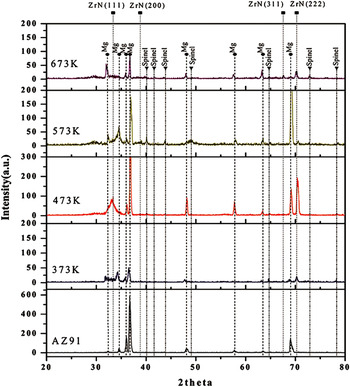
SEM micrographs (not presented here) show that all the ZrN films are uniform and homogeneous without voids, pinholes, or cracks on the surface. Figure 1 illustrates diffraction patterns collected from different samples over the 2θ range of 20–80° with a step-size of 0.01° and a counting time of 5 s per step. The patterns show the formation of (111), (200), (311), and (222) ZrN peaks at temperatures between 373 and 673 K. It can be seen that ZrN film crystallinity decreased at 573 and 673 K.
XRD patterns of ZrN thin films on AZ91 magnesium alloy at different substrate temperatures.

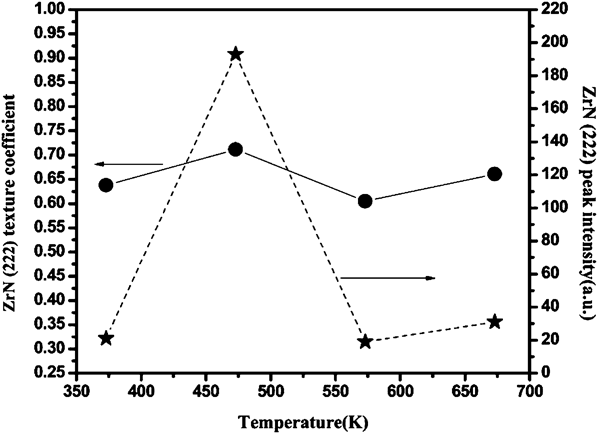
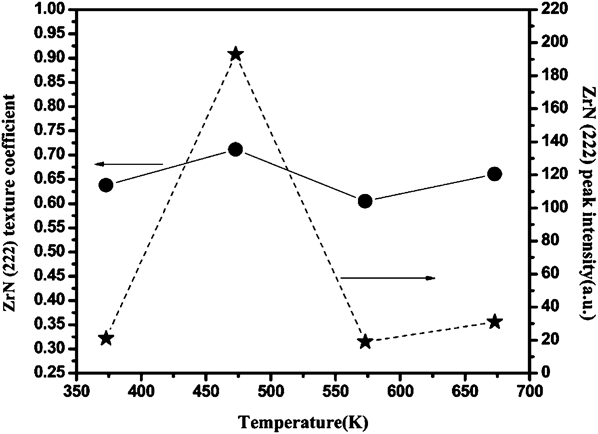
The texture coefficient f of ZrN film for (222) planes was calculated using f (222) = I (222)/I (111) + I (222), where I (ijk) is the intensity of the (ijk) planes. The x-ray peak where there is an overlap between ZrN (111) and the substrate peak was fitted with a Voigt function which is a convolution of Gaussian and Lorentzian functions. Figure 2 indicates that (222) planes remained at the preferred orientation at any temperature, even at elevated temperatures at which the degree of crystallinity is low, according to the ZrN peak intensity. The variation of preferred orientation was a result of kinetic processes such as adatom surface migration and competitive grain growth. An increase in T s led to an increase of adatom mobility, which permited adatoms to have enough energy to migrate and locate in planes with higher thermodynamic stabilityReference Qi, Huang, Zhu, Sun and Wang3 (i.e., lower energy). Moreover, parameters such as incidence angle, ratio of incoming ions to deposited atoms, substrate temperature, and lattice mismatch between the substrate and the film may also affect preferential growth.Reference Ting, Chen and Liu12 The lattice parameter of ZrN thin film in cubic structures is:
 $$d^2 = a^2 /(h^2 + k^2 + l^2 )\quad ,$$
where d is the spacing between adjacent lattice planes, a is the lattice parameter, and (hkl) are Miller indices.
Variations of texture coefficient and peak intensity of ZrN(222) as a function of T s.
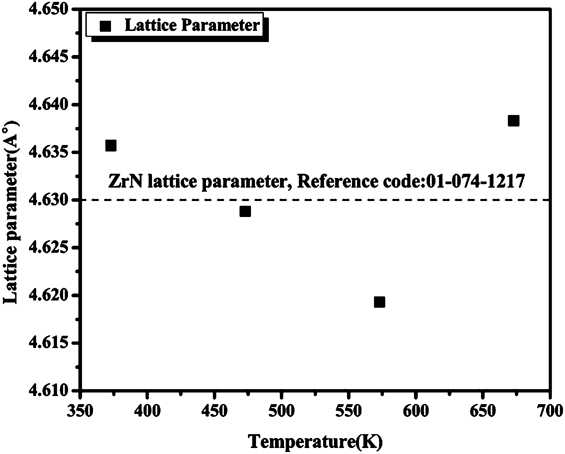
The lattice parameter values were correlated with T s and are depicted in Fig. 3. The correlation shows that an increase in T s initially decreased the lattice parameter, reaching a minimum at around 573 K and then increased T s at 673 K. There was a change in lattice parameter over the bulk value, suggesting that the film grains were strained. The lattice parameter was less than that of bulk ZrN for films deposited at 473 and 573 K, probably due to nitrogen vacancy in the lattice.Reference Qi, Huang, Zhu, Sun and Wang3 At this temperature range, the absence of nitrogen atoms may have occurred on the surface by desorption because they lacked the energy to stay on or diffuse into the film. At 673 K, lattice expansion, which indicated the occupation of interstitial sites by nitrogens, was related to the diffusion of nitrogen into the lattice.Reference Wen, Guan, Peng, Ren, Wang and Hu6,Reference Barna and Adamik13,Reference Aufderheide14 At this temperature, nitrogen adatoms overcame the diffusion energy barrier, and the growth of the film can be explained using the diffusion-controlled growth model.
ZrN film lattice parameter as a function of T s.
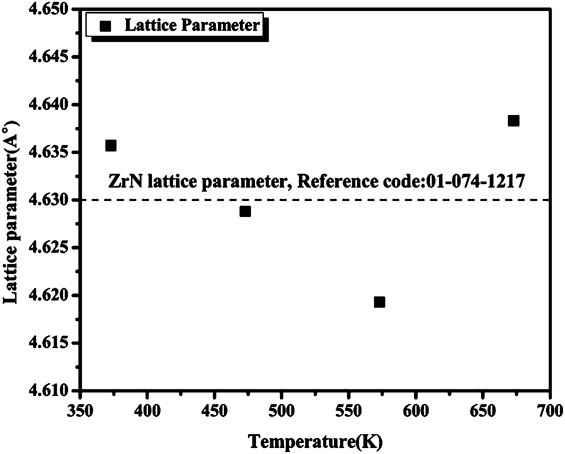
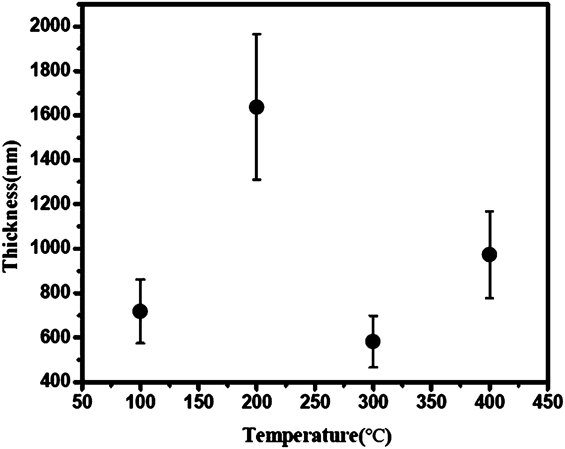
Figure 4 depicts the ZrN film thickness as a function of T s. Despite the irregular behavior of the thickness with substrate temperature, note the correlation between film crystallinity (Fig. 2) and thickness. This can be understood by taking into account that the peak intensity was related to the number of planes that generate diffraction.
ZrN film thickness as a function of T s.
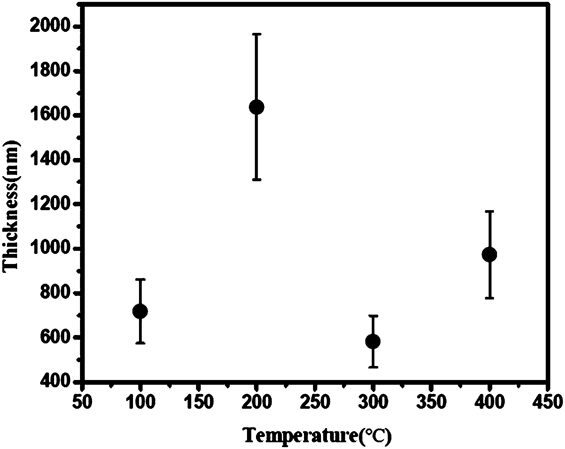
It is well established that film growth is controlled by mechanisms such as surface reaction, diffusion, adsorption, and resputtering, which in turn depend strongly on the substrate temperature. An increase in thickness at 473 K can be related to an increase in adatom surface diffusion and a surface reaction on the substrate. Its reduction at 573 K probably resulted from film densification caused by surface diffusion on the growing film and by the elevated substrate temperature. Qi et al.Reference Qi, Huang, Zhu, Sun and Wang3 and Lee et al.Reference Lee, Lee and Joo15 have reported a similar behavior for ZrN and TiN coatings, respectively, for different T s.
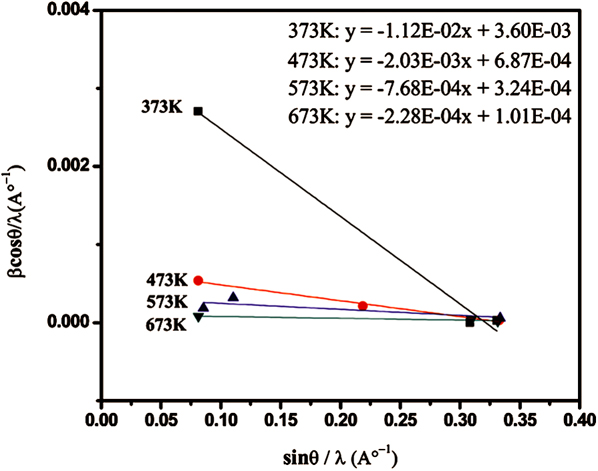
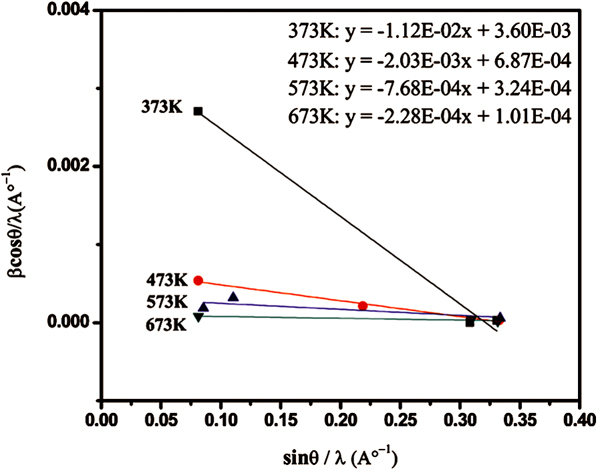
Grain size and lattice strain can shift and broaden diffraction peaks. In the present work, the classic Williamson–Hall methodReference Kalita, Deka, Das, Hazarika, Dey, Das, Paul, Sarmah and Sarma16 was used to calculate average crystallite size (D WH) and lattice strain (e) using the following relation:
 $$(\Delta K)^2 = (0.9/D_{{\rm{WH}}} )^2 + 4e^2 K^2 \quad ,$$
where ΔK = 2cosθ βC/λ, βC is FWHM of the diffraction lines, θ is the Bragg angle, λ is the wave length of Cu Kα radiation (0.15406 nm), and K = 2sinθ/λ. It is worth mentioning that the XRD pattern (Fig. 1) indicated the presence of microstrain rather than macrostrain in the deposited films that was caused by an insignificant peak shift.Reference Sciti, Celotti, Pezzoti and Guiccardi17
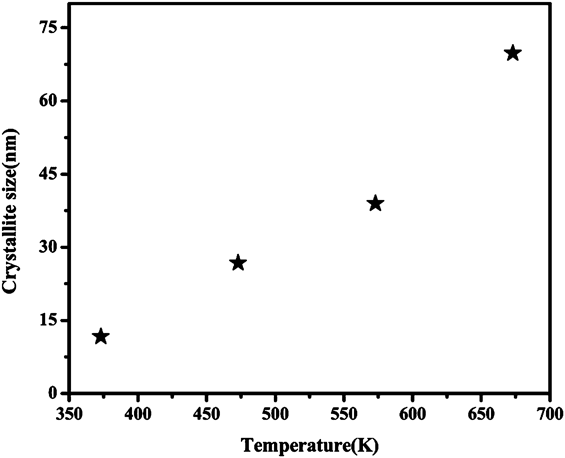
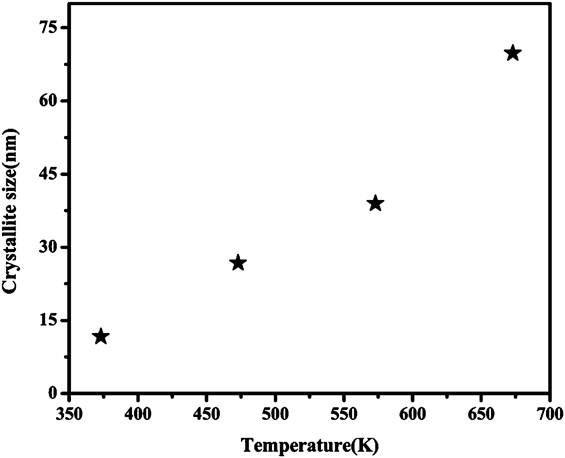
The slope of the βC cosθ/λ and sinθ/λ plots gives the microstrain and the inverse y-intercept gives the crystallite size value. Figure 5 shows the Williamson–Hall plot of thin ZrN film prepared at different T s. The crystallite size of ZrN film was estimated from the Williamson–Hall equation (Fig. 6). Note the increase in crystallite size by T s that resulted from higher atomic mobility and grain boundary mobility at high temperatures.
Williamson–Hall plot to determine grain size and strain of ZrN films prepared at different T s.
ZrN film crystallite size calculated by Williamson–Hall plot as a function of T s.
Film adhesion can be calculated by the following relationReference Kim, Jeong, Lee and Kwona10:
 $${\rm{d}}U_f /{\rm{d}}r = 2{\rm{\pi }}t({\rm{\kappa d}}P/{\rm{d}}r + {\rm{\lambda }})\quad ,$$
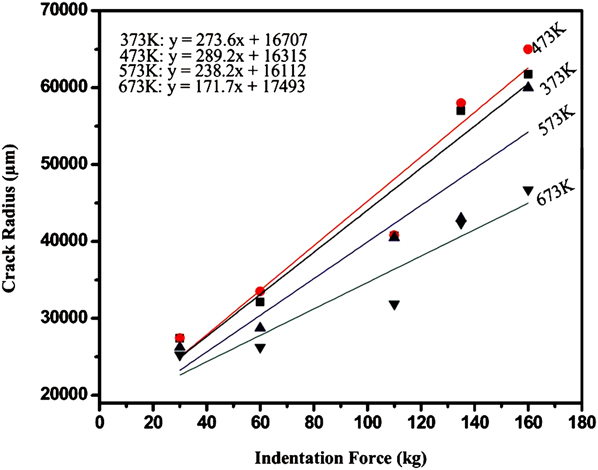
where dU f is the energy stored in the film to be delaminated, r is the interfacial crack radius, t is film thickness, κ and λ are constants dependent on the material properties, and P is the indentor pressure. The P–r results are linearly fitted in Fig. 7. The slope (dP/dr) is proportional to the adhesion energy.
Variation of r as a function of P for ZrN films at different temperatures.
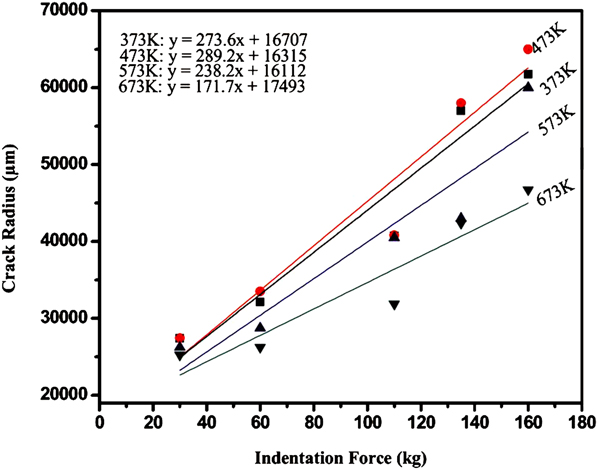
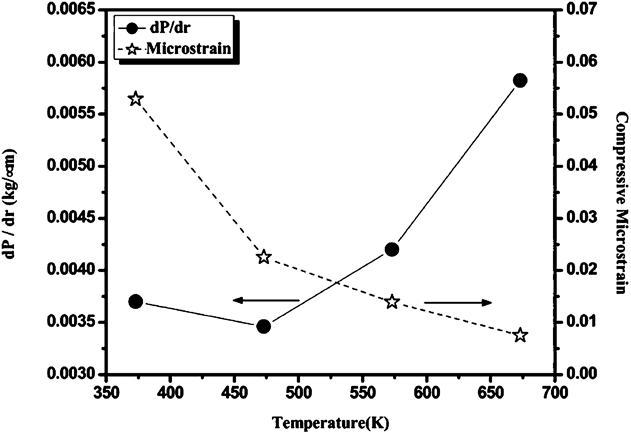
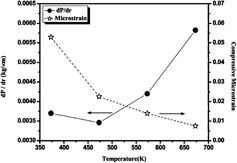
Figure 8 presents the graphics of the microstrain and measured adhesion as a function of T s. It can be observed that the microstrain decreased as T s increased. In general, the origin of stress can be attributed to the lattice mismatch and difference in the coefficient of the thermal expansion between the film and the substrate. According to Timoshenko's model, when the thickness of thermal expansion is significantly higher than that of the film, the force per unit width (P) acting in the film and the substrate can be reduced toReference Zhang and Zhao18:
 $$P = - M_{\rm{f}} \times {\rm{ }}h_{\rm{f}} \times {\rm{ \varepsilon }}_{\rm{m}} \quad ,$$
where h f is the film thickness, M f is the effective Young's modulus, εm = (a s − a f)/a f is the mismatch strain, and a f and a s are the lattice parameters of the film and the substrate, respectively. The relation shows that the microstrain is proportional to the residual force (stress). The stress in ZrN film could also be caused by the interstitials and vacancies. The relaxation of the microstrain (equivalent to residual stress) as the deposition temperature increased arose from thermal mismatch between the film and the substrate caused by the difference in their thermal expansion coefficients.
Variations of dP/dr and microstrain as a function of T s.
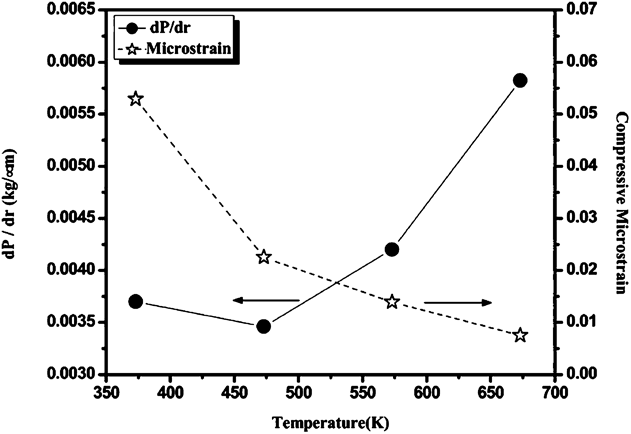
As seen in Fig. 8, the slope of the microstrain is higher for the film prepared at low temperatures (below 473 K). At higher temperatures (above 473 K), the linear dependence of the Williamson–Hall plot is stronger, indicating that broadening was caused by microstrain. Jiménez et al.Reference Jiménez, Restrepo and Devia1 have reported similar behavior for ZrN film grown on a stainless steel substrate using the pulsed arc technique. They suggest that the temperature of 473 K is a critical point, above which changes in film properties could occur. Figure 8 shows an increase in adhesion with an increase in substrate temperature. The film adhered to the substrate because of the interatomic and intermolecular forces established at the interface. These forces belong to the categories of chemical adhesion, dispersive adhesion, and diffusive adhesion. Temperature increase could promote more chemical reactions between the film and substrate atoms (e.g., nitrogen with Al) as well as more species penetration by the ZrN film into the substrate, resulting in an increase in adhesion. Details on the mechanisms of adhesion can be found in the paper of Zhao et al.Reference Zhao, Wang and Yu19 It can be deduced from Figs. 6 and 8 that the microstrain decreased as the crystallite size increased from the decrease in the appearance of grain boundaries.
Figure 8 presents two different behaviors, microstrain and adhesion, as a function of T s. This can be understood in light of the relationship of experimentally measured adhesion to basic adhesion given byReference Pulker, Perry and Berger20:
 $${\rm{EA}} = {\rm{BA}} - {\rm{IS}}\quad {\rm{,}}$$
where IS is the internal stress, EA is the measured adhesion, and BA is the basic adhesion. The term “basic addition” is used to signify the summation of all interfacial intermolecular interactions between the film and the substrate; the terms “measured adhesion” or “practical adhesion” are used to represent the force or the work required to detach the adhering system. It can be inferred from Eq. (5) that the higher the internal stress (equivalent to microstrain), the weaker the measured adhesion.
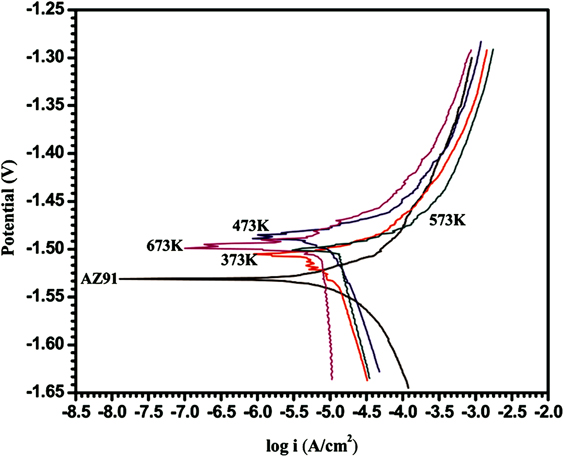
Figure 9 shows the potentiodynamic polarization curves at different T s values in Ringer's solution. These curves provide the anodic and cathodic slope values necessary to obtain correct estimations of the corrosion resistance. For comparison, the polarization behavior of the substrate is also plotted. The polarization curves do not show any passive behavior caused by the active behavior of magnesium alloy.Reference Altun and Sinici4,Reference Guo-Song, Ai-Ying, Ke-Jia, Cai-Yun, Wei and Ai-Jiao5,Reference Altun and Sen21
Potentiodynamic polarization curves for samples prepared at different T s in Ringer's solution.
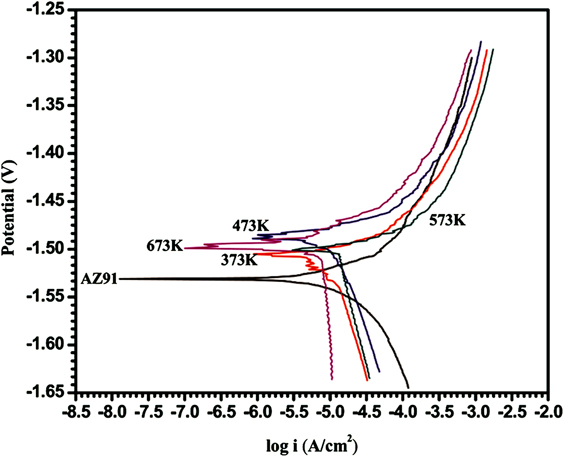
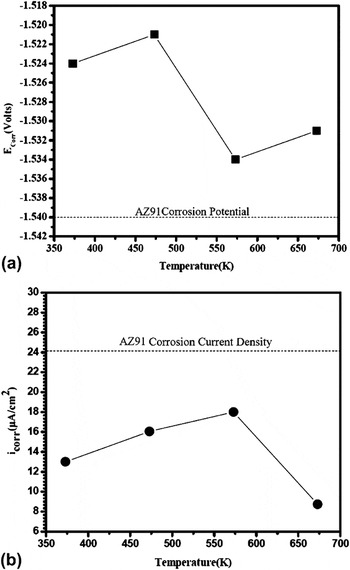
In Fig. 10, variation of the corrosion potential (E corr) with the substrate temperature is presented. The corrosion potential of the coated AZ91 is more electropositive than that of the blank substrate. The corrosion potential of the AZ91 substrate is about −1.540 V. The corrosion potential of each sample is in approximately the same position. E corr values for the coated specimens are only slightly different from those of AZ91, within 20 mV, which indicates that the corrosion of the ZrN-coated specimens was mainly caused by the dissolution of the metal substrate and not from the ZrN film.
Variations of (a) corrosion potential and (b) corrosion current density of AZ91 coated with ZrN as a function of T s.

The variation of I corr versus T s is shown in Fig. 10. It can be seen that all ZrN coatings increased the corrosion resistance of the uncoated AZ91 substrate as I corr decreased. The corrosion resistance behavior of the coated systems appears to be governed by a complex interrelated ensemble of adhesion,Reference Gruss and Davis22 thickness,Reference Huang, Tsa and Yu23 grain size,Reference Schlüter, Zamponi, Piorra and Quandt24 defects such as vacancies and interstitials,Reference Afshar, Yari, Larijani and Eshghabadi25,Reference Chou, Yu and Huang26 microstrain, and chemical composition.Reference Huang, Tsa and Yu23,Reference Roman, Bernardi, Amorim, Souza, Spinelli, Giacomelli, Figueroa, Baumvol and Basso27 It can be observed that the lattice parameter and corrosion resistance (Figs. 3 and 10) behaved similarly with an increase in temperature. This could mean that a decrease in network parameters caused a decrease in the corrosion resistance of the film. As mentioned, a lattice parameter lower than that of stoichiometric ZrN can be related to the formation of vacancies in the network. Simonetti et al.Reference Simonetti, Saravia, Brizuela and Juan28 and Jiang et al.Reference Jiang, Dai, Norby and Middleton29 have reported that vacancies are preferential sites for the onset of corrosion because of their higher energy. The greater the number of vacancies, the lower the corrosion resistance. This is why corrosion resistance decreased at 573 K; however, the variation of resistance was not significant. At 673 K, high adhesion, low microstrain, and the existence of interstitial nitrogen together significantly increased the corrosion resistance over that of virgin AZ91 in Ringer's solution.
IV. CONCLUSION
ZrN films deposited on AZ91 magnesium alloy using the ion beam sputtering method at substrate temperatures of 273–673 K were grown with preferential orientation along ZrN(222) planes. It was deduced that, unlike microstrain, the crystallite size of ZrN film and its adhesion to substrates increased as substrate temperature increased. The lattice parameter of the film was found to be dependent on the substrate temperature. In addition, the deviation of the lattice parameter from that of bulk ZrN was explained by the development of interstitial nitrogen or nitrogen vacancy. The corrosion resistance of the samples prepared at 373–573 K slightly decreased but significantly increased at 673 K in comparison with that of pristine AZ91 substrate. Because of the similar behavior of corrosion resistance and the lattice parameter, a correlation was established between nitrogen vacancy and the protective effect of the ZrN film against corrosive agents in Ringer's solution.