INTRODUCTION
Difficulties with naming and word finding are well-established features of Alzheimer’s disease (AD). Even patients with amnestic mild cognitive impairment (aMCI), which might be a prodromal state of AD, achieve significantly lower scores on naming tests, especially when presented with the task of naming very specific items (Adlam, Bozeat, Arnold, Watson, & Hodges, Reference Adlam, Bozeat, Arnold, Watson and Hodges2006; Dudas, Clague, Thompson, Graham, & Hodges, Reference Dudas, Clague, Thompson, Graham and Hodges2005). Naming complaints are also very common among healthy cognitive aging, especially among those older than 70. They perform worse on naming tests than do young adults (Albert, Heller, & Milberg, 1988; LaBarge, Edwards, & Knesevich, 1986; Zec, Markwell, Burkett, & Larsen, 2005) and may show a pattern of naming errors that is similar to that of AD and aMCI patients (Balthazar, Cendes, & Damasceno, Reference Balthazar, Cendes and Damasceno2008).
Semantic memory impairment has been demonstrated in AD patients across various tests and modalities of knowledge (Chertkow & Bub, Reference Chertkow and Bub1990; Hodges & Patterson, 1995; Rogers & Friedman, Reference Rogers and Friedman2008). When making semantic errors on naming tests (when the answer is semantically related to the target word), AD patients tend to make errors that belong to a broader, less specific level than that of the target word, regardless of the target word category. For example, they may substitute “bird” for “pelican” (a superordinate error) or “dog” for “squirrel” (a coordinate error) (Lukatela, Malloy, Jenkins, & Cohen, Reference Lukatela, Malloy, Jenkins and Cohen1998; Salmon, Butters & Chan, Reference Salmon, Butters and Chan1999). In addition, patients also sometimes incorrectly respond in a way that describes or indicates the function of the target word (circumlocutory errors). This type of error indicates that a considerable amount of knowledge is preserved even when the patient fails to produce the target word. Patients with mild AD or aMCI may experience an initial loss of subordinate knowledge involving the most specific attributes of a semantic category, while their knowledge of its superordinate category remains relatively preserved (Salmon, Butters & Chan, Reference Salmon, Butters and Chan1999).
These patterns of naming difficulties experienced by patients with AD are similar to those seen with certain other conditions, such as semantic dementia (SD). SD is the temporal lobe variant of frontotemporal lobar degeneration and is the prototype of progressive semantic impairment. It is associated with atrophy in the anterior and lateral portions of the temporal lobes that may be more pronounced on the left side (Hodges, Patterson, Oxbury, & Funnell, Reference Hodges, Patterson, Oxbury and Funnell1992; Snowden, Goulding, & Neary, Reference Snowden, Goulding and Neary1989). As discussed by Lambon Ralph and Patterson (Reference Lambon Ralph and Patterson2008), one prominent form of overgeneralization naming error in SD is the commission of semantic coordinate errors in which the name produced is a more common, more typical instance of the category to which the target instance belongs. The other main form of overgeneralization in naming made by patients with SD is the production of a superordinate label such as “animal” instead of “horse.” Other neurological conditions that affect the temporal lobes [such as stroke, herpes simplex virus encephalitis (HSVE) and temporal lobectomy] can also cause semantic naming errors, especially when the left temporal lobe is affected.
These kinds of semantic errors may be partly explained by a feature-based model of concept representation in which category-level knowledge is supported by information that is common to many members of the same category (shared features), whereas more specific, exemplar-level knowledge, requires information that is unique to a single member (distinctive features) (Garrard, Lambon Ralph, Patterson, Pratt, & Hodges, Reference Garrard, Lambon Ralph, Patterson, Pratt and Hodges2005). According to this model, the knowledge underlying the representation of subordinate exemplars, and enabling distinctions between coordinate exemplars may be attenuated as connections supporting distinguishing features are progressively lost in the course of neurodegenerative diseases.
When one considers that semantic memory may be partly disrupted in AD and that SD and other neurological conditions affecting the anterolateral temporal lobes present a pattern of semantic errors similar to those found in AD, the question arises as to whether these distinct clinical conditions share a common anatomical locus of dysfunction that causes the observed similarities in their naming disorder profiles. Both AD and SD involve pathological changes in the temporal lobes. However, SD is characterized by marked atrophy in the temporal poles (more on the left side), whereas AD is characterized first by atrophy in medial temporal structures, but later by atrophy of lateral temporal cortex, anterior and posterior (although there is evidence for clinical and anatomopathological heterogeneity, even in the early phase of the disease) (Cummings, Reference Cummings2000).
If we consider that pathology in the temporal lobes might cause semantic impairment and naming deficits, we could ask why patients with SD experience greater naming difficulties than AD patients (although the patterns may be similar). There are two (not mutually exclusive) possibilities: (1) Tip of the iceberg effect. It is possible that the semantic impairment is due simply to the loss of the substrate for feature knowledge throughout the temporal lobes, and that the particularly severe atrophy in the anterior temporal lobe (ATL) seen in SD is the alteration that is most readily detectable using traditional neuroimaging (structural and functional) techniques. Whitwell et al. (Reference Whitwell, Avula, Senjem, Kantarci, Weigand and Samiklogu2010) has used a newer neuroimaging method, diffusion tensor imaging in the assessment of gray matter integrity, and shown GM loss and increased mean diffusivity in the entire left temporal lobe in SD. Temporal pole atrophy, therefore, could be considered as simply a marker for a more generalized temporal lobe disease. The loss of feature knowledge in this scheme affects more specific items to a greater degree because more features are needed to represent more specific items; (2) Functional gradient effect. It is possible that, although loss of feature knowledge contributes to the pattern of naming impairment in SD, there is also a specificity gradient along the posterior–anterior temporal lobe axis. Martin and Chao (Reference Martin and Chao2001) suggested that the temporal lobe object representation system might be organized hierarchically, with increasing convergence and information integration occurring along its posterior/anterior axis. For example, in the left hemisphere language network, the hierarchy leads from the recognition of auditory word-forms, to the identification of intelligible words, to the decoding of general word meaning and the association of the word to its unique referent. This process extends from the temporoparietal junction to the most anterior parts of the superior and middle temporal gyri (Mesulam et al., Reference Mesulam, Rogalsky, Wieneke, Cobia, Rademaker and Thompson2009). According to this hypothesis, the ATLs might be related to more specific (subordinate and coordinate) levels of information, and atrophy or dysfunction of these regions might cause coordinated and circumlocutory naming errors.
Although discriminating between these two mechanisms is difficult, a correlation between the pattern of naming errors and the structural abnormalities seen in AD, aMCI and normal aging may help clarify this issue. These three groups show a qualitative pattern of naming errors that is similar to the pattern seen in SD patients, but they do not show marked temporal pole atrophy. Therefore, it is unlikely that in this sample of subjects, temporal polar atrophy would represent a tip of iceberg effect. Consequently, if a correlation were found between ATLs atrophy and more specific semantic naming errors, it would provide evidence of a temporal lobe functional gradient. Thus, to verify the anatomical correlates of semantic naming errors in patients with mild AD, aMCI and normal aging, we studied the correlation between the pattern of semantic errors made in the Boston Naming Test (BNT) and the whole brain gray matter density (GMD), as measured by voxel-based morphometry (VBM). We also sought to determine whether the pattern of naming errors (coordinate, superordinate, and circumlocutory) in these three groups was similar to that observed in SD. The finding of a different pattern of errors might cast doubt on the functional gradient hypothesis.
The validity of our hypothesis testing would be undermined if the naming errors in AD, aMCI and normal aging were substantially lexical in origin, in contrast to SD, in which they are substantially semantic. As discussed by Jefferies, Patterson, and Lambon Ralph (Reference Jefferies, Patterson and Lambon Ralph2008), phonemic cueing might be less beneficial in conditions in which errors are predominantly semantic. This is because, in semantic disorders, additional phonemic input cannot compensate for the underspecification of concepts resulting from the loss of semantic feature knowledge. In contrast, when naming difficulty stems from problems with lexical access, meaning that phonological representations elicited by damaged connections from semantics are insufficiently specified, the provision of additional phonologic information may be sufficient to achieve the threshold for phonological production. Thus, if the semantic errors made by subjects with AD are similar in origin to those made by subjects with SD, phonemic cueing should be no more effective in enabling naming in AD than in SD.
METHODS
We studied 48 subjects over the age of 50: 17 with aMCI, 15 with mild AD treated at the Unit for Neuropsychology and Neurolinguistics (UNICAMP Clinic Hospital), and 16 controls. Routine laboratory examinations studies, including B12 and folate levels, syphilis serology, thyroid hormone levels, and brain computed tomography were carried out in all patients. The local ethics committee approved these experiments. Diagnosis of aMCI in our clinic is made by trained neurologists using a standardized mental status battery that evaluates episodic memory, orientation, language, attention, abstract thinking, calculation, and visual perception. The diagnostic process consists of a detailed interview with the patient and an informant (who is usually a close relative of the patient). The diagnosis of MCI was made according to the criteria of the International Working Group on Mild Cognitive Impairment (Winblad et al., Reference Winblad, Palmer, Kivipelto, Jelic, Fratiglioni and Wahlund2004), which include the following: the person is neither normal nor demented, there is evidence of cognitive deterioration (shown by an objectively measured decline over time and/or a subjective report of decline by self and/or informant in conjunction with objective cognitive deficits), activities of daily living are preserved and complex instrumental functions are either intact or minimally impaired. We made a diagnosis of aMCI if the clinical history and cognitive performance pointed to an exclusive memory deficit and the patient received a Clinical Dementia Rating (CDR; Morris, Reference Morris1993) score of 0.5 with an obligatory and exclusive memory score of 0.5.
The diagnosis of probable AD was based on National Institute of Neurological and Communicative Disorders and Stroke/Alzheimer’s Disease and Related Disorders Association (NINDS/ADRDA) criteria (McKhann, Drachman, Folstein, Katzman, Price, & Stadlan, Reference McKhann, Drachman, Folstein, Katzman, Price and Stadlan1984). We included only patients who were classified as CDR 1. Exclusion criteria were a history of other neurological or psychiatric diseases, a head injury with loss of consciousness, the use of sedative drugs in the last 24 h before the neuropsychological assessment, drug or alcohol addiction, and prior chronic exposure to neurotoxic substances. The control group consisted of subjects who were classified as CDR 0 and had no history of neurological disease, psychiatric disease, or memory complaints.
Neuropsychological Evaluation
Category naming (animals) was tested in all subjects. Global cognitive status was measured using the Mini Mental Status Examination (MMSE; Folstein, Folstein, & McHugh, Reference Folstein, Folstein and McHugh1975; Brazilian version by Brucki, Nitrini, Caramelli, Bertolucci, & Okamoto, Reference Brucki, Nitrini, Caramelli, Bertolucci and Okamoto2003). Delayed recall of episodic memory was evaluated by the Rey auditory verbal learning test (RAVLT-A7; Rey, Reference Rey1964). Visual perception was assessed by subtests of Luria’s Neuropsychological Investigation (LNI), items G12, G13, G14 (the patient is asked to examine and name pictures of objects that are scribbled over or superimposed one on another); G17 (item from Raven’s test) and one item for mental rotation of figures (in both items the patient is asked to complete a structure from which a portion is missing by choosing from a series of offered options) (Christensen, Reference Christensen1979); and four items of Ratcliff´s manikin test for mental rotation (Ratcliff, Reference Ratcliff1979). Working memory was assessed by the forward (FDS) and backward digit span (BDS) subtest of WAIS-R (Wechsler, Reference Wechsler1987). We also administered the Cornell Scale for Depression in Dementia (CSDD; Alexopoulos, Abrams, Young, & Shamoian, Reference Alexopoulos, Abrams, Young and Shamoian1988; Carthery-Goulart et al., Reference Carthery-Goulart, Areza-Fegyveres, Schultz, Okamoto, Caramelli and Bertolucci2007). Data analysis was performed using Systat software 12.0. We performed the Kruskal-Wallis and Mann-Whitney tests for inter-group comparisons of the demographic and cognitive scores. Results were considered to be statistically significant when p < .05.
Assessment of Naming Ability
The sixty-item BNT (Kaplan, Goodglass, & Weintraub, Reference Kaplan, Goodglass and Weintraub1983), translated and culturally adapted for the Brazilian population by Dr. Cândida Camargo (Psychiatry Institute, Medicine School, University of São Paulo), was administered to all subjects. We scored both the number of spontaneous correct responses and the number of correct responses after a semantic cue. The cues were either a short explanation about the picture (e.g., “it’s part of a carnival fantasy” for the target “mask”) or a superordinate category (e.g., “it’s a kind of animal” for the target “elephant”). We provided the semantic cue only if the patient made an incorrect response (for example: dog instead of tree) or stated that he/she did not know what the picture was. We provided a phonemic rather than a semantic cue if the spontaneous wrong answer was semantically related to the target word (for example, dog instead of camel) or if the subject did not know the picture even after receiving a semantic cue. A phonemic cue consisted of the first phoneme of the target word.
Error Classification
We modified the classification of Lukatela et al. (Reference Lukatela, Malloy, Jenkins and Cohen1998) and divided spontaneous errors into four mutually exclusive types: omission, visual paragnosia (a phonologically unrelated word sharing no semantic features with the target), phonologic (a semantically unrelated word sharing first phoneme with the target) and semantic.
A detailed analysis of these data was published elsewhere (Balthazar, Cendes & Damasceno, Reference Balthazar, Cendes and Damasceno2008). In the present study we focus on the semantic errors. Semantic errors were classified into three mutually exclusive categories: circumlocutory (the response described or indicated the function of the target word), coordinate (the response was in the same category as the target word), and superordinate (the response belonged to a broader level than that of the target word). Two independent researchers (MLFB and BPD) performed this classification, and any discordance in their assessments was solved by consensus.
To evaluate whether the number of semantic errors was reduced by phonemic cues, we analyzed the percentage of correct answers after phonemic cueing for each participant using a separate Mann-Whitney test. This analysis was undertaken only for the categories of semantic errors that were significantly correlated with the GMD.
MRI Scanning Protocol and Imaging Processing
High-resolution MRI was performed using a 2.0 Tesla (T) scanner (Elscint, Haifa, Israel). T1- and T2-weighted images were acquired in axial, coronal, and sagittal planes with thin cuts. In addition, volumetric (3D) T1 gradient echo (GRE) images were acquired in the sagittal plane with 1-mm-thick slices (flip angle = 35°, time to repeat = 22 ms, echo time = 9 ms, matrix = 256 × 220, field of view = 23 × 25 cm). Before preprocessing, we checked all scans for scanner artifacts and gross anatomical abnormalities. We used MRIcro to convert from the original DICOM format to the ANALYZE format (www.mricro.com) (Rorden & Brett, 2000) and to set the origin of the coordinate system to the anterior commissure.
We used SPM8b (Wellcome Department of Imaging Neuroscience, London, England; www.fil.ion.ucl.ac.uk), running on MATLAB 7.5, to perform voxel-based morphometry (VBM). For segmentation, we used the “New Segment” toolbox from SPM8b. The algorithm used for segmentation is based on “Unified Segmentation” (Ashburner & Friston, Reference Ashburner and Friston2005), which is based on a Gaussian mixture model and combines image registration, tissue classification and bias correction within one generative model. To obtain a more accurate intersubject alignment, we chose the DARTEL (Diffeomorphic Anatomical Registration Through Exponential Linear Algebra) registration model, which uses approximately 6,000,000 parameters to achieve better anatomical alignment (Ashburner & Friston, Reference Ashburner and Friston2009). The model alternates between computing a template (based on the average tissue probability maps from all subjects) and warping individual tissue maps into alignment with the average template (Ashburner & Friston, Reference Ashburner and Friston2009). During this process, the model creates a “flow field” for each subject that encodes the necessary parameters for warping (or deforming) individual images to match the average shape of the template. To preserve the volume of each tissue (the modulation step), we chose to scale the warped images by the Jacobian determinants (the images are multiplied, voxel-by-voxel, by these determinants), which encode information on the volumes of the tissue before and after warping (Ashburner, Reference Ashburner2009). Finally, the normalized, segmented, modulated (Jacobian-corrected), and warped images were smoothed by convolving with an isotropic Gaussian kernel with full width at half maximum of 10 mm to reduce interindividual gyral variation (Bergougnian et al., Reference Bergougnian, Chupin, Czechowska, Kinkingnehun, Lemogne and Le Bastard2009). After this preprocessing, the resulting normalized, modulated, and smoothed data were used for statistical analysis.
For statistical analysis, we used Non-Parametric Mapping (NPM) software (http://www.sph.sc.edu/comd/rorden/npm, Rorden, Bonilha, & Nichols, Reference Rorden, Bonilha and Nichols2007).
Voxel-Based Correlation Analysis
We performed a multiple regression analysis using NPM software to identify brain regions in which the GMD values were significantly correlated with the absolute numbers of semantic errors within each subtype (superordinate, coordinate, and circumlocutory). Age, education, total intracranial volume, and global cognition (as measured by the MMSE) were also included in the analysis as independent variables. Total intracranial volume was the sum of the volumes of gray matter, white matter, and cerebrospinal fluid.
For multiple regression analysis, we considered the three groups together (normal aging, aMCI, and mild AD) to increase our data variance and enhance the correlation between cerebral region and psychological function. We assumed that denser gray matter would mean better naming performance and vice versa.
The results were corrected for multiple comparisons using the Bonferroni method, which involves adjustments to the statistical threshold to control for the overall familywise error rate (FWE). To control for FWE, we also performed a permutation analysis (4000 permutations) using NPM (Rorden, Fridriksson, & Karnath, Reference Rorden, Fridriksson and Karnath2009).
The results of these comparisons are displayed as statistical maps with the number of standard deviations (Z score) representing the strength of the correlation. Because NPM only makes positive correlations, we inverted the magnitude of our data by adopting a scoring convention in which the subject who made the greatest number of errors scored zero and subjects who made fewer errors scored proportionally better.
To improve power, we also performed a region of interest (ROI) analysis of the relationship between the GMD of the left and right temporal poles and semantic naming errors production. We extracted the mean gray matter probability in temporal poles by using the software MarsBar (www.marsbar.sourceforge.net). The GMD from the ROIs was correlated with the total number of semantic errors, within each subtype, using the software Systat 12.0. We used a statistical threshold of p < 0.05.
RESULTS
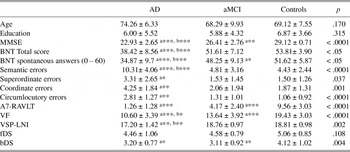
As shown in Table 1, there were no significant differences among the three groups with regard to age (p = .17) or education (p = .31). In every test, except for the backward digit span test, there was a continuum of neuropsychological performance that ranged from the patients with mild AD to the normal controls. With regard to the BNT total score, AD patients performed worse than aMCI patients (p < .001) and controls (p < .001), while aMCI subjects were similar to controls (p = .464). With regard to spontaneous answers during the BNT, AD patients performed worse than both aMCI patients and controls (p < .001), and aMCI subjects performed worse than controls (p < .05). There were significant differences in the absolute number of every type of semantic error between patients with mild AD and subjects with aMCI and control subjects, but there were no significant differences between the aMCI group and the control group (Table 1).
Demographic and neuropsychological data

Note
Data presented as mean ± SD. AD = Alzheimer’s disease; aMCI = amnestic mild cognitive impairment; MMSE = Mini-Mental Status Examination; A7- RAVLT = delayed recall of Rey auditory verbal learning test; BNT = Boston naming test; VF = verbal category fluency (animals); VSP-LNI = visuospatial perception item of Luria’s neuropsychological investigation; fDS = forward digit span; bDS: backward digit span. a: significantly different from controls; b: significantly different from aMCI; *** p < .001, ** p < .005, * p < .05.
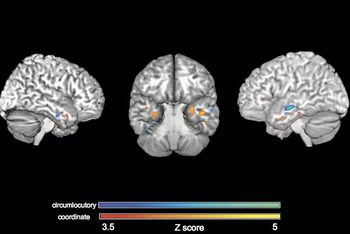
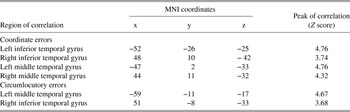
There were significant correlations between coordinate and circumlocutory errors with the GMD of different areas in the temporal poles and inferior and middle temporal gyri when the three groups were considered together (Figure 1). The strongest correlations between the numbers of naming errors and the GMD are shown in Table 2. There was no statistically significant correlation between GMD at any locus and the number of superordinate errors in the three groups (Figure 1).
Areas of correlation between coordinate (red/yellow) and circumlocutory (blue/green) errors in all three groups taken together (p < .05; familywise error rate corrected for multiple comparisons).

Brain areas of statistically significant correlation

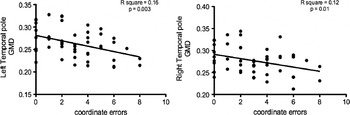
Considering the analysis of ROIs and semantic errors subtypes, we found significant correlations between temporal polar GMD and coordinate errors in the left (R square = 0.16; p = .003) and right (R square = 0.12; p = .01) temporal poles (Figure 2). There were no significant correlations between temporal poles and superordinate and circumlocutory errors.
Scatter plots of regions of interest in temporal poles showing the distribution of mean gray matter concentration (y axis) and total number of coordinated semantic naming errors (x axis) considering the three groups together. GMD = gray matter density.

To determine the effect of phonemic cues, we tested whether coordinate and circumlocutory errors were reduced by providing the patient with phonemic cues; we compared this error reduction in the mild AD group with that in the control group. After phonemic cueing, mild AD patients answered correctly after coordinate errors 36.4% of the time, whereas controls answered correctly 70.6% of the time (p = .001). For circumlocutory errors, mild AD patients answered properly after phonemic cues 43.5% of the time, whereas controls answered correctly 60% of the time (p = .07).
DISCUSSION
This study provides new evidence that coordinate and circumlocutory (but not superordinate) semantic naming errors were related to anterior and lateral temporal lobe atrophy (left more than right) in elderly control subjects and patients with aMCI and mild AD across a range of both GMD and naming performance. Except for correlation between circumlocutory errors and a small area in the right posterior inferior temporal gyrus, the anatomical distribution of the structural abnormalities that correlated with coordinate and circumlocutory errors was very similar to the pattern of atrophy seen in SD. Moreover, as in SD, our AD patients did not benefit much from phonological cueing, when they committed spontaneous coordinate errors.
There is little basis for a tip of the iceberg effect in the groups we tested given that they do not have the marked ATL atrophy characteristic of SD. Our findings, therefore, provide some support for the idea of a functional gradient effect in the temporal lobes, in which the more anterior parts would be related to the retrieval of more specific concepts, regardless of category. A hierarchical theory of object processing has been proposed by Damasio (Reference Damasio1989) and was later developed by Simmons & Barsalou (Reference Simmons and Barsalou2003). According to this theory, when processing an object, the visual features associated with it are bound together in convergence zones (CZs). In the model of Simmons & Barsalou (Reference Simmons and Barsalou2003), CZs are arranged hierarchically, with those in posterior regions coding simple combinations of features and those in more anterior regions binding increasingly complex conjunctions of features. Such a hierarchical structure would provide a basis for processing objects at different levels of specificity, with posterior CZs representing more coarse-grained configurations of features and the anteromedial CZs, coding the more complex feature conjunctions underlying object identification (Bright, Moss, Stamatakis, & Tyller, Reference Bright, Moss, Stamatakis and Tyller2005).
On the other hand, the correlations we found between coordinate errors and temporal polar GMD were quite modest. This suggests that, to the extent that there is a functional gradient effect in the temporal lobes, it is a weak one and its magnitude may have been overestimated from studies based on subjects with SD. Because the semantic error patterns observed in AD and SD (tendencies to make superordinate and coordinate errors) could arise solely from loss of connections supporting features distinguishing coordinate exemplars, the question remains as to the mechanism for the apparent gradient effect we observed. The fact that this effect appears to be modest helps to reconcile the results of studies of subjects with dementia like ours with the results of studies of subjects who have undergone anterior temporal lobectomy for treatment of refractory epilepsy in which observed deficits in naming have been relatively mild (Lu et al., Reference Lu, Crosson, Nadeau, Heilman, Gonzales-Rothi and Raimer2002).
Several authors have also found correlations between the ATL atrophy and naming errors, although the majority of studies do not emphasize the nature of the naming failure. Grossman et al. (Reference Grossman, McMillan, Moore, Ding, Glosser and Work2004) studied VBM and confrontation naming in AD, frontotemporal dementia and corticobasal degeneration, and they found that left lateral temporal atrophy was a common source of impaired naming across these patient groups. They also found that only category fluency was significantly correlated with naming difficulty in the AD group. Another VBM study of SD (Mummery, Patterson, Price, Ashburner, Frackowiak, & Hodges, Reference Mummery, Patterson, Price, Ashburner, Frackowiak and Hodges2000) showed that the degree of semantic memory impairment across six SD cases correlated significantly with the extent of atrophy of the left ATL. Galton et al. (Reference Galton, Patterson, Graham, Lambon-Ralph, Williams and Antoun2001) found significant correlations between object naming ability, category fluency, and volumetric measurements of the left temporal pole, and the inferior and middle temporal gyri in a combined group of AD and SD patients. Venneri, McGeown, Hietanen, Guerrini, Ellis, and Shanks (2008), also using VBM method, found significant correlations between performance in a confrontation naming test and structural abnormalities in the bilateral middle temporal gyri and the left superior temporal gyrus. Schwartz et al. (Reference Schwartz, Kimberg, Walker, Faseyitan, Brecher and Dell2009) demonstrated that lesions within the ATL gave rise to semantic errors in word production.
Our findings provide some support for the idea that the ATLs are involved in the retrieval of the more specific aspects of objects (basic and subordinate levels), regardless of their categories. This is because the presence of coordinate and circumlocutory errors indicates that a considerable amount of knowledge is preserved, but subjects fail to produce the word that precisely corresponds to the presented picture, because of attenuation of the feature knowledge that distinguishes the target from a near concept. It is likely that integrity of these regions is essential for the most accurate response. Although BNT pictures are poorly suited to evaluate the hypothesis that the ATLs function as an amodal hub that encodes similarity relationships (Patterson, Nestor & Rogers, Reference Patterson, Nestor and Rogers2007), and the social (Simmons, Reddish, Bellgowan, & Martin, Reference Simmons, Reddish, Bellgowan and Martin2010), or emotional theories (Olson, Plotzker, & Ezzyat, Reference Olson, Plotzker and Ezzyat2007) our analysis of the anatomical substrates of naming errors showed that there is some correlation between “more specific” errors and ATLs, regardless of the category.
We used responsivity to phonemic cueing as a measure of the extent to which naming impairment was semantic rather than lexical in origin. Our patients with AD benefited less from phonemic cues than did normal controls, especially when they committed coordinate errors. In a similar manner, patients with SD exhibit little benefit from phonological cueing. This is because, given semantic impairment, phonological cues cannot necessarily compensate for loss of differentiating semantic feature knowledge (Lambon Ralph & Patterson, Reference Lambon Ralph and Patterson2008). However, the small benefit after phonological cueing is not definitive evidence of a central semantic impairment. Other non-semantic causes for circumlocutory errors in object naming can arise from impairment of other levels in the naming process, including difficulty in selecting the appropriate phonological response to a particular semantic question, attentional problems and a decline in inhibitory control over phonological output processes (Faust, Balota, & Multhaup, Reference Faust, Balota and Multhaup2004).
Our study has some limitations, such as the relatively small sample size and the fact that the BNT is not well balanced in terms of psycholinguistic variables. Despite this consideration, the BNT is one of the most widely used naming tests in clinical practice, and it continues to be a well-accepted measure of naming impairment in brain-damaged patients. In conclusion, our findings suggest that coordinate and circumlocutory naming errors are most strongly related to anterior temporal atrophy (more on the left side than on the right), as in SD. These findings provide some support for the theory of a functional gradient effect in the temporal lobes, with ATL involvement in the retrieval of the more unique aspects of objects. Although the small benefits seen with phonemic cueing may not be a definitive demonstration of semantic impairment, we showed (at least at the coordinate level) that AD and SD have similarities both in response to cues and in the anatomical correlates of semantic naming difficulties.
ACKNOWLEDGMENTS
This work was supported by grants from FAPESP (Brazil). Process: 2009/02179-2. We thank Dr. Stephen Nadeau for his careful reading and helpful suggestions on an earlier draft. The authors report no conflict of interest.