


Introduction
Low-risk AmpC-producing Enterobacterales, including Serratia marcescens, Morganella morganii, and Providencia species, are frequently treated with carbapenems due to long-standing concerns regarding inducible resistance, despite growing evidence supporting the use of third-generation cephalosporins (3GC) when in vitro susceptibility is confirmed. Reference Tamma1–Reference Mulbah4 Within Island Health authority (Vancouver Island, British Columbia), microbiology reports historically included restrictive interpretive comments that superseded susceptibility results and discouraged the use of ceftriaxone and piperacillin-tazobactam (PTZ) in favor of using carbapenems.
AmpC β-lactamases are variably expressed among gram-negative organisms, and the clinical relevance of inducible resistance differs substantially by species. Reference Tamma1,Reference Choi5 Increased AmpC expression confers resistance to 3GC and may arise through inducible expression, chromosomal derepression, or constitutive expression. Reference Choi5 Treatment dilemmas arise for organisms that appear sensitive to 3GC by in vitro methods but may demonstrate increased AmpC expression and resistance following exposure to these agents in vivo. The Infectious Diseases Society of America published updated guidelines in 2022 dividing inducible AmpC-producing Enterobacterales into two categories: those at moderate to high risk of clinically significant inducible AmpC production (MRAC; including Enterobacter cloacae complex, Klebsiella aerogenes, and Citrobacter freundii complex), and those at low risk of clinically significant inducible AmpC expression (LRAC; including Serratia marcescens, Morganella morganii, and Providencia spp.). Reference Tamma6 AmpC-stable β-lactams, such as carbapenems or cefepime, are recommended for infections with MRAC based on prior trials demonstrating mortality benefits, but outcomes are less clear for LRAC organisms and AmpC-stable agents may not be required. Reference Tamma1,Reference Hardy2,Reference Mulbah4,Reference Stewart7
Available data demonstrate that derepression and resistance emergence during 3GC therapy are <5% in LRAC organisms. Reference Tamma1,Reference Hardy2,Reference Mulbah4,Reference Stewart7 A narrative review by Mizrahi et al reported favorable outcomes and low resistance rates when organism risk stratification was applied. Reference Mizrahi3 Retrospective cohort studies comparing ceftriaxone with cefepime or carbapenems have demonstrated no differences in mortality, relapse, or resistance emergence amidst LRAC infections. Reference Hardy2 These findings are reflected in the 2024 IDSA antimicrobial-resistant treatment guidance, which endorses susceptibility-guided ceftriaxone therapy for LRAC organisms. Reference Tamma1
Despite this evolving evidence, existing microbiology reporting practices in British Columbia often suggest the avoidance of cephalosporins for LRAC organisms, which results in a strong framing effect on prescriber behavior. Prior stewardship studies have shown that microbiology reporting narrative comments can influence antibiotic choice more strongly than formal guideline dissemination alone. Reference Hardy2 This study was based on the hypothesis that removing restrictive interpretive comments and aligning laboratory reporting with contemporary guidance would normalize evidence-based prescribing and reduce unnecessary carbapenem use. The purpose of this quality improvement study was to evaluate the effects of a laboratory comment-based stewardship intervention on antibiotic choice for treatment of blood stream infections caused by LRAC organisms.
Methods
Population and design
This study was conducted at Island Health, a regional health authority in British Columbia, Canada. The Island Health microbiology laboratory provides centralized antimicrobial susceptibility testing (AST) for 12 acute care hospitals in Vancouver Island serving a population of approximately 865,000 people. 8 Before the intervention, Island Health microbiology reports for LRAC organisms included interpretive comments warning about inducible resistance with use of 3GCs and PTZ; ceftriaxone and PTZ susceptibilities were hence reported “resistant” regardless of in vitro results across all specimen types.
In collaboration with the Island Health Antimicrobial Stewardship Program, the microbiology laboratory implemented an intervention on February 13, 2023 to revise the interpretive comment for LRAC organisms and reported ceftriaxone and PTZ susceptibilities as tested in vitro without modification. Educational and background sessions regarding the IDSA guideline update and subsequent microbiology changes were provided to several physician and pharmacist groups leading up to the implementation. Prior to this, there were no antimicrobial stewardship interventions recommending the use of ceftriaxone or PTZ for LRAC bacteremia in this health authority.
A single prepost quasi-experimental design was used to assess the impact of the intervention. Outcomes during the preintervention period (June 12, 2021–February 12, 2023) were compared with those during the postintervention period (February 13, 2023–October 31, 2024). The temporal association between the intervention and changes in prescribing behavior was used to infer the effect of the intervention. Eligible patients were adults (age ≥ 18 years) admitted with blood cultures positive for LRAC organisms, including Serratia marcescens, Morganella morganii, Providencia spp., and Proteus vulgaris. Although Proteus vulgaris does not carry an inducible AmpC beta-lactamase, Proteus species were included in the preintervention LRAC organism group historically as the genus previously included Proteus rettgeri, prior to this species being renamed to Providencia rettgeri.
Patients were required to have received at least 72 hours of definitive inpatient intravenous antibiotic therapy. Exclusion criteria included autopsy samples, cases with incomplete documentation, or samples where the patient already had an infection with a ceftriaxone or PTZ-resistant organism or a MRAC organism. Definitive therapy was defined as antibiotics prescribed after organism identification and AST reporting. C. difficile infection was defined as a positive toxin antigen or polymerase chain reaction test with three or more loose stools in 24 hours within 30 days after definitive therapy. All-cause 30-day mortality was defined as death from any cause within 30 days of hospital discharge. Retreatment was defined as antibiotic therapy for the same organism at any culture site within 30 days of completing definitive therapy. Immunocompromised status was defined as the presence of an active solid or hematologic malignancy, HIV infection with a CD4 count <200 cells/µL, treatment with prednisone ≥20 mg daily for more than 14 days, or use of transplant immunosuppressants or biologics.
The primary process measure was the proportion of patients receiving definitive intravenous ceftriaxone or PTZ following organism identification and AST. Definitive therapy was defined as antibiotics prescribed after AST results were available. Secondary outcome measures included repeat positive blood cultures with the same organism, emergence of resistance to ceftriaxone or PTZ within in any subsequent clinical sample, all-cause mortality, and C. difficile infection, all measured within 30 days of treatment completion. The source of bloodstream infection was determined by identifying the same organism obtained from another body site, in conjunction with reviewing Infectious Diseases consultation notes.
Statistical analysis
Continuous variables were summarized using medians and interquartile ranges, and categorical variables were summarized using frequencies and percentages. Comparisons between groups were performed using χ2 or Fisher’s exact tests. All statistical tests were two-tailed, and P values < 0.05 were considered statistically significant. Multivariate logistic regression was used to identify factors independently associated with receipt of non-carbapenem therapy. Data were analyzed using IBM SPSS Statistics 2025 version 31.
Ethical considerations
This project was conducted as a healthcare improvement initiative. It involved no deviation from standard of care, and no patient-level interventions were performed. Data were collected retrospectively from existing clinical records. Formal research ethics board review was not required under institutional policy.
Results
Baseline demographics
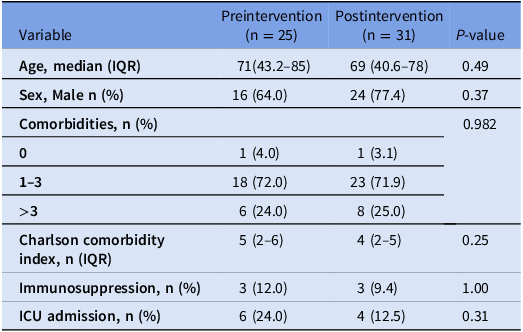
Baseline demographic and clinical characteristics of patients in the pre- and postintervention groups are summarized in Table 1. A total of 25 patients were included in the preintervention group and 31 in the postintervention group. The median age was similar between groups (71 years [IQR 43.2–85] preintervention vs 69 years [IQR 40.6–78] postintervention, P = .49). The proportion of male patients did not differ significantly (64.0% vs 77.4%, P = .37).
Patient demographics in the pre- and postintervention groups

Table 1. Long description
A table comparing patient demographics pre- and post-intervention. The table has 8 rows and 5 columns. Column headers are Variable, Preintervention (n = 25), Postintervention (n = 31), and P-value. Row labels include Age, median (IQR), Sex, Male n (%), Comorbidities, n (%), Charlson comorbidity index, n (IQR), Immunosuppression, n (%), and ICU admission, n (%). Row 1: Age, median (IQR), 71 (43.2-85), 69 (40.6-78), 0.49. Row 2: Sex, Male n (%), 16 (64.0), 24 (77.4), 0.37. Row 3: Comorbidities, n (%), 0, 1 (4.0), 1 (3.1), 0.982. Row 4: Comorbidities, n (%), 1-3, 18 (72.0), 23 (71.9), 0.982. Row 5: Comorbidities, n (%), >3, 6 (24.0), 8 (25.0), 0.982. Row 6: Charlson comorbidity index, n (IQR), 5 (2-6), 4 (2-5), 0.25. Row 7: Immunosuppression, n (%), 3 (12.0), 3 (9.4), 1.00. Row 8: ICU admission, n (%), 6 (24.0), 4 (12.5), 0.31.
IQR, interquartile range.
The burden of comorbidities was comparable between groups (P = .98), with most patients presenting with 1–3 comorbidities (72.0% preintervention vs 71.9% postintervention). The Charlson Comorbidity Index also did not differ significantly between groups (median 5 [IQR 2–6] vs 4 [IQR 2–5], P = .25). Rates of immunosuppression were similar (12.0% vs 9.4%, P = 1.00). ICU admission occurred in 24.0% of patients in the preintervention group compared with 12.5% in the postintervention group, a difference that did not reach statistical significance (P = .31).
Microbiological characteristics and clinical outcomes
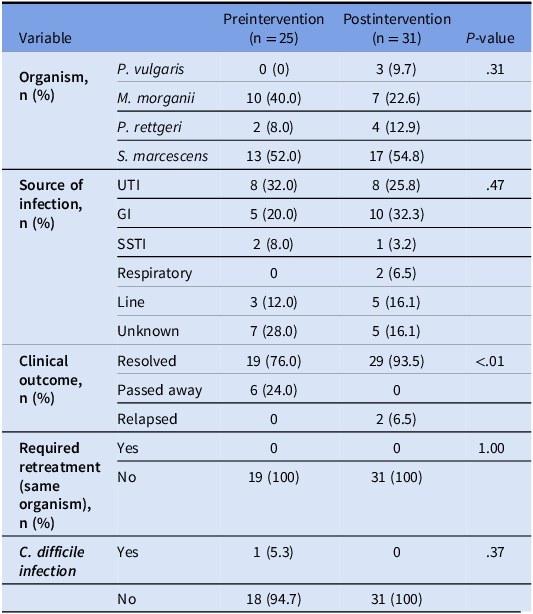
Table 2 summarizes the microbiological characteristics, sources of infection, and clinical outcomes in the pre- and postintervention groups. The distribution of causative organisms did not differ significantly between groups. Serratia marcescens was the most frequently isolated organism (52.0% preintervention vs 54.8% postintervention), followed by Morganella morganii (40.0% vs 22.6%). Providencia rettgeri and Proteus vulgaris were less frequently isolated (8.0 vs 12.9% and 0% vs 9.7%, respectively). There were no polymicrobial bloodstream infections.
Microbiological characteristics, sources of infection, and clinical outcomes in the pre- and postintervention groups

Table 2. Long description
A table comparing microbiological characteristics, sources of infection, and clinical outcomes pre- and postintervention. The table has 4 rows and 5 columns. Column headers are Variable, Preintervention (n=25), Postintervention (n=31), and P-value. Row labels include Organism, Source of infection, Clinical outcome, Required retreatment (same organism), and C. difficile infection. Row 1: Organism, P. vulgaris 0 (0), 3 (9.7), .31; M. morganii 10 (40.0), 7 (22.6), .31; P. rettgeri 2 (8.0), 4 (12.9), .31; S. marcescens 13 (52.0), 17 (54.8), .31. Row 2: Source of infection, UTI 8 (32.0), 8 (25.8), .47; GI 5 (20.0), 10 (32.3), .47; SSTI 2 (8.0), 1 (3.2), .47; Respiratory 0, 2 (6.5), .47; Line 3 (12.0), 5 (16.1), .47; Unknown 7 (28.0), 5 (16.1), .47. Row 3: Clinical outcome, Resolved 19 (76.0), 29 (93.5), <.01; Passed away 6 (24.0), 0, <.01; Relapsed 0, 2 (6.5), <.01. Row 4: Required retreatment (same organism), Yes 0, 0, 1.00; No 19 (100), 31 (100), 1.00. Row 5: C. difficile infection, Yes 1 (5.3), 0, .37; No 18 (94.7), 31 (100), .37.
UTI, urinary tract infection; GI, gastrointestinal infection; SSTI, skin and soft tissue infection.
The sources of infection were predominantly urinary (32.0% vs 25.8%) and gastrointestinal (20.0% vs 32.3%), with smaller proportions from skin and soft tissue (8.0% vs 3.2%), line-related (12.0% vs 16.1%), and respiratory sources (0% vs 6.5%). No significant differences were observed between groups (P = .47).
Clinical outcomes differed significantly between groups. Resolution of infection occurred in 76.0% of patients in the preintervention group compared with 93.5% in the postintervention group (P < .01). Mortality was observed in 24.0% of patients (n = 6) in the preintervention group, whereas no deaths occurred in the postintervention group. Of note, mortality in the preintervention was largely driven by underlying metastatic malignancy or to other acute non-infectious etiologies (ie, bowel perforation, intracranial hemorrhage, or myocardial infarction). Relapse was reported in two patients in the postintervention group, compared with none in the preintervention group; one patient with Serratia marcescens bacteremia clinically deteriorated with progression of necrotizing pneumonia after transitioning to oral ciprofloxacin, and another patient clinically deteriorated after transition to oral ciprofloxacin with potential seeding of joint with Serratia marcescens. Neither patient had regrowth of the same organism in any culture sample, and both patients recovered after broadening IV antibiotic therapy to a carbapenem. Within either group, no patients required retreatment for bloodstream infection with the same organism (P = 1.00). Rates of C. difficile infection within 30 days posttherapy were low across both groups and did not differ significantly (5.3% vs 0%, P = .37).
Antibiotic choice and duration
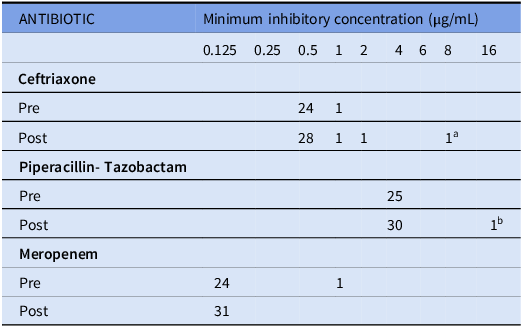
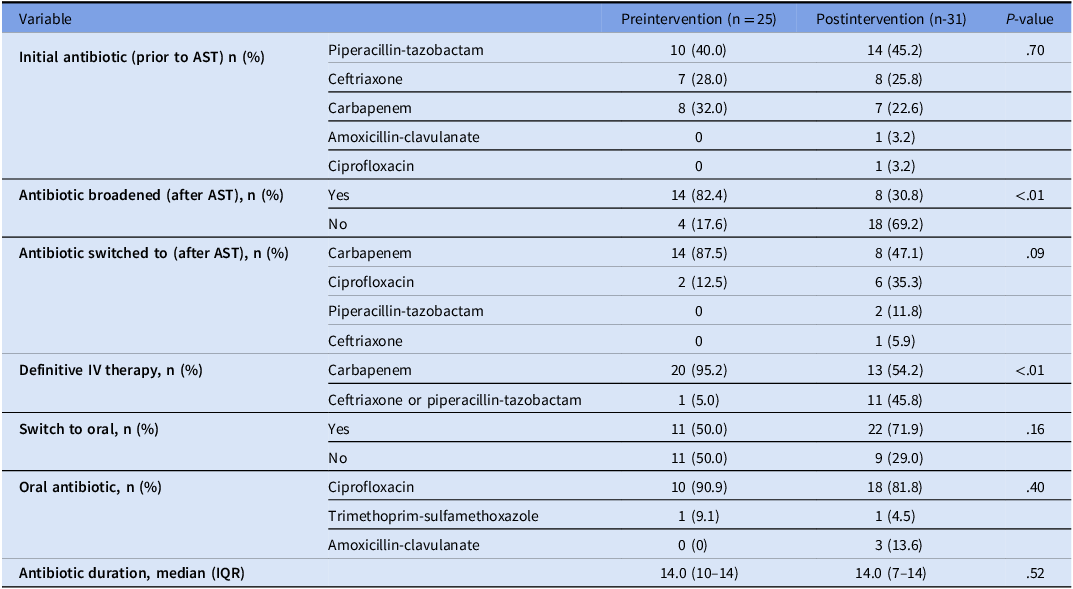
AST data with MIC values were tabulated for ceftriaxone, PTZ, and meropenem in Table 3. One P. mirabilis isolate tested resistant to ceftriaxone in the postintervention group based on CLSI M100 34th edition breakpoints. Table 4 outlines the antibiotic choices and duration of therapy in the preintervention compared to the postintervention group. The distribution of empiric antibiotic selection prior to AST did not differ significantly in the pre and postintervention groups (P = .70). PTZ was the most frequently prescribed initial agent (40.0% preintervention vs 45.2% postintervention), followed by ceftriaxone (28.0% vs 25.8%) and carbapenems (32.0% vs 22.6%). Use of amoxicillin-clavulanate and ciprofloxacin as initial agents was only observed in the postintervention group (3.2% each).
Number of blood culture isolates based on minimum inhibitory concentrations for CRO, PTZ, and meropenem in the pre- and postintervention groups

Table 3. Long description
A table comparing minimum inhibitory concentrations of antibiotics pre- and post-intervention. The table has 3 columns and 7 rows. The columns are labeled ANTIBIOTIC, Minimum inhibitory concentration (µg/mL), and values. The rows are labeled CEFTRIAXONE, PRE, POST, PIPERACILLIN-TAZOBACTAM, PRE, POST, MEROPENEM, PRE, and POST. The values in the Minimum inhibitory concentration column are 0.125, 0.25, 0.5, 1, 2, 4, 6, 8, and 16. The values in the CEFTRIAXONE PRE row are 24 and 1. The values in the CEFTRIAXONE POST row are 28, 1, and 1a. The values in the PIPERACILLIN-TAZOBACTAM PRE row are 25. The values in the PIPERACILLIN-TAZOBACTAM POST row are 30 and 1b. The values in the MEROPENEM PRE row are 24 and 1. The value in the MEROPENEM POST row is 31.
a Resistant isolate based on CLSI M100 (2024, Ed. 34) breakpoints.
b Susceptible dose-dependent isolate based on CLSI M100 (2024, Ed. 34) breakpoints.
Antibiotic choice in the preintervention and postintervention groups

Table 4. Long description
A table comparing antibiotic choices and therapy duration in preintervention and postintervention groups. The table has 10 rows and 5 columns. Column headers are Variable, Preintervention (n = 25), Postintervention (n = 31), and P-value. Row labels include Initial antibiotic (prior to AST), Antibiotic broadened (after AST), Antibiotic switched to (after AST), Definitive IV therapy, Switch to oral, Oral antibiotic, and Antibiotic duration, median (IQR). Row 1: Initial antibiotic (prior to AST), Piperacillin-tazobactam, 10 (40.0 percent), 14 (45.2 percent), 0.70. Row 2: Ceftriaxone, 7 (28.0 percent), 8 (25.8 percent). Row 3: Carbapenem, 8 (32.0 percent), 7 (22.6 percent). Row 4: Amoxicillin-clavulanate, 0, 1 (3.2 percent). Row 5: Ciprofloxacin, 0, 1 (3.2 percent). Row 6: Antibiotic broadened (after AST), Yes, 14 (82.4 percent), 8 (30.8 percent), less than 0.01. Row 7: No, 4 (17.6 percent), 18 (69.2 percent). Row 8: Antibiotic switched to (after AST), Carbapenem, 14 (87.5 percent), 8 (47.1 percent), 0.09. Row 9: Ciprofloxacin, 2 (12.5 percent), 6 (35.3 percent). Row 10: Piperacillin-tazobactam, 0, 2 (11.8 percent). Row 11: Ceftriaxone, 0, 1 (5.9 percent). Row 12: Definitive IV therapy, Carbapenem, 20 (95.2 percent), 13 (54.2 percent), less than 0.01. Row 13: Ceftriaxone or piperacillin-tazobactam, 1 (5.0 percent), 11 (45.8 percent). Row 14: Switch to oral, Yes, 11 (50.0 percent), 22 (71.9 percent), 0.16. Row 15: No, 11 (50.0 percent), 9 (29.0 percent). Row 16: Oral antibiotic, Ciprofloxacin, 10 (90.9 percent), 18 (81.8 percent), 0.40. Row 17: Trimethoprim-sulfamethoxazole, 1 (9.1 percent), 1 (4.5 percent). Row 18: Amoxicillin-clavulanate, 0 (0 percent), 3 (13.6 percent). Row 19: Antibiotic duration, median (IQR), 14.0 (10 to 14), 14.0 (7 to 14), 0.52.
AST, antimicrobial susceptibility testing; IV, intravenous.
Following AST results, antibiotic broadening was significantly lower in the postintervention group (82.4% preintervention vs 30.8% postintervention, P < .01). Among those requiring a switch in antibiotic therapy, carbapenems remained the most common agent in both groups, though less frequently prescribed postintervention (87.5% vs 47.1%, P = .09). Ciprofloxacin use increased correspondingly in the postintervention group (12.5% vs 35.3%). In terms of definitive IV antibiotic therapy, nearly all preintervention patients received carbapenems (95.2%), whereas postintervention prescribing was more heterogeneous, with carbapenems used in only 54.2% of cases (P < .01). Instead, ceftriaxone or PTZ accounted for 45.8% of definitive IV therapy in the postintervention group. After adjusting for critical illness, patients in the postintervention group had 17.7-fold higher odds (CI 1.9–162.6) of receiving definitive ceftriaxone or PTZ compared to the preintervention group.
Rates of switch to oral antibiotic therapy were higher in the postintervention compared to the preintervention group (71.9% vs 50%), though this did not reach statistical significance (P = .16). Ciprofloxacin was the predominant oral agent used in both groups (90.9% vs 81.8%, P = .40), with smaller contributions from amoxicillin-clavulanate (13.6%) and trimethoprim-sulfamethoxazole (4.5%) observed only postintervention. Antibiotic duration remained unchanged between groups, with a median of 14 days in both (IQR 10–14 preintervention vs 7–14 postintervention, P = .52).
Discussion
This healthcare improvement initiative demonstrated a marked increase in guideline-concordant non-carbapenem antibiotic therapy for bloodstream infections with LRAC organisms following revision of microbiology reporting language.
Impact of the stewardship intervention on prescribing
The primary outcome showed a marked shift in prescribing behavior, with definitive ceftriaxone or PTZ therapy increasing from 5% in the preintervention period to 45.8% postintervention. After adjustment for illness severity and comorbidities, postintervention status remained independently associated with receipt of non-carbapenem therapy. This finding reinforces prior evidence that microbiology reporting language substantially influences clinician decision-making, in addition to newly published formal guidelines.
Our results are directionally consistent with the stewardship intervention described by Hardy et al. (2023), who observed an increase in definitive ceftriaxone use from 5% to 66% following removal of AmpC warning comments and targeted prescriber education. Reference Hardy2 Although the absolute uptake of ceftriaxone in this study was lower, this likely reflects differences in study populations, a smaller sample size, and differences in targeted prescriber education.
Clinical outcomes and safety of non-carbapenem therapy
Increased use of ceftriaxone and PTZ was not associated with worse clinical outcomes. No patients in either group experienced relapse with a 3GC/PTZ-resistant isolate or required retreatment for the same organism within 30 days. Rates of C. difficile infection at 30 days were low and comparable between groups, supporting the potential collateral benefit of carbapenem-sparing strategies.
Although 30-day all-cause mortality was lower in the postintervention group, this difference appears largely attributable to baseline imbalances, as patients in the preintervention group had higher comorbidity burden and severity of non-infection related illness. This was reflected in the higher proportion of patients that required ICU admission in the preintervention compared to the postintervention group. Nonetheless, the absence of excess mortality in the postintervention group provides reassurance regarding the clinical safety of narrowing therapy in this population.
Our findings closely mirror those reported by Mulbah et al. (2025), who found no difference in 30-day mortality between patients with bacteremia due to LRAC organisms treated definitively with ceftriaxone (n = 54, 9.3%) versus cefepime or carbapenems (n = 109, 10.1%), referred as “AmpC-stable treatment group”. Reference Mulbah4 In that study, resistance emergence was rare and absent in the ceftriaxone group, further supporting the concept that 3GC remain viable options when susceptibility is confirmed. Reference Mulbah4 Similarly, clinical failure rates in this study were low and numerically lower than those reported by Mulbah et al. (n = 5, 9.3% in ceftriaxone and n = 23, 21.1% in the AmpC-stable treatment group), potentially reflecting differences in patient acuity and infection sources. Reference Mulbah4
Antimicrobial resistance
The development of antimicrobial resistance remains a primary concern when using 3GCs for AmpC-producing organisms; however, our study found no emergence of resistance within 30 days of completing therapy. This finding is strongly supported by both Mulbah et al and Hardy et al., who reported that resistance emergence was rare and, in some analyses, entirely absent in the ceftriaxone treatment groups. Reference Hardy2,Reference Mulbah4 Specifically, Mulbah et al noted that ceftriaxone resistance only occurred in the AmpC-stable treatment group (3.7% vs 0%). Reference Mulbah4 Collectively, these findings provide robust support for the 2024 IDSA guidance, which endorses the use of 3GCs for LRAC organisms like S. marcescens, M. morganii, and Providencia spp. when susceptibility is confirmed, as the risk of clinically significant induction is substantially lower than previously thought. Reference Tamma1
Role of infectious diseases specialist consultation
An important observation in our study was the tendency toward escalation to carbapenems following infectious diseases consultation in the postintervention period. This phenomenon has been described previously and likely reflects entrenched concerns regarding inducible resistance, as emphasized in older teaching frameworks such as the “SPICE” or “SPACE” mnemonic. Reference MacDougall9,Reference Tamma10 However, this may be due to selection bias: Infectious Diseases specialists are typically consulted only for complex infections involving LRAC organisms, which may require escalation or broadening of antibiotics based on clinical judgement. However, the study by Mulbah et al did not account for such complexity; despite the difference in Infectious Diseases specialty consultations, both the ceftriaxone and AmpC-stable treatment groups exhibited comparable clinical severity at baseline, as evidenced by similar qSOFA scores, ICU admission rates, and vasopressor requirements. Reference Mulbah4 Our findings highlight an opportunity for further education to prescribers to reinforce updated evidence and the recommendations outlined in the 2024 IDSA guidance, which endorses susceptibility-guided therapy for LRAC organisms. Reference Tamma1
Limitations
This study has several limitations, including the single-center, quasi-experimental design and modest sample size (<100 patients), which limit generalizability and the ability to detect rare outcomes such as resistance emergence. Baseline differences in illness severity may have also influenced outcomes. Additionally, factors such as source control, antibiotic dosing optimization, and molecular confirmation of AmpC mechanisms were not fully captured. Thirty-day follow-up for adverse reactions may have occurred outside the study hospitals (eg, with a family physician), and such outpatient consultations would not have been captured; however, microbiological investigations were captured on a centralized electronic medical database regardless of where they were performed in British Columbia. Additionally, outcomes beyond 30 days were not assessed, and therefore it is possible that mortality between the groups was underestimated. The cause of clinical relapse in the two patients in this study could not be established and as such we cannot definitively exclude clinically significant AmpC production as a contributor to relapse. Finally, maturation may also be a limitation, as guidance from the Infectious Diseases Society of America on the treatment of AmpC-producing Enterobacterales may have influenced prescribers to select definitive ceftriaxone therapy independent of the study intervention.
Conclusions
This intervention was useful, sustainable, and required minimal resources. Aligning microbiology susceptibility reporting with contemporary evidence significantly reduced unnecessary carbapenem exposure while maintaining patient safety. This intervention has applicability to other institutions and supports broader antimicrobial stewardship efforts. Future work should assess long-term outcomes and explore additional impacts with complementary educational strategies.
Acknowledgements
We would like to acknowledge the Island Health Authority Microbiology Laboratory staff for their technical expertise. We would also like to thank Balbir Jaswal (Microbiology Technical Coordinator, Island Health) for her help with LIS data extraction.
Author contributions
Conceptualization: H.H., V.Y., and M.S. Data curation: H.H., C.K.-F.L., and A.A. Formal data analysis: H.H. Funding acquisition: N/A. Investigation: H.H. and V.Y. Methodology: H.H. and V.Y. Project administration: H.H. and V.Y. Supervision: H.H. and V.Y. Writing—original draft: H.H. and G.A. Writing—review and editing: H.H., G.A., C.K.-F.L., V.Y., J.M.G., S.M., and M.S.
Financial support
No external funding was received for this work.
Competing interests
The authors declare that they have no competing interests.
Ethical standard
This study was considered exempt from research ethics board review by the Island Health Research Ethics and Compliance Office.

 Open access

