Background
Dementia brings a significant burden to the healthcare system worldwide. Clinical trials on possible interventions preventing or delaying the onset of dementia are on rapid development. The greatest challenge for successful prevention is early identification of cognitively at-risk individuals. The use of cognitive tests as a predictor for decline in the community is of special relevance in regions where neuroimaging and cerebrospinal fluid (CSF) biomarkers are not widely available.
Decline in cognitive function began years before the clinical diagnosis of dementia (Hall et al., Reference Hall, Lipton, Sliwinski and Stewart2000; Grober et al., Reference Grober, Hall, Lipton, Zonderman, Resnick and Kawas2008; Johnson et al., Reference Johnson, Storandt, Morris and Gavin2009). The trajectories of cognitive decline are highly variable among participants. Episodic memory is not the only cognitive domain being affected at the preclinical phase. In the Baltimore Longitudinal Study of Aging (BLSA), it was shown that memory performance predicted future Alzheimer's dementia sensitively and early in the decline, while measures on executive dysfunction become more discriminating toward the time of diagnosis (Rubin et al., Reference Rubin, Storandt, Miller, Kinscherf, Grant and Berg1998). A sharp inflection point followed by accelerating decline exists in multiple cognitive domains in preclinical dementia (Johnson et al., Reference Johnson, Storandt, Morris and Gavin2009).
Cognitive decline may also occur in the absence of significant neurodegenerative pathologies (Ebly et al., Reference Ebly, Hogan and Parhad1995). Some studies reported selective effects on certain cognitive domains and some studies reported a global effect. Visual memory, semantic memory, and executive function were susceptible to age-related decline in BLSA (Grober et al., Reference Grober, Hall, Lipton, Zonderman, Resnick and Kawas2008). A global decline in all cognitive domains was reported with increasing age, including general cognitive ability, episodic memory, primary memory, verbal fluency, and visuospatial ability (Small et al., Reference Small, Fratiglioni, von Strauss and Bäckman2003). Significant decline was observed in global cognition, episodic memory, semantic memory, working memory, perceptual speed, but not visuospatial ability in another study (Wilson et al., Reference Wilson, Beckett, Bienias, Evans and Bennett2003). It was also reported that cognitive performance remained stable in participants without dementia (Galvin et al., Reference Galvin2005). Early detection focusing on episodic memory tasks only may not be sensitive enough to detect subsequent dementia cases. Other cognitive domains have also been shown to have significant decline in the preclinical phase, like visuospatial ability (Johnson et al., Reference Johnson, Storandt, Morris and Gavin2009), verbal memory (Howieson et al., Reference Howieson, Dame, Camicioli, Sexton, Payami and Kaye1997), and executive function (Chen et al., Reference Chen, Ratcliff, Belle, Cauley, DeKosky and Ganguli2001).
Data from local studies previously studied volunteers in the community with subjective memory complaints (Lam et al., Reference Lam2008c). The study aimed at validating a short cognitive screening test for mild cognitive impairment (MCI) and mild dementia. The Chinese Abbreviated Mild Cognitive Impairment (CAMCI) Test consists of shortened form of the Category Verbal Fluency Test (CVFT) and delayed recall. It was shown that the battery was sensitive in detecting MCI in both phase 1, comprising of volunteers from social centers and residential hostels, and phase 2, comprising of population-based random samples. A subsequent 20-month follow-up showed that the CAMCI was able to identify participants with higher likelihood of progression to dementia. The group being followed up was the volunteer participants from phase 1, with lower education level and was older. Besides, by responding to the advertisement of the study, this group of participants was more likely to have subjective memory complaints and the result might not be projectable to the whole population. Follow-up data from a population-based sample with a longer follow-up period are needed to derive suitable paradigm for screening purpose.
The objectives of this study were to examine the longitudinal cognitive profiles in Chinese older adults without dementia in Hong Kong. We hoped to identify early cognitive predictors of dementia in the community to capture early changes.
Methods
Study design and participants
This is a five-year follow-up study from a population-based community survey of the prevalence of cognitive impairment in Chinese older people in Hong Kong, the Hong Kong Memory and Ageing Prospective Study (HK-MAPS). The baseline survey was conducted from October 2005 to July 2006. In short, a total of 6,100 people aged 60 years or above were randomly sampled from a non-institutionalized population in Hong Kong and were screened using the Cantonese version of the Mini-mental State Examination (CMMSE) and the Abbreviated Memory Inventory for the Chinese (AMIC). Local validated cut-offs used for CMMSE were 18 and below, 20 and below, 22 and below for participants with no education, one to two years of education, and more than two years of education, respectively. The cut-off used for AMIC was three or above (Lam et al., Reference Lam2008a). Those who were screen-positive and a randomly selected 5% of the screen-negative participants were invited for further assessment for dementia following a standardized protocol. Clinical dementia was defined according to the criteria of the Diagnostic and Statistical Manual of the Mental Disorders, 4th edition (DSM-IV, American Psychiatric Association, 2000). Nine hundred and thirty-one participants completed the assessment and 144 had a diagnosis of dementia. The remaining 787 participants constituted the sample for this study.
The participants were assessed at baseline (T0), at two years (T1), and at five years (T2). The baseline assessment was conducted from October 2005 to July 2006, the first follow-up from August 2007 to June 2008, and the second follow-up from March 2011 to February 2012. Participants who agreed to a follow-up assessment were contacted by phone and/or by post. Participants who skipped the first follow-up were also invited to take part in the second follow-up. Interviews were conducted at their place of residence or at a regional social/health center. The trained research assistants and psychiatrists collected information by face-to-face assessments using standardized questionnaires and cognitive tests. Before commencement of the interview, written informed consent was obtained from each participant or from a first-degree relative if the participant was not able to give consent. The study was approved by the ethics committee of the Chinese University of Hong Kong and the Department of Health of the Government of the Hong Kong Special Administrative Region.
Assessment
Background personal and clinical data
Sociodemographic data and lifestyle characteristics were obtained. Self-rated health and mobility were recorded. Additional information was obtained from informants available and by inspecting prescribed medications and/or medical records kept by the participants. Self-reported medical history was recorded using the Cumulative Illness Rating Scale (CIRS) (Conwell et al., Reference Conwell, Forbes, Cox and Caine1993). The CIRS gives a cumulative score as a measure of impairment due to physical illness in 13 organ systems. A higher score indicates a greater burden of physical illness. Depressive symptoms were assessed using the Cornell Scale for Depression in Dementia (CSDD; Alexopoulos et al., Reference Alexopoulos, Abrams, Young and Shamoian1988).
Measures of cognitive function
Diagnoses of dementia were made by a trained psychiatrist with DSM-IV TR criteria. The severity of cognitive impairment was determined by the global Clinical Dementia Rating (CDR). CDR is a semi-structured clinical interview rated with a scoring from 0 to 3 along six dimensions including memory, orientation, judgment, community affairs, hobbies and habits, and personal care. The criteria of MCI follow a combined clinical and cognitive model used in a previous study, evaluated to be more practical in MCI screening in the local aged population (Lam et al., Reference Lam2010). The criteria of amnesic MCI include (1) subjective complaints of memory loss or cognitive impairment; (2) objective memory impairment of delay learning scores being ≥1.5 SD below education- and age-matched persons with CDR 0; (3) relatively intact activities of daily living; and (4) clinically without dementia (CDR < 1). Non-amnesic MCI will be identified with a memory score above the −1.5-SD cut-off, but non-memory cognitive scores below 1-SD cut-off, two or more non-memory domains in CDR scored >0. Both amnesic and non-amnesic MCI were included in this study.
Cognitive assessments included the Chinese version of the Alzheimer's Disease Assessment Scale-Cognitive Subscale (ADAS-Cog), the CMMSE, ten-minute delayed recall, the CVFT, and the trail making tests (A and B).
1. The Chinese ADAS-Cog is an 11-item scale with scores ranging from 0 to 70. Higher scores indicate greater severity. It includes components of memory, language, and praxis. It is considered a sensitive test to monitor changes in cognitive function (Rosen et al., Reference Rosen, Mohs and Davis1984; Chu et al., Reference Chu, Chiu, Hui, Yu, Tsui and Lee2000).
2. The CMMSE is a standard clinical test for global cognitive function (Folstein et al., Reference Folstein, Folstein and McHugh1975). The maximum score is 30. It assesses orientation, registration, attention, recall, language, and visual construction. It has been validated locally (Chiu et al., Reference Chiu, Lee, Chung and Kwong1994).
3. The ten-minute delayed recall was an extension of the first part of the ADAS-Cog. In ADAS-Cog, participants were required to recall the ten words after a learning trial with ten minutes delay.
4. The CVFT is a test of language, semantic memory, and executive function. Participants were asked to generate as many exemplars as possible from semantic categories including animals, fruits, and vegetables, in one minute for each category (Chiu et al., Reference Chiu1997).
5. The trail making test is a test providing information about visual search speed, scanning, speed of processing, mental flexibility, as well as executive functioning (Bowie and Harvey, Reference Bowie and Harvey2006). There are two parts to the Chinese trail test: A, in which the subject needs to connect numbers in sequential order, and B, in which the subject alternates between Arabic and Chinese to suit the literacy of local older population.
Statistical analyses
The sample size estimation was performed using the Power and Precision software version 3.0 (Biostat, Englewood, New Jersey, USA). From the same group community-dwelling older adults without dementia, the two-year conversion rate was 5.3% (Leung, Reference Leung2008). For sample size estimates for computation of significant predictors, logistic regression with diagnosis of dementia by CDR as dependent variable was adopted. For 100 cases of dementia identified, the power for estimation of risk factors would be 80% power (α of 0.05). Assuming that the deterioration rate is uniform, the five-year conversion rate would be 13.25% and about 104 participants are expected to develop dementia. The sample size available at the baseline should be able to achieve satisfactory power (82%).
All other analyses were performed using the Statistical Package for Social Sciences (SPSS) software (Chicago, Illinois, USA). Baseline characteristics assuming normal distribution were compared by Student's t-test, non-parametric variables by the Mann–Whitney U test, and categorical data by the χ2 test. The trajectory of changes over time for each specific cognitive domain was determined. In addition to studying the absolute change in scores, changes in cognitive domains were computed by Z scores at specific time points with reference to the baseline performance of age- and educational level-matched participants with a CDR of 0. Test scores at different time points were compared by a paired-T test. Statistical significance was set at p ≤ 0.05. In a previous local study, MCI participants were shown to differ from normal participants by 1 SD in cognitive scores (Lam et al., Reference Lam2008b). Thus, a 1-SD drop was used in analysis in this study as a significant drop in cognitive performance. Multivariate logistic regression analyses were performed to examine possible baseline predictors of incident dementia.
Results
Baseline characteristics
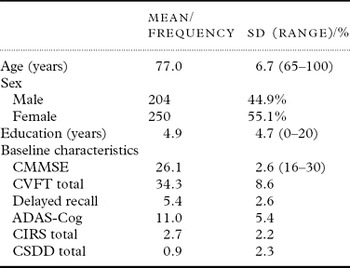
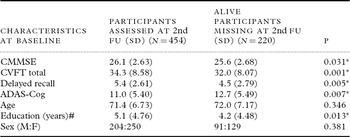
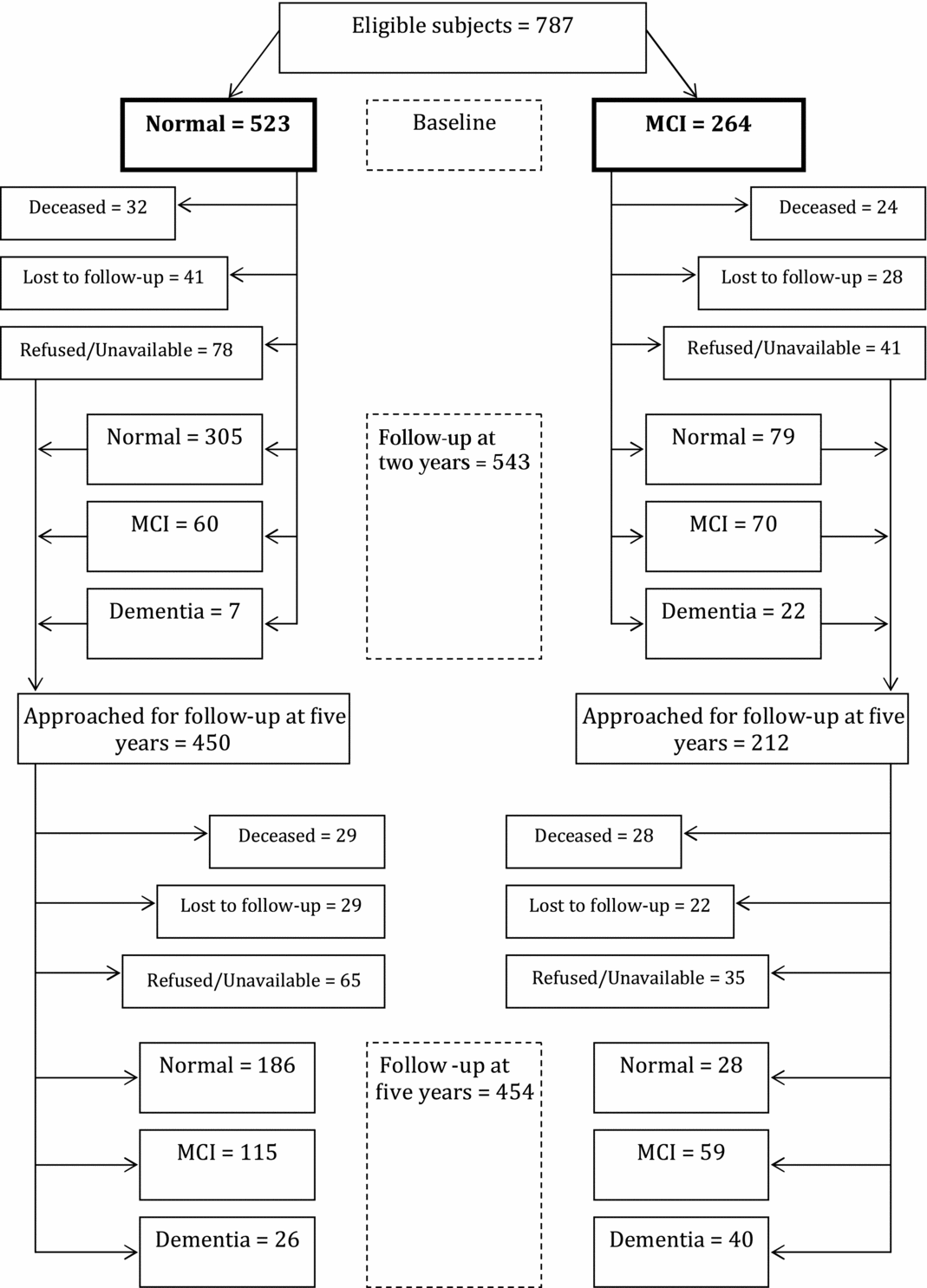
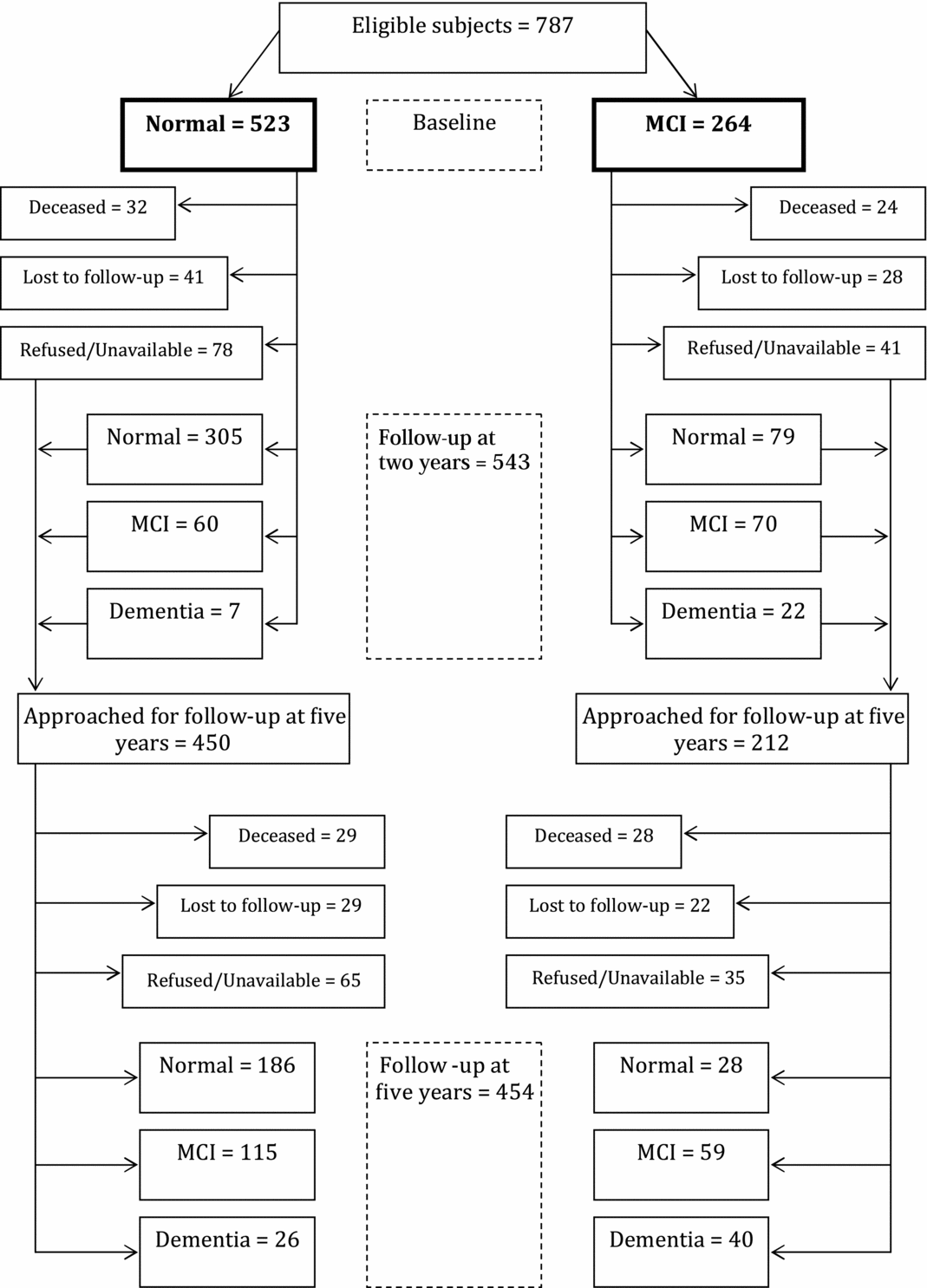
In the 787 participants, 523 (66.5%) were cognitively normal and 264 (33.5%) were MCI at baseline (T0). A total of 543 participants participated in the first follow-up (T1). By five years (T2), 113 (14.4%) died and 120 (15.2%) were lost to follow-up. In the remaining 554 participants, 100 (18.1%) declined participation or were not available for assessment (due to hospitalization or being away from Hong Kong). Therefore, 454 participants were assessed in the second follow-up (T2): 327 of them were normal at baseline and 127 were MCI at baseline (Figure 1). The mean follow-up interval of the first follow-up was 22.3 months, and that of the second follow-up was 64.7 months. The sample had a mean age of 77.0 years at five years (SD = 6.7, range = 65–100), 44.9% were male, mean education was 4.9 years (SD = 4.7, range = 0–20) and the baseline mean CMMSE score was 26.1 (SD = 2.6, range = 16–30) (Table 1). The differences in baseline characteristics between those who were assessed at five years and those who did not but were alive were evaluated (Table 2). The participants who were assessed at T2 had better cognitive function at baseline with higher CMMSE (p = 0.031), CVFT (p = 0.001), delayed recall score (p = 0.005), and lower ADAS-Cog total score (p = 0.007). They had higher education level (p = 0.013). There was no difference in age and gender.
Demographics characteristics for participants assessed at five years (N = 454)

CMMSE = Cantonese version of the Mini-mental State Examination; CVFT = Category Verbal Fluency Test; ADAS-Cog = Chinese version of the Alzheimer's Disease Assessment Scale-Cognitive Subscale; CSDD = Cornell Scale for Depression in Dementia; CIRS = Cumulative Illness Rating Scale; SD = standard deviation.
Comparison of the baseline characteristics of participants who were assessed at second follow-up with those who did not

Note. p value of sex by χ 2; # by Mann–Whitney U test; others by t-test.
*p = ≤ 0.05.
CMMSE = Cantonese version of the Mini-mental State Examination; CVFT = Category Verbal Fluency Test; ADAS-Cog = Chinese version of the Alzheimer's Disease Assessment Scale-Cognitive Subscale; 2nd FU = second follow-up.
Flow chart of clinical outcome at five years.
Progression to dementia at five years
Table 3 shows the follow-up status of participants at the second follow-up. For the baseline normal participants, 56.9% remained cognitively normal; 46.5% of the MCI participants stayed as MCI. The five-year conversion rate into dementia was 7.9% and 31.5% for baseline normal and MCI participants, respectively (χ2 = 40.8, p < 0.001). The participants who progressed were older (p < 0.001), less educated (p < 0.001), and had lower cognitive scores at baseline (CMMSE, CVFT, delayed recall, and Trail A, p < 0.001; Trail B, p = 0.001).
Cognitive status at five years (N = 787)

MCI = mild cognitive impairment.
Change in cognitive profile across the five years
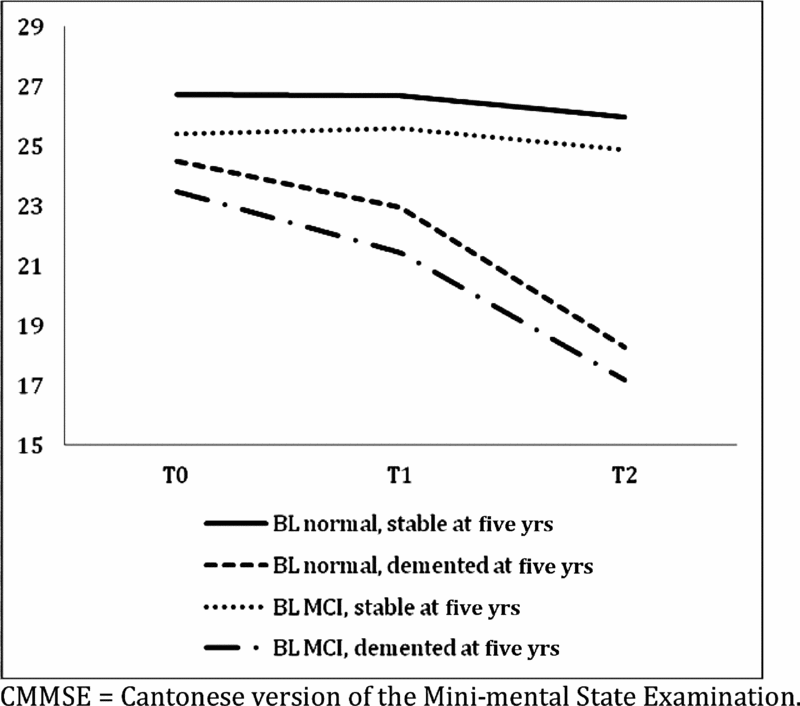
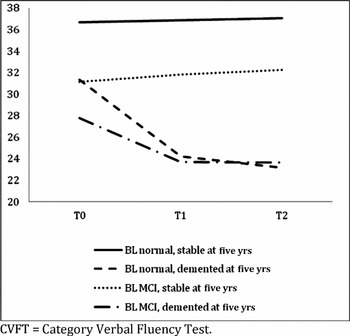
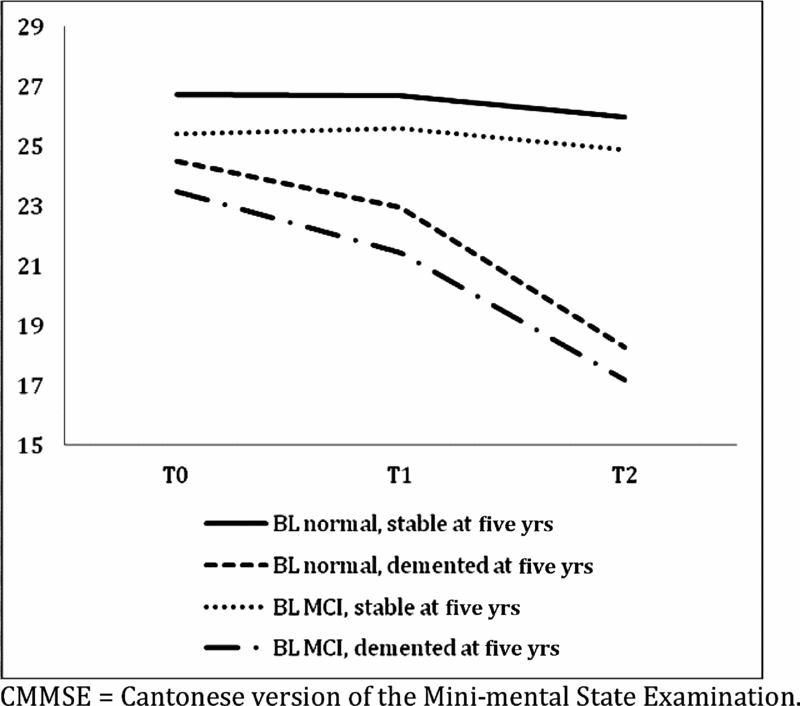
The drop in CMMSE scores was significant across the five years (p < 0.001). The annual drop in CMMSE scores from T1 to T2 was more than from T0 to T1, indicating a more rapid decline with time (Figure 2). An early drop in CVFT was found in participants who progressed to clinical dementia at T2 (p = 0.388) (Figure 3). The drop in ten-minute delayed recall and Trail B was also significant (p < 0.001, p = 0.009, respectively). The changes in ADAS-Cog and Trail A were not significant.
Trajectories of the CMMSE score over five years.
Trajectories of the CVFT score over five years.

Baseline predictors of subsequent progression to dementia at five years
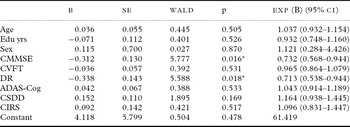
Baseline characteristics differed significantly between the participants who remained stable and those who developed dementia at five years (age, years of education, CMMSE, CVFT, delayed recall, and ADAS-Cog p < 0.001; CSDD p = 0.001; CIRS p = 0.016; sex: χ2 = 15.39, p < 0.001). These baseline characteristics were put into logistic regression model and results were shown in Table 4. CMMSE and delayed recall scores at baseline were shown to be significant predictors of subsequent incident dementia at five years.
Baseline predictors of subsequent dementia by logistic regression

Note. Good model fit was evidenced by non-statistically significant results on the Hosmer–Lemeshow test, χ 2 = 6.012, df = 8, p = 0.646; Cox and Snell R 2 = 0.161; Nagelkerke R 2 = 0.400.
*p = ≤ 0.05.
Edu yrs = years of education; CMMSE = Cantonese version of the Mini-mental State Examination; CVFT = Category Verbal Fluency Test; DR = Delayed Recall; ADAS-Cog = Chinese version of the Alzheimer's Disease Assessment Scale-Cognitive Subscale; CSDD = Cornell Scale for Depression in Dementia; CIRS = Cumulative Illness Rating Scale; CI = confidence interval.
Decline in cognitive profile in two years predicting progression over five years
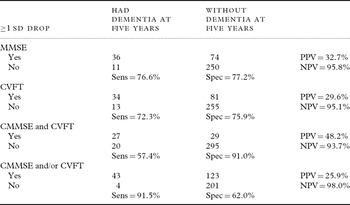
The sensitivity and specificity were 72.3%–77.2% if we evaluate a 1-SD drop in either CMMSE or CVFT alone to predict dementia at five years. A significant drop in either CMMSE or CVFT or both tests predicts dementia at five years with a sensitivity of 91.5%. A stable MMSE and CVFT predicted a 91% chance of maintaining stable cognitive state at five years (Table 5).
CMMSE and CVFT drop at two years and progression to dementia at five years (all participants)

CMMSE = Cantonese version of the Mini-mental State Examination; CVFT = Category Verbal Fluency Test; SD = standard deviation; Sens = sensitivity; Spec = specificity; PPV = positive predictive value; NPV = negative predictive value.
The analyses were repeated separating the participants into baseline normal and MCI groups. In the baseline normal group, a significant drop in both CMMSE and CVFT predicts dementia at five years with a sensitivity of 84.6% and a specificity of 88.0%. In the baseline MCI group, a significant drop in both CMMSE and CVFT predicts dementia at five years with a sensitivity of 88.9% and a specificity of 83.3%.
Discussion
A higher proportion of baseline MCI participants (31.5%) than baseline normal participants (7.9%) progressed to dementia after five years. The estimates of annual conversion rates of 1.6% and 6.3% for normal and MCI groups are comparable with previous studies. Our findings might be slightly conservative as participants who were not available or declined follow-up had lower cognitive profiles at baseline, suggesting that they had higher risks developing dementia. In fact, our results were consistent with conversion rates reported in other population-based studies, which reported annual conversion from MCI to dementia to be 3%–16% (Ritchie et al., Reference Ritchie, Artero and Touchon2001; Amieva et al., Reference Amieva2004; Busse et al., Reference Busse, Angermeyer and Riedel-Heller2006). Petersen (Reference Petersen2003) reports that after approximately six years, 80% of the MCI cohort has progressed to dementia, but the conversion figure was based on a clinical sample, which might be more impaired than population-based samples.
For participants who developed dementia at five year, the drop in CMMSE in the first two years was significant, and the mean drop was around 2 points. Only few population-based studies explicitly examined the predictive accuracy of a decline in total MMSE score over time to future development of dementia. In a study in Gothenburg, a decline of 4 points over three years was found to be the best cut-off for dementia in participants with age 85–88, and the participants who progressed to dementia had an average annual MMSE drop of 2.3 points (Acvarsson and Skoog, Reference Acvarsson and Skoog2000). In the AMSTEL project, −3/−4 points had the highest sensitivity, while −5/−6 points had the highest specificity over one year (Schmand et al., Reference Schmand, Lindeboom, Launer, Dinkgreve, Hooijer and Jonker1995). In another study in Leipzig, the best cut-off drop in raw MMSE score was −1 point over two years to predict dementia at nine years (Hensel et al., Reference Hensel, Luck, Luppa, Glaesmer, Angermeyer and Riedel-Heller2009). The findings suggested that global cognitive function as assessed by MMSE could be a cognitive predictor for decline in a community sample.
The decline in the CVFT score was also significant in participants who progressed to dementia. Interestingly, the decline in CVFT was present in the first two years over the five-year period. Detecting a significant decline in CVFT may indicate risk of developing dementia in the next few years. CVFT involves semantic memory and executive function. In our study, we were not able to tell whether memory declined before T0, but it was clear that a significant decline in CVFT scores to a low level comparable to over 1 SD below cognitive normal participants in two years predicted subsequent progression to dementia. Previous studies also reported that cognitive decline would start as early as seven years before clinical diagnosis of dementia (Grober et al., Reference Grober, Hall, Lipton, Zonderman, Resnick and Kawas2008). We also echoed the findings that cognitive decline was present many years before clinical diagnosis of dementia. Also, the trajectories of decline of specific cognitive domains are different and may have an impact on the predictability of disease progression. The sensitivity to changes with the dementing process varies among different cognitive tests, which may explain the different trajectories observed in CMMSE versus CVFT performance. Delayed recall has been found to be a strong cognitive predictor of future decline. However, the decline in this test had reached a floor effect early in the cognitive decline process in participants of this study.
Our results offered useful information on cognitive predictors for decline in a community sample. CMMSE and CVFT were chosen for analysis in combination because they are convenient to administer in clinical practice and the completion rate of these tests was high. For community-dwelling participants assessed serially, a drop in MMSE scores of 2 points and CVFT of 6 points (for baseline normal participants) and 4 points (for baseline MCI participants) in two years would be predictive of subsequent progression to dementia in the next few years. If a 1-SD drop in either test predicted subsequent dementia with a sensitivity of 72.3%–76.6% only; but when both tests were considered together, a 1-SD drop in either test in two years predicted 91.5% dementia cases at five years. A stable performance in either test predicted dementia-free at five years with a specificity of 75.9%–77.2% only, but a stable performance in both tests at two years predict a 91% chance of not progressing to dementia at five years. When analyzing the baseline normal and MCI participants separately, the predictive power of the early decline in both tests became more significant than considering either test alone. The two tests are simple to administer. This relatively simple algorithm may serve as a screening tool in the community for early identification of individuals at risk of developing dementia, and help in the selection of potential participants for interventions for dementia prevention. This study also provided additional information when compared with a local study (Lam et al., Reference Lam2008c). The current study offered a longer follow-up for a population-based random sample, while the previous study provided data on volunteers with subjective memory complaints.
There are a number of limitations concerning the study design. The follow-up interval between the two follow-up assessments was not uniform. A more reliable trajectory of cognitive changes over time could only be deduced if data are available for more follow-up time points with regular follow-up interval. Participants lost to follow-up were older and had poorer cognitive performance at baseline. The conversion rate to dementia was likely an underestimation of the actual figure in the population. Moreover, the diagnosis of dementia was not ascertained with neuroimaging investigation. The profile of cognitive decline would be different for people with dementia of Alzheimer's type and vascular dementia. However, it would be difficult to delineate a group with “pure” Alzheimer's in this locality, because the local prevalence of cardiovascular events is high and the mixed-type dementia is common.
This study adds further data to the existing literature on the trajectory of cognitive profile in older adults, both in cases with normal aging and those who progressed to dementia eventually. It helps giving insight and evidence to how the screening and timely intervention can be modeled for the best effect.
Conflict of interest
None.
Description of authors’ roles
Candy H. Y. Wong formulated the research question, designed the study, collected the data, was responsible for the statistical design of the study, carried out the statistical analysis, and wrote the paper. Grace T. Y. Leung designed the study and collected the data. Ada W. T. Fung and W. C. Chan collected the data. Linda C. W. Lam formulated the research question, designed the study, supervised the data collection, and wrote the paper.