Introduction
Native to eastern and southeastern Asia (Cini et al. Reference Cini, Ioriatti and Anfora2012; Centre for Agriculture and Bioscience International 2019), spotted-wing drosophila, Drosophila suzukii Matsamura (Diptera: Drosophilidae), was first detected in North America and Europe in 2008 (Rombaut et al. Reference Rombaut, Guilhot, Xuéreb, Benoit, Chapuis, Gilbert and Fellous2017) and in the Okanagan Valley of British Columbia, Canada in 2009 (Walsh et al. Reference Walsh, Bolda, Goodhue, Dreves, Lee and Bruck2011; Thistlewood et al. Reference Thistlewood, Shearer, Steenwyk, Walton and Acheampong2012). Drosophila suzukii is highly polyphagous on a wide range of cultivated soft fruits and non-crop plants (Lee et al. Reference Lee, Bruck, Curry, Edwards, Haviland, Van Steenwyk and Yorgey2011a; Cini et al. Reference Cini, Ioriatti and Anfora2012; Centre for Agriculture and Bioscience International 2019; Thistlewood et al. Reference Thistlewood, Rozema and Acheampong2019). Owing to its sclerotised, serrated ovipositor and preference for undamaged rather than rotting fruit, economic damage by D. suzukii is considerably greater than that caused by other Drosophila Fallén species (Lee et al. Reference Lee, Bruck, Curry, Edwards, Haviland, Van Steenwyk and Yorgey2011a; Keesey et al. Reference Keesey, Knaden and Hansson2015; Rombaut et al. Reference Rombaut, Guilhot, Xuéreb, Benoit, Chapuis, Gilbert and Fellous2017). Its status as an economically important invasive pest has generated numerous research projects and publications on various aspects of its biology and management. The reader is referred to the reviews of Lee et al. (Reference Lee, Bruck, Curry, Edwards, Haviland, Van Steenwyk and Yorgey2011a, Reference Lee, Bruck, Dreves, Ioriatti, Vogt and Baufeld2011b), Cini et al. (Reference Cini, Ioriatti and Anfora2012), Centre for Agriculture and Bioscience International (2019), and Thistlewood et al. (Reference Thistlewood, Rozema and Acheampong2019) for additional information on the natural history, distribution, and economic status of this pest recently new to Canada.
Considerable economic damage to cherries and other berry crops has been reported in the Okanagan Valley, British Columbia and adjacent regions in Washington State and Oregon, United States of America (Beers et al. Reference Beers, van Steenwyk, Shearer, Coates and Grant2011; Thistlewood et al. Reference Thistlewood, Rozema and Acheampong2019) since 2010. Economic impacts include direct damage, restricted export sales, and increased production costs from monitoring and insecticide applications. The earliest papers on D. suzukii from Japan (Kanzawa Reference Kanzawa1939) include mention of damage to grapes, Vitis Linnaeus (Vitaceae), but the severity and frequency of damage were not outlined. More recently, damage to wine and table grapes (Vitis vinifera Linnaeus) has been widely reported from Europe (Grassi and Pallaoro Reference Grassi and Pallaoro2012; Linder et al. Reference Linder, Martin, Laboisse, Chatelain and Kehril2014; Ioratti et al. Reference Ioriatti, Walton, Dalton, Anfora, Grassi, Maistri and Mazzoni2015; Baser et al. Reference Baser, Broutou, Verrastro, Porcelli, Ioriatti and Anfora2018; Rombaut et al. Reference Rombaut, Guilhot, Xuéreb, Benoit, Chapuis, Gilbert and Fellous2017; Entling et al. Reference Entling, Anslinger, Jarausch, Michl and Hoffman2019) and North America (Saguez et al. Reference Saguez, Lasnier and Vincent2013; Ioratti et al. Reference Ioriatti, Walton, Dalton, Anfora, Grassi, Maistri and Mazzoni2015; Pelton et al. Reference Pelton, Gratton and Guédot2017; Rezazadeh et al. Reference Rezazadeh, Sampson, Stafne, Marshall-Shaw, Stringer and Hummer2018; Shrader et al. Reference Shrader, Burrack and Pfeiffer2019). Questions remain, however, about the severity of damage caused to table and wine grapes, environmental effects on D. suzukii numbers and susceptibility of fruit, and if oviposition and successful larval development requires fruit to be first diseased or damaged. Though collected in apple cider vinegar traps in vineyards throughout the Okanagan Valley, there have not been any reports of serious economic damage to grapes. The objectives of this study were to monitor D. suzukii populations in Okanagan Valley vineyards and determine the relative susceptibilities of damaged and intact table and wine grapes based on collection of fruit naturally exposed to D. suzukii in the field and exposed to flies under artificial conditions.
Materials and methods
Monitoring of adult Drosophila suzukii
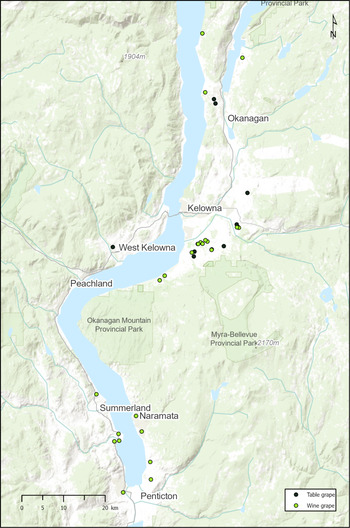
Adult D. suzukii were monitored in 12 table and 25 wine grape vineyards from May to November of 2011–2013 by means of standard clear deli cup traps baited with apple cider vinegar, in 2014 with apple cider vinegar traps paired with Trappit dome traps baited with Trece lures, and in 2015 with Trappit dome traps baited with Trece lures. Apple-cider-vinegar traps were made from 500-mL clear plastic cups and lids (Interior Beverage, Kelowna, Canada) with four to six 0.5 cm diameter holes drilled 4–7 cm below the rim on one side. Traps were filled to a depth of approximately 4 cm with Heinz apple cider vinegar (Kraft Heinz, Pittsburg, Pennsylvania, United States of America) and a drop of Dawn (Proctor & Gamble, Cincinnati, Ohio, United States of America) unscented dish soap to break the surface tension. The tops of the internal tubes of Trappit dome traps (Trécé, Chelsea, Oklahoma, United States of America) were screened with flexible 0.635-cm mesh to exclude large insects. Trece D. suzukii lures were suspended at the top of the traps, and a 10% drowning solution (400 g boric acid in 4 L of water plus 10 drops of liquid soap) was added to a depth of approximately 4 cm. Due to crystallisation during very high summer temperatures, the concentration was reduced to 5%. Lures were changed every four weeks. Trap solutions were replaced weekly and collected D. suzukii flies identified under a binocular microscope based on the characteristic bright red eyes, wing spots of adult males, and enlarged ovipositor of females (Centre for Agriculture and Bioscience International 2019). Numbers of other Drosophila species were also tallied for comparative purposes. Monitoring sites were in the Central Okanagan from Westbank north to Lake Country for table grapes and from Penticton north to Lake Country for wine grapes (Fig. 1).
Locations of table and wine grape vineyards in the Okanagan Valley, British Columbia, where adult Drosophila suzukii were monitored and where fruit samples were collected.

Field collection of fruit
During September to November 2011–2012, approximately 4–5 clusters each of damaged and intact grapes were collected weekly from each of the 12 table and 25 wine grape vineyards that were monitored for adults, permitting availability, and brought to the laboratory to assess emergence of D. suzukii. Damaged fruit included injury by birds (Aves), wasps (Hymenoptera), hail, sunburn, and split fruit. In conditions where samples of either damaged or intact berries could not be obtained as a cluster, individual berries were collected throughout the vineyard. Damaged and intact clusters were pooled for each vineyard, and 100 subsamples each of damaged and intact grapes were placed into 1-L deli food containers (Interior Beverage, Kelowna, British Columbia, Canada) that had an opening in the lid covered with organza mesh for ventilation. Deli containers were held at room temperature at the British Columbia Ministry of Agriculture facility in Kelowna and inspected daily for vinegar fly emergence for a maximum period of three weeks. One week after the first identified D. suzukii had emerged, cages were placed into a freezer. Cage contents were later defrosted, and a float technique was used to retrieve D. suzukii by placing fruit in a lukewarm water bath, agitating the bath, and extracting flies that floated to the surface and by pouring liquid through organza mesh to collect all D. suzukii. Flies were identified using a 7–30 × microscope (Motic SMZ168TP) and categorised as (i) male D. suzukii, (ii) female D. suzukii, or (iii) other Drosophila, then labelled and preserved in vials of 75% ethanol solution. To determine levels of sugar, another subsample of 50 grapes was gently crushed and the released juice tested for per cent brix concentrations using a hand-held refractometer (ATAGO ATC-1 E, brix 0–32%). The same procedure was used to assess infestation levels for table grapes during 2013–2015, but due to high numbers of D. suzukii and large amounts of sour rot in 2013, 2–3 clusters of wine grapes were instead placed in vented plastic shoe box containers (6 L; 34.2 cm × 20.9 cm × 11.6 cm) lined with paper towels for one week before freezing and fly identifications. Wine grape cultivars included in the study were Bacchus, Baco Noir, Chardonnay, Foch, Gamay Noir, Gewurztraminer, Lemberger, Merlot, Optima, Ortega, Pinot Blanc, Pinot Gris, Pinot Noir, Siegerrebe; table grape cultivars were Concord, Coronation, Einset seedless, Glenora, Patricia, Pink surprise, Reliance, Skookum, and Venus.
Artificial infestation of fruit
To evaluate the susceptibility of wine grapes to D. suzukii oviposition and larval development in relation to sugar content (brix) and cultivar, clusters of intact grapes were brought to the laboratory from the end of September to October 2011, and their sugar content measured as outlined above. On each sample date, 10 berries of each cultivar were also placed into individual plastic deli containers (950 mL) that were left uncovered for two days in cages containing a healthy colony of D. suzukii maintained at the Agriculture and Agri-Food Canada Summerland Research and Development Centre in screened cages and supplied artificial diet (Formula 4–24 Instant Drosophila Medium, Carolina Biological Supply Company, Burlington, North Carolina, United States of America) in shallow 350-mL plastic dishes. The containers were then removed and enclosed with lids vented by two 2-cm holes covered with organza to contain any emerging flies. Cups were maintained in a growth chamber at 21 °C and low light for 14 days, and then the contents were frozen to allow for counts of emerged adults, pupal cases, and larvae. Specimens were retrieved using the flotation technique described earlier and preserved in 75% ethanol to allow for separation of males and females. The wine grape cultivars sampled included Chardonnay, Gamay Noir, Gewurztraminer, Merlot, Pinot Blanc, Pinot Gris, Pinot Noir, Riesling, Siegerrebe, and the hybrid cultivar Sovereign Opal; table grapes were Skookum, Concord, and a series of unnamed cultivars remaining from a discontinued breeding program at Agriculture and Agri-Food Canada Summerland Research and Development Centre.
Statistical analysis
A total of 491 field collected table grape samples (100 berries per sample, damaged n = 249, intact n = 242) and 444 samples of wine grapes (100 berry per sample, damaged = 220, intact = 224) were used to rear out Drosophila species. To assess if some factors influenced the presence or absence of D. suzukii or other Drosophila species, we performed multiple Pearson’s chi-squared test or Kruskal-Wallis rank sum test adjusted for multiple comparisons using the Benjamini and Hochberg (Reference Benjamini and Hochberg1995) method from the “stat” package in R version 3.6.1. To investigate the importance of each identified factor that could affect the rearing of D. suzukii, the same data were also used in a generalised linear model in R. For this additive model, we considered the presence or absence (binary) of D. suzukii or other Drosophila species using a binomial distribution with brix levels, grape cultivar, fruit damage (damaged or intact), and other grape qualities (skin colour, skin type) as covariates after blocking against the year. Different models were evaluated for both table grapes and wine grapes. The complementary log-log model was chosen because of the disproportion in the presence–absence ratio but showed no difference with the Logit model based on the Akaike information criterion (P > 0.05). To investigate the effects of the grape brix levels, we fitted a general linear model to the log abundance of D. suzukii and other Drosophila species after removing data points where no Drosophila were recovered and the Pearson coefficient of the corresponding data was reported. For the generalised linear models, data were normalised using the “bestNormalize” R package version 1.5.0 (Peterson and Cavanaugh Reference Peterson and Cavanaugh2019) when required.
Statistical tests for the trap capture datasets were conducted using Fisher chi-test rank test or using the Kruskal-Wallis rank test with Benjamini and Hochberg (Reference Benjamini and Hochberg1995) correction where applicable. Dunn test from the “dunn.test” R package version 1.3.5 (Dinno and Dinno Reference Dinno and Dinno2017) and Benjamini and Hochberg post hoc procedure were used to compare the different factors.
Results
Monitoring of adult Drosophila suzukii
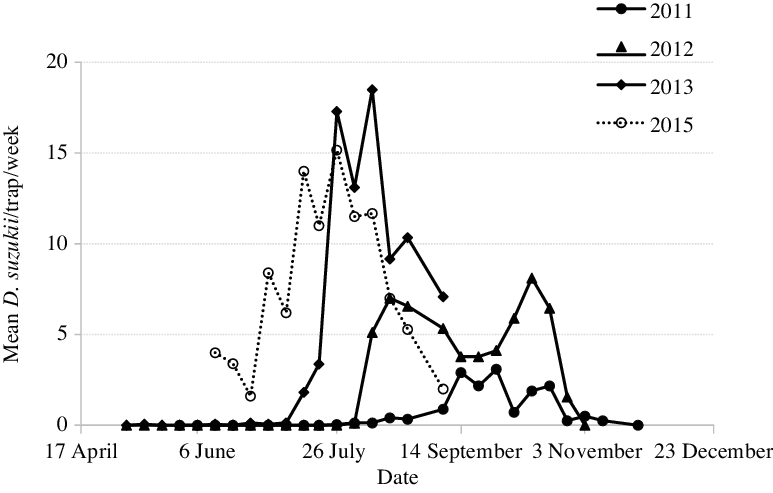
Adult D. suzukii were trapped in all vineyards in all years. Trap captures varied significantly by year (P < 0.001) and by cultivar (location) (P < 0.001), with first captures of D. suzukii in table grape vineyards occurring the week of 27 July, 6 August, and 14 May in 2011, 2012, and 2013, respectively, and in the week of 19 June in 2015 (Fig. 2). We may have missed first trap captures in 2015 due to delays in receiving trapping supplies, and D. suzukii were caught the week traps were set up (Fig. 2). More D. suzukii were recorded from traps placed in blocks of black- or red-skinned cultivars than in pink or white (Dunn’s test, P = 0.038).
Mean numbers of Drosophila suzukii/trap/week captured in table grape vineyards in the Okanagan Valley of British Columbia using standard deli cup traps baited with apple cider vinegar from 2011 to 2013 and Trappit dome traps with Trece lures in 2015. First trap captures were in the week of 27 July, 6 August, 14 May, and 19 June in 2011, 2012, 2013, and 2015, respectively.

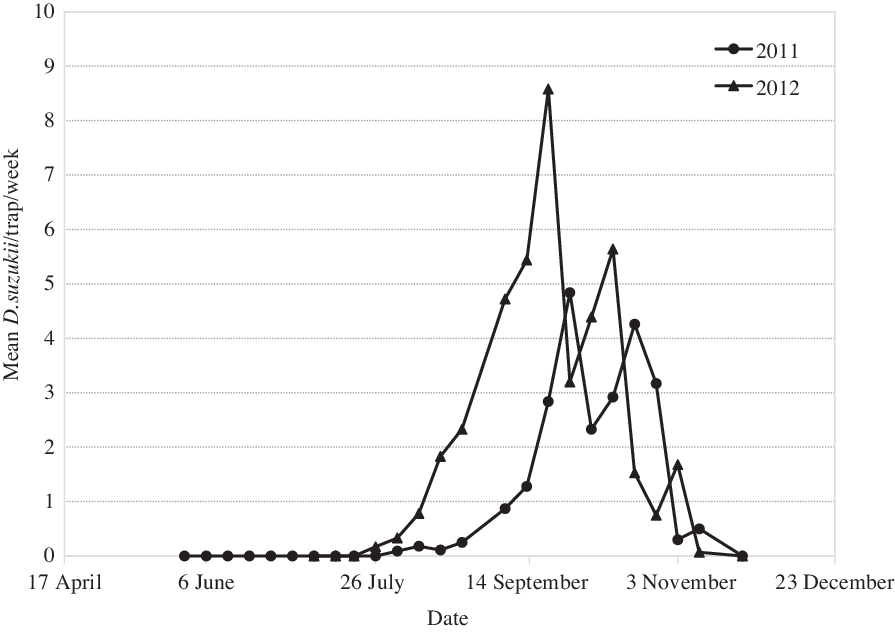
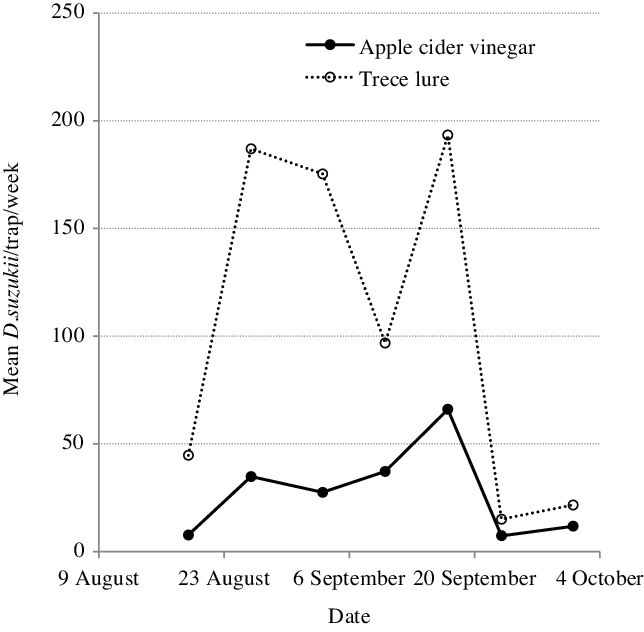
First captures of D. suzukii in wine grapes were during the weeks of 3 August 2011 and 27 July 2012 (Fig. 3). Drosophila suzukii adults were not monitored in the wine grape vineyards in 2013 to 2015. Numbers of D. suzukii trapped in wine grapes varied significantly between the two years (P < 0.001) but not between cultivars (P = 0.70). Depending on the year, peak population levels occurred from July to October, which overlapped with the timing when the susceptibility studies were carried out. Averaged across all sites, a peak of approximately 18 D. suzukii/trap/week was recorded for table grapes near mid-August 2013 (Fig. 2). Population density was similar between table and wine grapes. Peak average weekly trap captures in wine grape vineyards of approximately 4.8 and 8.5 at the end and mid September of 2011 and 2012, respectively (Fig. 3), were only marginally higher than peaks of three and eight recorded for traps placed in table grape vineyards in the corresponding years (Fig. 2). Trappit dome traps baited with Trece lures caught significantly more (P = 0.016) D. suzukii adults than standard deli cup traps baited with apple cider vinegar in table grape vineyards in 2014 (Fig. 4).
Mean numbers of Drosophila suzukii/trap/week captured in wine grape vineyards in the Okanagan Valley of British Columbia using standard deli cup traps baited with apple cider vinegar during 2011 and 2012. First trap captures were in the week of 3 August and 27 July in 2011 and 2012, respectively.

Mean numbers of Drosophila suzukii/trap/week captured in table grape vineyards in the Okanagan Valley of British Columbia using paired standard deli cup traps baited with apple cider vinegar and Trappit dome traps baited with Trece D. suzukii lures in 2014. Trece baited traps caught significantly more D. suzukii than apple-cider-vinegar traps (Kruskal-Wallis, P < 0.05).

Field collection of fruits
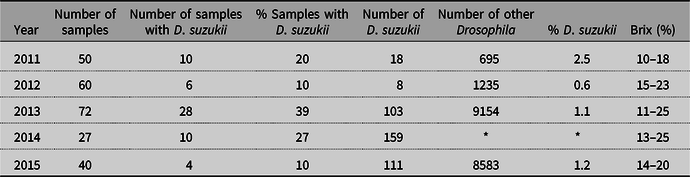
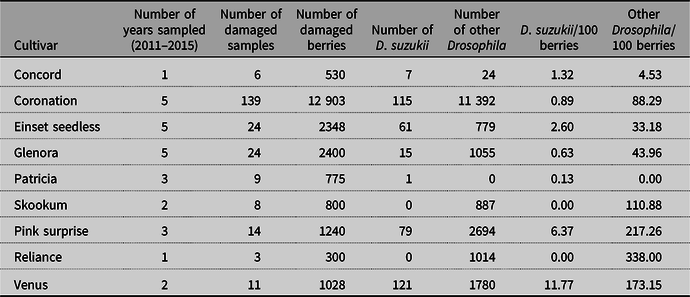
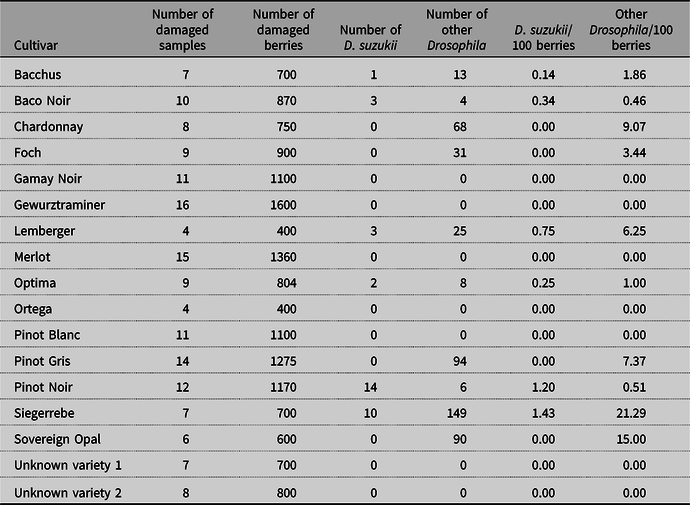
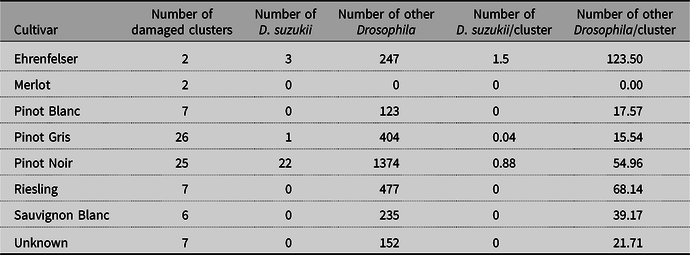
Over the three years of sampling, D. suzukii were not reared from any of the 217 samples of intact wine grape fruit (100 berries/sample) during any time period. It was also not reared from the 110 intact table grape berry samples (100 berries/sample) brought to the laboratory during 2011 and 2012. Of the 72 samples of intact table grapes collected in 2013, five D. suzukii were, however, successfully reared from three samples of the cultivars Pink Surprise and Einset Seedless. In contrast to intact grapes, D. suzukii were successfully reared in small numbers from damaged table and wine grapes during all years (Tables 1–2) with the highest percentage from damaged fruit occurring in 2011. Drosophila suzukii adults were reared from damaged Concord, Coronation, Einset Seedless, Glenora, Patricia, Pink Surprise, and Venus table grapes (Table 3) and from damaged Bacchus, Baco Noir, Ehrenfelser, Lemberger, Optima, Pinot Gris, Pinot Noir, and Siegerrebe, wine grapes (Table 4).
Numbers of Drosophila suzukii and other Drosophila species reared from damaged table grapes collected from Okanagan Valley vineyards in 2011–2015.

* Other Drosophila species were not recorded in 2014.
Drosophila suzukii and other Drosophila species reared from damaged wine grapes from Okanagan Valley vineyards in 2011–2013. Each sample consisted of 100 berries in 2011–2012 and 2–3 grape clusters in 2013.

Drosophila suzukii and other Drosophila species reared from damaged table grape cultivars collected from Okanagan Valley vineyards in 2011–2015.

Drosophila suzukii and other Drosophila species reared from damaged wine grape cultivars collected from Okanagan Valley vineyards in 2011 and 2012.

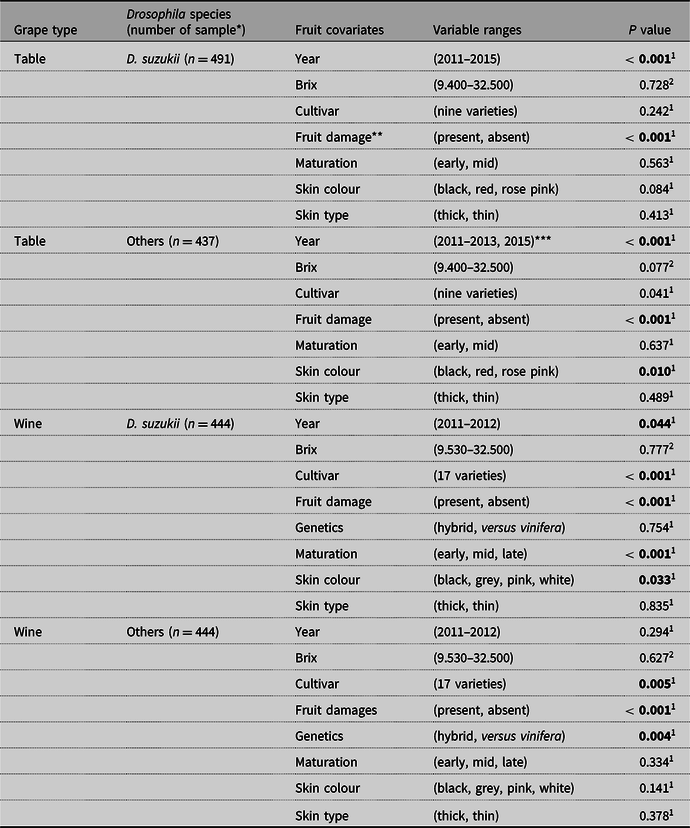
For D. suzukii infesting table grapes in the field, statistical analysis showed significant differences in infestation levels between years (P < 0.001) and between damaged and intact fruit (P < 0.001), while there were no differences among cultivars (P = 0.242), or related to skin colour (P = 0.084) or skin type (P = 0.413) (Table 7). In addition to significant differences between years (P < 0.001) and fruit damage (P < 0.001), for other Drosophila species, there were significant differences in infestation levels related to cultivar (P = 0.041) and skin colour (P = 0.01).
Statistical analysis of D. suzukii infestation levels for wine grapes collected from the field showed significant differences between years (P = 0.044), fruit damage (P < 0.001), cultivar (P < 0.001), skin colour (P = 0.033), and fruit maturation dates (early, mid, late; P < 0.001) (Table 7). For other Drosophila species, there was no difference between the two years (P = 0.294), but significant differences in infestation were found for cultivar (P = 0.005), fruit damage (P < 0.001), and between Vitis vinifera and hybrid wine grapes (P = 0.004). It should be noted that cultivar differences are possibly confounded with vineyard location and production practices.
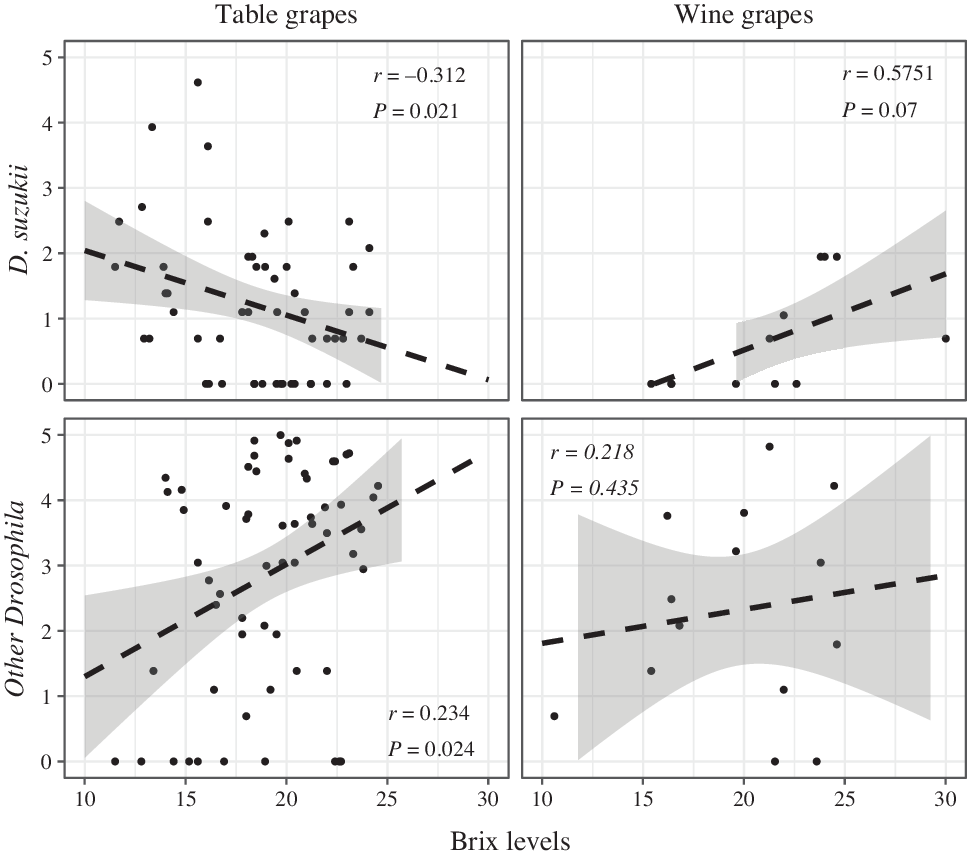
For D. suzukii and for other Drosophila species, damage to fruit was the major determining factor for infestation of both table and wine grapes (D. suzukii in table grapes F = 58.702 P < 0.0001, D. suzukii in wine grapes F = 20.414 P < 0.0001; other Drosophila in table grapes F = 146.006 P < 0.0001; other Drosophila in wine grape F = 19.015 P < 0.0001). Brix levels of table and wine grape samples ranged from 10 to 25 (Tables 1–2). Overall, D. suzukii infestations were not related to brix levels for table grapes (P = 0.998) or wine grapes (P = 0.735). Regression analysis of damaged table grapes data showed a weak negative relationship between D. suzukii infestations and increasing brix levels (Pearson r = −0.312, P < 0.021) and a positive relationship for other Drosophila species with increasing brix levels (Pearson r = 0.234, P < 0.024) (Fig. 5). Due to the smaller number of positive samples for damaged wine grapes, no conclusion could be drawn from the relationship of brix levels to vinegar fly infestations. Numbers of D. suzukii adults reared from damaged table and wine grapes were low relative to numbers of other Drosophila species (Tables 1–5). Proportions of D. suzukii reared from damaged table grapes over the five years relative to total numbers ranged from a low of 0.6% in 2012 to a high of 2.5% in 2011 (Table 1). Other than in 2011 when D. suzukii comprised 14.3% of the total number of Drosophila flies reared from damaged wine grapes (Table 2), there was little difference between table and wine grapes; 98–99% of the flies reared from damaged table and wine grapes in 2012 and 2013 were other Drosophila species (Tables 1–2).
Number of Drosophila suzukii and other Drosophila species reared from damaged grapes between 2011 and 2015 in relation to brix levels for both table and wine grapes. For each individual data point, the total number of Drosophila species reared (log-scale) corresponds to emergence from 100 collected berries (see Material and methods). All samples where Drosophila emerged are reported in the figure (number of Drosophila > 1). The number of positive samples (total n = 179) is for table grape (D. suzukii n = 54, other n = 96) and for wine grape (D. suzukii n = 12, other n = 15). Dashed lines correspond to a fitted general linear model with a 0.95 confidence level (shaded regions). Pearson correlation coefficients (r) and the associated P values are indicated.

Artificial infestation of fruit
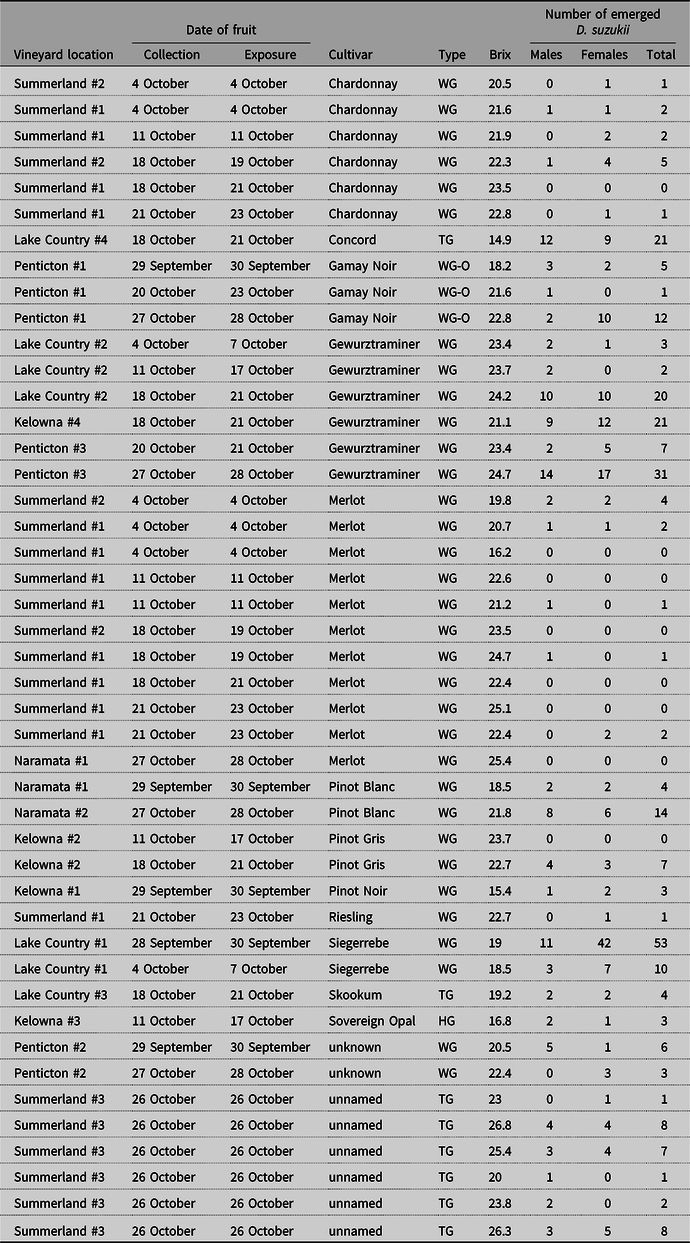
Under caged laboratory conditions, Drosophila suzukii completed development in 38 out of the 45 (84%) apparently intact berries of all the tested wine and table grape cultivars (Table 6). Considering the intense oviposition pressure and caged conditions, numbers of D. suzukii that emerged successfully were quite low and variable, ranging from 0 to 53 individuals (mean 6.2). No D. suzukii were recovered from eight of the 45 fruit exposures (17%). Statistical analysis (Pearson chi-squared test and Kruskal-Wallis Rank Sum test) for the artificial infestations found no difference in numbers of D. suzukii between intact table and wine grapes (P = 0.295), or due to differences among cultivars (P = 0.339), ripening period (P = 0.295), vineyard management (P = 0.810), date of fruit collection (P = 0.780), or brix (P = 0.211). The marginally higher numbers reared from Siegerrebe and Gewurztraminer wine cultivars and Concord table grapes suggest the need for additional study to determine if these cultivars are more susceptible to D. suzukii or more prone to splitting and bruising during handling (Table 6).
Drosophila suzukii and other Drosophila species reared from damaged wine grape cultivars in the Okanagan Valley, 2013. Grape clusters were used for rearing out flies.

Numbers of adult Drosophila suzukii reared from fruit of various grape cultivars artificially infested in the laboratory in relation to brix levels (sugar content).

WG, conventional wine grapes; WG-O, organic wine grapes; HG, conventional hybrid grapes; TG, conventional table grapes. Summerland #3 consists of samples from six different unnamed table grape selections remaining at SuRDC from a previous breeding programme.
Discussion
The standard apple-cider-vinegar traps captured significant and variable numbers of adult D. suzukii from all the investigated Okanagan Valley vineyards, with earliest emergence and highest numbers occurring in 2013 (Figs. 2–3). In 2014, Trappit traps baited with Trece lures caught significantly more (P < 0.05) D. suzukii than did the standard apple-cider-vinegar deli cup traps (Fig. 4). A large study using apple-cider-vinegar traps in various habitats and fruit crops throughout the Okanagan-Columbia basin during 2010–2014 similarly trapped increasing numbers of adult D. suzukii after the initial discovery in 2009 with a peak also occurring in 2013 (Thistlewood et al. Reference Thistlewood, Gill, Beers, Shearer, Walsh and Rozema2018). Drosophila suzukii populations may be modulated by winter temperatures (Beers Reference Beers2015), which would account for the high numbers and earlier emergence in the Okanagan in 2013 that followed a mild winter (Thistlewood et al. Reference Thistlewood, Gill, Beers, Shearer, Walsh and Rozema2018). Our capture of large numbers of D. suzukii in vineyards is not surprising given that adults have been collected widely from vineyards throughout North America and Europe (e.g., Rouzes et al. Reference Rouzes, Delbac, Ravidat and Thiery2012; Saguez et al. Reference Saguez, Lasnier and Vincent2013; Van Timmeren and Isaacs Reference Van Timmeren and Isaac2014; Thistlewood et al. Reference Thistlewood, Gill, Beers, Shearer, Walsh and Rozema2018). As in our study, Thistlewood et al. (Reference Thistlewood, Gill, Beers, Shearer, Walsh and Rozema2018) captured very few adult D. suzukii prior to the middle of May. Coupled with our results, their findings also show that adult D. suzukii populations would have been approaching their highest level over the period when table and wine grapes were reaching maturity. Their study found the highest density of D. suzukii in cherry (Prunus Linnaeus; Rosaceae) orchards and the lowest in vineyards, suggesting that grapes are a less attractive host (Thistlewood et al. Reference Thistlewood, Gill, Beers, Shearer, Walsh and Rozema2018).
We did not rear D. suzukii from intact field-collected fruit of any wine grape cultivars over the three years even when trapping of adult flies indicated populations were very high, as in 2013 (Fig. 3). These findings agree with those of Weissinger et al. (Reference Weissinger, Schrieber, Breur and Müller2019) who reported no successful oviposition from field-collected intact Pinot Noir berries and little evidence of oviposition scarring in spite of the high numbers of D. suzukii that were trapped in nine of 14 vineyards. Pelton et al. (Reference Pelton, Gratton and Guédot2017) found that infestation of hybrid grape cultivars was low, and there was no correlation between trap counts and infestation levels, leading to the suggestion that “monitoring for adults is of limited value in determining infestation levels in cold hardy grapes”. We were able to rear small numbers of D. suzukii from only 17% of the intact wine grape samples artificially exposed in the laboratory (Table 6), further showing that wine grapes are a poor host. Based on a study with bunch and Muscadine grapes, Rezazadeh et al. (Reference Rezazadeh, Sampson, Stafne, Marshall-Shaw, Stringer and Hummer2018) concluded that grapes are generally not preferred oviposition hosts for wild or caged D. suzukii. In Switzerland, D. suzukii were found at very low levels only in red cultivars and nearly always in association with other Drosophila species (Linder et al. Reference Linder, Martin, Laboisse, Chatelain and Kehril2014). We did not find an association of D. suzukii infestations with skin colour of table (P = 0.084) or wine grapes (P = 0.597), but a higher infestation level for other Drosophila species was associated with darker skinned table grape cultivars (P = 0.010) (Table 7). Other Vitaceae also appear not to be preferred hosts, as D. suzukii were not reared from 12 samples of Virginia creeper vine, Parthenocissus quinquefolia (Linnaeus) Planchon, fruit collected in the Okanagan valley, British Columbia (Thistlewood et al. Reference Thistlewood, Rozema and Acheampong2019). Contrary to these findings, observations in Italy indicated that Vitis vinifera wine grapes can become a field host, with soft-skinned cultivars being more susceptible (Cini et al. Reference Cini, Ioriatti and Anfora2012).
Statistics for presence of Drosophila species reared from field-collected table and wine grapes from Okanagan Valley vineyards, 2011–2015.

* Analysis based on presence (n > 1) or absence of D. suzukii or other Drosophila in the reared samples. A sample consisted of 100 berries (see Material and methods).
** Visible damage on the collected berries.
*** Other Drosophila species were not recorded in 2014.
1 Pearson’s chi-squared test (adjusted for multiple comparisons using Benjamini and Hochberg method).
2 Kruskal-Wallis rank sum test (adjusted for multiple comparisons using Benjamini and Hochberg method).
We successfully reared D. suzukii from field-collected damaged fruit of wine (Table 5) and table grape (Table 1) cultivars and from intact table grapes during 2013 when trap counts were high (Fig. 2), but some seemingly intact fruit might have been infected with sour rot in 2013. Damage was a major factor (P < 0.001) in our study that determined infestation of table and wine grapes for both D. suzukii and other Drosophila species (Table 7). Pelton et al. (Reference Pelton, Gratton and Guédot2017) reported that prior damage to hybrid grapes increased attack rates and higher emergence rates. Laboratory bioassays with the wine grape cultivar Early Gamay showed that D. suzukii deposited considerably more eggs on injured fruit than on intact fruit and that successful development only occurred with injured fruit (Linder et al. Reference Linder, Martin, Laboisse, Chatelain and Kehril2014). In our study, the intact table grape cultivars that suffered damage in 2013, Pink Surprise and Einset Seedless, have thin skins, a condition that other workers have reported to be associated with increased susceptibility (Griffo et al. Reference Griffo, Frontuto, Cesaroni and Desantis2012; Linder et al. Reference Linder, Martin, Laboisse, Chatelain and Kehril2014). Our recovery of D. suzukii from intact wine grapes following artificial exposure in the laboratory (Table 6) might be due to higher oviposition pressure, but it is also possible that fruit was slightly damaged or bruised during handling. Results from other laboratory studies have shown that wine grapes are generally quite resistant to infestation unless the fruit is incised or otherwise damaged (Linder et al. Reference Linder, Martin, Laboisse, Chatelain and Kehril2014; Ioratti et al. Reference Ioriatti, Walton, Dalton, Anfora, Grassi, Maistri and Mazzoni2015).
Increasing susceptibility of wine grapes to D. suzukii was determined by Ioriatti et al. (Reference Ioriatti, Walton, Dalton, Anfora, Grassi, Maistri and Mazzoni2015) to be characterised by increasing sugar content (brix) and a decrease in pH and penetration resistance of the skin. Contrary to that finding, Entling et al. (Reference Entling, Anslinger, Jarausch, Michl and Hoffman2019) determined that susceptibility of grape cultivars to D. suzukii was explained by berry skin resistance rather than chemical composition of the berries (i.e., acidity, total soluble solids, etc.). Shrader et al. (Reference Shrader, Burrack and Pfeiffer2019) found that penetration force rather than skin thickness was a determining factor for successful oviposition, while sugar levels were not. Our results with field-collected fruits showed no relationship between sugar concentrations and susceptibility to D. suzukii or other Drosophila for table or wine grapes (P > 0.05; Table 7). Sugar (brix) level was also not a significant factor (P = 0.211) for the susceptibility of wine grapes exposed artificially in the laboratory. These results are supported by other studies with table or wine grapes that likewise found no correlation between brix levels and D. suzukii infestations (Lee et al. Reference Lee, Bruck, Curry, Edwards, Haviland, Van Steenwyk and Yorgey2011a; Pelton et al. Reference Pelton, Gratton and Guédot2017; Rezazadeh et al. Reference Rezazadeh, Sampson, Stafne, Marshall-Shaw, Stringer and Hummer2018). For damaged table grapes from the field, our data did show a negative correlation between D. suzukii infestations and increasing brix levels and a positive correlation between increasing brix levels and higher infestations by other Drosophila species (Fig. 5).
The majority of vinegar flies reared from wine and table grapes naturally exposed in the field were species other than D. suzukii. Although it was the only species reared from three field collected samples of Einset Seedless and Pink Surprise table grape cultivars, overall D. suzukii contributed only a small proportion of the total. Small numbers of D. suzukii infesting grapes relative to other Drosophila species were also found for wine grapes in Québec, Canada (Saguez et al., Reference Saguez, Lasnier and Vincent2013), Michigan, United States of America (Van Timmeren and Isaacs Reference Van Timmeren and Isaac2014), and Switzerland (Linder et al. Reference Linder, Martin, Laboisse, Chatelain and Kehril2014). Native Drosophila were identified from 88% of the infested clusters in the latter study, compared to 68% for D. suzukii; with half as many D. suzukii emerging per infested berry. Of relevance to the question if D. suzukii is responsible for higher rates of rot diseases in vineyards, Linder et al. (Reference Linder, Martin, Laboisse, Chatelain and Kehril2014) reared only indigenous Drosophila species from berries showing signs of sour rot even though monitoring showed that high numbers of D. suzukii were present. They concluded that the presence of D. suzukii was not correlated with rot diseases. Olfactory studies have shown a greater attractiveness to ripening rather than rotting fruit for D. suzukii, while D. melanogaster Meigen has been shown to prefer fermenting or rotten fruit (Keesey et al. Reference Keesey, Knaden and Hansson2015). Drosophila species are known to have symbiotic relationships with yeasts that cause sour rot, but establishment of the pathogen is thought to require inoculation to grape flesh exposed by prior damage (Rombaut et al. Reference Rombaut, Guilhot, Xuéreb, Benoit, Chapuis, Gilbert and Fellous2017; Da Silva et al. Reference Da Silva, Park, Blood and Walton2019).
Wine grape growers in the Okanagan Valley, British Columbia, do not generally spray insecticides against D. suzukii, while table grapes currently receive at least one insecticide spray yearly to control D. suzukii although the degree of economic injury is unclear. Due to zero tolerance in table grapes, growers will continue to apply prophylactic insecticide sprays until there is sufficient field data to provide information as to the economic impact of this pest on various table grape cultivars in the absence of sprays. As for other Drosophila species, D. suzukii has been implicated in the spread of botrytis and other pathogens (Van Timmeren and Isaacs Reference Van Timmeren and Isaac2014; Ioratti et al. Reference Ioriatti, Walton, Dalton, Anfora, Grassi, Maistri and Mazzoni2015), which could be a factor in management decisions. Linder et al. (Reference Linder, Martin, Laboisse, Chatelain and Kehril2014) found that D. suzukii infestations do not favour the development of rot diseases in grapes or the development of other Drosophila species.
Our findings that table and wine grapes are poor hosts for D. suzukii might relate only to other regions with a similarly arid environment. It has been suggested that desiccation is a limiting factor for D. suzukii (Cini et al. Reference Cini, Ioriatti and Anfora2012), which is supported by the work of Thistlewood et al. (Reference Thistlewood, Gill, Beers, Shearer, Walsh and Rozema2018). Temperatures above 30 °C have been reported to reduce adult activity (Lee et al. Reference Lee, Bruck, Dreves, Ioriatti, Vogt and Baufeld2011b). Within the Okanagan, levels of fruit damage will vary between years due to weather conditions and between vineyards due to differing varieties and management practices, such as irrigation type and degree of fruit exposure. Rezazadeh et al. (Reference Rezazadeh, Sampson, Stafne, Marshall-Shaw, Stringer and Hummer2018) suggest that calcium treatments applied to grapes to thicken the skin should be evaluated for activity against D. suzukii. Our results show that D. suzukii is not the dominant Drosophila species infesting grapes in the Okanagan Valley. In agreement with Entling et al. (Reference Entling, Anslinger, Jarausch, Michl and Hoffman2019), management of D. suzukii might best be achieved by controlling rots and preserving a firm intact berry skin.
Acknowledgements
We thank Kari Bredahl, Tristan Mennell, Caitlin Miller, Brian Muselle, Edith Fallon (Agriculture and Agri-Food Canada), and staff of the British Columbia Tree Fruits Cooperative for technical assistance; Jonathan Decker and Michael Dykes, British Columbia Ministry of Agriculture for producing a map of the study sites; Dr. Etienne Lord for statistical analysis; Dr. Joan Cossentine (Agriculture and Agri-Food Canada) for allowing use of the D. suzukii colonies; three anonymous reviewers; and the British Columbia Grape Growers Association for administering the funds for the study and all participating growers for allowing us access to their vineyards. Funding for the study was provided by the British Columbia Ministry of Agriculture through Growing Forward 1 and 2, a federal-provincial-territorial initiative.